


The most popular advice for slicers, buy a low-spin ball, is incomplete. A lower-spinning driver ball can reduce curvature, but it won't square an open clubface, and the same ball may make iron shots curve more or take away wedge control. The useful question isn't which ball flies straighter off the tee. It's which one reduces driver curvature without creating a new problem elsewhere in the bag.
By Dialed Golf
Table of Contents
- Quick Picks by Player Type to Try First
- Can a Ball Fix a Slice and Which Factor Matters Most
- Why Low Driver Spin Can Make Your Irons Curve
- Test Balls on Your Own Launch Monitor
- Drills and Fit Tips to Pair With Your Ball
- Confirm the Ball Before You Switch
Quick Picks by Player Type to Try First
A slicer's shortlist should start with balls that lower driver curvature, then survive an iron test. If a ball straightens the driver but adds draw or height to the 7-iron, it has moved the miss rather than reduced it. That is the filter for the table below.
| Player type | Start with | Why it made the shortlist | Check before committing |
|---|---|---|---|
| Driver slice at 100 mph or more | TaylorMade Tour Response | Low driver spin in the 2026 robot test | Short-game spin and 7-iron curve |
| Driver slice, lowest driver spin wanted | Callaway Supersoft or Bridgestone Tour B RXS | Among the lowest driver-spin balls in the same test | Carry loss at the player's club speed |
| Driver slice, tighter dispersion wanted | Bridgestone e12 Straight | Straight-flight model; test it against a lower-spin ball | Compare 7-iron curvature |
| Driver sidespin, human swing | Srixon Q-Star Tour | Human-swing comparison put it among lower-sidespin balls | Confirm 7-iron launch and spin |
| Driver-only miss, irons hold line | Maxfli Straightfli | Low driver sidespin, but higher iron spin is the risk | Keep it only if iron shots stay straight |
| Slower swing, under 85 mph | Callaway Supersoft | No 2026 robot value below 86 mph | Test it against one higher-spin ball |
| Greenside control is the priority | No single leader | The test does not name a clear winner | 50-yard wedge stopping distance |
The robot-test results in this table come from the 2026 MyGolfSpy ball test, which measured driver spin and left-right dispersion across its test field. That test placed TaylorMade Tour Response, Callaway Supersoft and Bridgestone Tour B RXS among the lowest-spinning driver options, while higher-spin models leaned toward iron and wedge spin. The first two rows are therefore useful starting points for a driver-curvature problem, not automatic recommendations.
The Srixon Q-Star Tour line comes from a human-swing comparison, so its lower driver sidespin is a reason to test it, not proof that it will tighten every player's pattern. The Maxfli Straightfli line is the opposite warning: a low driver-sidespin result can coexist with higher iron spin, and higher iron spin can add curvature or height with the scoring clubs.
Put two or three of these balls on your launch monitor and compare driver curvature against 7-iron curvature and wedge stopping distance. A ball earns a place in the bag only if it lowers the driver miss without making the irons curve more or balloon.
Can a Ball Fix a Slice and Which Factor Matters Most
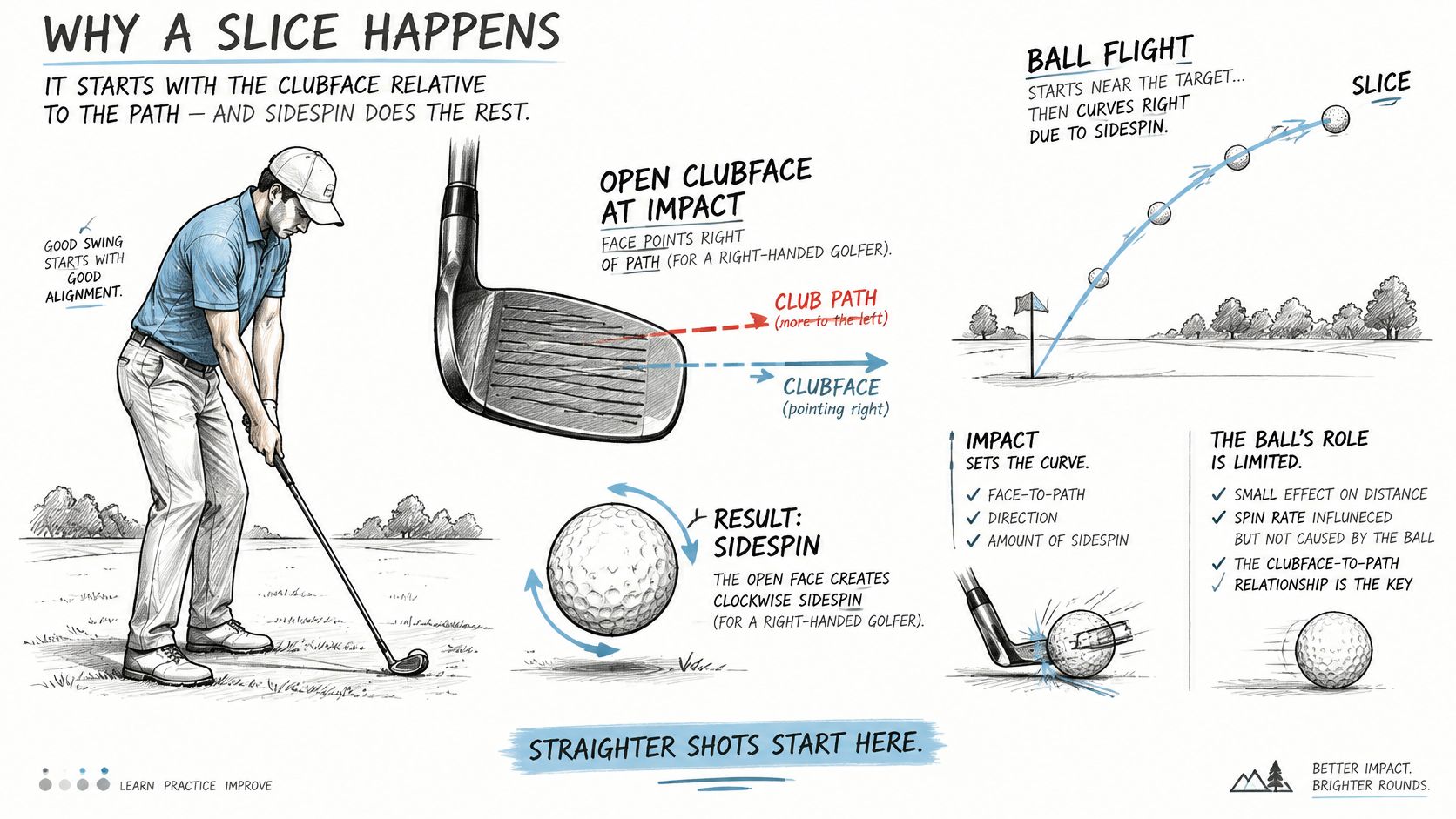
A golf ball cannot straighten an open clubface. A slice begins with the face-to-path relationship at impact, and the ball only changes how the spin from that delivery behaves in flight. Its aerodynamics depend on dimple size, shape, distribution, and surface coverage. According to the R&A's golf-ball equipment research, spin interacts with that surface geometry to create lift and drag, and conforming balls can sit anywhere across a wide range of lift and drag properties. Two balls launched with identical numbers can still finish on different lines a few seconds later, and that gap shows up as lateral dispersion on a launch monitor.
The factor that changes driver curvature
Driver spin is the main ball-related lever for slice reduction. Struck with the same open face and out-to-in path, a lower-spin ball curves less sharply because total spin falls, even though the face-to-path error is unchanged.
The independent 2026 robot test of 48 balls at three driver speeds found roughly 600 rpm between the highest- and lowest-spinning balls at 116 mph against a field median of 2,311 rpm. The same test placed TaylorMade SpeedSoft among the tightest left-right performers at 86 and 102 mph and among the lowest-spin group at higher speeds, with Bridgestone e12 Straight also ranking strongly for left-right dispersion.
| Construction factor | What it changes | Effect on a slice | Trade-off |
|---|---|---|---|
| Driver spin | Sidespin from the same swing error | Lower total spin can reduce curvature by shrinking sidespin | Too little spin can cost carry stability |
| Cover material | Greenside spin and feel | Indirect, with little effect on driver curve | Softer covers can trade durability for greenside spin |
| Compression | Feel and launch at a given swing speed | Little direct effect on curvature | Firmer feel may suit faster swings; softer feel may suit slower swings |
| Iron and wedge spin | Approach stopping power | Irons can curve even when driver spin is low | More spin can hold greens but also add sidespin |
Read the table by column. Driver spin is the one row that alters curvature from an identical swing error; the others move feel, launch, or scoring performance. Carry stability is the constraint to watch: a ball that pulls spin down far enough to straighten a miss can also flatten the flight past the point where a solid drive stays airborne. Judge that on your own numbers, not on the ball's packaging.
The modern dimpled ball made longer flight possible by lowering the aerodynamic drag-crisis threshold compared with a smooth sphere. Surface design matters. Dimple-count marketing remains a poor way to choose an anti-slice ball, and the R&A's research points toward measured launch, spin, carry, and dispersion as the useful evidence.
Compression can change feel and launch for a given swing speed. The delivery that produces a slice survives any compression change. Cover construction matters more to feel and greenside performance than to the driver's basic curve. For a closer look at how a substance on a driver face can affect ball flight, see this discussion of chapstick on a driver.
The fitting rule is simple: test at the golfer's actual club speed. A low-spin ball may reduce a slice, and an excessive reduction can cost carry stability or short-game control. No single ball is universally straight.
Why Low Driver Spin Can Make Your Irons Curve
Maxfli Straightfli produced only 130 rpm of driver sidespin, less than three-quarters of the balls in the cited test, yet its higher 7-iron spin increased sidespin and weakened its straight-flight advantage, according to GolfLink's ball testing. That contrast is why a ball can look like a driver fix and still be the wrong fit for the rest of the bag.
A ball can win the driver and still lose the 7-iron.
A golfer with a driver-only miss and reliable iron flight has a different fitting problem from someone whose approaches also curve. The first golfer can judge a candidate mainly by driver dispersion, then confirm that irons remain predictable. The second needs to record results by club instead of relying on one overall average that can hide a poor iron pattern.
Track the ball by club
For each ball, compare launch angle, total spin, spin-axis tilt, carry, and offline distance with the driver and 7-iron. These readings help distinguish a straighter flight from a shot that launched differently or finished closer to the target by chance. A high or curving iron flight can erase the benefit of a more playable drive.
Wedge control belongs in the same decision. A ball that resists sidespin with the driver may offer less stopping power on a wedge, while a higher-spin ball may hold a green but also carry more sidespin on an imperfect strike. The point isn't to maximize every number. It's to find a combination that keeps the driver playable without making approach shots harder to predict.
The most useful question is: Which ball reduces the slice without making the irons balloon or curve more? A practical check uses three clubs: driver, 7-iron, and a 50-yard wedge. Record each club's flight and dispersion separately, then keep the ball only if the driver improvement doesn't come at an unacceptable cost to iron control or wedge stopping distance.
Test Balls on Your Own Launch Monitor
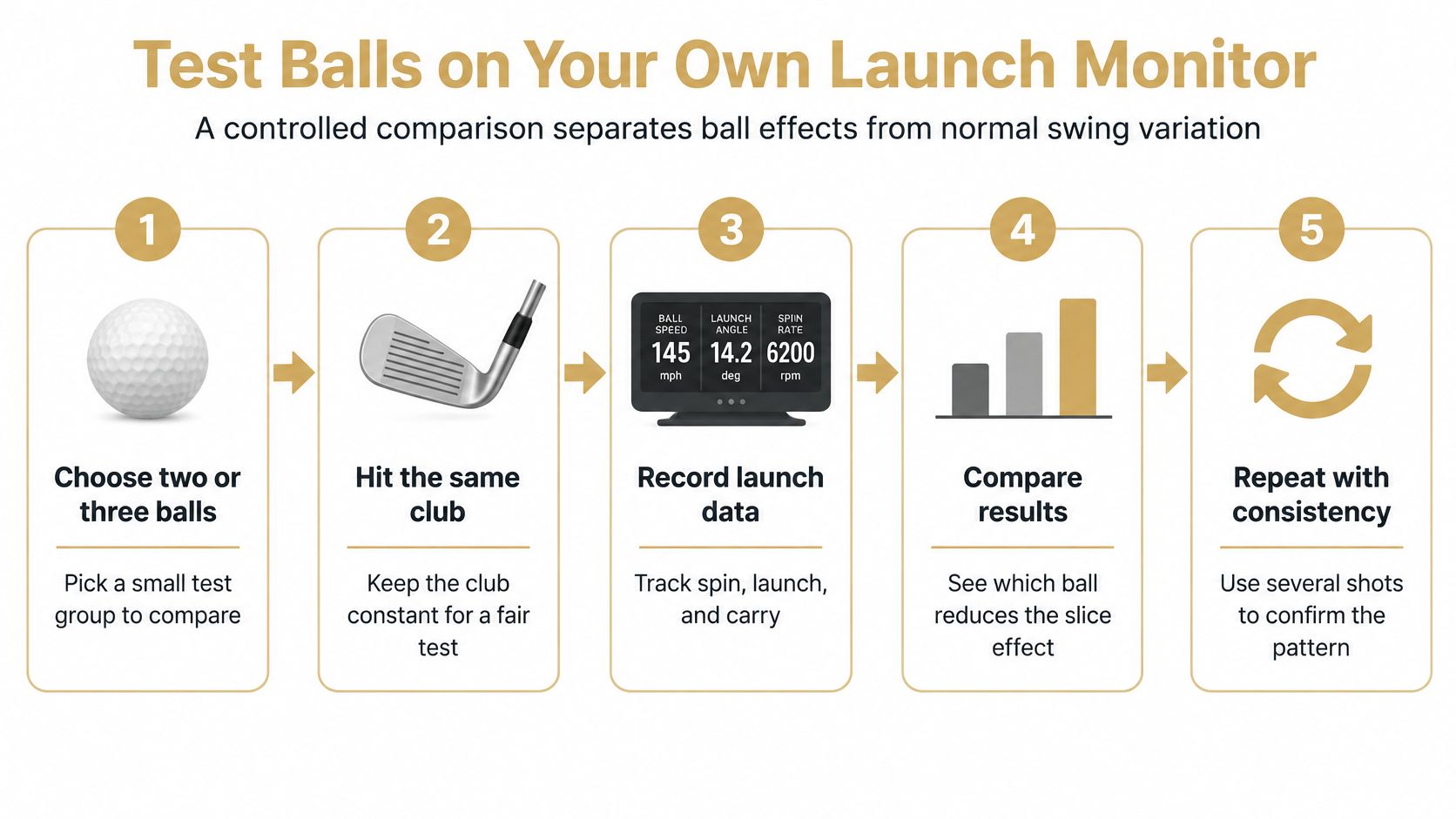
A single straight drive proves nothing. Swing speed drifts across a bucket, strike point wanders, and one flushed shot can make a mid-priced ball look like the fix. Separating a ball's effect from ordinary variation takes a protocol that holds everything else constant and compares medians rather than highlights. The USGA's limited-distance-ball testing shows how much conditions drive the answer: its conforming limited-distance ball traveled 286 yards at a 120-mph swing speed, approximately 23 to 30 yards shorter than popular contemporary professional-tour balls, or 8.5% shorter on average. Shift the conditions and the ranking of any ball shifts with them. A curvature trial that holds the face open through impact will bend a conforming ball too, which is why face angle and strike location have to stay fixed across every trial in the set.
A repeatable comparison
Choose two or three candidates. Start with balls that match the likely problem in the quick-pick table. Three is enough to reveal a pattern; six turns a range session into bookkeeping.
Hold the setup steady. Same club, same tee height, same swing intent, same monitor settings. Every variable left free becomes an explanation you cannot rule out later.
Alternate balls for at least 10 centered driver shots per ball. Hitting one model 30 times in a row lets rhythm and fatigue drift toward whichever ball came last.
Record the same measurements each time. Ball speed, launch, total spin, spin-axis tilt, carry, and offline distance. Compare median dispersion, not the best shot.
Repeat with the 7-iron and a 50-yard wedge. The driver answers only the first question. The iron shows whether the ball holds its line at the same launch window, and the wedge shows whether it stops.
Keep the ball that holds up across all three clubs. A clean result means tighter offline spread, intact carry, and iron shots that remain predictable rather than ballooning.
The numbers that decide the question are rarely the ones golfers screenshot. Total distance can climb while offline distance widens, and a lower spin figure can arrive alongside a broader left-to-right spread. Sort the shots by club, compare the middle of each distribution rather than the outlier, and ask one question of the data: did the driver column improve without the 7-iron column losing height or gaining curve? Because every shot in the sample was centered, a wide spread is the ball and the delivery talking, not a heel strike.
For capture, Dialed Golf's macOS and Windows app records live launch-monitor sessions locally and reports carry, total distance, ball speed, spin, launch, and club-speed trends, starting with Garmin R10 pairing and expanding. Where a monitor only exports, the Garmin guide to exporting driving-range sessions covers the CSV route, and importing that file keeps the comparison intact without re-hitting a single shot. Whether a unit reports spin-axis tilt at all is a separate buying decision, covered in this guide to choosing a launch monitor for the driving range.
Drills and Fit Tips to Pair With Your Ball
Start with the swing. Each drill below targets the face-to-path cause, while the ball only changes how the miss flies. Keep the swing intent fixed during a ball comparison, and judge the two changes separately: a straighter shot after a lesson can come from the new delivery, while a tighter offline pattern on the same delivery points to the ball.
Three drills with a clear target
Path drill: Lay an alignment stick along the target line and check whether the club crosses it from outside-in. A path that stays on or inside the line is the target. Under the same test conditions, the ball is helping when the same miss curves less.
Towel-under-the-arm drill: Tuck a towel under both armpits and make half swings while keeping the arms connected. The target is a clubface that returns square with less curvature. Forced hand roll is a different move and muddies the comparison.
Half-swing 7-iron drill: Hit smooth half shots before adding full swings. Check whether the selected ball's iron flight stays straight, then build speed only after the pattern remains predictable.
Change one variable at a time. Test a candidate ball with the same half-swing 7-iron pattern before and after a practice adjustment, but keep swing intent consistent during the ball comparison. Setup affects delivery too, so the guide to a correct driver stance can help review alignment and ball position. Equipment still has to earn its place through the flight it produces.

The Golf Ball Fitter free tool finds a ball profile that fits a golfer's flight and feel. Use it to narrow the starting choices before testing. Swing speed works as an initial filter for compression and launch. The launch-monitor comparison then checks the question that matters for this section: does driver dispersion improve without a worse iron or wedge result? A candidate that cuts driver curve while adding iron sidespin or a ballooned flight has traded one problem for another, which is why the drill work and the ball fit belong in the same practice block.
Confirm the Ball Before You Switch
| Check | Keep candidate when | Switch when |
|---|---|---|
| Driver pattern | Curvature shrinks and carry stays in a range you can play | The ball flies straighter only on one or two drives |
| Iron pattern | 7-iron holds height and line with stable spin | Sidespin climbs and longer irons balloon or curve |
| Wedge control | 50-yard shot stops inside your normal window | Greenside check is worse than your current ball |
| Feel and price | Feel and price break a tie after flight data | Either one is the only reason to keep the ball |
Score each row pass or fail. Keep a ball only if it passes all three clubs: driver, iron, and wedge. A candidate that gains a few yards off the tee but loses greenside control has not solved the slice problem; it has moved the miss. The check prevents a single good drive from buying a ball a permanent place in the bag.
That decision rule changes the order of the shortlist. The straightest driver ball is not automatically the winner if the 7-iron starts ballooning. A lower-priced ball is not a value if the golfer cannot predict the wedge. Use feel and price to separate two candidates that already pass the flight checks, never to override a failed row.
Before committing to a sleeve, compare the candidate against the current ball in the same session and decide which rows changed. If driver curvature improves and iron and wedge rows hold, the switch is defensible. If only the driver row improves while the other two regress, stay with the current ball and keep testing.
Golfers can use Dialed Golf's free Golf Ball Fitter to narrow the shortlist, then compare launch-monitor sessions across driver, iron, and wedge shots. Visit Dialed Golf to build the test around actual flight data.