


Bigger coil is the most popular swing advice, and it is the wrong first goal. A wider shoulder turn and a bigger gap between shoulders and hips get treated as automatic power. Stretch vs windup is a sequencing trade-off judged by ball-speed efficiency and dispersion, not by who stores the largest coil. Extra separation adds cost when smash factor falls or the strike pattern spreads, even if clubhead speed ticks up.
A short, arm-heavy turn needs more windup. A full turn that still starts with the shoulders needs a better stretch. The limit is the stage that breaks contact, not the stage that looks most athletic in a still photo.
Table of Contents
- Stretch vs Windup at a Glance
- How the Windup and Stretch Sequence the Downswing
- Common Faults and the Concept Behind Each
- Measuring Windup and Stretch With Launch Monitor Data
- Drills and Progressions to Build Each Move
- Choose Which Move to Build First
Stretch vs Windup at a Glance
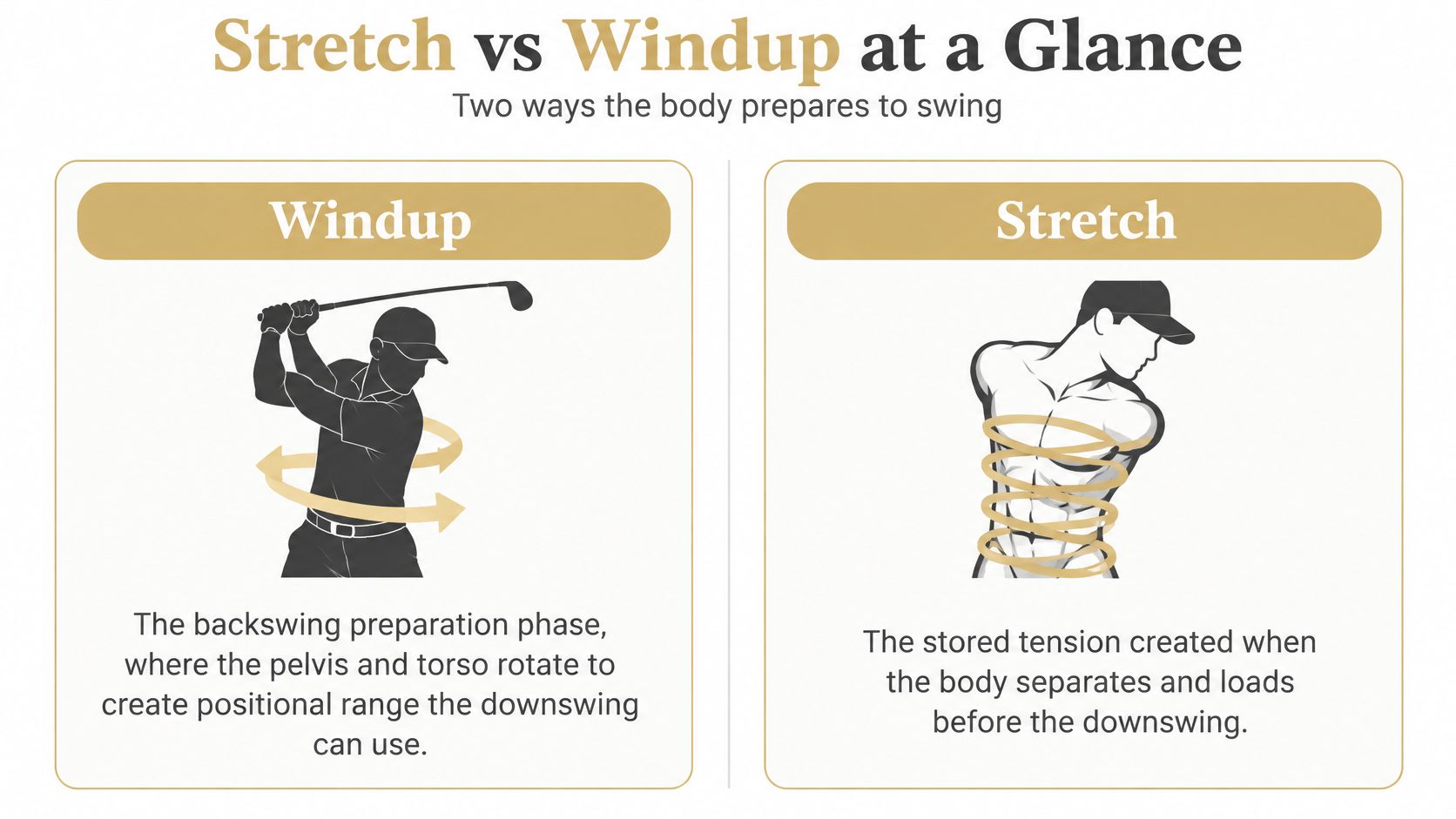
Windup is the backswing's preparation phase. The pelvis and torso rotate to create positional range the downswing can use. Stretch is the separation in transition, when the pelvis starts toward the target while the thorax and shoulders stay delayed. That delay is the measured X-factor stretch.
| Element | Windup | Stretch |
|---|---|---|
| Core idea | Builds positional range by rotating pelvis and torso in the backswing | Creates dynamic separation as the pelvis leads into the downswing while the upper body lags |
| Swing phase | Address to top of backswing | Top of backswing into the first move down |
| Main measure | Shoulder and hip turn, static X-factor at the top | Peak X-factor and pelvis lead during transition |
| Typical benefit | Larger power arc and more room to accelerate | Efficient sequencing and elastic energy stored in the trunk |
| Typical risk | Overturning, sway, reduced repeatability at the top | Forced separation, lumbar load, late or rushed timing |
| Emphasize when | Turn is short and the arms are doing the work | Turn is adequate but the downswing starts with the upper body |
| What a launch monitor shows | Clubhead speed and carry variability as the turn grows | Ball speed efficiency, smash factor and low-point consistency |
These are two stages of one sequence, not rival techniques. Most golfers already have both. The useful question is which stage limits the swing.
A large static shoulder-to-hip gap at the top is a windup measure. It doesn't prove a good stretch, because stretch is what the pelvis does after the top.
The table is the reference from here on. Each later part expands one row, so the miss on the course can be matched to the element that needs work.
How the Windup and Stretch Sequence the Downswing
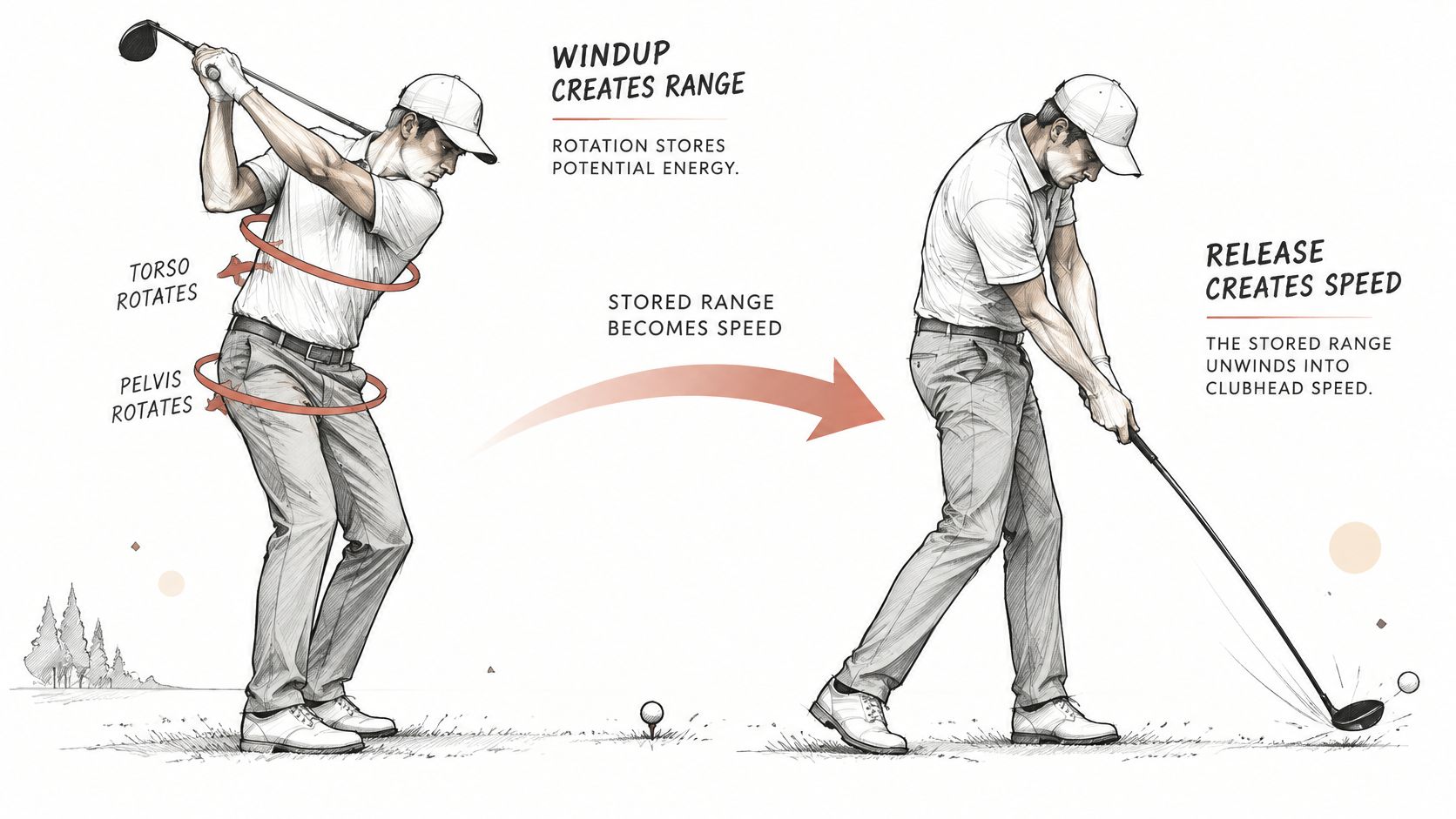
The transition determines whether a full backswing turn becomes usable speed. A study of 74 skilled male golfers found the large-backswing-stretch group had the most favorable pattern. Their transition extended from the end of pelvic rotation to the top of the backswing, supporting a proximal-to-distal sequence: movement began nearer the body's center and passed outward toward the club.
The handoff matters more than the still-frame shape. The sequence below shows a coiled top moving into a release with room to accelerate.
From the top into pelvis lead
As the pelvis starts toward the target, the thorax and shoulders remain relatively delayed. That brief difference in timing lets the trunk resist the pelvis before the chest catches up. The sequence is closer to a wave moving through the body than a single block turning all at once.
Golfers with poor backswing preparation and less total stretch tended to use a shorter transition and a prolonged early downswing. They tried to create separation too late, after the useful handoff had already passed.
Consider a down-the-line and face-on video that shows a full shoulder turn, followed by the chest and hips firing together. The top may look powerful in a still image, yet the club can arrive early, the path can steepen, and contact can climb the face. In that sequence, more turn would not fix the timing. The pelvis needs to begin first, with the upper body briefly lagging behind.
Why the lower body has to lead
From the top, the pelvis accelerates, then the torso, arms, and club follow. When the hands stay back as the hips turn, the club is less likely to be thrown early. The chest then catches up, and speed moves outward through the arms and club.
Forced separation has a cost. It can increase lumbar loading, while an overly large turn may make the sequence harder to repeat. Judge the move by repeatable timing, stable contact, and ball speed, not by the largest possible X-factor. Ball-speed efficiency and dispersion help show whether added separation is improving the shot or adding effort without control.
Compare separation at the top with peak separation during transition. Then check when the pelvis accelerates relative to the thorax. That timing distinguishes a useful handoff from a large turn that never becomes an effective sequence. Full-speed video can reveal an upper body that starts late in the wrong way, or one that fires too soon, more clearly than a freeze frame at the top.
Common Faults and the Concept Behind Each
Faults usually show up in transition and at impact. Casting from the top is the most common. The upper body and the hips start together, the wrists unload, and there is no lag. One symptom can come from either concept, so the top has to be checked before the correction is chosen.
| Symptom | Likely Cause | Concept Involved | First Correction |
|---|---|---|---|
| Early extension and loss of posture | Hips slide toward target after an over-wound backswing | Windup | Shorten the top and rehearse hip hinge in transition |
| Casting from the top | Upper body and hips start together with no lag | Stretch | Start the lower body first and hold the top briefly |
| Steep, over-the-top path | Excess upper-body rotation forced at the top | Stretch | Reduce top rotation and keep the arms on a shallower path |
| Short, stalled backswing | Shoulders under-turned while the arms do the work | Windup | Add shoulder turn while keeping the lower body stable |
| Hanging back at impact | Too much lag and hips arriving late to lead | Stretch | Start the pelvis earlier from the top |
| Inconsistent strike depth | Transition timing changes from shot to shot | Both | Use a tempo cue and repeat the transition at half speed |
| Lower back soreness after sessions | Separation forced beyond current mobility | Stretch | Reduce top turn and add trunk strength work |
Read the top before changing the move
Film down-the-line and face-on. Pause at the top and at the first move down, then compare those two frames. An overbuilt top often produces a rushed transition, so a stretch fault is the compensation for a windup problem.
Check the top frame before rewriting the downswing. The first move is often paying for a position built a half-second earlier.
Early extension follows an over-wound backswing when the hips slide toward the target. Shorten the top and rehearse the hip hinge. A steep, over-the-top path often comes from upper-body rotation forced at the top, so the arms need a shallower route, not more coil. A short, stalled backswing is the opposite problem. The shoulders never turn, and the arms do the work.
Hanging back means the hips arrive late. Start the pelvis earlier. Inconsistent strike depth means the transition changes from shot to shot, so both concepts are involved and half-speed reps come before a full swing. How the hands meet the grip also changes how much lag can be held, which is why driver hand feel belongs in the same check.
Lower-back soreness during or after sessions means the separation was forced past current mobility. Reduce the top turn, add trunk strength work, and see a qualified professional before continuing. Match the first correction to the concept, then build it with a short progression rather than a bigger coil.
Measuring Windup and Stretch With Launch Monitor Data
A bigger coil is useful only when it improves the shot. Compare changes using at least 20 shots under the same conditions, and keep the change only if ball speed holds or rises, smash factor stays steady or improves, and carry standard deviation does not widen. A single strong session is not enough to judge a new pattern.
A comparison in a strength and conditioning review of golf athletes.pdf) found greater X-factor stretch among higher-skilled golfers, approximately 57 degrees versus 50 degrees. That difference describes a sequencing pattern, not a promise of more speed. The review identifies lower-body strength, power, and musculotendinous stiffness as more reliable determinants of clubhead speed and carry than flexibility alone. It also describes golf's stretch-shortening cycle as potentially slower than the rapid reflex cycle in jumping, leaving more time for force to build after the trunk lengthens under load.
How to read the metrics
| Metric | What It Tells You | Windup Read | Stretch Read |
|---|---|---|---|
| Shoulder-to-hip separation at top | Range of the backswing turn | Keep a larger turn only if strike holds | Treat it as context, not a target |
| Transition timing | Order and pace of the move down | Usually secondary to the turn | Look for a pelvis lead without a rushed move |
| Clubhead speed | Speed delivered by the club | Check whether a larger turn adds speed | Check whether improved sequencing adds speed |
| Smash factor | Ball speed relative to clubhead speed | Should hold as the turn grows | Should improve if contact becomes more efficient |
| Attack angle and low point | Delivery and strike control | Watch for overshoot from a large turn | Watch for a hanging low point when the hips arrive late |
| Carry standard deviation | Shot-to-shot carry variation | Should not widen | Should not widen |
Use the table to connect each movement change to its result. Shoulder-to-hip separation describes the range created at the top; it does not establish that the turn is useful. Transition timing helps assess whether the pelvis leads smoothly, while clubhead speed shows whether that sequence produces more speed.
Smash factor puts ball speed in context: a larger turn should not cost efficiency, and a sequencing change should improve efficiency rather than merely feel faster. Attack angle and low point help identify changes in delivery, while carry variation shows whether the pattern is repeatable. If speed rises but dispersion widens, the added speed may not be worth the trade-off.
Read the measures together. Compare clubhead speed and ball speed with attack angle, strike location, launch, spin, and carry variability. A stretch change earns its place when sequencing and ball-speed efficiency improve without wider dispersion or an inconsistent low point. Keep the test setup consistent, using the same conditions described in this launch-monitor practice guide.
Drills and Progressions to Build Each Move
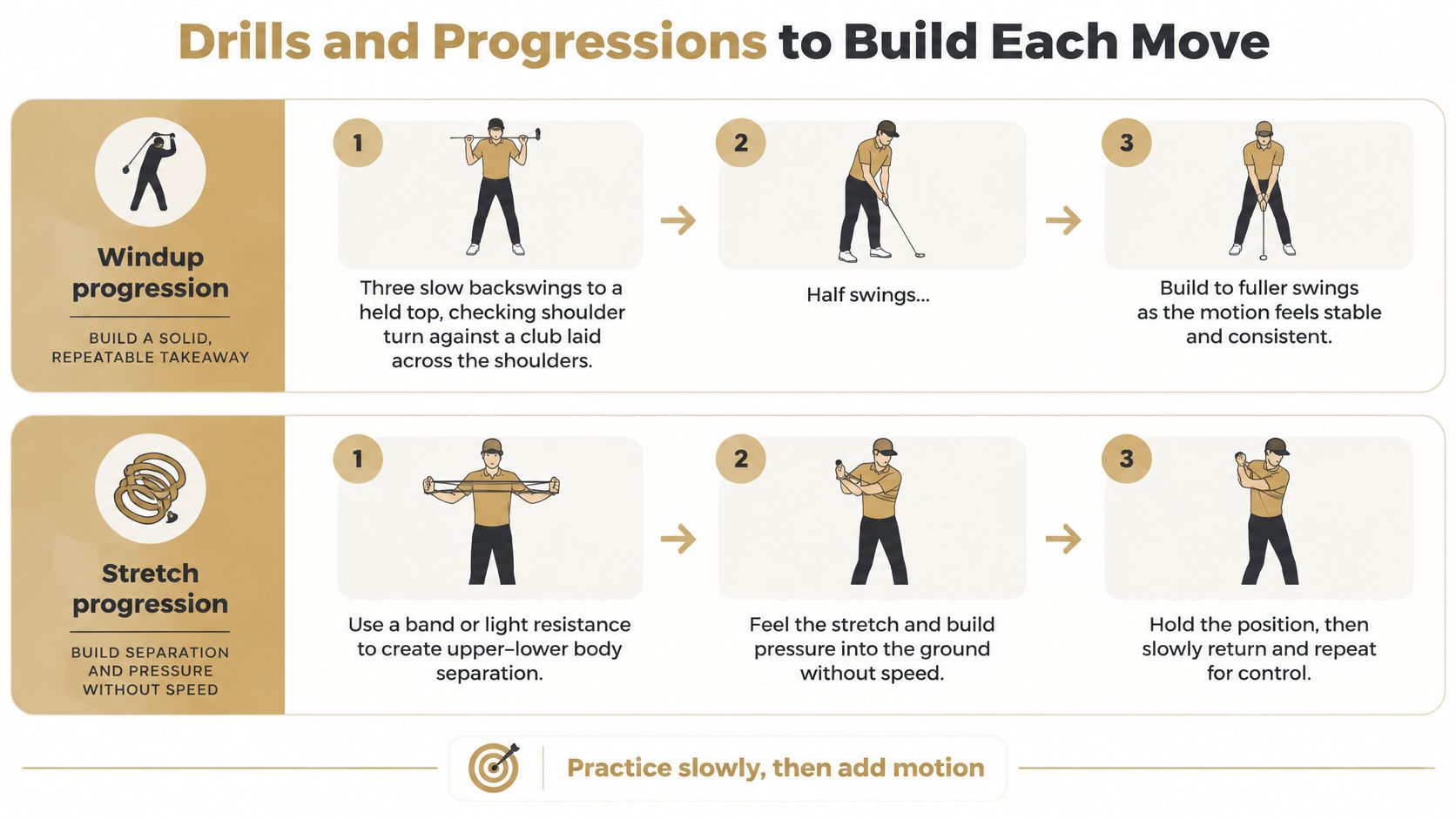
Don't add speed until the pattern survives slow reps. Keep each session to 15 to 20 minutes. Advance only when direction and strike hold across 10 consecutive shots. Film the reps or use a mirror, and stop if pain shows up.
Windup progression
- Make three slow backswings to a held top. Lay a club across the shoulders and check that the turn is real, not just lifted arms.
- Hit half swings with a two-second pause at the top, 10 reps. The pause shows whether the top can be found twice.
- Hit feet-together swings so balance has to survive while the turn grows. A sway here means the arc isn't ready for a full stance.
- Hit full swings with a target-focused tempo. Pass the gate only if direction and strike hold for 10 shots in a row.
A stable driver stance keeps the lower body from drifting while that turn grows. If the feet wander, the extra shoulder turn is sway, not range.
Stretch progression
- Use a step drill from the top. Step the lower body toward the target before the arms drop, so the pelvis has a head start.
- Hit pause-at-top swings with a two-second hold, then let the pelvis lead. The hold stops the chest from starting the downswing.
- Hit half-speed transition-only swings, 10 reps, and watch for pelvis lead. Speed is not the point of this stage.
- Hit full swings with the feel of a lower-body start, then check ball flight. Keep the change only if the gate of 10 solid shots is met.
Why the gate is the coach
A pretty pause that scatters ten balls is a fail. The gate is contact and direction, not how big the coil felt. If strike depth changes as soon as speed returns, drop back one stage instead of adding reps at full speed. Pain ends the session. Range that has to be forced isn't a progression, it's a load the trunk isn't ready to own.
Build one track per block of practice. Mixing a bigger top and a new transition in the same 20 minutes makes the launch numbers impossible to read.
Choose Which Move to Build First
Payoffs and costs
Build windup when the backswing turn is short and the arms keep lifting after the shoulders stop. More usable turn can give the downswing a longer arc to accelerate through. The trade-off is control: overturning or swaying can make the top hard to repeat and the strike less predictable.
Build stretch when the backswing turn is already adequate but the chest and arms start down too soon. A better sequence can give the club room to accelerate without asking for a bigger coil. The trade-off is load: forcing separation can stress the lower back or make the club approach from across the line.
A larger turn is not automatically a faster or more reliable swing. Flexibility alone does not create speed; the golfer still needs to transfer pressure and sequence the motion. For example, a golfer may rotate freely in a chair yet see carry spread widen on the course. In that case, more chair rotation does not address the loss of control. Judge the change by ball-speed efficiency and dispersion, not by how large the coil looks.
Five questions that settle it
Use video and launch-monitor results to make the choice. A swing can feel powerful while producing a wider carry pattern.
- Is the top turn short or stalled? If the shoulders stop while the arms keep lifting, windup may be the first move to build.
- Does the downswing start with the upper body? If the chest and arms move first while the hips stay quiet, work on stretch and sequence.
- Does the lower body lead clearly? A visible pelvis-first start suggests that stretch is already present; adding more separation may not help.
- Does smash factor fall as speed rises? That can signal that added coil is costing efficiency rather than improving the strike.
- Has back discomfort appeared? Reduce the separation and seek a qualified assessment rather than trying to force more range.
If-then verdicts
A short turn with a clean transition points to windup. An adequate turn with a rushed transition points to stretch. If both are limited, build the transition at lower speed before adding range. This keeps the order of changes clear: first address the move that limits delivery, then retest.
A golfer with limited hip rotation and early extension should avoid forcing a large shoulder turn. The goal is a motion the hips can support while the golfer maintains posture through impact.
Back pain, or carry that becomes less consistent as separation grows, is a reason to reduce the range and stop self-coaching the lumbar spine. No delivery pattern guarantees a season without injury. The load depends on the individual motion, fatigue, and the surface underfoot.
Consider one clear case: a 3-wood starts left because the chest spins first, while the turn on video is already full. Build the transition rather than adding windup, then check whether the strike and ball-speed efficiency improve.
For a 7-iron with a stalled shoulder turn and rising arms, the first move to build may be windup. Add turn only while keeping the lower body stable, then check whether carry remains consistent. The faults and their corrections are covered in the earlier sections; here, the key is choosing the change that addresses the measured limit.
The best coil is the one a golfer can repeat at impact.
A two-week plan
Use the first two days to establish a baseline. Film down-the-line and face-on, answer the five questions, and choose one measurement that fits the problem: smash factor for speed without efficiency, carry standard deviation for a pattern that sprays, or shoulder turn on video for a stalled backswing.
From days 3 through 10, work on one progression, not both. Keep the club, ball, and target the same so the comparison stays useful. Use the clubs you play when you retest. Golfers can add those clubs to their locker, then pair a launch monitor at the range or import a session.
During days 11 through 14, repeat the measurement under the same conditions. Hit at least 20 shots in the same window. Keep the change if ball speed holds or rises, smash factor does not fall, and carry spread does not widen. If speed comes with a wandering low point, drop the change. Then leave the motion alone for a week of normal swings before working on the other move.
Use the same test to compare the two moves, not the size of the coil. Windup earns its place when it improves the usable turn without widening the pattern. Stretch earns its place when it improves the sequence without costing strike quality. If neither change holds up under the retest, return to the smaller, more repeatable motion.