

Buying the ball at the top of a longest-distance chart isn't a fitting strategy. It's a bet that a golfer's swing produces the same launch, spin, and contact as the test setup. The best golf ball for distance is the one that produces repeatable carry and useful total distance at the golfer's actual driver speed, without creating an unacceptable trade-off on approach shots or around the green.
Table of Contents
- Why One Longest-Ball Ranking Misleads
- Best Golf Ball for Distance by Swing Speed
- The Four Forces That Set Carry Distance
- Matching Distance Balls to Your Game and Conditions
- Questions Golfers Ask Before Switching Balls
- Test and Confirm Your Distance Ball on the Launch Monitor
- Why the Longest Ball Depends on Your Swing
Why One Longest-Ball Ranking Misleads
The longest-ball leaderboard usually measures the test setup more than the golfer. A ball that tops one controlled protocol can be a sensible candidate, but the ranking becomes misleading when different speeds, metrics, years, and reporting rules are flattened into one list.
Published distance results by test and speed
| Ball | Test source and year | Clubhead speed | Reported result |
|---|---|---|---|
| Callaway Chrome Tour | Robot test, 2025 | 93 mph | 210.8 yards carry |
| Pinnacle Soft | Robot test, 2025 | 93 mph | 200.6 yards average |
| Callaway Chrome Tour X | Today's Golfer, 2024 | 115 mph | 283.2 yards carry |
| Callaway Chrome Tour Triple Diamond | MyGolfSpy robot test, 2025 | 115 mph | 328.05 yards |
| Titleist Pro V1x Left Dash | MyGolfSpy, 2024 | 115 mph | 348 yards total |
The first pair provides the cleanest comparison: in Today's Golfer's 2025 robot test of 62 retail balls, Callaway Chrome Tour carried 210.8 yards at 93 mph, while Pinnacle Soft averaged 200.6 yards, a 10.2-yard, or 5.08%, gap from changing the ball. The 10.2-yard gap applies to that controlled setup and will vary for other golfers.
The other rows answer different questions. Some report carry, another explicitly reports total distance, and the Triple Diamond result is presented as distance. Combining them into a single descending ranking would hide those differences.
Carry and total distance aren't interchangeable
Carry measures flight to the landing point. Total distance includes rollout, which makes turf firmness, slope, and the model's ground settings relevant to interpretation. A ball that wins on simulated rollout might not clear a forced carry or deliver the same advantage on a soft fairway.
Different test years also shouldn't be treated as a continuous leaderboard. Unless setup, measurement, environmental conditions, and reporting conventions match, the larger number doesn't establish a better ball.
Practical rule: Compare balls within the same test before comparing results across publishers or years.
A useful personal report therefore includes more than the longest drive:
- Carry and rollout: Separate airborne distance from the ground contribution.
- Peak height and descent angle: Describe how the ball reaches its landing point.
- Dispersion: Show whether extra distance remains usable.
- Launch and backspin: Help explain why the distance changed.
The robot identifies candidates, not a personal winner
Today's Golfer's full 2025 results used driver speeds of 114, 93, and 84 mph, with results changing by speed. That makes the golfer's speed band the first filter before model selection.
A fair personal comparison keeps clubhead speed, impact location, temperature, tee height, and delivery as consistent as practical. Launch and spin should be recorded, not artificially forced to match, because changes in those outputs may explain the ball's benefit.
The fitting question is therefore specific: which ball produces the strongest repeatable carry and total-distance averages for that golfer's delivery? Published results deserve more weight when their speed, launch, and spin resemble the golfer's own launch-monitor averages.
Best Golf Ball for Distance by Swing Speed
Starting ball profile by driver speed
| Driver speed | Ball profile to try first | Main trade-off to check |
|---|---|---|
| Under 75 mph | Lower-compression, higher-launch balls | Launch, carry and soft feel before premium wedge spin |
| 75-85 mph | Soft to mid-compression balls with iron spin | Distance alone can make approaches release too far |
| 86-95 mph | Mid-compression profiles | Driver efficiency versus wedge response and feel |
| 96-105 mph | Mid-firm and tour-style profiles | Launch and driver spin control |
| 106 mph and above | Firmer, tour-level profiles | Flight control without assuming maximum wedge spin |
These bands are screening categories, not validated compression cutoffs. A golfer shouldn't reject a ball that performs well just because its feel or construction falls outside the suggested starting profile. The driver ball speed chart helps distinguish clubhead speed from the speed transferred to the ball.
Lower-speed starting points
Under 75 mph, a lower-compression, higher-launch candidate provides a sensible comparison against the current ball. The confirming evidence is improved carry with a sustainable flight, not softness alone.
For 75-85 mph, the test should extend beyond the driver. A soft or mid-compression candidate remains useful only if its iron landing behavior suits the golfer's greens. A longer drive doesn't compensate automatically for approaches that release beyond their intended landing area.
Moderate and faster starting points
The 86-95 mph band calls for balance rather than an automatic move to the firmest tour ball. A golfer around 90 mph can use a mid-compression profile as the reference, then compare alternatives according to the actual driver-spin pattern, wedge response, and preferred feel.
For 96-105 mph, mid-firm and tour-style constructions belong in the candidate pool. Wind testing becomes useful when the golfer needs to determine whether a promising indoor flight remains manageable outdoors.
At 106 mph and above, firmer tour-level profiles are reasonable candidates, but speed doesn't prescribe a particular wedge-spin response. Driver and short-game performance need separate checks.
A speed band narrows the test. It doesn't select the ball.
The practical next step is to identify the relevant band and name the most important trade-off: airborne distance, driver-spin control, approach stopping, or feel. That priority determines which candidate deserves a place beside the current ball.
The Four Forces That Set Carry Distance
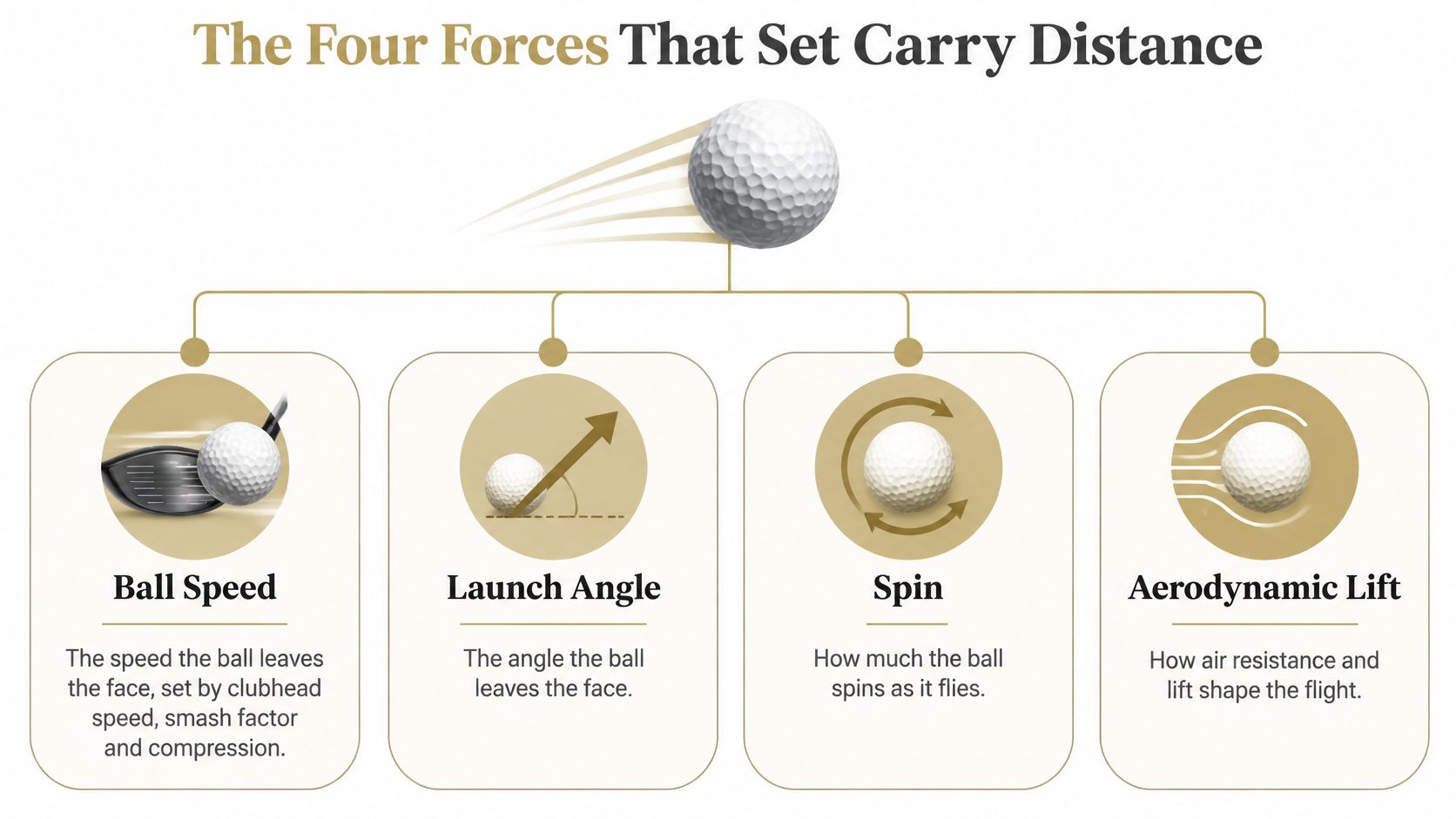
A robot leaderboard can rank balls at one delivery. A golfer's result is the repeatable carry and total distance built from four outputs at that golfer's driver speed.
Initial speed and direction
Ball speed is the exit speed off the face. Clubhead speed, strike efficiency, and the ball's impact response feed it. Compression shapes that response; the launch monitor shows whether the pairing is producing speed.
Launch angle is the initial flight angle. Its value depends on the speed available and the spin that rides with it. A flight that adds carry holds height and keeps moving; a flight that climbs and stalls spends speed without gaining ground.
Spin and aerodynamic behavior
Backspin creates lift and drag at the same time. The trade-off has a measurable reference point: Reuters' account of the governing bodies' distance standard reports a 317-yard limit plus a 3-yard tolerance, with an announced 2028 test change to 125 mph, 11 degrees, and 2,200 rpm. For a golfer near 95 mph, the useful check is the same pattern at a lower speed: enough spin to keep the ball flying, restrained enough to keep it from ballooning. A drive that falls early needs lift; a drive that climbs and dies has drag working against carry.
Aerodynamics covers how the ball works through airflow after launch. The R&A's review of golf-ball dimples explains that dimple size, shape, and distribution affect lift and drag; dimple count alone is an incomplete spec.
- Speed check: Read ball speed with strike quality, since a hot number from a heel or toe strike can mislead.
- Flight check: Judge launch and spin as a pair; chasing the lowest spin or highest launch can move the shot away from carry.
- Repeatability check: Prefer the flight that survives several centered strikes over the single longest ball.
A conforming ball still answers to that test ceiling. Personal gains come from a compatible speed, launch, spin, and repeatability pattern, rather than expectations of open-ended speed differences between models.
Matching Distance Balls to Your Game and Conditions
A ball's distance advantage is useful only if it holds under the conditions in which it will be played. Compare results at a similar driver speed, then check whether the pattern carries over to the golfer's usual rounds.
Cold rounds and mixed environments
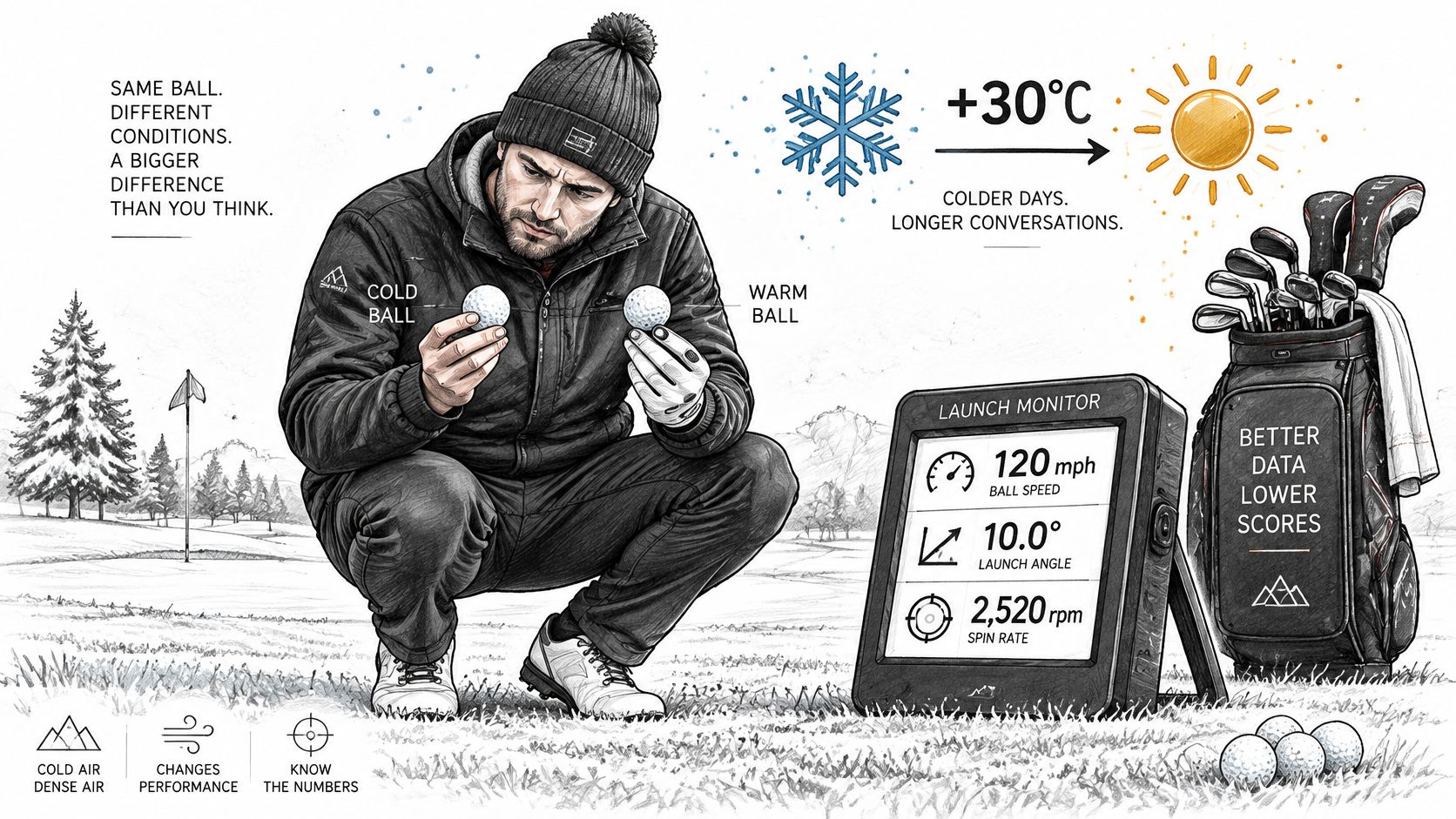
Record temperature before comparing distance. A warm indoor session and a cold outdoor round differ in more than ball choice, so changing both the ball and the environment makes the result harder to interpret.
For example, a winter comparison of two models in the same cold temperature band can show whether one maintains its carry advantage in those conditions. Keep a session record: ball model, temperature, and outcome.
Used balls and changing delivery
Start with clean, undamaged balls of similar condition. Mixing fresh balls with heavily played samples adds a variable that can obscure the difference between models. Record ball condition alongside the results.
A change in delivery also affects the comparison. If the golfer's driver setup or swing has changed, results from an earlier session may no longer describe the current fit. Outdoor observation can add context to the recorded numbers.
Rule changes and replacement purchases
The governing bodies' revised-testing FAQ explains the announced future testing changes. It does not establish which current model will retain its relative position after manufacturers respond.
Keep a session record with the ball model and condition, driver setup, temperature, indoor or outdoor setting, and outcome. Include launch, carry, total distance, and dispersion. Those details help distinguish a repeatable distance pattern from a result limited to one set of conditions.
Questions Golfers Ask Before Switching Balls
Does a firmer ball always add distance?
A firmer feel alone does not predict greater distance. Speed, launch, spin, and aerodynamics all affect flight, so a firmer candidate earns consideration only if its average distance improves without an unwanted change in driver flight or short-game response.
Can a distance ball help at slower speeds?
A higher-launch, lower-compression profile may be worth comparing when the golfer wants more carry. For example, if that ball feels softer but carries farther on average at a similar driver speed, the flight result is more useful than the label or feel alone.
A ball earns its place through the shots the golfer can repeat, not the category printed on its packaging.
Is another test necessary after a driver or swing change?
A new club setup or delivery can change how a ball performs. Establish a fresh baseline with the current ball before comparing alternatives, so a change in equipment or swing is not mistaken for a ball-related gain.
Must every session have identical conditions?
Use the testing protocol in the next section to compare results under consistent conditions.
Test and Confirm Your Distance Ball on the Launch Monitor
A ball's distance advantage matters only if it survives a fair comparison. The launch monitor measures shots; the test design determines what the results mean. The launch-monitor guide for driving-range practice can help golfers choose a setup for collecting those readings.
A repeatable comparison routine
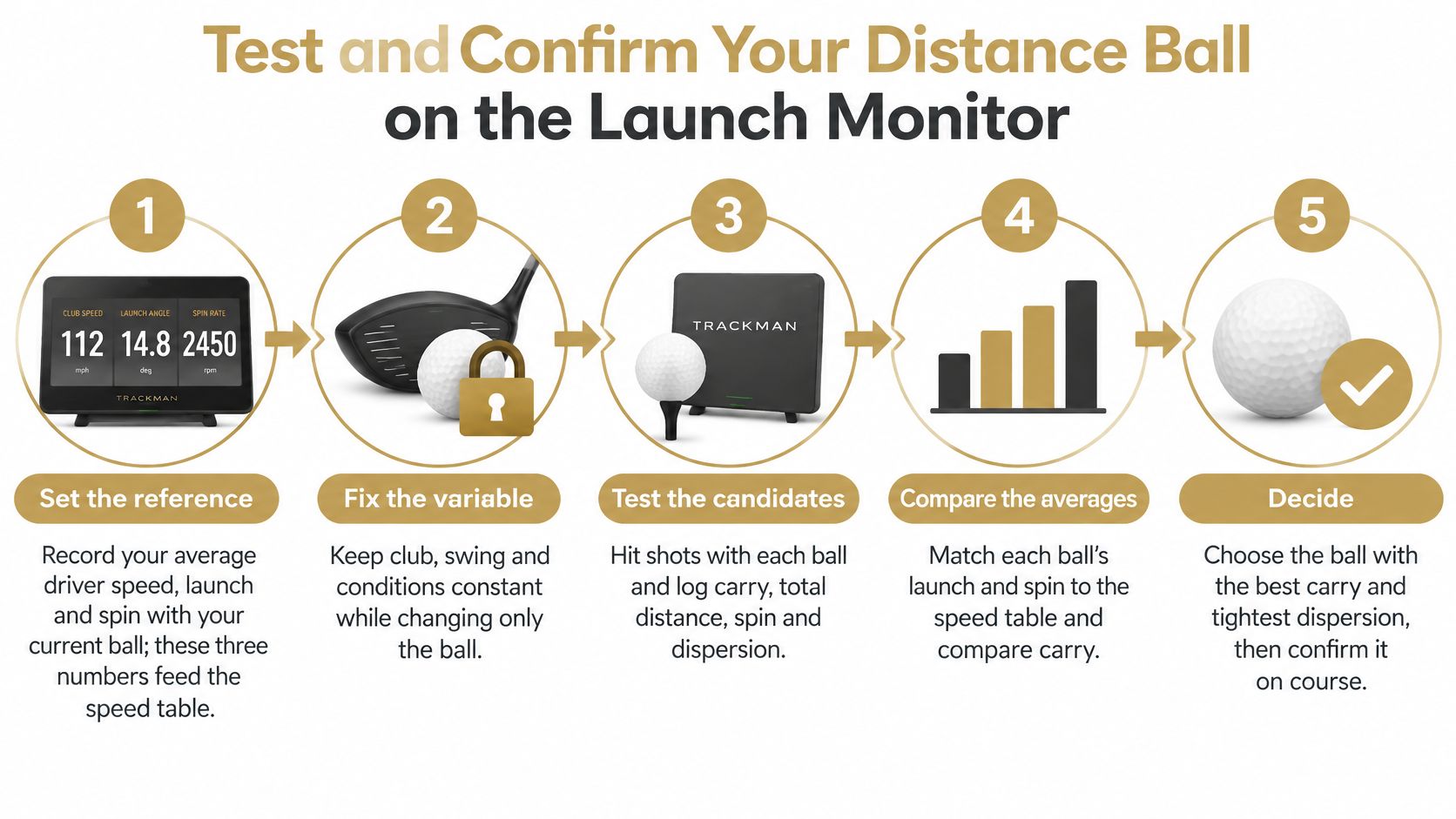
Set the reference. Record average driver speed, launch, and spin with the current ball. Keep the session record, including ordinary shots, rather than relying on remembered best drives.
Fix the conditions. Use the same club, tee height, ball position, and monitor settings. Record temperature, and keep the driver adjustment unchanged.
Collect centered strikes. As a practical protocol, aim for eight to ten accepted shots per model. Alternate short groups between candidates so fatigue or a changing swing is less likely to favor one ball.
Apply an exclusion rule. Remove clear measurement failures, unintended mishits, and shots disrupted by wind, using the same rule for each candidate. Keep valid centered strikes, even when their distance is disappointing.
Record the full result. Save ball speed, launch, backspin, carry, and total distance. Include height, descent angle, and dispersion when available. Mark which values the monitor measures and which it estimates.
Compare averages and spread. A higher average is less useful if the candidate produces a wider range of outcomes. Review ordinary playable misses separately; a centered-strike sample alone does not represent every on-course result.
Export the session. Garmin's Approach R10 export instructions describe opening the Golf app, selecting Activity, choosing the session, selecting the export control, and choosing Export to CSV. A swing video is not a shot-record export.
Keep the decision rule alongside the results.
Confirm before committing
Repeat the comparison in a separate session before treating a small distance difference as meaningful. Look for a similar carry and total-distance advantage at comparable driver speeds, rather than relying on one standout session.
- Comparable speed: The apparent winner was not hit with materially faster swings.
- Stable flight: Launch and spin support repeatable carry.
- Useful spread: Extra distance does not come with unsuitable dispersion.
- Course response: Approaches and short shots remain manageable.
Dialed Golf's free Golf Ball Fitter identifies a ball profile suited to a golfer's flight and feel. For additional confirmation, record the selected ball across the next three sessions before making a final purchase decision.
Why the Longest Ball Depends on Your Swing
A distance-ball ranking can narrow the choices, but it cannot settle the decision for every golfer. Robot tests measure performance under a controlled delivery; a golfer's speed, strike, launch, and spin determine how closely that result applies in play.
The published comparison in “Why One Longest-Ball Ranking Misleads” shows how results vary by test method and swing speed. Treat those figures as context, then judge candidates by repeatable carry and total distance from launch-monitor averages in the golfer's own driver-speed band.
Separate the ball effect from the swing effect
A distance gain is difficult to attribute to the ball if the candidate also receives faster swings or better contact. Compare accepted shots, clubhead speed, and strike patterns before interpreting averages.
Alternating candidates can help reveal whether a change in comfort or contact is influencing the result. If the samples differ materially, the comparison is inconclusive; another session provides stronger evidence. A consistent driver stance also helps keep setup from changing alongside the ball.
A useful distance gain should hold up in a fair retest.
Decide what kind of distance is valuable
A golfer facing forced carries may prioritize dependable airborne distance, including the shorter accepted shots. On firm, open fairways, total distance may matter more. The better choice depends on which result helps the golfer play the course.
Consider the rest of the bag, too. If candidates perform similarly off the tee, approach control and predictable wedge release may carry more weight than a small driver advantage.
A useful decision record contains:
- The primary requirement: More reliable carry, controlled driver flight, or useful total distance.
- The acceptable trade-off: Feel or stopping behavior the golfer can tolerate.
- The rejection condition: A flight or dispersion pattern that makes the gain unusable.
Keep the record connected to play
Dialed Golf offers Free and Pro plans, with a macOS and Windows app for one golfer's range and practice sessions. Golfers add their clubs to a locker, then pair a launch monitor or import a session; the app tracks distance and other shot metrics, as well as changes between sessions.
The immediate fitting step is to use a representative driver session to identify the golfer's speed band, then compare candidate balls under similar conditions. A ball earns its place when its carry and total-distance advantage repeats without an unacceptable change in flight or control.
Dialed Golf's free Golf Ball Fitter helps identify a ball profile suited to flight and feel. The desktop app can review live-captured or imported practice sessions. Visit Dialed Golf to use the free fitter and assess a candidate against repeatable results.