

A player strips a 7-iron on the range, then goes home and regrips it. Next session the same swing produces thin contact, and the club feels different even though the head and shaft look unchanged.
Swing weight is a 14-inch balance code, A0 to G9, logged beside total mass, length, and strike data.
That code is a starting clue, never a verdict. Moving from D2 to D3 adds head feel; one golfer may square the face sooner, another may lose speed. A useful swing weight golf check asks what changed in the build and whether carry, ball speed, and impact pattern improved. Feel can argue with the ball data, so record both before changing parts.
Table of Contents
- Swing Weight Codes Golfers See on Spec Sheets
- Why the Same Weight Can Feel Different
- What Moves a Club Up or Down the Scale
- How Swing Weight Changes Club Speed
- How to Check Swing Weight Before You Change It
- Set Matching When Lengths and Shafts Differ
- Compare Two Swing Weights in One Practice Session
Swing Weight Codes Golfers See on Spec Sheets
Spec sheets, fitting charts, and builder notes compress the whole system into two characters: one letter and one digit. These are the bands a golfer is likely to meet.
Swing weight bands golfers see on spec sheets
| Band | What the code usually means | Who often plays it |
|---|---|---|
| A0 to B9 | Lightest end of the letter-number scale | Rare in conventional full sets |
| C0 to C9 | Lighter head feel for the same style of club | Many women's, senior, and lighter men's builds |
| D0 to D2 | Common men's starting band | Standard irons and many drivers |
| D3 to D5 | Slightly more mass toward the head | Players who want a heavier release or more stability |
| D6 to E9 | Heavy end of normal manufacturing | Stronger players or specialty builds |
| F0 to G9 | Beyond typical production clubs | Mostly extreme custom or theoretical builds |
These bands work as fitting starting points. Age, gender, and strength alone assign no band. A golfer chasing stability still needs to test whether a head-heavier build improves contact, since a higher code helps some swings and hurts others.
The Golf Lens swing-weight guide counts 70 nominal combinations on the scale and traces Robert Adams's Lorythmic Scale to the early 1920s and its United States patent in 1934, U.S. Patent No. 1,953,916.
Reading the letter and number
The letter identifies a broad band; the numeral locates the club within that band. Moving from D2 to D3 is a small increment, while moving from D0 to E0 spans ten points and usually feels obvious in the hands.
At the bench, D0 works as a lighter men's starting point. D2 is a familiar target for men's irons and drivers, and D4 describes a modestly more head-heavy build.
A higher code describes balance relative to the grip end, and nothing more.
Two clubs can share one code and differ widely in total mass. A code written down alone tells a fitter less than a code written down beside length and grams.
Starting points aren't prescriptions
Slower-swing builds often occupy the C letters, yet swing speed alone never selects the balance. Transition tempo, preferred head awareness, and the ability to repeat contact carry more weight than a demographic label.
Putters and specialty wedges do different jobs. A putter's stroke and a wedge's partial swings answer to their own demands, so neither needs forcing onto the iron specification.
The system originally helped builders match clubs that differed in length and total weight. That remains its useful role: making a set coherent.
Before any component change, the build record needs three entries:
- Identify the existing code. A catalog specification is a target, so measure the club as played before trusting it.
- Record the companion measurements. Playing length, total mass, and a recent strike pattern belong beside the code.
- Preserve the baseline. Later changes only become meaningful when the original build remains documented.
Why the Same Weight Can Feel Different
A golfer places similar-looking clubs on a gram scale and gets matching readings. During a waggle, however, one head feels much more noticeable.
Nothing is wrong with the scale. It has answered the total-mass question, not the balance question.
A balance beam rather than a bathroom scale
The technical material in this USPTO-hosted document describes swing weight as a static torque-style measurement around a fulcrum approximately 14 inches from the grip end, rather than a measurement of total mass or clubhead rotational inertia.
The diagram shows why the position of the mass matters.
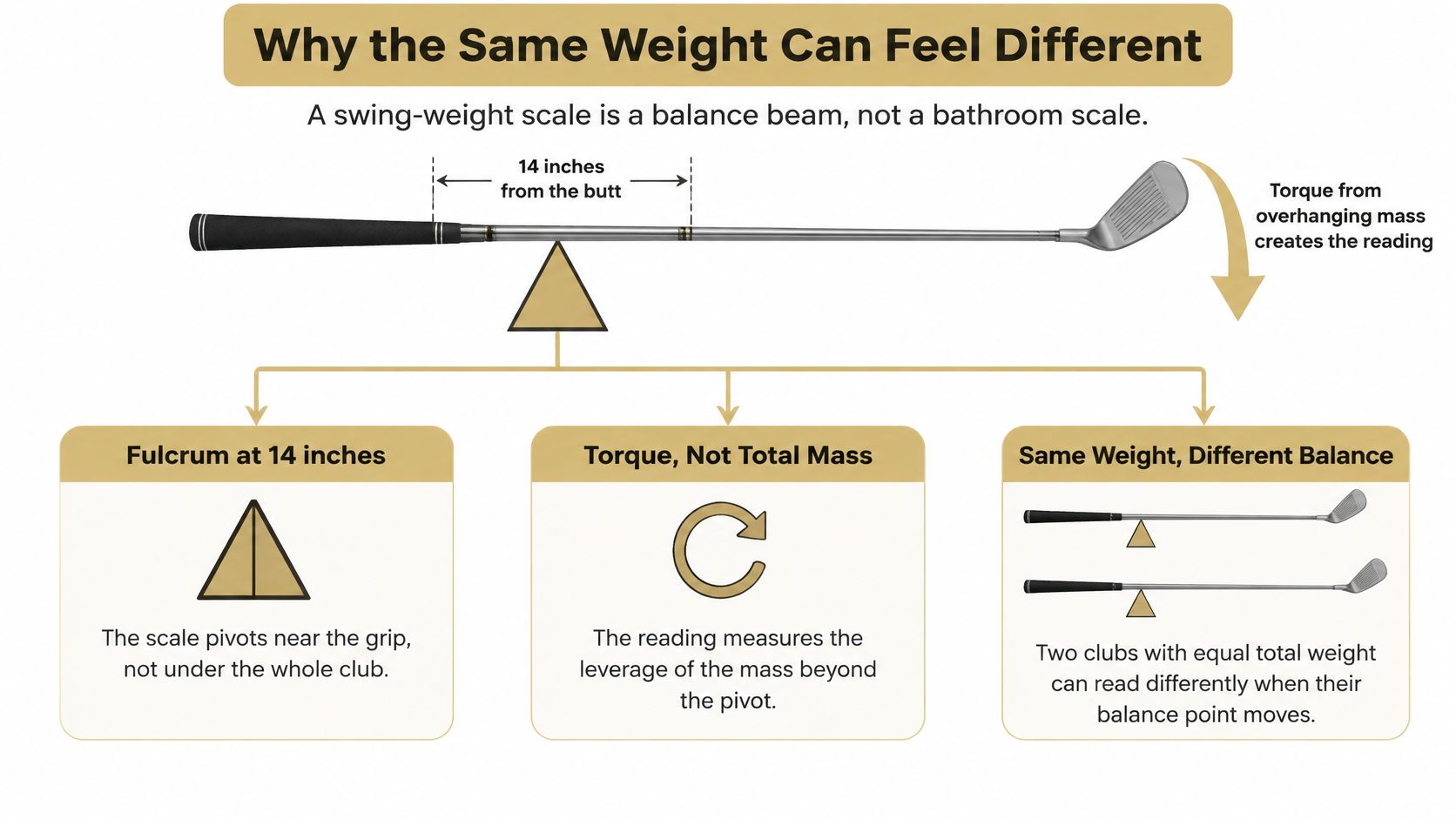
Mass farther toward the head has greater influence around the reference point. Moving mass toward the hands changes that effect, even if the gram scale still reports the same total.
Say a builder redistributes mass from the grip end toward the head while keeping overall mass unchanged. The resulting club can register a higher swing weight without becoming heavier on the gram scale.
A higher code means a more head-heavy balance, not necessarily a heavier club and not a more forgiving head.
Balance doesn't describe every kind of resistance
Clubhead moment of inertia, often shortened to MOI, concerns the head's resistance to twisting on an off-center strike. Swing weight doesn't measure that forgiveness.
The resistance involved in accelerating the entire club during a swing is another consideration. A stationary balance reading can't completely describe a moving club in a golfer's hands.
That distinction prevents a common fitting mistake: assuming matching codes guarantee matching behavior. Different shafts can produce different loading sensations even when their finished clubs share a static reading.
The fitting record therefore needs these measurements together:
- Total mass, recorded in grams.
- Balance point, measured consistently from the same end.
- Playing length, using the same measuring method.
- Swing weight, recorded as the letter-number code.
Shaft mass distribution, torque, and flex profile still deserve their own entries. The code identifies a balance condition; the golfer's motion determines whether that condition is useful.
What Moves a Club Up or Down the Scale
A fitter at the bench has three ways to move the reading on the scale's 14-inch fulcrum: mass at the head, playing length, and mass at the grip end. Each lever does a different job, so the builder picks the one that solves the actual problem.
A head adjustment preserves the existing playing length. A grip adjustment changes the counterbalance but also changes what the golfer holds. A length adjustment affects setup and contact as well as the balance reading.
Build changes that move swing weight
These workshop comparisons give the direction and relative size of each move. Measuring the finished club settles the question.
| Change | Effect on the reading | Rough size |
|---|---|---|
| A small amount of mass added at the head | Raises swing weight | A small step up the scale |
| The same small amount removed from the head | Lowers swing weight | A similar-size step down |
| More playing length | Raises swing weight | A noticeably bigger move for a modest change |
| Less playing length, cut or choked | Lowers the effective feel | A similar-size drop once the shaft is actually cut |
| Grip or butt weight added | Lowers swing weight | Balance point shifts toward the hands |
| Heavier shaft, same head | Often lower or different in loft-to-head feel | Set by where the shaft's mass sits |
Lead tape is a practical, reversible way to explore a slightly higher reading. Strips vary, so the builder weighs each piece rather than trusting a printed length.
A heavier grip, counterweight, or butt weight works at the opposite end. It can lower the code while increasing total mass, which is why a lower reading doesn't guarantee an easier club to accelerate.
Shaft weight isn't head weight
A heavier shaft spreads the added mass along the club instead of concentrating it at the head. Its balance profile matters: material near the butt behaves differently from the same material near the tip, so two shafts of equal weight can move the scale by different amounts.
Flex, torque, and kick point aren't swing-weight settings. They can change dynamic feel without producing the balance change a golfer expects.
Choking down needs careful language too. The golfer swings a shorter effective lever, yet the unmodified club still reads at its full length on the scale. Cutting the shaft produces a different finished build, one that has to be measured again before it enters the record.
Bench rule: Change one component, remeasure the assembled club, then decide whether the rest of the set still makes sense.
A permanent alteration is rarely the right first response to an uncertain sensation. Reversible testing separates a preference for balance from a preference for length, grip shape, or shaft behavior. Whatever survives that testing gets logged next to total mass, playing length, and the strike pattern it produced, because a heavier code is not automatically more stable or slower for every golfer.
How Swing Weight Changes Club Speed
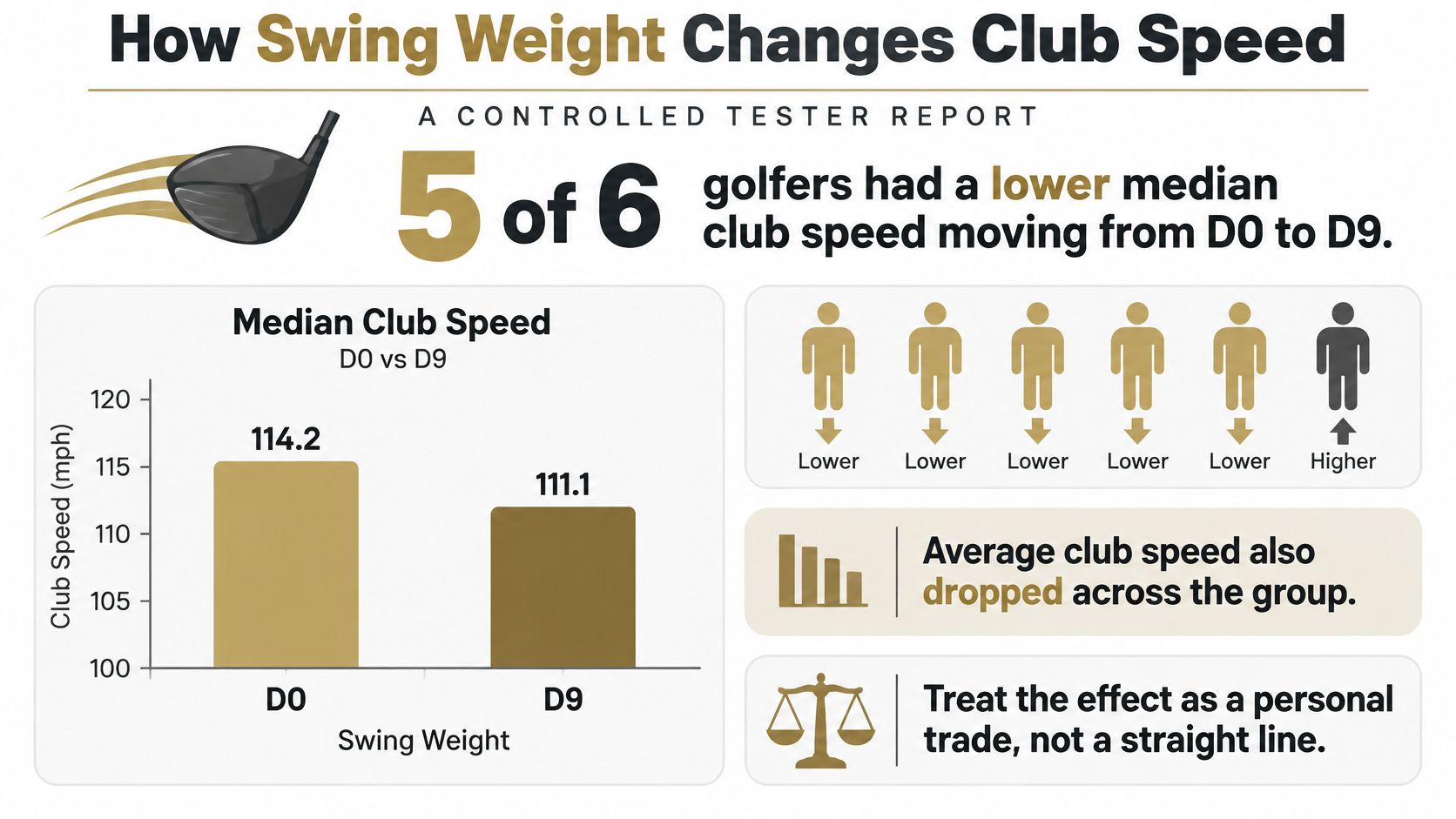
Swing weight is a balance code taken around a point 14 inches from the grip end, so a higher reading describes where mass sits rather than how fast the club will move. In one controlled tester report, five of six golfers recorded lower median club speed after moving from D0 to D9, and separate testing cited in the same report found a lighter driver head moving faster through the swing. The result comes from those six testers and does not predict any one golfer's response.
The speed gain can come with a cost
A head-heavier configuration can require more effort to accelerate. Some golfers still prefer the sensation through impact and deliver the face more consistently.
A lighter head may move faster but produce a less useful shot pattern. If contact spreads across the face, gear-effect variation and directional misses can outweigh the extra speed.
Swing-weight speed tests side by side
| Change | Speed result | What else changed |
|---|---|---|
| D0 to D9, five of six golfers | Median club speed fell for those golfers; the reported average loss was about 2.75 mph | Heavier setup can feel more stable and takes more effort to accelerate |
| Lighter driver head | Clubhead speed up about 3.7 mph | Lower head MOI and more twisting on off-center strikes |
Speed figures as reported in Plugged In Golf's swing-weight testing.
These comparisons establish no universal speed change per swing-weight point. Adding counterbalance and removing head mass are physically different interventions, so a fitter should identify the actual build change rather than crediting the letter-number code alone.
A slower median can be a win when the misses get smaller and useful ball speed holds up.
Reading the entire shot pattern
A fair comparison holds loft, shaft, ball, and launch-monitor conditions constant while testing different head-weight or swing-weight settings. Because the code describes balance only, it belongs in a log alongside total mass, playing length, and the strike data that explains the result. The record should include clubhead speed, ball speed, delivered face angle, strike location, launch, spin, and dispersion wherever reliable measurements are available.
Ball speed helps reveal whether the golfer converted movement into useful impact. The driver ball speed chart provides context for that measurement without making club speed the only objective.
The video below examines the same relationship between build and performance.
A golfer might describe the heavier setting as controlled while delivering a wider pattern. Another might dislike its initial feel yet strike it more consistently.
A heavier code is not automatically more stable or slower for every player. The stronger setting is the one whose useful pattern the golfer can repeat.
How to Check Swing Weight Before You Change It
A credible check begins with the club as played, including its installed grip, existing tape, and current length. Measuring an incomplete build and treating that result as the finished specification creates unnecessary confusion.
The overview below groups the work into baseline, measurement, adjustment, and comparison.
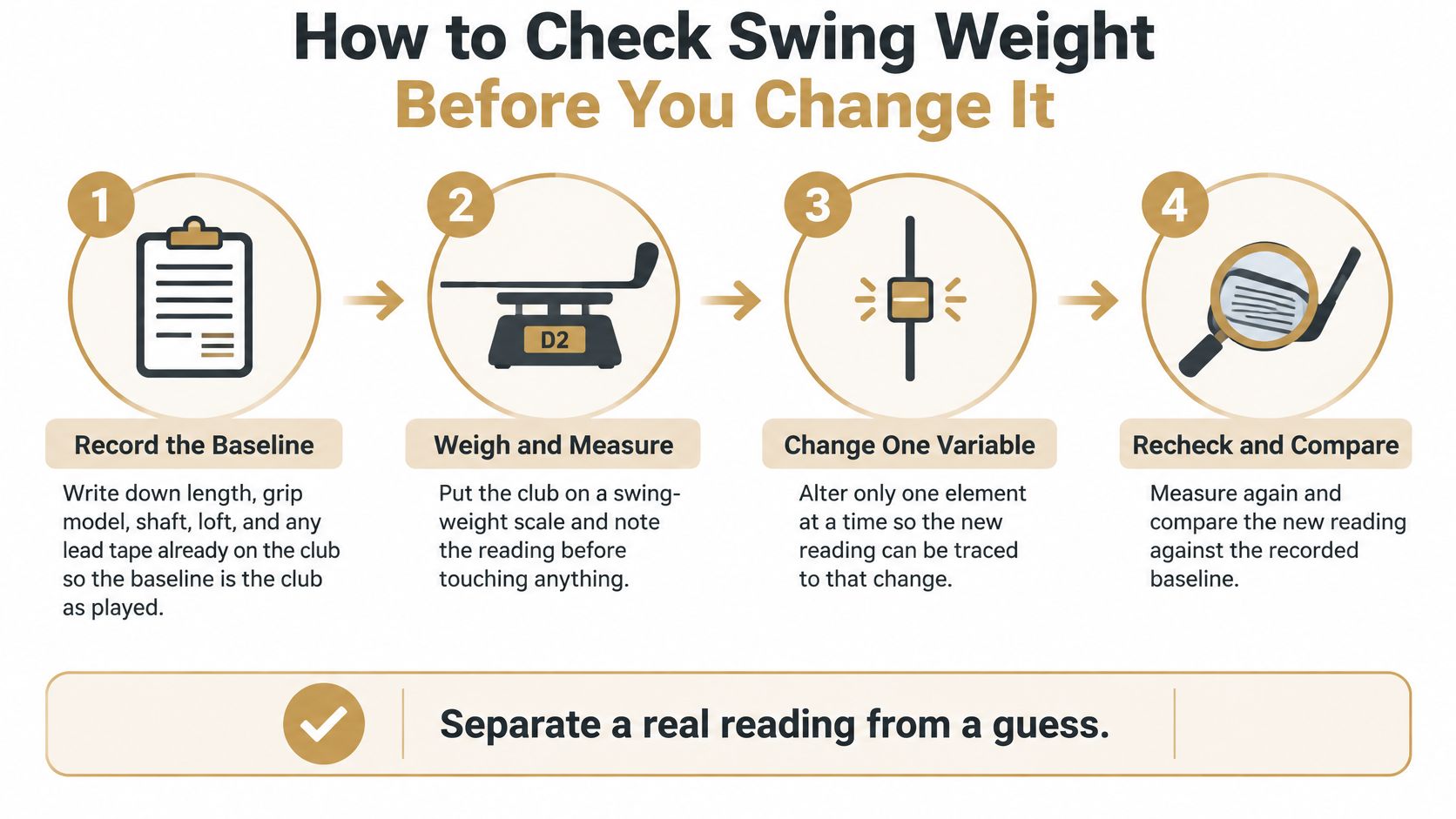
A practical bench sequence
Describe the existing build. Record playing length, grip model, shaft, loft, and any head tape or adjustable weights. A quick photograph helps preserve the location of additions.
Weigh the entire club in grams. Keep total mass in its own column. A suitable gram scale measures mass; a kitchen or luggage scale doesn't directly produce a swing-weight code.
Measure the actual balance code. On a swing-weight scale, seat the grip end against its stop, support the club correctly, and allow the mechanism to settle according to the instrument's instructions. Without that instrument, a fitter can provide the actual reading; a simple balance-point comparison only indicates relative balance.
Compare neighboring clubs. An unusual reading matters more when it matches an unusual feel or strike pattern. A catalog target alone doesn't establish that the club is wrong.
Make a small, traceable change. Use a weighed piece of tape or a documented component replacement. Record the new total mass and balance reading before hitting.
Compare before and after under consistent conditions. Use the same ball and test on the same day where practical. Note whether the golfer can make a normal transition or feels forced to steer or accelerate the club.
Keep the measurement separate from the sensation
The club's physical specification and the golfer's effective grip position aren't identical. Choking down changes the lever used during the swing, whereas cutting the shaft changes the actual build.
A lighter replacement grip can also shift the reading, even if the player thinks of the work as routine maintenance. The relevant specification is the finished club, not the code written on an old fitting sheet.
The useful record includes both measured changes and player observations. Entries such as rushed transition, easier center contact, or wider heel-to-toe strike spread make the test more informative than a vague note saying better.
The check has worked when the player can repeat the motion and the new code is stored beside the old one. A reading without a repeatable result is only a measurement.
Set Matching When Lengths and Shafts Differ
A long iron and a pitching wedge can share a swing-weight code while differing substantially in length and total mass. That isn't a contradiction: the builder is matching a balance relationship, not making identical clubs.
An iron set built around a code such as D2 is a practical example. The intended outcome is a comfortable progression through the set, not an assurance that every club will feel indistinguishable.
Matching the code can miss the player
Mixed shafts, replacement grips, and inconsistent assembly can disrupt the progression. Applying identical pieces of tape to every head also doesn't guarantee a suitable result across different club lengths.
The fitter needs to distinguish an accidental outlier from an intentional progression. A club that measures differently but produces dependable contact may have a reason to remain different.
- Drivers and fairway clubs use a different combination of length and shaft mass from irons, so their best balance needn't match the iron target.
- Partial-swing wedges should support distance control and touch rather than comply automatically with the full-swing specification.
- Putters deserve assessment for their own stroke demands.
- Counterbalanced builds can show a moderate code while retaining substantial total mass.
A useful progression beats a uniform label
The strongest challenge to universal matching is the golfer who repeats contact better with a gentle progression from long clubs to short clubs. Forcing the whole bag onto a single target can remove a useful preference.
Transitions between hybrids and irons deserve particular attention because loft alone doesn't explain their different build characteristics. The hybrid golf club lofts chart helps organize that part of the bag while the fitter assesses balance separately.
A sensible set record preserves component details and performance notes alongside the codes. Uniform specifications are useful only when the golfer can use them consistently.
Compare Two Swing Weights in One Practice Session
A useful comparison starts with a club the golfer trusts and one modestly adjusted alternative. A hypothetical trial might move about one to three points using approximately 2 to 6 grams of head tape. The scale confirms the change; the golfer's strike pattern and ball flight show whether it helps.
Keep the comparison readable
- Copy the baseline. Record playing length, total mass, balance point, and current swing-weight code.
- Change one lever. Label the alternative and measure it again before hitting.
- Hold other inputs steady. Keep loft, shaft, ball, and practice conditions consistent.
- Capture both blocks. Follow the measurements listed in the Club Speed section, and note the strike location when available.
- Compare patterns side by side. Include representative misses, not just the best shots.
- Store the decision. Keep the setting that produces repeatable results and retain both build records.
Know What the Monitor Measures
For Garmin R10 sessions, Garmin's technical guidance identifies clubhead speed, ball speed, launch angle, and launch direction as directly measured radar inputs. Treat modeled outputs with appropriate caution when judging a subtle build change.
Carry changes need context across the bag, too. A golf bag gap analysis can show whether the retained setting creates useful distance spacing, rather than producing a longer best shot.
Swing weight is a 14-inch balance code, not a measure of total mass or a guarantee of stability. Log the code alongside club length, total mass, and strike results.
Dialed Golf's macOS and Windows practice app pairs with or imports sessions from launch monitors and simulator sources. Live capture records shots locally for review, while the app highlights club gaps, overlaps, personal bests, and session-to-session changes. Its desktop practice record can help keep the two build comparisons together.
Dialed Golf also offers a consumer app on TestFlight and a separate Dialed Golf Academy product for clubs. The seven free web tools require no account. Golfers can visit Dialed Golf to use the tools and organize a before-and-after session around measured balance, strike location, and repeatable ball flight.