

A 4-hybrid isn't just “easier” than a 4-iron. In one independent Arccos analysis, 0 to 5 handicappers hit more fairways with the 4-iron, 46.20% versus 43.50%, yet every handicap bracket still posted a lower score off the tee with the 4-hybrid. The uncomfortable takeaway is simple, the better club depends on who's swinging it, where it's being used, and what the rest of the bag is doing around it. Arccos' handicap-segmented comparison shows why this decision has to be made with data, not dogma.
| Club | Usual loft | Typical flight | Main strength | Main trade-off |
|---|---|---|---|---|
| 4-iron | 18° to 20° | Lower, more penetrating | Tee-shot control for elite players | Harder launch, less help from rough |
| 4-hybrid | 22° to 24° | Higher, softer landing | Easier launch, more carry and stopping power | Less tee-shot accuracy for some elite players |
| 7-wood | Varies by model | Highest of the three | Peak height and soft landings | Can crowd the top of the bag |
Table of Contents
- Why the 4 Iron vs Hybrid Question Has No Universal Answer
- What Each Club Is
- Comparing Launch, Spin, Carry and Descent Angle
- Turf Interaction and Rough Performance
- Reading Your Own Launch-Monitor Data to Decide
- The Third Option Most Comparisons Skip
- Situational Recommendations and a Decision Tree
- Common Questions About Choosing Between a 4 Iron and 4 Hybrid
Why the 4 Iron vs Hybrid Question Has No Universal Answer
The cleanest answer is also the least satisfying one. A 4-iron and a 4-hybrid do not solve the same problem for every golfer, because the scoring outcome changes with skill level, strike quality, and launch conditions. Arccos' segmented launch-monitor analysis found that while 0 to 5 handicappers hit more fairways with the 4-iron, every handicap bucket still scored better off the tee with the 4-hybrid. For 11 to 15 handicappers, the scoring edge was even clearer, 4.46 with the hybrid versus 4.64 with the iron, according to the same Arccos breakdown.
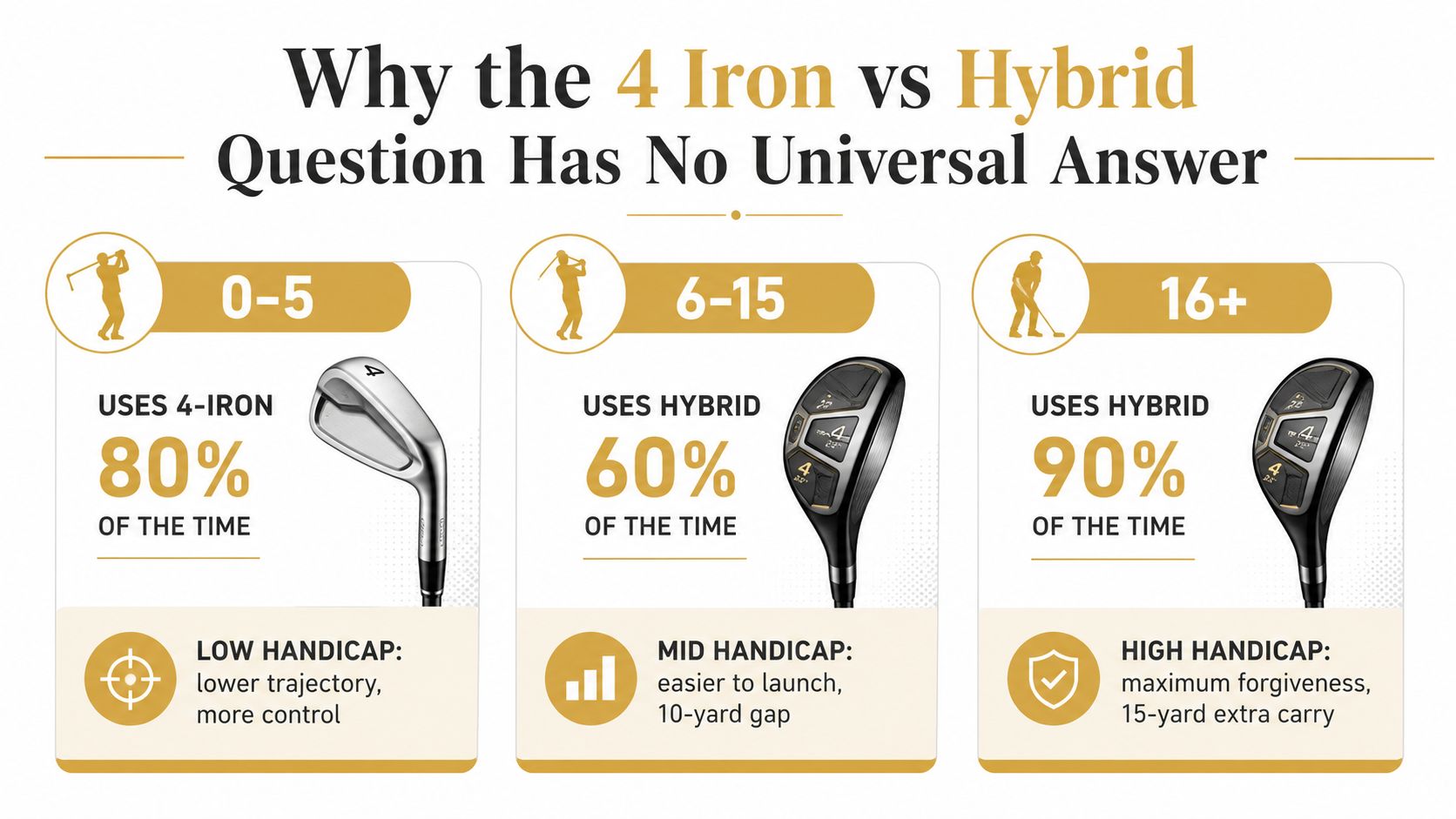
The handicap split matters more than the label
That gap tells you something most generic club advice misses. A lower-handicap player can absolutely prefer the 4-iron for tee-shot precision and still leave strokes on the table compared with the hybrid, because the hybrid's launch and carry help it recover value in other parts of the shot pattern. A mid-handicap player usually doesn't need another “player's club.” They need the club that produces the better playable shot more often.
Practical rule: if one club gives you cleaner misses and the other gives you better averages, don't guess. The average usually wins unless your course setup demands precision.
The deeper point is historical. Long irons got squeezed by a broader shift away from lower-launch, lower-spin designs and toward easier-to-launch hybrids in mainstream bag setups, especially for recreational golfers. That shift didn't happen because tradition changed. It happened because the ball flight changed.
So this isn't a debate about which club is “better” in the abstract. It's a fit question, and the final answer should come from your own launch, carry, and dispersion pattern, not from the shape of the head alone.
What Each Club Is
A 4-iron and a 4-hybrid can share a number, but they are built for different shots. The iron is the more traditional tool, with a thinner sole, a more compact profile, and a face that usually rewards a cleaner strike. The hybrid is designed to help the player get the ball airborne faster, with a deeper body and a build that biases launch and forgiveness.
Why the loft gap changes the shot
The common loft ranges explain most of the difference. Equipment-reference data puts a 4-iron around 18° to 20° loft and a 4-hybrid around 22° to 24° loft, which is enough to move the flight window meaningfully even before you factor in shaft length or head shape. That extra loft, paired with the hybrid's lower center of gravity, is why hybrids usually launch higher and land softer. Shot Scope's equipment guide makes the same broad point, and it matches what fitters see on launch monitors every day.
Why hybrids exist at all
Hybrids did not become common by accident. They became standard because many golfers struggle to launch long irons consistently, especially as club designs got longer and less forgiving in the harder-to-hit slots. Once the 4-iron became a club that demanded speed, center contact, and confident delivery, the hybrid became the practical replacement for a huge slice of the market.
A good fit is not about whether you like the look of the clubhead. It is about whether you can repeat the launch window it needs.
The 4-iron still has a place, though. Skilled players often value the flatter flight, the tighter tee-shot control, and the more iron-like response at impact. The hybrid gives up some of that in exchange for easier elevation and more playable misses. That trade-off is exactly why the decision stays player-specific. For golfers trying to compare their own launch window against a replacement club, a ball-fitter tool can also help separate raw speed from the flight conditions that make one option easier to score with.
Comparing Launch, Spin, Carry and Descent Angle
The useful question is not whether the 4 hybrid launches higher. It is how that extra launch changes scoring windows for your handicap and your miss pattern. One equipment test in the same test setup showed the 4-hybrid producing about 6 mph more ball speed, 1.6° higher launch, 1,200 rpm more spin, 13 yards more carry, and a 40° descent angle versus 32° for the 4-iron. That is a meaningful spread, because it changes both the distance gap and the way the ball behaves when it lands.
For a mid-handicap player, the bigger takeaway is not raw carry. It is whether the club gives you enough height and descent angle to hold a green from a normal approach. A shot that lands at 32° is more likely to release, especially if the green is firm or the landing area runs away. At 40°, the hybrid is much more likely to stop closer to where it first lands, which matters more than a small gain in straight-line distance.
Low-handicap players should read the same numbers differently. If you already flight a 4-iron high enough and your strike pattern is tight, the lower launch and flatter descent can be useful off the tee or into the wind. The hybrid still produces the easier launch window, but that does not automatically make it the better scoring club for a player who controls a long iron well. The decision comes down to whether your usual strike can produce enough carry and enough stopping power on the courses you play.
| Metric | 4 Iron | 4 Hybrid | Difference |
|---|---|---|---|
| Ball speed | Lower | Higher | +6 mph for the hybrid |
| Launch | Lower | Higher | +1.6° for the hybrid |
| Spin | Lower | Higher | +1,200 rpm for the hybrid |
| Carry | Shorter | Longer | +13 yards for the hybrid |
| Descent angle | 32° | 40° | Steeper landing for the hybrid |
That table is useful, but it should not be treated as a universal verdict. A player who already carries a 4-iron far enough and lands it steep enough may not gain much from the extra launch. A player whose long iron falls out of the air, or who sees the ball come off thin and weak, is usually telling you the club is asking for more speed and precision than that handicap level can provide. The gap matters most for golfers who need help turning decent contact into a playable shot, not for those who are already living near the top end of the club's flight window.
For your own setup, use a fitting process that compares launch, spin, carry, and descent together, not one number in isolation. Dialed Golf's golf ball fitter tool is a practical starting point if you want to see whether the ball or the club is driving the bigger gap in your numbers.
Turf Interaction and Rough Performance
A lot of golfers talk about “forgiveness” as if it only means mishits on the face. It also means what happens when the club meets the ground. The hybrid's wider sole and lower center of gravity let it glide through thicker grass more easily, while the 4-iron's narrower sole can dig if the strike is steep or the lie is poor.
Why rough is where the hybrid earns its keep
The rough exaggerates every weakness in a long iron. If the face comes in with too little speed, the ball can stay down. If the leading edge grabs, distance collapses. The hybrid's deeper body and launch-friendly build help it keep the ball moving upward through the grass, which is why it often preserves useful carry from lies that make a 4-iron look harsh and demanding.
Clean fairway lies are the 4-iron's best argument
The 4-iron's case is strongest when the lie is clean and the player delivers the club well. A narrower sole tends to reward precise turf interaction, and skilled golfers often prefer that sharper response because it gives them a more predictable feel through impact. On a fairway lie, the 4-iron can offer a tighter window for players who already know how to control low point and strike location.
The better club is the one that survives your normal miss, not your best swing.
That's the part many players overlook. Mid and high handicappers usually miss long irons more often, and the miss is expensive because it costs both distance and direction. If your 4-iron contact pattern is inconsistent, a prettier ball flight on the rare flushed strike doesn't matter much. The hybrid's job is to keep the miss playable.
Reading Your Own Launch-Monitor Data to Decide
Launch-monitor data removes the guesswork, but only if you know what to look at. The first number to trust is carry, because total distance can hide a poor shot pattern that gets extra roll on one strike and dies on another. After that, the important question is dispersion, not just peak ball flight.
What to compare in your session
Start by hitting your current long-iron option and the hybrid replacement in the same session. Compare carry distance, shot-to-shot consistency, launch angle, and ball speed relative to club speed. If the ball speed rises but the carry doesn't, you may be creating too much spin or too much height. If carry is fine but dispersion is wide, the club is asking too much of your delivery.
You're looking for a simple pattern.
- Low launch plus low spin: the club is too hard to raise, so the long shot leaks value.
- Good carry plus wide dispersion: the club may be playable, but not repeatable enough.
- Solid height and tight windows: you've found the better fit, even if your eyes prefer the other club.
Check the gaps around it
A good decision also depends on what the club does to the rest of the bag. If a 4-hybrid overlaps too closely with a 3-iron or a 5-wood, the answer may not be “hybrid or iron.” It may be “rebuild the top end.” Use a carry-distance chart to see whether the club fills a real window or just adds another number with no practical separation.

A useful launch-monitor session should leave you with one clean conclusion. Either the 4-iron gives you the flight you can repeat, or the hybrid does a better job of turning your swing into a playable shot.
The Third Option Most Comparisons Skip
The comparison often isn't 4-iron vs 4-hybrid. It's 4-iron vs 4-hybrid vs 7-wood. That's becoming more relevant because a lot of golfers care less about traditional iron-style control and more about peak height, landing angle, and rough performance. Independent equipment coverage increasingly frames the decision that way, especially for players who struggle to hit longer clubs and want a club that stops faster.
When a 7-wood is the best answer
A 7-wood makes sense when you want the easiest launch and the softest landing of the three. If your long-game issue is not just distance but getting the ball high enough to hold a green, the 7-wood can solve the problem more cleanly than a 4-hybrid. It can also be the better rough club for golfers who need help popping the ball up quickly.
When it creates a new problem
The downside is gapping. A 7-wood can overlap too much with a 3-wood or a strong hybrid, depending on how the rest of the bag is built. It can also give you so much height that tee-shot control becomes less appealing than with a 4-iron, especially for players who use the slot as a positional club.
If you already launch a 4-hybrid well, the more honest question is not whether the hybrid works. It's whether a 7-wood would give you better long-approach performance without creating a messy overlap above or below it. That's a bag-construction problem, not a brand-loyalty problem.
Why this matters for modern fit decisions
The old binary comparison misses the point. Modern players are choosing among clubs that solve slightly different problems, and the best replacement club is often the one that fills the most useful shot window. A 4-iron is about precision. A hybrid is about playable launch. A 7-wood is about height and stopping power.
Situational Recommendations and a Decision Tree
The easiest way to choose is to stop asking which club is “better” and ask which club survives your normal game. A low-handicap ball striker can absolutely prefer the 4-iron if the launch window is stable and the tee-shot control matters more than extra carry. Mid-handicap golfers usually get more value from the 4-hybrid, especially when long-iron contact is inconsistent or the bag needs a better gap-filler.
Who should lean where
- Low-handicap players: choose the 4-iron if you can control launch and you want a flatter flight for tee shots and windy conditions.
- Mid-handicap players: choose the 4-hybrid if you need easier launch, better carry, and more reliable scoring shots from fairway or light rough.
- High-handicap players: choose the 4-hybrid by default, because forgiveness and launch usually matter more than traditional iron control.
- Slower-swing-speed golfers and seniors: choose the 4-hybrid unless your launch-monitor data proves the 4-iron is still getting up in the air.
Decision rule: if your carry is short of the window you need and your dispersion is wide, the hybrid wins. If you strike the long iron cleanly, launch it high enough, and the top of your bag already gaps properly, the 4-iron stays in play.
The 7-wood is the tiebreaker for golfers who still can't hold greens from long range. It's not a novelty club. It's a real answer when the problem is height, not just forgiveness. If the 4-hybrid launches well but still doesn't stop fast enough, the 7-wood deserves a look before you force the 4-iron into the bag.
Use a proper bag check before you decide. A golf bag gap analyzer will show whether the slot is open, whether another club is crowding it, and whether the best answer is a different loft instead of a different head.
Common Questions About Choosing Between a 4 Iron and 4 Hybrid
Does a 4-hybrid replace a 5-wood?
Sometimes, but not always. A 4-hybrid can sit below a 5-wood in the bag, yet the right answer depends on your launch windows and whether the clubs overlap too much. If both clubs go the same distance, the bag is not gapped well.
How often should I retest the decision?
Retest whenever your swing speed, strike pattern, or shaft setup changes enough to affect carry and launch. A club that worked last season can stop working if your delivery changes, so the numbers should be checked again when the pattern shifts.
Do shaft differences matter this much?
Yes, because the shaft affects launch, feel, and how consistently you return the head. A 4-hybrid with the wrong shaft can launch too high or fall out of the air, while a 4-iron with the wrong shaft can feel harsh and difficult to load.
Does a players-style 4-iron change the answer?
It can, but only if you already strike it well. A forged or players-style head may feel better and look better to skilled golfers, yet it still has to produce a playable launch and carry window. Shape is not a substitute for fit.
If you want a cleaner answer than guesswork, test your current top-end clubs and compare the shot windows side by side. Dialed Golf gives you the launch, carry, and gap structure to make the call with confidence, not habit. Visit Dialed Golf and use the data to decide whether the next club in your bag should be a 4-iron, a 4-hybrid, or the better-fitting third option.