


Approximately 73% of U.S. golf courses were open to public play at the end of 2023, according to the National Golf Foundation's facilities report, roughly 11,650 public courses within a national supply of 15,963 courses at 13,963 facilities. Public golf isn't a small alternative to private membership. It's the main route onto the course, although an open door doesn't always mean an affordable, convenient tee time.
Table of Contents
- What Makes a Golf Course Public
- Who Can Play and How to Book a Tee Time
- How to Confirm a Course Is Open to the Public
- How Municipal, Daily-Fee and Resort Courses Differ
- Hidden Costs and Access Friction at Public Courses
- A Minnesota Example
- Pick the Public Course That Fits Your Next Round
What Makes a Golf Course Public
A public golf course allows golfers to book and play without club membership. A tee time is a reserved starting time, and the green fee is the charge for playing the course.
Access describes who can book; it says nothing about conditioning or prestige. A public course may have a challenging layout, well-kept greens and a high green fee. A private club may be more modest in its facilities.
Who can play each type of golf course
| Course type | Who can play | How tee times are booked | Membership needed |
|---|---|---|---|
| Public daily-fee | Anyone who pays the green fee | Online, by phone or at the pro shop; walk-up availability may vary | No |
| Municipal | Anyone, with resident rates in many cities | Online booking, sometimes with resident-only early windows | No |
| Resort | Hotel guests and public players accepted under the resort's access policy | Through the resort booking system, often at higher peak prices | No, though lodging requirements should be checked |
| Semi-private | Public players alongside members | Public booking channels, with members usually receiving priority | No for public slots; optional membership provides additional privileges |
| Private club | Members and their invited guests | Member booking or the club's guest procedure | Yes for independent access; invited guests follow guest rules |
Semi-private usually means a course sells memberships while also accepting public bookings. A membership offer on a course's website, by itself, does not determine whether public tee times are available.
A course called a “country club” may also sell public tee times. Check the booking rules, not just the name. For example, a daily-fee course may let anyone reserve an available time, while a private club may require a member to arrange guest access.
Practical rule: Public status tells you who may book; the course's rules determine which times are available and under what conditions.
The question behind a golf course public access search is straightforward: Can nonmembers book a tee time without a member's invitation? That answer establishes whether public access is offered.###
Who Can Play and How to Book a Tee Time
Public facilities accounted for about four of every five U.S. golf rounds, according to the National Golf Foundation's July 2025 rounds report. Understanding the booking process therefore matters far beyond the occasional vacation round.
At most public courses, a golfer doesn't need a sponsor or handicap certificate for ordinary recreational play. A handicap measures playing ability for scoring and competition purposes; it isn't normally an admission ticket. A tournament or particular venue may impose additional requirements, so event entry shouldn't be confused with routine public booking.
Follow the booking route
The usual starting point is the course's online tee sheet, a calendar of available starting times. The course releases inventory according to its booking window, which is the period during which advance reservations are permitted.
Phone booking helps when the website doesn't explain availability, particularly for weekend mornings, single players or rental clubs. Calling doesn't necessarily reveal extra times, but staff can explain whether an empty screen means sold-out inventory, unreleased times or a reserved event.
Walk-up play is less predictable. The pro shop may fit a golfer into an opening or an incomplete group, but arriving without a reservation isn't a reliable plan for a busy period.
Understand priority before choosing a time
Municipal courses may offer residents lower prices or earlier booking access. Resorts may prioritize overnight guests, while semi-private facilities may release member reservations before public inventory.
Prime weekend slots attract golfers with similar schedules. The scarce resource can therefore be a suitable starting time, even when the course welcomes everyone.
The main booking traps appear in a predictable order:
- Early-access windows: Members, residents or hotel guests may reserve before the general public.
- Cancellation and no-show charges: A booking may carry a financial obligation even when payment isn't collected immediately.
- Twilight cutoffs: A discounted late start may leave insufficient daylight to finish the intended round.
A reservation confirms a starting time, not a promise that every preferred condition comes with it.
The confirmation should identify the date, starting time, player count and applicable rate. Any uncertainty about carts, rentals or arrival requirements belongs in a conversation with the pro shop before payment.
How to Confirm a Course Is Open to the Public
A directory can describe a course as public while its current booking rules permit something narrower. Ownership changes, seasonal arrangements and member-priority periods can make a broad listing less useful than the course's own reservation terms.
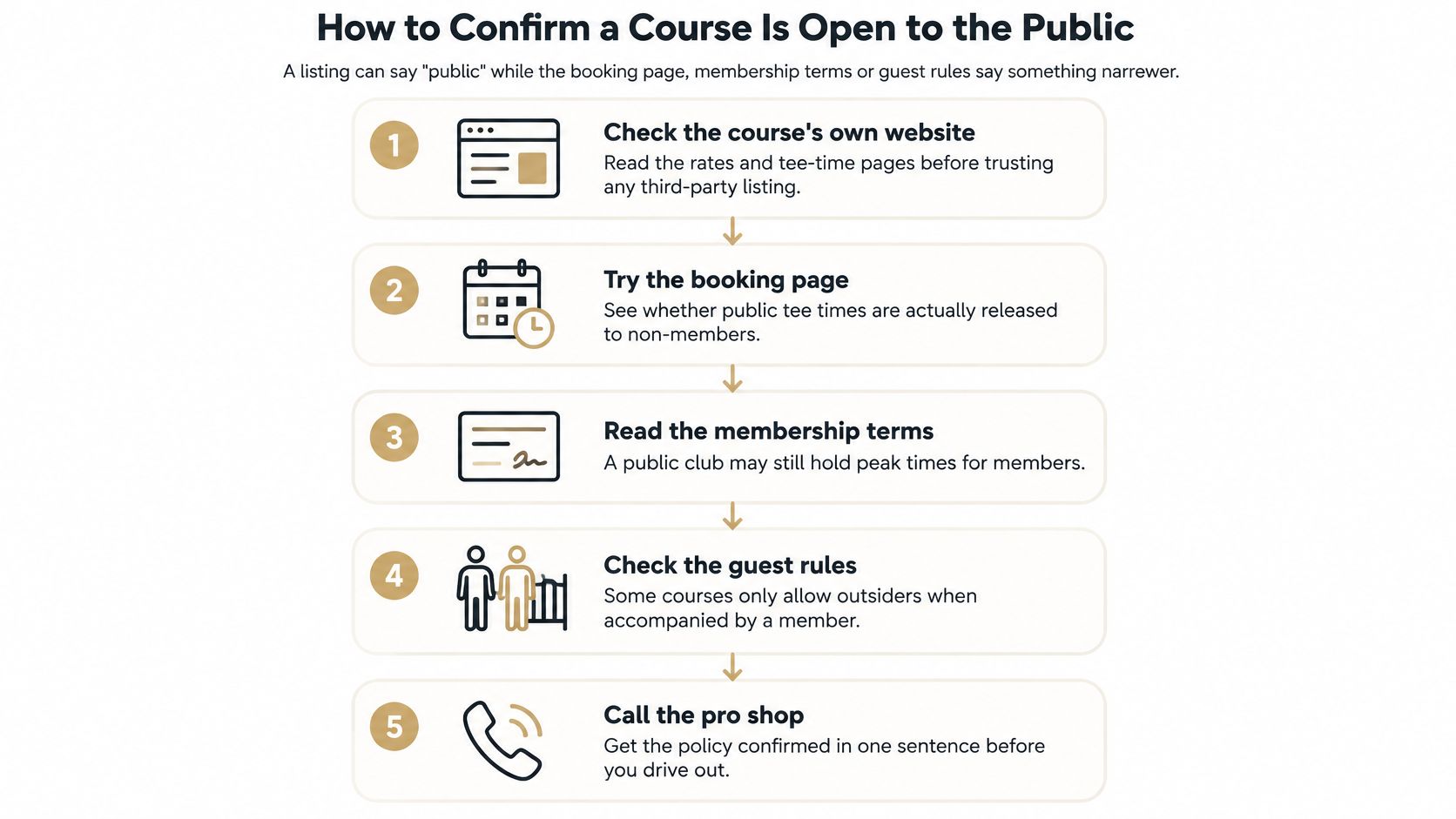
The verification process starts with the operator and ends with a bookable round. This visual summarizes the core checks.
Check the policy against the actual booking
Read the course's own website. Look for explicit public-access language on the golf, rates and reservations pages. A general welcome on the restaurant page doesn't establish permission to play golf.
Open the booking page without a member login. Look for a guest booking route and public rates attached to available times. An account-registration requirement may identify customers, whereas a member-number requirement deserves clarification.
Read membership terms and guest rules together. Check for sponsor requirements, guest-day limits and member-only periods. Public memberships can be optional, but an outsider's booking route should remain identifiable.
Call the pro shop with a specific proposed visit. Ask whether a nonmember can reserve that day and time, what the complete playing charge includes and whether residency documentation is required. A precise question gets a more useful answer than asking only whether the course is public.
Check restrictions on days, hours and groups. League play, outings and maintenance can remove otherwise public inventory. A course might welcome public golfers generally but have no suitable opening during the planned visit.
Confirm walking and cart rules. Ask whether walking is allowed for that reservation and whether a cart charge is mandatory. A walking rate shown elsewhere on the website may not apply to the selected time.
Resolve conflicting answers before traveling
Suppose a listing says public, the website advertises memberships, and the booking page demands an account. None of those details alone settles access. The decisive point is whether a nonmember can complete a legitimate reservation under the published rules.
A screenshot of the rate and the booking confirmation can help resolve a misunderstanding at check-in. It's also sensible to record any staff-confirmed exception in the reservation notes rather than relying on an informal assumption.
A confirmed answer has recognizable parts: a public tee time, a posted or directly confirmed green fee, and no undisclosed member-guest restriction. If staff can't explain those terms clearly, another course may offer a less uncertain outing.
How Municipal, Daily-Fee and Resort Courses Differ
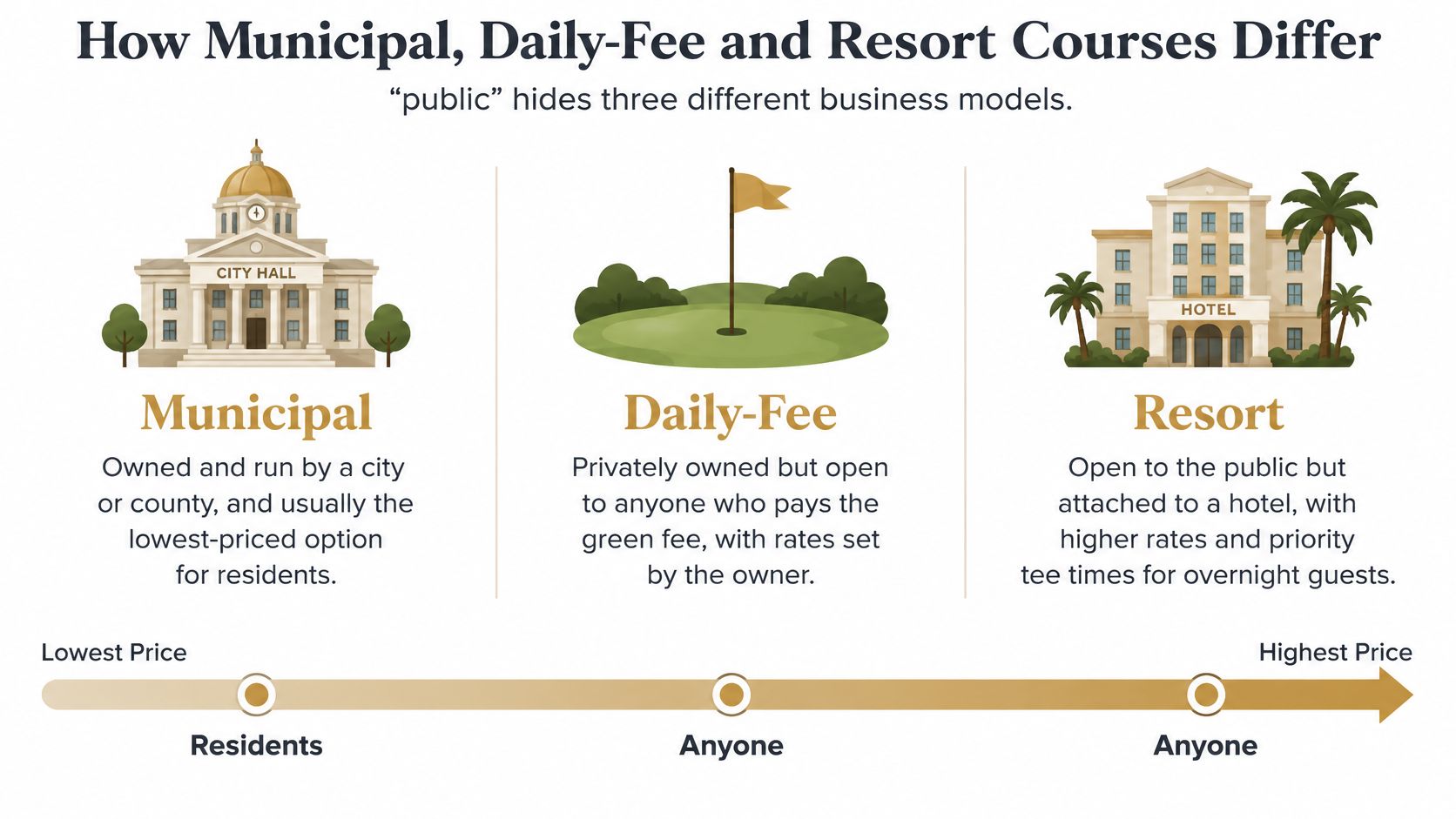
A public course can be run by a city, a private owner or a resort business. The operating model shapes who can play, how the course is funded and what the price includes. The image compares these three models at a glance.
Compare ownership with what the golfer receives
Municipal courses belong to a public body, such as a city or county. The municipality may operate the facility itself or appoint a management company. Their public role can shape decisions about upkeep and investment, so judge the course by the conditions and facilities you plan to use.
Daily-fee courses are privately owned businesses that sell rounds individually. Owners set rates based on the facility, location and booking period. Compare the charge with practical benefits such as practice space, course conditions and a booking process that fits your schedule.
Resort courses are connected to a lodging business. Some welcome outside golfers, while others prioritize hotel guests or limit public access. Read package terms closely: lodging, golf, carts and other charges may be grouped together.
According to LINKS Magazine's account of municipal golf revitalization, since 2006, municipally owned and operated golf increased 7%, while daily-fee public courses declined 18% and private clubs declined 12%. For golfers, that shift suggests municipal courses have become a larger part of the supply, while fewer daily-fee options may leave less choice in some areas.
Course types compared on trend, price and watch-outs
| Course type | Change since 2006 | Price pattern | Main watch-out |
|---|---|---|---|
| Municipal | About +7% | Typically lower public green fees, especially for residents | Maintenance and capital needs can affect course conditions |
| Daily-fee public | About -18% | Owner-set rates by region, quality and starting time | Fewer nearby options can make preferred times harder to find |
| Resort | No trend figure available | Often higher, sometimes bundled with lodging | Package pricing can obscure the golf charge |
| Private club | About -12% | Membership dues and possible joining fees, plus applicable playing charges | Access generally depends on membership |
The table shows why ownership is only part of the decision. A lower rate may suit a golfer who values affordability, while another may prefer a resort package or a daily-fee course with facilities they will use. Compare the full price and the access each model offers for the round you want to play.
Hidden Costs and Access Friction at Public Courses
A low green fee can still lead to an expensive or awkward round. Compare the full cost of playing with how easily you can book, arrive, warm up and keep a comfortable pace.
Club + Resort Business's reporting on municipal facilities describes pressures that can affect a golfer's experience, including aging infrastructure, staffing demands and limits on capital investment. These pressures may show up as fewer amenities, maintenance disruptions or service delays.
Build the complete round budget
Treat the green fee as the starting point, not the final total. Add any required cart charge, then consider optional costs such as range balls, rental clubs, food or a lesson.
Separate required charges from choices. A mandatory cart belongs in the core comparison; an optional meal does not. If you plan to take a lesson, confirm whether it includes a separate tee-time reservation.
Score access in the order it happens
Use this access score to compare courses. Rate each criterion from 1 to 5 across three visits, with higher scores meaning a better fit, then compare totals.
- Price band: Compare complete weekday and weekend charges for the times you can realistically play.
- Booking lead time: Judge whether you can reserve a suitable time without an impractical routine or special status.
- Beginner-friendly layout: Look for forward tees, manageable carries and a shorter route.
- Practice capacity: Check whether the range and short-game areas have usable space before your round.
- Walking policy: Confirm that walking is allowed, consider the terrain and compare its cost with riding.
- Arrival access: Consider parking, transit connections and the distance from arrival point to check-in.
- Expected pace: Check how staff guide play, how often groups wait and whether you can keep up comfortably.
Add brief notes to explain the scores. A low practice score caused by a temporary closure means something different from a warm-up area that is consistently overcrowded.
Value test: A higher green fee may be worthwhile if you can book reliably, prepare comfortably and finish without avoidable delays.
For course condition, ask whether the greens were rolled or aerated in the past week and whether any holes are closed. Then consider whether landing areas are playable and maintenance disruptions are communicated. Predictable access and a suitable pace can matter more over repeated rounds than the cheapest advertised fee.
A Minnesota Example
Consider a golfer who moves to Minnesota and wants an affordable place to learn without feeling hurried. The immediate problem isn't finding an impressive course photograph. It's choosing a facility that fits a work schedule, a beginner's pace and a realistic practice routine.
The Minnesota Golf Association reported that public daily-fee facilities recorded 861,146 rounds in 2025, up 2.4% from 841,053 rounds in 2024. Those figures describe activity in the reported category, not a guarantee of open reservations in every town.
Minnesota's scenery can make the choice appealing, but the practical comparison still belongs at the booking desk and practice area.

An illustrative comparison, not a course ranking
Suppose the newcomer considers a municipal course and a privately owned daily-fee course in the same town. These are hypothetical facilities, and the scores below demonstrate the comparison method rather than describe real businesses.
The municipal course offers a resident discount, comfortable walking and nearby parking. Its clubhouse looks dated, but the playing surfaces are serviceable. The main drawbacks are crowded weekend reservations and a small warm-up area.
The daily-fee course costs more, but the golfer finds suitable reservations more easily. Its larger practice area supports an unhurried warm-up, and staff explain suitable tees and pace expectations clearly.
Compare results against the actual schedule
In this hypothetical scoring example, the municipal course earns 29 out of 40: strong marks for price, walking and arrival, but weaker marks for booking and practice capacity. The daily-fee course earns 33 out of 40, giving up points on price while doing better on reservation convenience, preparation space and pace.
The higher total isn't an automatic instruction to spend more. If the newcomer can play quiet weekday periods, the municipal option may fit perfectly. If weekend mornings are the only realistic opportunity, the daily-fee course may justify its premium.
An aging clubhouse needn't disqualify an otherwise useful course. Equally, a large practice facility has little value to someone who never has time to use it.
The best public course is the one that matches the golfer's budget, availability, pace and practice needs. The comparison becomes useful when those priorities remain consistent across visits.
Pick the Public Course That Fits Your Next Round
A first-time golfer on a tight budget may value a municipal course's resident rate, forward tees and practice space. A visitor may find a resort course convenient, but should compare its full package charge with the cost and access at nearby daily-fee courses. Match the course to the round you can book and afford.
For golfers who track their play, a course that is easy to revisit can make it simpler to compare rounds over time. The best fit depends on which access model suits your plans, not just the posted green fee.
Prepare without using extra course time
Dialed Golf's desktop app lets one golfer pair a launch monitor or import a practice session, then review the captured shots in one locker. The app shows trends in carry, total distance, ball speed, spin, launch and club speed, which can help a golfer review practice before a planned round.
Dialed Golf also offers seven free golf tools that work without an account. The Carry Distance Chart Generator creates a printable reference for trusted clubs, while the Golf Bag Gap Analyzer spots overlaps and missing yardages. Before your next round, use Dialed Golf's free golf tools to prepare.