

A drilling team can have a sound geological target, a competent rig, and a carefully prepared program, yet still lose control of the well because the planning logic was fragmented. An offset report sits in one file, the pressure model in another, casing assumptions in a spreadsheet, and the response plan exists mainly in people's memory. The practical question is not whether the team has enough information. It's whether the information connects subsurface objectives, well design, equipment limits, field execution, and post-well learning.
That's why Steve Devereux's Practical Well Planning and Drilling Manual still deserves attention. Published by PennWell in 1998, the 522-page hardcover reference was built around the complete path from well planning to wellsite operations and reference information. Its value today isn't that it supplies a universal recipe. Its value is that it frames drilling as an integrated engineering and execution discipline, while modern teams must add data governance, human validation, and explicit controls for conditions the original workflow could not anticipate.
Table of Contents
- Understanding the Foundation of Well Planning
- Navigating the Three-Part Operational Workflow
- Establishing Well Integrity and Control Early
- Engineering Casing and Cementing Programs
- Bridging Traditional Manuals with Digital Workflows
- Adapting Planning for Extreme Operating Environments
- Implementing a Traceable Planning Checklist
- Future Directions for Drilling Engineering References
Understanding the Foundation of Well Planning
A well program is tested long before the bit reaches bottom. Engineers must turn an uncertain subsurface objective into a construction sequence that the rig, people, equipment, and barriers can execute. That requires more than selecting a trajectory or copying a successful offset. It requires a connected chain of assumptions, calculations, decisions, and verification points.
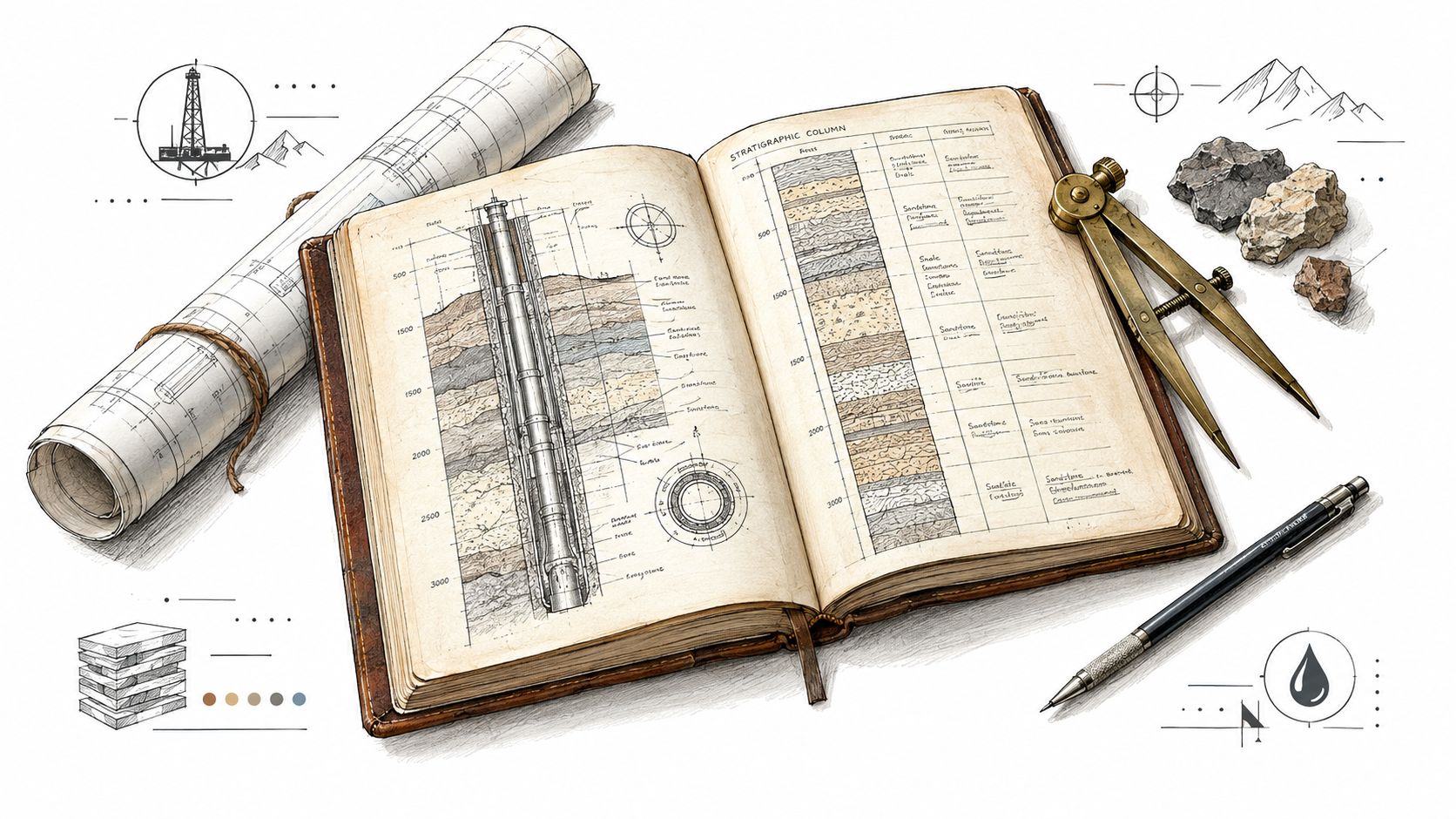
Devereux's manual was published by PennWell in 1998 and carries ISBN 0-87814-696-2, with the 13-digit ISBN 978-0-87814-696-3. Its scale matters. A 522-page professional reference is not a short introduction to rig work. It reflects the breadth of information a drilling engineer needs to design a well and prepare its drilling program. The manual's catalog record identifies its hardcover format, publication details, and organization.
Why the historical structure still works
The manual appeared during a late twentieth-century transition toward more systematic engineering design, planning documentation, and technical reference data. Established field practices remained essential, but drilling programs increasingly had to make the logic behind those practices visible and repeatable.
That context explains why the manual remains useful. It doesn't treat drilling as an isolated rig activity. It connects the subsurface target to well construction, then connects construction to field execution. Modern digital systems should preserve that logic rather than replace it with disconnected dashboards or automated recommendations.
Practical rule: A planning document earns trust when every important operational instruction can be traced back to a design assumption, a known limitation, or a defined risk response.
The modern gap is that historical planning logic often lives separately from live operational data. Offset wells may contain valuable lessons, but inconsistent naming, incomplete reports, and undocumented changes can make those lessons difficult to apply. A current practical well planning and drilling manual must therefore combine engineering fundamentals with disciplined data handling. The technology helps only when engineers can identify which data is reliable, which is uncertain, and who owns the final decision.
Navigating the Three-Part Operational Workflow
The manual's three divisions create a practical sequence: well planning, wellsite operations, and reference information. Engineers can use that structure as a working control loop, not just as a table of contents.
Begin with construction design
The well-planning portion answers the design questions before the rig begins work. What is the subsurface objective? Which trajectory reaches it? Where should casing seats be placed? What pressure assumptions govern each hole section? Which equipment and fluids can operate inside the expected envelope?
The useful output isn't a collection of calculations. It's a coherent program in which trajectory, casing, mud, hydraulics, cementing, drillstring design, and contingency actions support one another. If a proposed casing shoe doesn't tolerate the next section's pressure and circulation loads, the trajectory may be elegant but the well plan is not solid.
Convert design into field execution
The wellsite operations portion translates engineering intent into actions that crews can perform and supervisors can verify. It should define operating limits, testing requirements, reporting expectations, and responses to deviations. A program that says “monitor returns” without defining the detection criteria, responsible person, and escalation path is incomplete.
Field execution also exposes assumptions that office work can conceal. Formation behavior may differ from the model. Equipment performance may narrow the operating window. A good program gives the rig team enough structure to respond without forcing them to improvise the entire decision process.
Use reference information deliberately
Reference data is most useful when it supports a live decision. Engineers may consult technical properties, equipment limits, pressure relationships, fluid behavior, or calculation methods while reviewing a deviation or validating a contingency. The reference section should support judgment, not encourage copying values without checking their applicability.
The historical development of drilling shows why this workflow matters. Drake's 1859 well in the United States reached approximately 65 feet and produced about 2,000 barrels of oil during its first year, while rotary methods later became central to petroleum development. By 1914, rotary drilling was used for roughly 10% of U.S. oil wells, and Spindletop's rotary-drilled discovery well is commonly treated as a milestone in the modern petroleum industry. These historical facts are summarized in the Society of Petroleum Engineers catalog material.
The lesson is operational: planning, execution, and technical reference must remain connected. Separating them creates handoff risk.
Establishing Well Integrity and Control Early
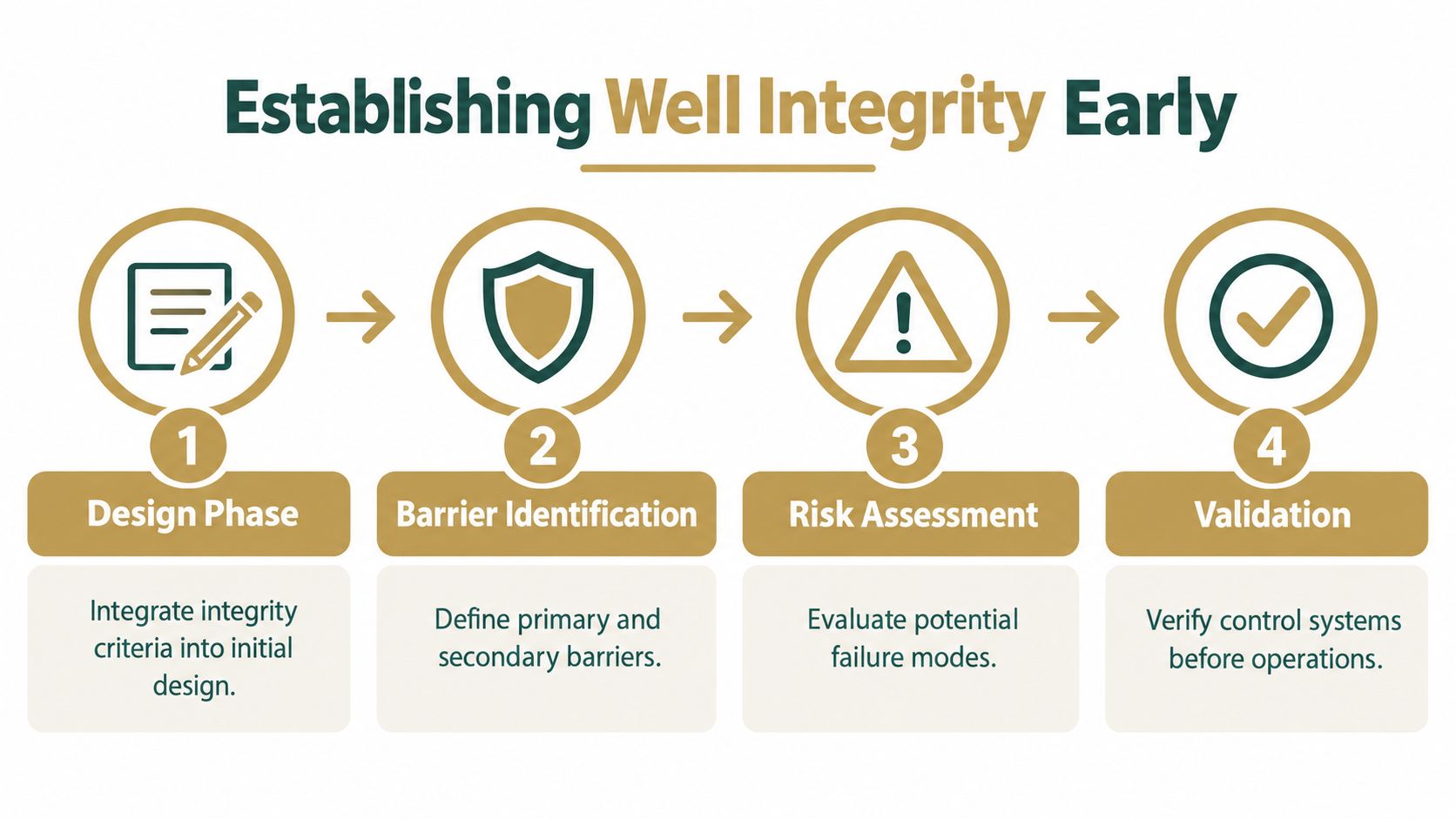
Well integrity isn't a response package reserved for the rig floor. It begins with the design basis. Before drilling starts, the team should know which assumptions define the pressure window, which barriers protect the well, how influx will be detected, and what happens when equipment or formation behavior invalidates the original plan.
The IADC Deepwater Well Control Guidelines organize the planning logic around operational risk management, well integrity, well planning and rig operations, equipment, well-control procedures, training and drills, and emergency response. That structure is useful beyond deepwater work because it forces the program to connect design, barriers, equipment, people, and response.
Build the pressure and barrier basis
The pressure model should document pore-pressure and fracture-gradient assumptions for each hole section. From that basis, the engineer can define casing-seat selection, kick tolerance, mud-weight operating windows, expected surge and swab effects, and the pressure limits of the planned equipment.
A barrier diagram then turns the design into a control picture. It should identify primary and secondary barriers, their verification methods, their failure modes, and the actions required if either barrier degrades. BOP and diverter configuration, shut-in responsibilities, influx-detection criteria, and escalation actions belong in the same planning system.
Validate before the well creates pressure
Formal risk assessment should test foreseeable events rather than merely confirm that a checklist exists. Losses, kicks, shallow flows, dynamic-pressure changes, ballooning, delayed influx detection, and degraded equipment each require a defined recognition and response path.
Competency-based drills matter because a written procedure doesn't prove that responsibilities are understood. The team should rehearse who calls the event, who monitors pressures, who operates equipment, who communicates with shore or the operator, and who has authority to escalate. In narrow-margin or deepwater wells, riser and choke limitations, temperature effects, ballooning, and delayed influx detection can reduce the usable pressure window.
Barrier discipline: If the program can't explain how a barrier is created, tested, monitored, and restored, the barrier exists on paper only.
The strongest plans connect each hole section to its pressure model, barriers, equipment limitations, operating envelope, verification tests, and contingency decision points. That systems approach is more reliable than a drilling sequence written as isolated instructions.
Engineering Casing and Cementing Programs
Casing and cementing are pressure-isolation systems. Treating them as mechanical construction steps misses their role in preventing formation communication, protecting the wellbore, and preserving barriers throughout drilling and later operations.
U.S. offshore requirements provide a useful benchmark. Wells must be cased and cemented, and programs must control formation pressures and fluids while preventing direct or indirect fluid release through the wellbore into offshore waters. For specified casing sections, cement behind the bottom 500 feet must reach at least 500 psi compressive strength before drilling out or beginning completion work. These requirements are described in the U.S. offshore regulatory benchmark.
Design the cement job around the barrier
The cementing program should begin with compatibility and placement, not with a standard slurry copied from another well. The engineering review should cover:
- Slurry compatibility: Confirm that cement, mud, spacer, and formation fluids can coexist without damaging placement or strength development.
- Density and rheology: Keep the designed fluid properties within the pressure window while maintaining displacement and placement performance.
- Fluid-loss control: Limit unwanted filtrate loss that could impair placement or alter the surrounding formation response.
- Spacer effectiveness: Verify that the spacer can separate mud from cement and clean the intended surfaces.
- Centralization: Support effective annular coverage rather than assuming pipe position is adequate.
- Placement rate: Check that the planned rate supports displacement without exceeding fracture or equipment limits.
- Displacement volume: Reconcile calculated and actual volumes, including uncertainty and operational contingencies.
Wait-on-cement time, pressure tests, and evaluation of returns or cement placement complete the verification chain. A job isn't finished because the calculated volume was pumped. The team needs evidence that the intended isolation exists and that the next operation won't compromise it.
Check the shoe against the next section
The casing shoe must withstand the next hole section's expected pressure, including the selected safety margin and anticipated surge, swab, and kick loads. The design should also account for equivalent circulating density and the possibility that operational conditions differ from the static model.
A practical review therefore asks two separate questions. Can the casing and cement isolate the formations? Can the shoe and surrounding formation tolerate what the next section will impose? The first protects pressure isolation. The second protects the ability to continue drilling.
Casing design becomes a well-control decision here. Extra casing may add cost and complexity, but an underdesigned shoe can remove the pressure margin needed to manage losses or influx safely.
Bridging Traditional Manuals with Digital Workflows
A drilling program can look complete while its key assumptions rest on mismatched offset records, outdated interpretations, or decisions that no one can trace. Traditional manuals provide sound calculations and checklists, but digital operations require a controlled way to connect those foundations with live data, regulatory requirements, and field decisions.
The NSTA technology insight on well drilling and construction describes the shift toward digital planning environments that combine data and engineering science for well construction. It also discusses intervention databases designed to capture performance indicators and operating practices with less manual entry. These systems reduce fragmentation. They do not replace the engineer who judges whether an offset is comparable or whether a recommendation fits the current well.
The practical challenge is that historical planning logic often sits apart from live operational data. Offset wells can contain useful lessons, yet inconsistent naming, incomplete reports, and undocumented changes make those lessons difficult to apply. A modern practical well planning and drilling manual must connect engineering fundamentals with disciplined data handling, a standard that established manuals anticipated before digital workflows existed.
Build a workflow, not another dashboard
An integrated process should connect four activities:
- Offset review, including source quality, missing fields, interpretation limits, and criteria for comparable wells.
- Trajectory selection, tied to geological objectives, anti-collision limits, drilling mechanics, and completion needs.
- Execution monitoring, comparing live deviations with the assumptions used to build the program.
- Post-well learning, recording events, costs, performance, and failures in a format the next team can apply.
The difficult work occurs between these stages. Engineers clean historical records, reconcile conflicting identifiers, rank uncertainty, and record why a decision changed. A polished recommendation built on poor inputs only creates confidence without control.
Set governance before using AI
AI is moving from trials into operational use. ADNOC's deployment of an AI-enabled real-time operations platform across more than 120 drilling rigs was reported in the ADNOC Technology Review, Q3 2025, covering offset-well review and risk identification.
The engineering question is what data quality, human review, governance, and failure controls must exist before an AI-generated offset analysis or well plan can support a decision.
A digital recommendation should show its source data, uncertainty, assumptions, reviewer, and approval history.
That record protects the operation when someone challenges the recommendation. Human validation is the control that keeps automation assistive rather than allowing it to become an unaccountable decision maker.
Adapting Planning for Extreme Operating Environments
A casing program that works in a conventional well can fail quickly when temperature, pressure, fluids, or logistics move beyond its qualification basis. High temperature can damage tools and elastomers. Corrosive fluids can shorten equipment life. Uncertain material behavior, limited water, and abnormal-pressure mud requirements can also invalidate assumptions that looked sound during office design.
Superhot-rock research identifies well construction as a common failure point because of extreme temperatures and pressures, temperature variation, corrosive hydrothermal conditions, poorly characterized materials, and limited high-temperature stimulation tools. The research paper on superhot-rock well construction highlights a limitation in conventional manuals: they often present casing, cementing, drilling fluids, and integrity design as established procedures without defining when those procedures cease to apply.
Define the boundary of applicability
Before selecting a standard design, identify the conditions that could exceed its qualification basis. Check tool and elastomer temperature limits, cement behavior through the expected thermal cycle, corrosion compatibility, drilling-fluid stability, measurement reliability, and the ability to verify barriers after exposure.
A scenario-based decision tree gives the team more control than a single standard case. For each major uncertainty, record the expected condition, the threshold that requires redesign, the evidence needed to proceed, and the person authorized to approve the change. Conventional procedures become unreliable when the operating envelope changes. A practical well planning and drilling manual must therefore define boundary conditions before applying standard designs to extreme environments.
Surface and environmental constraints deserve the same treatment. A 2025 Dallas Fed Survey of Business Uncertainty found that 42% of Permian executives expected produced-water management to slightly constrain drilling and completion activity over the next five years, while 32% expected a significant constraint, according to the Federal Reserve Bank of Dallas, 2025 Survey Results. Abnormal-pressure mud design can also force extra casing and materially increase drilling cost.
Balance integrity against logistics
Water availability, waste handling, regulatory exposure, and transport capacity can change the technically preferred plan. Extra casing may improve pressure control, yet increase material, cement, and execution demands. A heavier mud system may protect the wellbore while increasing losses, treatment requirements, or disposal complexity.
Record these trade-offs in the program. State which risks are acceptable, which require additional qualification, and which conditions trigger suspension or redesign. Digital models can compare scenarios, but experienced engineers still need to validate the assumptions, approve changes, and preserve an auditable decision record.
The visual below reinforces the need to connect planning assumptions with field conditions rather than treating the rig as a place where the design is merely executed.
Implementing a Traceable Planning Checklist
A checklist earns its place at the rig when it exposes weak assumptions before they become decisions. It should be brief enough to use under pressure, while preserving the engineering logic behind each approval. Its purpose is to make omissions, uncertainty, and ownership visible.
Established manuals provide a useful sequence: define the pressure basis, select the well architecture, verify barriers, and release each hole section only after the evidence is acceptable. Digital workflows can accelerate that sequence, but they cannot decide whether an input is comparable, stale, or poorly governed. Human review remains part of the control system.
Start with data quality and ownership
Classify each important input by source, age, completeness, and relevance to the planned interval. A simple scoring matrix can label data as verified, usable with limitations, or unsuitable for design. Record the reason for every lower score. This prevents a clean-looking model from hiding weak pressure, trajectory, or geological evidence.
Assign an accountable owner for the pressure basis, trajectory, casing seats, cement design, equipment limits, barrier status, and contingency decisions. The owner must approve the input, define its uncertainty, and state what would invalidate it. An unowned assumption is likely to survive unnoticed into execution.
Use the program as a decision record
The working checklist should include:
- Pressure basis: Record sources, uncertainty, fracture limits, and the acceptance criteria for updating the model.
- Trajectory design: Confirm targets, anti-collision limits, torque and drag, hydraulics, and completion requirements.
- Casing design: Verify shoe integrity, loads, pressure margins, and the next section's contingency options.
- Cement verification: Confirm compatibility, centralization, placement requirements, wait-on-cement time, testing, and isolation evidence.
- Barrier release: State test criteria, responsible signatory, escalation route, and conditions that stop progression.
- Execution limits: Record equipment ratings, operating envelopes, crew interfaces, and approval levels for changes.
The checklist should distinguish rig-level actions from changes requiring engineering, management, or regulatory approval. Each revision needs a reason, owner, timestamp, and reference to the affected assumption. This creates traceability without turning the program into paperwork detached from operations.
Before release, a reviewer should be able to separate measured fact, modeled assumption, engineering interpretation, and approved decision. If those categories blur, the well plan still has a governance gap.
Future Directions for Drilling Engineering References
Future drilling references should retain the disciplined logic of established manuals while showing engineers how to work with connected data, uncertainty, automation, and organizational risk. Their value will come from linking each digital output to its source, its limits, and the human decision required before operations change.
A useful manual should show how to rank uncertainty, test its effect on the design, and assign responsibility for the decision. It should include worked cases where offset records are incomplete, live data conflicts with the original model, and the team must choose whether to continue, redesign, or suspend operations. Future manuals should also include uncertainty-ranking worksheets adapted from API RP 59, Guidelines for Well Planning and Drilling Risk Assessment, to structure confidence assessments for offset data.
Use a decision matrix, not a technology slogan
A planning matrix makes the evidence gap visible before a software recommendation becomes an operational instruction.
| Planning question | Evidence required | Action when confidence is low |
|---|---|---|
| Is the subsurface basis comparable? | Offset quality, pressure evidence, geological context, and known gaps | Obtain additional data or widen the uncertainty range |
| Can the design be executed? | Equipment limits, hydraulics, trajectory analysis, and crew capability | Modify the design or add a verified contingency |
| Can barriers be demonstrated? | Barrier diagrams, test criteria, monitoring requirements, and response ownership | Stop progression until verification is complete |
| Can the decision be audited? | Source records, assumptions, reviewer, approval, and change history | Preserve the decision trail before execution |
The matrix keeps digital systems in a supporting role. Software can surface an offset, flag a missing field, or compare actual performance with the model. A qualified reviewer must still decide whether a questionable data point represents the current well, whether the evidence is sufficient, and what consequence follows from uncertainty.
Build references around failure modes
Future manuals should cover data cleaning, uncertainty ranking, model validation, AI oversight, and post-well learning. They should explain how to detect data drift, prevent stale interpretations from entering a new program, and distinguish an automated alert from an approved operational instruction.
References also need scenarios outside conventional qualification. Superhot-rock projects, narrow-margin wells, water-constrained regions, and complex regulatory environments require designs built around conditions and failure responses. Each example should identify material qualification requirements, threshold conditions, alternative designs, and the evidence needed to return to the original plan.
Devereux's manual remains valuable because it connects well design, wellsite work, and technical reference material. Its modern successor must add the connective tissue digital operations require: clean data, traceable assumptions, human validation, explicit failure modes, and lessons that remain usable after the well is finished.