

A golfer faces a fairway approach where the pitching wedge may fly past the flag, while reaching it with a sand wedge would take an awkward swing. A gap wedge can offer a more comfortable option, but its usefulness depends on the golfer's pitching-wedge loft and measured carry, not the label stamped on the club.
Before adding one, check whether its carry fills a real distance gap or overlaps the clubs already in the bag.
By Dialed Golf
Table of Contents
- What a Gap Wedge Is Used For
- Shots a Gap Wedge Handles Best
- Checking Whether a Gap Wedge Fits Your Bag
- Choosing Gap Wedge Loft, Bounce and Sole
- How to Dial In Your Gap Wedge Yardage
- Set Your Gap Wedge Yardage Before Your Next Round
What a Gap Wedge Is Used For
A golfer facing a shot between comfortable pitching-wedge and sand-wedge distances may reach for a gap wedge. Its job is to provide an intermediate approach without forcing an unusually hard or delicate swing. Whether it fills that role depends on the golfer's pitching-wedge loft and measured carry, not the name stamped on the club.
Loft describes the angle of the clubface, not a guaranteed yardage. More loft generally produces a higher flight and less forward distance, while club speed, contact, and delivered loft also affect carry.
Typical wedge lofts and roles
| Wedge | Typical loft | Main role | Carry reference |
|---|---|---|---|
| Pitching wedge | About 44–48 degrees, according to GolfMagic's wedge guide | Full approach shots from the fairway | Measure the golfer's smooth full-swing carry as the longer reference |
| Gap wedge | Typically 48–54 degrees, according to Golf Lounge's gap-wedge glossary | Intermediate approaches, partial pitches and chips | Roughly 85–115 yards for controlled approaches, according to Stix's wedge distance guide; the average golfer lands closer to 100–105 yards, according to Vokey Design's gap-wedge guide |
| Sand wedge | Generally 54–58 degrees | Bunker shots and high, soft greenside shots | Measure the golfer's smooth full-swing carry as the shorter reference |
GolfMagic describes a pitching-to-sand-wedge loft difference of roughly 6–14 degrees that can produce a practical distance gap of approximately 20–30 yards in its wedge guide. Vokey Design gives an 80–110-yard gap-wedge distance range in its gap-wedge guide. These are reference points, not target numbers for every golfer.
Read the table from longer approaches toward shorter, higher shots. The pitching wedge sets the longer carry reference, and the sand wedge sets the shorter one. A gap wedge is useful when its carry falls between them and creates a distinct option. Compare carry figures against your own numbers, using similar swings and conditions.
A golfer with a slower swing may use a gap wedge from a distance another golfer covers with a shorter swing. Neither is using the club incorrectly. The useful question is whether the wedge fills a real distance between that golfer's other clubs.
Why the middle club became useful
Stronger pitching-wedge lofts can increase the separation from a traditional sand wedge. The gap wedge fills the space only when its measured carry sits between the two clubs.
The wedge set works like a staircase: each club should offer a usable step in distance. If the gap wedge flies almost as far as the pitching wedge, or nearly the same distance as the sand wedge, its loft label alone does not make it a useful addition.
A gap wedge is not meant to outdistance the pitching wedge. If the target requires an unusually forceful swing with the gap wedge, a longer club may be the better choice.
Fitting principle: A useful gap wedge creates a new, predictable landing distance. A different stamp on the sole does not establish that difference.
In practice, the gap wedge handles scoring shots when the golfer needs a comfortable carry between the pitching and sand wedges. Loft offers a starting point; the golfer's own carry numbers show whether the club earns a place.
Shots a Gap Wedge Handles Best
The gap wedge earns its place through usable shots, not just a tidy loft progression. Its best opportunities usually allow a predictable landing area and enough room for the ball's natural release.
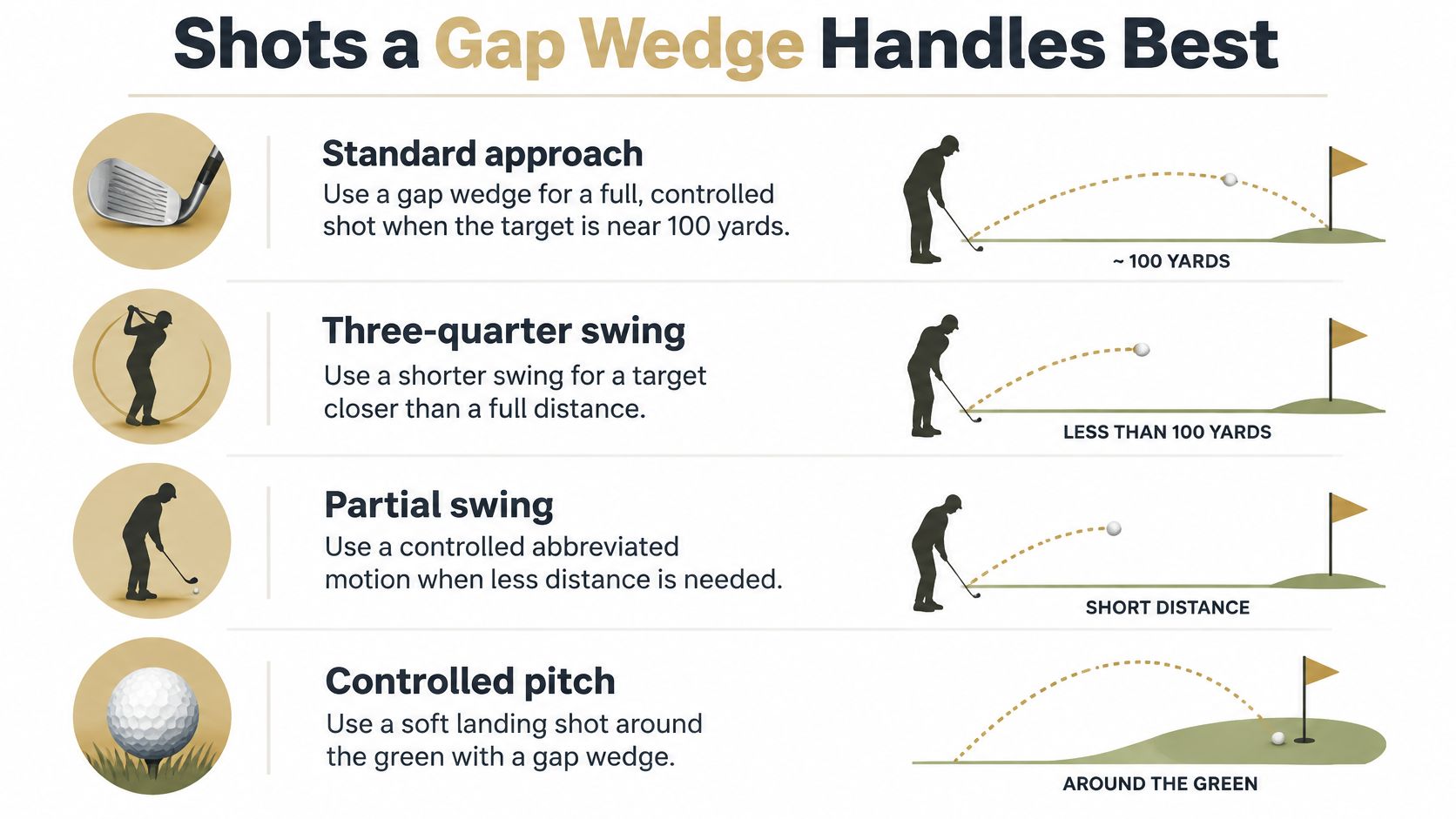
These common shot types show how swing length changes the club's job.
Approaches and shorter scoring shots
- Standard approach: A target near 100 yards is a familiar gap-wedge use described by The Golf News Net's wedge-gapping article, provided that distance matches the golfer's measured carry.
- Three-quarter swing: A shorter backswing suits a target inside the club's full distance. The golfer should retain a balanced finish rather than try to stop the club at impact.
- Partial swing: An abbreviated motion covers shorter landing targets. Consistent contact matters more than making the swing look precisely fractional.
- Controlled pitch: A gap wedge can offer more height than a pitching wedge while retaining more forward travel than a sand wedge.
For medium chips and bump-and-runs, the golfer should choose a landing spot before choosing the club. A centred gap-wedge chip may produce about 40% carry and 60% roll, as described in GOLF's guide to using wedges, but ball position and swing speed change that ratio.
Longer bunker escapes are another possibility. Sole width, bounce, sand firmness, and the lie affect whether the club moves cleanly through the sand, so the gap wedge isn't automatically the safest bunker choice.
Lower flight without slowing down
For a flighted shot, move the ball slightly back, favour the lead side modestly, and use controlled shaft lean to reduce delivered loft, following the technique explained in GOLF's pitch-shot instruction. The golfer should control distance through swing length and contact, not deceleration.
The guide to hitting a wedge provides a practical companion for rehearsing those movements.
The following video offers another instructional reference for wedge technique.
Reserve the gap wedge for repeatable approaches, longer pitches, and controlled running shots. A higher-lofted wedge is usually better when a short-sided target demands height and very little release.
Checking Whether a Gap Wedge Fits Your Bag
Use carry numbers to check the spacing
A gap wedge earns its place when it fills a distance your other clubs do not cover. The club's name alone cannot tell you that: start with your pitching wedge's actual loft, then compare the carries you hit with each wedge.
The SCHEELS golf-gapping guide recommends roughly 4–6 degrees of loft separation as a starting point. The carry bands below are screening estimates, not guarantees. Your own measured carries decide whether the clubs overlap.
| Loft gap between wedges | Typical carry gap | What it means |
|---|---|---|
| Under 4 degrees | Under about 10 yards | Possible overlap; check whether one wedge duplicates another |
| 4–6 degrees | About 10–15 yards | A starting range to compare against your carry numbers |
| Over 6 degrees | More than 15 yards | Possible hole; an intermediate loft may be worth testing |
A small loft difference is a reason to measure before buying. If two wedges repeatedly carry to nearly the same distance, they may still serve different purposes, such as producing different trajectories or performing better from particular turf. Keep both only if that distinction has a clear use.
Fix the spacing, not just the label
A bag gap does not always call for a new club.
- Adjust an existing wedge: A club fitter can assess whether bending it would improve the carry spacing. Bending also changes bounce, so check how the sole interacts with the turf afterward.
- Change the sand-wedge loft: This may redistribute the spacing while keeping the approach club you prefer.
- Carry fewer specialty wedges: If a wedge duplicates another, leaving it out can make room for a club that covers a different distance.
Compare full-shot carry, partial-shot carry, and dispersion. That gives you a clearer picture of whether each wedge has a distinct job.
A club that repeatedly finishes beside the pitching wedge needs a specific short-game purpose to stay in the bag. If your pitching wedge and sand wedge leave a carry gap beyond the table's screening range, test an intermediate option and keep it only if its distances are predictable.
Choosing Gap Wedge Loft, Bounce and Sole
Start with the pitching wedge's actual specification. The letter stamped on it doesn't reveal whether its loft matches a traditional wedge or a stronger modern iron set.
For a hypothetical fitting, a golfer with a 44–45-degree pitching wedge could test a nominal 50-degree gap wedge. Another golfer with a 48-degree pitching wedge could compare 52–54-degree options instead. These are candidates for measurement, not automatic recommendations.
Match the underside to the ground
Bounce is the angle that helps the sole resist digging. Higher bounce generally suits softer turf, fluffy sand, and golfers who deliver the club steeply; lower bounce can suit firm turf and tight lies.
Sole width and grind matter alongside that angle. A wider sole can offer more resistance to digging, while relief around the heel or trailing edge changes how the club sits when the face opens. A golfer who mainly hits square-faced approaches may prefer a different sole from someone who regularly manipulates the face around the green.
- Inspect the usual lie: Test from the turf the golfer commonly plays, not only from a forgiving practice mat.
- Watch the strike: Deep digging, repeated heavy contact, or a leading edge that sits awkwardly high can indicate a mismatch.
- Try the intended shots: Full approaches and delicate pitches may expose different strengths in the same head.
Keep the shaft transition comfortable
Shaft weight and flex should support the golfer's tempo, speed, and preferred feel. An abrupt change from the iron set can make the gap wedge harder to time, even when the static loft looks suitable.
The club-loft comparison guide reinforces the wider fitting habit of checking actual specifications rather than trusting club names.
Loft remains the starting point, but sole design can alter contact and therefore carry. Before committing, the golfer should confirm that the selected head and shaft produce the intended landing distance from a measured range or launch-monitor session.
How to Dial In Your Gap Wedge Yardage
A gap wedge earns its place when its carry fills a real distance between neighboring clubs. Check that with repeatable swings and measured landings, since the club name alone cannot tell you whether its yardage fits your bag.
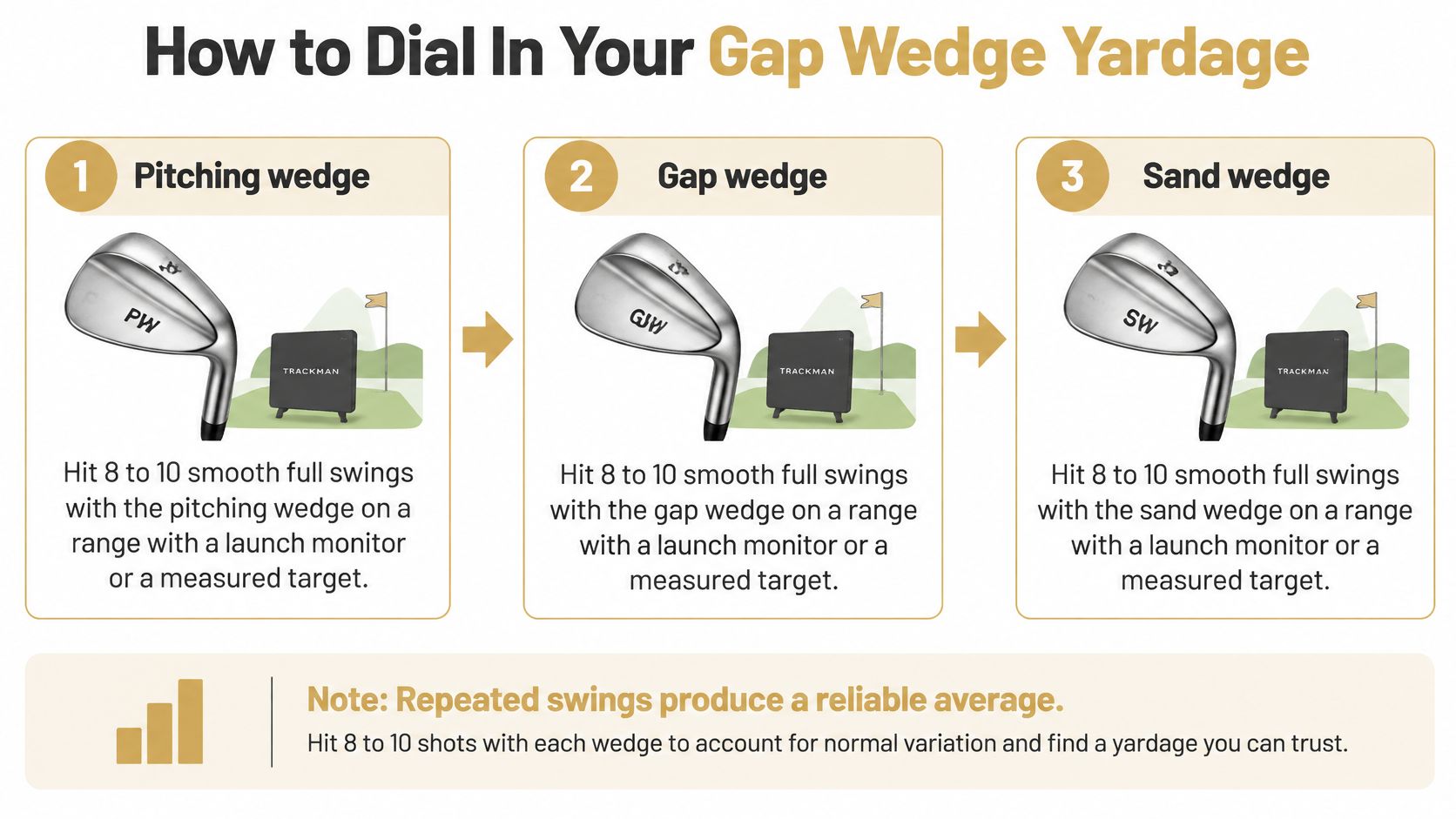
The process graphic shows the clubs to test under matching conditions.
Build the full-swing baseline
Collect a repeatable sample. As a practical testing protocol, hit 8 to 10 smooth full swings each with the pitching wedge, gap wedge, and sand wedge. Use a launch monitor or measured landing targets, warm up first, and avoid adding effort just because a club seems short.
Record carry separately. Write down where each shot lands, not where it finishes after rolling. Mark obvious poor strikes, including heel contact, and exclude them from the clean-strike average while keeping them visible in the session record.
Compare neighbouring averages. Calculate the average carry for each club, then subtract adjacent results. Treat the result as your starting point: loft spacing can suggest how clubs might separate, but your measured carries show whether the gap wedge fills a hole or overlaps another club.
The average describes a stock shot, not every shot the golfer will hit. A narrow average gap with a wide landing pattern can still leave club selection uncertain.
Add scoring distances and check reliability
Measure shorter motions. Hit three-quarter and partial gap-wedge swings and record a separate carry average for each. Use a recognisable backswing checkpoint so the motion can be repeated on the course rather than relying on a vague feeling of reduced effort.
Inspect dispersion. Note both short-to-long spread and left-to-right misses. A club that occasionally produces the desired distance but frequently misses well short is not yet a dependable solution.
Change one variable and retest. Adjust the club choice, loft, or swing length, then repeat the test over further sessions. Keep the ball consistent, since changing its characteristics can change flight and undermine the comparison.
Use a golf bag gap analysis guide to interpret the measurements across neighboring clubs.
Testing safeguard: Keep clean-strike averages and mishit patterns separate. The averages show typical carry; the misses show how reliably the club produces it.
Carry is the landing distance, while total distance includes the roll afterward. Firm ground can make a shorter shot finish beside a longer one, hiding a gap in the distances the golfer needs to cover.
Set Your Gap Wedge Yardage Before Your Next Round
Before your next round, check whether the gap wedge fills a real distance gap. Its name and loft alone cannot answer that: compare its measured carry with your pitching wedge and the other clubs you trust.
Keep practice and course decisions connected
Record full and partial carry averages, then keep them with the clubs in your locker. Dialed Golf's desktop app lets you pair a launch monitor or import a session, so you can review those distances alongside later practice.

Use the screenshot to see how club distances and practice sessions can be reviewed together.
- Test before playing: Record full and partial carry averages for the wedges in your bag.
- Keep one record: Add your clubs to your locker, then pair a launch monitor or import a session to compare practice results.
- Retest after changes: If you change the ball, shaft, or loft, measure again before relying on the old reference.
The free Golf Bag Gap Analyzer can help spot overlaps and missing yardages. Check your measured carries before buying: a gap wedge earns its place when it fills a distance your current set leaves uncovered. Explore Dialed Golf's free tools.