


A 3-hybrid carried 12 yards farther than a 4-iron and flew 15 feet higher, despite the iron having one degree more loft, in the Ping G440 comparison reported by Golf Digest's highest-launching hybrids coverage. That result captures the decision for high handicappers. Loft labels don't tell the whole story. Head design, launch, carry and the iron being replaced decide whether a hybrid earns a place in the bag.
Table of Contents
- Quick Picks for High-Handicap Hybrid Models
- Why Hybrids Replace Long Irons for High Handicappers
- Head Design, Loft and Shaft Features That Forgive
- Matching Hybrid Traits to Your Dominant Miss and Swing Speed
- How to Run a Carry Test Against Your Current Iron
- Confirm Your Hybrid Before You Buy
Quick Picks for High-Handicap Hybrid Models
The shortlist below works as a testing reference, not a ranking of the best hybrid clubs for high handicappers. Each row points to a different job, so a golfer should start with the row that matches the iron causing trouble or the miss costing strokes. A strong number in isolation doesn't make a club right for a particular bag.
| Model or test | Reported launch | Measured result | Best fit |
|---|---|---|---|
| Wilson Dynapower 22° Hybrid | 13° average | Nearly 145 mph ball speed, forgiving from rough | Reliable long-approach or fairway recovery |
| Titleist GT1 Hybrid | 12.3° average | Lightest and most forgiving GT model | Thin, low or short long-club misses |
| Ping G440 3-hybrid vs 4-iron | Little change vs 4-iron | Carried 12 yards farther, flew 15 feet higher | Replacing a hard-to-launch 4-iron |
| Golf Digest 6-hybrid vs 6-iron | Higher-launching flight | Averaged 18 yards more carry for high handicappers | Replacing a 6-iron |
How to Read Each Row
Launch shows whether the ball gets up fast enough to produce usable height. A low, flat flight can look powerful off the face and still fail the practical test, because it may run through a green or fall short when the golfer needs the ball to carry a bunker, rough patch or false front. Height only helps when it arrives with enough carry and a landing angle that lets the ball stop.
Measured result shows what happened under test conditions, not what every golfer will produce. Swing speed, strike location, shaft, loft setting and the ball used can all shift the outcome. That's why these figures work best as benchmarks for a fitting session. They give the golfer a realistic reference point, then personal testing decides whether the pattern repeats.
Best fit is the column that matters most. A recovery club for rough, a launch aid for thin strikes and a direct 6-iron replacement solve different problems. Choosing by problem first prevents the common mistake of buying the longest hybrid on the rack, then discovering it overlaps a fairway wood or worsens a left miss.
A row only matters if it fills a real gap in the reader's own bag.
Use the table to build a short demo list of two or three candidates. Then test each one against the iron it would replace, with the same ball and target, and keep the club that produces a distinct, repeatable carry number.
Why Hybrids Replace Long Irons for High Handicappers
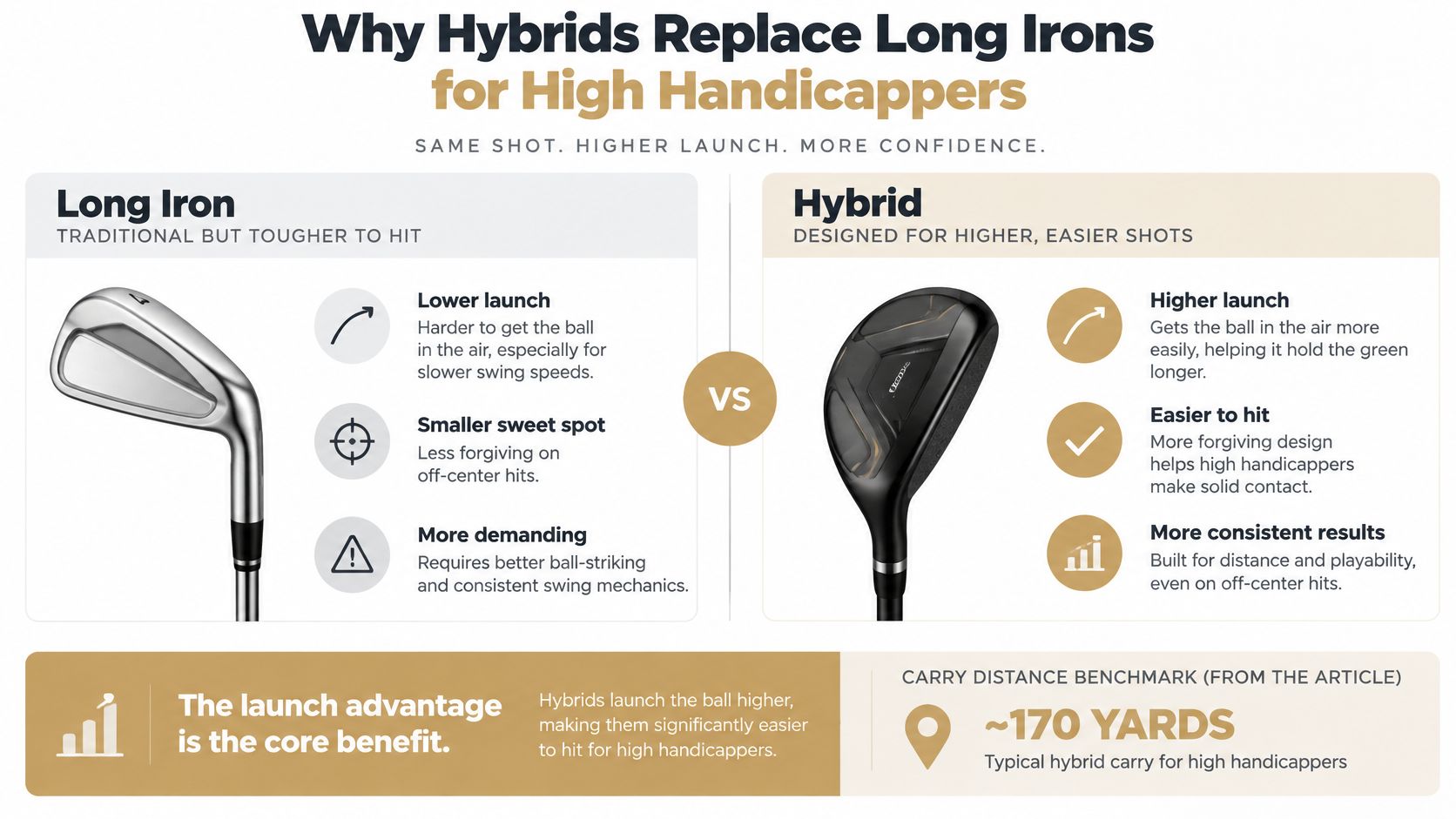
Hybrids became a genuine equipment category because they launch the ball higher than the low-lofted irons they replaced. That launch advantage still explains their value. A long iron asks for speed and precise contact to produce height, while a hybrid head places mass lower and deeper, helping the ball climb from ordinary strikes. For a high handicapper, adequate height and landing angle often matter more than raw ball speed.
The clearest benchmark comes from the Golf Digest test conducted with Club Champion, where high-handicap golfers hit a 6-hybrid an average of 18 yards farther in carry than a 6-iron. Carry distance is the right measure here because it shows whether a long approach can reach its target and hold a green. Total distance can flatter a low runner that never had a chance of stopping near the flag.
The same testing highlighted a familiar hybrid pattern, a higher-launching, higher-spinning flight with some natural draw bias. Those traits address insufficient launch and inconsistent long-iron contact, but draw bias isn't free help for everyone. A golfer who already misses left may find that the most forgiving-looking head makes the dominant miss worse, which is why directional results belong in every comparison.
The Average Is a Benchmark, Not a Promise
That 18-yard gap is a test average influenced by swing speed, strike quality, loft, shaft and club fitting. It doesn't guarantee the same result for every golfer or model. A player who already launches a 6-iron well may gain little, while a player who hits that iron thin and low could gain a playable club where none existed before.
The honest way to use the benchmark is simple. It proves a properly matched hybrid can produce materially more usable carry for golfers who struggle with the corresponding iron. It doesn't remove the need to measure. Any seller promising a fixed yardage gain from a shelf club is skipping the fitting variables that created the result.
The Loft Label Trap
Club numbers mislead because modern iron lofts vary by set. A 4-hybrid can replace different irons across different manufacturers, and a 25- or 26-degree hybrid may replace a different iron depending on the maker's loft structure. Recent equipment coverage makes the same point about stronger iron lofts and changing top-end setups in Golf Digest's Hot List equipment guidance, noting that a hybrid is generally easier to hit than a current 6-iron but may not suit every golfer.
Three bag questions decide the purchase:
- Which iron leaves: The hybrid should replace a specific 5-iron or 6-iron, not sit beside it at the same carry distance.
- What sits above it: The golfer needs a clear step to the shortest fairway wood or 7-wood, without a crowded overlap.
- One hybrid or two: A second hybrid only earns its place when it covers another unreliable iron with its own distinct carry.
Compare each candidate directly with the iron it would replace on launch, carry, descent angle, dispersion and stopping power. The rule never changes. Measure the carry gap before buying, and never choose by club number alone.
Head Design, Loft and Shaft Features That Forgive
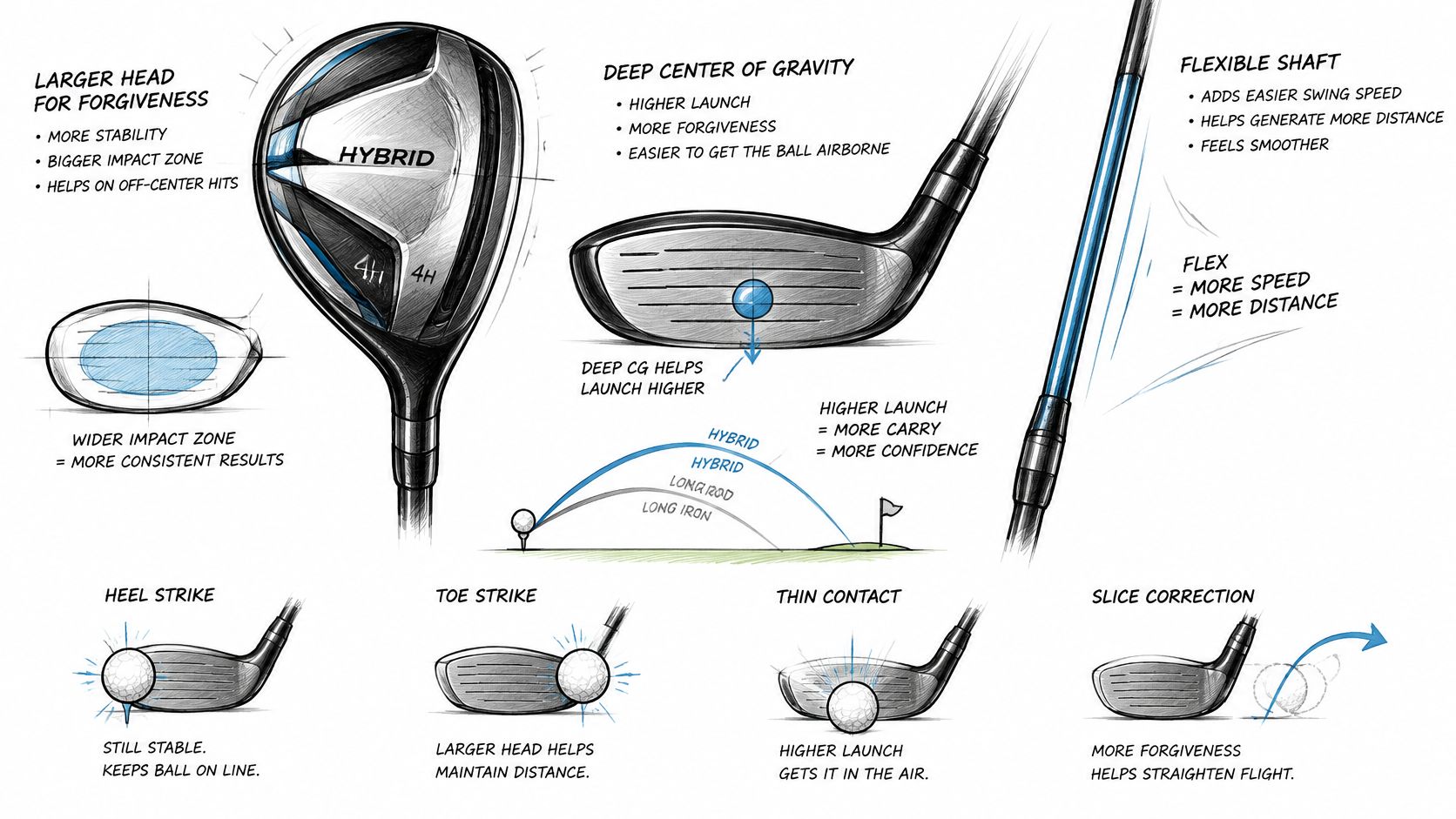
Forgiveness is not a single feature. It is the combination of head stability, loft, shaft, and sole working against the misses a golfer makes. The table below outlines what to look for, which miss each feature helps, and what the golfer gives up in return.
The diagram below shows how those design elements differ from a conventional iron profile.
| Feature | What to look for | Miss it helps | Trade-off |
|---|---|---|---|
| Head size and stability | Larger footprint with forgiving profile | Heel and toe strikes | Can look bulky at address |
| Loft and launch | Higher loft for launch and landing angle | Insufficient launch on long shots | Less distance on centered strikes |
| Shaft weight and flex | Lighter options for slower tempo | Low or weak launch | Can feel unstable for faster swings |
| Sole and lie | Turf-friendly sole, adjustable or flatter lie | Rough and tight-lie contact | Needs fitting to confirm the effect |
Head Size and Stability
A larger footprint spreads mass away from the center, so heel and toe strikes twist less and lose less direction. Golfers shouldn't judge that stability by the best shot in a demo session. The useful evidence is the spread of ordinary strikes, especially the low-face contact that turns a long iron into a ground-hugging miss. A stable head keeps those shots airborne and closer to the target line.
The trade-off is visual and practical. Some golfers like the confidence of a bigger head behind the ball, while others aim it poorly or feel it hangs up in thick grass. Address comfort matters because a golfer who doesn't trust the look tends to steer the swing. Test the head from fairway turf and rough, not only from a perfect mat lie.
Loft as a Stopping Tool
Loft does more than set distance. It shapes launch, peak height and descent, which together decide whether a long approach can hold a green. Golfers comparing nominal lofts across brands can use a hybrid golf club lofts chart as a starting reference, then confirm the actual gap by carry. More loft usually brings easier launch and softer landing, but it can cost distance on a centered strike.
That trade is often worth making. A hybrid that carries slightly shorter but lands steeply gives the golfer a shot that can be aimed at a green. A stronger-lofted option that flies flat may win a range contest and still be the wrong approach club, because rollout is hard to control from long range.
The short video below is useful for seeing how loft and head shape present at address before a demo session.
Shaft, Sole and Lie
A lighter shaft can help a slower tempo produce speed and launch without swinging harder. The risk appears when tempo quickens under pressure. A shaft that feels unstable can widen dispersion, so golfers should test at normal effort and at the effort used late in a round. Current high-launch families such as the Ping G440 range offer lightweight shaft choices with loft and lie adjustability, as shown in PING's G440 hybrid specifications, which gives fitters more than one way to solve a launch problem.
Sole design governs turf interaction. A wider, rounded sole tends to glide rather than dig, helping from rough and uneven lies, while a flatter profile can sit cleaner on tight fairways. Lie angle and face bias then fine tune direction. A feature only matters if it reduces the miss the golfer makes on the course.
Matching Hybrid Traits to Your Dominant Miss and Swing Speed
Start with the miss, then check speed. That order matters because two golfers with the same swing speed can need opposite hybrids. One hits the ball thin and low, the other launches it high and slices it. Giving both players the same high-launch, draw-biased head solves one problem and creates another.
Thin, Low or Short Long-Iron Shots
A thin long-iron strike produces a flat ball flight that carries short and runs unpredictably. The fix is launch help built into the head and a lighter overall build that doesn't demand extra effort. The Golf Monthly review of the Titleist GT1 Hybrid describes it as the lightest and most forgiving model in Titleist's GT hybrid lineup, with a large head intended to increase confidence and stability. In GCQuad testing with 2025 Pro V1x balls, it averaged a 12.3° launch and launched significantly higher than the other GT models.
That GT1-type profile suits golfers whose long-club misses finish thin, low or short. The large footprint steadies off-center contact, and the lighter build helps the golfer maintain speed without forcing the swing. The reviewer also found it effective from the rough and suitable for higher handicappers, which matters because thin strikes rarely happen only from clean fairway lies.
The limit is clear. A golfer who already launches the ball high, or who plays often in strong wind, may get more control from a compact, penetrating model. Extra height stops being help when it turns into ballooning shots that fall short into a headwind. Peak height and carry into the wind deserve a place in any outdoor test.
Fairway Recovery and Rough Misses
Some high handicappers don't need a green-hunting club first. They need a reliable way to advance the ball from rough, bare patches and awkward stances without the leading edge digging or the head twisting shut. For that job, turf interaction and dispersion on imperfect contact outweigh maximum ball speed.
The useful benchmark comes from Golf Monthly's controlled review of the 22° Wilson Dynapower Hybrid, which used a Foresight GCQuad and Titleist Pro V1x balls and recorded nearly 145 mph of ball speed with a 13° average launch. The reviewer found it forgiving from the rough, easy to advance from challenging lies, and consistent with tight dispersion. That combination is exactly what a recovery club needs, because the shot rarely starts from a perfect lie.
A high-launching 4- or 5-hybrid in that mold can replace a difficult long iron while producing a descent angle more suitable for holding greens. Golfers working out the expected yardage slot can cross-check a typical 4-hybrid distance against their own measured carry rather than trusting the number on the sole. The club earns its place when its carry gap is distinct from both the longest reliable iron and the shortest fairway wood.
Compare launch and dispersion at realistic, imperfect contact, not only peak distance.
That principle protects golfers from demo-day deception. High handicappers commonly lose more strokes through low-face, heel or rough strikes than through insufficient centered-hit speed. A hybrid that preserves playable carry on those swings beats a longer club that collapses whenever contact drifts from the middle.
Slice, Hook and Face Bias
Directional misses need a different conversation. Many game-improvement hybrids carry some draw bias, which can soften a slice by helping the face close relative to the path. For a chronic slicer, that bias may turn a weak right miss into a playable shot. For a golfer whose stock miss is a hook, the same design can produce unusable left shots that start left and keep going.
Launch help and directional forgiveness aren't the same thing. A club can get the ball airborne beautifully and still send it to the wrong place. That's why lie angle, face bias and shaft profile deserve checking before purchase. A more upright setup tends to encourage a left start for many golfers, while a flatter option can reduce that tendency, but only testing shows the effect for a given delivery.
The most forgiving head on paper may not be the best choice if its shaft, lie or face bias worsens the dominant miss. Golfers who fight a hook should include at least one neutral or fade-leaning candidate in the test, even if its headline forgiveness looks lower. Golfers who slice should confirm that draw bias tightens the pattern rather than producing a two-way miss at higher effort.
Steep contact adds another filter. A golfer who hits down sharply may catch a wide sole high on the face from tight lies, while a shallower delivery often suits a broader, lower profile. Neither pattern is a flaw to hide during a fitting. It's delivery information, and the right sole shape should work with it instead of demanding a swing rebuild before the club performs.
Swing Speed as a Starting Point
Speed bands narrow the shaft and launch conversation, but they don't finish it. Tempo, transition and release pattern can move a golfer out of the expected category, so every band below needs confirmation on a launch monitor or in an in-person fitting.
| Swing speed band | Shaft and launch focus | Watch for |
|---|---|---|
| Slower | Lightweight shaft, higher-lofted head, maximum launch help | Ballooning flight that loses carry into wind |
| Moderate | Mid-weight shaft with stable feel, loft chosen by carry gap | Overlap with the shortest fairway wood |
| Faster | Heavier, more stable shaft, penetrating profile | Draw bias turning into a hook at full effort |
Slower swingers usually benefit most from the launch-first setup because height creates carry that a flat long iron can't produce. Moderate swingers have the widest choice, which makes gapping the deciding factor. Faster high handicappers often need stability more than help, since an overly light build can feel loose and widen the dispersion they're trying to fix.
Whatever the band, the confirmation standard stays the same. Record launch angle, carry distance, peak height, offline dispersion and strike pattern over at least 10 usable shots. Keep the setup only if it improves the dominant miss, preserves playable carry on mishits and leaves a clean distance step on both sides of the hybrid.
How to Run a Carry Test Against Your Current Iron
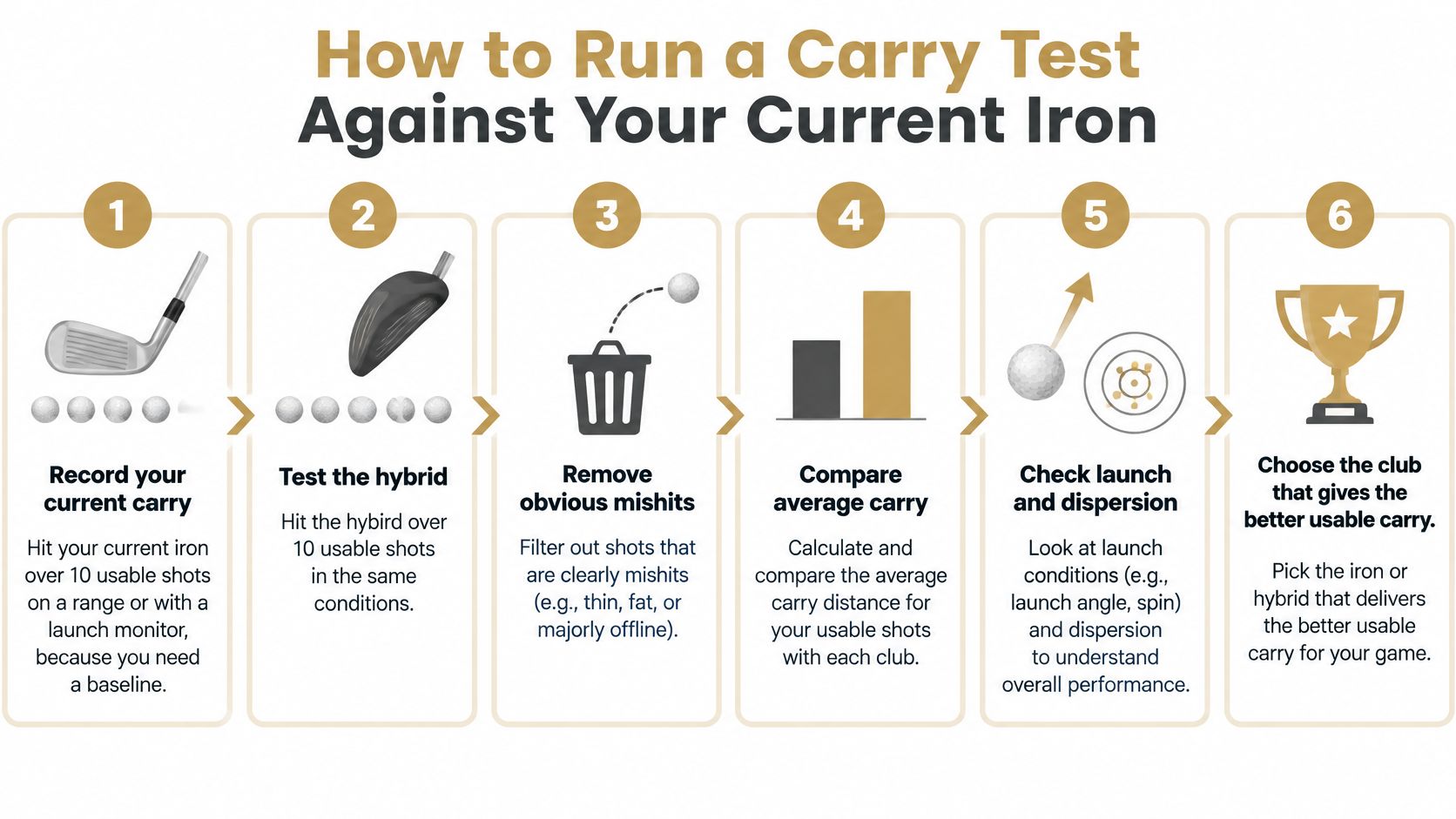
A carry test removes guesswork from the best hybrid clubs for high handicappers debate. It takes one range session, the iron under threat and a consistent target. The six steps below work on a launch monitor or on a measured range with clear distance markers.
The Six Steps
- Record the iron baseline: Hit 10 usable shots with the current iron and note where each ball carries, because no comparison means anything without a starting number. Keep normal effort throughout, since a baseline built on forced swings won't match on-course reality.
- Hit the hybrid the same way: Use the same ball, target and effort for 10 shots with the candidate hybrid. Changing only the club keeps the comparison honest and stops a fresh ball or bigger swing from inventing a winner.
- Log the full flight: Record launch angle, carry, peak height, descent angle and left-right dispersion for each shot. Carry alone hides whether the ball can hold a green, and dispersion shows whether the extra distance is usable.
- Score the mishits: Mark thin, heel and toe strikes and compare how much carry each club keeps. High handicappers lose strokes on those contacts, so mishit retention often matters more than the single best strike of the session.
- Check the gap: Compare average carry and spread, then confirm the hybrid sits clearly between the longest iron and the shortest fairway wood. A structured gap analysis makes overlaps easier to spot before money changes hands.
- Choose the reliable gap: Keep the club that fills the largest reliable gap with a pattern the golfer can aim. Reject any club that wins only on its best swing, because that swing won't show up on demand.
Recording the Results
Golfers who own a launch monitor can run the session at the range or in a garage setup. The Dialed Golf desktop product runs a live pair with the Garmin R10, with more devices expanding, and imports CSV files from Garmin, Rapsodo, SkyTrak, FlightScope, Uneekor, GSPro, Awesome Golf and more. That record keeps the iron and hybrid numbers side by side instead of relying on memory.
Two free tools support the same process without any hardware. The Golf Bag Gap Analyzer spots overlaps and missing yardages in the golfer's bag, while the Carry Distance Chart Generator builds a printable reference for the clubs the golfer trusts. Both sit among the free web tools, which stay free rather than forming part of a paid plan.
Clean result: consistent carry, usable descent and a dispersion pattern the golfer can live with, repeated across ordinary strikes.
If the hybrid only wins on total distance because the ball runs out low, the test has failed the approach-shot purpose. If it carries a little farther, lands steeper and keeps mishits in play, the golfer has found a genuine replacement rather than another club fighting for the same yardage.
Confirm Your Hybrid Before You Buy
One buying rule covers every case in this guide. Buy the hybrid that fills the largest reliable carry gap, produces launch and descent the golfer can hold greens with, and keeps mishit dispersion within a pattern the golfer can aim. Any club that fails one of those three tests is a compromise dressed up as an upgrade.
The verdict follows the dominant miss. Thin, low long-iron shots point to a high-launch, forgiving head with a lighter build, because height and mishit carry solve the actual problem. Rough and recovery trouble points to a sole that glides and a head that stays stable from poor lies. A slicer should confirm face bias in testing before buying, and a hooker should treat strong draw bias as a warning sign rather than a feature.
Overlap is the quiet deal-breaker. A hybrid that carries the same distance as a trusted fairway wood or the longest iron adds cost without adding a shot. Golfers should want a clear step on each side of the new club, proven by averages across a full test session, not by a single flushed strike that flatters one candidate.
The Action for This Week
Run the carry test once, on the range or with a launch monitor, before ordering anything. The seven free golf tools require no account, so checking gaps and building a carry reference costs nothing but the range balls. Golfers with a monitor can record the session on desktop, since the macOS and Windows apps remain the place for live launch-monitor capture, and CSV exports from other devices land in the same golfer record.
That record matters after the purchase too. A hybrid that tested well in one session should confirm its carry number across the next few practice sessions, in different conditions, before the replaced iron leaves the bag for good. Seasonal changes in tempo and fitness can shift the gap, and a stored baseline makes those shifts visible instead of mysterious.
If the test results conflict, with one club launching better and another dispersing tighter, a qualified club fitter should settle the shaft, lie and loft questions before purchase. Thirty minutes of verified fitting beats a season of guessing. The best hybrid clubs for high handicappers aren't the ones with the boldest distance claims. They're the ones that pass a measured test against the golfer's own iron, miss pattern and bag.
Run the carry test, log the session and check the gaps before spending anything. Dialed Golf brings range and garage practice into one golfer record through its macOS and Windows desktop product, with live pairing for the Garmin R10 and CSV imports from other launch monitors, while its seven free web tools stay free with no account required. Golfers who want the full picture across app and desktop can explore Golfer Pro, and ranges or clubs can look at Dialed Academy for memberships and front-desk operations at a flat platform fee.