


Ask a dozen golfers which hybrid is easiest to hit and you'll get a dozen confident answers, several of them wrong for the person doing the asking. Equipment tests don't settle it either. Two reviews of the same season can crown different clubs, because each one tested a different swing, a different miss, and a different set of lies.
The category itself isn't in dispute. A Darrell Survey cited in the recorded history of the hybrid club found that 7% of golfers used a hybrid in 2004, rising to 30% by 2007, and by 2018 most golfers carried at least one. The long iron lost that argument two decades ago.
What's left is the choice, and it's a choice you can make with numbers instead of a page of rankings. What follows is the design logic behind an easy-to-hit hybrid, the fitting variables that change it, a test you can run on your own launch data, and a clear way to decide whether your 4-iron or 5-wood is the club that should go.
Table of Contents
- The Design Traits That Make a Hybrid Easier to Hit
- How Fitting Changes Hybrid Ease
- How to Test Hybrid Ease on a Launch Monitor
- Choosing a Hybrid for Your Specific Miss
- Choosing Between a Hybrid, Long Iron and Fairway Wood
- Confirm Your Short List Before You Buy
The Design Traits That Make a Hybrid Easier to Hit
The one-line answer is a higher-lofted, wide-soled head with a low and back center of gravity and a high moment of inertia. Notice what's missing from that sentence: length. The easiest hybrid to hit isn't the longest one on the rack, and the strongest-lofted head in a lineup is usually the hardest to launch for anyone without tour-level speed. Independent hybrid testing treats forgiveness as consistency of outcome, especially dispersion, and recommends higher launch, somewhat higher spin, and more forgiveness for a hybrid used on approach shots.
What each trait actually does
Every forgiveness trait solves a specific failure. Loft gets the ball airborne, weight position decides how much of that loft shows up as height, and stability decides how much of the flight survives a strike that isn't centered.
| Design trait | What it does | What to check |
|---|---|---|
| Higher loft | Raises launch and keeps the ball in the air longer | Compare 4, 5 or 6 hybrid lofts rather than 2 or 3 |
| Low, back center of gravity | Lifts launch and steadies the head on off-center strikes | Look for a stated low-back CG or higher launch in the test data |
| High MOI with perimeter weighting | Limits face twist when the strike misses the center | Check stated MOI and perimeter weight claims |
| Wide sole | Moves through turf with less tendency to dig | Compare sole width against the lies you actually play from |
| Shorter shaft length | Reduces swing radius and timing demand for more centered contact | Test standard and slightly shorter lengths |
The practical consequence is a loft bracket. Compare 4-, 5- and 6-hybrid lofts rather than defaulting to a stronger 2- or 3-hybrid, because the right head is the one that repeatedly produces adequate carry, a usable descent angle, and tight front-to-back dispersion. A 3-hybrid asks for clubhead speed and center contact that many recreational swings can't produce often enough to matter.
A larger footprint and a deeper center of gravity also earn their keep from the rough, where the sole moves through turf with less tendency to dig. If a head feels like it's excavating a wet lie rather than skimming it, the sole is wrong for the courses you play, no matter how the launch monitor numbers look off a mat.
The three-point check before you read a single ranking: loft in the 4 to 6 bracket, a weight profile that sits low and back, and a sole wide enough to skip rather than dig. A model that passes all three is worth testing, whatever the review says.
If you're unsure how a 5-hybrid sits against the 5-iron it would replace, start with a hybrid golf club lofts chart and then confirm the number on a monitor rather than trusting the label on the sole.
How Fitting Changes Hybrid Ease
Loft, shaft length, and impact location move the numbers more than the badge on the sole does. Launch-monitor fitting guidance is direct about it: fitting often matters more than the model name, and the measurements it should capture are ball speed, launch angle, trajectory, spin rate, carry, and total distance.
The order that matters
Work through the variables in sequence and don't skip ahead, because a length change made before the loft is settled just muddies the comparison.
- Loft first. Start with a loft that overlaps the longest iron or fairway wood it would replace by roughly 10 to 15 yards of carry. That closes the gap without creating a jump.
- Length second. Test standard and slightly shorter lengths. A shorter hybrid reduces the swing's radius and timing demand, so it's easier to center, and the length producing the highest consistent smash factor usually delivers the most repeatable performance.
- Flex third. Choose the flex that keeps launch and spin in a consistent cluster, not the one that feels best on a single flushed shot.
Impact location deserves the same attention as the spec sheet. Heel and toe strikes tell you whether the head stays stable, and a footprint that looks forgiving at address can still twist on the miss you happen to own.
The target isn't maximum clubhead speed. It's a tight cluster of playable shots with enough launch and spin to stop on the intended landing area.
The reject rule: drop any configuration that produces large launch or spin variation, even if its best strike travels farther than everything else you tried. A club whose good shots are excellent and whose ordinary shots scatter isn't easy to hit. It's occasionally brilliant, which is a different and much more expensive thing.
How to Test Hybrid Ease on a Launch Monitor
A ranking tells you what worked for someone else's swing. A test tells you what works for yours, and it takes about an hour in a bay. Set it up so the only variable is the head in your hands.
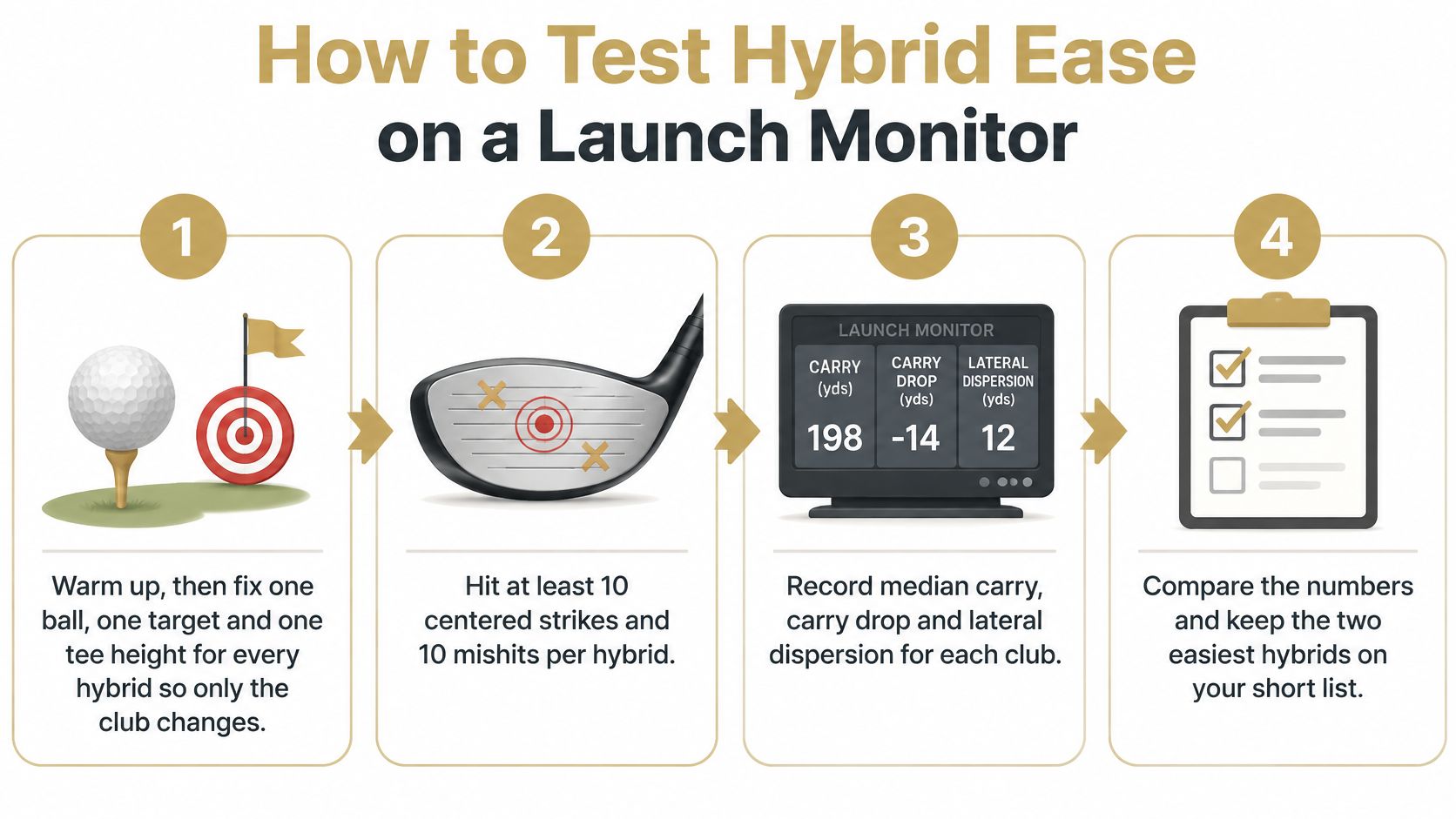
Run the same protocol on every candidate
Each step below exists to remove a way the comparison can lie to you.
- Warm up, then freeze the variables. One ball model, one target, one tee height, same bay. Change only the club, or you're testing the wind and your own warm-up.
- Hit at least 10 centered strikes and 10 mishits per candidate, logging carry, launch angle, spin rate, and left-right dispersion for every shot. The mishits carry the information you need, because that's where the differences between heads live.
- Work out smash factor from the centered strikes. A 2025 Purdue University engineering study using a Foresight GCQuad recorded an average smash factor of 1.42 for a commercial hybrid against 1.27 for an experimental design across ten strikes near the center of each face, which shows how much face construction and energy transfer change ball speed.
- Compare median carry, not the longest shot. Then note the spread between the shortest and longest carries for each head.
- Check peak height and descent angle on anything you plan to hit into greens. Those two numbers decide whether the ball stops or runs off the back.
- Rank by consistency. The hybrid with the tightest carry spread and the narrowest dispersion wins, even if its best strike is shorter than a rival's best.
- Retest the top two on another day. A result that doesn't repeat was a good afternoon, not a good club.
Read the numbers the way a fitter does
| Metric | What it shows | How to use it |
|---|---|---|
| Median carry | Typical distance with the club | Compare candidates on median, not the longest shot |
| Carry spread | Gap between shortest and longest carry | A smaller spread means more repeatable results |
| Left-right dispersion | Offline pattern for each shot | Choose the head with the tightest pattern for your miss |
| Launch angle and spin | Shape of the flight | Keep them in a consistent cluster |
| Peak height and descent angle | Whether the ball stops on greens | Check these before using the club into greens |
| Smash factor | Energy transfer on centered strikes | A higher, steady value shows good energy transfer |
For context on the range you're shopping in, 2025 equipment testing reported a leading model at approximately 222 yards of carry, 36.5 yards of peak height, and 6.5 yards of carry standard deviation under the test conditions. Those aren't your numbers and shouldn't become your target. What transfers is the relationship between them: decent height, modest sideways error, and a carry that doesn't swing wildly from shot to shot.
Sort the shortlist by median carry, then confirm the winner's number sits between the clubs on either side of it in your bag. A gap analysis walkthrough shows how to set that target before you start swinging.
A fitting session shows the sequence in real time, including how a fitter reacts when a head looks good on one shot and falls apart on the next.
The pass mark is a cluster you could repeat tomorrow with your eyes closed. One career shot and nine mediocre ones is a failure, even when that one shot is the longest of the session.
Choosing a Hybrid for Your Specific Miss
Published verdicts disagree, and the disagreement is the most useful thing in the category. One round of equipment testing on the most forgiving hybrids flagged the Ping G440, Callaway Quantum Max OS, TaylorMade Qi4D Max, and PXG Black Ops 0311 as especially easy to hit. Another named the Callaway Elyte the easiest overall because it won both the height and forgiveness categories. A 2024 rescue club review made the TaylorMade Qi10 Max Rescue the pick of that year on a deep center of gravity and perimeter weighting.
Three lists, three winners, and every one of them defensible. That's the tell. Ease isn't a stable ranking unless the test states strike location, swing speed, lie, launch, spin, carry, and dispersion. Without those, a winner is just a club that suited the tester.
Easy for which miss
Match your most frequent miss to the measure that exposes it, then judge candidates on that measure alone.
| Use case | Measure first | Rank candidates by |
|---|---|---|
| Low swing speed | Launch height and carry | Test high-launch heads first |
| Rough escape | Sole width and descent from rough | Favour a wide sole and deeper center of gravity |
| Tee accuracy | Carry consistency and dispersion | Rank by carry spread |
| Anti-left miss | Left-right dispersion against that miss | Keep the head with the smallest left dispersion |
| Shallow fairway lies | Sole shape and descent angle | Compare descent angle and turf interaction |
A worked example
Say a golfer with below-average clubhead speed fights a left miss and wants a hybrid for a 175-yard approach. Two high-launch heads go into the bay for ten centered and ten heel-side shots each. The first produces a marginally longer best strike, but three of its ten centered shots finish left of the target line and its carry spread runs to 14 yards. The second carries two yards shorter at the top end and holds an eight-yard spread with one left miss across the set.
The second head wins, and the decision is made in about twenty minutes with data the golfer already owns. The longer best strike was never the point.
Choose the miss you hit most often, test two or three heads against that single shot, and keep the one with the smallest dispersion. A hybrid that's easy on someone else's miss is just a club you happen to own.
Choosing Between a Hybrid, Long Iron and Fairway Wood
The head-to-head question has a real answer for most golfers, and a tracked-shot comparison of hybrids and long irons puts numbers on it. Hybrids outperform equivalent long irons across greens hit, proximity, dispersion, and rough distance, and the advantage grows as handicap rises. One example in that comparison has a 20-handicap finishing about 16 feet closer with a hybrid.
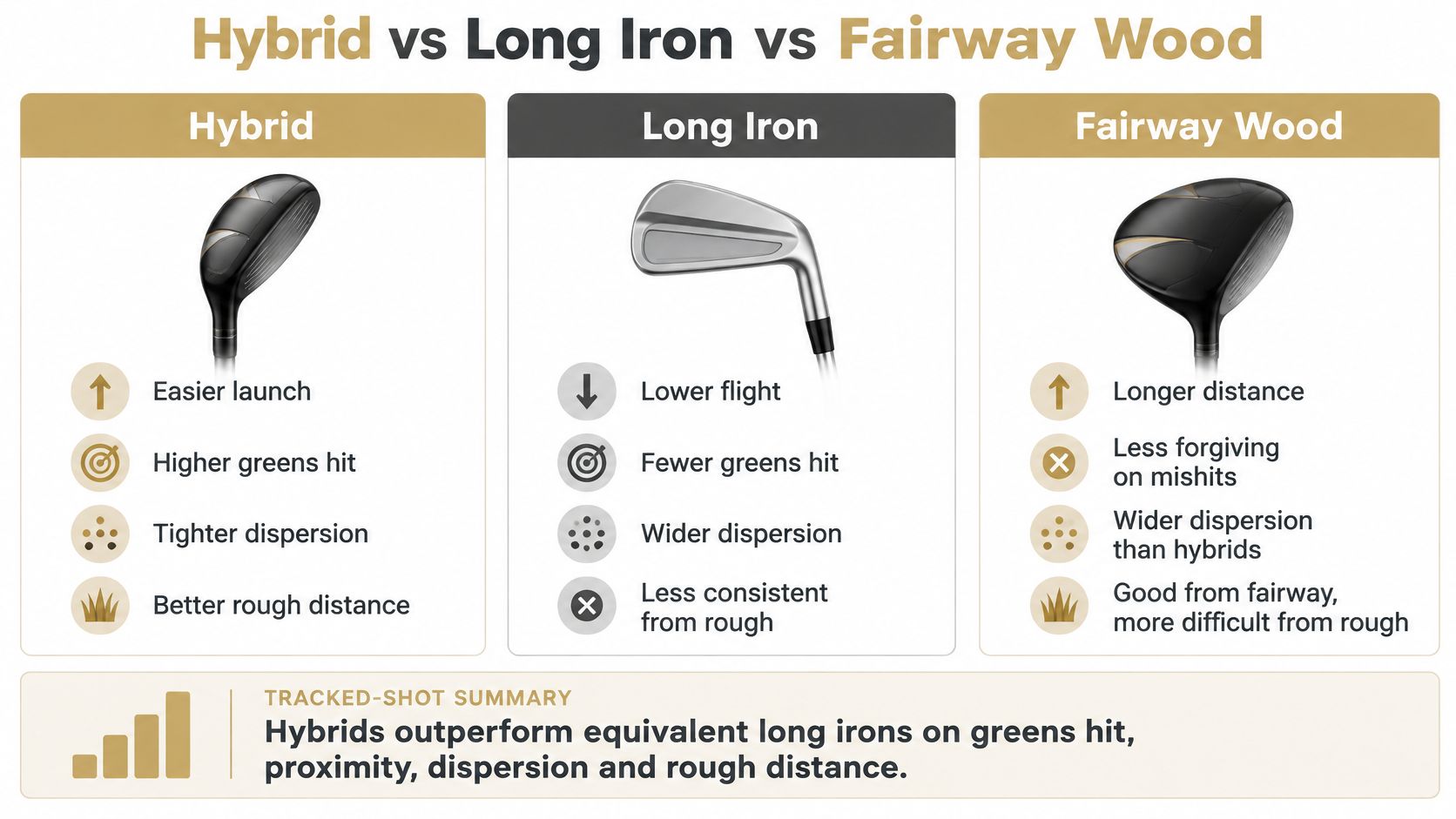
That doesn't make a hybrid the universal replacement. A higher-lofted fairway wood can deliver more height and stopping power on approaches, and a compact hybrid may suit a stronger player who needs to hold the face open against a hook. The category isn't the answer. The shot you need is.
Where each option wins and where it costs you
| Option | Best case | Where it falls short |
|---|---|---|
| Hybrid (4 or 5) | More launch help and mishit tolerance than the equivalent long iron | Less stopping power than a compact head for a stronger player who holds the face open |
| Long iron (4-iron or 5-iron) | Lower, more controllable flight and a compact head | Harder to launch and more dispersion for players with moderate speed |
| Higher-lofted fairway wood (7-wood) | More height and stopping power on approaches | Harder to strike cleanly from the turf than a hybrid |
Decide with measured carry, not with club labels. Check the gapping against the clubs on both sides of the slot, the lie you usually play from, your strike pattern on the face, and your left-right dispersion. A 4-hybrid distance breakdown is a useful starting point for estimating where the slot lands before you hit anything.
Decision rule: if your long iron shows a wide carry spread, test a hybrid of similar carry first. If the gap comes from loft and shaft rather than club category, fix the spec before you change the club type. Swapping a 4-iron for a hybrid that's also three degrees too strong solves nothing.
Confirm Your Short List Before You Buy
Three moves take you from a shortlist to a decision. Choose two or three hybrids that answer your most frequent miss. Run the protocol from the bay, comparing median carry, carry spread, dispersion, and peak height. Then check whether the winner fills the hole in your current gapping rather than duplicating a club you already trust.
Putting the trade-offs on paper
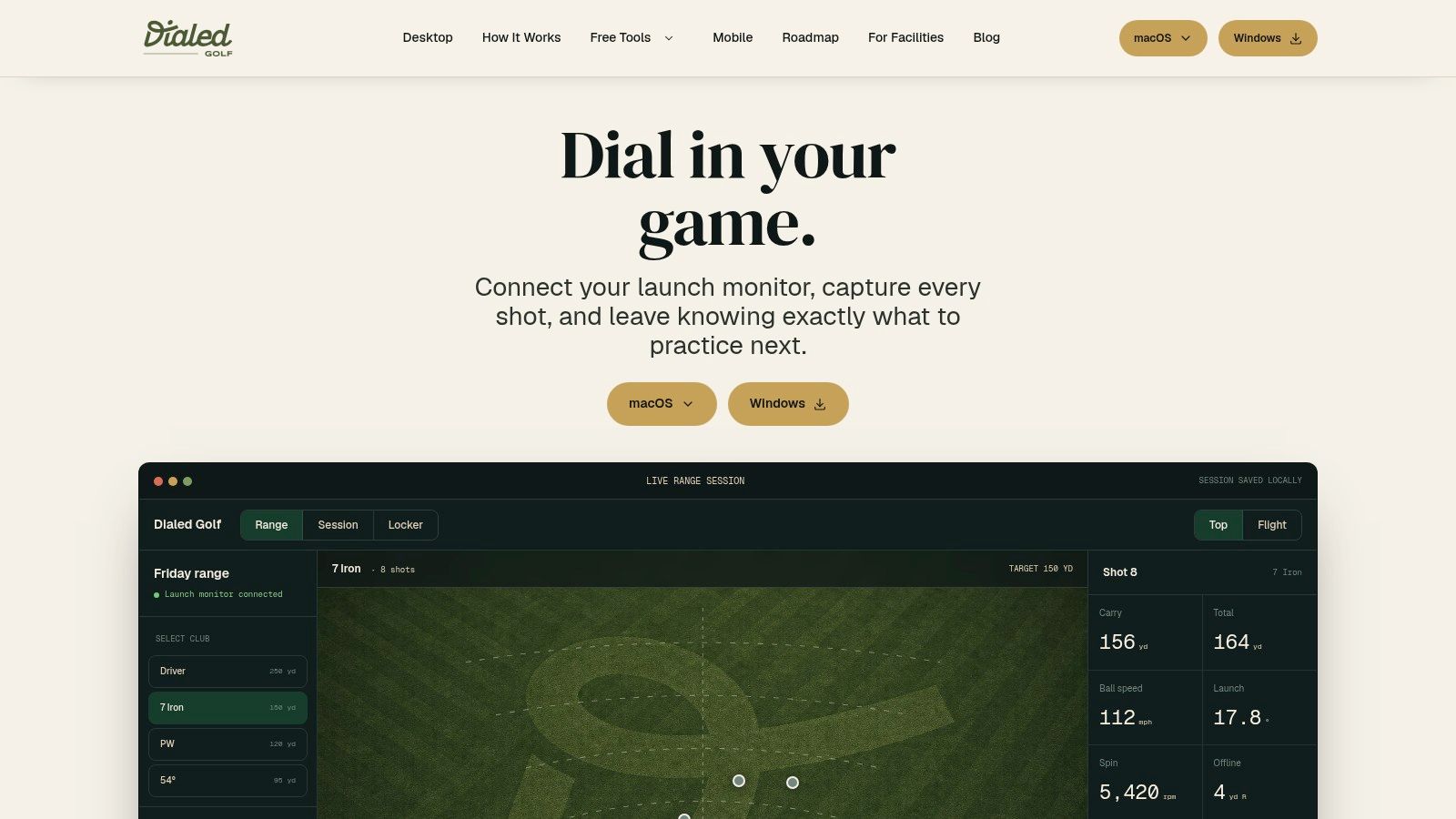
Dialed Golf is an independent golf-fitting and launch-data service, and its free web tools take measured club speed, spin rate in revolutions per minute, and spin axis in degrees, then return a named build, alternatives across price tiers, a no-purchase option, and a printable spec sheet. That format matters when two heads finish within a couple of yards of each other, because the decision moves to shaft, price, and turf interaction. The Carry Distance Chart Generator free tool builds a printable reference for the clubs the golfer trusts, which makes a new hybrid's slot obvious before the card is ever charged.
For anyone testing repeatedly, the Dialed desktop product runs launch-monitor practice with a live pair that starts with the Garmin R10 and is expanding, plus CSV import from Garmin, Rapsodo, SkyTrak, FlightScope, Uneekor, GSPro, Awesome Golf, and others, so sessions stay together for later review. The consumer app is in TestFlight now rather than general availability, and Golfer Pro runs $9.99 per week, $29.99 per month, $149.99 per six months, or $249.99 per year across app and desktop. Ranges and clubs that want memberships and a front desk have Dialed Academy at $99.99 per month or $999.99 per year, with the club keeping its dues.
Keep the fitting in the room
The Dialed Golf methodology page is explicit that an in-person fitting remains the gold standard and frames the free tools as a first step and second opinion. That's the right order. Use the data to arrive at a fitting with a specific question instead of a vague hope, then let a fitter check lie angle, shaft profile, and turf interaction on real grass.
Export the session, enter the two finalists, and book an in-person fitting if the results still sit within a few yards of each other. Two clubs that test nearly identically on a mat are usually separated by the lie you play most often.
If you're narrowing a hybrid decision this month, Dialed Golf gives you a free place to start: enter the club speed, spin rate, and spin axis from your last session and see the recommended build, the alternatives at other price points, and a printable spec sheet you can take into a fitting. It's a second opinion built on your numbers rather than someone else's ranking, and it costs nothing to check before you spend on a club. Visit Dialed Golf and run your two finalists through it before the next tee time.