

A golf course rating is the expected score a scratch golfer would shoot under normal conditions, expressed to one decimal place. It's a difficulty benchmark separate from par, so a course rated 71.8 isn't automatically a par-72 course or an easy one.
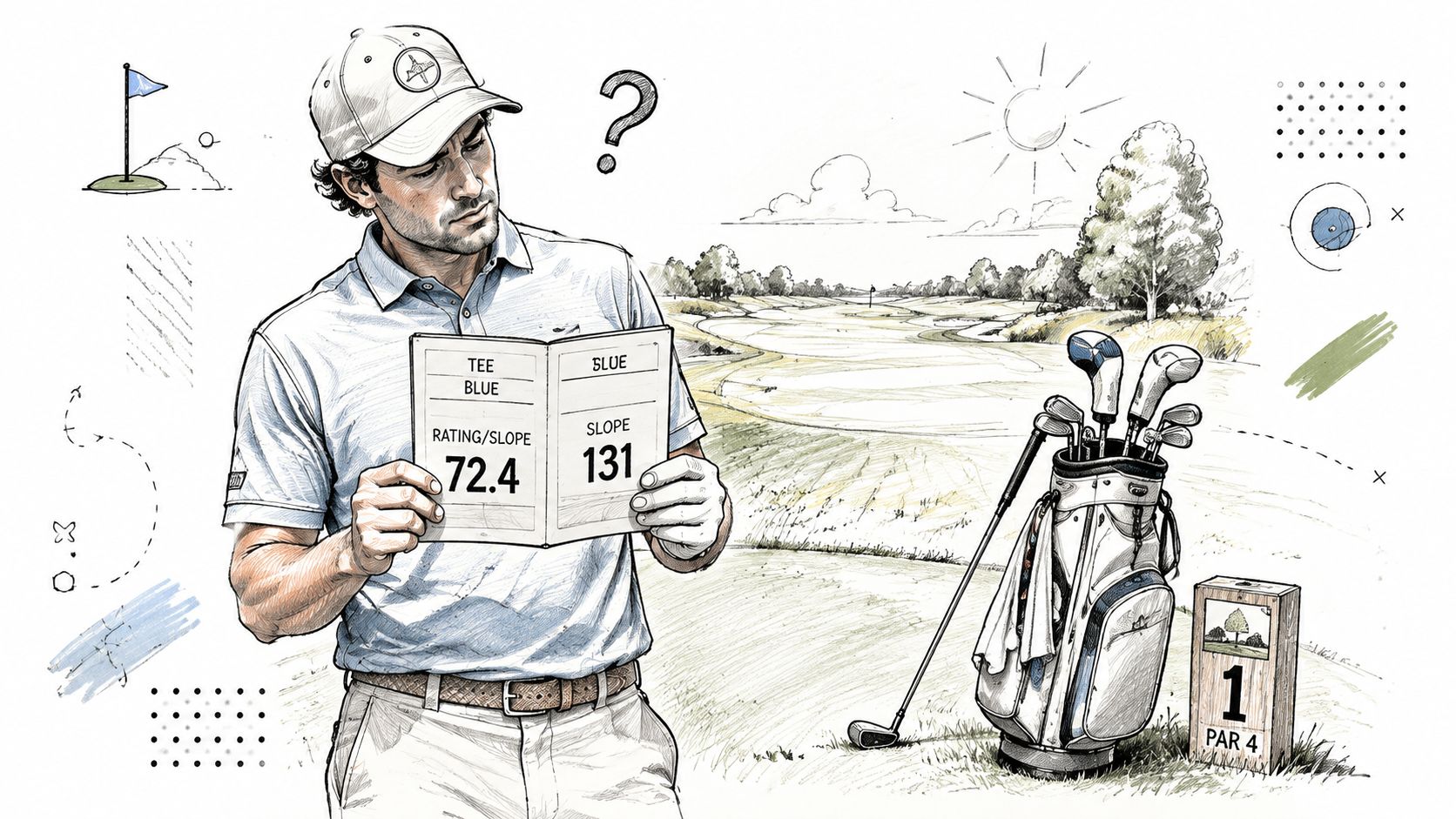
A golfer often discovers the difference after a round, while studying the scorecard and wondering why the tee markers show numbers such as 72.4 and 131 beside par. Those figures aren't arbitrary decoration. They describe how the course is expected to test different skill levels, and they help turn a score into useful information rather than a number viewed in isolation.
For golfers who practice with launch-monitor data, the meaning goes further. Course and slope ratings can influence tee selection, handicap calculations, practice priorities, and the way a player judges whether a round was strong.
Table of Contents
- The Numbers on Your Scorecard That Matter
- Understanding Course Rating as a Scratch Golfer Benchmark
- How Slope Rating Measures Relative Difficulty
- What Goes Into Calculating a Course Rating
- Reading Ratings Across Different Tees and Courses
- Using Ratings for Handicaps and Smarter Tee Selection
- Putting Course Ratings to Work on Every Round
The Numbers on Your Scorecard That Matter
That moment after a round, when you unfold the scorecard and see unfamiliar numbers beside par, often raises two questions. One value may sit close to par, while the other looks like a three-digit code. These are Course Rating and Slope Rating, and they describe how the selected tees are expected to play.
Par gives each hole an assigned scoring standard. It does not show the full challenge created by distance, hazards, forced carries, rough, or green targets from a particular tee. Course Rating and Slope Rating supply that missing context, helping you read a score against the course rather than in isolation.
Two numbers, two questions
Course Rating asks what a scratch golfer, a player with a Handicap Index of 0.0, would be expected to score under normal conditions. It is expressed to one decimal place and reflects the demands that affect a highly skilled player. The USGA explains the distinction in its overview of Course Rating and Slope Rating.
Slope Rating asks how much more difficult the same course is expected to be for a bogey golfer than for a scratch golfer. Handicap systems use both values to make scores more comparable across courses and tee sets.
The ratings also belong to specific tees. Move forward or back, and the numbers can change because the starting position changes the effective challenge. That matters during launch-monitor practice: match the tee you plan to play with the carry distances and approach patterns you are testing, then use the ratings to judge whether that practice setting represents the course.
Practical rule: Check both numbers before choosing tees. Par describes the hole design, while the ratings describe how that design is expected to affect different golfers.
A scorecard with these values helps you set a realistic target, select tees that fit your current ball-striking ability, and compare rounds with a meaningful baseline. It also gives launch-monitor data a course context, so practice numbers can guide an on-course decision rather than stand alone.
Understanding Course Rating as a Scratch Golfer Benchmark
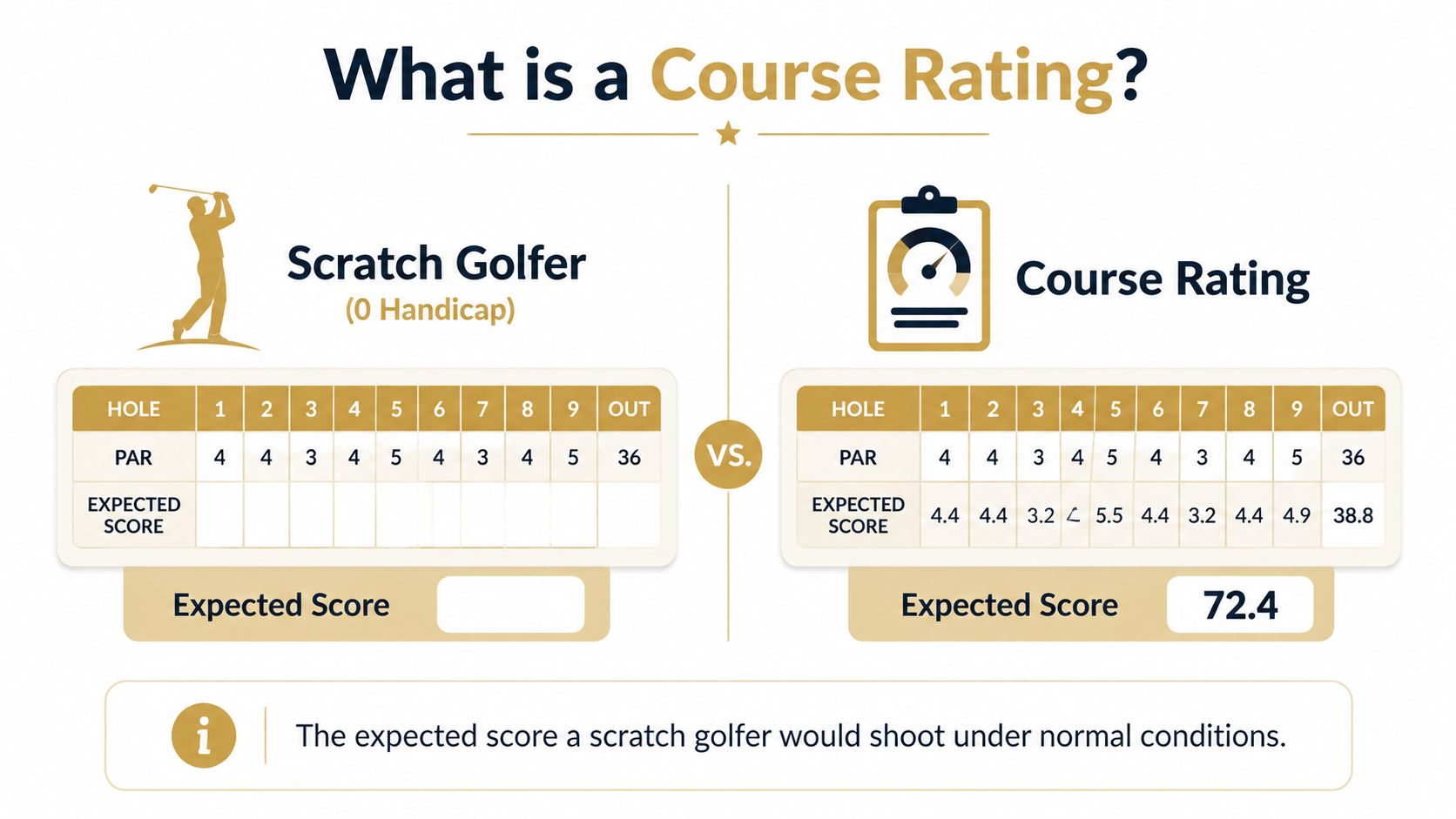
Course Rating is best understood as a scratch golfer's expected score, not as a revised version of par. A scratch golfer has a Handicap Index of 0.0, and the rating estimates the score that player should achieve under normal course and weather conditions. The USGA also states that the rating is expressed to one decimal place, as explained in its Course Rating definition.
Par is fixed by the hole layout and its intended scoring design. Course Rating reflects how the course plays for a highly skilled golfer. A useful coaching analogy is this: par is what the architect assigned, while Course Rating is what the course demands.
Read the number in three steps
- Find par. This is the course's assigned standard score.
- Find the Course Rating for the chosen tees. It may be higher, lower, or equal to par.
- Compare the two. The difference gives a quick sense of how the layout tests a scratch golfer.
Suppose a course is par 72 and carries a Course Rating of 74.5 from the back tees. The rating means a scratch golfer would be expected to shoot about 74.5, or roughly two and a half strokes over par, under normal conditions. That doesn't mean every scratch golfer will shoot that number. It's a benchmark used to describe expected difficulty.
The decimal matters because whole numbers hide useful detail. A rating of 71.8 and a rating of 72.4 may both look like “about par,” but the decimal gives the handicap system greater precision when comparing performance.
The rating also belongs to a specific tee set, not merely to the golf course as a whole. A forward tee, middle tee, and championship tee can each have a different Course Rating because the effective playing length and obstacles change.
That tee-specific number becomes the baseline for interpreting other golfers' scores. It doesn't say whether a particular round was good or bad by itself. It provides the reference point that handicap calculations use to account for the course being played.
How Slope Rating Measures Relative Difficulty
Slope Rating measures the gap between how a course plays for a scratch golfer and how it plays for a bogey golfer. A bogey golfer is commonly described as a player around a 20-handicap for men or 24-handicap for women, but the important idea is skill level, not the label. This golfer is more affected by distance, recovery shots, forced carries, and hazards than a scratch player.
The Slope Rating scale runs from 55 to 155, and 113 represents standard or average difficulty, according to the USGA's explanation of Slope Rating. A higher number indicates a steeper difference between scratch and bogey performance.
That distinction prevents a common mistake. A higher Slope Rating does not mean the course is harder for every golfer in the same way. It means the course's difficulty rises more sharply for the bogey golfer relative to the scratch golfer.
Why certain hazards affect slope
A forced carry may be manageable for a scratch golfer with reliable carry distance, but it can create repeated trouble for a golfer whose contact and distance vary. Tight landing areas, deep bunkers, and difficult recovery zones create a similar effect. The scratch player may avoid or escape those problems more consistently, while the bogey golfer pays for them through extra shots.
Consider two tee sets with similar Course Ratings but different Slope Ratings. The tee set rated 125 has a greater relative challenge for a bogey golfer than one rated 113, even if the scratch-golfer baseline is similar. The slope figure is therefore especially useful when a higher-handicap golfer compares courses or tees.
| Slope Range | What It Means | Example Scenario |
|---|---|---|
| 55 to below 113 | The relative gap is below the standard benchmark | A bogey golfer may find the course's design less punishing than an average-rated layout |
| 113 | Standard or average relative difficulty | A useful reference point for interpreting other slope values |
| Above 113 to 155 | The relative gap is greater than the standard benchmark | Obstacles and length may affect a bogey golfer substantially more than a scratch golfer |
Slope also affects the number of strokes a golfer receives for handicap purposes. The calculation accounts for the player's Handicap Index and the chosen tee's relative difficulty, allowing competition to remain more equitable across different layouts.
What Goes Into Calculating a Course Rating
A Course Rating isn't based on the yardage printed on the card alone. The USGA describes a process that adjusts effective playing length for factors such as roll, wind, elevation changes, altitude, dog-legs, and forced layups, so the rating reflects how far holes play in practice rather than only how far they measure.
A mountain course can therefore play longer than a flatter course with a greater listed yardage. Uphill approaches, limited roll, wind exposure, and forced layups all change the shots a scratch golfer must hit.
The first pillar, effective playing length
The rating process starts with measured length, then asks how the golfer experiences that distance.
- Elevation changes can make an approach play longer uphill or shorter downhill.
- Roll changes how far a tee shot travels after landing.
- Wind can add difficulty or reduce effective distance depending on direction and exposure.
- Dog-legs may prevent a player from using the full measured length of a tee shot.
- Forced layups make a hole play longer by requiring a golfer to stop short of an obstacle.
The result is a playing-length adjustment that better represents the shots demanded by the course.
The second pillar, obstacle factors
Rating teams also evaluate ten obstacle categories. These describe the trouble surrounding shots and the difficulty of recovering from mistakes:
- Topography, including slopes and uneven ground.
- Fairway width, including the usable landing area.
- Green target size, visibility, and approach demands.
- Recoverability after a missed fairway or green.
- Bunkers, including their position and severity.
- Out of bounds and the effect of nearby boundaries.
- Water hazards and other crossing or lateral obstacles.
- Trees, including density and proximity to play.
- Green surface, including contours and tiers.
- Psychology, the cumulative pressure created by the other factors.
The USGA's Course Rating and Slope Rating procedures explain that these elements contribute to a measured evaluation rather than an arbitrary opinion.
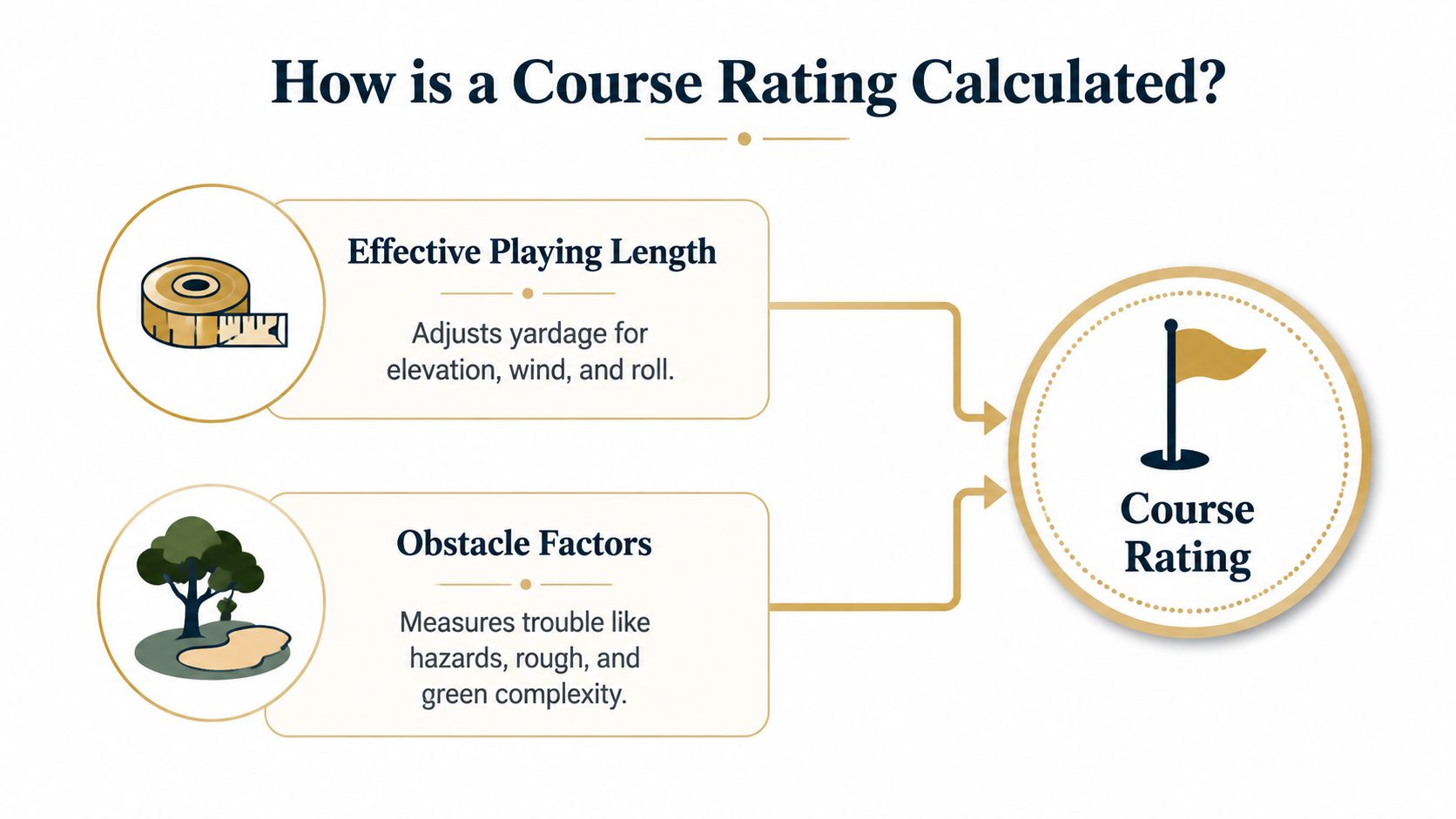
USGA-certified rating teams conduct on-site work, walking the holes, reviewing conditions, and measuring the features that affect play. Golfers who want more guidance on rules and handicap concepts can also explore Dialed Golf's rules and handicap resources. The final rating combines effective length with obstacle difficulty to create a course-specific scratch baseline.
Reading Ratings Across Different Tees and Courses
A scorecard becomes much easier to read when the ratings are compared in context. Consider a hypothetical par-72 course with three tee sets. The back tees may carry a Course Rating of 74.2, while the middle tees show 68.5. Those numbers describe different tests for the same scratch golfer, even though the holes and par remain the same.
The table below uses illustrative values to show how golfers can organize the information. The yardage figures are intentionally qualitative because the rating system accounts for effective playing length, not just the printed distance.
| Tee Set / Course | Yardage | Course Rating | Slope Rating | Par |
|---|---|---|---|---|
| Championship tees | Longer listed layout | 74.2 | Higher relative challenge | 72 |
| Middle tees | Moderate listed layout | 68.5 | Moderate relative challenge | 72 |
| Forward tees | Shorter listed layout | Lower than middle tees | Lower or higher depending on obstacles | 72 |
| Tight, tree-lined parkland course | Course-specific | 71.8 | 135 | Varies by layout |
| Open links-style course | Course-specific | 70.1 | 118 | Varies by layout |
The comparison reveals why Course Rating and Slope Rating must be read together. A tight, tree-lined layout can have a lower Course Rating than another course yet a higher Slope Rating because its narrow landing areas and recovery demands affect bogey golfers disproportionately. An open links-style course can present a lower scratch baseline while producing a smaller gap between scratch and bogey performance.
Match the number to the player
A scratch golfer usually pays close attention to Course Rating because it describes the expected score for that skill level. A bogey golfer should study Slope Rating more carefully because it indicates how sharply the course's demands may affect that player.
A higher Slope Rating doesn't automatically mean a higher Course Rating. The two figures answer different questions.
The same logic applies across tee boxes. A player shouldn't choose tees solely because the par is familiar or because the back markers look prestigious. The rating and slope attached to each tee provide a clearer picture of whether the course fits the golfer's current game.
Using Ratings for Handicaps and Smarter Tee Selection
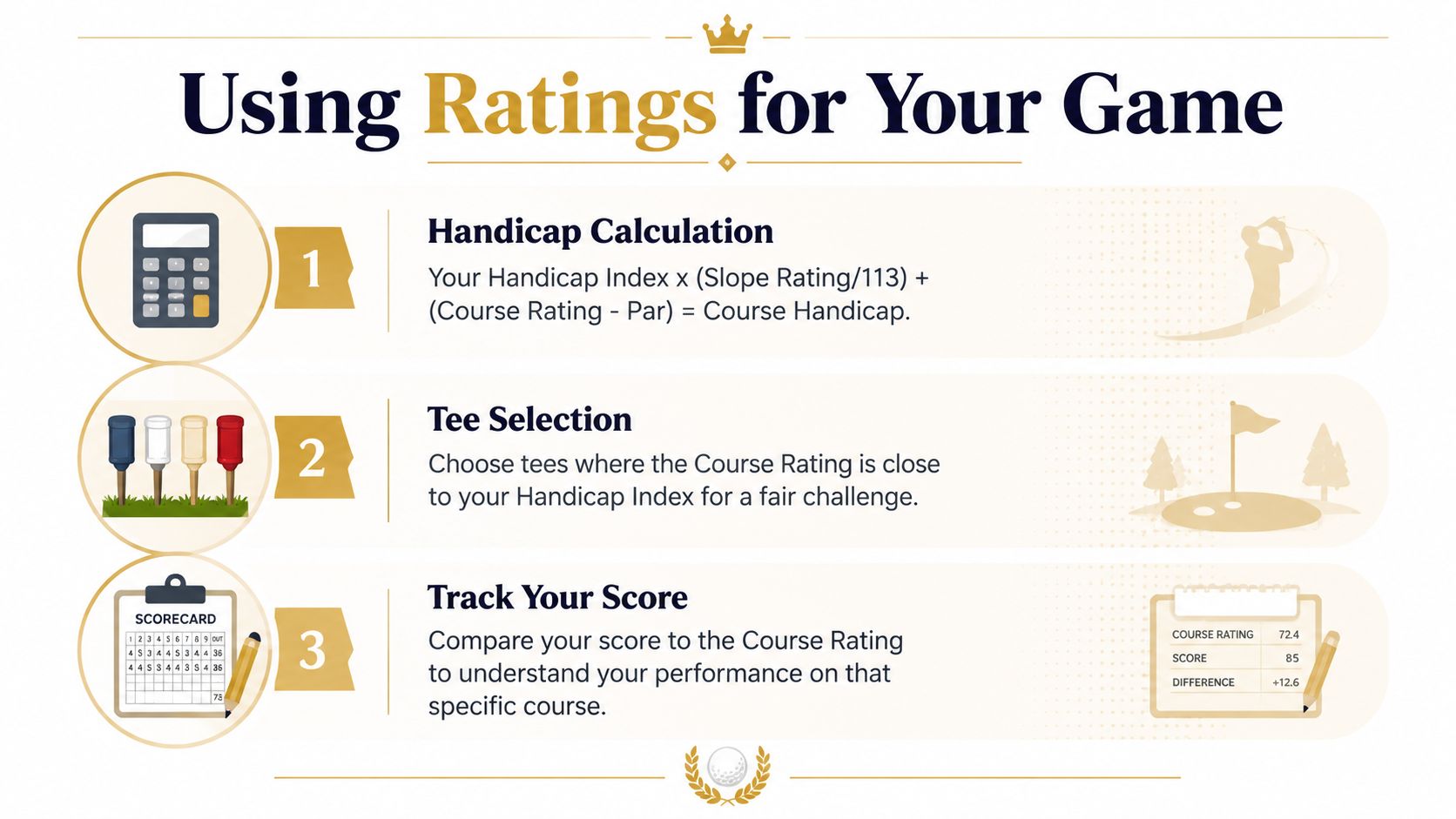
Course Rating and Slope Rating feed into the World Handicap System by converting a golfer's Handicap Index into a course-specific playing number. The commonly presented relationship is:
Course Handicap = Handicap Index × (Slope Rating ÷ 113) + (Course Rating − Par)
The benchmark of 113 matters because it represents standard relative difficulty. The Course Rating minus par adjustment then accounts for whether the chosen tee set is expected to play above or below its par for a scratch golfer.
A practical slope comparison
Take a golfer with a 15 Handicap Index choosing between two tee sets. One has a Slope Rating of 125, and the other has a Slope Rating of 140. Keeping the other variables unchanged, the formula gives the golfer more course-specific strokes from the tee set with the 140 slope because the relative difficulty is greater.
That isn't a reward for choosing tougher tees. It's the handicap system responding to the fact that the course's challenge affects a non-scratch player more sharply. The final calculation also depends on Course Rating and par, so the slope comparison alone isn't the complete result.
Golfers can review the broader process in Dialed Golf's handicap calculation guide. The useful habit is to compare tee ratings before the round, not after a difficult score has already been posted.
Use launch-monitor data to choose tees
A data-driven tee decision starts with carry distance and dispersion. A golfer who knows the carry distance of each club can compare those numbers with the course's effective playing length and identify the tee set that leaves manageable approach shots rather than repeated forced carries.
Launch-monitor practice can support that decision in a garage simulator or at the range. Dialed Golf's desktop product is built for launch-monitor practice, with a live pair first and expanding device coverage, plus CSV and import workflows for several launch-monitor and simulator data sources. The consumer app serves as a pocket caddy on the course, while Dialed Academy provides memberships and front-desk tools for ranges and clubs.
The goal isn't to chase a particular rating. It's to find tees where the golfer can use a normal club sequence, manage dispersion, and reach a reasonable number of greens without turning every hole into a recovery exercise.
Putting Course Ratings to Work on Every Round
Course Rating becomes practical once a golfer stops treating it as a mysterious scorecard number. It sets the scratch-golfer baseline, while Slope Rating describes the relative difficulty faced by a bogey golfer. Together, they support handicap calculations, tee selection, and more realistic scoring expectations.
Before each round, a player can record the Course Rating and Slope Rating for the chosen tees, then compare those values with other courses played regularly. Over time, patterns emerge. One layout may expose poor driving dispersion, while another may reveal weak distance control on approach shots or difficulty escaping hazards.
The same information can shape launch-monitor practice. If a course's effective playing length creates long approaches, practice can prioritize the clubs needed for those distances. If obstacle factors make misses costly, a golfer can rehearse safer shot shapes, tighter dispersion windows, or recovery decisions rather than spending every session on maximum distance.
A personal performance log becomes more valuable when scores are viewed against the rating for the tees played. That comparison doesn't replace sound course management, but it gives each round a clearer context and helps the golfer separate a poor score caused by avoidable mistakes from one produced by a demanding setup. Dialed Golf's practice and data resources can support that broader habit of connecting practice information with on-course decisions.
A golfer who checks ratings, chooses tees deliberately, and records results against the proper baseline turns every round into a useful data point. That process builds sharper self-awareness, more targeted practice, and better decisions before the first tee shot.
Dialed Golf connects on-course planning with launch-monitor practice through one golfer record, with a consumer app, desktop practice workflows, and Dialed Academy for ranges and clubs. Visit Dialed Golf to explore the free web tools and choose the setup that fits the next round's rating, slope, and practice goals.