

The average amateur golfer hits a 3-wood 218 yards, with scratch golfers averaging 261 yards and 25-handicappers averaging 178 yards. Your own reliable number, though, depends on whether the shot comes from a tee or fairway and whether you're measuring carry or rollout.
A golfer standing over a 3-wood on a tight par 5 usually knows the club's reputation, but not the number that matters. The question isn't whether the club can reach the corner or advance the ball toward the green. It's whether this particular swing, from this particular lie, produces enough predictable carry to justify leaving the driver in the bag.
That's why a population average is useful as a starting point, but weak as a decision tool. A structured launch-monitor session can turn “about 220” into separate tee, fairway, and gapping numbers that hold up under pressure.
Table of Contents
- What the Average 3 Wood Distance Actually Looks Like
- Launch Conditions That Drive 3 Wood Distance
- Why Context Changes Your Real 3 Wood Number
- Building a Reliable 3 Wood Range Session
- Exporting and Importing Your 3 Wood Data
- Turning Numbers into a Usable Carry Window
- Tracking Your 3 Wood Distance Over Time
What the Average 3 Wood Distance Actually Looks Like
The golfer on the tee has a familiar choice. The driver offers maximum distance, but the fairway narrows near the landing area. The 3-wood looks safer, yet pulling it creates a second question: is the expected distance based on a clean strike, total rollout, or an optimistic range shot?
The most recent broad benchmark gives a clear starting answer. A 2025 Shot Scope data summary reports an average amateur 3-wood distance of 218 yards, with a substantial spread by handicap. Scratch golfers average 261 yards, while 25-handicappers average 178 yards. The figures are reported in Golf Monthly's summary of average amateur 3-wood distances.
| Handicap | Average 3-Wood Distance | Average Driver Distance | Typical Gap |
|---|---|---|---|
| Scratch | 261 yards | 288 yards | 27 yards |
| Average amateur | 218 yards | 245 yards | 27 yards |
| 25 handicap | 178 yards | Not specified in the source | Not specified in the source |
The same summary places average male amateur driver distance at 245 yards, meaning the typical 3-wood plays about 27 yards shorter than driver for that population. That gap helps explain why the club functions as a control option rather than a weaker driver.
A separate 2021 Shot Scope database analysis covering 80 million shots found overall off-the-tee averages of 225 yards for driver and 203 yards for 3-wood, a 22-yard separation. The analysis also described the usual driver-to-3-wood difference as falling in the 20-to-30-yard range, as reported in this independent woods-distance summary.
Practical rule: A 3-wood that carries near the benchmark for a golfer's handicap may be doing its job even if its total distance looks modest. Carry determines whether the ball clears the trouble.
A player below the 218-yard amateur benchmark isn't automatically losing distance. The more useful question is whether the club's carry is consistent, whether the gap to driver is meaningful, and whether the 3-wood produces a better result on the holes where it gets selected.
Launch Conditions That Drive 3 Wood Distance
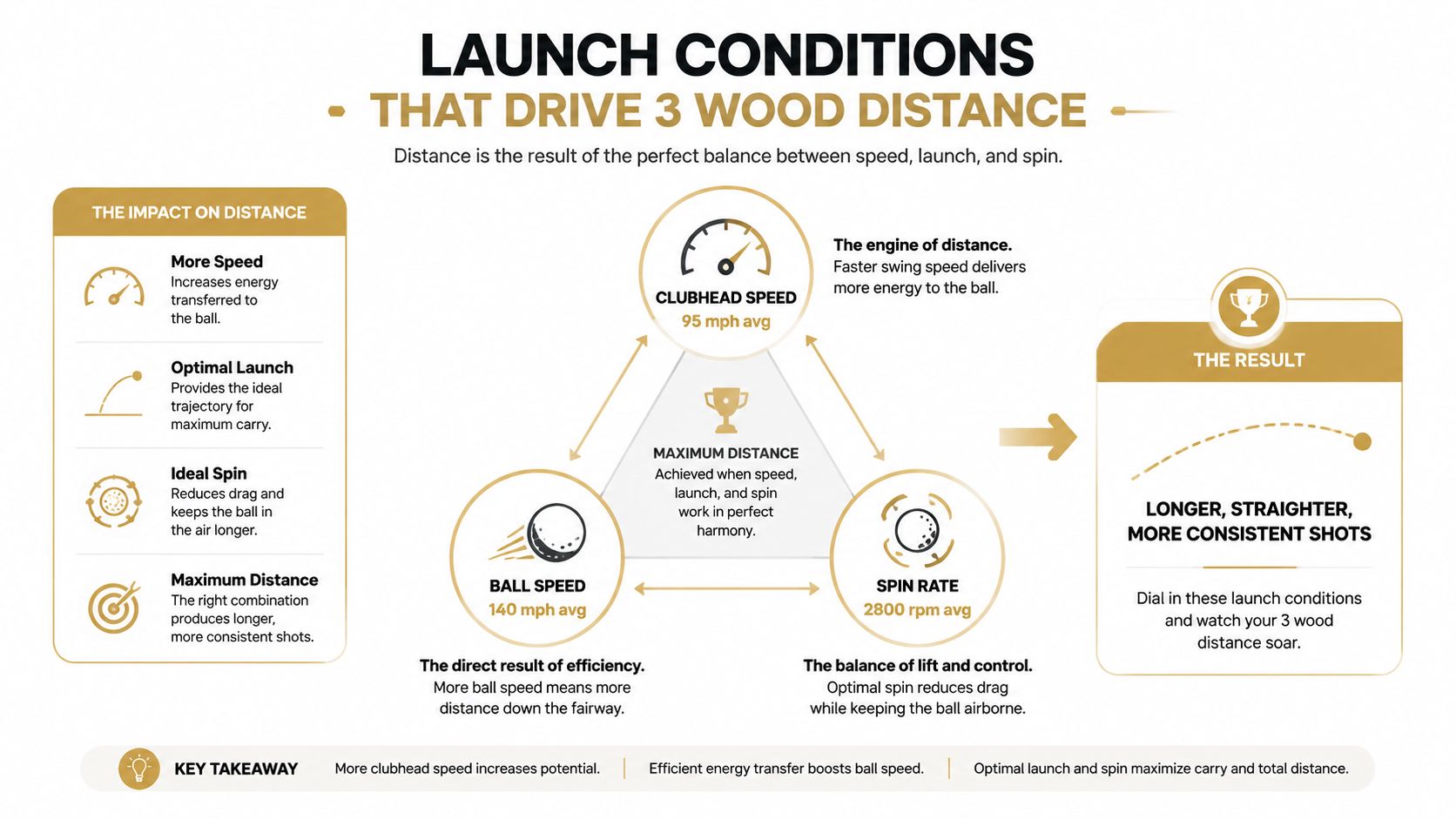
Loft alone doesn't determine 3-wood distance. Clubhead speed, strike quality, ball speed, launch angle, and spin have to work together, and the correct relationship changes with the golfer's delivery.
Tour-level numbers show how demanding that relationship is. PGA Tour 3-wood performance is typically around 243 yards of carry, with approximately 107 mph clubhead speed, 3,600 to 3,700 rpm of spin, a launch near 9 to 10 degrees, and a smash factor around 1.47, according to PGA Tour wood and hybrid performance benchmarks. Those numbers describe highly centered strikes and a delivery designed to create speed without excessive spin.
What the monitor should reveal
Clubhead speed sets the available ceiling, but it doesn't guarantee useful distance. Ball speed tells whether that speed reached the ball efficiently. A golfer who swings quickly but strikes low on the face may produce less carry than a slower player with a centered contact pattern.
Launch angle and spin rate control how the ball stays in the air. Independent fitting tables place a broad effective 3-wood carry window around 215 to 250 yards, with launch roughly 12 to 15 degrees and spin about 2,800 to 3,500 rpm for many golfers. The launch-monitor guidance from Up Your Club also notes that slower swings generally need slightly more launch and spin, while faster swings can benefit from lower values.
The apparent difference between the tour benchmark and broad amateur guidance isn't a contradiction. Tour players deliver more speed and strike efficiency, so their optimal launch profile can sit lower while still producing enough height and carry. An amateur chasing those exact numbers may create a low, short shot.
Carry matters more than a range total
A launch monitor may show a satisfying total distance after rollout, but the carry figure is the one to use for hazards, forced carries, and approach planning. Excess spin can cost forward progress, while insufficient spin can make the flight fall out of the air before the golfer reaches the intended landing area.
The best test is comparative. Record carry, ball speed, launch, spin, and strike location, then look for the combination that produces a repeatable landing distance. The longest single shot usually says less than the cluster of solid strikes around it.
Why Context Changes Your Real 3 Wood Number
A golfer doesn't have one 3-wood distance. The golfer has a tee carry, a fairway carry, a poor-lie result, and perhaps a different number when the club is being used to fill a gap between driver and 5-wood.
Arccos-based independent summaries report that 11-to-15-handicap golfers average 186 yards with 3-wood off the tee, while approach-shot results are shorter. The same coverage reports that amateurs generally hit 3-woods about 20 yards farther than 5-woods off the tee, but only 11.4 yards farther on approach shots, as detailed in this tee-versus-approach analysis.
The lie changes the delivery
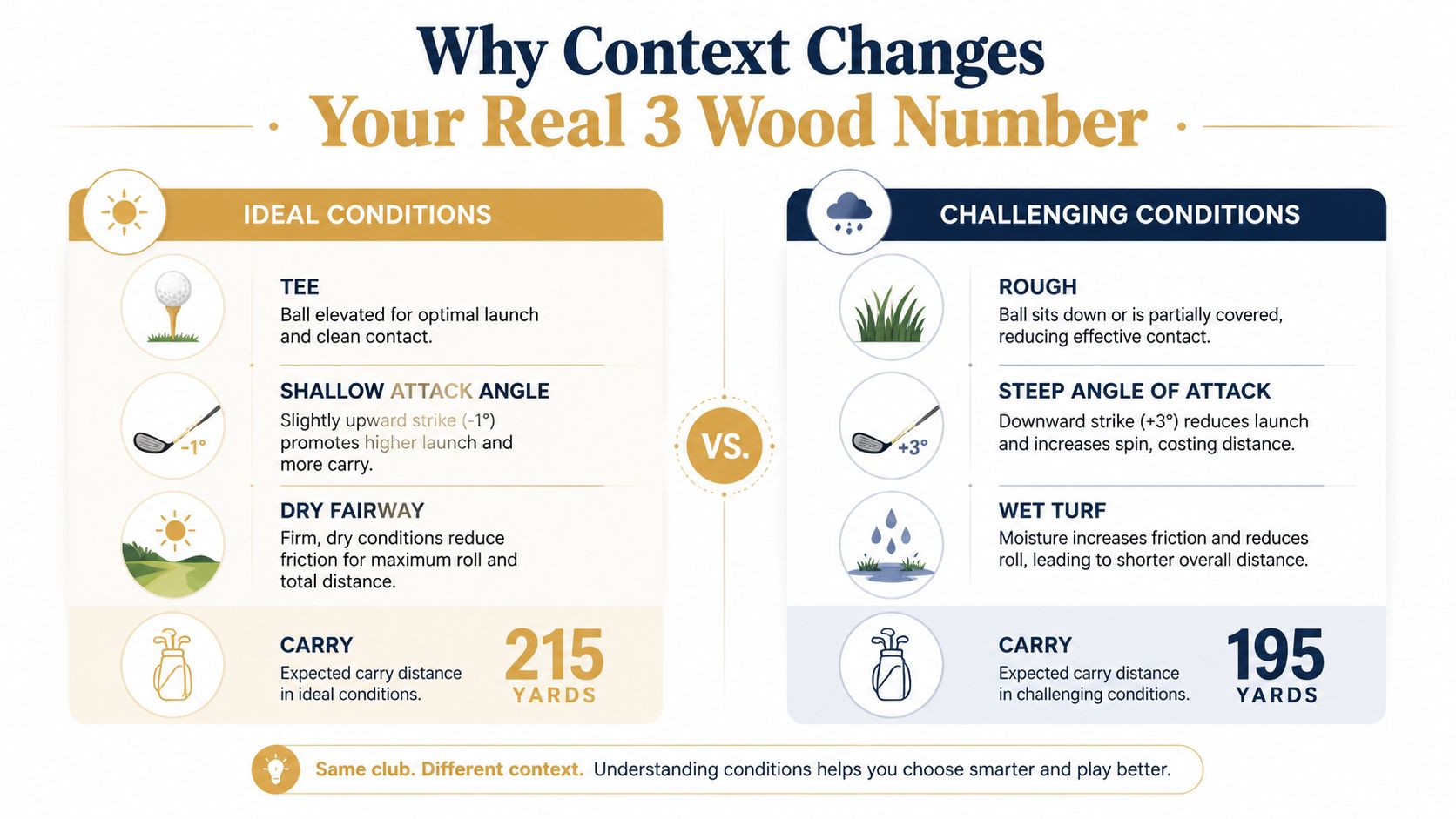
Off a tee, the golfer controls the lie and can position the ball to make a shallow strike easier. From the fairway, the ball sits lower and the player has less margin for a heavy or thin strike. Rough adds another variable because grass can interfere with face contact and reduce speed.
Attack angle matters, too. Recent robot-testing coverage found that a 3-wood can lose carry when the attack angle becomes steeper, with reduced carry observed at both 95 mph and 85 mph swing speeds. The club doesn't behave exactly like a hybrid or iron, so an iron-style downward strike isn't automatically productive.
A 3-wood should be tested as a tee club, a fairway club, and a gapping club. Treating those as one shot is how golfers build misleading yardage charts.
Wet turf, a steep delivery, and a poor lie can turn a nominally long club into a short-carry option. That doesn't make the 3-wood useless from the fairway. It means the golfer needs a separate fairway number instead of borrowing the tee-shot number.
Building a Reliable 3 Wood Range Session
A trustworthy session starts before the first recorded shot. The golfer should decide what the data needs to answer: tee distance, fairway carry, or the relationship between the 3-wood and the rest of the bag.
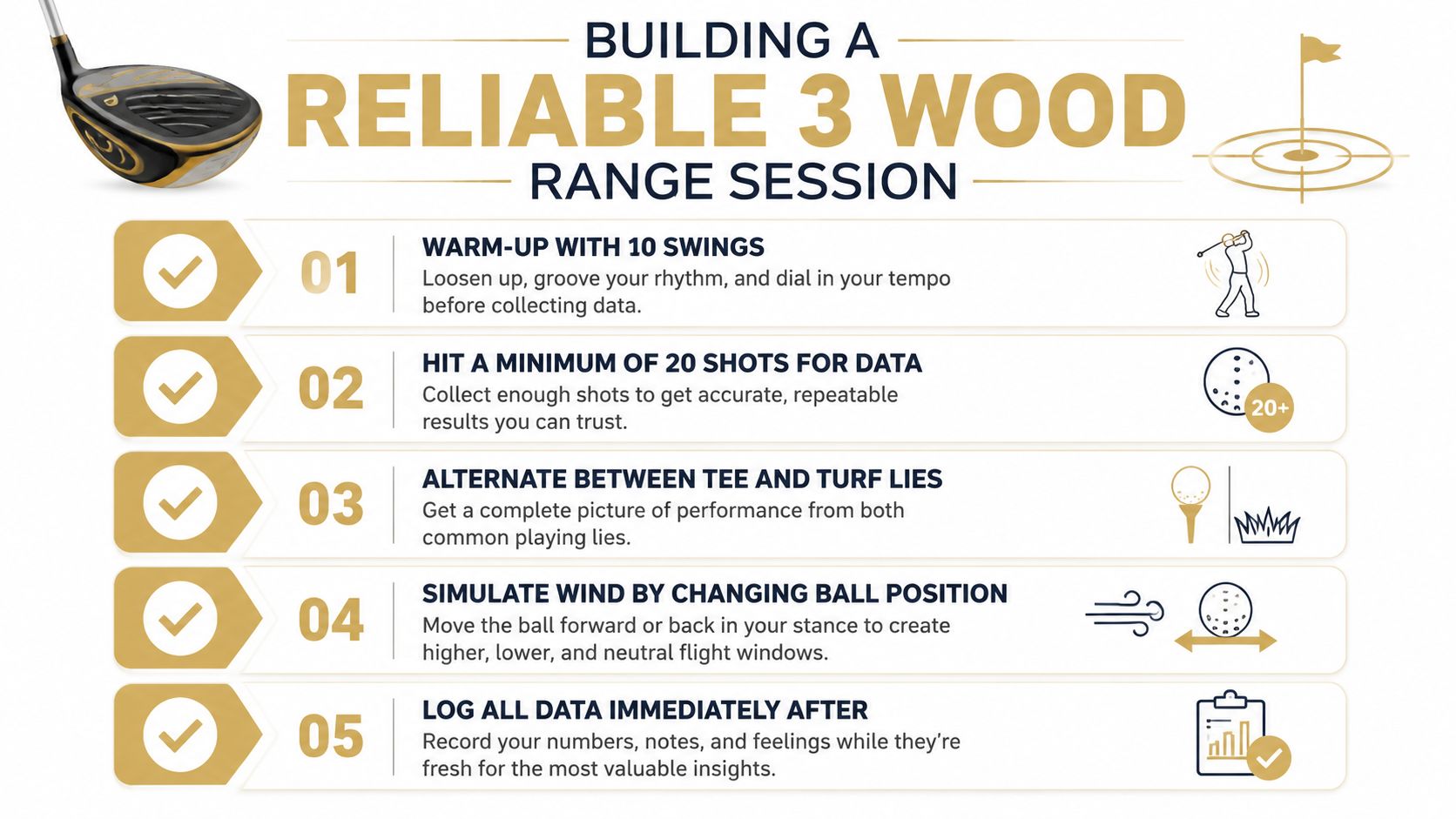
A practical session can follow this sequence:
Warm up without recording. Use ten relaxed swings to establish rhythm and contact. The purpose isn't to chase speed before the body is ready.
Collect a meaningful sample. Hit at least 20 recorded shots so the session includes normal variation rather than only the first few flushed strikes.
Alternate the lie. Switch between tee and turf rather than hitting every tee shot first and every fairway shot afterward. That separation makes the context visible in the eventual file.
Change the setup deliberately. Vary ball position to rehearse different launch windows and conditions. Don't label every altered shot as a stock carry.
Log the session immediately. Record club, lie, ball, setup notes, and any equipment change while the details are still fresh.
The shot filter matters as much as the shot count. Discard obvious mishits, topped balls, hosel strikes, and swings interrupted by a technical experiment. Keep normal misses, because removing every imperfect strike creates a number that won't survive on the course.
A useful file can include both carry distance and total distance, but the golfer should use carry for club selection. The analysis should also preserve launch, spin, ball speed, and clubhead speed where available, since those fields explain why two shots with similar carry may have arrived there differently.
For a broader practice workflow, golfers can review this guide to choosing a launch monitor for driving-range practice before building a repeatable setup.
The goal isn't to hit until the average looks flattering. It's to produce a clean record of the shots the golfer can reasonably reproduce.
Exporting and Importing Your 3 Wood Data
A launch-monitor session has limited value if it stays buried in an app. Export the file, preserve the original, and add the shots to a record that supports future gapping decisions. Garmin support documentation shows that a driving-range session can be exported as a CSV file by opening the session in the Garmin Golf app and selecting “Export to CSV,” as described in the official CSV export instructions.
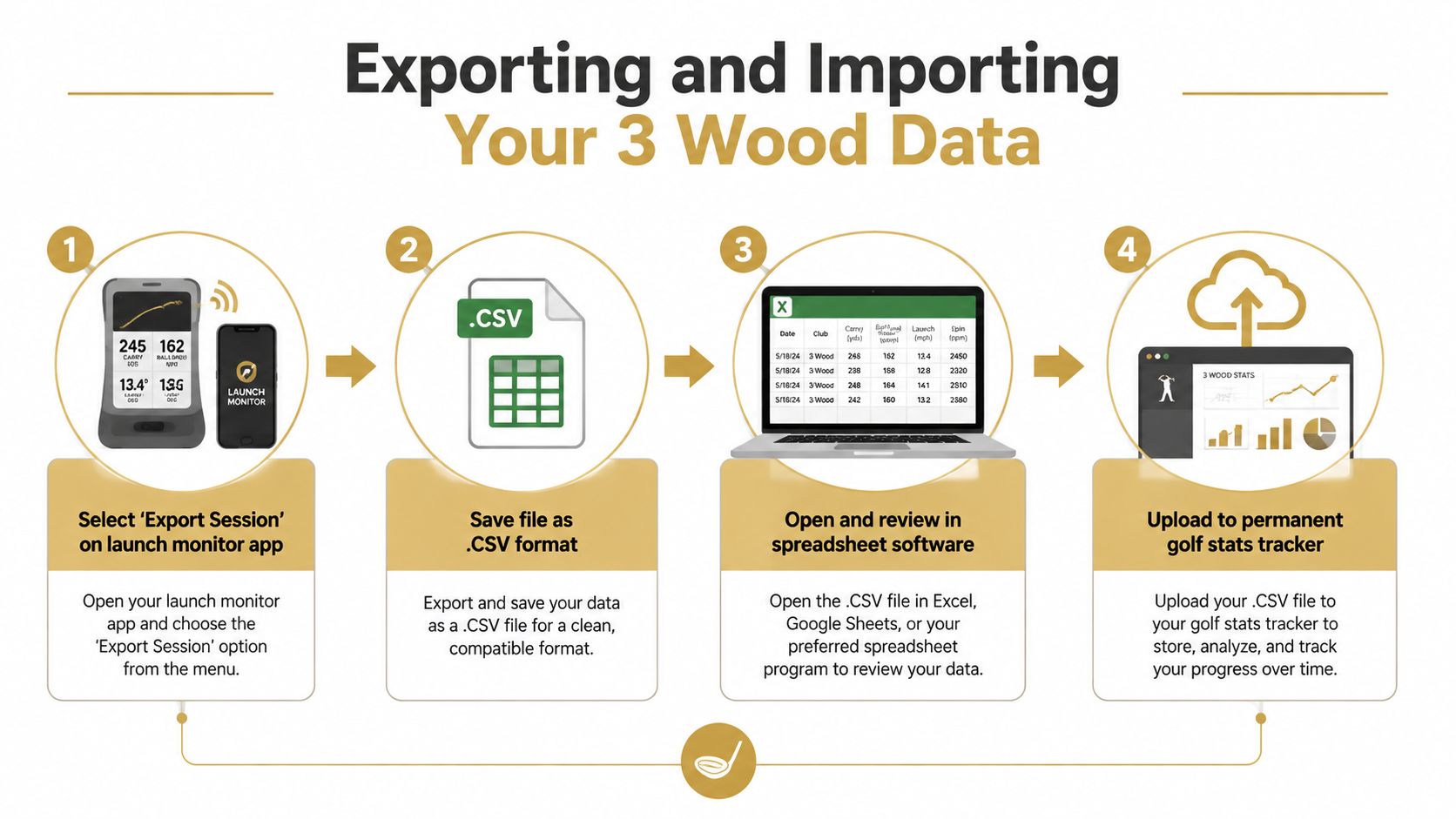
A clean four-step workflow
Select one session. Export a discrete practice session rather than combining unrelated clubs, lies, or dates. Keeping sessions separate makes tee and fairway comparisons easier to audit.
Protect the raw CSV. Store the untouched export, then make a working copy for cleanup. A spreadsheet edit can shift a column, change a value, or remove information you later need.
Map the fields. Match the monitor headers to the analysis fields. Carry distance should map to carry, total distance to total, and the club identifier should stay attached to every shot.
Validate the import. Confirm that each row includes the expected club, context, and distance fields. Check delimiters, blank rows, changed headers, and date formats before analysis. A file can import successfully and still produce a misleading result if its columns were mapped incorrectly.
The same process applies across compatible launch-monitor and simulator exports. For step-by-step setup, follow Dialed Golf's CSV import walkthrough before adding the session to a permanent tracker.
Keep the fields that explain the distance, not just the headline number. A useful file can contain carry distance and total distance, while carry remains the figure for club selection. Preserve launch, spin, ball speed, and clubhead speed when available. Those fields show why two shots with similar carry may have reached it through different launch and strike conditions.
The goal is a clean, reusable record of normal shots. It should support later comparisons between tee and fairway use without turning one flattering average into a false playing number.
Turning Numbers into a Usable Carry Window
A golfer can average 218 yards with a 3-wood and still lack a dependable playing number. The shots may include tee balls, fairway attempts, and mishits, creating either a tight cluster or a spread too wide for confident club selection.
Build a carry window from normal strikes. Sort the imported rows by context, remove obvious outliers, and identify the range that represents usable shots. The result should answer two practical questions: how far does the club usually carry, and how short can a normal miss finish?
Build the window around decisions
Start with tee shots. If the 3-wood is used to find a fairway, prioritize the carry that reliably clears the intended landing area. The longest shot in the CSV is a reference point, not a planning number.
Review fairway shots separately. A fairway carry window can be shorter because lie, strike, and attack angle change. Keep it distinct from the tee profile, especially when planning an approach over a hazard.
Use a broad external benchmark only as a check. Independent fitting tables place an effective 3-wood carry window around 215 to 250 yards, but personal launch-monitor results should determine the number used for decisions.
Then compare the 3-wood with driver and 5-wood. Perfectly even gaps are unnecessary. The useful question is whether each club covers a common target without duplicating another club's role.
Decision test: If the 3-wood's strongest value is accuracy from the tee, classify it as a tee club. If it fills a practical distance between longer and shorter clubs, classify it as a gapping club. Let the shot pattern set the label.
Use this gap-analysis workflow to organize those comparisons. Recheck the window after a loft, shaft, ball, or meaningful swing change. A carry window is a working reference, not a permanent identity for the club.
Tracking Your 3 Wood Distance Over Time
Population averages answer the search question, but a longitudinal record answers the on-course question. The golfer needs to know whether the 3-wood still carries its normal distance after a winter break, equipment change, or swing adjustment.
Schedule structured retesting and preserve the same categories each time. Keep tee and turf shots separate, record the club specification, and note changes that could affect launch or strike. A clean history makes it easier to distinguish a real equipment effect from one unusually good or poor practice day.
The desktop workflow matters because it lets golfers bring launch-monitor sessions into one record instead of relying on memory or isolated app screens. Dialed Golf's desktop product is built around launch-monitor practice, with live pairing first through Garmin R10 and expanding support, plus CSV and import workflows for Garmin, Rapsodo, SkyTrak, FlightScope, Uneekor, GSPro, Awesome Golf, and more. The consumer app remains a pocket caddy, currently available through TestFlight rather than general App Store availability, while free web tools stay free and Golfer Pro spans app and desktop at $9.99 per week, $29.99 per month, $149.99 for six months, or $249.99 per year.
The next useful step is simple: book a practice session, capture separate tee and fairway data, export the CSV, and build the first carry window. That personal record will beat any generic average when the golfer has to choose a club with trouble in play.
Dialed Golf gives golfers a desktop-first place to pair launch monitors, import CSV sessions, and keep 3-wood carry data with the rest of the bag record. Visit Dialed Golf to start building a personal distance and gapping workflow around the shots that occur on the course.