

You're standing over an 80-yard wedge after a decent drive, and the lie looks simple enough. Then the swing gets a little quick, the contact blinks thin, and a shot that should've been routine turns into a scramble for par. That's the part most golfers know too well, because the shot feels easy right up until it doesn't.
The internet is full of wedge tips, but most of them stop at ball position, weight forward, and “make a smooth swing.” Those cues matter, but they don't solve the core scoring problem, which is choosing a repeatable carry window under pressure. A better wedge game comes from combining sound setup with a measurable system for distance control, so you're not guessing from 60, 75, or 90 yards.
Table of Contents
- Why Your Wedge Game Is Costing You Strokes
- The Unskippable Fundamentals of a Crisp Wedge Setup
- Mastering Distance Control with the Clock System
- How to Control Trajectory for Any Pin Location
- Build Your Personal Wedge Matrix with Launch Monitor Data
- Translating Your Range Data to On-Course Success
- Conclusion Your Path to Becoming a Scoring Threat
Why Your Wedge Game Is Costing You Strokes
A lot of golfers lose strokes on a shot they think should be safe. They pick a wedge, make a half-committed swing, and watch the ball finish a club or two short, or fly past the landing area they had in mind. The problem usually isn't touch alone. It's that the player is trying to solve a distance-control problem with a feel-only method that changes from swing to swing.
That's why generic advice falls apart so quickly. Independent instruction notes that tour players often use a clock system and keep consistent loft gaps between wedges, about 4–6 degrees, so their carry windows stay usable, while Golf.com points out a common amateur mistake, trying to hit a full lob wedge from 60 yards instead of choosing a lower-loft club and a controlled swing length, a mistake that forces too much manipulation into the shot distance gaps and club choice.
Practical rule: if the shot is inside your normal wedge range, the first question isn't “how hard should I swing?” It's “which club and which swing length gives me the cleanest carry window?”
The real scoring leak
The shot doesn't need to be heroic. It needs to be repeatable. That's where a lot of amateurs get stuck, because they practice wedge shots as isolated events instead of building a system that tells them, with confidence, what 7:30, 9:00, or 10:30 produces. Once you start thinking in carry windows instead of one-off swing feels, your practice gets more useful and your on-course decisions get simpler.
A modern wedge game is part technique and part calibration. The technique keeps the strike reliable, but the calibration is what stops you from guessing under pressure. If you've ever stood over a wedge and felt torn between three clubs and two swing thoughts, that's the sign you need numbers, not more noise.
The Unskippable Fundamentals of a Crisp Wedge Setup
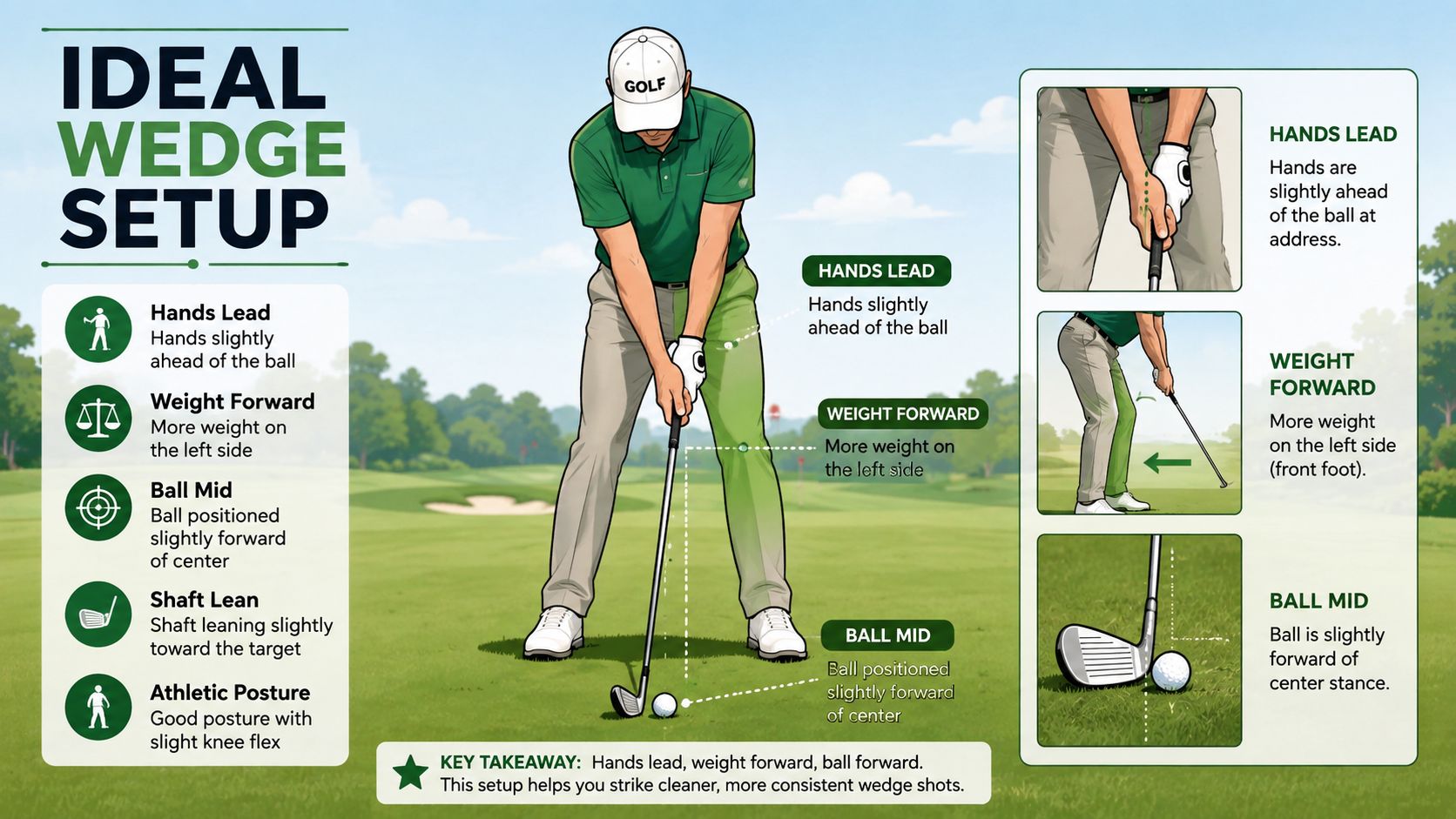
A crisp wedge starts before the club moves. If you want predictable carry numbers, the setup has to put the club in a position where it can return to the ball cleanly, with the low point in front of it. The standard setup pattern is straightforward, a slightly back-of-center ball position, forward shaft lean, and most of the pressure on the lead foot, usually about 55–70% at address setup fundamentals.
That position changes the strike pattern immediately. With the ball a little back and the pressure already favoring the lead side, the club is more likely to contact the ball first and then take a shallow divot after impact. That is the contact pattern that gives you a controllable wedge shot instead of one that depends on a last-second hand flip.
Build the address position first
A narrower stance does more for wedge control than most players realize. One coach identifies a wide stance as a common mistake because it makes the low point less stable, while a hip-width or narrower base helps promote a ball-first strike setup fundamentals. A wide stance can feel solid, but on wedge shots it often makes the body hang back and encourages the club to bottom out too early.
Use this as your pre-shot checkpoint.
- Ball position: just back of center, not buried well behind the lead foot.
- Pressure: favor the lead side, about 55–70% at address.
- Stance width: hip-width or narrower.
- Hands: slightly ahead of the ball, with visible shaft lean.
- Goal: a low point that sits in front of the ball.
The common amateur mistake is trying to lift the ball with the hands. That usually adds wrist action, shifts the low point around, and turns a simple partial swing into a timing test. A quieter body and a stable setup remove a lot of avoidable variation before the club even starts back.
Let the motion stay compact
The same instructional sources warn against over-swinging past three-quarter length and against too much wrist action setup fundamentals. A controlled chest turn and a finish that keeps moving toward the target do more for contact than trying to hold the clubface open or force a late rescue through impact. The handle and belt buckle still need to keep working forward, because a wedge shot that stalls at the bottom usually loses both strike quality and distance control.
That trade-off matters. A compact motion may feel less powerful, but it gives you a more repeatable strike window and better distance control, which is what lowers scores. In my coaching work, the players who improve fastest are the ones who stop chasing a prettier swing shape and start building a setup they can trust under pressure.
Mastering Distance Control with the Clock System
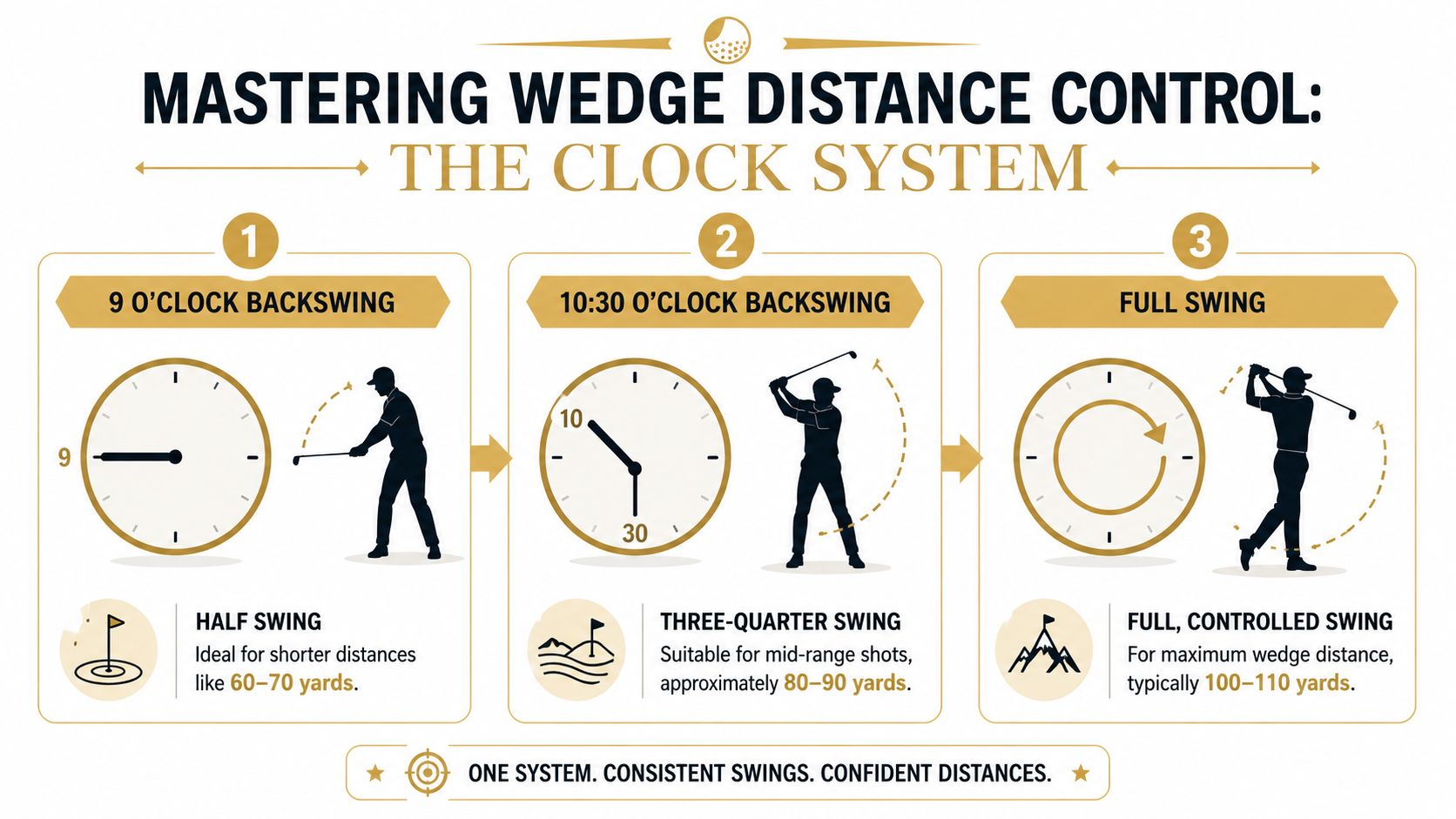
Distance control gets easier when you stop thinking in effort and start thinking in swing length. The clock system gives you three dependable reference points, 7:30, 9:00, and 10:30, so the backswing becomes a map instead of a guess. A common training approach uses several shots per wedge at fixed swing positions to create reliable windows carry matrix protocol.
The reason this matters is simple. In amateur wedge play from inside 100 yards, misses long or short are almost twice as large as misses left or right, and for a 5-handicap player from 100 yards that was described as roughly 12 yards long/short versus 7 yards left/right wedge miss pattern. That means the wedge problem is mostly a depth problem, not a target-line problem.
Use swing length as the primary variable
A useful wedge stock pattern starts with a consistent rhythm and a repeatable finish. The goal isn't to swing harder on one shot and softer on the next. It's to keep the motion recognizable while the backswing length changes enough to produce different carry distances.
That's where the three checkpoints help.
- 7:30 feels like a short, controlled motion for tighter windows.
- 9:00 gives you a middle distance option you can trust.
- 10:30 stretches the motion without turning it into a full, loose swing.
The point isn't that those numbers are magic. The point is that they reduce decision fatigue. If you know what each swing length produces with each wedge, you can choose the shot instead of hoping a touchy, in-between swing lands where you want.
Good wedge practice measures carry, not total distance. Rollout changes with turf, spin, and landing angle, so total distance can mislead you badly.
That distinction is especially useful in scoring practice. A shot that lands exactly where you wanted can still roll out differently from one lie to another, so practice has to prioritize the number that determines the landing area. A carry chart keeps you honest.
Build the habit around a fixed process
A good range session doesn't need to be long, but it does need structure. Hit the same swing lengths with different wedges, record the carry, and look for overlap or dead spots between clubs. If a 9:00 pitching wedge and a 7:30 gap wedge produce the same carry, one of those clubs or motions isn't giving you a clean decision.
Use this carry distance chart tool to organize the numbers once you start building them. It's a straightforward way to turn scattered wedge reps into something you can use on the course.
How to Control Trajectory for Any Pin Location
A wedge to a back pin on a firm green asks for a different flight than a front pin tucked behind trouble. The shot still needs to start with a clean setup, but once that is in place, trajectory becomes a choice about how much height and spin you want to trade for control. Lower shots usually give you more run and less exposure to wind. Higher shots can help the ball land softer, but they demand better strike quality and more precise distance control.
The biggest mistake is trying to create trajectory with a late hand flip. That adds timing pressure and usually costs contact. A better approach is to control flight through setup, ball position, and shaft lean, then match the shot to what the green asks for. The setup fundamentals you already learned matter here because they shape the launch before the club ever reaches impact.
Match the flight to the shot, not to ego
A tucked pin does not always call for the highest shot you can make. If you have room to land the ball short and let it release, a flatter wedge can be the smarter play. A soft landing into a firm surface is different. That shot often needs a cleaner, higher launch so the ball stops without a lot of rollout.
Here is the practical breakdown:
- Lower flight: ball slightly farther back, hands ahead, less dynamic loft.
- Standard flight: neutral ball position, stock setup, stock tempo.
- Higher flight: ball a little more centered, less shaft lean, still controlled.
Each option comes with a trade-off. Lower flight tends to hold up better in wind and release more predictably, but it leaves less stopping power. Higher flight can stop faster, but only if the strike is solid and the contact stays centered. The right call depends on the lie, the green firmness, and how much room you have between the landing area and the hole.
A common amateur mistake is trying to force height by opening the face a lot or stabbing at the ball. That usually changes the strike pattern more than the flight pattern. Keep the motion simple and choose the loft and setup that produce the trajectory you need, then confirm the carry windows with your own numbers. A practical golf bag gap analyzer helps you see which wedge and flight window gives you the cleanest scoring option.
Build Your Personal Wedge Matrix with Launch Monitor Data

A wedge session gets useful fast when you stop hunting for one perfect swing and start building a carry matrix. Hit each wedge at fixed swing lengths, record the carry, and give yourself a chart you can trust under pressure. The point is to separate your windows clearly enough that you know which club and motion fit the shot in front of you.
Launch monitor data makes that process honest. A good strike that you remember subjectively is not the same thing as a repeatable number. If you are comparing a 58° lob wedge, a 54° sand wedge, and a 50° gap wedge, the question is simple, which club gives you distinct carry gaps without a lot of overlap.
A simple matrix beats a vague one
Use a clear structure and fill it with your own numbers.
| Swing Length | 58° Lob Wedge | 54° Sand Wedge | 50° Gap Wedge |
|---|---|---|---|
| 7:30 | Record average carry | Record average carry | Record average carry |
| 9:00 | Record average carry | Record average carry | Record average carry |
| 10:30 | Record average carry | Record average carry | Record average carry |
That chart is not there to invent yardages. It gives you a place to capture them. The value comes from seeing which combinations separate cleanly and which ones sit too close together to use with confidence.
Keep the session plain. Use the same ball, the same motion, and log carry only. Total distance can hide a flushed strike or a generous bounce, while carry shows whether the ball started in the window you wanted. If you want a clean way to organize the numbers, the Wedge Distance Matrix Builder keeps the comparison in one place.
Make the data usable, not just collected
A matrix only helps if you can reference it quickly on the course. If your 54° at 9:00 carries the same as your 50° at 10:30, you do not have a range problem, you have a decision problem. Either your swing lengths are too close together or your loft spacing needs to change.
That is why a launch monitor session should end with clear notes, not just a pile of shots. Dialed Golf is one option that stores launch-monitor sessions and organizes carry, dispersion, and comparison data, which makes it easier to repeat the same test without living in spreadsheets.
The published routine of hitting each wedge at a set number of shots per window matters because it keeps one bad swing from skewing the picture. Enough shots to see the pattern, enough structure to trust the pattern. That balance is what makes a wedge matrix useful on the course.
Translating Your Range Data to On-Course Success
A wedge matrix only matters if you can trust it on the course. The range gives you the baseline, but real rounds add uphill and downhill lies, wind, firm or soft turf, and pressure. Those variables can change the shot shape enough that your number becomes a starting point, not a promise.
That's why even elite players still leave work to do from wedge range. From 75–100 yards, the average Tour professional finishes about 17 feet from the hole, and the average PGA Tour scrambling rate in 2023 was 58.97% Tour wedge performance. The lesson is clear. The goal is consistency, not perfection.
Use your matrix as the first decision, not the last
On the course, start with the carry you trust, then adjust for conditions. A downwind shot, a flyer lie, or a firm fairway can all change what the ball does after landing. A loft choice that worked on a neutral range might be too much or too little once the environment changes.
That's why the best wedge players don't make tentative swings. They commit to a club and a swing length, then accept the result. Half-swings made in doubt tend to be worse than a confident stock motion, especially when the player starts steering the club at the ball.
Trust the window you built, then make a small adjustment for the course instead of rebuilding the shot in your head over the ball.
Keep the decision simple. If your matrix says a 9:00 54° is your 80-yard shot, that's your base plan. If the lie is fluffy or the wind is helping, you can adjust club or swing length, but the matrix still gives you the anchor point.
For course management, the Golf Bag Gap Analyzer can help you check whether your wedge lofts and yardages leave the spacing you need. That matters because good wedge play starts before the swing, with clubs that create clear choices.
Conclusion Your Path to Becoming a Scoring Threat
A good wedge game isn't built on feel alone. It starts with a stable setup, it becomes reliable through a clock system, and it becomes usable when you turn practice into a carry matrix. That combination replaces guesswork with decisions, and that's what lowers scores.
Most golfers don't need a dramatic new motion. They need better information and a cleaner process. Once you know your setup, your swing lengths, and your actual carry windows, wedge shots stop feeling random and start becoming one of the most dependable parts of your game.
Dialed Golf helps golfers organize launch-monitor sessions, compare carry windows, and build wedge distance charts without digging through scattered notes or spreadsheets. If you want to map your own wedge matrix and see how your clubs really gap, visit Dialed Golf and start tracking the numbers that matter most on scoring shots.
[…] the stock shot. The wedge practice guidance from Dialed Golf can support a more deliberate approach […]
[…] a different spin profile as loft changes. If you want a practical check on wedge contact and spin, this guide on how to hit a wedge is a useful place to […]