

A urethane golf ball cover can deliver substantially more wedge spin without delivering a longer drive. That distinction matters more than the premium label: the cover, core and conditions influence different parts of the result. A useful fitting decision separates stopping power from speed, and surface discoloration from actual damage.
Table of Contents
- Urethane and Surlyn Covers Side by Side
- Spin on Wedges and Why Urethane Holds Greens
- Feel, Distance and the Core Trade-off
- Reading Cover Effects in Launch Monitor Data
- Durability, Water Exposure and When to Replace a Ball
- Who Benefits Most from a Urethane-Covered Ball
- Choosing a Cover and Testing It on Your Range
Urethane and Surlyn Covers Side by Side
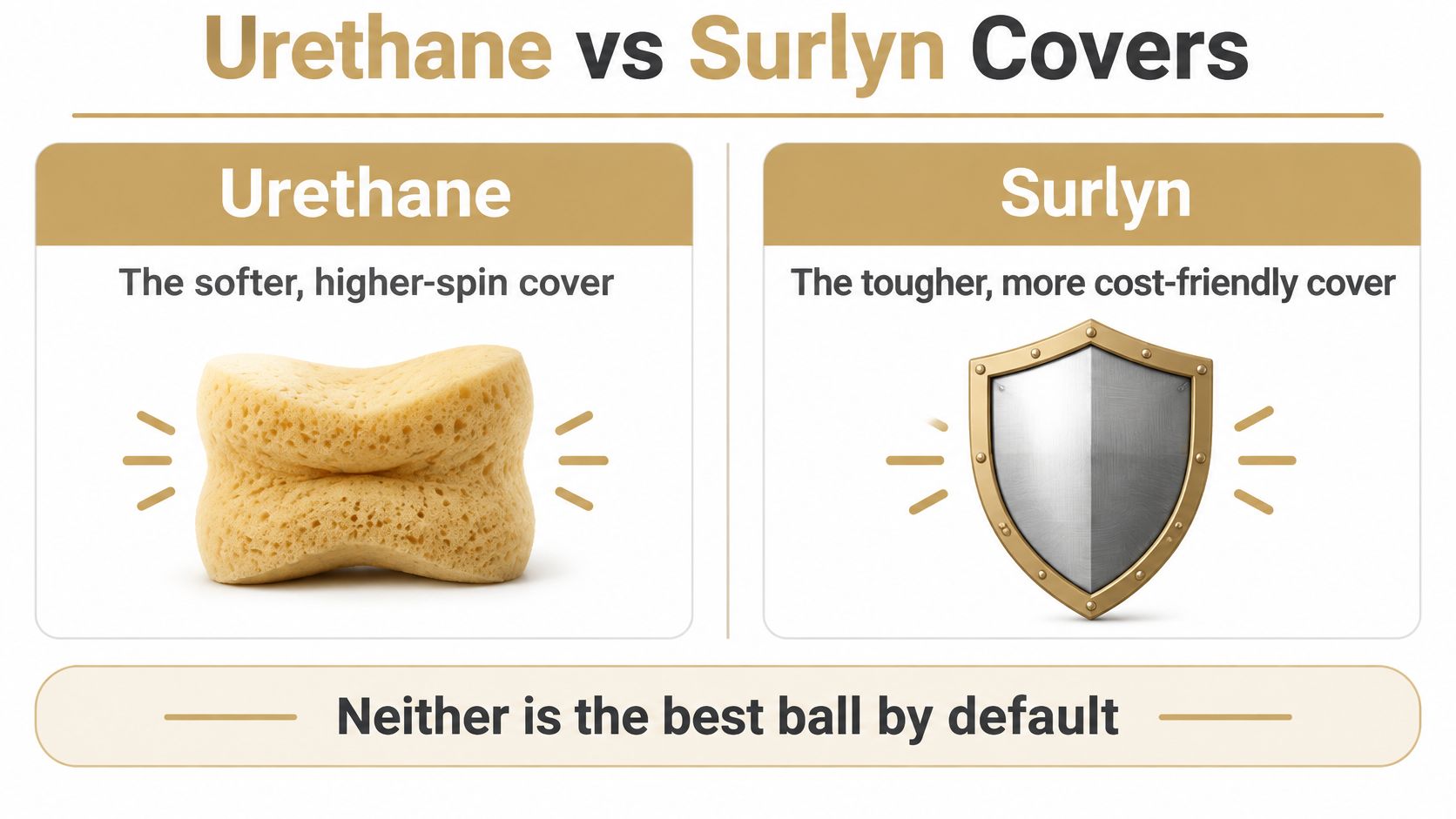
Urethane covers typically provide a softer feel and more greenside spin, while Surlyn covers favor durability and value. Those tendencies describe the cover, not the entire ball: core design and construction also shape performance.
Urethane vs Surlyn cover at a glance
| Criterion | Urethane cover | Surlyn (ionomer) cover |
|---|---|---|
| Primary design goal | Soft feel and greenside spin, with better cut resistance than balata | Durability and value, with a distance orientation |
| Greenside spin | Higher; leading models outspin ionomer models in the cited wedge comparison | Lower than the leading urethane models |
| Feel | Generally softer and more responsive, closer to balata | Generally firmer; the whole construction still matters |
| Durability | Good cut and shear resistance, substantially better than balata | Strong scuff resistance, attractive for high-volume play |
| Driver distance | Depends on core and compression, not automatically longer | Can produce the longest result in a sample |
| Best first test | Wedge spin and short-game feel | Driver speed, scuff life and cost per round |
Balata was valued for its soft feel and control. Synthetic ionomers such as Surlyn began displacing it for durability in the mid-1960s. Urethane later offered another balance of playing response and resilience. Golf-ball patent literature records polyurethane development in U.S. Patent No. 4,123,061, granted in 1978, and identifies the first commercially successful polyurethane-covered ball as sold in 1993.
Durability needs a reference point
Calling urethane soft does not mean it is fragile. Its historical purpose was to retain much of balata's playing response while resisting cuts and shearing better.
Surlyn's reputation for durability also needs context. It does not establish that every ionomer formulation outlasts every urethane formulation under every impact. The patent record includes polyurethane formulations with improved cut and shear resistance compared with balata and ionomer covers. Material names indicate general tendencies; the finished ball's construction and actual use affect how long it lasts.
For fitting, start with the shots that expose cover differences most clearly. Test wedge spin and short-game feel, then consider how often the ball scuffs or needs replacing on the courses you play. A golfer who keeps balls intact may value different features from one who regularly damages or loses them. Surlyn remains a reasonable choice when durability, value and a firmer feel matter more than the extra greenside spin offered by leading urethane models.
Spin on Wedges and Why Urethane Holds Greens
9,550 rpm is the historical nine-iron spin figure reported for two-piece balls with an advanced cover, compared with 5,400 rpm for contemporary ionomer-covered two-piece balls and 9,700 rpm for wound balata. This comparison illustrates the goal of developing a cover that could deliver control close to balata while improving on its vulnerability. The figures come from a particular historical test, not a prediction for a modern golfer's wedge session, and the golf-ball development and performance history describes that context.
Reported spin results by test type
| Test | Urethane cover | Ionomer (Surlyn) cover | Balata reference |
|---|---|---|---|
| Nine-iron, two-piece balls, historical patent test | About 9,550 rpm | About 5,400 rpm | About 9,700 rpm, wound construction |
| Partial-wedge shots, independent robot-test summaries | Roughly 30–50% more spin than non-urethane balls | Non-urethane comparison baseline | Not reported |
| 35-yard wedge test | Leading urethane models were the highest spinners | No ionomer model matched the leading urethane balls | Not reported |
| Highest-to-lowest spin spread in that wedge test | Nearly 4,000 rpm across the complete test set | Included in the spread, not separately quantified | Not reported |
The robot-test summaries report partial-wedge results, while the 35-yard test shows a wide spread among the tested models. These findings should remain distinct from the historical nine-iron comparison: club, shot length and impact conditions all affect spin.
Why the cover matters at this speed
On a wedge shot, the cover deforms against the clubface and interacts with its grooves. Urethane supports that interaction, helping skilled players produce shots that land and stop rather than release across the green. The practical question is how that response changes the shot a golfer needs to play.
Spin alone is an incomplete fitting measure. Carry, launch, landing angle and stopping distance determine whether the ball finishes near the intended target. If a higher-spinning ball changes carry or landing behavior, the golfer may need to adjust the landing point. Predictable checking can serve a player better than an occasional high-spin result paired with inconsistent outcomes.
Fitting rule: A spin advantage matters when the golfer can use the resulting landing and stopping pattern.
What makes the comparison fair
Use the same club, similar strike quality, comparable temperature and consistent ball condition. Test several shots with each ball. A single clean strike can make the gap appear larger than it is.
Keep delivery consistent, too. A change in technique can affect the result as much as a ball change. The wedge-shot practice guide can help maintain a consistent shot intention while comparing equipment.
Cover formulation and layer structure vary between models, so results from one urethane ball do not predict every other model's spin. Urethane's clearest advantage is greenside response, where a golfer can judge the value through wedge spin and how the ball lands and stops. A single distance result does not establish that advantage.
Feel, Distance and the Core Trade-off
A driver carry result reflects the complete ball, not its cover alone. The core's coefficient of restitution, or COR, describes rebound efficiency: how effectively the collision returns speed rather than losing energy through deformation and other processes. Core behavior therefore matters when comparing driver performance, while cover effects are more useful to assess through short-game response.
The USGA/R&A distance and symmetry protocol specifies a calibration ball with a polybutadiene core, Surlyn cover, 60 Shore D cover hardness, 2.1 mm cover thickness, 45.2 g mass and 42.72 mm diameter. It measures ball speed, launch, spin and aerodynamic behavior under controlled conditions. These variables help explain why a cover label alone cannot diagnose a distance result.
A distance result isn't a cover diagnosis
An ionomer-covered ball may carry farther than a urethane ball in a driver test, but that result includes the core, compression, layers and launch characteristics of each finished product. In a fitting example, a golfer tests both types and the ionomer model carries farther. If ball speed and launch differ too, the cover cannot be isolated as the cause.
The practical conclusion is that the complete ionomer ball performed better for that driver delivery. A cover-only conclusion would require a controlled construction comparison, which an ordinary retail test does not provide.
A driver ball-speed reference can help frame the speed result. Record feel as a preference, not as a speed result.
Feel belongs in the fitting record
Urethane generally gives a softer, more responsive sensation around the green, while ionomer tends to feel firmer. Compression and the ball's full construction also shape impact feel, so cover material alone does not predict sensation with every club.
A fitter can note that a golfer prefers one ball's feel while another produces a better driver launch. Both observations matter, but they answer different questions. Feel describes preference; measured speed and carry describe driver performance.
For the fitting decision, compare driver ball speed and carry with wedge spin, launch and rollout as distinct outcomes. A driver carry shortfall from one complete construction does not rule out urethane when its wedge performance better matches the golfer's needs. Judge the cover on the shots where its effect is most relevant, and judge distance through the whole ball's measured performance.
Reading Cover Effects in Launch Monitor Data
Launch monitor metrics and what drives them
| Metric | Cover influence | Other drivers | How to read it |
|---|---|---|---|
| Wedge spin rate on partial shots | Strong relative influence | Loft, strike, turf and face wetness | Average a repeated set for each ball |
| Landing angle and rollout | Indirect and shot-dependent | Flight, spin and turf firmness | Read alongside spin and observed stopping |
| Shot dispersion | Difficult to isolate | Strike quality, delivery and ball wear | Compare against the golfer's baseline |
| Driver ball speed | Relatively weak | Core COR and compression | Evaluate the complete construction |
| Driver carry | Weak to moderate | Launch, spin and core | Read speed, launch and spin together |
| Launch angle | Shot-dependent | Club loft and delivery | Control the club and strike before attributing changes |
These are interpretive priorities, not experimentally measured percentages of influence. A monitor records the result of an impact; it doesn't identify which layer caused every difference.
Keep separate shot families
Driver, full-iron and partial-wedge results should remain in separate groups. Combining them into an overall average hides the very trade-off the golfer is trying to evaluate.
For each group, the useful record includes carry, launch angle, landing angle and spin rate, plus notes on strike and ball condition. A practical session can use five or more shots per candidate, treated as a repeatable sampling rule rather than a scientifically established minimum.
The desktop view provides a place to examine practice data without reducing the decision to the longest shot.

A golfer assessing a practice setup can use the driving-range launch-monitor guide to frame the equipment workflow. The ball comparison still depends on consistent testing, rather than the presence of a dashboard.
A worked reading without invented results
Suppose a golfer compares a urethane candidate with an ionomer candidate using the same wedge. The first calculation is the difference between their average spin rates, followed by the spread within each set.
If the urethane candidate averages more spin but also varies widely, the fitter should inspect strike quality before declaring a winner. If its spin advantage repeats with comparable carry and a tighter stopping pattern, the case is stronger.
Landing angle then supplies context. A spin increase accompanied by a different flight may change the landing requirement, while similar landing angles make the spin and rollout comparison easier to interpret.
Observed rollout should remain distinct from a monitor's modeled estimate. When possible, a golfer should validate the preferred ball on the actual greens where stopping performance matters.
The monitor can't measure feel. Temperature, turf and wind can also differ between sessions, so the record needs enough context to distinguish an equipment change from a different testing environment.
Durability, Water Exposure and When to Replace a Ball
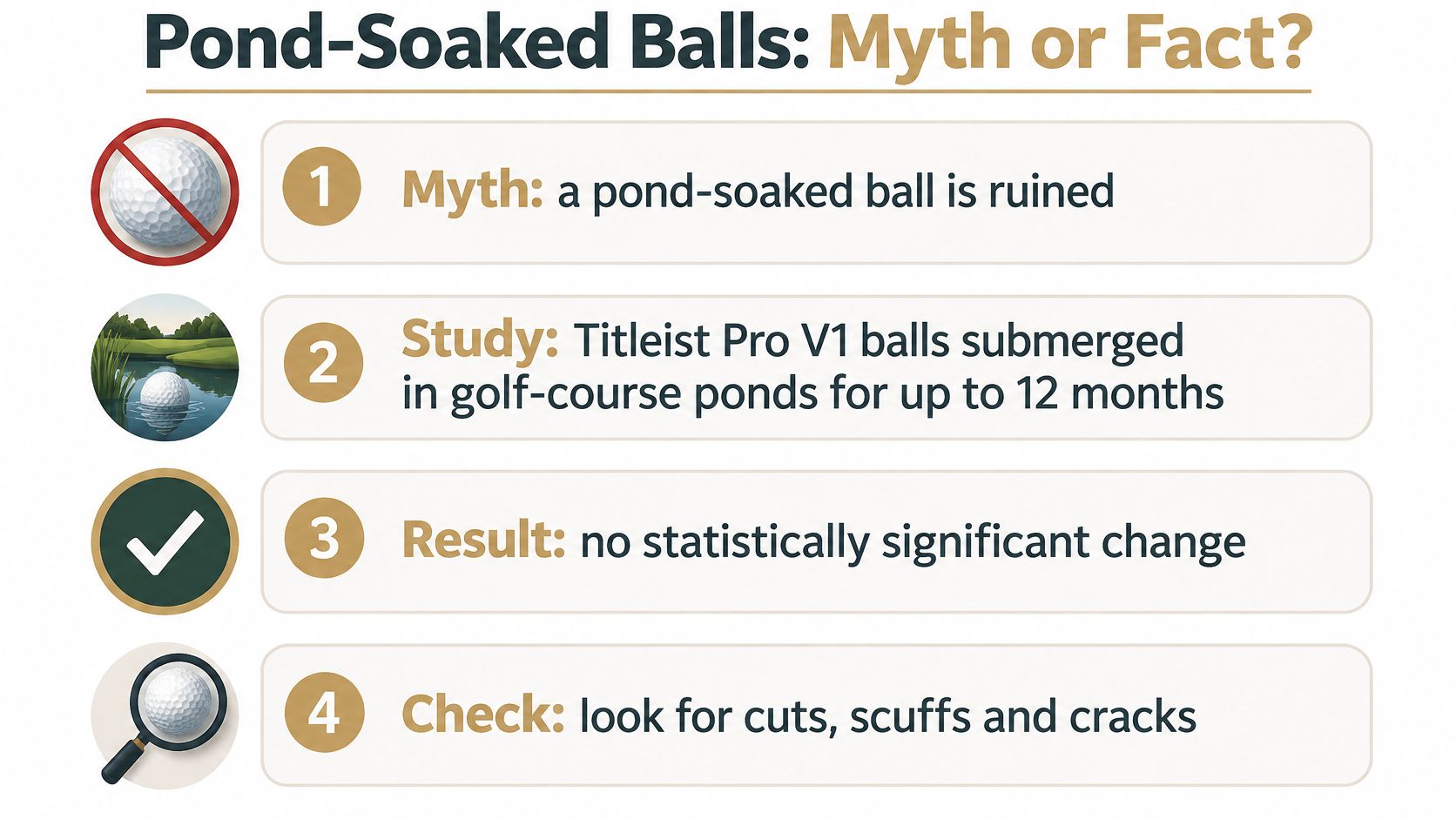
A pond-soaked ball can remain playable. In a study of a premium urethane model submerged in golf-course ponds for up to 12 months, researchers found no statistically significant difference in total distance or carry dispersion compared with dry-stored control balls. Discoloration was the main consistent change, and it had no relationship to those measured outcomes in the pond-submersion study.
The result applies to the model and conditions tested. It does not establish that every recovered ball, regardless of its storage history or cover condition, will perform the same way. A change in color alone is not evidence of a distance loss.
Submersion, impact wear and wet contact are different
Pond storage, repeated impacts and a wet clubface involve different conditions. The submersion research measured performance after storage; it does not establish how a damaged cover or a wet wedge shot will behave. A recovered ball may retain its measured distance while still needing inspection for cuts, raised material or deep scuffs.
A ball-caddie-style comparison summarized in Golf Monthly's urethane-versus-ionomer guide reported that urethane lost approximately one-tenth of wedge spin in wet conditions, compared with nearly one-third for ionomer. That comparison concerns water on the ball or clubface at impact, not damage caused by pond storage.
Ball condition, measured effect and action
| Condition | Evidence or measurement boundary | Action |
|---|---|---|
| Pond submersion | No general conclusion beyond the model and duration studied | Inspect the cover and compare with a known baseline |
| Yellowing or discoloration | Color alone does not establish a performance change | Don't reject the ball on color alone |
| Wet ball or clubface on a wedge shot | The cited comparison found reduced spin in wet conditions | Expect less bite and reassess the landing target |
| Cuts, raised material or deep scuffs | The cited evidence does not quantify a universal loss for each mark | Replace the ball rather than assume its cover grips normally |
| Repeatable monitor deviation | A measured change needs confirmation; it does not identify the cause | Recheck conditions and replace the ball if the deviation persists |
Replace based on damage and repeatable results
Visible damage offers a practical reason to retire a ball. Cuts, raised material and deep scuffs can affect how the cover meets the clubface, even when the precise spin penalty for a particular mark is unknown.
For less obvious cases, record the ball model, approximate age, storage history and visible condition. Compare it with an intact ball of the same model, using the same club and similar shot conditions. A result that repeats is more useful than a single monitor reading; a difference against an unrelated model cannot isolate the cover's effect.
Condition check: Color is an inspection clue, not a performance verdict.
Rain, morning dew, humid storage and coastal play are distinct exposures. Record the conditions of the shot and the ball's storage rather than treating every moisture-related result as proof that the ball was water-damaged.
Who Benefits Most from a Urethane-Covered Ball
Urethane is most useful when a golfer regularly needs wedge shots to stop quickly and can keep the ball in play. The benefit depends on the shots faced and the results measured, not on handicap alone.
Player needs make the decision clearer:
- Control-focused golfers: A player who repeatedly short-sides themselves and needs a pitch to hold the green has a practical reason to test urethane. Compare wedge spin and landing behavior with the same type of shot.
- Feel-led players: A golfer who relies on short-game feedback around the green may prefer urethane's feel. The preference matters most when wedge results also support it.
- Golfers who lose or wear out balls: Someone who often finds water or damages balls on cart paths may spend more replacing premium balls. Surlyn's durability and value deserve greater weight in that situation.
- Distance-first golfers: A player whose drives fall short should assess the full ball construction and driver launch conditions. The cover alone may not address the limiting factor.
- Coaches and fitters: For a player unsure whether wedge control or driver distance should lead the choice, compare separate wedge and driver results under consistent conditions, and record the ball model and test conditions.
Price matters through actual usage
Retail listings at Dick's Sporting Goods in 2025 showed premium urethane models priced at $44.99 to $47.99 per dozen. Those listing prices provide a reference point, while actual value depends on how often a golfer loses or retires balls.
A golfer who uses a ball through repeated rounds faces a different replacement cost from one who loses balls frequently. Consider that pattern alongside the shots played: someone who mainly hits running approaches may use less of urethane's greenside-spin benefit than a player facing short-sided pitches throughout a round.
Avoid the distance-first mismatch
Slower swing speed alone does not determine whether urethane suits a golfer. The relevant question is whether the ball's full construction fits the player's driver needs while delivering useful wedge performance.
A golfer seeking more distance may pay extra for a short-game feature without addressing the measured driver limitation. Another player may choose against urethane after seeing a longer drive from a different complete ball construction, even when wedge control is the recurring problem. Evaluate the clubs and shot conditions separately before deciding which trade-off matters most.
The best purchase addresses a recurring on-course problem at a replacement cost the golfer can accept.
Choosing a Cover and Testing It on Your Range
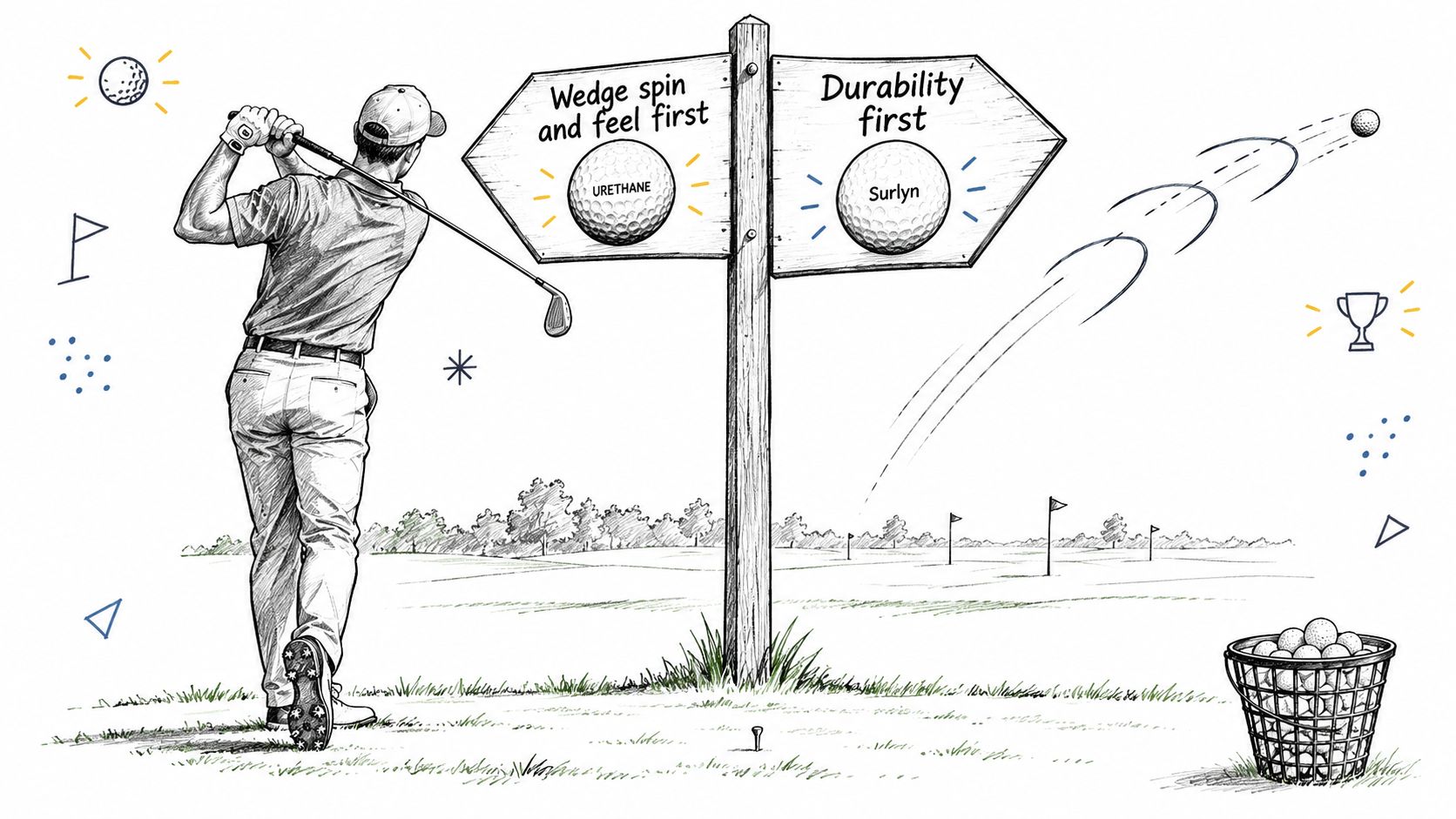
Urethane is most useful when wedge response and feel matter; Surlyn suits golfers who value durability and lower replacement costs. A driver-speed concern calls for testing the ball's overall construction, since the cover alone may not address it.
A useful comparison isolates the cover's contribution from the core and the shot conditions. Judge wedge spin and landing behavior alongside distance, rather than letting one long drive decide the result.
A repeatable range protocol
- Select candidates. Use intact urethane and ionomer balls suited to a similar playing need.
- Control the shot. Keep the club and target consistent, and use the sampling approach described earlier.
- Record the full result. Track carry, launch angle, landing angle and spin. Keep driver, iron and wedge results separate.
- Repeat in varied conditions. On another day, note temperature, wetness, strike quality and ball condition.
- Compare averages and spread. Give more weight to a useful difference that recurs than to a single peak number.
- Retire compromised balls. Replace one when visible damage appears or its performance departs from its baseline.
The results apply to the finished balls tested and to the golfer's delivery. They do not establish that every ball made with one cover material will perform alike.
Free web tools can help frame the question, while desktop practice records can preserve results across sessions. On-course feel and stopping behavior still matter.
Match the next test to the weakest measured result. For limited wedge stopping, focus on wedge data; for a driver-speed concern, assess the complete ball construction.
Dialed Golf connects an on-course pocket caddy, desktop launch-monitor practice and academy tools under one golfer record and Pro plan. The pocket caddy is available through TestFlight, and desktop practice supports Garmin and other major launch monitors through live pairing or file imports. Mobile live pairing for academy use is planned for later.
Free web tools remain free. Golfer Pro covers the app and desktop, while Academy memberships and front-desk software are priced separately, with clubs retaining their dues (product overview, desktop workflow, facility operations). Visit Dialed Golf to organize a cover comparison and build practice around the result that needs improvement.