


You can stand on the range with a 4 hybrid in one hand and a 4 iron or 7 wood in the other and still feel unsure which club belongs in the bag. That uncertainty usually shows up after one launch monitor session, when the numbers don't look like the internet promised, and the “average distance” you read online doesn't match your swing, your strike, or your gaps.
The fix is to stop treating 4 hybrid distance like a universal number. The better question is what your 4 hybrid carries, how tightly it groups, and what job it does between your longer club and your next iron, because the right answer is the one you can repeat under pressure.
Table of Contents
- Why Your 4 Hybrid Number Is Personal, Not Universal
- What a 4 Hybrid Actually Is and Why It Behaves the Way It Does
- 4 Hybrid Distance by Skill Level and Swing Speed
- Factors That Move Your 4 Hybrid Number Up or Down
- 4 Hybrid vs 4 Iron vs 7 Wood and Which One Earns the Slot
- Recording and Comparing Your Hybrid Numbers With Launch Monitor Data
- Putting Your 4 Hybrid Number to Work This Week
Why Your 4 Hybrid Number Is Personal, Not Universal
The first mistake golfers make is asking for a single yardage as if every 4 hybrid were built for the same player. They aren't. A club that's perfect for a smooth-swinging 15 handicap can be wrong for a faster player who already launches the ball high, and that's why the useful number is the one you measure, not the one you borrow.
A 4 hybrid usually lives in a very wide performance band. Independent distance guides place it roughly from 145 to 240 yards, and one equipment guide puts average male and female 4 hybrid distances around 180 yards and 145 yards respectively, while another ties carry to swing speed at about 130 yards at 70 to 79 mph, 150 yards at 80 to 89 mph, 168 yards at 90 to 99 mph, and 183 yards at 100+ mph (Tell Me More Golf). That spread is the point. A 4 hybrid doesn't have one universal distance, it scales with speed, strike, and player skill.
Practical rule: If your launch monitor number and your on-course number disagree, trust the larger sample, not the single best shot.
A range session tells the truth faster than a headline average
A mid-handicapper often sees the same pattern. One shot jumps out, one comes up short, and one finishes long because the strike caught the center. The average online yardage doesn't tell you how your personal window behaves when contact isn't perfect.
That's why the most useful 4 hybrid distance is the one that comes from your own session data. A launch monitor gives you the carry pattern, the miss pattern, and the club-to-club overlap, which is what decides whether the club belongs in the bag. If your gap between clubs is clean, the number matters. If it's muddy, the number is just trivia.
What a 4 Hybrid Actually Is and Why It Behaves the Way It Does
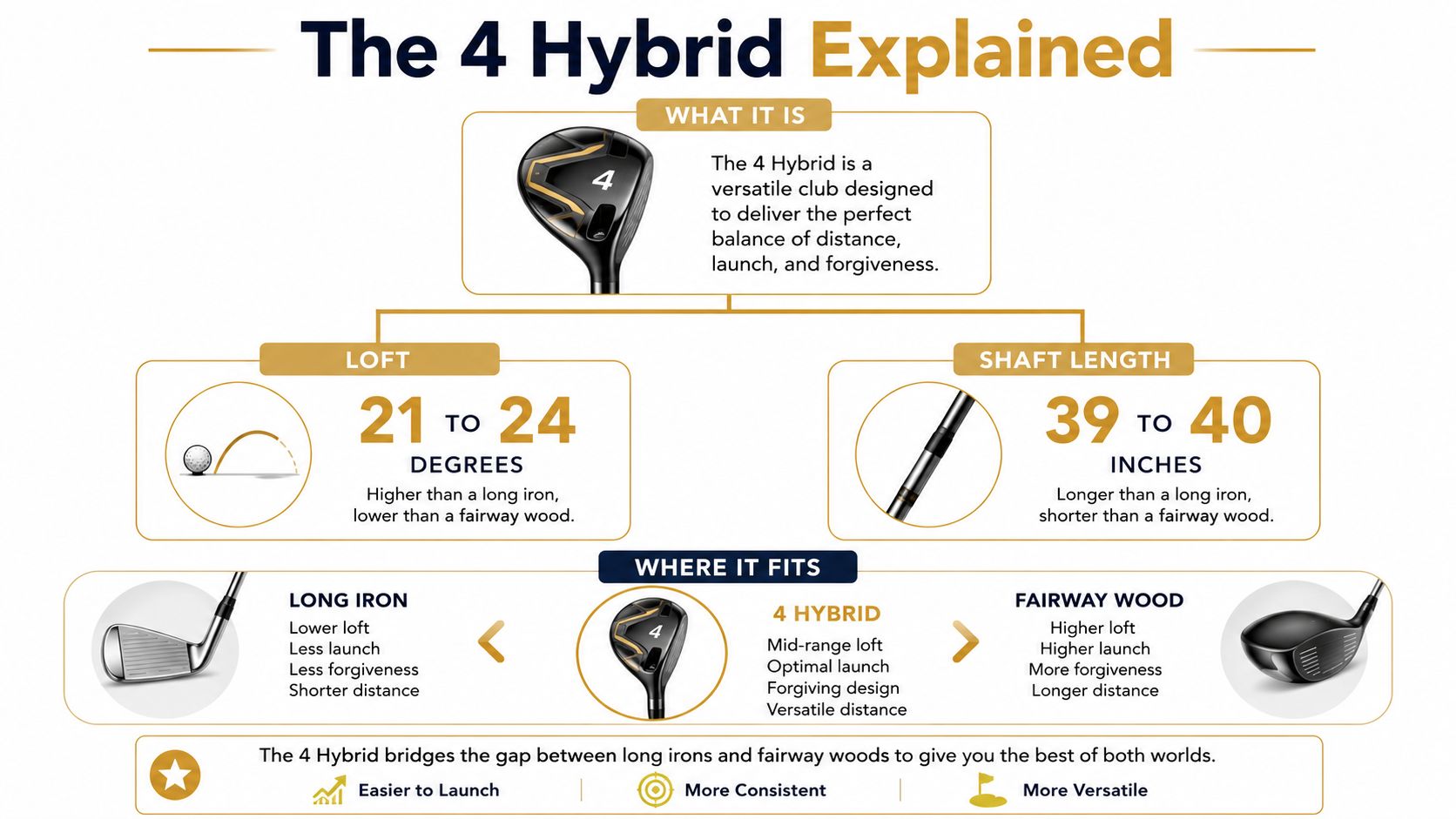
A 4 hybrid sits in the middle of the bag by design. Typical specs place it around 21° to 24° loft and about 39 to 40 inches in length, which puts it between a long iron and a fairway wood. PING lists one 4 hybrid at 23.0° loft, 39 3/4 in. length, and 58.0° lie angle, while other retail listings show 22° loft and 39 in. length (PING G440 Hybrid).
That geometry matters because it changes how the club behaves at impact. The shorter shaft usually makes center contact easier, and the loft helps the ball get up without forcing you to manufacture height. So a 4 hybrid often feels easier to control than a 4 iron, especially when the lie isn't perfect or the swing speed isn't high enough to launch a long iron consistently.
Control first, distance second
That's why fitters usually treat the 4 hybrid as a gap club rather than a pure bomb club. It's there to give you a predictable launch window and enough stopping power for approach shots. If a club gives you a cleaner window into greens, that can be more valuable than squeezing out a few extra yards.
For a lot of players, the 4 hybrid is not about chasing the longest number possible. It's about making the long end of the bag playable enough that you stop guessing from the fairway. That's the difference between a club that looks good on paper and one that helps you score.
4 Hybrid Distance by Skill Level and Swing Speed
A 4 hybrid only makes sense if you treat its distance as your own number, not a chart you borrow from someone else. Two players can stand over the same club and produce very different carry because one delivers more speed, cleaner contact, or a better launch window. That is why the best way to read a 4 hybrid is to start with swing speed, then see where your handicap profile fits around that window.
One published comparison of approach shots found that the 11 to 15 handicap group was nearly 5 yards longer with the 4 hybrid than with the 4 iron, and most handicap brackets recorded more greens in regulation with the 4 hybrid. The 0 to 5 handicap group still posted a 22.09% GIR rate at an average distance of about 165 yards (Arccos comparison). The useful lesson is simple. A 4 hybrid can score well even when the raw yardage does not look dramatic, because it often gives you a friendlier launch and a more playable shape into the green.
Read the swing-speed band before you read the average
Start with the speed band your launch monitor puts you in. If your speed sits lower, your 4 hybrid usually plays shorter and launches higher, which helps it get airborne without needing a forceful move through impact. As speed climbs, carry climbs too, but not in a clean straight line that works the same for every player.
One guide places many male amateurs around 154 to 194 yards, with common amateur ranges often quoted around 150 to 190 yards and broader “average” ranges around 160 to 210 yards depending on strike and speed (Monark Golf). Those ranges are wide because the club is reacting to the player, not the other way around. A 4 hybrid in the hands of a smoother swinger can look like a high, controlled gap club, while the same head in the hands of a faster player may act more like a strong approach club.
| Swing speed | Carry (yards) |
|---|---|
| 70 to 79 mph | 130 |
| 80 to 89 mph | 150 |
| 90 to 99 mph | 168 |
| 100+ mph | 183 |
Use that table as a reference point, not a promise. The number that matters is the one your launch monitor repeats after a handful of solid strikes, because one flushed shot can flatter the club and one thin strike can make it look shorter than it is.
A handicap chart can also create false confidence if you treat it like a fixed outcome. MyGolfSpy's handicap-based chart shows a 4 hybrid average of 121 yards for the overall sample versus 149 yards for the “P-average” player, which is a much bigger spread than casual golf talk usually admits (The Golf Ace). That difference is why one golfer's “easy 4 hybrid” is another golfer's “too much club.” The chart helps you start the conversation, but your launch monitor should settle it.
Short version: the number on the internet is a starting point, your launch monitor is the source of truth.
Factors That Move Your 4 Hybrid Number Up or Down
A 4 hybrid does not have one fixed number attached to it. The carry you see comes from a chain of parts working together, or working against each other, on that specific swing. If you want to make sense of a session, start with the full picture. Carry matters, but the levers underneath it matter more.
A useful way to think about it is simple. Your launch monitor is not handing you a verdict, it is showing you how the club, ball, and strike pattern are interacting on that day. One golfer can hit the same head well in a range session and see two different results because the contact moved slightly from center to low face, or from toe to the middle. That is why the same 4 hybrid can feel long one day and ordinary the next.
Speed and strike create the first layer
Clubhead speed and ball speed set the top end of the result. If either one drops, carry usually drops with it. Two swings can still show similar ball speed and produce different outcomes if one strike is centered and the other is low on the face or out toward the toe.
Launch angle and spin rate show how the ball is getting airborne and whether it will keep its shape in the air. With a 4 hybrid, those numbers often explain why the club carries well even when it does not look as hot off the face as a long iron. A hybrid that launches a little higher and spins a little more can hold its line and stop more predictably, which matters as much as raw yardage. In a launch monitor session, that extra height is often what separates a club that just flies a number from one that fits a scoring gap.
Shot shape and contact change the usable number
A ball that starts on line and curves softly is much easier to trust than one that carries the same distance and finishes outside your target window. A launch monitor's start direction and dispersion pattern show whether the club is serving your target line or producing a decent carry number.
The cleanest way to read a session is to ask three questions.
- Did the strike stay near the center? If it did not, the carry window you saw may be a contact issue, not a club issue.
- Did launch and spin stay in a repeatable band? If those numbers jumped around, the club is not giving you a stable picture yet.
- Did the ball finish where you needed it? A 4 hybrid that carries well but will not hold your landing window is still the wrong fit for that job.
Gap work gets clearer when you organize the results instead of trusting memory. If you want a simple place to sort the numbers before you rewrite your yardage notes, the Dialed Golf ball fitter can help you compare what the club is doing across sessions.
Temperatures, turf, and ball type can also move the number. A range mat can hide a thin strike, firm fairway turf can make launch look cleaner, and a softer ball may change the way the hybrid launches and spins. That is why a launch monitor session on its own should be read as a test environment, not a promise for every round. The goal is to find the pattern that repeats often enough to trust, then build your carry matrix from that pattern.
4 Hybrid vs 4 Iron vs 7 Wood and Which One Earns the Slot
A fitting answer starts with a real bag decision. You are not only asking how far a 4 hybrid flies, you are asking which club gives you the cleanest gap, the most repeatable launch, and the best shot pattern for the yardage window you face most often.
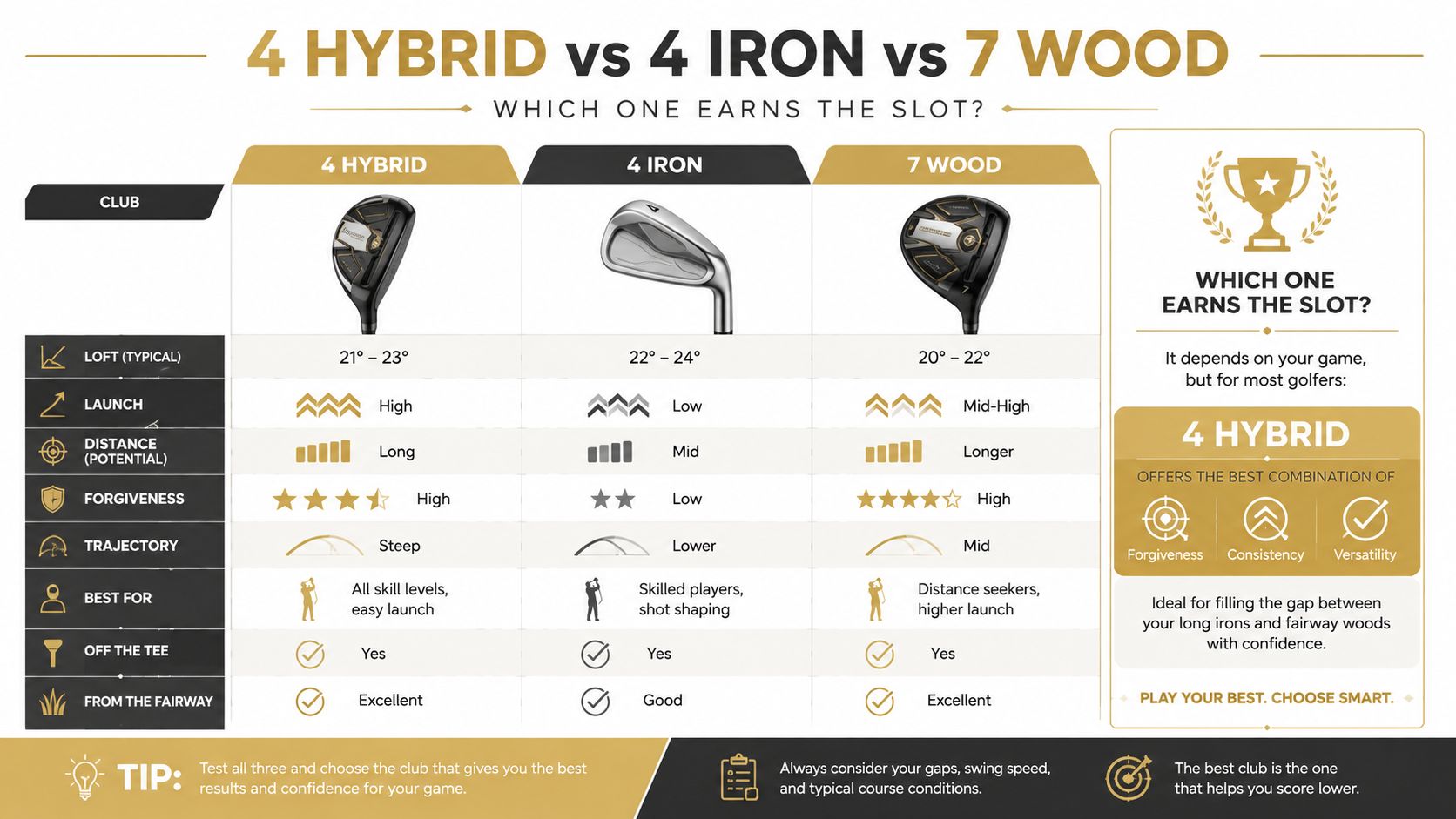
A 4 hybrid usually gives more usable approach results than a 4 iron for a wide range of players. The reason is simple. It is easier to launch, easier to center, and less likely to punish a slightly thin strike. The comparison from Arccos comparison points in that direction too. In their data, the 4 hybrid produced more greens in regulation in most handicap groups, and the 11 to 15 handicap bracket saw a distance edge of almost 5 yards with the hybrid on approach shots. Off the tee, the picture shifts. The 0 to 5 handicap group hit the 4 iron more than 4 yards farther than the 4 hybrid, while the 20+ handicap group was only about 2 yards longer with the iron, which shows how the gap tightens as player skill changes.
That is the part many players miss. A club can be longer in one use case and better in another. If you mostly need a dependable approach club, the hybrid often wins. If you want a tee club and you already launch long irons well, the iron may still earn its place.
Where the 7 wood fits
A 7 wood sits close enough to a 4 hybrid that players often compare them directly, but close yardage does not mean the same job. One comparison notes that both clubs often live in the 170 to 210 yard range, yet the 7 wood can carry about 10 yards farther at moderate swing speeds because of its longer shaft. For faster swingers over about 100 mph driver speed, that gap can shrink or disappear (Golf Sidekick).
The choice becomes clearer when you ask what each club is supposed to do.
- Pick the 4 hybrid if you want a lower-profile control club that bridges fairway woods and mid-irons.
- Pick the 4 iron if you strike long irons well and want a tee-shot option with a flatter flight.
- Pick the 7 wood if your priority is higher launch and a longer carry window into greens.
A simple way to sort the slot is to compare overlap. If the club below your 4 hybrid and the club above it leave you with clean separation, the hybrid stays. If the hybrid overlaps both neighbors, it is probably the wrong link in the chain. If two clubs cover the same yardage, keep the one you trust more under pressure and in less-than-perfect lies.
The Golf Bag Gap Analyzer is useful for a second look at those overlaps, because it helps you compare the gaps instead of relying on memory alone.
A quick visual comparison can also help when you are deciding between the three clubs.
Recording and Comparing Your Hybrid Numbers With Launch Monitor Data
The cleanest way to find your real 4 hybrid distance is to record it the same way every time. Start with a launch monitor session, build a small club set around the 4 hybrid, and hit enough shots to see the pattern. Then separate clean strikes from obvious mishits so you don't confuse one hot strike with your actual carry window.
Build the session around comparison, not guesswork
A useful workflow looks like this:
- Put the 4 hybrid in the bag lineup with the clubs above and below it.
- Capture a session of clean strikes on your launch monitor or import a CSV export if that's how your device stores data.
- Check the carry window, dispersion, and start direction instead of just the longest shot.
- Compare the 4 hybrid to the nearby clubs and mark where the overlap starts.
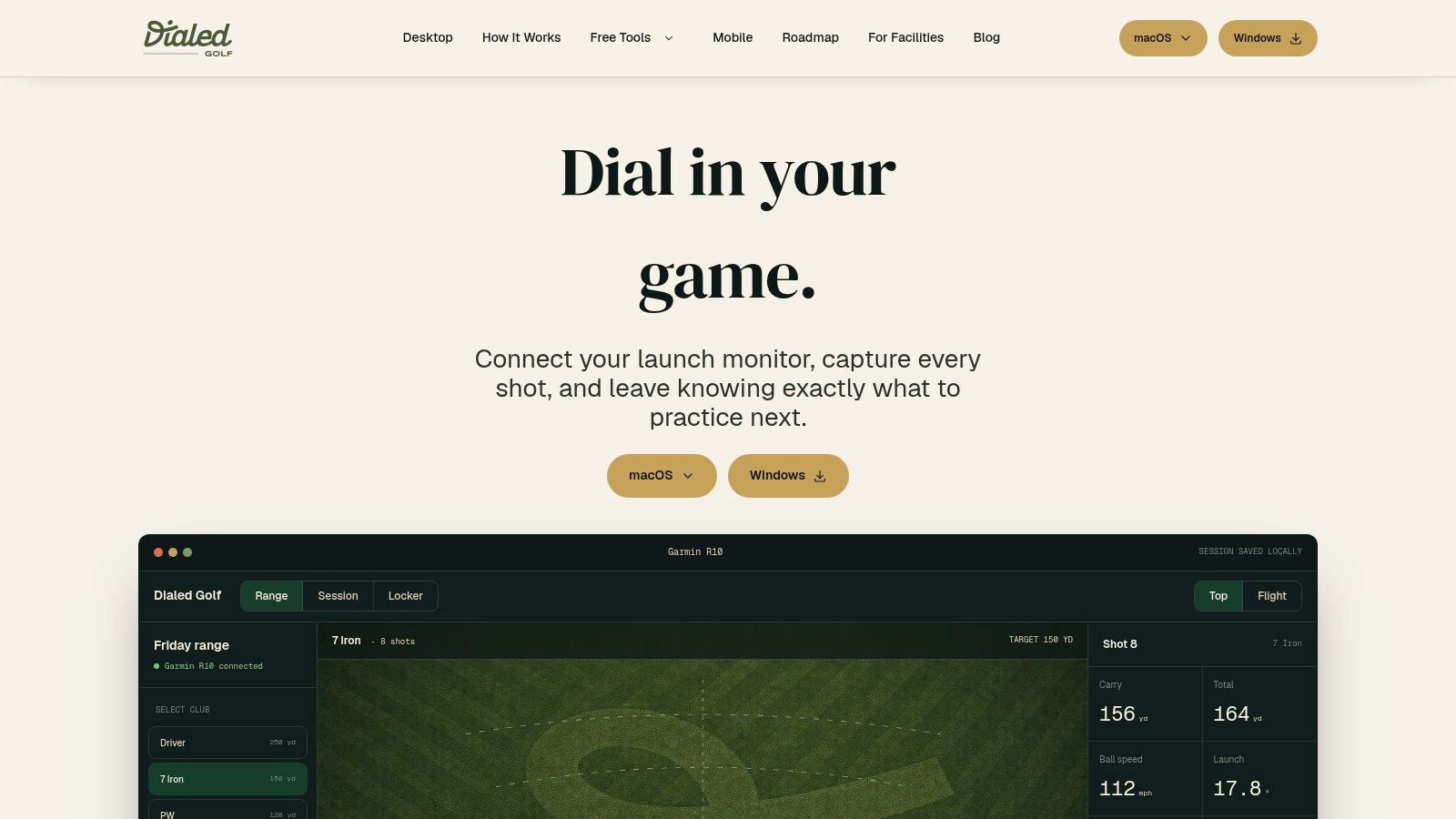
Dialed Golf's desktop app is one option that can connect to supported launch monitors or ingest CSV exports, then organize shot history into club lockers, sessions, and carry windows. It also offers free public tools without an account, including a Carry Distance Chart Generator, so you can start mapping distances before you commit to a full workflow. The same workspace is built to surface the next practice priority from your data, which is useful when your goal is less guessing and more gapping.
Turn one session into a carry matrix
Don't write down one number and call it done. Write down your likely carry, your best-contact carry, and whether the club overlaps the 4 iron or the 7 wood. That small matrix gives you a much better answer than a single average, because it shows how the club behaves when you're not perfect.
Record the club when you're fresh, then again after a few swings. The second set often tells you more about what you can trust on the course.
If you want a simple starting point for building that chart, the Carry Distance Chart can help you turn session data into a repeatable reference instead of a loose memory.
Putting Your 4 Hybrid Number to Work This Week
Start with your swing-speed band, because that tells you which distance window is realistic. Then hit one focused session with the 4 hybrid, compare it to the 4 iron and 7 wood if you carry both, and write down the carry number that shows up most often on solid strikes.
Once you have that number, keep the dispersion window next to it. A club that flies a little shorter but lands tighter is often more useful than a longer one that wanders.
After that, move through the rest of the bag the same way. The goal isn't to chase one perfect distance, it's to build a full set of clubs that each own a job.
Dialed Golf gives you a way to capture launch-monitor shots, sort them into clubs, and turn those sessions into carry charts and gap decisions. If you want to stop guessing at 4 hybrid distance and start building a bag that fits your own swing, visit Dialed Golf and map your next session around the clubs you use.
[…] its repeatable pattern rather than a best-ever strike. For players working through a longer gap, a 4-hybrid distance guide can help frame the club's role, but the course still demands your actual carry window and miss […]