

Greens in regulation means reaching the putting surface with at least two strokes remaining for par, one stroke on a par 3, two on a par 4, and three on a par 5, with the fringe not counting. It's a hole-by-hole yes-or-no measure of whether the approach got the ball onto the actual green in time to leave a two-putt chance for par.
A mid-handicap golfer standing over a 180-yard approach on a par 4 often has a different question in mind: “Can this shot finish near the flag?” GIR asks a more useful first question: did the ball reach the putting surface in the required number of strokes?
That distinction turns a vague feeling about ball striking into a clean performance signal. A player can hit the green and make three putts, or miss the green and save par with a strong chip. The score records the result, while GIR shows whether the approach created a reasonable chance before the short game and putter took over.
Table of Contents
- What Greens in Regulation Actually Means on the Course
- How the Par Minus Two Rule Breaks Down Hole by Hole
- How GIR Is Counted and Rolled Up Over a Round
- The Fringe Question and Other Edge Cases That Confuse Golfers
- Why GIR Is a Ball-Striking Signal You Can Practice
- Why Hitting Every Green Is Overrated in 2026
- Putting Greens in Regulation to Work in Your Next Round
What Greens in Regulation Actually Means on the Course
A green is hit in regulation when the ball reaches the putting surface with at least two strokes left to complete the hole. The calculation is simple:
- Par 3: The ball must reach the green with one stroke.
- Par 4: The ball must reach the green with two strokes.
- Par 5: The ball must reach the green with three strokes.
That definition is consistent with the standard golf explanation of greens in regulation, and it's also how the statistic functions in practical scoring. The expected finish is two putts for par once the ball is safely on the green.
The important word is putting surface. The fringe, collar, and apron sit around or beside the green, but they don't qualify. A ball can be close enough to touch with a putter and still count as a missed green if it comes to rest outside the actual putting surface.
GIR is separate from the number on the scorecard
GIR is recorded before the final score is known. If a par 4 approach comes to rest on the green after two shots, the player gets a GIR whether the hole ends in two putts, three putts, or a one-putt birdie.
That binary design makes the stat useful. It separates approach-play quality from putting outcomes. A golfer who misses several greens can then investigate whether the problem is contact, distance control, direction, or recovery play instead of blaming every dropped shot on the putter.
Practical rule: Mark the green first, then record the score. GIR describes where the ball arrived, not how the hole finished.
The statistic is especially helpful for a mid-handicap player because it identifies the part of the hole where pressure began. A missed green forces a chip, pitch, bunker shot, or difficult recovery. A green hit in regulation gives the player a normal two-putt route to par, even if the eventual score isn't perfect.
How the Par Minus Two Rule Breaks Down Hole by Hole
The phrase par minus two explains the entire calculation. Subtract two strokes from the hole's par, and the result is the maximum number of strokes allowed before the ball must be on the putting surface.
| Hole Type | Par | Strokes Needed on Green | Strokes Remaining |
|---|---|---|---|
| Par 3 | 3 | 1 | 2 |
| Par 4 | 4 | 2 | 2 |
| Par 5 | 5 | 3 | 2 |
On a par 3, the first shot is the approach. A ball that lands on the green from the tee is a GIR. If the tee shot misses and the next shot lands on the green, the player has reached the putting surface with only one stroke left for a three, so the hole is not a GIR.
A par 4 follows the familiar tee shot plus approach pattern. The ball must be on the green after the second stroke. That leaves two putts available to make par. A par 5 permits three strokes to reach the green, whether those strokes are a driver, layup, and wedge or three controlled shots that never require a risky attempt to reach the green in two.
A worked par 5 example
Consider a 480-yard par 5. A drive travels 240 yards, the second shot advances the ball 200 yards, and a wedge from 40 yards finishes on the green. The ball reached the putting surface in three strokes, so the hole counts as a GIR.
Now change only the second-shot result. The drive finds a bunker, the player escapes and lays up, and the next shot finishes on the collar. Even if the golfer holes the next shot for birdie, the hole isn't a GIR because the ball wasn't on the putting surface after the third stroke.
That example shows why GIR is built around a two-putt expectation, not the final score. The stat doesn't ask whether the player made par or birdie. It asks whether the ball reached the green early enough to make par with two putts.
Because the formula doesn't depend on a hole's exact yardage or surface type, it gives golfers a consistent way to compare approach performance from course to course. The strategic choices can vary, but the calculation stays stable.
How GIR Is Counted and Rolled Up Over a Round
After each hole, record whether the ball finished on the putting surface within the allowed strokes for that hole. Mark yes for a GIR and no when the ball finishes elsewhere or arrives too late. The result is a hole-by-hole record, not a rating of how close the approach came to the flag.
Across a round, add the yes results and divide by the number of holes played. A golfer who records 14 GIR over 18 holes has a GIR rate of 77.8 percent, calculated as 14 divided by 18, then multiplied by 100. Official golf statistics pages use this same percentage format.
That total can coexist with a high number of putts. Fourteen greens provide fourteen chances to complete the hole with the expected two-putt pattern, but GIR says nothing about the distance of the first putt, the quality of the read, or whether the second putt falls.
Why the binary record remains useful
The yes-or-no format keeps the first review clear. You do not need to decide whether an approach was “good enough” based on feel. The ball either finished on the putting surface within the regulation limit, or it did not.
That clean record helps you compare rounds played on different courses. Putting performance and green difficulty can change your score, while the GIR total gives you a separate view of how often your shots reached the intended surface in time.
Use the result as a starting point for better questions. Which holes missed the green, and what happened before the miss? Did the approach finish short, wide, long, or on the wrong level? A scorecard or stat-tracking routine can capture those details, while the Dialed Golf rules and handicap resources can help organize rules and handicap concepts.
GIR is therefore a foundation, not a complete player profile. It shows how often your ball reached the green in regulation, then points toward the approach patterns and launch-monitor numbers you can practice next.
A GIR percentage is a clean starting point for asking better questions about approach play.
The Fringe Question and Other Edge Cases That Confuse Golfers
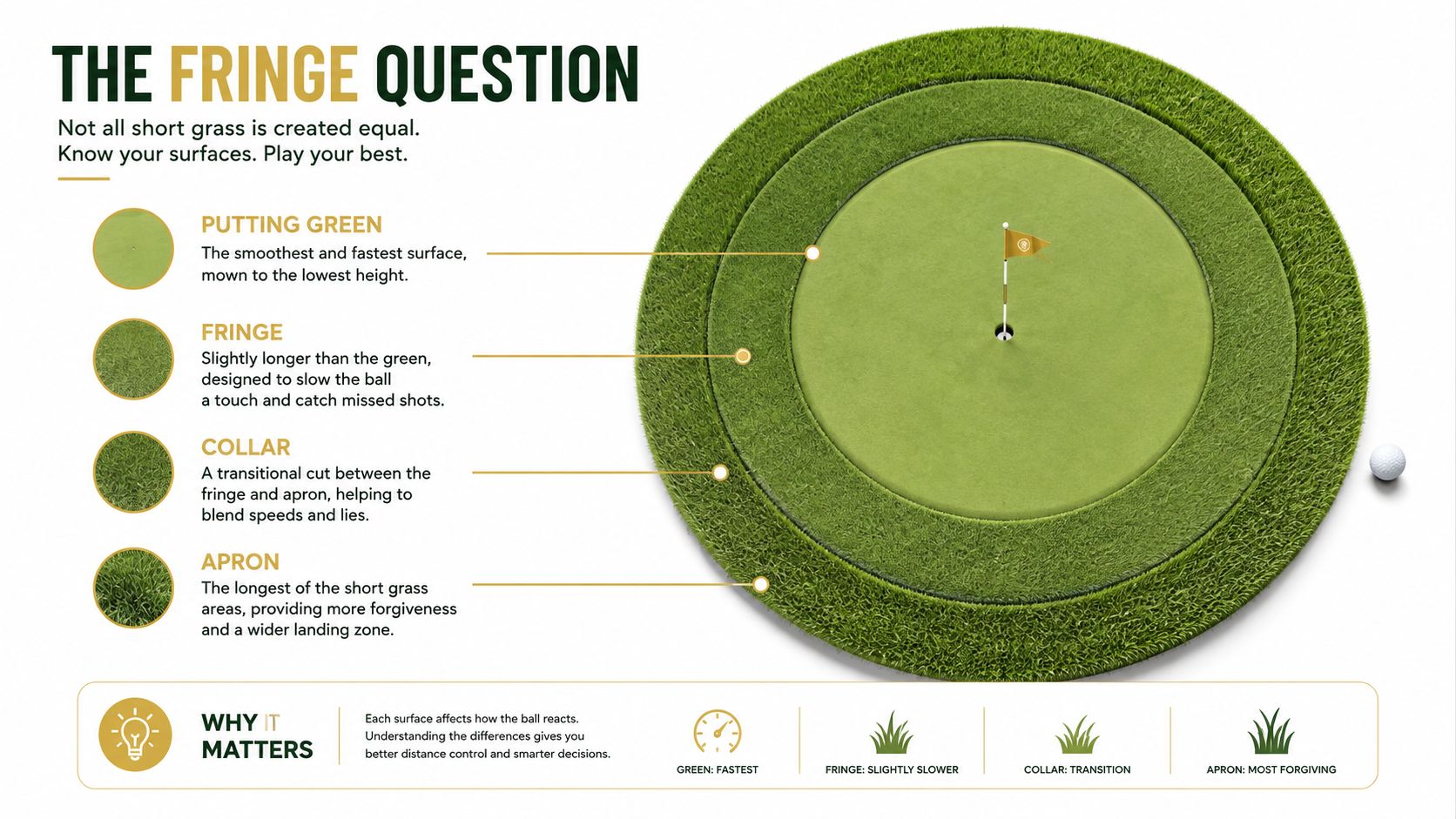
The most common GIR dispute happens near the edge of the green. The putting green is the designated surface around the hole. The fringe, collar, and apron are separate surrounding areas, even when the grass is short enough for a putter.
The ball must come to rest on the actual putting surface. A technical explanation of GIR and its surface requirement distinguishes reaching the green from merely reaching its immediate surroundings.
Three situations that settle the argument
- Two feet onto the fringe on a par 4: Not a GIR. The ball is close, but it isn't on the putting surface after two strokes.
- A shot rolls back off the green and stops on the collar: Not a GIR. The ball reached the green during the shot, but its final resting place is outside the putting surface.
- A par 3 tee shot lands on the apron before rolling onto the green: GIR. The ball finishes on the putting surface after one stroke, which satisfies the par 3 requirement.
For casual rounds, consistency matters more than debate. Players should agree before starting whether a temporary green is the official putting surface for that hole, then apply the same decision throughout the round. A damaged section of green still requires a practical ruling based on where the ball finishes, while a double green should be treated according to the course's designated hole and putting area.
A current GIR glossary discussion also highlights why fringe and collar questions continue to confuse golfers. The safest habit is to look at the ball's final resting place, not the grass it touched during the shot.
Why GIR Is a Ball-Striking Signal You Can Practice
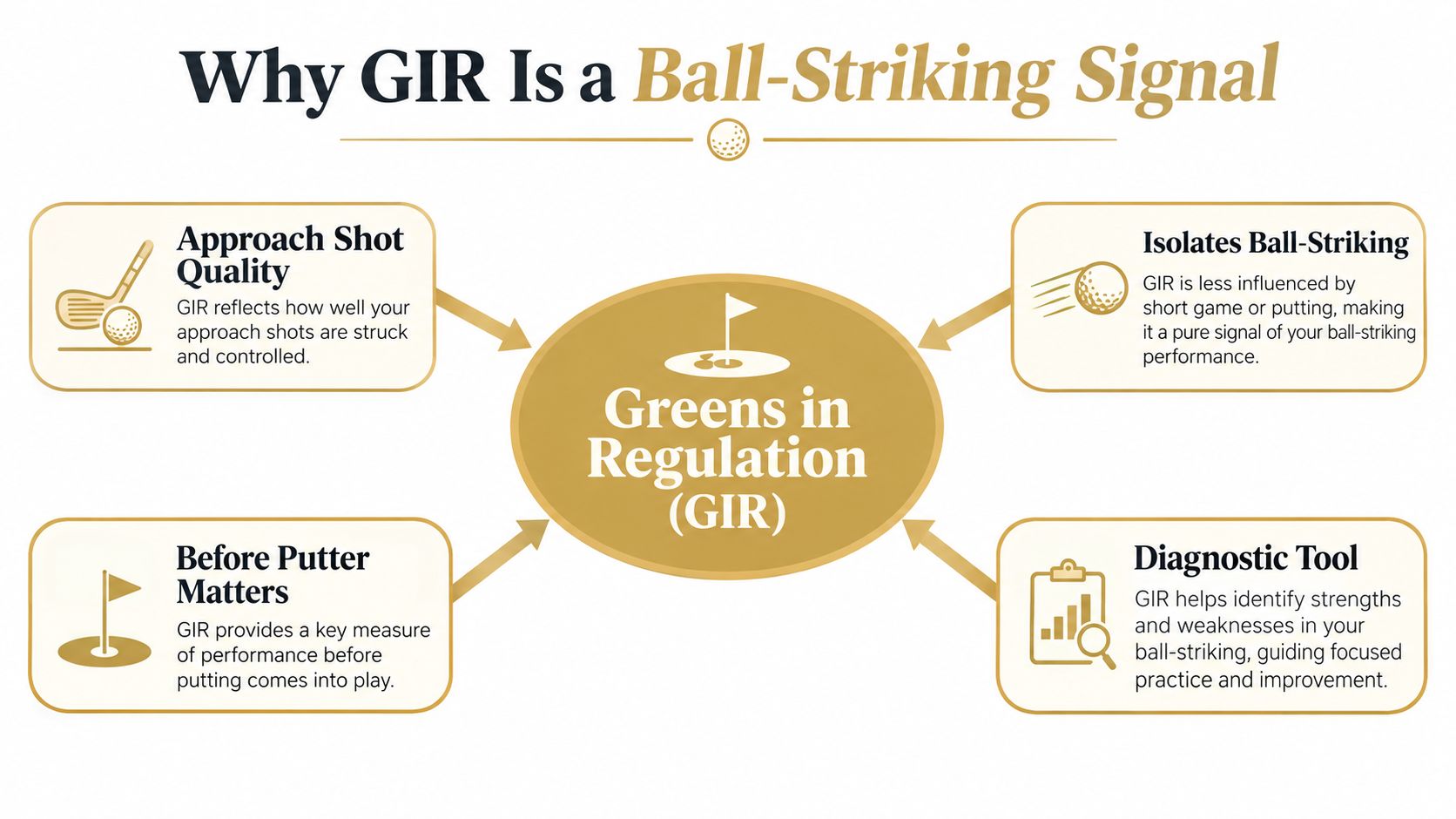
GIR is reached before the putter matters, which makes it a useful ball-striking signal. It captures whether an approach had enough carry, direction, and stopping control to finish on the green, without mixing that result with green reading or putting mechanics.
A launch monitor can turn that hole-level outcome into practice inputs. Carry distance determines whether the ball reaches the target. Lateral dispersion shows how often the shot misses left or right. Angle of attack affects launch and contact, while smash factor helps describe how efficiently the club delivers speed into the ball.
Suppose a player is practicing a 150-yard approach. One shot carries 148 yards but finishes 12 yards offline. Another carries 152 yards and finishes 4 yards offline. The second shot offers a better GIR profile because it combines adequate distance with a tighter directional result, even though neither number alone guarantees a green hit on a real hole.
Turn the output into a practice target
The practice objective shouldn't be “hit more balls.” It should be to learn a repeatable stock shot for a specific yardage.
- Choose a target distance. Use a normal approach yardage rather than a maximum-effort swing.
- Record carry and dispersion. Separate shots that finish short from shots that carry correctly but miss laterally.
- Look for the dominant miss. A consistent short miss points toward carry or contact. A two-sided miss may point toward poor start-line control.
- Retest the stock shot. The wedge practice guidance from Dialed Golf can support a more deliberate approach routine.
GIR becomes trainable. The course records whether the green was hit, while launch-monitor data helps explain why the ball did or didn't arrive there.
Why Hitting Every Green Is Overrated in 2026
A perfect GIR round is not required for a strong score. The PGA TOUR statistics page lists Scottie Scheffler at 72.52 percent GIR, showing that even an elite player does not hit every green across a season. That figure defines GIR more clearly: it measures how often your approach creates a putting opportunity, not whether every hole follows a perfect script.
A missed green can still lead to par when the ball finishes in a manageable location. A green hit can still produce a bogey if the first putt is long, the break is misread, and the next putt is missed. Approach play creates the opportunity, while chipping and putting determine how often you turn that opportunity into a score.
A hypothetical comparison
| Player | Greens in Regulation | Scrambles Made | Three-Putts | Final Score |
|---|---|---|---|---|
| Player A | 12 of 14 | 0 | 2 | Higher |
| Player B | 8 of 14 | 5 | 0 | Lower |
The comparison is hypothetical, so the final result also depends on what happened on the other holes. The scoring lesson is still useful. More GIR can provide more par and birdie chances, yet weak conversion can remove that benefit. A player with fewer greens and a reliable recovery game may finish with the lower score.
Better target: Build enough approach consistency to create regular par chances, then pair it with a short game that handles the greens the approach misses.
GIR is a leading indicator of scoring potential, not a completed score. Use it to judge whether your approach shots are giving you chances, rather than chasing a perfect percentage by attacking every flag. A safer target line can leave a simple chip, while a direct pin attack may bring a bunker or runoff area into play. The best decision often preserves the next scoring opportunity, even when it does not produce a GIR.
Putting Greens in Regulation to Work in Your Next Round
The practical use of GIR starts before the first tee shot. A golfer should select three approach yardages that match stock carry numbers, perhaps a 7-iron, hybrid, and wedge, then build decisions around those reliable distances rather than the longest possible swing.
A launch monitor can help establish the carry number, typical dispersion, and common miss for each club. That information supports better club selection on the course, particularly when the front edge, pin location, and trouble around the green make a small distance error costly.
Before the round
Choose three approach situations that appear often in the player's normal rounds. The practice task isn't to force every ball toward a flag. It's to learn the shot pattern that gives the largest practical margin for finishing on the putting surface.
The approach to gap analysis can help connect actual carry numbers with club selection. A golfer who knows the gap between clubs is less likely to manufacture an uncertain swing when a stock motion would produce a more predictable result.
During the round
Track GIR immediately after each hole. Mark yes only when the ball finishes on the putting surface in the required number of strokes, including the edge-case rulings already covered. Pair the total with putts per GIR, because that comparison shows whether the player is creating chances and converting them efficiently.
A practical on-course sequence looks like this:
- Confirm the carry. Choose the club for the distance the ball must fly, not only the total yardage.
- Pick the safer productive side. Favor the part of the green that leaves the easiest up-and-down if the shot misses.
- Commit to one stock shape. A predictable fade or draw is more useful than changing aim and swing on every approach.
- Accept a two-putt opportunity. A GIR doesn't require a tap-in. It requires a realistic route to finish the hole.
After the round
Review the misses by pattern. Separate short approaches from offline approaches, then note whether the miss came from a poor club choice, an uncertain swing, or a bad target. A player should track GIR over at least five rounds before treating a pattern as a stable baseline.
Dialed Golf connects course tracking with desktop launch-monitor practice. Its desktop experience is live-pair first with Garmin R10 and expanding, while file import supports Garmin, Rapsodo, SkyTrak, FlightScope, Uneekor, GSPro, Awesome Golf, and more, as documented on its device compatibility page. The consumer app is a pocket caddy distributed through TestFlight rather than general App Store availability, and the desktop practice record can use file-based workflows where supported.
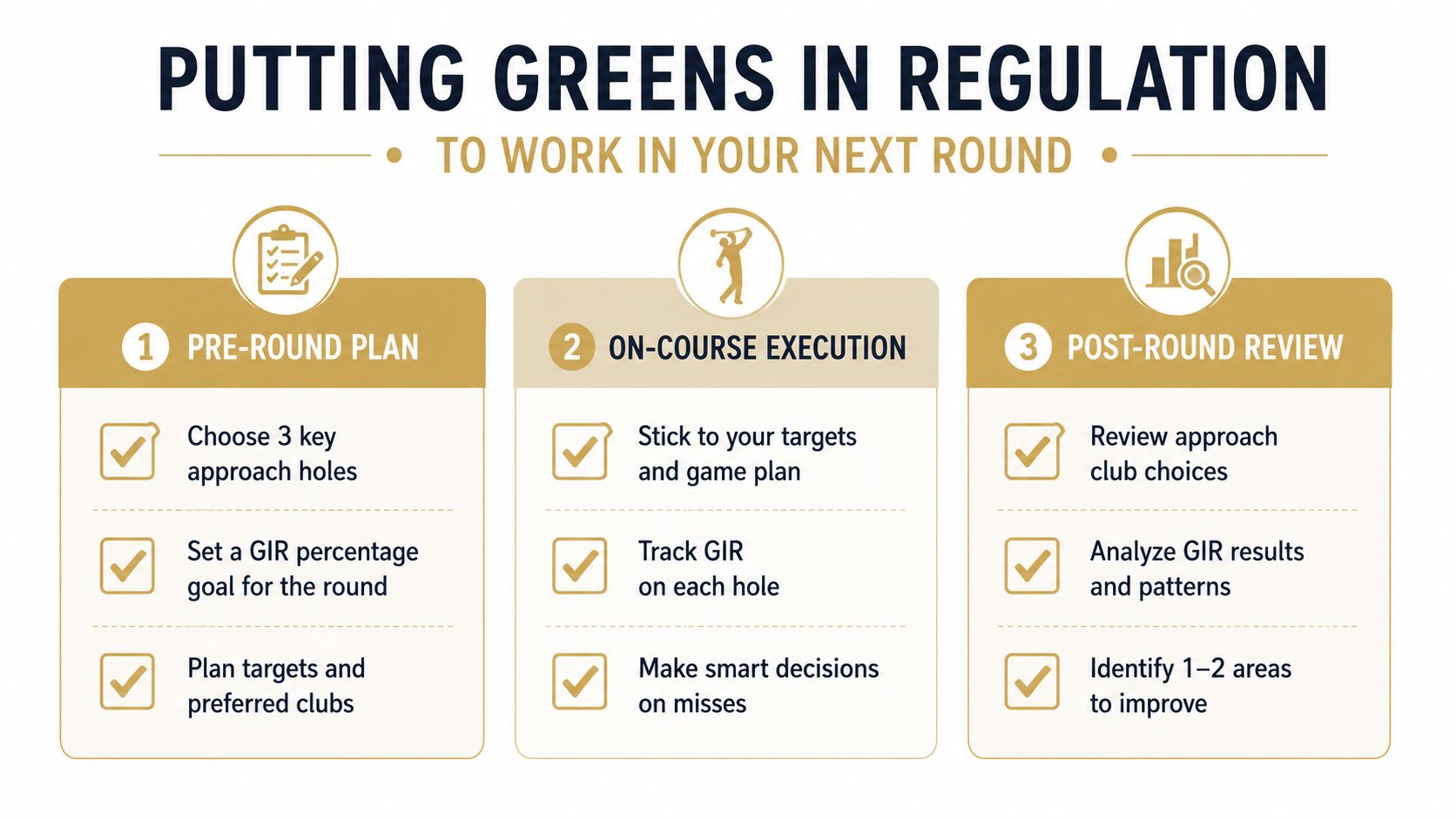
Finish each round with a calm checklist: confirm carry distances, choose one shot shape per club, mark GIR without negotiating with the result, and read lag putts to a comfortable stopping area rather than chasing the hole. The purpose isn't to turn every round into a data project. It's to make each approach decision clearer and each practice session more connected to the shots that determine whether the ball reaches the green.
Dialed Golf gives golfers one connected record across a pocket caddy app and desktop launch-monitor practice, with free web tools remaining free and Golfer Pro available across the app and desktop. Visit Dialed Golf to track GIR on the course, connect approach practice to launch-monitor data, and build a more dependable picture of ball striking.