

A golfer can spend an entire afternoon hitting balls, leave the range tired, and still face the same scoring problem in the next round. The wedges may have received plenty of attention, yet three-putts from 15 feet remain untouched because nobody decided what the practice was supposed to change.
That's the failure behind many coaching practice plans. The issue isn't a lack of drills. It's the absence of a connection between a competitive goal, a weekly schedule, a defined session, and evidence that the work is helping. A useful plan turns practice from a collection of exercises into a repeatable process for changing decisions, execution, and scoring.
Table of Contents
- Why Coaching Practice Plans Matter More Than Drills
- Building a Periodized Practice Calendar
- Designing the 90-Minute Practice Session
- Tracking Progress with Launch Monitor Data
- Reactive Planning Versus Proactive Periodization
- Creating a Weekly Schedule Around One Emphasis Per Day
- Turning Practice Plans Into Scoring Improvements
Why Coaching Practice Plans Matter More Than Drills
The golfer on the range often starts with a familiar routine. A few wedges become a bucket of full swings, a poor drive triggers more driver work, and the final minutes disappear into random shots at targets. The session feels productive because the player has made plenty of swings, but volume alone doesn't identify whether the practice addressed the next round's demands.
A coach-built plan begins elsewhere. It asks which scoring outcome matters, what evidence supports that priority, and what behavior should look different on the course. A golfer who loses shots through poor distance control needs a different session from one who chooses the wrong target under pressure. Both may hit wedges, but they aren't training the same problem.

Structure changes the question
A drill list asks, “What should the golfer do?” A practice plan asks, “What should be different in competition after this work?” That distinction forces the coach to define a target, establish a starting point, select an intervention, and decide how progress will be checked.
A gap analysis for golf practice can help expose the difference between what a player enjoys practicing and what costs strokes. The point isn't to eliminate enjoyable work. It's to stop familiar drills from consuming time just because they're comfortable.
Practical rule: Every block needs an intended change, a constraint that encourages it, and a simple way to judge whether it happened.
Periodization gives that structure a longer horizon. A season goal is divided into phases, phases become weekly priorities, and weekly priorities become timed sessions. The resulting plan may include fewer total activities, but each activity has a reason to be there.
A 2023 study of coaches' planning concepts found that 71% described their approach as training periodization, while 85% said defining a season-long goal was necessary and 73% said dividing the season into distinct manageable periods was necessary. Those findings support a practical coaching principle: practice shouldn't begin with a drill. It should begin with the performance change the season requires, as described in the study of coaches' planning concepts.
Building a Periodized Practice Calendar
A periodized calendar doesn't need academic language or a complicated spreadsheet. It needs three useful time scales.
The macro cycle is the season view. It identifies the main competitive objective and the broad qualities that must develop before important events. The meso cycle is a training block with one dominant theme, such as wedge control, approach-shot dispersion, or decision-making. The micro cycle is the weekly arrangement of sessions, recovery, playing, and review.
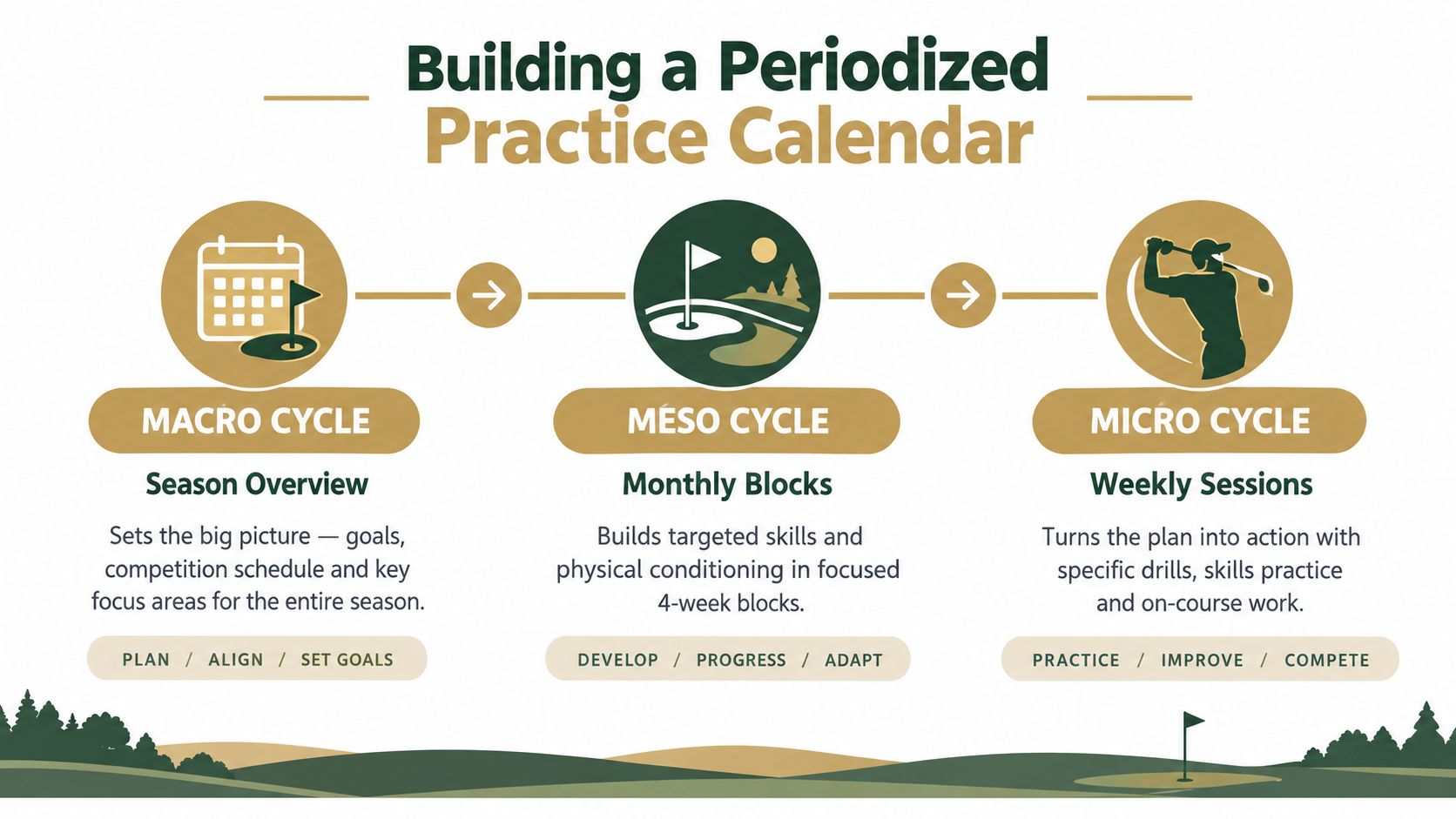
A workable seasonal skeleton
A 12-week pre-season block might start with assessment and technical priorities, move toward representative shot patterns, then finish with scoring simulations and competitive preparation. An in-season block needs a different balance. It may maintain reliable strengths, preserve recovery, and address one high-value weakness without creating excessive fatigue before events.
The calendar should change as the player changes. A junior competitor preparing for a tournament needs more deliberate competition transfer than a club golfer managing work and limited range access. The underlying logic remains the same:
- Season goal: Define the scoring or performance outcome that matters most.
- Training block: Select one main capability that supports that outcome.
- Weekly emphasis: Assign a small number of sessions with clear roles.
- Review point: Reassess the evidence before extending or replacing the block.
The choice of emphasis should account for three signals: the next event, the player's current recovery, and recent round data. If an event is close, the plan may shift toward familiar execution and pressure routines. If fatigue is high, the coach can reduce intensity while retaining contact with the key movement or decision. If the same miss appears across several rounds, it deserves more attention than a single unusual score.
A useful calendar records more than drills. It notes the intended load, the player's readiness, the target outcome, and what the coach will review afterward. Coaches can find related planning ideas in Dialed Golf's practice data resources.
The video below offers another visual reference for organizing practice around defined phases.
Periodization prevents a common error: overtraining the visible weakness while neglecting the skills that already support scoring. A player may spend weeks chasing a swing position when the larger competitive problem is poor club selection or unreliable distance control. The calendar keeps the coach anchored to the outcome, not the loudest frustration from the previous session.
Designing the 90-Minute Practice Session
A golfer can spend 90 minutes hitting balls and leave without knowing what improved. The session needs a clock, a question, and a clear connection to scoring. Dialed Golf's workflow makes that practical: start with the player's recent miss, assign a block to the skill behind it, then finish with shots that test whether the change holds under a different target or club.
A review of 75 structured practice plans across 12 sports found an average session length of 87 minutes, with sessions ranging from 60 to 120 minutes. Plans averaged 9.1 timed periods, each lasting 9.6 minutes, according to the review of structured practice plans. Golf coaches can use that pattern without treating it as a rule. Short blocks create enough variety to maintain attention while giving every part of the session a defined job.
Build the session around a scoring question
For a wedge session, the question might be: can the player produce predictable carry from several distances, then select and execute the right shot without a rehearsal-heavy routine?
Use the answer to shape the blocks:
- Warm-up: Start with controlled chips and partial swings. Watch contact and rhythm before judging distance.
- Baseline: Hit a small set of shots and record carry, dispersion, and strike quality. This gives the coach a starting reference.
- Technique block: Address the movement or contact pattern linked to the recent miss. Keep the task narrow.
- Carry windows: Practice selected wedge distances, recording actual carry instead of relying on feel.
- Variable lies: Change the lie or landing area while preserving the intended outcome.
- Club and target changes: Alternate clubs, distances, and targets. The player must choose a shot rather than repeat a memorized sequence.
- Pressure test: Add a score, consequence, or completion standard that resembles the next round.
- Transfer block: Blend the skill into a short sequence of random shots, then review which decisions or strikes broke down.
- Cool-down: Finish with relaxed swings and one written priority for the next session.
The coach should stop a block when quality drops, not just when the timer ends. A fatigued player may need fewer technical repetitions and more low-intensity decision work. The schedule remains structured, but the emphasis responds to the player in front of you.
A timed block protects the purpose of practice. It does not guarantee improvement.
That distinction matters because a meta-analysis of deliberate practice found that deliberate practice accounts for only a modest share of performance differences, about 20% of variance in sports overall and 14% across domains. More swings are not a plan. Each block needs a defined objective, useful feedback, and a progression from controlled execution to shots that resemble play.
Tracking Progress with Launch Monitor Data
After a month of practice, a player may report better contact yet show no scoring change. The coach needs evidence that connects practice to a specific outcome: tighter carry windows, narrower dispersion, steadier strike quality, or better decisions under changing targets.
Dialed Golf supports that process through a desktop-first launch-monitor setup. Live pairing starts with Garmin R10 and is expanding. CSV and import workflows also accept data from several launch-monitor and simulator systems. Imported rows become useful only after the coach maps them to meaningful sessions, clubs, blocks, targets, and outcomes.
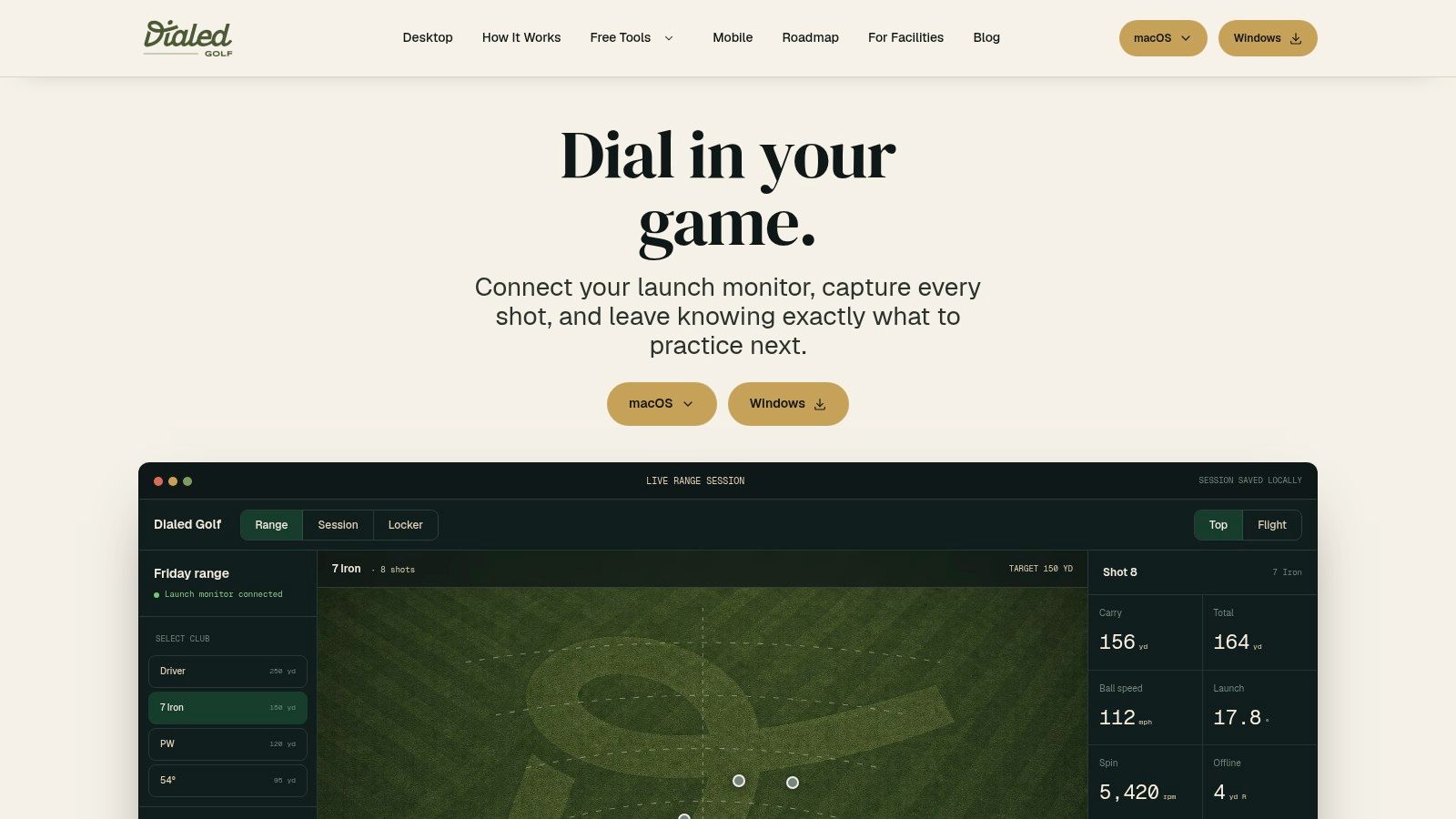
Start with the coaching question
A spreadsheet full of shots cannot explain why the player practiced or whether a change lasted beyond the first few swings. Set the question before opening the trend report. For example, ask whether a wedge carry window remains predictable after several clubs and targets, or whether approach dispersion holds when the player changes the intended target.
Use a short validation check before trusting the pattern:
- Confirm the session boundary: Match imported rows to the intended practice date and block.
- Check field meaning: Verify that carry, total distance, spin, direction, and dispersion retain their original definitions.
- Inspect missing values: Separate unavailable measurements from genuine zeroes or failed shots.
- Compare exports: Check for renamed columns, changed units, or different conventions between device files.
- Test a small sample: Compare selected rows with the original session before reviewing a longer trend.
The metric should match the decision. Carry consistency helps set wedge windows. Dispersion helps determine targets and assess approach control. Spin matters when landing behavior depends on it, provided the measurement is stable enough for the question.
Total shots hit is mainly a workload record. Higher volume can still reproduce the same miss. A smaller group of well-labeled shots often shows more clearly whether the intended change survived the session.
The launch-monitor app workflow works best inside the weekly plan. The coach defines the question, imports the relevant practice data, and uses the result to keep, adjust, or replace the next training block. That creates a working loop between measurement and scheduling, rather than a report that sits apart from practice.
Reactive Planning Versus Proactive Periodization
Reactive planning has a legitimate place in coaching. A player arrives after a poor round, reports a recurring miss, and needs an immediate response. The danger appears when the latest bad shot becomes the entire training calendar.
A 2024 review of coaching practice in golf reported that 12 of 39 respondents, or 30.8%, primarily worked on what recent performances suggested was most important, as documented in the golf coaching practice review. That approach can be responsive, but it can also confuse noise with a stable pattern.
The decision is about evidence and timing
Proactive periodization protects the larger plan. It keeps a season objective in view and gives a player enough exposure to a skill before judging it. Reactive planning protects immediate relevance. It lets the coach address a new constraint, a tournament demand, or a clear breakdown without waiting for the calendar to catch up.
| Coaching signal | Better response |
|---|---|
| One poor hole or unusual miss | Record it, but avoid rebuilding the week around it |
| Repeated pattern across recent rounds | Increase its priority and connect it to the current block |
| Tournament approaching | Reduce experimentation and rehearse reliable decisions |
| Fatigue or declining practice quality | Deload the session and retain a smaller technical touch |
| Strong technical data but weak scoring transfer | Shift toward random targets, choices, and pressure |
A coach should ask whether the evidence reflects a root cause or a symptom. A poor drive may come from a swing issue, but it may also follow an aggressive target choice or a rushed pre-shot routine. Fixing the visible shot without checking the decision can polish the wrong problem.
The strongest plans use a default priority and a controlled exception process. The calendar sets the week's emphasis. A meaningful pattern can change that emphasis, but the coach records why the change happened and what evidence would justify returning to the original plan.
That discipline stops the player from chasing every miss. It also gives reactive adjustments a place within proactive development rather than allowing them to replace it.
Creating a Weekly Schedule Around One Emphasis Per Day
A golfer can spend a week “improving wedges” and still finish without a usable plan. The coach needs to set the training days, session length, daily emphasis, recovery space, and review point before practice begins.
A workable schedule uses 45 to 60 minute sessions, one emphasis per day, and 48 to 72 hours between focused practice blocks, as outlined in this golf practice scheduling guidance. These boundaries protect practice quality and recovery while fitting around work, travel, and changing energy. They also force a useful trade-off: the golfer gets fewer priorities, but each one receives clearer attention.
Build the week around the player's current block and the evidence available in Dialed Golf:
- Monday, review and reset: Examine the previous round or practice record. Select one technical or scoring priority instead of carrying every weakness into the new week.
- Tuesday, technical block: Train the movement or contact pattern behind that priority. Keep the task narrow, and stop before execution quality falls.
- Wednesday, recovery or play: Avoid another demanding block. A short round, relaxed putting, or recovery keeps the next focused session purposeful.
- Thursday, FTR, forced transfer: Revisit the wedge emphasis with different targets, clubs, lies, and shot choices. The golfer must apply the skill without repeating the original drill.
- Friday, data check: Import and compare the relevant sessions in the desktop workflow. Use the results to decide whether Saturday needs technical reinforcement, more transfer, or lower load.
- Weekend, pressure and scoring: Use a course session, competitive game, or defined consequence structure. Record decisions and outcomes, not only strike quality.
Thursday exposes whether the technical change survives a realistic choice. The golfer must select a club, choose a landing area, and respond to an imperfect lie. The Thursday FTR session matters because a cleaner practice motion can disappear under those demands. Compare Wednesday's wedge work with Thursday's transfer evidence before setting Friday's focus.
A schedule can also work during travel. Compress it into a short technical session, a longer playing session, and a review block, with each session assigned a different job. Let the plan bend around the golfer's life, while preserving its emphasis, spacing, and check-in points.
Turning Practice Plans Into Scoring Improvements
The golfer who improves isn't necessarily the one who practices the most. Improvement comes from connecting a defined goal to a suitable block, checking the evidence, and changing the plan only when the evidence supports a change.
That's why structured coaching practice plans outperform drill-heavy range time. Periodization prevents random priorities. Timed sessions protect attention. Imported data shows whether a technical change survives beyond a single practice. A deliberate choice between reactive adjustment and proactive development keeps emotion from controlling the calendar.
A real improvement story needs evidence, not an attractive narrative. Without a verified scoring record, a claim that a golfer dropped two strokes per round after changing plans shouldn't be presented as fact. The honest standard is to track the rounds, define the comparison period, record the practice change, and preserve the data that connects the two.
The operating principles are straightforward:
- Define the performance goal first.
- Structure the available time.
- Import and query the relevant data.
- Prioritize recurring patterns over emotional reactions.
- Schedule recovery as part of development.
- Judge success through competition, not range volume alone.
Dialed Golf brings a consumer pocket caddy, a desktop launch-monitor practice workflow, and Dialed Academy memberships and front-desk tools into one golfer record and one Pro plan. Visit Dialed Golf to keep free web tools at the top of the funnel, review the current TestFlight app status, and explore the practice and club workflows that fit the golfer's schedule.