

Chasing a single magic number for driver ball speed is the fastest way to misread a launch monitor session. Popular advice treats a peak reading as a grade, yet that reading doesn't show whether contact was centered, whether launch was playable, or whether the next ten drives would stay in play. A good ball speed for driver performance isn't a universal pass mark. It's a player-specific speed value, judged against clubhead speed, strike quality, carry, and dispersion that a golfer can repeat under normal intent.
Table of Contents
- Why Driver Ball Speed Is Not a Universal Score
- How Clubhead Speed Becomes Driver Ball Speed
- Good Driver Ball Speed by Swing and Handicap
- What Ball Speed Means for Carry and Playability
- Measure Driver Ball Speed Without Guessing
- Build a Repeatable Ball Speed Practice Plan
- Choose Drills and Techniques That Fit the Problem
- Build Your Personal Ball Speed Target
Why Driver Ball Speed Is Not a Universal Score
Two golfers can record similar driver ball speeds and walk away with very different results. One produces a centered strike with playable launch and a tight left to right pattern. The other reaches the same number on one flushed swing, then sprays the next several because strike location and face control keep changing. The monitor didn't lie in either case. The interpretation was incomplete.
Ball speed matters because it captures more than effort. It reflects how fast the clubhead was moving and how cleanly that motion transferred into the ball. In the 2023 USGA study of 627 golfers, ball speed explained 94% of variation in measured driver ability, and each additional 1 mph corresponded on average to 2.02 additional yards of driving performance. That relationship explains why coaches watch the number closely, but it doesn't turn any single reading into a verdict.
Peak Speed Versus Reliable Speed
Peak ball speed is the fastest ball in a set. Reliable ball speed is the speed a golfer can reproduce while keeping shots in a playable corridor. Those two figures can point to opposite practice decisions. A rising peak with a flat or falling median often signals harder swinging without better delivery. A rising median, even with an unchanged peak, usually signals contact that's becoming more repeatable.
Good ball speed is contextual. It describes how well speed, strike, and shot shape work together for a particular golfer, not whether a reading clears an arbitrary line.
Launch angle, spin, attack angle, weather, and ground conditions also shape what a given ball speed produces. A drive that launches too low with excess spin won't carry like a drive launched in a better window, even at identical speed. Wind and firm turf can flatter or punish total distance without changing impact quality at all.
The practical question therefore changes. Instead of asking whether a number looks impressive beside a tour benchmark, a golfer benefits from asking whether that speed is efficient for the swing that produced it, and whether it creates carry that stays in play. That framing turns ball speed from a scoreboard into a diagnostic tool.
How Clubhead Speed Becomes Driver Ball Speed
The sequence starts with the moving clubhead, passes through impact, and ends with the ball leaving the face. Each stage answers a different question, and confusing them leads to poor practice choices.
The visual below maps that transfer from clubhead motion to departing ball speed.
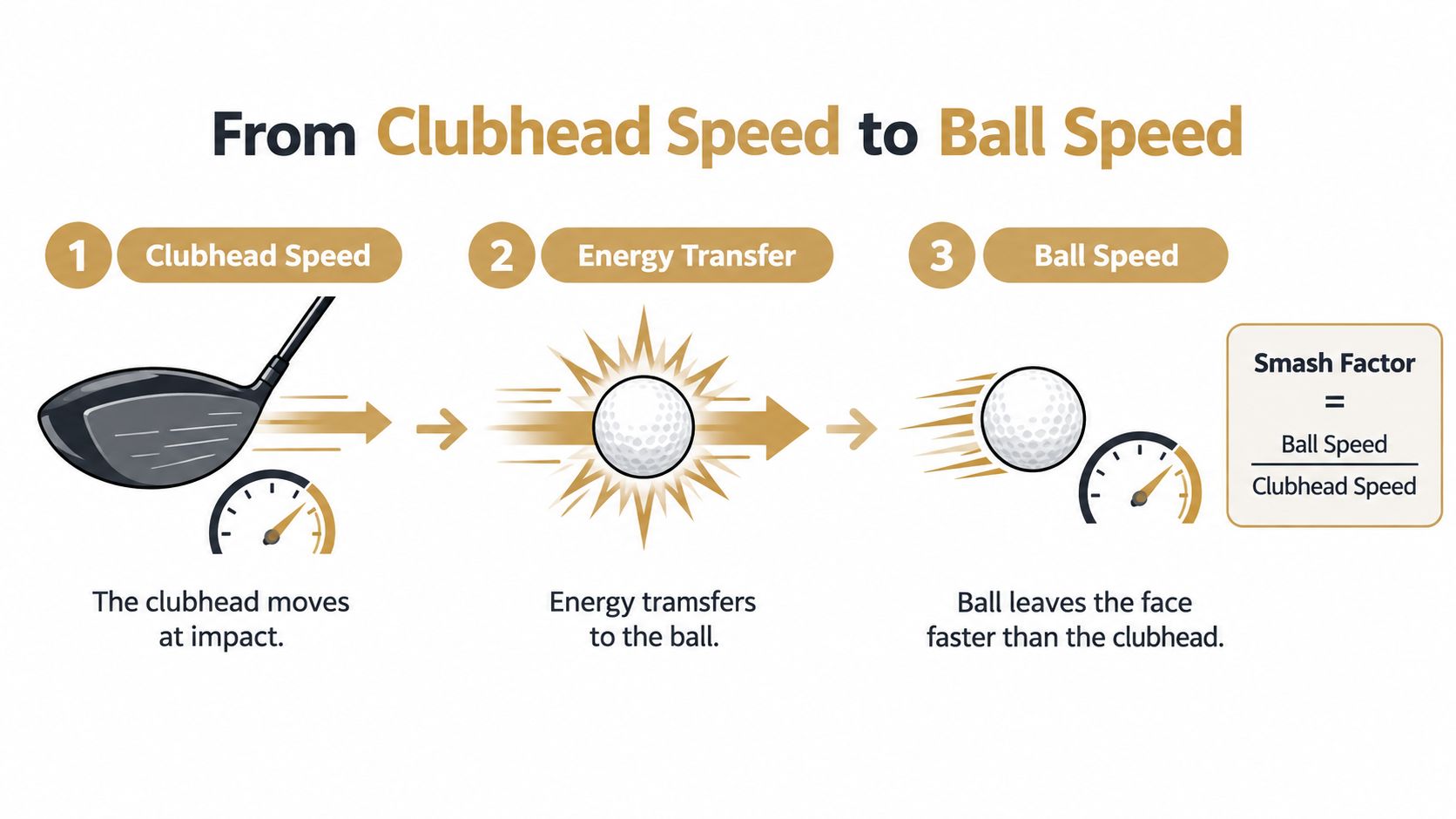
Clubhead speed describes how fast the driver head travels at impact. It sets a ceiling, because a slower moving head has less energy available to pass into the ball. It doesn't, however, reveal where the ball met the face or how much energy survived that collision.
Ball speed describes how fast the ball leaves the face. That figure rises when clubhead speed rises, but it also rises when contact moves closer to center at the same clubhead speed. This dual source is exactly why ball speed is more informative than swing effort alone. A golfer who swings slightly slower but finds the middle more often can match or beat a harder swinger who keeps catching the heel or toe.
Smash Factor Makes Transfer Visible
Smash factor is ball speed divided by clubhead speed. It's a simple ratio with a clear job. It shows how efficiently a given swing converted clubhead motion into ball motion on that strike. When clubhead speed holds steady and smash factor climbs, contact quality is improving. When clubhead speed climbs and smash factor falls, added effort is leaking away at impact.
A concrete example keeps the math grounded. At 94 mph of clubhead speed, approximately 137 mph of ball speed corresponds to a smash factor of about 1.46, and sustained readings around 135 to 140 mph indicate efficient energy transfer for that example speed, as shown in the reference example pairing 94 mph club speed with optimized carry. Materially lower ball speed at that same club speed points toward off center contact, excess dynamic loft, or inefficient strike conditions rather than a simple lack of effort.
That distinction gives launch monitor review a useful vocabulary. A speed gain means the clubhead itself is moving faster. A transfer gain means the same clubhead speed is producing more ball speed through cleaner impact. Both can raise distance, but they call for different practice, and only one of them requires swinging harder.
Good Driver Ball Speed by Swing and Handicap
Benchmarks help golfers locate a starting point, provided those benchmarks stay tied to player context. A figure that's ordinary for a scratch player may be strong for a higher handicap golfer, and a figure that's modest in professional golf may be entirely functional for a recreational player who keeps the ball in play.
An amateur launch monitor dataset reported 133.8 mph average driver ball speed, ranging from 126 mph among golfers with handicaps of 20 or higher to 147.1 mph among scratch golfers, while the mean ball speed of the 10 fastest PGA TOUR players was 185.9 mph in 2023, according to the USGA distance report covering professional and amateur ball speed. Those figures describe populations, not prescriptions. They show where groups tend to sit, not where any individual must sit to play well.
Reading the Benchmark Table Without Overreading It
| Player Context | Reported Driver Ball Speed | How to Use the Figure |
|---|---|---|
| Handicap 20 or higher | 126 mph | A representative group average, useful as context rather than a ceiling |
| Average amateur dataset | 133.8 mph | A broad midpoint for recreational comparison across sessions |
| Male 14.5 handicap reference | Around 133 mph | A similar recreational reference point from launch monitor summaries |
| Scratch amateur | 147.1 mph | Strong amateur territory, reflecting speed and strike combined |
| 90 to 100 mph swing range | Roughly 131 to 145 mph commonly cited | A swing speed based window, best checked against smash factor |
| 10 fastest PGA TOUR players, 2023 mean | 185.9 mph | Elite upper benchmark, not a recreational target |
The table works best as a sorting tool. A golfer near the higher handicap average who wants more distance may gain more from centered contact than from clubhead speed work, especially if smash factor varies widely shot to shot. A golfer already near scratch amateur levels faces a different problem, since contact is probably more consistent and further gains depend more on genuine speed or launch refinement.
Why Handicap and Swing Speed Tell Different Stories
Handicap reflects scoring, which bundles driving with approach play, short game, and decision making. Swing speed reflects one physical input on one club. A lower handicap golfer doesn't automatically produce high ball speed, and a fast swinger doesn't automatically score well. That's why the two lenses belong together. Handicap context shows what similar scoring levels tend to produce. Swing speed context shows whether a golfer is converting available motion efficiently.
Professional numbers deserve careful handling. Elite performance near or above 180 mph shows what optimized athleticism, equipment, and impact can produce at the top end. It doesn't define a good ball speed for driver use at a local course, where fairway width, typical carry demands, and a golfer's dispersion pattern matter far more. Treating tour speed as a personal target often pushes recreational golfers toward effort levels that damage strike, which lowers the very ball speed they're chasing.
Available summaries also show how wide the human range is, from roughly 111 mph for a 15 handicap female amateur to about 171 mph for a PGA Tour player in the benchmark material reviewed for this guide. That spread reinforces a simple conclusion. A useful target sits relative to a golfer's own swing speed, physical profile, and current median, not at the far end of a published range.
The most defensible starting point is therefore personal. A golfer records a current median, checks smash factor against clubhead speed, and compares that picture with the relevant group range. Movement within that framework, sustained across sessions, counts as progress even when the absolute number remains far from professional territory.
What Ball Speed Means for Carry and Playability
Ball speed creates the potential for distance, but launch conditions decide how much of that potential becomes carry. The chart below illustrates the relationship using example amateur figures.
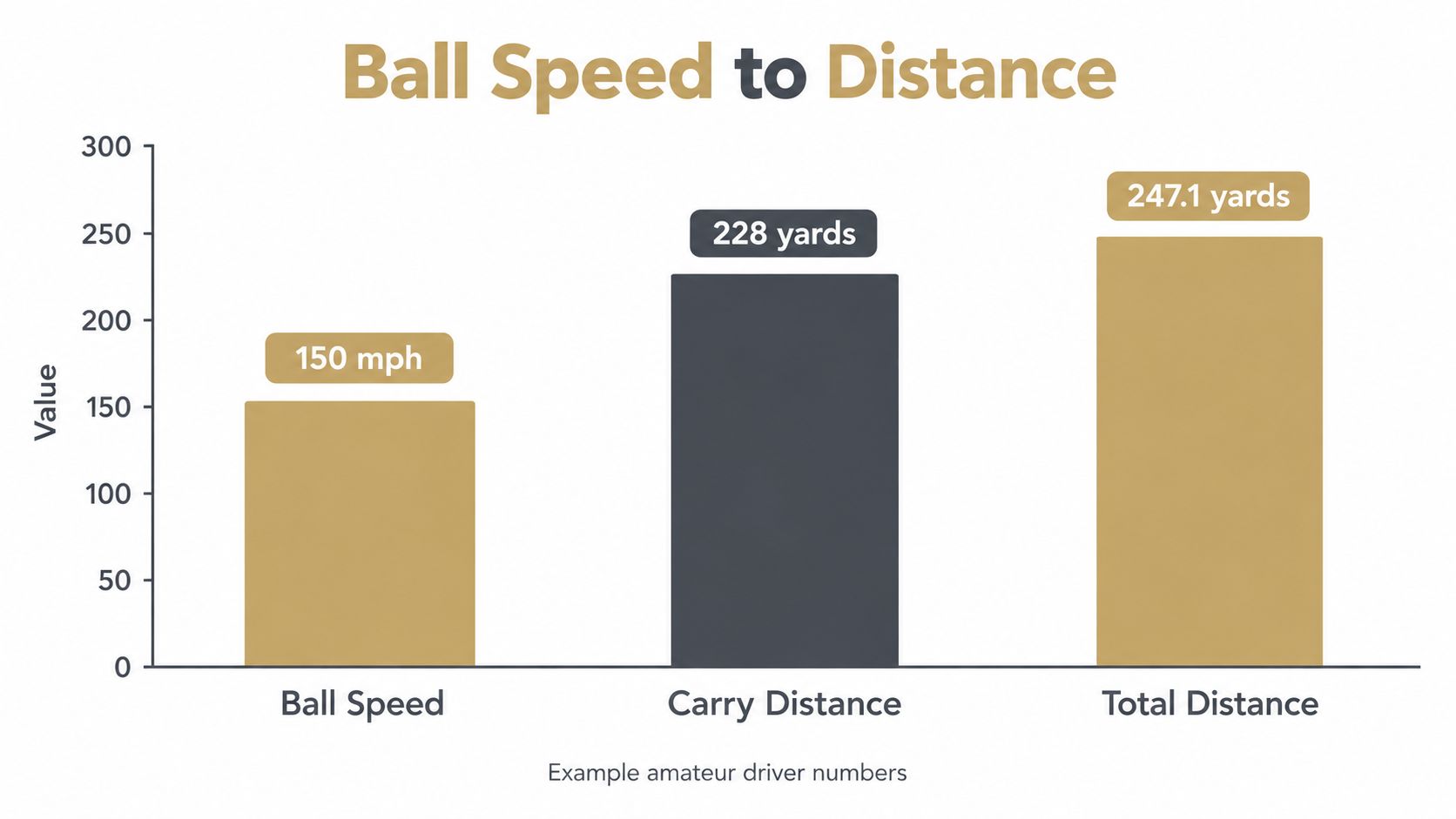
In the amateur example noted earlier, ball speed around the dataset average corresponded to approximately 228 yards of carry and 247.1 yards of total distance. That's an illustration, not a promise attached to any particular reading. Another golfer at similar speed can carry the ball shorter with low launch and high spin, or carry it farther with a better launch window and centered strike. Total distance adds further noise, since rollout depends on landing angle, turf firmness, and slope.
A structured gap analysis for driver and full bag distances helps separate carry that a golfer owns from total distance that conditions donated. Carry is the more honest planning number, because it determines whether a drive clears a bunker or reaches a safe landing zone regardless of bounce.
Where Playability Enters the Calculation
Dispersion decides whether added speed helps scoring. A modest speed increase that widens the shot pattern beyond fairway width can cost more strokes than it gains in shorter approach shots. Conversely, a small median speed gain inside the same dispersion corridor is valuable, even if the peak number barely moves.
The video below shows ball flight and launch concepts in motion, which helps connect static numbers to visible shot outcomes.
A sound judgment pairs three views of the same set of drives. Median ball speed shows typical output. Mishit ball speed shows the cost of off center contact. Carry within an acceptable corridor shows usable distance. When all three improve together, speed is helping. When only the peak improves, the session produced a highlight rather than a better driver game.
Measure Driver Ball Speed Without Guessing
Reliable measurement starts before the first recorded drive. A golfer who begins cold, changes tee height between shots, or alternates between range balls of different condition creates variation that has nothing to do with the swing. A short warm up, a consistent ball position, and the same target line across a set keep the comparison honest.
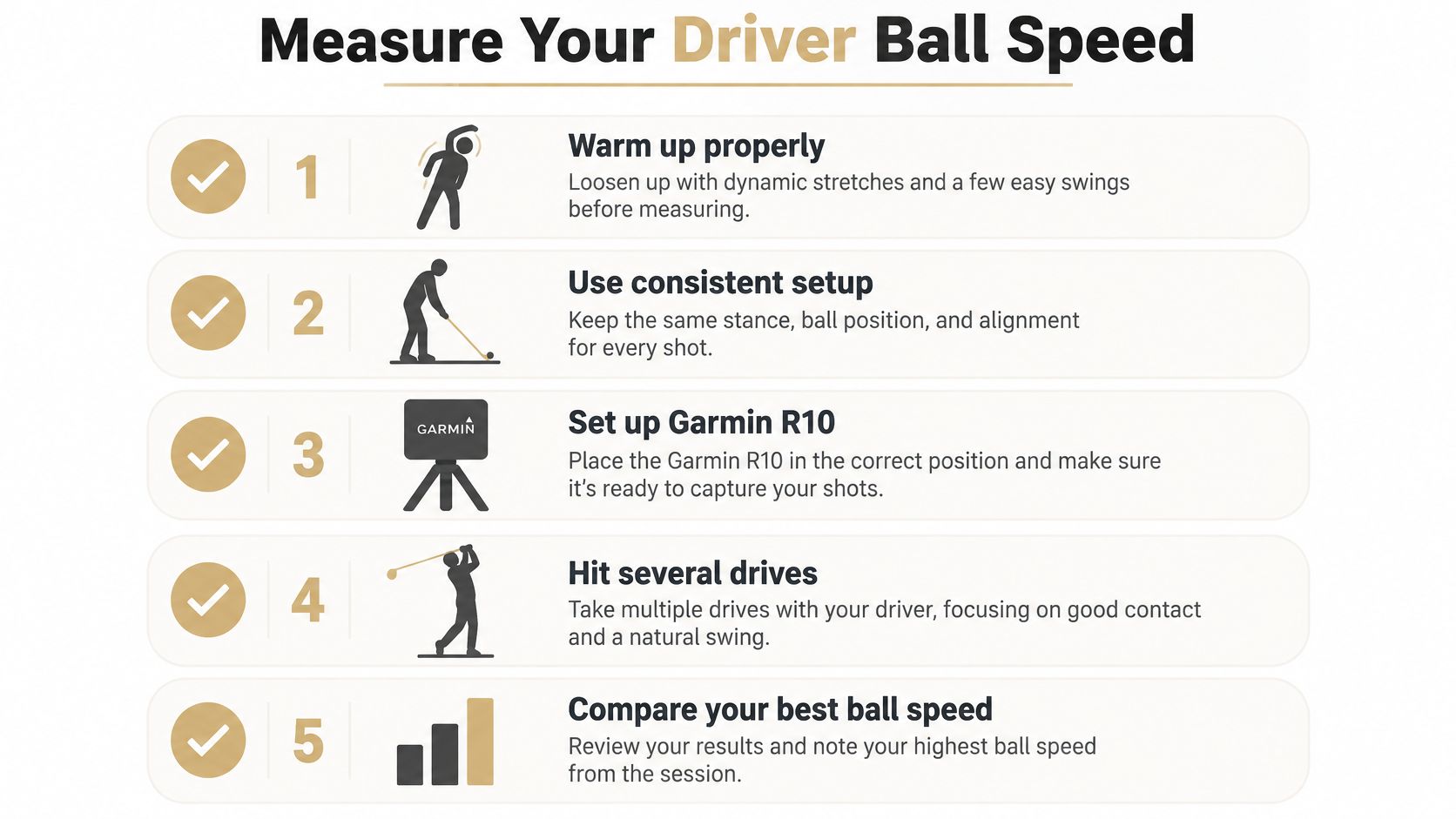
The checklist below summarizes a repeatable setup and capture routine.
A Comparable Session Routine
- Warm up first: Hit enough balls that swing tempo and contact feel normal before recording counts.
- Fix the setup: Keep tee height, ball position, stance width, and target consistent through the test set.
- Place the monitor consistently: Follow the device placement guidance the same way each session so readings stay comparable.
- Hit a representative set: Use normal on course intent rather than maximum effort, and keep mishits in the record.
- Review the middle, not the maximum: Compare median ball speed, smash factor, carry, and dispersion against the prior session.
Strike quality deserves direct evidence. Face tape or foot spray shows where contact clusters, which explains smash factor swings that numbers alone can't diagnose. A golfer whose contact lives low on the face has a delivery or tee height question to solve before any speed question. Guidance on choosing a launch monitor setup suited to driving range practice can help match the measurement environment to the questions being asked.
Moving Session Data to a Desktop
Historical sessions become more useful when they're stored where trends can be reviewed side by side. Garmin Approach R10 and R50 users can open the Garmin Golf app, select Activity, choose the session, select the export control, and choose Export to CSV, after which the resulting file can be shared from the phone, as described in the Garmin session export steps for R10 and R50. A CSV file holds shot level rows with fields such as club speed, ball speed, launch angle, spin, and carry, though available fields depend on the originating monitor and export.
That file based workflow differs from live pairing. Importing a CSV uses a session a golfer already recorded and exported. Live pairing connects a compatible monitor during practice and captures shots as they happen. Desktop practice tools can support both paths, but they solve different problems. Import rescues history. Live pairing streamlines the current session.
Session check: A session is comparable when warm up, setup, ball type, monitor placement, and swing intent match the previous session closely enough that remaining differences plausibly come from the swing.
Golfers who keep mishits in the data, note strike location, and export sessions for trend review stop guessing. The median either moves or it doesn't, and the reason usually sits in the accompanying fields.
Build a Repeatable Ball Speed Practice Plan
A practice plan built around ball speed begins with a baseline, not a goal. The baseline set, hit at normal intent after a warm up, establishes median ball speed, typical smash factor, carry, and dispersion width. Separating centered strikes from mishits within that set reveals whether the main gap involves clubhead speed, energy transfer, or simple repeatability.
Each diagnosis leads somewhere different. Low clubhead speed with healthy smash factor suggests the motion itself needs more velocity. Normal clubhead speed with low or erratic smash factor suggests contact work comes first. Good numbers on centered strikes paired with a wide spread of outcomes suggests delivery consistency is the limiting factor, and neither speed nor strike drills alone will fix it.
A Session Cycle That Produces Evidence
- Set one target: Choose a single focus for the session, such as centered contact or controlled speed, rather than several swing thoughts.
- Work in small blocks: Hit a short block with the chosen focus, then pause and review the numbers before fatigue changes the motion.
- Reset after quality drops: When strike or dispersion deteriorates noticeably, return to normal intent swings until contact stabilizes.
- Close with a test set: Finish with drives at on course intent and compare the median against the baseline set.
Speed work fits inside this cycle as a deliberate block, not as the whole session. A golfer can push intent for a few swings, watch whether ball speed rises through clubhead speed or collapses through poorer smash factor, and then return to stock swings. The test set at the end answers the only question that matters. Did the faster work leave the normal swing faster, or merely more scattered?
Progress also needs a time dimension. One strong session can reflect fresh legs, helpful wind, or a temporary swing feel. The same median across several comparable sessions reflects a change the golfer owns. Coaches often call this the difference between performance and learning, and launch monitor history makes it visible without guesswork.
Consolidation is a legitimate outcome. When a test set shows dispersion widening faster than median speed rises, the correct decision is to hold the current speed and rebuild strike quality at that level. A repeatable plan protects the golfer from chasing a number that the rest of the delivery can't yet support.
Choose Drills and Techniques That Fit the Problem
Drills should be selected by the metric they're meant to move, then kept or discarded based on evidence. A generic list of exercises treats every golfer as if the same link in the chain were broken.
Swing speed drills, including overspeed style work with lighter implements or intent based fast swings without a ball, aim at clubhead velocity. The metric to watch afterward is clubhead speed on normal swings, followed by whether ball speed follows. If clubhead speed rises but smash factor falls enough to erase the gain, the drill is producing motion the golfer can't yet control at impact.
Plyometric and general athletic work targets the physical capacity behind speed rather than the swing itself. Its effect, if any, shows up gradually in clubhead speed across weeks, not within a single range session. That slower timeline makes session logs especially valuable, since memory tends to overstate physical training effects on the golf swing.
Technical delivery changes address how the club arrives at the ball. Adjustments to sequencing, low point control, or attack angle aim to present the face more efficiently. Correct setup foundations matter here, and reviewing the correct stance positions for a golf driver gives delivery work a stable starting point. The evidence to watch is smash factor stability and launch consistency, not raw speed.
Strike focused practice, such as face spray feedback, tee height experimentation, or gate style contact drills, targets the transfer ratio directly. It suits golfers whose clubhead speed is adequate but whose contact wanders. Success looks like a tighter cluster of smash factor readings and a higher mishit ball speed floor.
One caution applies across all four categories. Improving efficiency alone does not guarantee optimal launch or accuracy, and ball speed interpretation should include launch angle, spin, strike location, and dispersion rather than relying on smash factor alone, as the launch monitor interpretation guidance on efficiency and accuracy makes clear. A drill earns its place when median ball speed or smash factor improves without an unacceptable cost in dispersion. Anything else is entertainment with data attached.
Build Your Personal Ball Speed Target
A personal target combines three numbers from comparable sessions. Median ball speed defines current reliable output. Peak ball speed shows the present ceiling under good contact. Mishit ball speed shows the penalty when contact wanders. Paired with smash factor, carry, and dispersion, those three figures classify the next intervention without ambiguity.
The classification is straightforward. A golfer with strong smash factor and tight dispersion but modest speed needs more clubhead velocity. A golfer with adequate clubhead speed and weak transfer needs cleaner contact. A golfer whose centered strikes look strong but whose pattern spreads widely needs more reliable delivery before either pursuit makes sense. Higher ball speed isn't automatically better when launch, spin, accuracy, or setup stability worsens alongside it.
Decision rule: Speed counts as gained when median ball speed and carry rise together inside a dispersion corridor the golfer would accept on the course.
Dialed Golf supports this kind of review as a practice data workspace across three connected products under one golfer record and one Pro plan. The consumer app works as a pocket caddy on the course and is available through TestFlight rather than general App Store release. The desktop product focuses on launch monitor practice at the range or in a garage simulator, with desktop first live pairing for Garmin R10 and expanding support, plus CSV import from Garmin, Rapsodo, SkyTrak, FlightScope, Uneekor, GSPro, Awesome Golf, and more. Dialed Academy provides memberships and front desk tools for ranges and clubs at $99.99 per month or $999.99 per year, with clubs keeping their own dues, while free web tools remain free and Golfer Pro runs $9.99 per week, $29.99 per month, $149.99 per six months, or $249.99 per year across app and desktop.
After the next range session, the review takes minutes. Compare the median, check the mishit floor, and look at where the shots went. A good ball speed for driver performance, for that golfer on that day, is the speed that survives all three checks.
Golfers ready to judge driver speed by median, carry, and dispersion rather than a single peak reading can organize launch monitor sessions, imports, and on course records in one place with Dialed Golf. The desktop practice workspace, pocket caddy app, and free web tools give every session a trend line worth trusting, so the next ball speed target gets built on evidence instead of guesswork.