

The approach looks too short for a pitching wedge, but a full sand wedge won't reach. The golfer eases off the pitching wedge, catches it cleanly, and watches the ball finish beyond the target. That awkward in-between shot is the reason to investigate gap wedge angle, but buying a familiar loft number doesn't automatically solve it.
The useful question is whether the club creates a dependable carry window between the wedges already in the bag. A fitting starts with loft, then checks what happens when that golfer hits the ball.
Table of Contents
- What Gap Wedge Angle Means and Why It Exists
- Typical Gap Wedge Lofts by Brand and Market
- How Loft Gaps Become Yardage Windows
- How to Choose the Right Gap Wedge Loft
- Match Bounce to Your Conditions
- Confirm the Gap on a Launch Monitor Before You Buy
What Gap Wedge Angle Means and Why It Exists
Gap wedge angle means the loft of the wedge between the pitching wedge and sand wedge, usually around 49°–53°, with 52° as a central reference point. Published descriptions span roughly 48°–54° because manufacturers do not use one universal specification.
Loft is the clubface's angle relative to vertical when the club is measured in its standard position. It influences launch height and carry, while the golfer's delivery affects how much loft reaches the ball.
Why the extra wedge became necessary
The USGTF history of the three wedges explains that after the sand wedge's development in the 1930s, pitching wedges typically carried approximately 48°–50° and sand wedges 54°–56°, leaving a manageable 4°–8° separation. As cavity-back irons became stronger, pitching wedges moved toward approximately 45°–46°, widening the separation to 8°–10°.
That change left more distance between the pitching wedge and sand wedge. The gap wedge filled the space, giving golfers another club for shots between those two.
Practical rule: Choose a gap wedge by checking the clubs around it and the carry distance it produces.
An iron-set wedge and a standalone specialty wedge can both fill this role, even when their lofts differ. The number on the sole is a useful starting point, but the golfer's own average carries show whether the club leaves a yardage hole or overlaps an existing option.
Where it fits on the course
The Golf Lounge gap-wedge guide describes use from roughly 85–115 yards, along with lower-flying chips and pitches. That broad range is not a personal distance promise. Actual carry depends on the golfer and the shot.
A golfer may use the club for a stock approach, a shortened pitch, or a chip that needs less height than a sand wedge provides. These shots produce different carries, so track them separately when judging whether the wedge covers a useful range.
Loft describes the face angle; bounce describes the sole's interaction with the ground. Start by checking the actual pitching- and sand-wedge lofts, then use average carry numbers to assess the distance between them.
Typical Gap Wedge Lofts by Brand and Market
| Model or source | Gap wedge loft | Bounce | Context |
|---|---|---|---|
| Titleist Vokey SM11 | 48°, 50°, 52° | Check the specific loft and sole option | Gap wedge range typically 48°–52° in the 2026 Vokey listing |
| Mizuno T24 (50°) | 50° | 8° | Listed in the 2024 GolfSource T24 lineup |
| Mizuno T24 (52°) | 52° | 9° | Same T24 lineup |
| Common design range | 49°–53° | Select for delivery and turf | Typical gap-wedge build range |
| Market average, 2026 | 48.5° | No market-wide bounce figure reported | StickPicker's 2026 review found matched gap wedges in 101 of 118 current iron sets, spanning 45°–52° |
The table separates model specifications from market context. A particular wedge's loft and bounce describe that club. A market average describes a collection of iron sets, not the correct specification for an individual golfer.
The matched-wedge average includes sets with strongly lofted pitching wedges. In those sets, a comparatively strong gap wedge can make sense because it continues the iron set's progression. Moving that same club into a bag with a weaker pitching wedge may create unnecessary overlap.
Read the surrounding clubs first
A set-matched gap wedge and a specialty gap wedge may also look and feel different at address. The golfer should consider whether the club will mainly handle full approaches or a broader mix of partial shots and greenside work.
Neither category earns an automatic place in the bag. The useful comparison is the carry produced with the golfer's normal swing, together with the quality of contact from typical lies.
- Start with the actual set: Record the pitching- and sand-wedge lofts before shopping.
- Check the complete specification: A loft listing alone doesn't identify the bounce or sole shape.
- Treat averages as context: A popular specification can still leave a hole in a particular bag.
The same label-versus-specification distinction applies farther up the bag, as the hybrid golf club lofts chart illustrates. Club names help organize equipment, but they aren't a substitute for checking the lofts and distances.
A 52° wedge is a common reference, not a universal answer. The right choice must fit the clubs on either side.
How Loft Gaps Become Yardage Windows
| Hypothetical setup | Pitching wedge | Gap wedge | Sand wedge | Loft steps |
|---|---|---|---|---|
| Balanced starting point | 44° | 50° | 54° | 6°, then 4° |
| Wider upper gap | 44° | 52° | 56° | 8°, then 4° |
| Tighter progression | 48° | 52° | 56° | 4°, then 4° |
These worked examples show where a fitter would start testing, not guaranteed distance outcomes.
The diagram illustrates the difference between wider and tighter spacing.
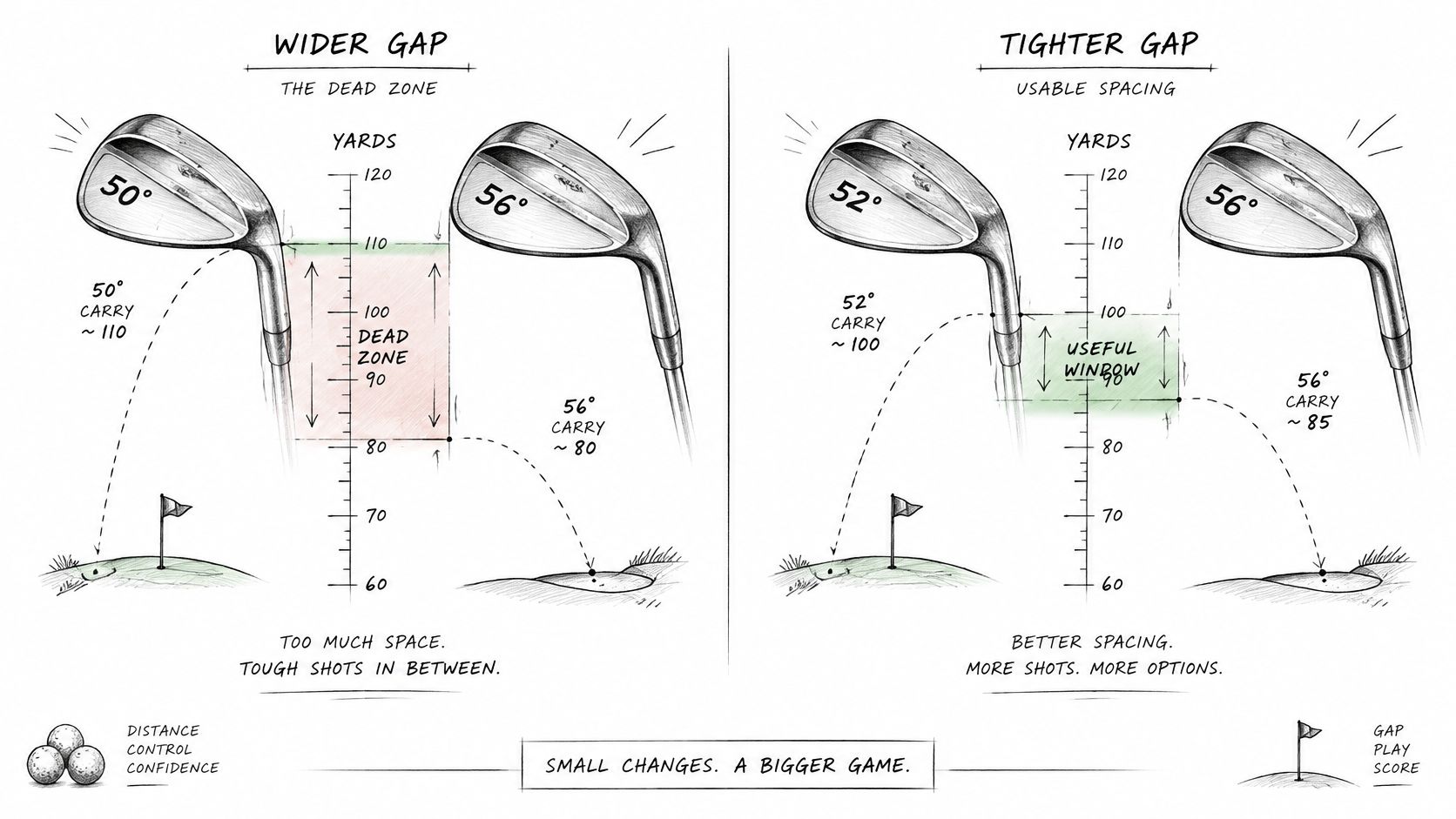
In the first example, the stronger gap wedge divides the available loft space into a reasonably balanced progression. That makes it a sensible starting hypothesis for useful carry windows, though testing could still reveal uneven distances.
In the second example, the pitching-to-gap step is much wider than the gap-to-sand step. A golfer may find an awkward approach distance between the first pair while having closely spaced choices between the second.
Read the distance, not just the arithmetic
The third example has equal loft steps. It could work well for a golfer who wants closely spaced approach options, but equal loft spacing still doesn't prove equal carry spacing.
The golf wedge equipment overview) identifies swing speed, strike quality, shaft, ball, and delivery as influences on the distance interval. A pitching wedge with a different head construction can also behave differently from the specialty wedge beside it.
A loft gap is a fitting hypothesis. A carry gap is the result that matters on the course.
Overlap means neighboring clubs repeatedly cover much the same carry window with the intended swing. A hole means the golfer lacks a comfortable, repeatable shot between those windows. Neither can be diagnosed from stamped lofts alone.
The following video provides an additional wedge reference.
Technique should remain reasonably consistent during comparisons. The guide to hitting a wedge provides a useful companion for golfers whose contact changes during testing.
The desired result is a sequence of usable carry windows across both full and controlled swings, rather than attractive loft arithmetic alone.
How to Choose the Right Gap Wedge Loft
The Callaway wedge buying guide gives a typical 49°–53° gap-wedge build range and a practical 4°–6° progression, commonly producing approximately 10–15 yards of full-swing carry separation. Those figures are starting points, not guarantees.
Gap wedge loft to try, by pitching wedge loft
| Pitching wedge loft | Gap wedge to try | Sand wedge target | Step size |
|---|---|---|---|
| 44°–46° | 50°–52° | 54°–56° | Aim for 4°–6° per step by selecting compatible endpoints |
| 47°–48° | 52° | 56° | 4°–5° first, then 4° |
| 49°–50° | 52°–53° | 56° | Approximately 3°–4° with suitable combinations; check for overlap |
| Above 50° | 52°–53° only if the measured step exceeds 4° | 56° | Test on a launch monitor before buying |
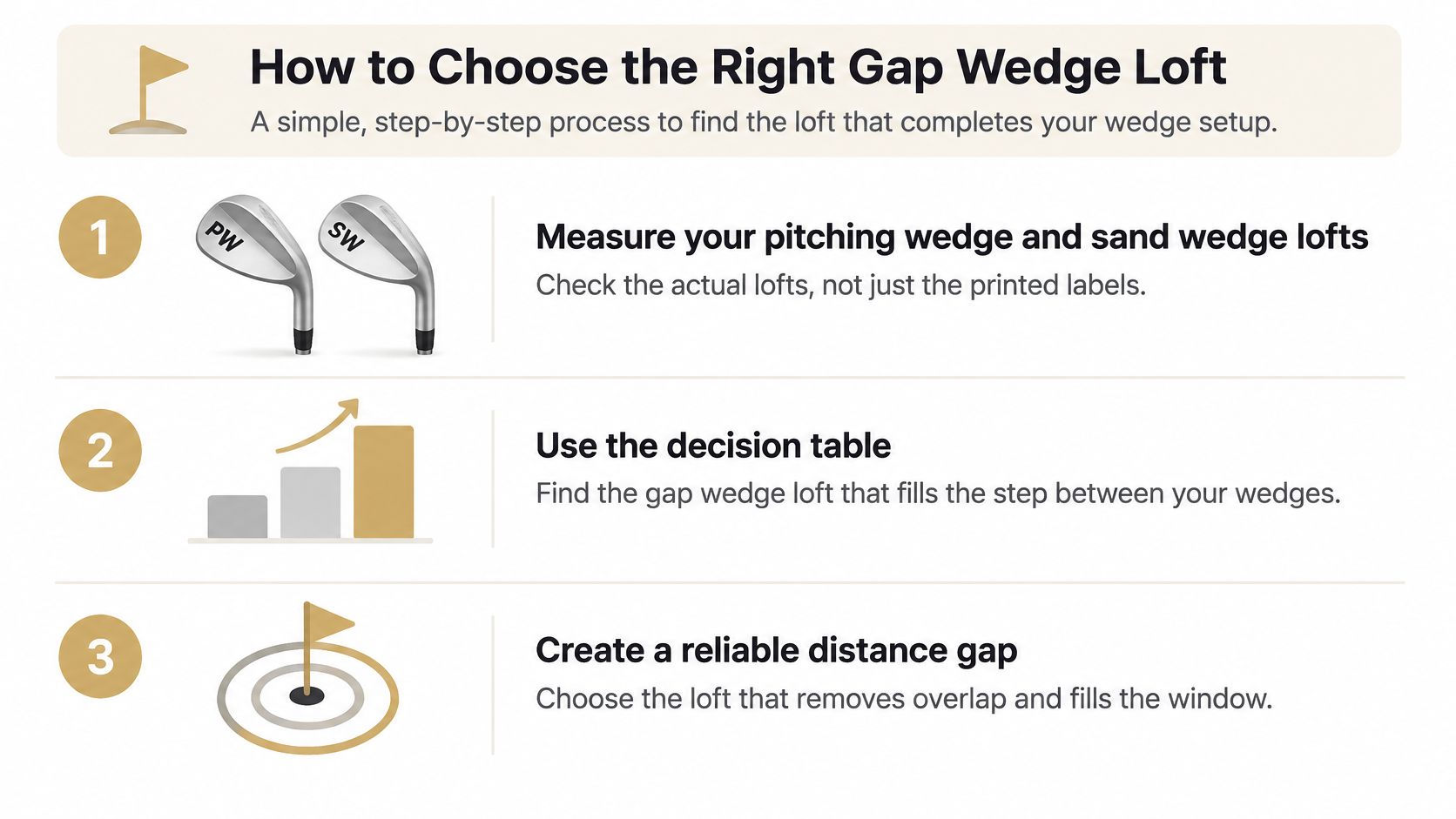
Measure the neighboring wedges. A fitter can check actual loft rather than relying on the model name or sole marking. That prevents a recommendation built around an incorrect starting specification.
Select a candidate from the table. These are trial combinations, not instructions to combine every endpoint. The final row is deliberately restrictive: if a candidate cannot create the stated step, another gap wedge may be unnecessary.
Check both sides of the candidate. Closing the pitching-to-gap interval isn't enough if the golfer creates a new problem between gap and sand. The full progression must work.
Record average carry for full and controlled swings. Testing should use the golfer's normal ball and intended shaft. The longest shot is a poor basis for choosing a club because it may not represent the shot available under normal playing conditions.
Adjust only after identifying the problem. The buying guide associates a degree of loft change with a small carry change, so a modest bend can matter. A fitter should confirm that the head is suitable for adjustment and then retest its turf interaction.
The selection process can be kept simple.
Final fitting checks
- Gap: The candidate covers a useful distance.
- Bounce: The sole suits the golfer's delivery and conditions.
- Lie: The club's lie angle and the tested ground conditions support predictable contact.
- Carry: Ordinary full swings and controlled swings produce repeatable results.
A loft should be selected only after those checks agree.
Match Bounce to Your Conditions
Bounce is the angle between the leading edge and the lowest part of the sole. It affects how the club moves through turf, which can influence strike quality, launch, spin, and carry consistency.
The Golf Monthly guide to wedges for different playing surfaces describes low bounce around 4°–8°, mid bounce around 8°–12°, and high bounce around 12° or more. The same guidance explains that strengthening loft by 1° generally reduces bounce by about 1°, while weakening loft increases it correspondingly.
| Recognizable condition or delivery | Bounce direction to test | What to watch |
|---|---|---|
| Firm lies and a shallow sweep | Lower bounce | Clean contact without the sole lifting the leading edge excessively |
| Average turf and moderate divots | Mid bounce | Predictable contact across normal approach shots |
| Soft ground and steep, deep divots | Higher bounce | Less digging and fewer heavy strikes |
Both extremes can cause trouble
Excessive bounce on firm ground can cause the sole to deflect upward before contact. The golfer may then catch the ball thin or blade it across the green.
Too little bounce presents the opposite problem for a steep delivery. The leading edge can dig, leaving the strike heavy and the carry short.
Fitting insight: A wedge that looks correctly spaced on a launch-monitor screen still needs to work from the golfer's usual turf.
The T24 specifications in the comparison table illustrate that bounce can change with loft within the same lineup. That relationship shouldn't be assumed across every model, and the exact SM11 bounce should be checked for the chosen loft and sole option.
Bending deserves particular care because it changes more than the face angle. After an adjustment, the golfer should test ordinary fairway lies and the firmer or softer conditions commonly encountered, rather than accepting an indoor carry result alone.
The useful match is loft for the distance window, bounce for reliable contact. Neither specification should be chosen in isolation.
Confirm the Gap on a Launch Monitor Before You Buy
A gap wedge earns its place when its average carry fills a real distance window between the pitching wedge and sand wedge. Start by hitting 8–10 full-swing shots per wedge, then test three-quarter and other controlled shots with the gap wedge. If contact varies widely, repeat the session before choosing a loft.
A launch monitor gives a direct carry comparison. A measured range with clear landing points can also help. Keep the ball, target, intended swing, and lie consistent across each group.
Record the normal shot
- Carry: Record landing distance, not rollout.
- Flight: Note launch, spin, and peak height when available.
- Dispersion: Include left and right misses alongside distance.
- Swing type: Keep full swings separate from three-quarter and shorter controlled shots.
- Strike notes: Mark obvious mishits, but retain ordinary results so the averages reflect normal contact.
Use the gap-analysis guide to organize club-by-club comparisons and spot overlaps or holes in your carry windows.
Carry window verdicts
| Wedge pair | Average carry gap | Verdict |
|---|---|---|
| Pitching to gap | 10–15 yards | Keep the gap wedge if dispersion and contact also work |
| Gap to sand | 10–15 yards | Keep the gap wedge if controlled shots cover the interval |
| Any adjacent pair | Overlap of more than a few yards | Adjust the loft after checking strike and swing consistency |
| Any adjacent pair | Hole of 10 yards or more | Adjust the loft or the set if no dependable controlled shot covers it |
Treat these as screening rules, not automatic buying instructions. A full-swing interval is not a missing shot if a repeatable controlled swing covers it. The best loft is the one that closes a gap in your own average carries, not the one that matches a label.
Keep practice and playing records connected
Dialed Golf's desktop practice record supports launch-monitor sessions at a range or garage simulator, including live pairing for Garmin R10 and CSV or file imports from supported sources.
The consumer app works as a pocket caddy on the course and is available through TestFlight now, not general App Store availability. Apple's TestFlight documentation explains TestFlight as a way to distribute beta apps.
Use the practice record to compare the existing pitching and sand wedges with a candidate gap wedge. Check averages, dispersion, and strike notes together before buying or adjusting loft. The record helps organize the results; it does not replace the measured carry comparison or automatically recommend a wedge.