

The cheapest urethane golf ball is the lowest-cost option that still keeps the spin and flight a golfer needs. Price matters, but so do durability and ball-to-ball variation. A ball that scuffs quickly or produces inconsistent results may cost more per usable round, even with a low sticker price.
Judge the trade-off against your scoring goals. If the ball's wedge spin, stopping power, or driver flight falls outside your required window, the lower price may not be worthwhile. The right choice is the least expensive ball that reliably fits your game.
Table of Contents
- Cheapest Urethane Golf Ball Prices per Dozen
- What Urethane Changes on Scoring Shots
- Kirkland Performance Plus Against Tour Balls
- Other Budget Urethane Options Worth Checking
- Cost per Round After Scuffs and Lost Balls
- Which Budget Urethane Fits Your Game
- How to Test a Dozen on Your Launch Monitor
- Choose a Dozen and Check the Next Session
Cheapest Urethane Golf Ball Prices per Dozen
At roughly $1.50–$1.67 per ball, the Kirkland Signature Performance+ sets a low retail benchmark for urethane. The Independent Golf Reviews buying guide puts it at about $17–$20 per dozen, typically sold in two-dozen packs for around $38–$40.
A Titleist Pro V1 is listed at around $55–$58 per dozen in the same guide. Against that range, the Kirkland costs approximately 64%–71% less. The gap is easier to judge per ball: about a dollar and a half for the Kirkland versus several times more for a premium model. That difference matters when balls get lost, but the lowest sticker price only helps if the ball still suits your scoring needs.
Price Benchmarks in One View
| Ball or benchmark | Price per dozen | Price per ball | Cover and build | Access limit |
|---|---|---|---|---|
| Kirkland Signature Performance+ | $17–$20; two-dozen packs about $38–$40 | $1.50–$1.67 | Three-piece, urethane cover | Costco membership and in-stock warehouse or online |
| Typical urethane-cover dozen | $32–$42 | $2.67–$3.50 | Urethane, construction varies | Mainstream retail, model dependent |
| Golf Datatech average dozen | $43 | $3.58 | Mixed covers, not all urethane | Market average; 45% higher than a decade ago |
| Titleist Pro V1 | $55–$58 | $4.58–$4.83 | Multilayer tour urethane | Widely stocked; premium sticker |
The columns answer different questions. Price per dozen is the checkout cost; price per ball shows what each lost or retired ball costs. The access column helps explain whether the displayed price is available to you without extra expense or effort.
For the Kirkland, Costco access and stock affect the actual cost. If you already shop there and find the two-dozen pack available, the listed price may be within reach. If you need to pay a reseller markup or make a separate trip for uncertain stock, your acquisition cost rises. The cheapest label price is not always the cheapest price paid.
Practical rule: Divide the final delivered price, including any applicable access cost, by the number of balls received. That per-ball figure is the number to start from.
What the Kirkland Price Actually Buys
The Performance+ is a three-piece urethane ball priced for budget buyers. Its construction gives golfers access to a urethane cover without paying the price of a premium model.
Cover type helps explain why two similarly priced balls can suit different needs. An ionomer ball generally competes on durability and a straighter, lower-spin flight. A urethane ball is designed to create more friction between the cover and wedge grooves, affecting check and rollout on scoring shots. The cover and build therefore matter alongside the price on the box.
Treat the Kirkland as a reference point, not an automatic choice. A more expensive urethane ball should earn its added cost through something useful to your game, such as better driver carry, tighter dispersion, longer cover life, or more consistent performance from ball to ball. Those are distinct trade-offs, and the right one depends on what you need to improve.
Compare balls on the same scoring goal. If an alternative costs twice as much and gives you similar wedge rollout and driver carry, with no clear durability advantage, its premium is difficult to justify. If it addresses a launch problem or lasts longer during short-game practice, its higher sticker price may work out cheaper over a season. Start with the cost per usable ball, then judge whether the added price buys performance you can use.
What Urethane Changes on Scoring Shots
Urethane's main measurable advantage is short-game friction, not automatic driver distance. That distinction should drive the whole buying decision. A golfer who expects a urethane cover to add free yards off the tee is testing the wrong claim.
The visual below frames the scoring-shot benefit before the test details.
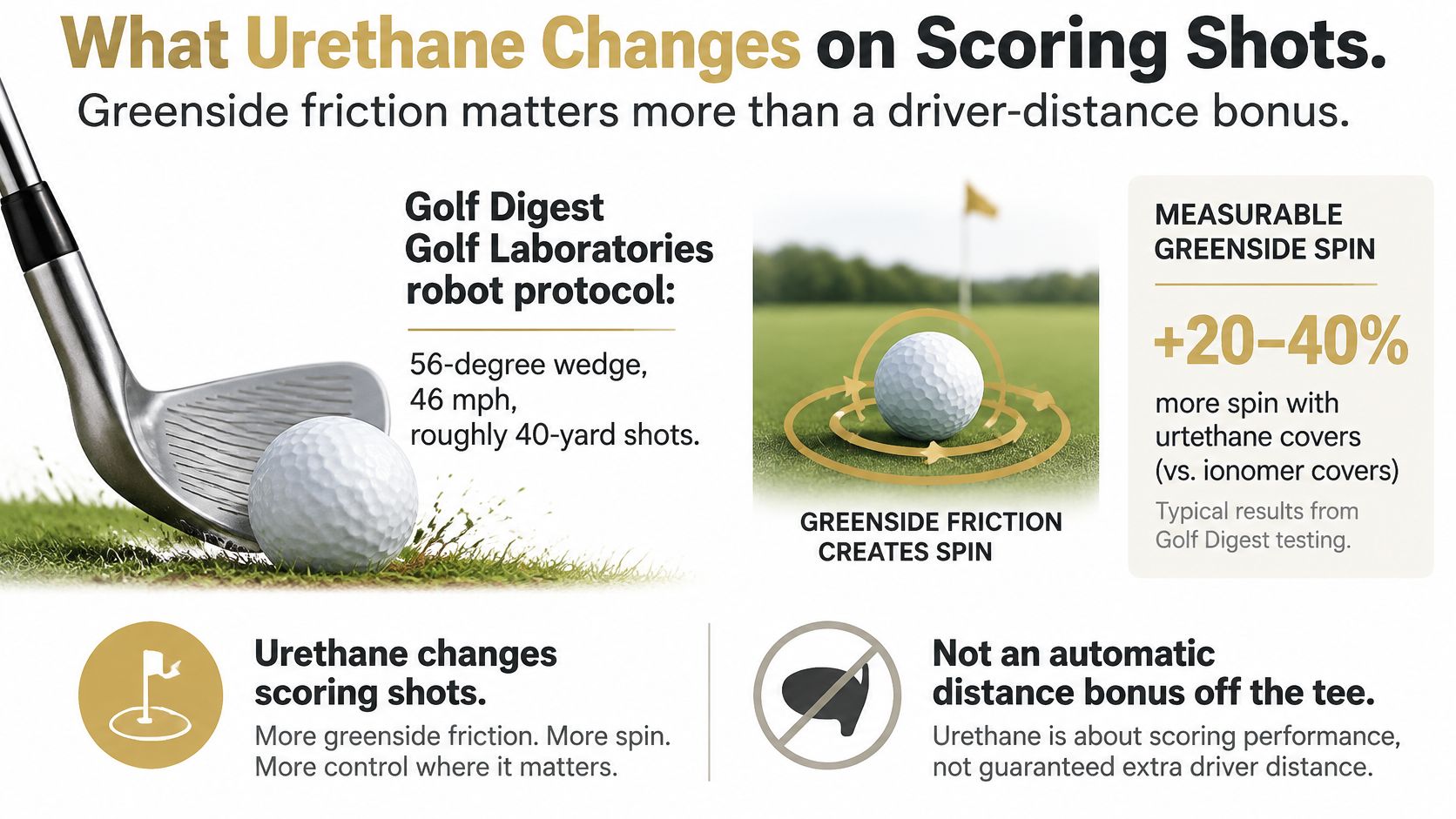
The controlled evidence comes from a specific protocol. Golf Digest's Golf Laboratories robot testing used a 56-degree wedge at 46 mph, producing roughly 40-yard carries, with six center-face strikes per ball and GCQuad measurement under controlled dry, windless conditions.
Across that testing, urethane models generally produced substantially more wedge spin than non-urethane models. Separate testing in the same report found differences of up to 4,000 rpm on a 45-yard shot, with non-urethane balls finishing as much as 15 feet farther from the hole because of reduced stopping power.
Why Rollout Matters More Than a Spin Number Alone
Spin only matters when it changes where the ball stops. A pitch that lands pin high and releases through the green creates a different next shot from a pitch that checks and settles near its landing spot. The golfer doesn't score with revolutions per minute. The golfer scores with proximity, predictable rollout, and fewer long comeback putts.
- Wedge spin: Shows how much grip the cover creates at impact.
- Launch: Shows whether the ball climbs, floats, or drives forward on a lower flight.
- Stopping distance: Shows the combined result that the golfer plays.
A cheap urethane ball that spins well but launches unpredictably may still be hard to trust. A ball with slightly lower spin but repeatable launch and rollout can be easier to score with. The three measures belong together.
The same test data identified Snell PR3, Snell PR4, and Seed SD17 as lower priced urethane balls capable of more predictable checking than many golfers might expect. That point is useful because it challenges the assumption that predictable greenside behavior requires a flagship tour price. It doesn't prove that every budget urethane ball checks the same way.
For a personal test, the order matters. Greenside performance comes first, with 30–50-yard wedge shots and short-iron landing behavior. Driver carry and dispersion come second as a separate check. A golfer refining contact and flight can pair that ball test with the mechanics in a practical wedge-hitting guide, while keeping the ball comparison itself to the same strike standard.
A ball that trims approach rollout can save more strokes than a ball that adds a few driver yards and leaves the scoring shots unchanged.
Kirkland Performance Plus Against Tour Balls
In a 43-ball comparison, the Kirkland Signature Performance+ showed a clear split between distance and short-game results. The 43-ball comparison reported by GolfLink recorded 135.8 mph of ball speed and 218.0 yards of driver carry. The ball ranked 36th for distance, while wedge control ranked 8th and stopping power ranked 13th.
Kirkland Results by Category
| Measure | Result | Rank or context |
|---|---|---|
| Driver ball speed | 135.8 mph | Rank not reported in the test summary |
| Driver carry | 218.0 yards | 36th of 43 for distance |
| Wedge control | Result reported | 8th of 43 |
| Stopping power | 42.3-degree descent, 9.3 yards of roll | 13th of 43 |
| Overall | Performance score tied | Tied for 19th of 43 |
| Value | About $19 per dozen | 4th for value in that test |
The pattern points to a trade-off rather than an all-around lead. Driver distance sits toward the back of the field, while wedge control ranks near the front. Overall performance falls in the middle, tied for 19th out of 43. Value ranks fourth, based on the test price of about $19 per dozen.
The approach-shot figures help explain the stronger short-game results. The test recorded a 42.3-degree descent angle and 9.3 yards of roll. A steeper descent means the ball arrives with less forward energy, while the roll figure shows how far it continued after landing. For a golfer who flies wedges toward a target and wants them to settle, those measures may matter more than the overall rank.
The Trade-Off Stated Plainly
A lower purchase price can come with useful greenside and approach-shot performance, alongside a driver-distance compromise. Which side matters more depends on where the golfer needs to save strokes.
Consider two golfers using the same ball. One loses strokes when pitches release too far or short irons run through greens. The Kirkland's wedge and stopping ranks may suit that scoring priority. The other already controls approach rollout but needs more driver carry to reach par fours in regulation. For that golfer, the distance rank deserves more weight.
Fitter's check: Rank the ball against the shots that cost the golfer strokes, not against a single overall score.
A tour ball's reputation cannot decide which trade-off is right for a particular golfer. The Pro V1 serves here as a cost reference, showing the room a budget option can leave in the golfer's budget. The useful question is whether the Kirkland's stronger categories align with the golfer's priorities closely enough to accept its weaker distance result.
A launch-monitor session makes that judgment personal. Comparison testing offers a pattern to check, but swing speed, strike location, launch, and spin can change the size of the carry gap. One golfer may see a small loss in carry alongside better wedge results; another may see less benefit around the green and a more noticeable distance cost. The ball earns a place in the bag when the golfer's own numbers support that exchange.
Other Budget Urethane Options Worth Checking
A urethane cover narrows the search, but it does not settle which ball costs least for your game. Snell PR3, Snell PR4, and Seed SD17 are alternatives identified in the Golf Digest robot test as lower-priced urethane balls. The test reports that they checked more predictably than many golfers expect, but it does not provide current retail prices for these models.
| Ball | Price per dozen | Cover | Reported behavior |
|---|---|---|---|
| Snell PR3 | Verify current retail price | Urethane | Checked more predictably than many golfers expect |
| Snell PR4 | Verify current retail price | Urethane | Checked more predictably than many golfers expect |
| Seed SD17 | Verify current retail price | Urethane | Checked more predictably than many golfers expect |
Treat that behavior as a starting point, not a guarantee for your swing. To compare cost fairly, check the price at a retailer you use, divide by twelve, and compare the per-ball figure with the Kirkland benchmark of $1.50–$1.67. Add shipping, membership fees, and pack size before deciding which option is cheaper.
Before buying, confirm three details:
- Cover: The listing should specify urethane, rather than relying on tour-style language.
- Model: Check the exact generation. A product name may carry over when a ball is revised.
- Delivered price: Include shipping, membership, and the number of balls in the pack.
The cover is only one part of performance. Compression, mantle design, dimples, and construction also shape flight and spin. A lower price earns attention only if the ball still fits your required flight and scoring-shot window. Then compare it on the course or launch monitor: check whether wedge shots hold as needed, whether driver flight suits your game, and whether the cover remains usable through your normal play.
A practical choice balances three things: delivered cost, the spin and flight you need, and how much variation or wear you can accept. If an unfamiliar ball misses your scoring-shot window, a cheaper dozen may not be the lower-cost option for your game.
Cost per Round After Scuffs and Lost Balls
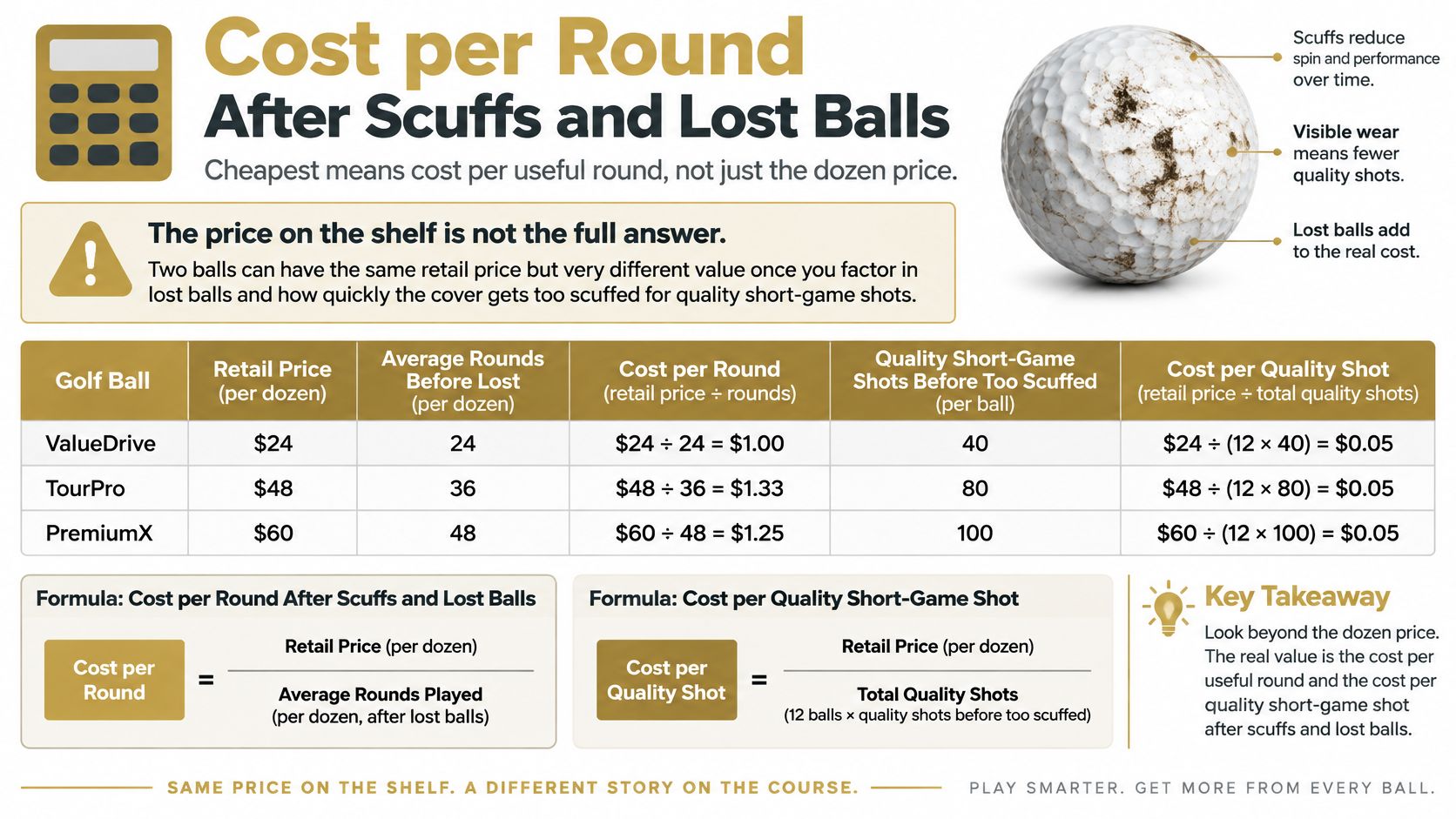
Sticker price is easy to compare, but it doesn't show how much useful play a ball provides. A dozen that costs less at checkout can cost more per round if its covers scuff quickly, balls are retired early, or practice uses up sleeves. The lowest cost that still preserves your needed spin and flight window depends on both cover life and how often you lose balls.
The chart compares ball costs in light of durability and lost-ball rates.
Start with a simple calculation: retail price divided by demonstrated usable lifespan. Count lifespan in rounds to estimate cost per round, as explained in Dataintelo's golf ball market report. The report places urethane-covered balls around $32–$42 per dozen. Golf Datatech reports that the average dozen costs $43, 45% more than a decade ago.
For golfers who practice wedges often, cost per round can miss the point. Cost per 100 quality short-game shots divides the price by the number of pitches and chips a ball survives before its cover is too marked to trust. A casual round and a week of short-game practice can wear a cover differently.
Three Buyers, Three Different Answers
The casual-round player is most affected by lost-ball risk. Losing two balls in a round makes the price difference between budget urethane and a premium tour ball matter immediately. Cover life has little effect if a ball is lost by the seventh hole, so a lower per-ball price may be the better value.
The high-volume wedge practicer faces a different calculation. Repeated contact with wedge grooves can mark urethane before a ball is lost. A 2025 review of TaylorMade Tour Response in the market report noted that several balls scuffed easily during short-game practice, while one remained playable for a full round. That points to model-specific durability within the urethane category. A more durable ball, or a discounted premium ball, may deliver more useful shots per dollar.
The recycled or lightly used buyer should compare remaining playable shots, not original retail status. A used tour ball with half its cover life left is not automatically cheaper than a new budget dozen. Estimate its remaining quality shots per dollar.
Cheapest means the lowest cost per useful round.
Build a Personal Lifespan Log
Durability varies with groove sharpness, bunker sand, cart paths, range surfaces, and practice volume. A short log helps you estimate how long a ball remains trustworthy.
- Ball model: Record the exact model you put into play.
- Shots and scuffs: Note wedge shots, rounds played, and when visible damage appears.
- Replacement date: Mark when flight or check no longer feels reliable.
- End reason: Distinguish lost balls from worn-out ones. Each points to a different buying decision.
After a month, use the pattern to choose what to optimize. If you mostly lose balls, prioritize a lower per-ball cost. If you mostly retire them for scuffs, prioritize cover survival. Your season cost follows from those results, not a generic ranking.
Which Budget Urethane Fits Your Game
The right budget ball depends on what the golfer is trying to protect. The decision map below starts with scoring priorities, then branches toward a buying call.
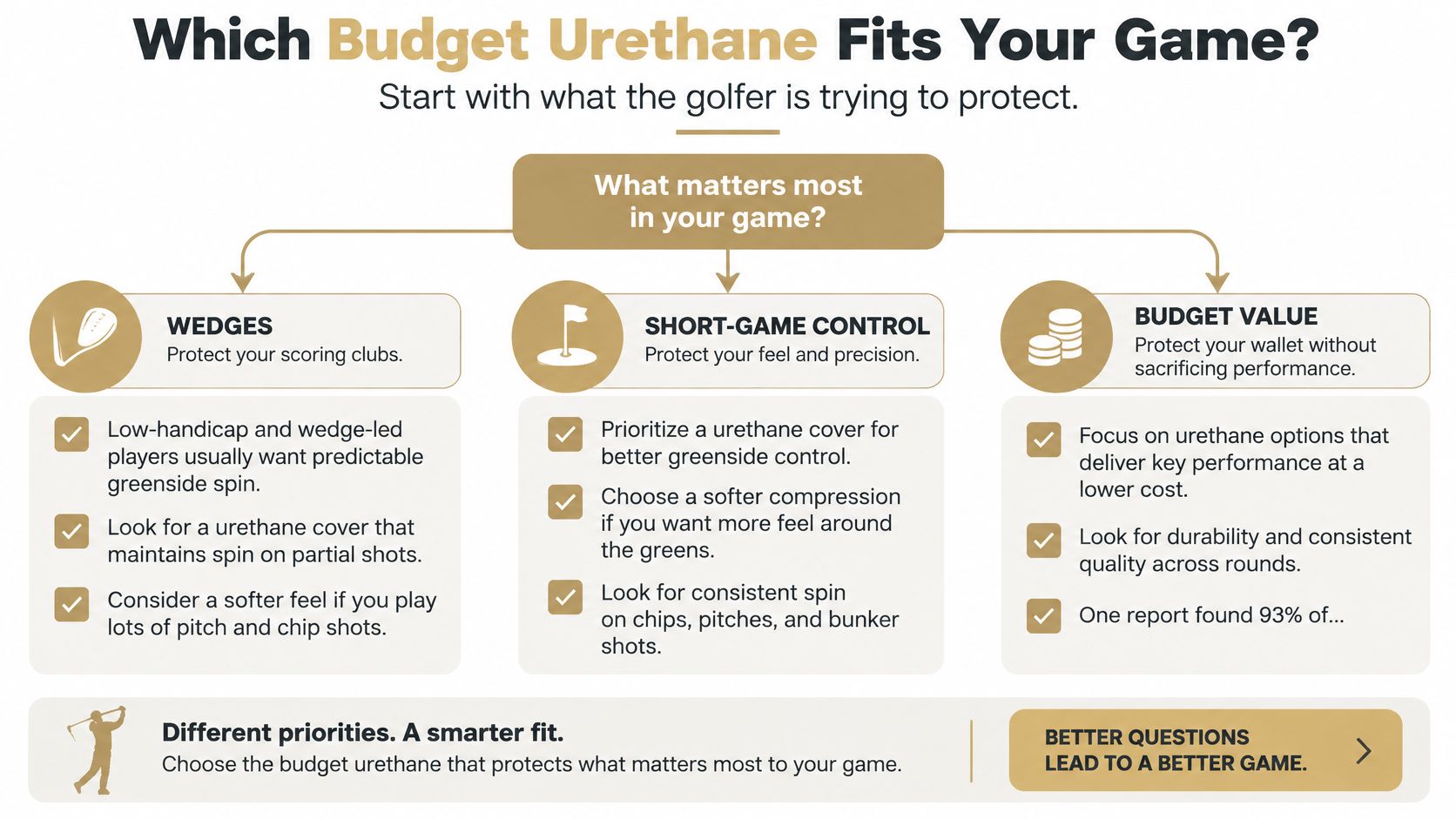
Evidence for the wedge-led case is strong at low handicaps. Golf Digest's urethane explainer cites a test finding that 93% of golfers below a 5 handicap noticed urethane's spin advantage, while non-urethane balls could require a different shot type to stop near the hole.
| Golfer | What to protect | Call on the cheapest urethane |
|---|---|---|
| Under 5 handicap or wedge-led scoring | Predictable greenside spin and check | Keep it if rollout matches the tour ball trusted now |
| Loses several balls a round | Cash per hole, not cover prestige | The $1.50–$1.67 urethane is usually the rational play |
| Slower swing or launch already off-target | Launch and compression that fit the swing | Test before buying; a firm urethane may be the wrong cheap ball |
| Faster swing with controlled launch | Driver flight that can be used | A budget three-piece may cost usable carry; test a firmer profile |
Reading the Four Profiles
A low-handicap or wedge-led golfer protects predictable check. The cheapest urethane golf ball stays in the bag only if partial wedges land and release within the window that golfer already trusts. A small price saving isn't worth relearning every greenside number.
A golfer who loses several balls a round protects cash per hole. Urethane only helps if the ball survives long enough to hit scoring shots. At the benchmark per-ball price, the penalty for a lost ball drops enough that the golfer can swing freely without turning each water hazard into a financial decision.
A slower swinger protects launch and compression fit. The right cover on the wrong compression profile can still produce low, weak flight. Swing speed works as a rough first filter, but wedge spin, iron peak height, and dispersion confirm whether the ball fits.
A faster player with controlled launch protects usable driver flight. If a budget three-piece gives up carry or spins outside a playable window, stepping up in price can be rational. The premium has to buy flight that shows up in session data, not just a tour label.
The video below adds a visual walkthrough of fitting priorities before the final filter is applied.
Three calls follow from the map. Buy the price-floor urethane when greenside spin is the scoring lever and lost balls are common. Test a mid-price urethane when driver spin, launch, or compression is the problem. Skip urethane only when a golfer never uses the extra check and loses balls so often that even a small cover premium has no chance to pay back.
How to Test a Dozen on Your Launch Monitor
A same-session test prevents a cheap ball from being judged against memories, range balls, or numbers from a different day. The protocol is strict for a reason. Small ball differences can look like swing changes when the test is loose.
Five-Step Same-Box Protocol
- Pull every ball from one box: Retire any scuffed or dirty ball before the first swing, and keep the test set separate from practice balls.
- Hit a driver block: Record at least 8–10 solid strikes, capturing ball speed, launch, spin, carry, and side dispersion.
- Hit scoring shots: Add a 30–50-yard wedge block and a short iron, recording spin, descent, carry, and rollout.
- Repeat with the current gamer: Use the same clubs in the same session, not a stored number from another day.
- Apply the keep rule: Keep the ball only if wedge stopping stays inside a usable window and driver flight doesn't become unplayable.
Step one carries the consistency warning. The Ball Caddie value comparison cites independent testing that found greater ball-to-ball variation in weight, diameter, and compression for Kirkland than for major-brand products. That comparison also positions the Kirkland at approximately $15–$20 per dozen, roughly one-third the per-ball cost of a Pro V1, while reported robot testing placed its ball speed and spin within a few percentage points of premium tour balls.
Variation changes how session noise should be read. If carry jumps or spin drops on one swing, the cause might be strike, the individual ball, or a cover that picked up damage. A golfer who mixes boxes or compares a worn ball with a fresh sleeve can invent a club problem that doesn't exist.
Session rule: One box, center strikes only, and no equipment conclusion from a single flyer.
The hardware requirement is modest. A desktop launch-monitor session or a saved export from a Garmin, Rapsodo, SkyTrak, FlightScope, or similar unit provides enough evidence for the comparison. A golfer comparing practice setups can use a guide to launch monitors for the driving range to match the device to the setting, but a new device isn't required to run the ball test.
Score the session by category, not by one blended verdict. Driver carry, driver dispersion, wedge spin, descent, and rollout each get a pass or fail against the current gamer. A ball that passes wedges and narrowly misses on driver carry may still be the right dozen for a wedge-led golfer. A ball that gains carry and fails rollout can cost strokes where scoring happens.
Choose a Dozen and Check the Next Session
Choose the lowest-priced urethane dozen that still meets your scoring needs. If Kirkland Signature Performance+ is available without a painful access premium, and lost balls or wedge check are the main concerns, start with one dozen at about $17–$20. Wait for session evidence before buying a season's supply.
If driver flight or compression is the concern, try the $32–$42 urethane band or a discounted tour ball, then run the same-box test. For short-game practice that scuffs covers quickly, judge value by shots survived as well as the dozen price.
Dialed Golf's seven free golf tools work without an account. The Golf Ball Fitter finds a ball profile that fits your flight and feel, helping narrow the starting choice. It does not replace testing with wedges and a driver. For saved practice, a launch monitor app workflow can help organize a comparison using the same clubs and strike standard.
Buy one dozen, run one same-box test, and note the model, visible scuffs, and whether approaches stopped.
Start with the least expensive urethane ball that passes the wedge test, then keep the session evidence rather than relying on memory. A consistent record of carry, spin, launch, and rollout makes it easier to compare one dozen with the next. Visit Dialed Golf to explore the free tools and set up a clearer baseline for your next ball test.