


The iron shot looks playable at first, then bends toward the trees. The golfer aims farther left, makes another swing, and watches the next ball finish in almost the same place. Another grip change or an exaggerated inside-out swing starts to sound reasonable.
An iron slice needs a diagnosis before it needs a drill. The useful starting point is the relationship between the clubface and swing path, followed by contact and lie angle. A swing rebuild can wait until those checks show that the swing needs rebuilding.
Table of Contents
- Read the Ball Flight to Find the Cause
- Measure Face-to-Path Before You Change Anything
- Check Lie Angle and Strike Before Rebuilding Your Swing
- How to Run a Three-Length Practice Ladder
- Choose the First Fix and Its Coaching Cue
- Confirm the Fix Across Sessions and Clubs
Read the Ball Flight to Find the Cause
Ball flight patterns and their likely causes
| Ball flight | Likely cause | First check |
|---|---|---|
| Starts right, curves right | Face open to target, with path close to target | Set the face square at address and check face angle |
| Starts left, curves right | Path strongly out-to-in, face slightly open relative to that path | Reduce the path error before adjusting the face |
| Starts right, flies straight | Face and path both aimed right, face-to-path near zero | Check aim and grip at address |
| Curve worsens with longer irons | A face or lie error interacting with changing loft and delivery | Compare short and long irons on the same practice ladder |
| Curves right only on heel strikes | Off-center contact changes effective face delivery | Check strike location with impact spray first |
These patterns describe a right-handed golfer. Left-handed golfers should reverse the directions, and every row should be treated as a starting hypothesis rather than a verdict.
An iron slice occurs when the clubface is open relative to the clubhead's path at impact. The Ulster University iron-launch paper identifies face angle and path as important contributors to launch direction, with the ball generally launching closer to the face direction than the path.
That distinction matters. A face can point left of the target yet remain open relative to a path traveling even farther left. The resulting ball can start left and curve right, so rightward curvature doesn't automatically mean the face pointed right of the target.
Separate the start from the curve
The golfer should describe each miss using three observations:
- Starting direction: Did the ball begin left, right, or close to the intended target line?
- Curvature: Did it bend gently or move sharply away from its initial line?
- Contact: Was the strike centered, heel-biased, or toward the toe?
A push that stays straight isn't the same problem as a shot that starts near the target and peels right. Treating both with an aggressive inside-out swing can create a new miss without resolving the original delivery.
Diagnostic rule: Open to the target and open to the path are different measurements. Only the relationship between them explains the basic curvature diagnosis.
Longer-iron trouble also deserves a closer look rather than a stock explanation about loft. Changing club length can expose contact or delivery inconsistency, while lie-related directional error must be checked separately.
For a quick baseline, the golfer can hit five consecutive shots with the same iron and note start direction, curve, and contact. The point isn't to fix anything yet. It's to identify a repeatable miss instead of reacting to the worst shot.
Measure Face-to-Path Before You Change Anything
A useful launch-monitor session begins with a defined target and a correctly aligned device. Otherwise, an apparent push may partly reflect a target-line mismatch rather than the golfer's delivery.
A written shot record makes that distinction easier to inspect.
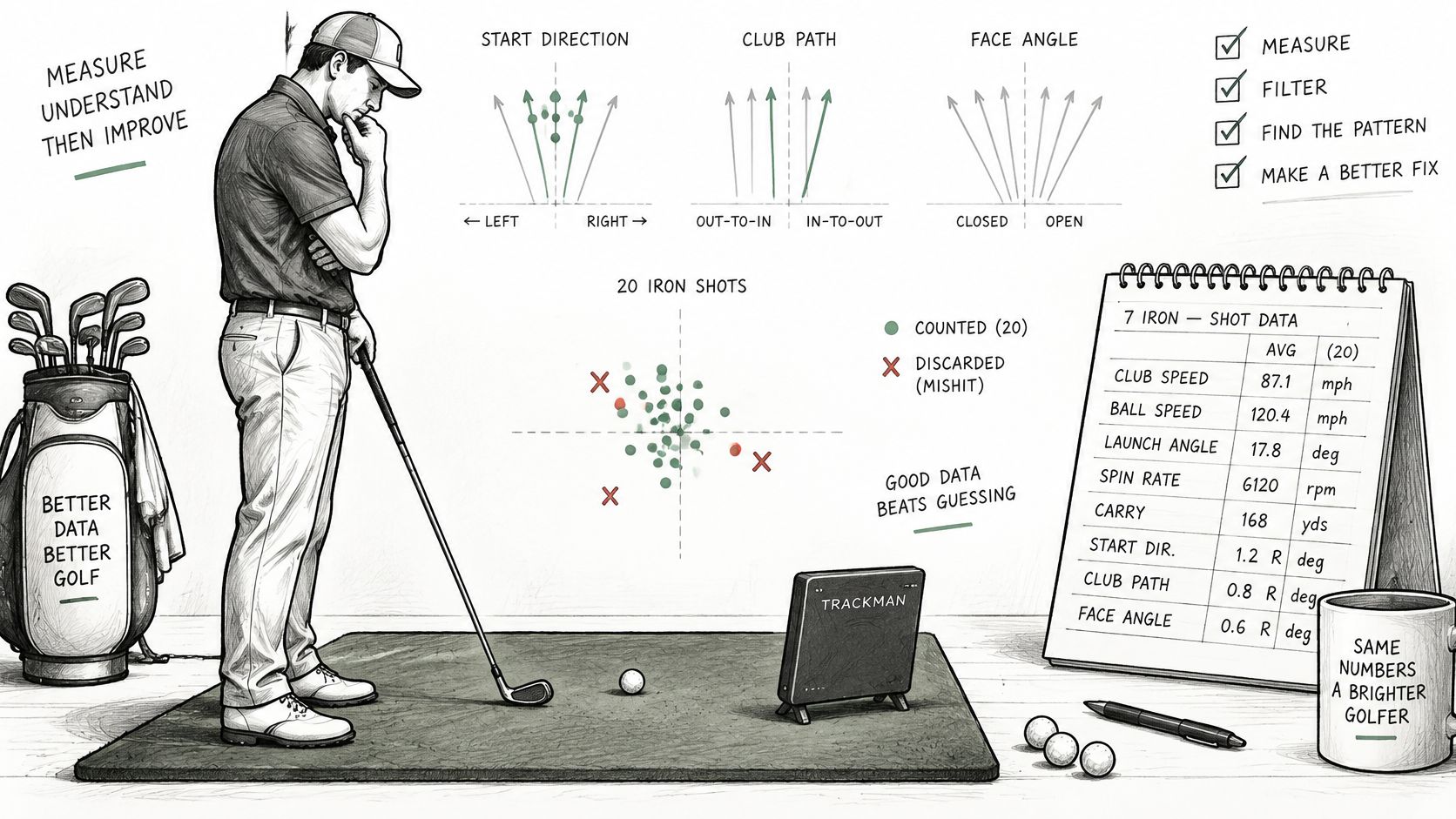
Collect at least 20 reasonably centered shots with the same iron, recording start direction, club path, face angle, face-to-path, attack angle, and impact location; the published iron-launch analysis attributes approximately 70–85% of initial launch direction to face angle and roughly 15–30% to path. Obvious mishits belong in a separate contact record rather than in the centered-strike comparison.
Read the sign before choosing the fix
Consider a hypothetical right-handed delivery: the face points 5° right of target, while the path travels 2° right. Subtracting path from face gives 3° open face-to-path, consistent with a ball that starts right and curves farther right.
The order matters. Reversing those face and path values produces a face closed to the path, not another slice example.
A practical measurement sequence is:
- Confirm the target line: Align the monitor and the golfer to the same reference.
- Inspect the face: A persistent rightward start makes face delivery an immediate priority.
- Compare face with path: Identify whether curvature comes mainly from the face, a strongly leftward path, or both.
- Retain attack angle: Keep it alongside path so comparisons between clubs don't ignore a change in delivery.
The launch-monitor practice guide provides context for organizing a session around usable feedback rather than collecting numbers without a decision.
Video can supplement the measurements, but it shouldn't replace the shot record.
Use the typical shot
The median matters more than the best swing. Sorting the readings and using the middle result prevents an unusually good shot from becoming the assumed standard. A tidy finish on video doesn't establish what the face delivered at impact.
The golfer should leave the baseline session with median start direction, median face-to-path, and median attack angle written beside the club name. If the path is reasonably close to target but the face repeatedly points right, face control deserves attention before a major path change. Moving the path farther right alone may merely exchange a slice for a push.
Check Lie Angle and Strike Before Rebuilding Your Swing
Contact can make a delivery problem look worse, or make an improved delivery look unchanged. In controlled robot testing published in the Proceedings of the Institution of Mechanical Engineers, a 5-iron was tested at 10 impact locations and five face angles, and cavity-back and blade heads responded differently to off-center impacts.
The experiment also found that toe impacts could rotate the head and open the effective face presentation. That isn't permission to apply driver gear-effect rules directly to irons. It's a reason to record strike location rather than assume that every ball contacted the same part of the face.
Run the equipment checks
- Mark contact: Apply impact spray or strike tape for a short shot block. Compare centered strikes with heel and toe strikes while keeping the target and swing intention unchanged.
- Check dynamic lie: Use a lie board or suitable impact-tape procedure with a fitter. Sole marks need interpretation alongside delivery and ball flight, not an automatic bend based on a single mark.
- Compare the set: Test short, mid, and long irons under the same conditions. A problem isolated to one club deserves a specification check before a universal swing prescription.
- Review recent changes: Older sets, custom builds, and shaft replacements warrant a loft-and-lie inspection when the directional pattern changes.
A lie angle that's too flat can orient a lofted face right, while an excessively upright lie can orient it left; higher loft makes lie misalignment more directionally significant, as explained in Golf Source's loft-and-lie guide.
That means worsening long-iron curvature doesn't prove a lie problem. Length, contact, face delivery, and loft change together, so the pattern needs measurement.
Interpret the miss without guessing
A consistent push with centered contact makes aim, face delivery, and dynamic lie worth checking. A ball that starts left and curves right still requires an open face-to-path relationship, even if upright delivery contributes to the leftward start.
A lie adjustment can change where the face points. It doesn't automatically remove a large face-to-path mismatch.
A setup correction or lie check may cost less than a swing overhaul, but neither should be prescribed blindly. Equipment and contact deserve a test before the golfer commits to rebuilding the grip or downswing.
How to Run a Three-Length Practice Ladder
A shorter swing provides a useful control condition. If the golfer can deliver the face consistently at reduced length but loses that relationship during a normal swing, adding more mechanical instructions may be less useful than controlling tempo and speed.
The ladder keeps the setup stable while swing length changes.
Build the ladder without chasing distance
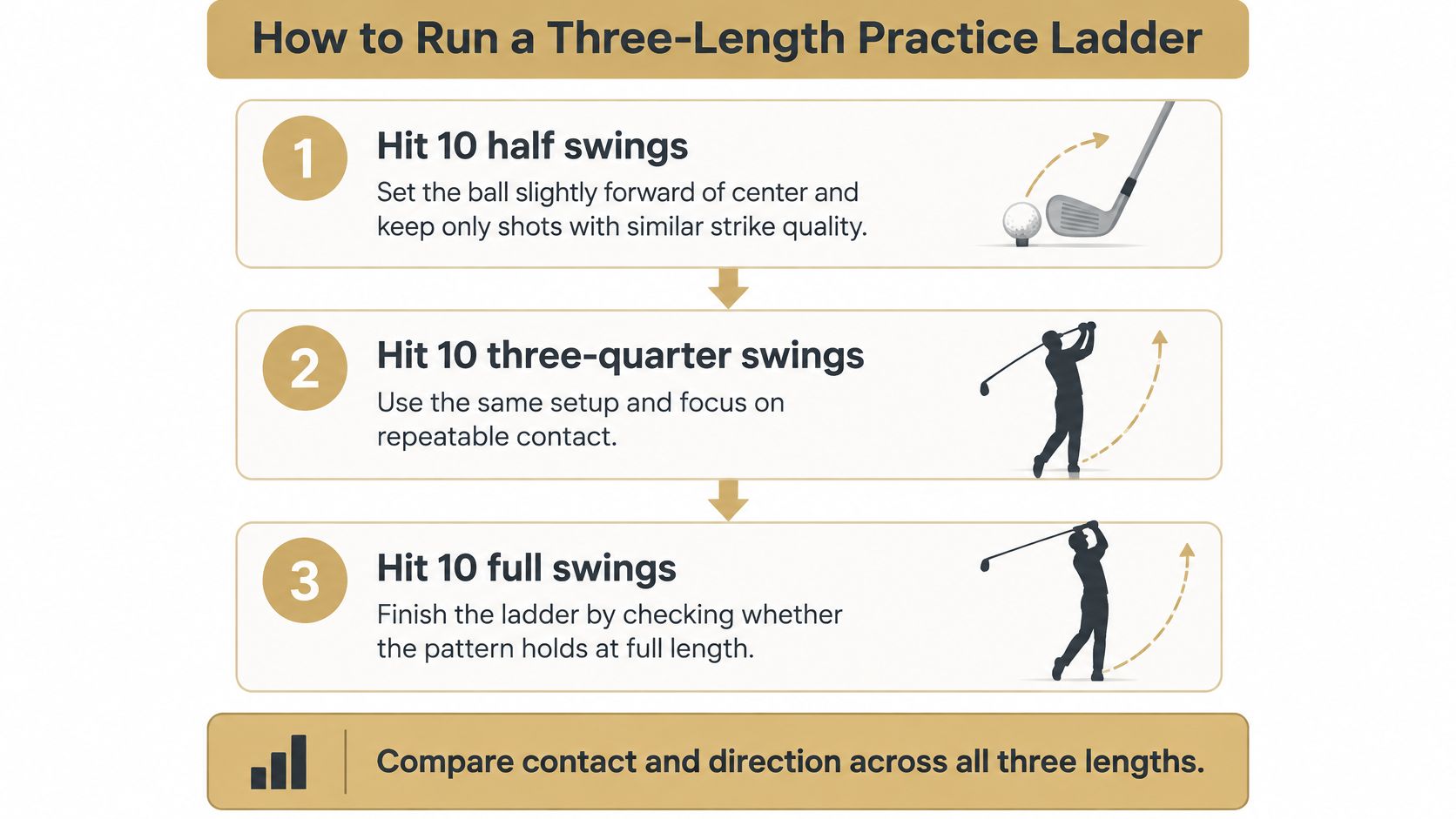
The sequence uses 10 half swings, 10 three-quarter swings, and 10 normal swings, retaining comparable strikes and comparing median face-to-path, consistent with the practice approach supported by the clubface-orientation and trajectory paper.
Start with half swings. Position the ball slightly forward of center and use a comfortable motion. Keep only similarly struck shots in the delivery comparison, while recording rejected strikes separately.
Move to three-quarter swings. Retain the same target, ball position, and grip intention. The golfer should add swing length without trying to manufacture extra distance.
Finish with normal swings. Use ordinary playing speed rather than a maximum-effort swing. Record contact before judging the resulting curve.
Compare the medians. Review face-to-path for each swing length rather than selecting the straightest ball. Keep start-line error and dispersion width beside those readings.
Match the pattern to the intervention. An open face across the ladder calls for a delivery check, including neutral grip alignment, excessive lead-wrist extension, and backswing length. Improvement at reduced length followed by deterioration at normal speed calls for tempo work and a controlled pause at the top.
Repeat across sessions. Use three blocks as a practical review period, without introducing another adjustment halfway through a block. Consistent conditions make the comparison more useful than an assortment of unrelated drills.
Read the result conservatively
Practice ladder results and next steps
| Ladder result | What it means | Next step |
|---|---|---|
| Face stays open to path at all three lengths | Delivery is the likely limiter | Test neutral grip, less lead-wrist extension, or a shorter backswing, separately |
| Better on half swings, worse at full speed | Timing or variability is the likely limiter | Use tempo work and a pause at the top, then repeat |
| Strikes drift heel-biased in any block | Contact confounds the swing comparison | Return to the strike check before judging the drill |
The golfer shouldn't force the face to stay physically square throughout the entire follow-through. The purpose is a more repeatable impact relationship, not a rigid motion that prevents a natural release.
Heel-biased contact can hide an otherwise useful change. A block with noticeably different contact isn't a clean test of the swing cue, even if the launch-monitor averages look persuasive.
Success means a sustained reduction in the unwanted face-to-path separation and right-side dispersion. After the review blocks, the decision is whether to retain the delivery change or return to face setup, not whether a single straight shot felt convincing.
Choose the First Fix and Its Coaching Cue
The best first cue addresses the measured error without requiring the golfer to manage several body positions. A cue is an experiment, not a diagnosis by itself.
Match the cue to the evidence
| Diagnosis | Coaching cue | First fix to test |
|---|---|---|
| Face remains open to path at every swing length | Hold the face square to the target line through the ball | Check grip for neutral alignment, treating the cue as a feel rather than literal restriction |
| Ball starts right while path is close to neutral | Set the face to the target at address | Align the face first, then confirm body alignment with a ground-level alignment stick |
| Path is strongly out-to-in | Swing the clubhead along the target line | Reduce the excessive leftward path before changing face delivery |
| Contact is heel-biased | Feel the ball toward the center of the face | Restore centered contact before prescribing a larger motion change |
The path cue deserves restraint. The clubhead travels on an arc, so along the target line is a directional feel around impact, not an instruction to drag the club straight down the line indefinitely.
Likewise, a neutral grip check shouldn't become an automatic strong-grip prescription. A stronger grip may help a golfer close the face, but it can also introduce a left miss if the original problem was mainly path or contact.
Keep the test clean: A useful cue changes the intended variable without requiring a second compensation.
Retain only a repeatable improvement
Run the selected cue for one ladder block while leaving the other setup choices alone. Changing grip, ball position, and tempo together makes the result difficult to interpret because the golfer can't identify which adjustment helped.
Surface tricks aren't a substitute for this process. The discussion of chapstick on a driver is a separate topic from learning repeatable iron delivery; the iron test needs a clean face and comparable contact.
A conservative retention rule is improvement in median face-to-path across two consecutive sessions, accompanied by acceptable start direction and contact. A straighter shot that now starts too far left isn't automatically progress. The cue stays only when the golfer can reproduce a better overall pattern.
Confirm the Fix Across Sessions and Clubs
A good range visit doesn't establish a durable fix. The useful comparison is the same club, under comparable conditions, with the same contact filter and a clearly recorded setup change.
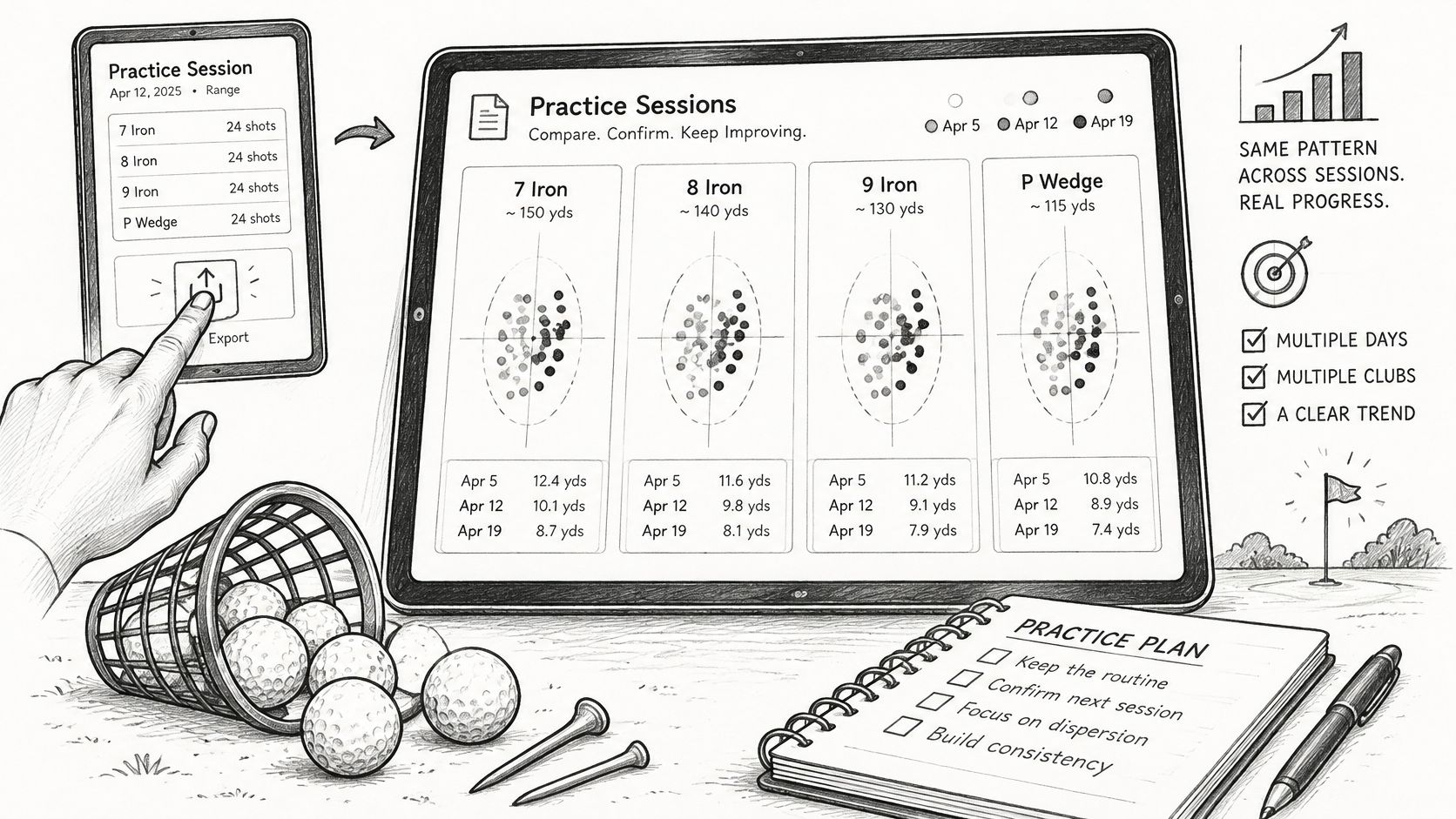
A session view helps separate an encouraging shot from a repeatable pattern.
Export a record that can be compared
For Approach R10 and R50 sessions, Garmin's CSV export instructions specify opening the Garmin Golf app, selecting the recorded session under Activity, choosing the export control, and selecting Export to CSV. The resulting file can be shared from the phone.
Files from other launch-monitor and simulator systems may use different column names, units, and sign conventions. Before combining sessions, map face angle, club path, and face-to-path, and confirm whether positive values mean rightward or open in each file. A face angle one system reports as open can carry the opposite sign in another export, so two sessions with identical delivery can look like a regression until the conventions are aligned. A missing club-delivery field should remain missing rather than be inferred from ball curvature.
Label each export with the club, the cue being tested, and the contact filter applied. When the follow-up session lands, compare medians and start direction across the block instead of reaching for the best shot in either file. One flushed mid-iron proves the swing can produce the pattern; the middle of the distribution shows whether it does.
The CSV import guide offers a practical starting point for organizing exported sessions into one comparable record.
Ask questions that change the next practice session
- Across clubs: Does the slice recur throughout the set, or does a particular iron stand out?
- Across lengths: Does face-to-path widen as the irons get longer, even when contact remains comparable?
- Across effort: Does the miss appear only at normal speed or late in the session?
A club-specific problem supports a closer equipment inspection of that iron. A speed-dependent problem supports a controlled progression rather than another immediate setup change. A broadly repeated pattern makes a shared delivery issue more plausible and justifies keeping the cue under test for another block.
For the next range visit, record a centered-strike baseline, run the ladder, change a single variable, and export the session before leaving the bay. Set the re-test date on the way out, then choose among keeping the setup change, adjusting the drill, or checking dynamic lie with a lie board. The fix counts only when the improvement survives the following session.
Dialed Golf connects launch-monitor practice and on-course support through one golfer record, helping golfers keep club-specific trends together instead of judging a slice from a single shot. Visit Dialed Golf to explore desktop pairing or session import and build a repeatable record for the next iron-slice test.