


About 69% less per ball was the price gap that made Costco's original Kirkland Signature a value-market milestone: the American University Business Law Review account describes its 2016 launch at $29.99 for two dozen, or $1.25 per ball, against roughly $4 for a premium tour ball. That comparison explains the attention. It doesn't establish whether every ball in a box performs alike.
A useful way to review Costco golf balls is to treat them as a measurement problem rather than a bargain hunt. The relevant question isn't whether one Kirkland produces an impressive drive. It's whether different balls produce sufficiently repeatable carry, spin and launch for a golfer to trust the resulting yardages.
Table of Contents
- How the Kirkland Ball Performs on the Numbers
- What the Kirkland Ball Is Built From and What It Costs
- Feel and Greenside Feedback
- Where Distance and Consistency Fall Short
- Who Should Buy Kirkland Balls and Who Should Skip Them
- How to Test Costco Golf Balls and Decide to Switch
How the Kirkland Ball Performs on the Numbers
The Kirkland Signature is a strong candidate for spin and short-game control, with a small driver-carry concession to premium tour alternatives in the cited testing. That's a directional verdict, not proof that it matches a premium ball across every shot.
The independent results below describe different parts of its performance. They shouldn't be combined into a single laboratory profile, because the testers didn't use identical conditions or necessarily identical product versions.
Kirkland Signature performance results from independent tests
| Test source | Shot or club | Kirkland result | Comparison or context |
|---|---|---|---|
| Golf Monthly, published in 2023 | 7-iron | About 5,000 rpm spin, just under 20° launch, 107 mph ball speed | Individual test result; no comparison specified in the cited figures |
| SkyTrak independent test, summarized by Ball Caddie | 50-yard wedge | 7,095 rpm spin, tenth-highest in the test | Eighth of 43 balls for wedge control |
| Independent launch-monitor test, summarized by Reading the Break | Driver at 88 mph swing speed | 231 yards carry | 234 yards for the premium tour comparison ball |
What the measurements actually establish
The iron result describes a particular combination of speed, launch and spin. It doesn't establish an ideal flight for every golfer. A player's delivery, strike location and available speed determine whether that combination produces useful carry and stopping power.
The wedge result is encouraging for golfers who struggle to hold greens. Still, spin isn't the same measurement as stopping distance. Landing angle, landing speed, green firmness and the quality of contact all affect what happens after the ball lands.
The driver comparison suggests a modest distance penalty under the reported conditions. Many recreational golfers would struggle to isolate that difference during normal play, where strike and conditions also change. A golfer shouldn't assume that a small published gap will remain equally small with a different delivery.
A test result describes what happened under the tester's conditions. A fitting decision requires the same pattern to appear under the golfer's conditions.
Why speed alone isn't the verdict
Ball speed helps diagnose whether contact and energy transfer remain comparable. Carry then shows whether the resulting launch and spin turn that speed into useful distance. The driver ball speed chart provides context for separating speed from distance rather than treating them as interchangeable.
The useful conclusion is narrow: Kirkland deserves a controlled comparison, particularly for golfers who value wedge response. These results indicate a performance direction, not a promised yardage or a universal upgrade.
What the Kirkland Ball Is Built From and What It Costs
Kirkland Signature Performance+ uses three-piece construction, consisting of a urethane cover, mantle and elastic rubber core, with a 338-dimple pattern, according to Ball Caddie's construction and test review. The same review summarizes the independent wedge findings shown above and characterizes the ball as a higher-spin option.
Each component has a different job. The cover provides the contact surface for the clubface, supporting short-game response and softer putting feedback. The mantle beneath it is intended to moderate longer-club spin, while the elastic core contributes to the ball's overall response and feel.
That design doesn't mean the ball can provide maximum greenside spin and minimum driver spin for every golfer. Construction describes the design approach, not a guaranteed fitting outcome. A golfer who already generates excessive spin should evaluate the resulting flight rather than selecting the ball because it has urethane.
Separate the product generations
The original launch ball and the later Performance+ shouldn't be treated as interchangeable. Their different constructions matter when interpreting old reviews, resale listings or recommendations from golfers who haven't checked the version.
The price comparison also needs its market and date attached. National Club Golfer reported $29.99 for two dozen in the United States in 2025, while Golf Monthly's 2023 UK test reported £26 for two dozen, slightly more than £1 per ball. Those are reported prices, not a guarantee of today's checkout total.
Kirkland Signature construction and price per ball by version
| Version or market | Construction | Cover and dimples | Price for 24 balls |
|---|---|---|---|
| Original ball, 2016 US launch | Four-piece | Urethane cover; dimple count not specified | $29.99, approximately $1.25 per ball |
| Kirkland Signature Performance+, US 2025 price report | Three-piece, urethane cover, mantle and elastic rubber core | Urethane cover, 338 dimples | $29.99, approximately $1.25 per ball |
| Kirkland Signature, UK 2023 Golf Monthly test | Not specified in the cited price finding | Not specified in the cited price finding | £26, approximately £1.08 per ball |
| Premium tour ball benchmark at the original launch | Multi-piece tour category; exact construction not specified | Not specified in the historical comparison | Approximately $96 equivalent, calculated from roughly $4 per ball |
The useful value calculation
The arithmetic is straightforward: divide the pack price by the ball count. The harder calculation is whether a lower purchase price changes anything the golfer relies on.
For a player who loses balls regularly, replacement cost can be a meaningful selection criterion. For a player maintaining carefully established approach distances, a change in flight might require new testing before the saving becomes useful.
- Purchase value: A low unit price makes a controlled trial less expensive.
- Playing value: The ball still needs to produce suitable flight, stopping behavior and feedback.
- Practice value: Results must be repeatable enough to support decisions about clubs and yardages.
The price gap explains why golfers investigate Kirkland. It's also why the performance claims need checking rather than accepting the construction as proof of equivalence.
Feel and Greenside Feedback
Feel is a preference, not a substitute for flight data. A ball can provide pleasant putting feedback while producing an unsuitable full-shot trajectory. Conversely, a slightly firmer sensation doesn't automatically mean worse scoring performance.
The urethane cover is the starting point for evaluating contact on chips and putts. On fuller swings, the response of the entire construction matters, so a golfer shouldn't expect the same sensation from a delicate chip and a driver strike.
A partner-assisted feel check
A simple comparison can reduce the influence of price and branding. This is a practice protocol, not a published performance finding.
- Conceal the identity. A partner places the candidate balls in unmarked sleeves labeled A, B and C, then records the identities separately. During play, the partner presents each ball with its branding turned away where practical.
- Use a fixed workload. The golfer hits ten chips and ten putts with each candidate, using the same club, starting area and target.
- Record separate ratings. A suggested scale runs from one to five for feedback, perceived softness and stopping behavior. Keeping those categories separate prevents softness from becoming shorthand for overall quality.
- Reveal after scoring. The partner compares average ratings only after the golfer has finished every candidate.
This isn't a laboratory blind test. Logos can become visible, and golfers may recognize markings or sound. It's still more useful than choosing a favorite immediately after seeing the price.
Feel check: The preferred sensation should survive a concealed comparison, not just a familiar logo.
Older descriptions of the original ball shouldn't determine expectations for Performance+. A golfer who likes the current ball on the practice green should still complete the full-shot comparison before committing to a box for regular play.
Where Distance and Consistency Fall Short
The more important concern is repeatability, not a dramatic loss of ball speed. Reading the Break's review summarizes comparable-speed driver testing with Kirkland carrying approximately 1 to 3 yards shorter than a premium tour reference, and Ball Lab measurements showing compression of approximately 88 to 103 across sampled balls, alongside weight and diameter inconsistency and some sampled balls exceeding the USGA weight limit, according to its Kirkland Signature assessment.
Those findings require two distinctions. A small carry difference describes distance efficiency under test conditions. A broad spread between sampled balls describes how confidently a golfer can treat separate balls as equivalent test objects.
The second issue can interfere with equipment decisions even when the first seems acceptable. A golfer might tolerate a little less driver carry but still need reliable approach distances.
Why variation complicates practice
Say a golfer hits one ball with a mid-iron and records a convincing carry number. Another ball produces a different launch and shorter carry despite apparently similar contact. Without repeated shots, the golfer can't confidently attribute that change to the swing, the ball or the measurement.
The problem resembles using a bathroom scale that gives different readings on repeated attempts. A single reading might look plausible, but it's a weak basis for deciding whether anything has changed.
This doesn't establish that every Kirkland sleeve contains a problematic ball. The reported measurements describe a sample, not every production run or the exact pack a golfer buys.
Practical rule: Judge a candidate ball by the center and spread of repeated results, not by its best drive.
A launch-monitor app can help organize those results, but software can't remove uncertainty introduced by changing test objects. The golfer still needs a repeatable collection method and a clear record of the ball version.
Use the median without hiding the spread
The median reduces the influence of unusually long or short results. It doesn't make inconsistent balls consistent, and it shouldn't replace inspection of the full session.
- Compare like with like: Keep club, intended shot and ball model identifiable.
- Retain ordinary misses: Those shots represent actual playing performance, provided they aren't obvious measurement failures.
- Inspect the distribution: A useful middle value can conceal a troublesome range of outcomes.
- Keep ball identity: Mark individual test balls so repeated anomalies can be investigated rather than blended away.
A narrow spread is especially valuable when a fitter is trying to separate a club adjustment from normal shot variation. If the candidate ball adds uncertainty, more shots may be needed before a change becomes interpretable.
Tournament decisions require another check. The reported sample findings aren't a blanket ruling on every current Kirkland model. A competitive golfer should verify the exact model's current conformity status and any applicable competition requirements rather than assuming that either an old review or a familiar logo settles the question.
Who Should Buy Kirkland Balls and Who Should Skip Them
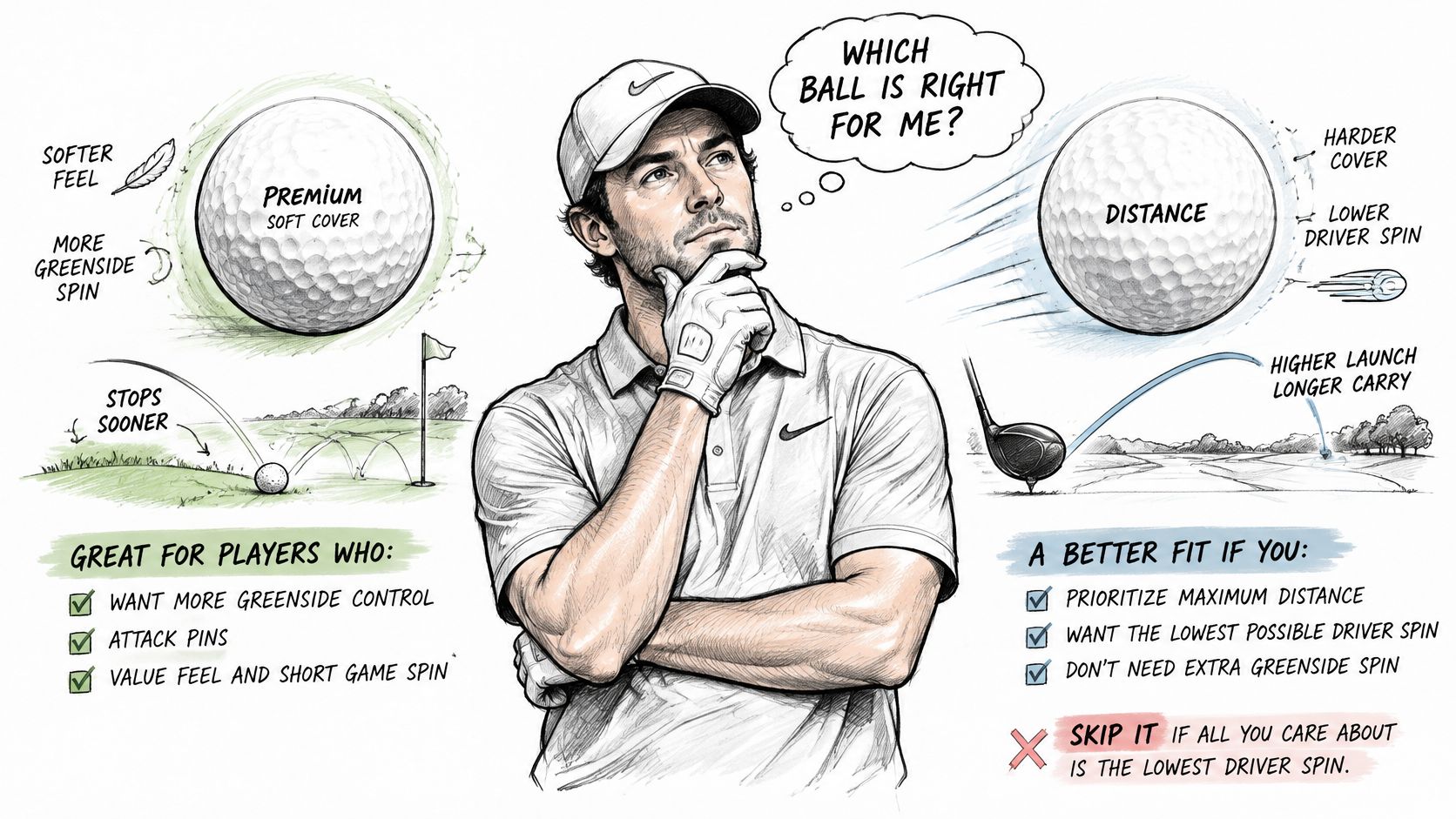
Kirkland's clearest fit is the golfer seeking greenside response and a premium-cover feel at a low purchase price. Its weaker fit is the golfer prioritizing minimum driver spin or especially tight ball-to-ball tolerances.
The distinction isn't beginner versus skilled player. A skilled wedge player may accept a modest long-game compromise, while a recreational golfer with excessive spin may find the flight unsuitable.
The decision diagram separates those priorities before a golfer begins testing.
Match the ball to the problem
Kirkland Signature fit by golfer type
| Golfer profile | Fit verdict | Reason from the evidence |
|---|---|---|
| Wedge-focused player needing greenside stopping power | Strong fit | Favorable wedge-control placement and high measured wedge spin support a trial |
| Budget buyer wanting one ball for practice and rounds | Strong fit | The reported purchase-price advantage makes using the same model in both settings more affordable |
| Data-focused golfer tracking launch-monitor trends | Strong fit with protocol | Group testing and median comparisons can support evaluation, but don't guarantee stable production tolerances |
| Golfer with excessive iron or wedge spin | Test first | Additional spin may change carry relationships and flight |
| Player seeking the lowest driver spin or longest carry | Test first | The cited driver testing doesn't establish a distance advantage |
| Competitive player needing tour-level consistency | Skip or verify | Sampled compression and dimensional concerns warrant closer scrutiny |
Dialed Golf's free Golf Ball Fitter finds a ball profile that fits the golfer's flight and feel. It can narrow the candidate profile before a physical comparison, but it doesn't replace checking how the selected model behaves with the golfer's clubs.
A reference ball must earn that role
A data-focused golfer shouldn't label Kirkland a stable reference ball merely because it's inexpensive enough to buy repeatedly. A reference ball needs to demonstrate suitable repeatability in the actual test setup.
That makes the conditional verdict important. A disciplined testing protocol can reveal whether a purchase works for the golfer; it can't guarantee that every ball will perform identically.
For players whose driver flight already becomes difficult in wind, a calm-weather distance result isn't enough. They should examine whether the candidate changes launch and spin in a useful direction before relying on it during exposed rounds.
The purchase decision is therefore practical rather than ideological. A golfer doesn't need Kirkland to equal every premium alternative. The ball needs to preserve the shots that matter while providing a worthwhile saving.
How to Test Costco Golf Balls and Decide to Switch
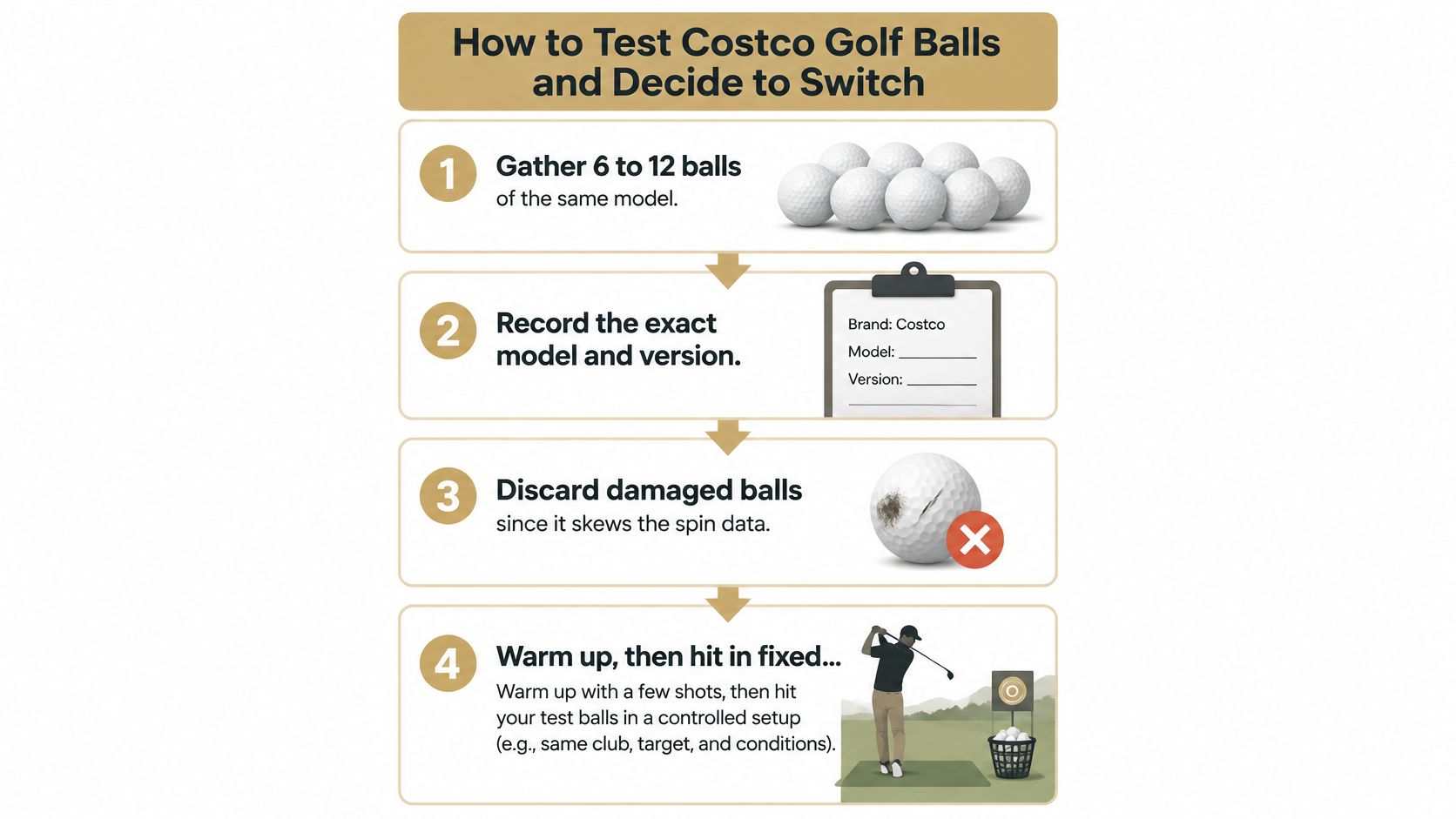
A credible comparison tests the dozen, not just the model name. Individual ball identification, controlled conditions and repeat sessions help separate a promising first impression from a dependable change.
The workflow begins before the launch monitor records a shot.
Build a controlled comparison
Gather matching balls and record their identity. Use a working sample of six to twelve balls of the same model, preferably the full dozen. Record the exact packaging description and version, then mark each ball individually. This recommended protocol checks whether the result survives a change of ball rather than repeated use of one favorable specimen.
Inspect the playing surfaces. Remove balls with cuts, scuffs or visible damage from the main comparison. Keep rejected balls separate so they don't accidentally return to the rotation and complicate spin interpretation.
Warm up before collecting results. A practical starting block is five driver shots, five mid-iron shots and five wedge shots per comparison cycle. These are suggested test counts, not a statistical guarantee; alternate the candidate and current ball so warm-up or fatigue doesn't affect only one model.
Keep the setup steady. Use the same hitting area, mat, club and target. Record meaningful temperature or wind changes, and pause the comparison if conditions shift enough to make the blocks unlike each other.
Export recorded sessions when appropriate. For Approach R10 or R50 driving-range sessions, Garmin's CSV export instructions specify opening the Garmin Golf app, selecting Activity, choosing the session, selecting Export to CSV, and sharing the file from the phone. Preserve the original export as well as any edited working copy.
Compare medians and distributions by club. Import the session into the desktop workflow, identify the ball used for each block, and examine carry, spin and launch separately. Don't pool driver and wedge shots or choose only the longest results.
Repeat before changing yardages. Run the comparison on another day. A useful result shows both a manageable spread and a difference from the current ball that persists across sessions.
The guide to choosing a launch monitor for driving-range practice provides setup context. Measurement quality still depends on positioning the device correctly and following its operating guidance.
The accompanying video provides another reference alongside the written testing workflow.
Keep capture and product roles clear
Dialed Golf is three products, one golfer record and one Pro plan. Its macOS and Windows desktop apps support launch-monitor practice at the range or garage simulator, with live pairing starting with Garmin R10 and expanding. Stated pairing or CSV/import compatibility includes Garmin, Rapsodo, SkyTrak, FlightScope, Uneekor, GSPro, Awesome Golf and more; that broader compatibility is the product's stated scope, not a conclusion from Garmin's export documentation.
Desktop remains the place for live capture, which records shots locally for session review. Mobile live pairing is later. The consumer pocket caddy is in TestFlight now, not generally available on the App Store; Apple's TestFlight overview identifies that distribution route as beta testing.
Golfer Pro covers app and desktop at $9.99/week, $29.99/month, $149.99/6 months or $249.99/year. Free web tools remain free entry points, not Pro features. Separately, the Academy memberships and front-desk product costs $99.99/month or $999.99/year per facility, and the club keeps its dues.
The decision rule is to switch only when median carry, spin and launch fit the golfer's gapping across repeated days. If the candidate disrupts trusted distances or produces an unhelpful spread, the current ball remains the better reference. Before tournament use, the golfer should also verify the exact current model's conformity status.
Dialed Golf offers free ball-profile tools and desktop practice software for comparing recorded sessions before a golfer changes equipment. Visit Dialed Golf to narrow a suitable flight-and-feel profile, then test a matching dozen against the current ball before rewriting trusted carry distances.