


Flex is the shaft's resistance to bending, commonly labeled Ladies, Senior, Regular, Stiff, or Extra Stiff, and those labels are not one universal measurement. A Regular from one maker can measure differently from a Regular from another, so the word printed on the shaft works as a starting hypothesis rather than a specification.
A golfer pulls a driver off the rack, reads Regular on the band, and has nothing to compare it to. The swing feels fine on the range. Then on the course the ball climbs, hangs, and drops short of where the same swing used to finish, or it flies low and right and never turns over. Same club, roughly the same swing, and a ball flight that's telling a story about how the shaft and the motion are meeting.
That story is worth learning to read. Flex isn't a grade of quality or a badge of how good a player is. It's the bend in the tube between the hands and the clubhead, and it shapes how the head arrives at the ball: how much dynamic loft, where the face points, and how repeatable the strike is. The path from here runs through the labels, the measurements behind them, the flights they produce, and a test a golfer can run.
Table of Contents
- What Flex Means on a Golf Club
- How Makers Measure Shaft Flex
- How Flex Changes Ball Flight and Feel
- Signs Your Shaft Flex Does Not Fit
- Why the Same Speed Needs Different Flex
- How to Compare Flex on a Launch Monitor
- Lock In a Flex You Can Repeat
What Flex Means on a Golf Club
A golfer choosing between two shafts may find the same flex letter on both, yet see different results with the same clubhead speed. The speed bands below offer a first row to try, not a final answer. Fit depends on how the golfer delivers the club, including dynamic loft, spin, strike, and dispersion.
The letters, in order
Five categories cover nearly every shaft on a shelf. Ladies (L) is the softest common option, Senior or Amateur (A) sits one step up, Regular (R) holds the middle, Stiff (S) comes next, and Extra Stiff (X) is the firmest standard label. These driver speed bands are common fitting starting points.
| Flex name | Common letter | Driver speed to try first | How the shaft tends to behave |
|---|---|---|---|
| Ladies | L | Under 75 mph | Bends readily and can help launch when speed is modest |
| Senior | A | 75–85 mph | Softer than Regular and often suited to a smoother transition |
| Regular | R | 85–95 mph | Mid bend and the letter many stock sets ship with |
| Stiff | S | 95–105 mph | Resists bend and needs enough speed or force to load |
| Extra Stiff | X | 105 mph and up | Least bend among standard labels and can feel boardy if underloaded |
What the row can and cannot tell you
The USGA equipment rules do not define a Ladies-to-Extra-Stiff scale; shaft labels are fitting categories, so two Regular shafts can produce different launch, spin, and dispersion in the same head. The same letters appear on drivers, fairways, hybrids, and irons, while weight, torque, and kick point also affect feel and delivery.
Mark the row closest to a typical driver speed, not a personal best. Use it to choose a starting point for comparison, then judge the fit by repeatable delivery rather than the letter alone.
How Makers Measure Shaft Flex
The letter is a category. The number a fitter measures is a clue. Neither one is the golf swing, and that gap explains a good share of the confusion around what is flex in golf clubs.
Frequency testing, in plain terms
A frequency machine clamps the butt of the shaft, deflects the tip, and releases it. The shaft oscillates, and the machine counts how fast, usually reported in cycles per minute. A higher reading generally points to greater measured stiffness. Deflection testing approaches the same question from another angle: the shaft is bent under a set load and the machine reads how far the tip travels, which describes how much the tube gives.
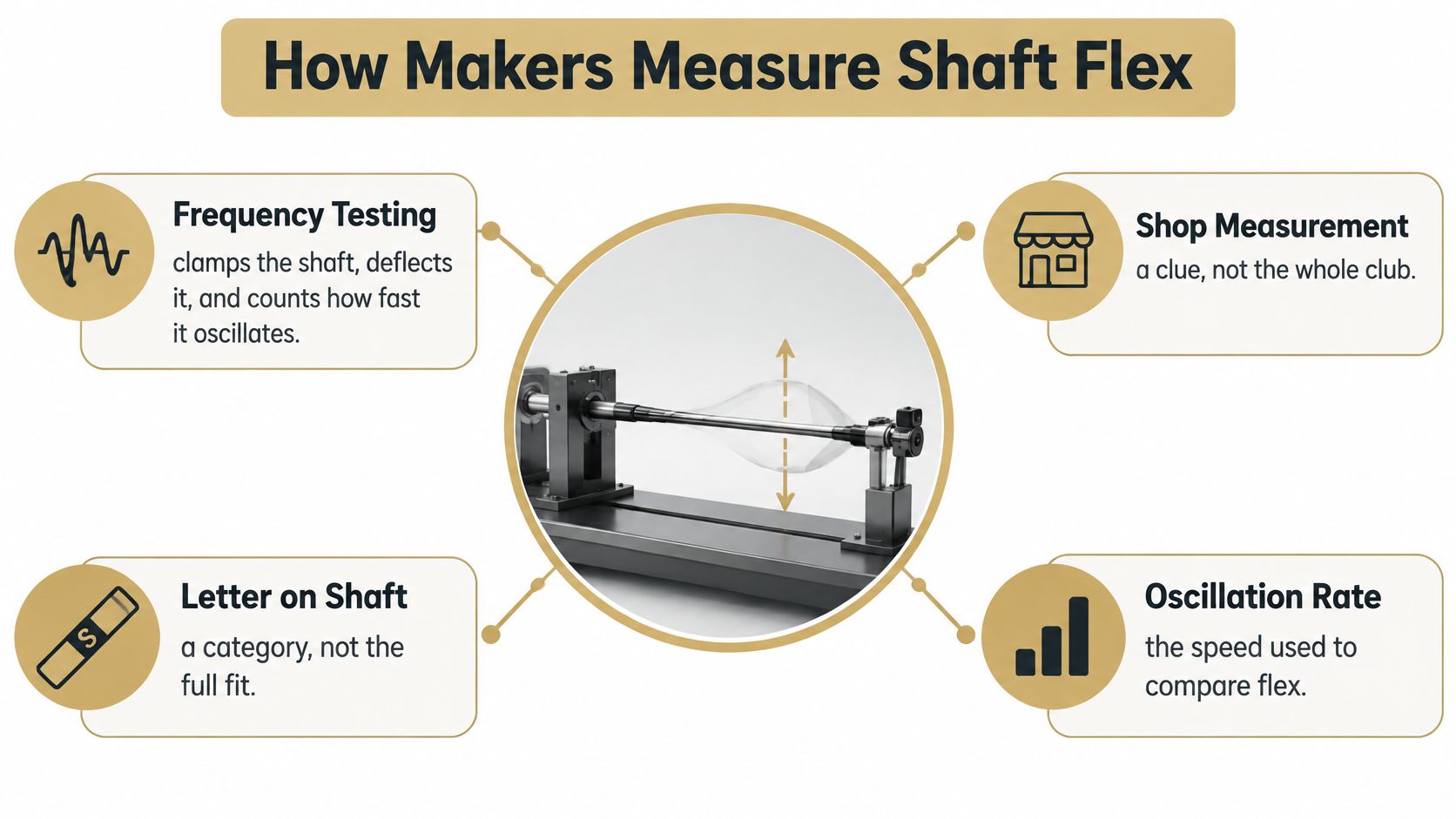
The research on shaft frequency and stiffness is direct about the limits of both tests. Two shafts with similar frequency can behave differently because stiffness isn't uniform along the length of the tube. Total club behavior also leans on length, head mass, grip, torque, and balance, and the reading itself shifts with how the butt was clamped and which protocol the shop uses. A cycles-per-minute number from one builder isn't automatically comparable with a number from another.
The clothing size analogy
Treat the letter as the size on a clothing tag, a frequency reading as a single tape measurement, and the bend profile as the cut of the garment. A medium from two labels can fit differently even when the tape reads the same number of inches. That's why a golfer who wears Regular in one brand can wear Stiff in another and feel nothing strange about either.
Profile, torque, and mass
Bend profile, often called kick point in fitting talk, is where the shaft prefers to bend. A softer tip can add dynamic loft at impact while a stiffer tip tends to hold the face and launch lower. Torque is how much the shaft twists, and most golfers feel it as face stability rather than as anything tied to the letter. Mass changes how easy the club is to load even when the label stays the same, so a light Stiff can feel loose and a heavy Regular can feel planted.
What the measurements can't settle is speed. Simulation work on shaft stiffness has found no consistent, systematic effect on clubhead speed. A more compliant shaft may recoil faster and store more bending energy, and that benefit can be offset by lower angular velocity at the grip end. The clearest effects show up in clubhead orientation, especially dynamic loft and face orientation.
Ask for the numbers, not the word: letter, weight, torque if it's printed, and any frequency the fitter shares. Four lines on a note card beat a memory of how the club felt on one good swing.
The point of documenting those four figures isn't to chase a higher frequency reading. It's to know exactly what changed when the next shaft goes in the same head, so the shots can decide.
How Flex Changes Ball Flight and Feel
The shaft works as a timing link between the hands and the clubhead, and it is still recovering as the head reaches the ball. Flex can influence how the head arrives, including its delivered loft and lie.
A double-blind study of 40 golfers hitting drivers with five shaft stiffness levels, published in a journal study indexed on PubMed, found that stiffness significantly affected clubhead velocity for 27 golfers, dynamic loft for 11, and lie angle for all 40. It did not significantly affect face angle, swing path, or attack angle. The results show that shaft stiffness can change how the clubhead is presented at impact, with different effects for different golfers.
What a mismatch looks like in the air
A shaft that is too soft for a player's transition may increase delivered loft, alter lie, and make start lines less consistent. A shaft that is too stiff for the player may feel difficult to load and time, changing how the head arrives at impact.
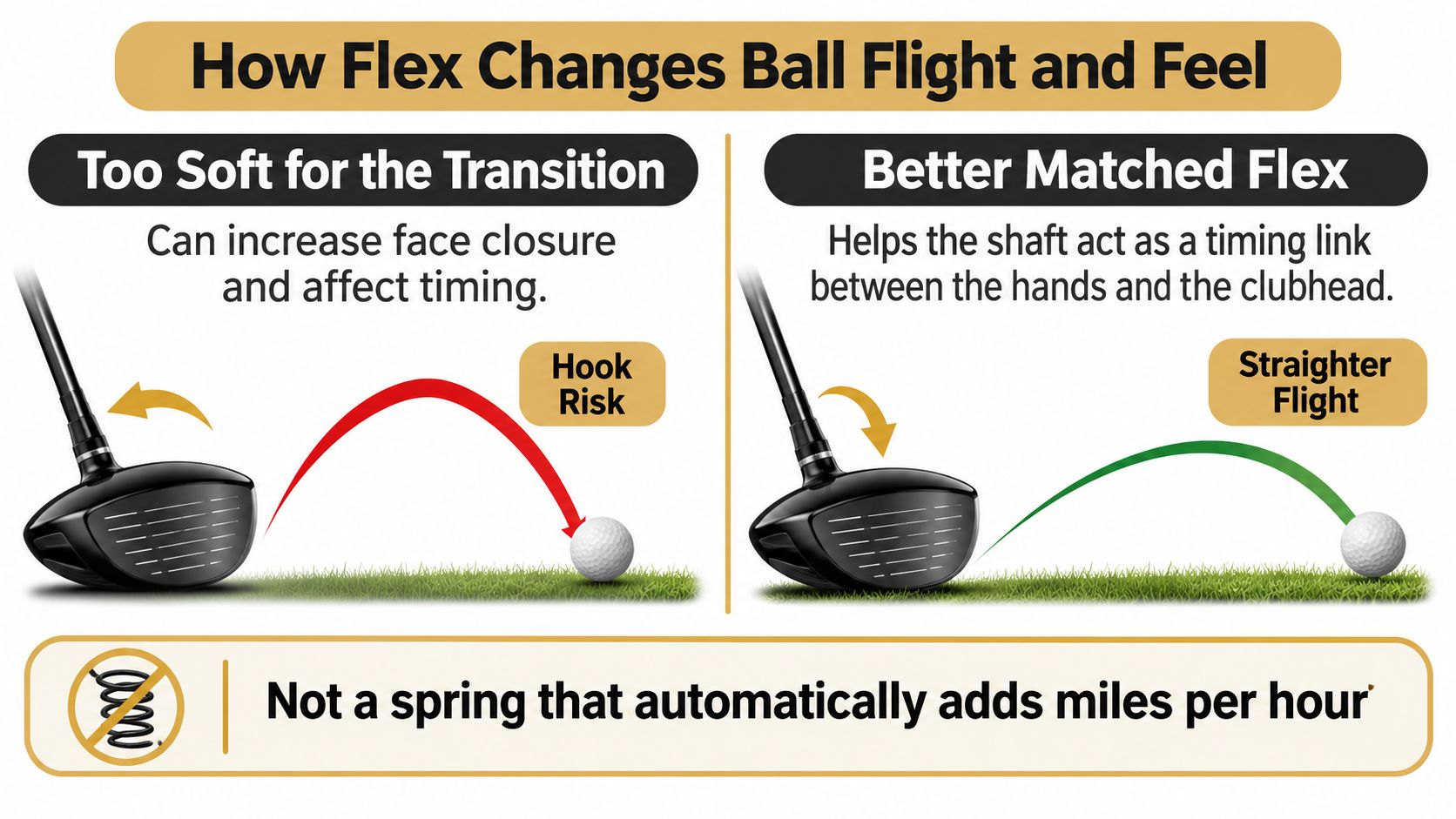
Those delivery changes can shape the flight. More dynamic loft generally raises launch and spin, which may help a golfer who needs carry or make a fast player's flight less useful in wind. Less delivered loft can produce a flatter flight and reduce carry, even when club speed stays healthy.
Feel is data too
A shaft that loads in transition and releases through impact gives the golfer a timing cue. If it feels harsh or difficult to sense, the golfer may rush the hands to make the club feel active, changing tempo.
The standard to hold: judge flex by repeatable launch-monitor outcomes such as dynamic loft, launch angle, spin, strike location, face-to-path, and dispersion, rather than swing speed alone.
Compare several options while keeping the head, loft, length, ball, and swing intent constant. The goal is a delivery pattern the golfer can repeat, not a letter that sounds right.
Signs Your Shaft Flex Does Not Fit
Diagnosis starts with pattern, not with a single swing. A golfer who has hit the same head and ball for three range sessions and keeps seeing one flight has a signal. A golfer who remembers one spectacular drive has an anecdote.
Assume a centered strike and a familiar ball before reading anything into the table below.
| What you see or feel | Flex mismatch to suspect | Delivery clue to check |
|---|---|---|
| High, spinny ball that balloons and stops short | Too soft or a tip that is too active | Dynamic loft and spin both up versus your usual window |
| Low, flat flight with weak carry | Too stiff to load at your tempo | Launch and spin both down even on center strikes |
| New hooks or pulls after a softer shaft | Face closing early for a right-handed player | Start line and face-to-path drifting left |
| New blocks or weak fades after a stiffer shaft | Late release and an open face | Start line drifting right and strikes moving toward the toe |
| Harsh hands and no sense of kick | Underloaded stiff or heavy shaft | Tempo speeds up and impact feels abrupt |
| Strike wanders while speed stays steady | Profile mismatch rather than one bad swing | Impact location scatters even when club speed is similar |
What the table cannot prove
Plenty of things mimic a flex problem. A closed face, a steep attack angle, a head that sits too upright, or a grip change made in the same week will all produce the flights in that left column. That's why strike location gets checked before any shaft comes out of the bag, and why a single flushed shot gets deleted from the evidence.
Foot spray or impact tape on the face answers the strike question in about ten swings and costs almost nothing. If the marks scatter across the face while club speed holds steady, the shaft is a suspect. If the marks sit in one spot and the flight is still wrong, the problem is more likely face angle, attack angle, or loft.
A pattern that holds across a full session outranks one spectacular carry number.
Change one thing at a time and change it after the strike has been checked. That rule saves more money than any flex chart ever will.
Why the Same Speed Needs Different Flex
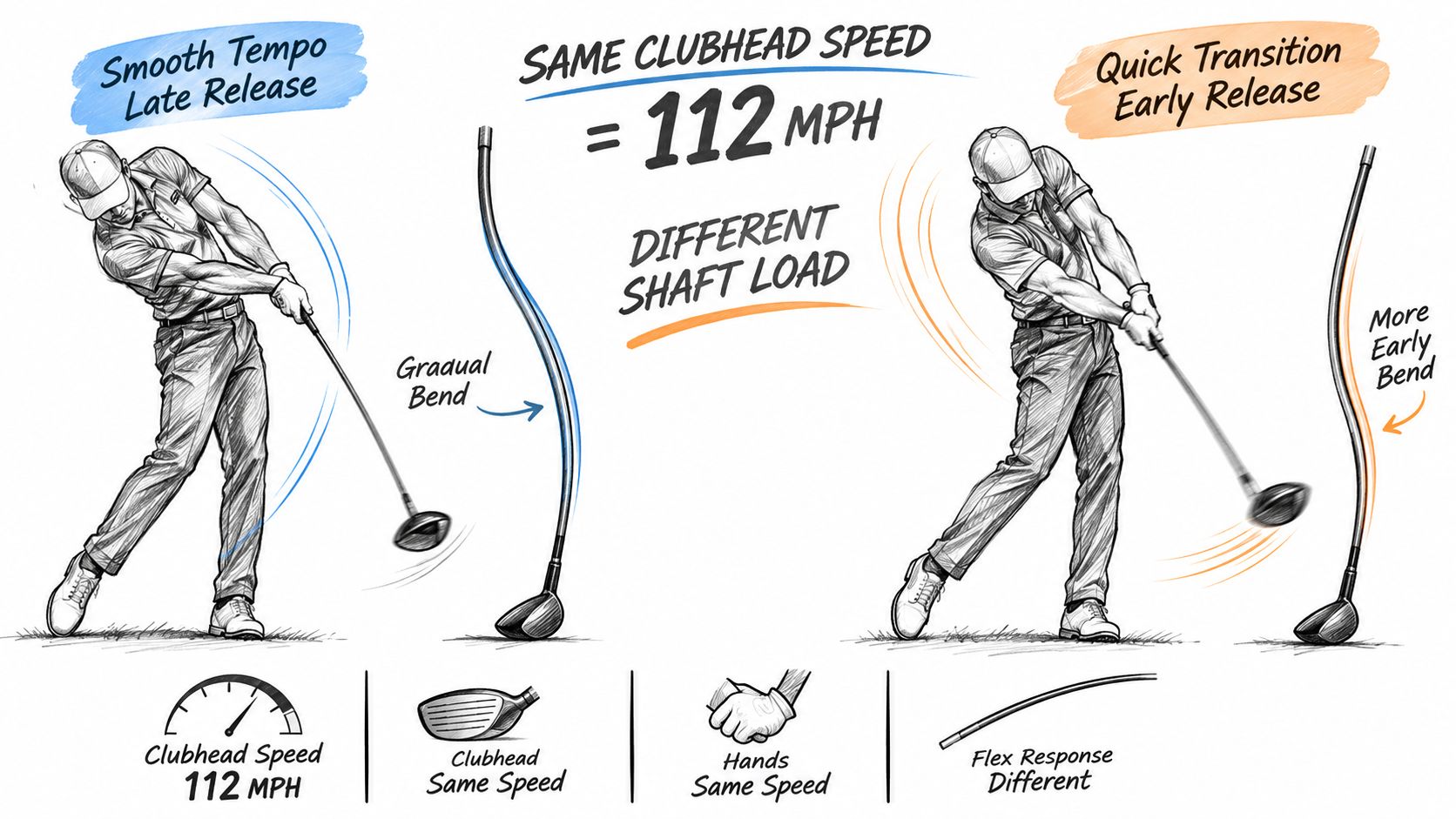
Two golfers can both swing a driver at 95 mph and need different shafts. One has a long, smooth transition and releases late. The other changes direction hard from the top and snaps the club through. The speed number at the bottom is identical, and the load the shaft feels on the way there isn't.
Transition force, total swing duration, and release timing are separate variables from the speed a monitor reports. Those variables are why a speed chart gets a golfer to a first row and no further. The driver ball speed chart is a useful reference for where a given ball speed tends to land in carry, and it still can't tell anyone how hard the handle is being loaded.
What the research says about tempo
Work published in the study on tempo, skill, and shaft flex reports that the interaction between swing tempo, skill level, and shaft flex significantly affected performance, with the strongest effects among expert golfers. Experimental work in the same area suggests players can compensate for a change in club mechanics by altering the torques they apply during the downswing, so measured club motion can look stable even after the shaft changed.
That finding cuts both ways. It undercuts the advice that tempo doesn't matter, and it undercuts the idea that speed alone decides the fit.
Two cases worth holding in mind
Take a player at 92 mph with a violent transition. A soft Regular may over-draw on them and feel unforgiving, while a Stiff in the same head may hold a start line all afternoon even though the chart says Regular. Now take a player at 100 mph with a long, syrupy swing. A Stiff may launch too low and struggle to hold a green, while a firm Regular or a lighter Stiff with a softer tip flies a window they can use.
Labels also drift by market. A Senior shaft sold in one region isn't guaranteed to match an Amateur shaft sold in another, which is why the session data matters more than the band.
Separate two questions before buying anything. How fast is the clubhead, and how hard is the transition. Some golfers adapt to a range of flexes and post similar numbers with all of them. Others need the profile that matches their timing and fall apart outside it.
How to Compare Flex on a Launch Monitor
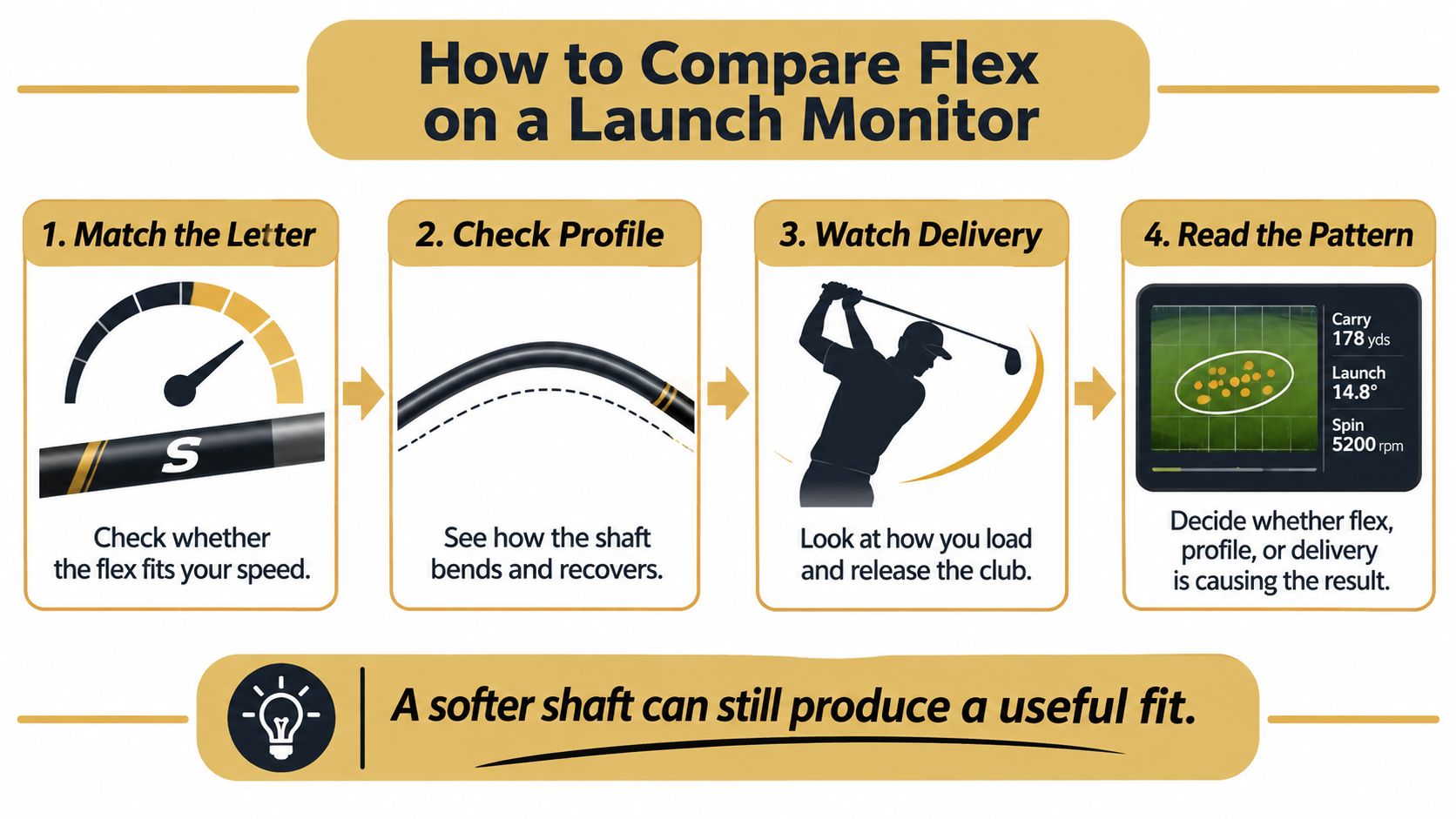
The useful question isn't only which letter matches a club speed. It's whether flex, shaft profile, or the player's delivery is causing the launch and dispersion pattern on the screen.
Independent testing reported by Golf.com's shaft fitting guide found that a softer shaft produced higher launch and spin, 11 more yards of carry, and a smaller dispersion area in one comparison, despite slightly lower ball speed. That result is the reason a single fast ball-speed reading makes a poor referee.
A five step test protocol
- Freeze everything else. Lock the head, loft, length, grip, ball, and swing intent, then record a baseline session with the shaft currently in the bag.
- Change one variable. Swap only the shaft, or compare two known flexes in the same head. Two changes at once teach nothing.
- Hit a full session at normal tempo. Tag strike location so a heel or toe miss doesn't get to crown the winner.
- Read the whole screen. Club speed, ball speed, launch angle, spin, dynamic loft where the monitor reports it, peak height, landing angle, carry, and side dispersion all go in the notes.
- Keep the shaft that tightens the pattern. Stable launch and spin with a narrower dispersion beats a longer single shot every time.
Edge cases worth planning for
If two shafts disperse the same and the numbers are close, choose the one the player will trust on a course with a card in hand. Feel decides ties, because a shaft a golfer doesn't believe in gets steered.
A garage session on a personal monitor is enough to run the protocol, provided the same setup gets repeated on a second day before money changes hands. The practical setup details in this guide to the best launch monitor for driving range work cover what to check so the two sessions are comparable.
A flex letter from one manufacturer is a hypothesis about another manufacturer's shaft. Nothing more.
Don't buy a stiffer shaft because a chart says the speed crossed a line. The line moves with tempo, and the session is the only thing that knows.
Lock In a Flex You Can Repeat
A shaft choice becomes easier to revisit when each test has a clear record. Use four habits to keep comparisons useful.
- Compare in the same head. Test the candidate shafts in one club, with the same ball, and track strike location.
- Retest on another day. If the speed-chart row and the first session point in different directions, repeat the comparison before buying.
- Break ties on trust. When the numbers are close, choose the shaft that feels loadable and lets the golfer swing freely under pressure.
- Save both sessions. Keep club speed, ball speed, spin, launch, carry, and notes on how the ball-flight window changed.
A saved practice record makes those comparisons easier to revisit. Dialed Golf's desktop app runs on macOS and Windows, supports live pairing starting with Garmin R10, and accepts session imports from golf launch monitors and simulator software.
Once a shaft is settled, re-run a gap analysis of the bag to check whether the new carry distances overlap with a neighbouring club or leave a yardage uncovered. A change in launch or strike can shift carry enough to alter the gaps between clubs.