

Two hybrids provide a sensible starting point, with the final count determined by the gaps in your measured carries and the lies you need to play. The right combination connects your longest reliable iron to your shortest trusted fairway wood, not merely one club number to another.
You face a tough long approach when the iron is difficult to launch and the fairway wood risks running through the green. A hybrid earns its place if it covers that distance and produces a more reliable strike from the lies you encounter, even when another club closes the gap more tightly. Answering “What hybrid clubs should I carry?” starts with mapping the bag, then choosing the hybrid that fills a measured gap.
Table of Contents
- How Many Hybrids Most Bags Really Need
- Matching Lofts to Measured Carry Gaps
- Hybrid, Fairway Wood or Long Iron by Lie
- Diagnosing Overlaps, Holes and Erratic Clubs
- How the 14-Club Limit Shapes the Bag
- Confirm the Bag Before Your Next Range Session
How Many Hybrids Most Bags Really Need
Two hybrids are a sensible starting point, not a requirement. Equipment guidance summarized by Keiser University's College of Golf identifies two as the typical count, with nearly one in four golfers carrying three or more, and recommends roughly 10–15 yards between adjacent clubs.
That baseline makes sense because hybrids address an ordinary equipment problem: long irons that don't launch or carry consistently. Their wood-inspired heads provide forgiveness while retaining a relatively iron-like setup. There's no reason to keep a difficult iron because it arrived with the set.
Hybrid count by bag situation
| Bag situation | Hybrids to carry | Where they usually go |
|---|---|---|
| Typical amateur with one unreliable long iron | 1 to 2 | Replace the longest unreliable iron, then bridge to the fairway wood |
| Mid-to-high handicap, weak from rough | 2 | Cover the 3- and 4-iron range, with the higher-launching option serving approaches |
| Clear gap still open after two hybrids | 3 | Add the third only where the measured carry gap exceeds about 15 yards |
| Low-speed or low-launch swing | 2 to 3 | Test lower-lofted hybrids for 3- and 4-iron distance, retaining them only if they produce sufficient height |
| Trusted 5-wood and no gap below it | 0, or 1 for a distinct lie problem | Add one only if the 5-wood cannot handle the rough or uneven lies encountered |
These are starting configurations, not fitting prescriptions. The rough specialist still needs a distinct job, and the low-speed golfer shouldn't assume that less loft automatically produces more useful distance. A hybrid that launches poorly can leave the same practical hole as the iron it replaces.
Establish the endpoints first
The simplest check begins with the longest iron the golfer trusts from the fairway and the shortest fairway wood that produces predictable carry. Record their normal results, then identify the uncovered approach distances between them.
The 4-hybrid distance guide can help frame a candidate club, but a category average isn't a personal carry number. A strong strike with a demonstration club doesn't establish a reliable yardage either.
Practical rule: Every added hybrid should supply a missing carry window or a demonstrably better shot from a recurring lie.
This week's useful task is therefore simple: list those trusted endpoints and the approach distances that neither handles comfortably. That list determines which lofts deserve testing before any purchase.
Matching Lofts to Measured Carry Gaps
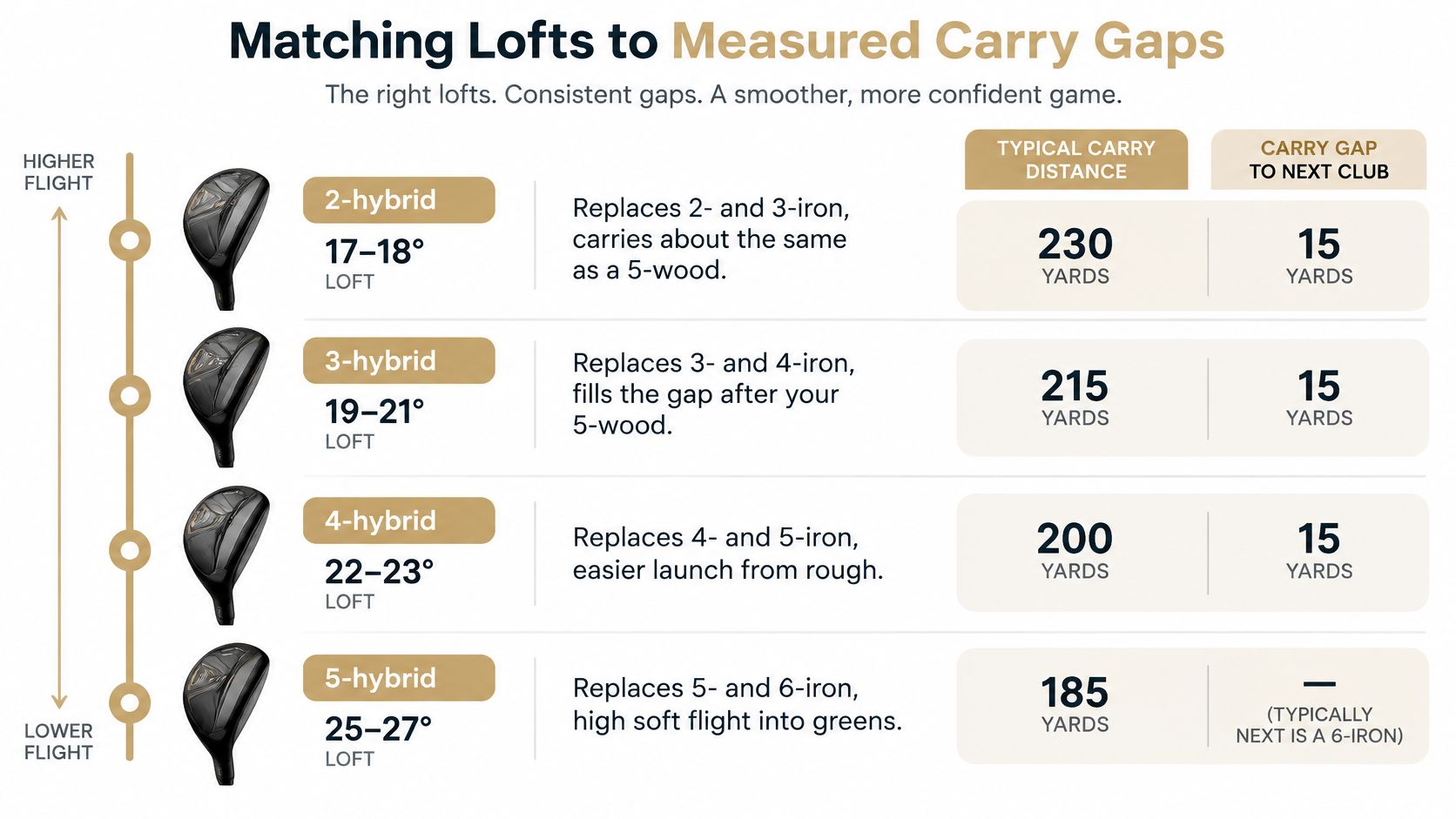
A bag with a 170-yard iron and a 205-yard fairway wood leaves a 35-yard interval. The right hybrid loft depends on how much of that gap it closes with a dependable carry, not the number stamped on the sole.
Typical hybrid loft by the iron it replaces
| Hybrid | Typical loft | Iron range it usually replaces |
|---|---|---|
| 2-hybrid | 17° to 18° | 2- and 3-iron |
| 3-hybrid | 19° to 21° | 3- and 4-iron |
| 4-hybrid | 22° to 23° | 4- and 5-iron |
| 5-hybrid | 24° to 25° | 5-iron |
| 6-hybrid | 27° to 28° | 6-iron |
These are typical ranges, not standardized labels. A hybrid lofts chart can help identify candidate lofts, but measured carry should decide which ones belong in the bag.
Run a repeatable carry test
Keep the trusted iron and fairway wood as endpoints while testing hybrids between them. If one candidate leaves awkward distances on both sides, test a second; the measured results may still support carrying only one.
- Keep the reliable iron. Start with the longest iron that works from the fairway, not necessarily the longest iron in the set.
- Collect centered strikes. Use 8–10 centered strikes to assess carry separation. Exclude obvious tops, heavy strikes, and monitor misreads, but keep ordinary misses in the record.
- Record useful flight. Note carry, peak height, descent angle, and left-right dispersion. Total distance includes rollout that may disappear on soft turf or become excessive on firm greens.
- Compare lofts by result. A 3°–4° loft increment is a reasonable testing step, but adjacent club numbers do not guarantee distinct carry distances.
- Check the wood endpoint. Measure the shortest trusted fairway wood under the same conditions and confirm that the hybrids connect to it.
- Screen for overlap. Treat a separation under about 8 yards as a possible overlap. Keep both clubs only if trajectory or performance from a recurring lie gives each a distinct job.
Separate clean-strike potential from playable performance
A hybrid's lower center of gravity and wider sole can raise launch relative to a same-loft iron. That can make an iron replacement more useful without making it a like-for-like distance replacement. If neighboring hybrids carry nearly the same distance, the higher-lofted option may provide a more useful approach flight. Keep the lower-lofted one when it handles a separate shot or lie better.
Compare carry dispersion, launch, spin, descent, and realistic lies. Range balls, turf, wind, and monitor calibration can make small differences difficult to interpret, especially when they fall within the normal spread of shots.
Track clean strikes separately from ordinary playable misses. A hybrid that posts the longest carry on a perfect strike may be the weaker choice if modest contact changes cost it distance or control.
A tighter carry gap can still be the better fit when that hybrid produces more consistent contact from the lies that matter.
Hybrid, Fairway Wood or Long Iron by Lie
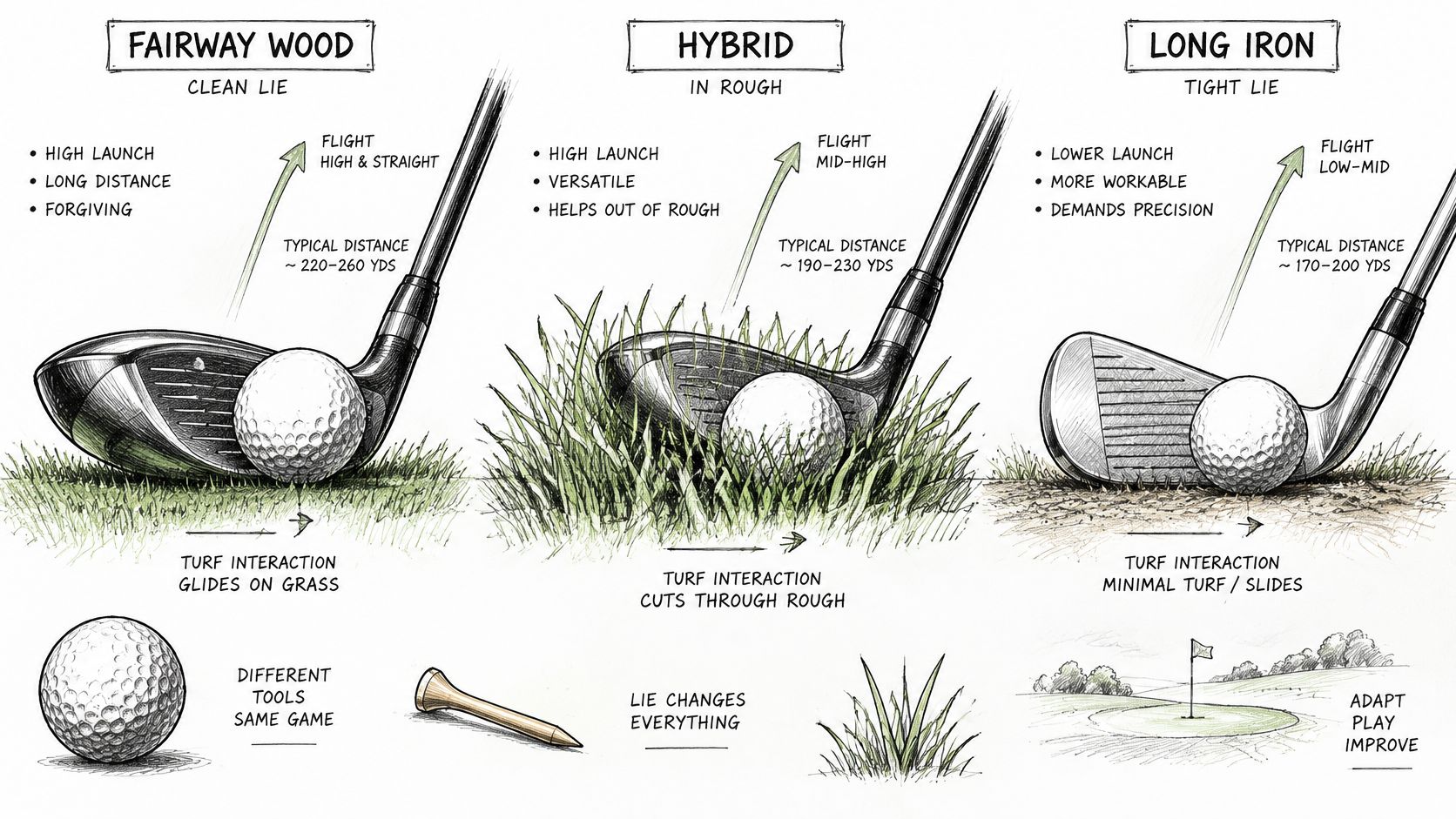
A fairway wood, hybrid, and long iron can reach similar parts of a course without being interchangeable. Lie, intended use, and landing flight determine which club earns the slot.
The comparison below shows their different starting roles.
Club types compared by lie, use and flight
| Club type | Best lie | Target use | Flight |
|---|---|---|---|
| Fairway wood | Clean fairway lies | Maximum distance from clean lies | Depends on attack angle and loft |
| Hybrid | Rough and uneven lies | Versatile long-iron replacement and controlled approaches | Higher launch than a same-loft iron |
| Long iron | Firm, clean lies | Precise shaping and workable approaches | Lower launch and less forgiveness |
Independent robot testing reported by Golf Digest found that a 5-wood and 5-hybrid could produce nearly identical spin, around 5,700 rpm, in neutral conditions; both could become more efficient with a steeper attack angle as excess spin fell. Its fitting guidance also identifies 22°–25° hybrids as potential fairway-to-mid-iron bridges and 26°–30° models as alternatives to difficult 5- or 6-iron shots.
Those are transition ranges, not additional rules for the iron-replacement ladder. The golfer's delivery still decides whether a particular loft produces adequate height and stopping power.
Fit the shot, not the longest result
A fairway wood deserves its place when it delivers dependable distance from clean turf. A hybrid often becomes more useful when the ball sits down slightly or the stance isn't level. Neither should be treated as a guaranteed escape club from deep grass.
The following video provides another way to assess these club-role differences.
The common mistake is reducing loft when an existing hybrid already flies too low. That can add rollout while reducing usable carry. Testing more loft, a higher-launch shaft profile, or a shorter playing length may produce a better flight, but each change needs validation rather than assumption.
Choose the club that supplies reliable carry from recurring lies, not the one that produces the longest isolated shot.
Diagnosing Overlaps, Holes and Erratic Clubs
A hybrid that fills a distance gap on paper can still be the wrong choice if its carry varies or it struggles from the lies you face. Diagnose the pattern first, then decide whether the fix is a different club, better contact, or a more reliable test.
Bag gap diagnosis and fixes
| Carry test result | What it means | Fix |
|---|---|---|
| Gap exceeds the Section 2 working range | Possible hole in the bag | Test a hybrid between the neighboring clubs, then compare carry and lie performance |
| Gap falls below the Section 2 working range | Possible overlap | Compare trajectory and consistency before removing either club |
| Wide carry spread with the same club | Strike or dispersion problem | Check strike location and club fit before adding another loft |
| Carry is on target but the ball lands shallow | Limited stopping power on approaches | Choose an option that produces a more useful landing flight |
| Gaps change between sessions | Conditions or measurement may be affecting results | Repeat the test under comparable conditions before changing the bag |
Diagnose the pattern before buying
A wide carry spread calls for a different response than a stable missing yardage. Face spray can show whether impact moves across the face. If contact is inconsistent, assess playing length, shaft suitability, and delivery before testing another hybrid.
A shallow-landing club may still suit shots into wind or those meant to run out. It is less dependable for an approach that needs to stop near its carry distance.
A club that closes a smaller gap but produces more consistent strikes can be the better choice. Keep it when its dependable carry and performance from useful lies add more value than a theoretical gap on a chart.
Record the ball type, hitting surface, weather, and monitor setup when you review a golf bag gap analysis. Compare like with like; changing test conditions can make a club appear better or worse than it is.
Confirm the same pattern across three comparable sessions before making a small adjustment. One poor session is weak evidence, particularly when the proposed change is smaller than the club's normal carry spread.
How the 14-Club Limit Shapes the Bag
Your bag has room for no more than 14 clubs under the Rules of Golf. Use each slot for a distinct shot, judged by measured carry and how reliably the club performs from the lies you face.
Choose what leaves by function
When a hybrid takes over a long iron's role, that iron is a natural candidate to remove. Keeping it “just in case” adds little if the hybrid covers the same shots more consistently.
Choose the lineup by responsibility:
- Keep the essentials. Retain the driver and putter, along with wedges that cover your scoring distances.
- Remove replaced jobs. Start with irons whose approach roles a hybrid now performs more reliably.
- Review duplicate coverage. Compare any remaining club that overlaps heavily with a hybrid.
- Protect useful differences. Similar carry can still be useful when clubs produce different trajectories or perform better from different lies.
An open slot can go to another hybrid if testing shows a useful shot is missing. If the hybrid closes a smaller distance gap but is easier to strike from the lies you play, that consistency may matter more than a perfect yardage interval. If it duplicates an existing club without improving reliability or trajectory, use the slot elsewhere.
Record each club's carry, normal flight, and intended lie. Those details show whether two clubs have separate jobs more clearly than their labels do.
Count every club after making a change. An old iron in a side compartment still counts, even if you no longer plan to play it.
Confirm the Bag Before Your Next Range Session
A hybrid substitution can change carry as well as contact. In its 2024 review of long-iron replacements, Golf Digest reported that high-handicap golfers gained an average of 18 yards of carry with a 6-hybrid compared with a 6-iron. Use your own measured carry to judge the replacement rather than assuming it matches the retired iron.
Finish with a usable bag record
Make the next session a focused check of the clubs and distances most affected by the change.
- Record typical carry and spread. Use a run of representative strikes, not the best shot, to capture each club's normal result.
- Check the neighbors. Compare the longest dependable iron, the hybrid, and the shortest trusted fairway wood.
- Test the priority change. Keep conditions consistent while comparing the candidate with the club it may replace.
- Repeat the check. Record a second session before changing another club. If the carry gap or strike pattern shifts, you can tell whether the first result was typical or a noisy range sample.
The Golf Bag Gap Analyzer can help identify overlaps and missing yardages. Use its bag overview to choose a focused test, then take your carry notes to the range.