

You're standing over a 3-hybrid on the range, watching one shot finish beside the 5-wood marker and the next fall short of the long-iron target. The club feels useful, but its job in the bag isn't clear. Is it replacing a 3-iron, filling the space below a 5-wood, or just providing confidence from difficult lies?
That uncertainty is why the question “how far does a 3 hybrid go” needs a better answer than one average yardage. The useful number is your reliable carry, measured with your normal ball and typical strike, then compared with the clubs around it. Published benchmarks can establish a sensible starting point, but a launch-monitor session and a clean gapping process determine whether the club earns its place.
Table of Contents
- Why the 3 Hybrid Distance Question Has No Single Answer
- Typical 3 Hybrid Carry and Total Distance Ranges
- How Loft and Club Design Shape 3 Hybrid Distance
- Measuring Your Own 3 Hybrid Distance with a Launch Monitor
- Using 3 Hybrid Data to Fix Gaps in Your Bag
- Why Swing Speed and Handicap Matter More Than Loft Alone
- Turning Launch Monitor Sessions into a Repeatable Gapping Plan
Why the 3 Hybrid Distance Question Has No Single Answer
A golfer can hit a 3-hybrid well and still struggle to explain what it does. One session may produce a penetrating shot that runs beyond the expected landing area. Another may show a high carry that stops quickly. Both flights can come from the same club, especially when strike quality, delivery, and turf interaction change.
The club is commonly fitted as a replacement for a 3-iron or 5-wood, which creates the first source of confusion. Those clubs don't occupy identical roles. A 3-iron generally asks for a more demanding strike, while a 5-wood tends to offer a longer shaft and a larger head. The 3-hybrid sits between those ideas, giving the golfer a compact, versatile option that can launch from the fairway, rough, or a tee.
The club's job matters more than its label
A 3-hybrid shouldn't be judged by whether it reaches a universal number. It should be judged by whether it produces a predictable carry that separates it from the longest iron and shortest fairway wood.
Independent charts put the broad carry range at about 140 to 195 yards, depending on swing speed, with the same source reporting most golfers in its 75 to 90 mph testing pool between 150 and 178 yards. Those figures are useful orientation points, not promises, as shown by the independent hybrid distance chart.
A golfer who carries a 3-hybrid 160 yards may have a perfectly functional club if the longest iron carries materially shorter and the next fairway wood carries materially longer. A golfer who carries it 190 yards may still have a poor setup if the club overlaps the 5-wood and leaves a dead zone below it.
Practical rule: Treat 3-hybrid distance as a bag-position question first and a club-distance question second.
What averages hide
Average distance blends golfers with different speed, contact, launch, and handicap profiles. It also mixes carry with total distance, which can make a lower-flight hybrid look more powerful than it is when the ball runs farther after landing.
The dependable answer comes from a repeatable set of shots. Record carry, inspect strike quality, remove obvious mishits, and compare the remaining pattern with neighboring clubs. That process turns a vague range observation into a decision about whether the 3-hybrid fills a real gap.
Typical 3 Hybrid Carry and Total Distance Ranges
A 3-hybrid can carry about 140 yards for a golfer swinging 70 to 79 mph, 160 yards at 80 to 89 mph, 178 yards at 90 to 99 mph, and 195 yards at 100 mph or more, according to this swing-speed distance chart. Use those figures as reference points, not fitting targets. The same club can fill a long-iron gap for one golfer and sit beneath a fairway wood for another.
Benchmarks by player profile
Handicap provides a second useful lens. One dataset estimates a 15-handicap golfer with a 93 mph swing speed at about 165 yards total with a 3-hybrid. Its figures also list 183 yards for 5-handicaps, 176 yards for 10-handicaps, 163 yards for 20-handicaps, and about 193 yards for scratch golfers, as reported in the handicap-based hybrid distance analysis.
| Player Profile | Swing Speed Band | Typical Carry | Typical Total |
|---|---|---|---|
| Lower-speed golfer | 70 to 79 mph | 140 yards | Varies with strike and rollout |
| Moderate-speed golfer | 80 to 89 mph | 160 yards | Varies with strike and rollout |
| Faster amateur golfer | 90 to 99 mph | 178 yards | Varies with strike and rollout |
| High-speed golfer | 100+ mph | 195 yards | Varies with strike and rollout |
| 15-handicap benchmark | 93 mph | Not specified in source | 165 yards |
| Scratch benchmark | Not specified in source | Not specified in source | 193 yards |
Keep carry and total distance separate. A ball carrying 160 yards and releasing well past that mark is a different club result from a ball carrying the same distance and stopping quickly. The distinction matters for approach shots, forced carries, and deciding whether the 3-hybrid overlaps the next club.
What counts as normal
A wide range is normal. The roughly 30-yard difference between scratch and 20-handicap benchmarks does not automatically call for a loft change. Strike quality, delivery, speed, launch, and centered contact can all create that separation.
A separate fitting-oriented discussion places 3-hybrid distance at about 164 yards for 25-handicap players and 211 yards for 5-handicap players. It also places typical adult male averages around 190 yards and low-handicap players around 210 to 230 yards, as summarized in this discussion of 3-hybrid distance and gapping.
For a useful bag decision, collect repeatable launch-monitor shots rather than relying on one flushed ball. Export carry, total, launch, and strike results to a CSV, remove obvious mishits, then compare the dependable carry band with the longest iron and shortest fairway wood. The right 3-hybrid distance is the one that leaves usable spacing between those clubs.
How Loft and Club Design Shape 3 Hybrid Distance
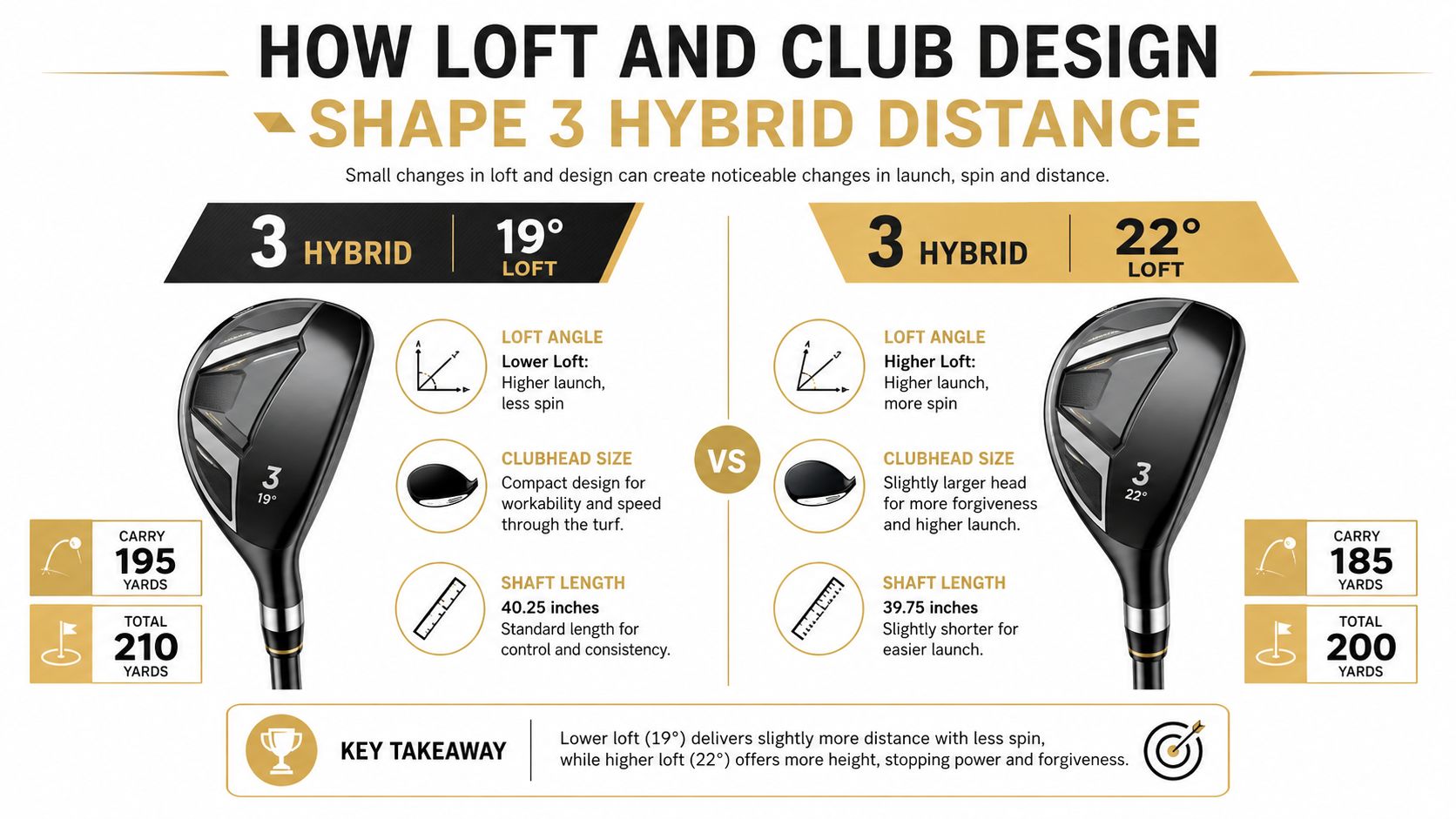
Loft gives a starting point, not a dependable yardage. A 3-hybrid commonly falls around 18 to 20 degrees, but the same stated loft can produce different launch, spin, descent, and carry results depending on the head design and the golfer's delivery. Use this hybrid golf club lofts chart to place a 3-hybrid within the wider range of hybrid configurations, then confirm the actual gap with launch-monitor carry data.
The club sits between a long iron and a fairway wood. Its head is usually larger and more forgiving than a long iron, while the shaft is shorter and the head smaller than a 5-wood. That compromise can reduce speed and launch compared with the fairway wood, yet it often makes centered contact easier than with a long iron. This explanation of fairway-wood and hybrid design provides useful background on those design differences, but it should not be treated as a 3-hybrid distance chart.
Three clubs, three different jobs
A 3-iron rewards a precise strike and a consistent low point. A 3-hybrid adds head volume and changes the center-of-gravity position, which can make launch easier without producing the same club length or flight as a fairway wood. A 5-wood generally has the longest shaft and largest head of the three, so it can create more speed, height, and carry. Its extra length can also make centered contact less consistent for some golfers.
The 3-hybrid works best as a controlled long-iron replacement, not an automatic distance upgrade. Its lower flight relative to a 5-wood may produce useful rollout, but that rollout makes total distance less predictable for approach planning.
Loft changes the shape of the gap
Lower loft can produce a flatter flight and more forward run when strike and delivery support it. Higher loft can raise launch and improve stopping power, while potentially overlapping a stronger iron or shorter hybrid.
Compare these measurements:
- Carry: The number used for approach-shot selection and forced carries.
- Total distance: Useful from the tee and for runout, but less stable across changing turf.
- Launch and descent: Indicators of whether the ball can hold a green.
- Strike pattern: The golfer's normal contact matters more than a theoretical center strike.
A visual demonstration can also help explain how setup and delivery change hybrid flight.
Measuring Your Own 3 Hybrid Distance with a Launch Monitor
Generic charts answer what might happen. A launch monitor answers what repeatedly happens with a specific club, ball, and swing. The measurement becomes useful only when the session is structured well enough to distinguish a normal shot from a thin, heavy, or poorly delivered one.
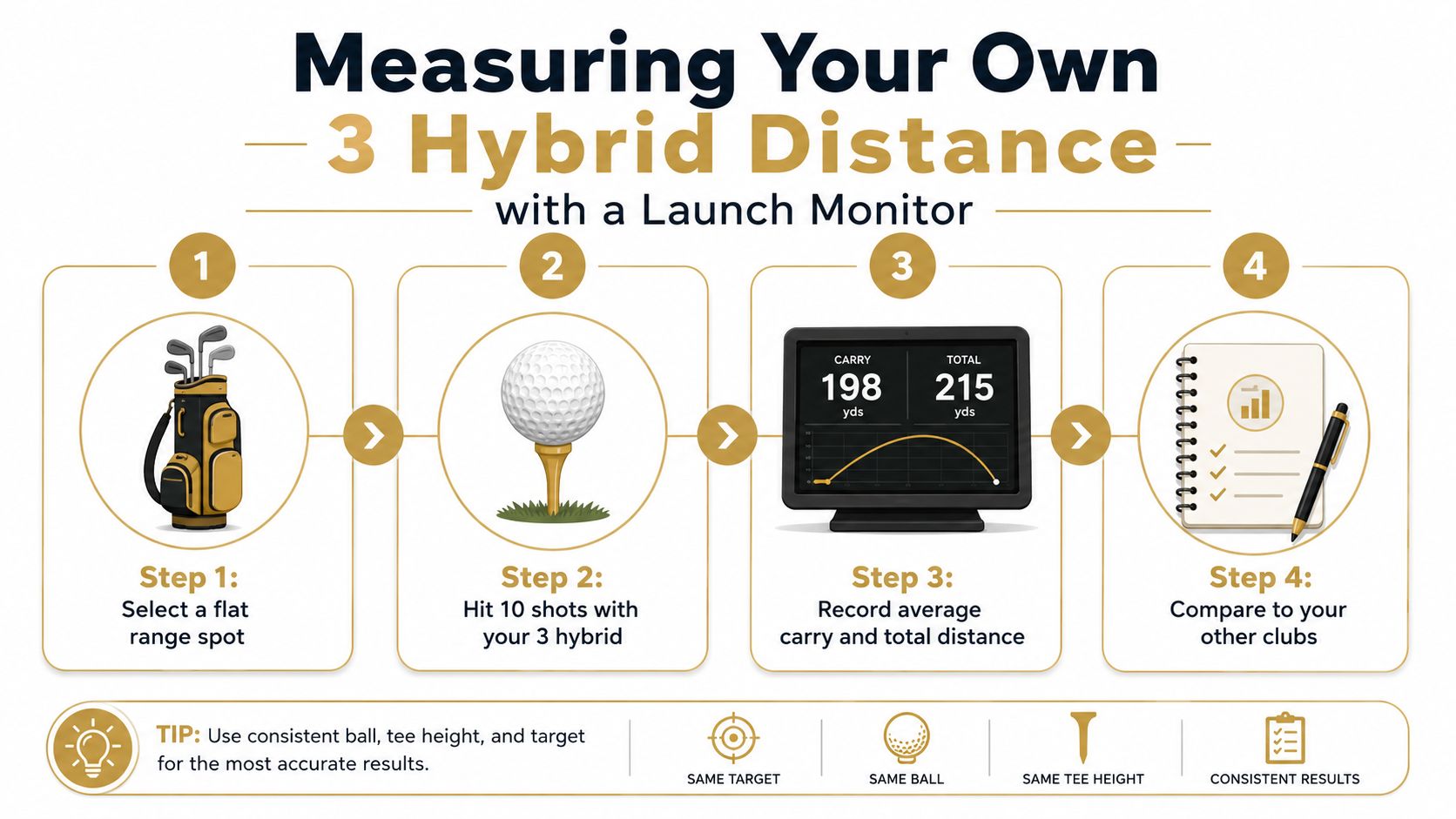
Start with a flat range spot or a consistent garage-simulator setup. Use the same ball model throughout the session, allow enough warm-up to establish a normal swing, and avoid changing technique to chase a longer number.
A clean session workflow
Choose the testing conditions. Keep the hitting area, ball type, tee height, and target consistent. A changing setup makes it difficult to tell whether a distance change came from the club or the conditions.
Hit a representative batch. Hit enough shots to reveal the usual pattern, not just the best strike. The supplied workflow calls for 10 shots, which gives the golfer a practical session size for recording average carry and total distance.
Filter the obvious errors. Remove shots that are clear mishits or accidental misreads, but don't remove every shot that falls below the desired number. If the golfer routinely produces a certain miss, that miss belongs in the world assessment.
Prioritize carry. Carry determines whether the ball clears a hazard and where it lands. Total distance still matters, but rollout changes with turf, wind, landing angle, and strike.
Why CSV data improves the answer
A launch-monitor display encourages immediate reactions. A CSV file creates a record that can be sorted, compared, and reviewed after the session. Garmin documents that Approach R10 and R50 driving-range sessions can be exported from the Garmin Golf app by opening the activity, selecting the session, and choosing Export to CSV, as described in the CSV import documentation.
The useful columns depend on the monitor and export, but the analysis should focus on carry, total distance, club speed, ball speed, launch, and strike-related indicators where available. The golfer can then compare the central pattern instead of selecting the longest shot as the club's official distance.
For practical guidance on choosing and using a range monitor, see the launch monitor guide for driving-range practice.
A reliable 3-hybrid number is the carry a golfer can plan around, not the longest shot saved in a session.
Using 3 Hybrid Data to Fix Gaps in Your Bag
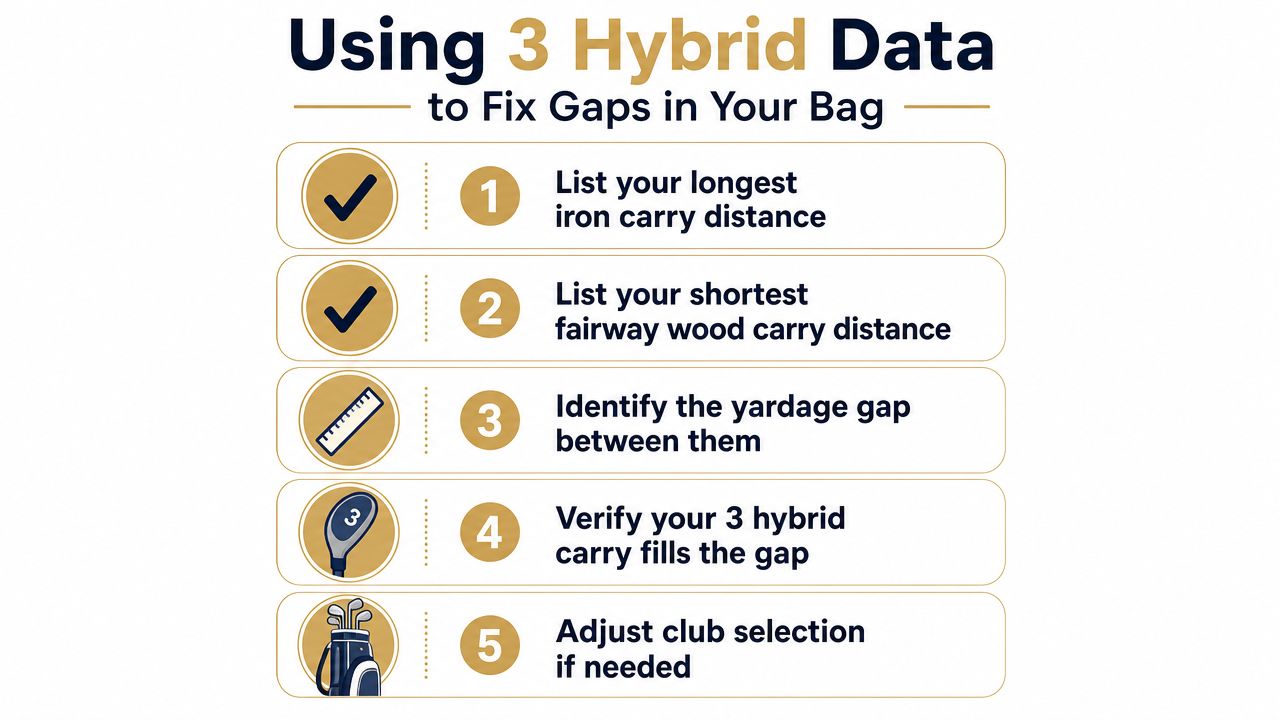
A 3-hybrid earns its place by covering a distinct carry window. Start with the longest iron and shortest fairway wood, then compare their measured carry distances. The question is whether the hybrid creates useful separation or repeats a club already in the bag.
Use a repeatable launch-monitor session, then export the results to CSV. Sort the shots by carry, review the middle of the pattern, and keep common misses visible. A single flushed shot can make a gap look larger than it is. As a practical filter, aim for clear separation on both sides, while treating that target as a guide rather than a rule.
Build the gap from carry numbers
Suppose your longest iron carries within a narrow range and your shortest fairway wood starts only slightly farther ahead. A 3-hybrid may fill that space and make the top of the bag easier to manage. If its carry overlaps the fairway wood, you may be carrying two clubs for similar shots while leaving another distance uncovered.
Review the clubs in this order:
- Record the longest iron carry: Use a repeatable session, not one perfect strike.
- Record the shortest fairway wood carry: Keep the ball and conditions comparable.
- Measure the space: Mark the actual gap, overlap, and normal shot pattern.
- Test the 3-hybrid: Compare carry, launch, height, and dispersion within that window.
- Choose the role: Keep, adjust, replace, or assign the club to a specific tee or approach shot.
Carry decides the fit, rollout decides the use
Carry determines whether the ball clears a hazard and where it lands. Rollout affects what happens afterward, so a hybrid can fit the distance chart yet perform poorly as an approach club if it launches too low or releases too far. On a firm course, that running flight might be useful from the tee.
Separate distance coverage from shot purpose. The club should fill a real yardage gap and produce the launch, height, and stopping power required for the shots you face most often. Use a framework for viewing club distance as a complete bag system to check whether the 3-hybrid fills a gap or creates overlap.
A comfortable club still needs scrutiny. Confidence matters, but an easy-to-hit hybrid that duplicates another club's carry does not solve the underlying gapping problem. Review the CSV pattern, confirm the carry window, and define its job before deciding whether it belongs in the bag.
Why Swing Speed and Handicap Matter More Than Loft Alone
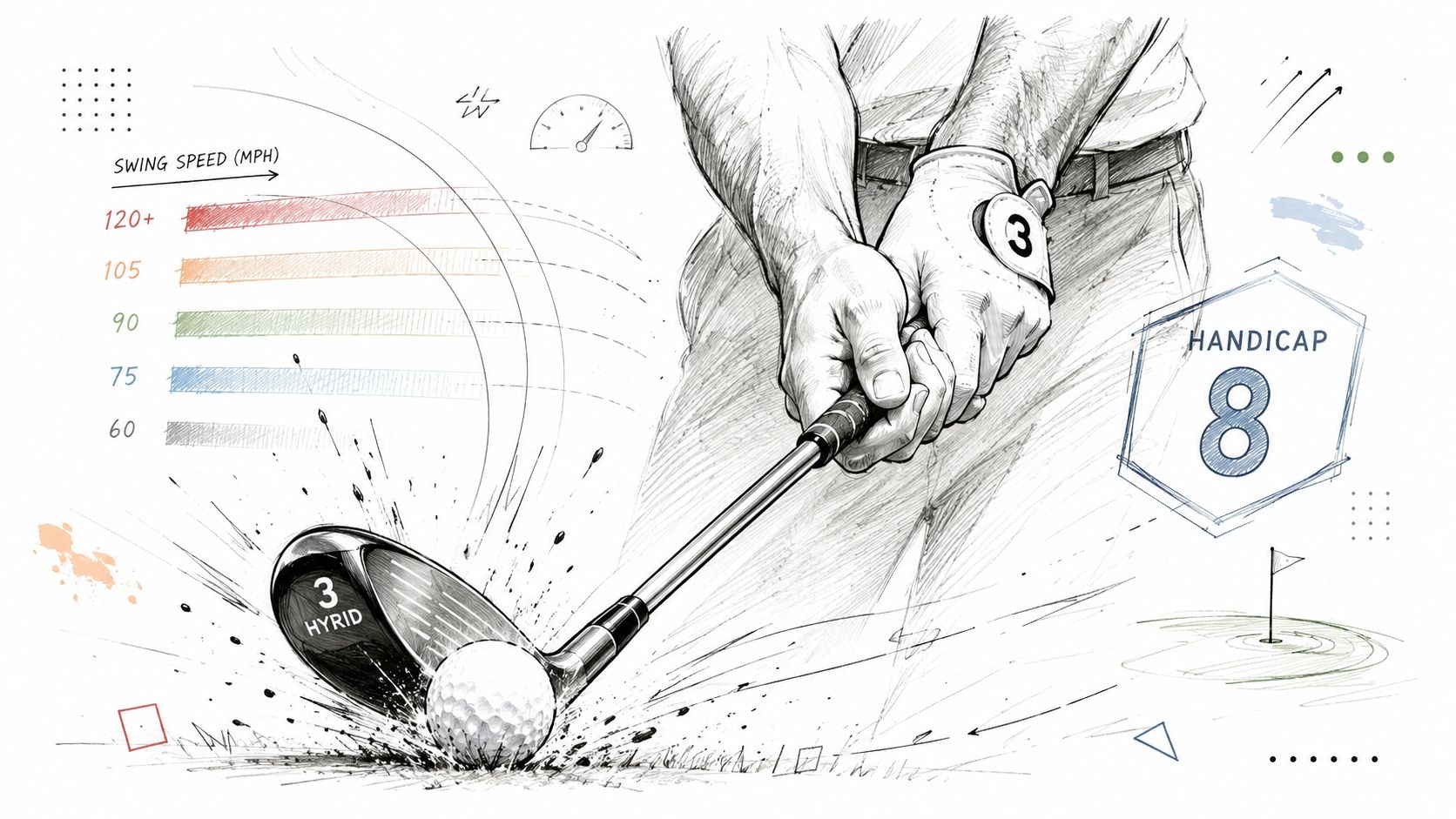
A 3-hybrid can produce very different results from two golfers with the same loft. Swing speed sets the available energy, but strike location, attack delivery, launch, and spin determine how much of that energy becomes useful carry. Handicap adds context because it reflects contact consistency and on-course repeatability, not only speed.
Use handicap as a starting filter, not a distance prescription. A higher-handicap golfer may create plenty of speed yet lose carry through low-face contact, excessive launch variation, or shots that finish as runners. A slower golfer who finds the center more often can produce a narrower, more dependable carry window. Loft alone cannot separate those patterns.
Swing speed changes the useful range
More speed can increase carry, but only when launch and strike remain controlled. If impact moves low on the face, ball speed drops and spin or launch can shift enough to erase the expected gain. A fast swing with scattered contact may therefore show a higher peak distance but a worse average result.
Check the session as a distribution. Export the launch-monitor data, sort shots by carry, and separate centered strikes from obvious misses. Compare ball speed, launch, spin, peak height, and carry for each group. The difference between the two groups shows whether the club needs a swing change, a setup adjustment, or a different role.
Strike pattern matters more than the label
A centered strike usually produces the most efficient transfer. Low-face contact often lowers flight and increases rollout, while heavy contact costs speed and carry. Thin contact can create a misleading total distance because the ball runs after a weak flight.
Ball construction and course conditions also affect launch, spin, and rollout, so range results should not be treated as direct course equivalents. Test with the ball you normally play when possible, then record carry separately from total distance.
Use handicap to decide how much consistency the club must provide. Choose the 3-hybrid's role from its normal carry window and dispersion, then adjust loft only if that change improves the gap.
Turning Launch Monitor Sessions into a Repeatable Gapping Plan
A repeatable plan starts with a simple record. Save each 3-hybrid session, note the ball and conditions, and compare the carry pattern with the longest iron and shortest fairway wood. Don't rebuild the bag from one unusually good range day.
CSV history makes that comparison easier across time and devices. Independent golf-shot analytics documentation describes both per-session CSV exports and full data dumps for Garmin R10 workflows, and notes that similar CSV histories can be imported from Rapsodo, SkyTrak, FlightScope, Uneekor, and other launch-monitor ecosystems through analysis software, as outlined in the multi-device analytics documentation.
Dialed Golf is built around three products, one golfer record, and one Pro plan. The consumer app works as a pocket caddy and is currently in TestFlight rather than general App Store availability. The desktop product is launch-monitor practice first, with live pairing beginning with Garmin R10 and expanding, plus CSV and import workflows for supported ecosystems, while Dialed Academy handles memberships and front-desk operations for ranges and clubs. Free web tools remain free, and Golfer Pro is available across app and desktop at $9.99 per week, $29.99 per month, $149.99 for six months, or $249.99 per year.
Keep the process focused: measure, export, filter, compare, then decide. The best 3-hybrid distance is the number that consistently fills the space in the bag.
Use Dialed Golf to organize carry-distance data, review launch-monitor sessions, and turn a 3-hybrid measurement into a practical gapping decision. Start with the free web tools, then use the desktop workflow when a repeatable record matters more than a single range-session guess.