

The phone is buried in a golf bag, the group is already walking toward the next tee, and the last hole included a penalty drop, a provisional ball, and a three-putt nobody wants to reconstruct. That's exactly when a paper scorecard earns its place. A pencil and the card already in the cart can preserve the round without battery life, signal, notifications, or another screen competing for attention.
The practical answer to how to keep a golf score without a phone isn't to rely on memory. It's to make the paper card a live capture tool, use a small number of consistent marks, verify the record with a marker, and move the information into digital form after the round. That routine works for casual play, handicap rounds, competition, and practice analysis.
Table of Contents
- Why the Paper Card Beats the Phone on the Course
- Reading and Writing the Standard Paper Scorecard
- Simplified Tally Systems That Fit on One Line
- Building a Pocket-Sized Printable Template
- Filling the Card Without Slowing Play
- Reconciling and Importing After the Round
- A Repeatable No-Phone Scoring Routine
Why the Paper Card Beats the Phone on the Course
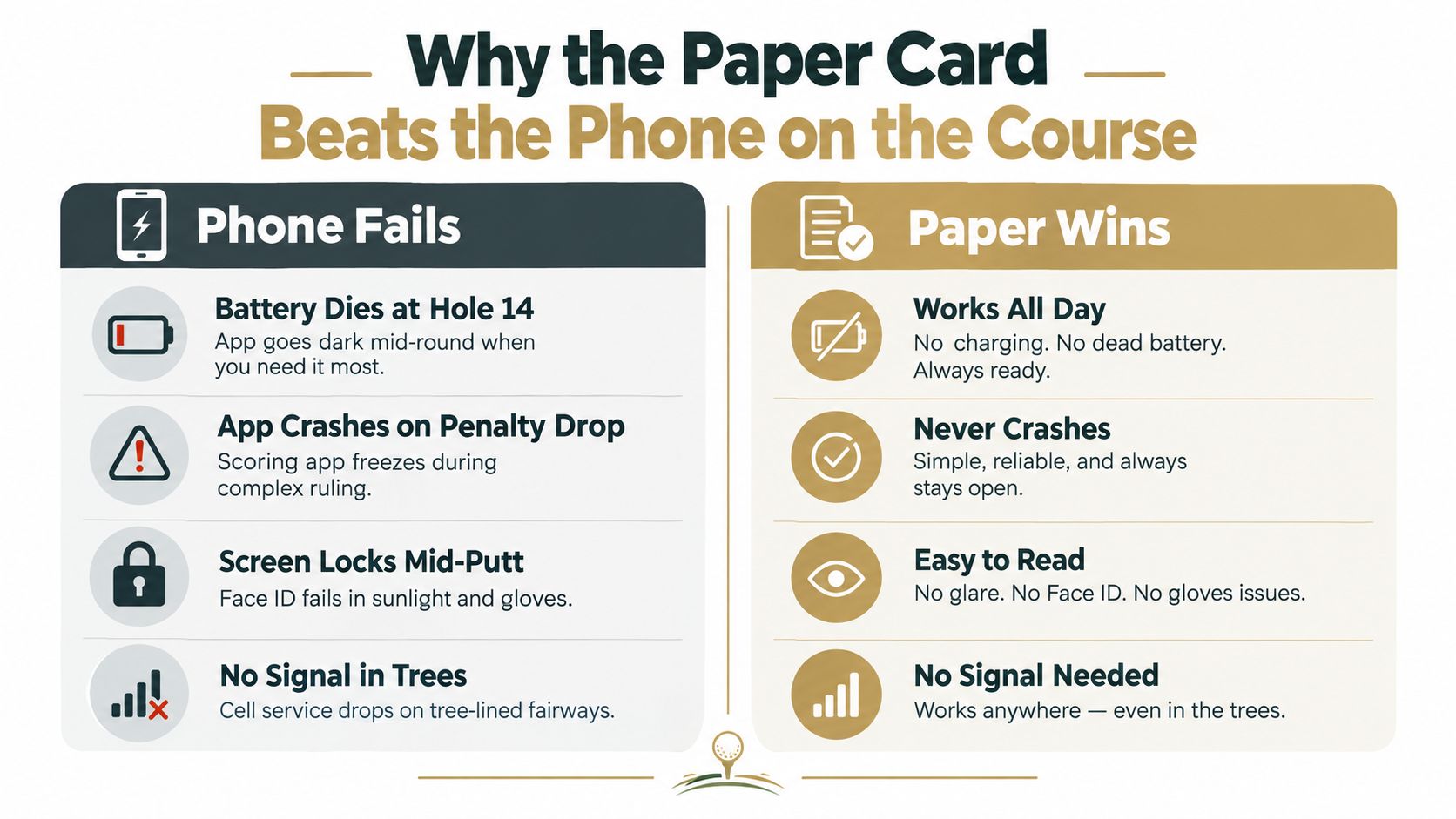
A messy hole ends at the green, the group is already heading to the next tee, and someone asks, “What did you make?” With a paper card, the answer takes one mark in the correct box. A phone may require waking the screen, finding the hole, waiting for service, and entering the score while everyone else is moving.
That difference matters under pace-of-play pressure. The card stays open, records the result immediately, and does not depend on battery life, signal, notifications, or a locked screen. It functions as live data capture, not a place to reconstruct the round later from memory.
Paper still has failure points. Rain can blur ink, rushed handwriting can become unclear, and arithmetic can expose an error during reconciliation. Those weaknesses are visible, though, and a marker can catch them before the round is closed. Phone-based scoring has its own problems, including a dead battery, a frozen app during a penalty situation, or a screen that is difficult to read in bright sunlight.
In stroke play, the card is a formal record. The marker confirms each hole score as play continues. The player checks the totals, makes sure the marker signs the card, signs it personally, and returns it before leaving the scoring area. Recording a lower score than the actual score can lead to disqualification, while a higher score stands, as explained in the official scoring procedures. The card therefore supports both pace and accountability.
Practical rule: Use the paper card as the primary record. Enter the round into a spreadsheet or CSV after play, then reconcile it with launch-monitor practice data if you are tracking performance. Use electronic scoring during the round only when the competition specifically approves it.
Match play follows different scoring requirements, and a scorecard is not required in the same way. For rules and handicap mechanics, consult the rules and handicap library.
Reading and Writing the Standard Paper Scorecard
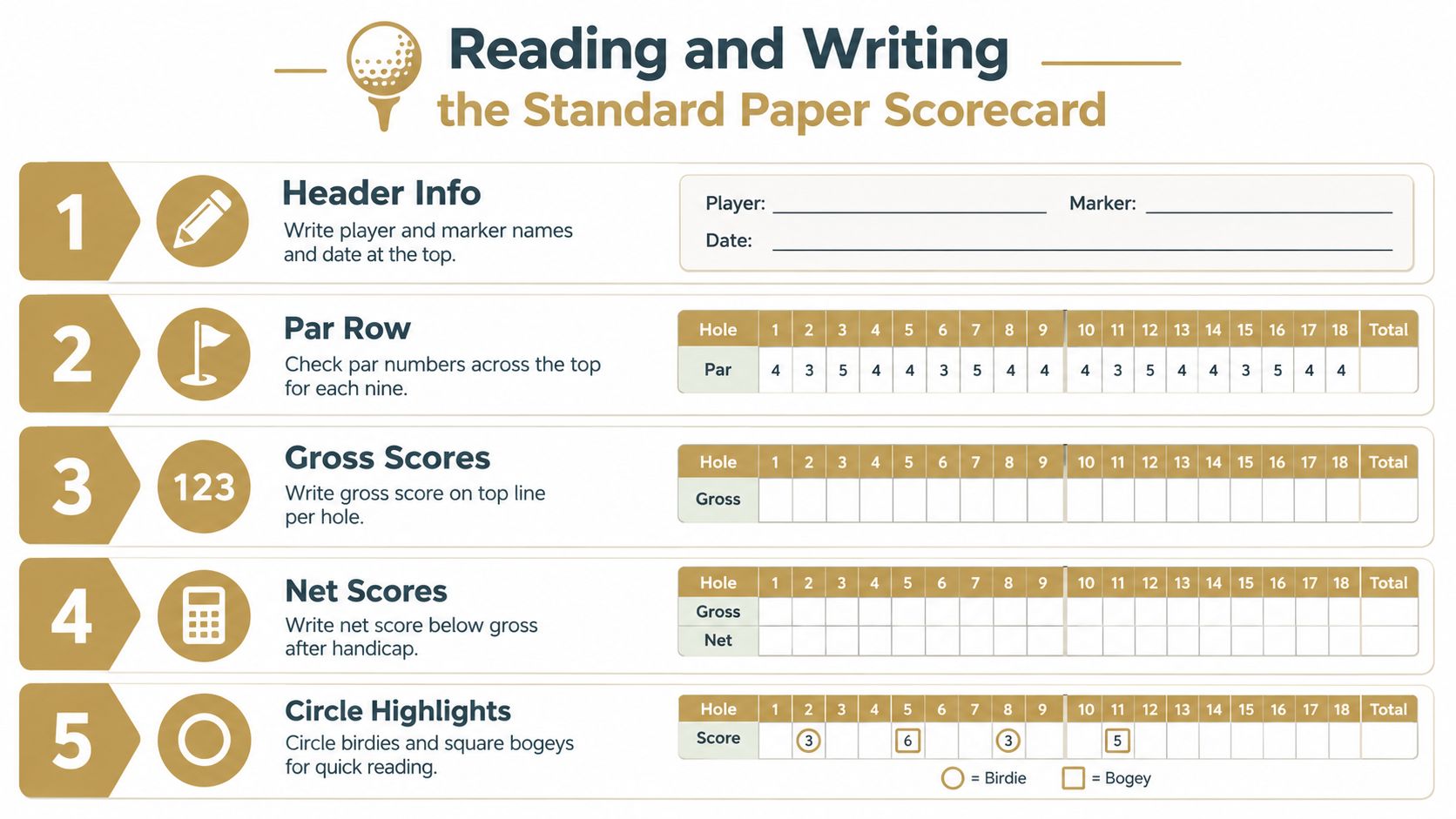
Most cards look more complicated than they are. The first job is to identify the right player column, the tees being played, and the marker. Write the player and marker names in the header, add the date if there's room, and mark the selected tees. Check the par row for each nine before the first tee shot.
The essential scorecard marks
For stroke play, write the gross score in the main score box immediately after holing out. Gross score means the total strokes, including penalty strokes. Net score is the gross score adjusted by handicap strokes, so it belongs in the net line only when the format requires it and the handicap allocation is clear.
The card can also capture useful performance information without turning into a worksheet:
- F records a fairway hit.
- G records a green in regulation.
- P records penalty strokes, with the number beside it when useful.
- U or X identifies an unplayable or lost-ball situation.
- Putts records the number of strokes taken on the green.
Write these marks while the hole is still fresh. A small putt number beneath the gross score is enough, while a circled penalty mark gives the marker an immediate prompt to check the hole.
Why the order matters
A scorecard should read from top to bottom with no reconstruction required. Record the gross score first, then putts and the supporting marks. If net scoring is part of the competition, apply handicap strokes carefully after the gross record is secure.
Keep pencil strokes light. Heavy writing makes corrections messy, and messy corrections create uncertainty when the marker checks the card. Before signing, compare the player's numbers with the marker's record. The Committee, not the player, adds the total and finalizes the score after submission, so the player's responsibility is accurate hole-by-hole recording and proper certification.
A short visual walkthrough can help new golfers recognize the layout before trying the method on the course.
Simplified Tally Systems That Fit on One Line
Full stroke recording is the safest choice for an official stroke-play round, but not every round needs the same amount of information. A practice round can use a lighter tally if the format is agreed before the first tee and the card clearly identifies what each mark means.
Stableford is useful when the round is scored by points rather than total strokes. The hole value can be written directly in the score box: 2 points for par, 3 for birdie, 5 for eagle, and 0 for double bogey or worse. Those values come from the supplied field guidance on simplified scoring, so the golfer doesn't need to carry a second stroke total for the points calculation.
Modified Stableford changes the incentives. The supplied system gives 8 points for an eagle and applies minus 2 for a double bogey, encouraging a player to accept the occasional aggressive attempt without treating every hole like a conventional medal round. That system needs clear agreement before play because its results aren't interchangeable with ordinary gross scores.
| System | Math Per Hole | Best Use |
|---|---|---|
| Stroke play | Record every stroke, then total the holes | Official totals, handicap records, and competitions |
| Stableford | Par 2, birdie 3, eagle 5, double bogey or worse 0 | Friendly points-based rounds |
| Modified Stableford | Eagle 8, double bogey minus 2, with the agreed values applied consistently | Aggressive formats where blow-up holes are penalized differently |
| Putt-only | Record only the putt count for each hole | Short-game practice and green-focused rounds |
| Match play | W, L, or H, plus the through-hole position | Opponent-based rounds where holes decide the result |
Putt-only tracking is the most stripped-down option. It's valuable when the purpose is to understand green performance, but it won't reconstruct a valid stroke-play score. Match play also needs separate treatment. Mark W, L, or H, then add the through-hole count so the match position remains understandable on the back nine.
The mistake is mixing systems. A card that contains stroke totals on some holes, Stableford points on others, and putt counts in the same score boxes can't be reconciled later. Pick one primary tally before the round begins.
Building a Pocket-Sized Printable Template
A custom template should fit the golfer's actual writing motion, not imitate a full administrative form. Put holes 1 through 9 on one face and holes 10 through 18 on the reverse. Each hole needs only the fields that will be used consistently: hole number, par, score, putts, and a one-letter penalty box.
Design for wind, gloves, and quick marks
A monospace grid keeps the columns aligned when the card is printed and folded. The score column should be visually dominant, while putts and penalties remain narrow. A side margin gives space for a paper score clip or rubber band, and the footer should include front-nine, back-nine, and total areas.
The back panel can remain mostly open for club selection, wind, or a brief note about a difficult decision. Those observations are more useful when they're attached to a hole number and can later be typed into a practice log.
A practical layout looks like this:
| Hole | Par | Score | Putts | Penalty |
|---|---|---|---|---|
| 1 | ||||
| 2 | ||||
| 3 |
The template should be small enough for a yardage-book cover or back pocket, but not so small that the score and penalty marks run together. Print blank copies on card stock, fold each along the centerline, and protect them in a plastic sleeve. A rubber band works as a backup, but it can catch on other items in the bag.
Test the card before trusting it
The test is whether one line per hole can be completed in roughly the same quick motion every time. If the player has to search for the putt column or decide where a penalty belongs, the design is too busy.
Use the mandatory pocket-sized scorecard design infographic as a visual check. The finished card should make the next action obvious: find the hole, write the gross score, add the putt count, and mark a penalty if one occurred.
Filling the Card Without Slowing Play
The safest time to write is during the hole transition, after the last ball is holed and before the group settles into the next tee sequence. Keep the pencil out of the swing, putting routine, and ball search. A short, repeatable entry takes less time than reconstructing the hole later.
Write the gross score in the correct hole box first. Add the putt count as a small digit, then mark F, G, or P while the hole is still clear in memory. If a penalty occurred, circle or flag that hole so the marker can ask about it before the group has moved away.
Read the score aloud to the marker, allow a quick check, and put the pencil away before the next player's turn. Confirming each hole at the next tee is faster than resolving several uncertain holes at the clubhouse, and it keeps the paper card usable as a live record under pace pressure.
Handle provisional balls visibly
A provisional ball creates trouble when its entry looks like a second scoring event. If the original ball is found and the provisional was not used, draw one horizontal line through the abandoned number and write P beside the replacement entry. Keep the sequence visible. Do not erase it.
The card should preserve the hole's events, including a reload, extra chip, or penalty decision. Those are the details memory tends to lose first, yet they are the details a marker needs to verify.
| Error | Cause | Fix |
|---|---|---|
| Forgotten putts | Recording only the total score | State the putt count before leaving the green |
| Wrong gross total | Adding the whole card in a rush | Add front and back nines separately |
| Incorrect handicap application | Writing net before the gross record is secure | Enter gross first, then apply the stroke allocation |
| Missing provisional entry | Treating the replacement ball as an ordinary shot | Strike through the abandoned number and mark the provisional |
| Marker disagreement | Waiting until the end to compare scores | Confirm the hole score at the next tee |
Late entry commonly produces forgotten putts, incorrect totals, handicap mistakes, and delayed corrections. A visible correction and an immediate marker check reduce those failures without interrupting play.
Use one scoring format for the round. Keep a Stableford tally separate from a stroke-play total, or record only the format required for that card. Mixing both on one line makes later reconciliation harder and weakens the card as source data for a post-round CSV or practice log.
Reconciling and Importing After the Round
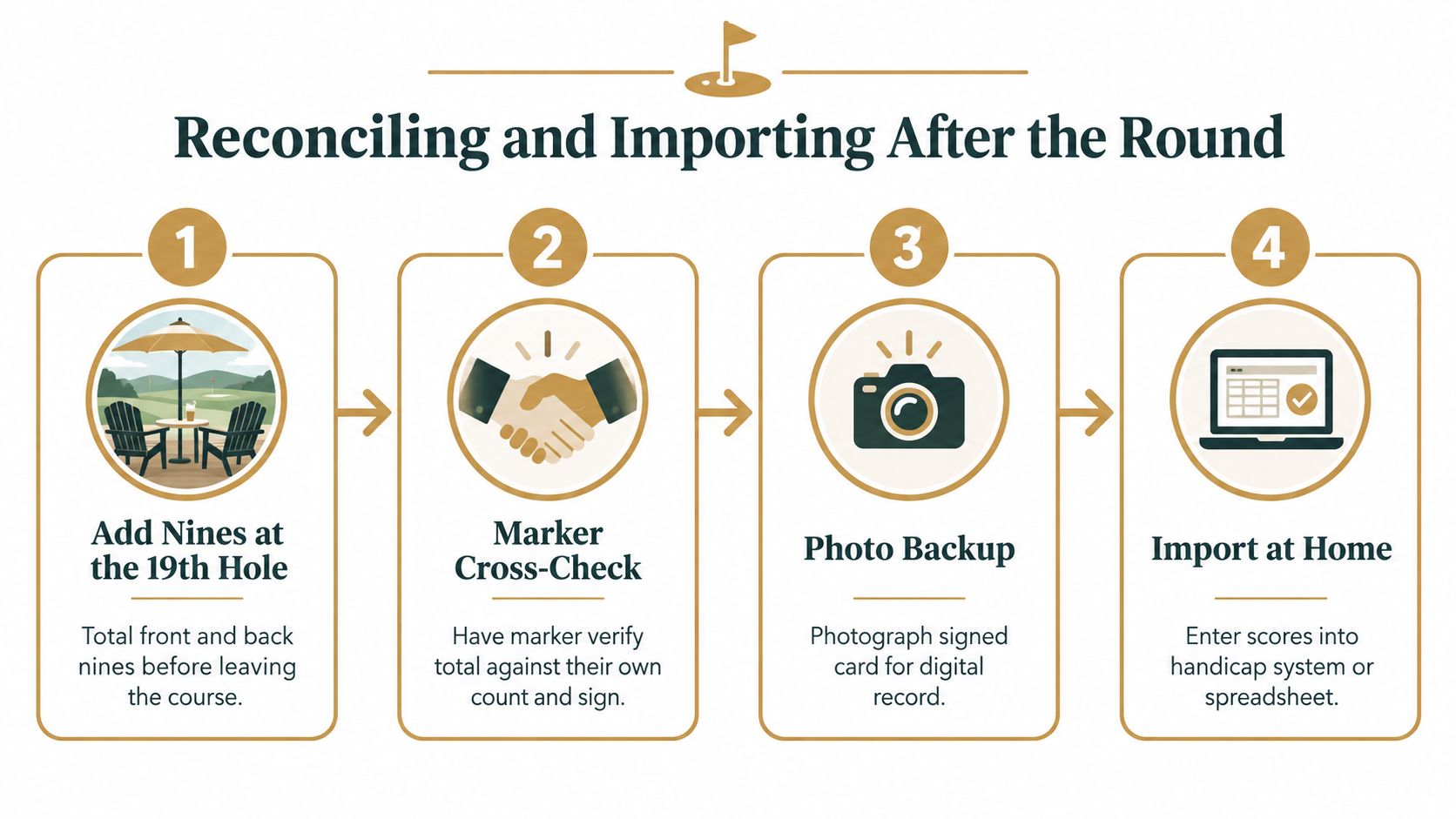
When the last putt falls, the card is still working data. Reconcile it at the clubhouse or beside the 19th tee, while the marker and player remember each decision. Add the front and back nines separately, verify the combined gross total, and compare it with the marker's count before signing.
Transfer the card in its printed order. Use one spreadsheet row per hole with fields for hole, par, score, putts, and penalty. Check each row against the paper card, then save the file as CSV. The signed card remains the audit trail. The CSV becomes the usable record for later review or import.
A launch-monitor practice record can sit beside the round when both records use a consistent date and hole reference. Export the practice session as CSV and import it through the same workflow, keeping the signed paper card as the audit trail. Follow the Garmin R10 export workflow, launch-monitor data import guidance, and CSV compatibility information for the relevant export and file requirements.
The practical benefit is continuity. The card records what happened under playing pressure, while practice data records launch and ball-flight work away from the course. Matching dates and hole references keeps those records usable together instead of creating a second, disconnected log.
Store the signed card in a labeled sleeve or binder. Before filing it, confirm any attestation requirements and use the handicap calculation guide when the round needs to enter a handicap record.
A Repeatable No-Phone Scoring Routine
A no-phone routine succeeds when each mark has a clear place and purpose. Before the first tee, clip a pencil to the bag, carry two marked scorecards, and fold a printed tally sheet into the back pocket. Use one card as the official marker record. Keep the duplicate as a personal check and a fallback if the first card gets wet or disappears.
During play, keep the sequence short:
- Finish the hole and confirm strokes with the opponent or marker.
- Write the gross score in the correct box.
- Add putts and the selected F, G, or P mark.
- Settle any lost-ball or provisional notation before the next tee.
- Put the pencil away and rejoin the group.
The card is a live capture tool, not a diary. Record only information you can verify quickly, then return attention to pace and position. If a hole needs clarification, resolve it before the group reaches the next tee rather than trusting memory.
At the end, add each nine, cross-check the total, obtain the required signatures, and transfer the same rows into a stable CSV. The CSV import workflow supports the post-round digital record while keeping the phone out of play.
Tournament rounds require tighter control. If an official card is required, select it before play begins and keep the personal tally parallel. Reconstructing a round afterward creates avoidable gaps. Digital scorecards can remove physical card exchanges in some competition workflows, but a paper-first routine remains useful when devices are restricted, unreliable, or unwelcome. The Golf Genius' contactless digital scorecard approach illustrates that digital workflows address a different set of conditions.
Dialed Golf connects the golfer record across a consumer course app currently in TestFlight rather than general App Store availability, desktop launch-monitor practice with live pair first and CSV or import support, and Dialed Academy for ranges and clubs. Golfer Pro costs $9.99 per week, $29.99 per month, $149.99 for six months, or $249.99 per year, while Academy costs $99.99 per month or $999.99 per year, with the club keeping its dues. Free web tools remain free, so the paper card can capture the round before digital records take over.
Use the paper card on the next round, verify every hole with the marker, and transfer the record only after signatures and totals are secure. Visit Dialed Golf to review the post-round workflow alongside paper-first scoring.