


A large bucket, a driver, and nothing that resembles a plan. That's how most range sessions begin, and roughly how often the average golfer gets to practice at all. GOLF.com's survey of how everyday golfers feel about their own games found that 47% of golfers reported practicing or visiting the range once a week during the season, while 17% did so twice a week. Two visits a week is not much time to spend on unfocused hitting.
A drill earns the name when three things exist. A specific fault it targets, whether that's a heel strike, a two-way miss, or a wedge that carries 78 yards one swing and 94 the next. A setup that gives feedback without a coach standing behind, like tees, tape, a towel, or a launch monitor. And a score written down after the session, so the next one has something to beat. Miss the third element and progress becomes a feeling, which is the least reliable measurement in the game.
The eight drills below run in a deliberate order, and the order carries as much value as the drills. The first two address path and face. The next two check strike. The middle pair builds wedge and full-club distance control. The seventh audits the whole bag against the data. The eighth finishes on the green, where strokes are saved. Run the sequence as one long session or split it across a week, but keep the order, because each drill depends on something the one before it established.
Table of Contents
- 1. Gate Drill
- 2. Alignment Stick Path Drill
- 3. Towel Drill
- 4. Impact Tape Strike Drill
- 5. Ladder and Clock Drill for Wedge Distance
- 6. Ladder Drill for Distance Control
- 7. Dispersion and Gapping Session
- 8. Putting Ladder Drill
- How the eight drills compare by skill, setup, and scoring
- Build a Practice Record, Not a Highlight Reel
1. Gate Drill
Fault it fixes. A clubface arriving open or closed at impact, and a path that cuts across the ball instead of tracking the start line. Ball flight has two authors, face and path, and the curve alone never says which one is at fault.
Push two tees into the turf just wider than the clubhead, with the ball between them and the gate sitting a fraction outside the ball so the club has room to pass through before it reaches the strike. Take a half swing with a 7-iron. A club that swings across the line clips the outside tee. A club that drops too far inside takes out the inside one.
Why it opens the session
The gate asks for control at low speed, which is exactly what the first ten minutes of a session should demand. A 2025 qualitative study found that almost 80% of golfers believed warming up could reduce injury risk, yet fewer than 1% knew what type of warm-up to perform (the golf warm-up knowledge study). A gate and a half swing fills that gap better than five minutes of static stretching.
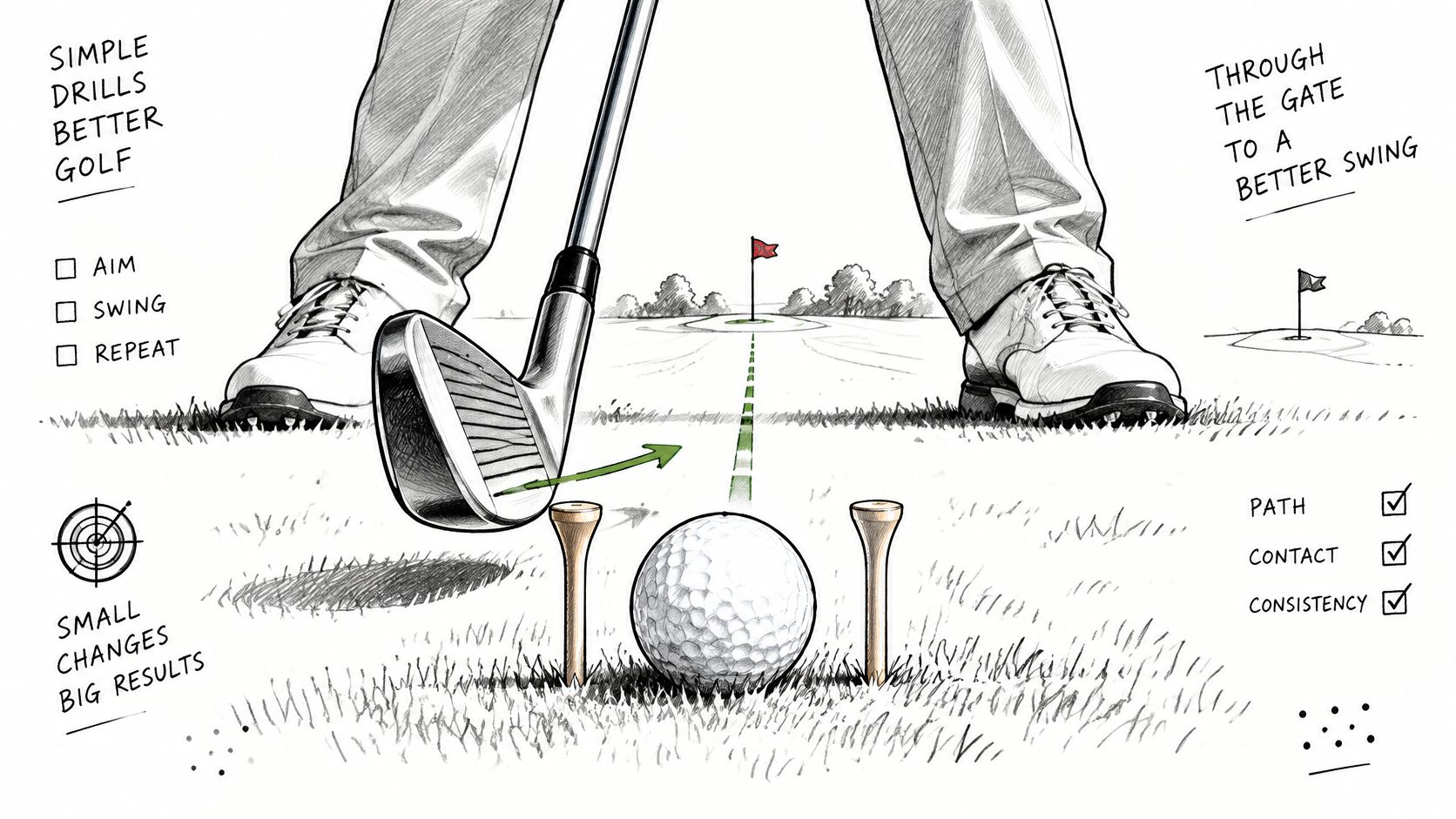
Ten balls is the set. Count clean passes out of ten and hit another ten only if the number reaches seven. Then move to full speed and read start line and side spin on a launch monitor, because a golfer can beat the gate by steering the hands. Dialed Golf's desktop app holds the start-line and curve numbers from a Garmin R10 live pair next to imported sessions, so the gate's effect shows up as a figure rather than a memory.
The number to beat: clean passes out of ten, plus start-line spread in yards at full speed.
2. Alignment Stick Path Drill
Path drills fail when the tool becomes the target. Two sticks on the ground achieve nothing by themselves. What they do is make takeaway direction and downswing plane visible from behind the ball, which is the piece most golfers cannot feel.
Lay one stick along the target line, pointing at the intended start line. Lay the second parallel to it a clubhead or two outside the ball, or angle it to match the plane the swing is trying to find. Set the leading edge square to the first stick, then make slow swings where the shaft traces the second stick going back and coming down.
Before laying sticks down, rule out the address position. An open shoulder line or a ball position too far forward drags the club off plane no matter how carefully the sticks are placed. The correct stance for the driver is the first thing to verify for any golfer whose path miss shows up with the big stick.
The trade-off worth knowing
Sticks teach a shape, not a number. A golfer can trace the plane perfectly at 40% speed and still swing across it at full speed, so escalate deliberately: ten slow tracings, then five full-speed swings with no sticks, reading only where the ball starts.
Scoring is by start line. Hit ten full-speed 7-irons and count how many finish inside a start-line window defined before the first ball. The drill has worked when the count holds up with the sticks removed.
3. Towel Drill
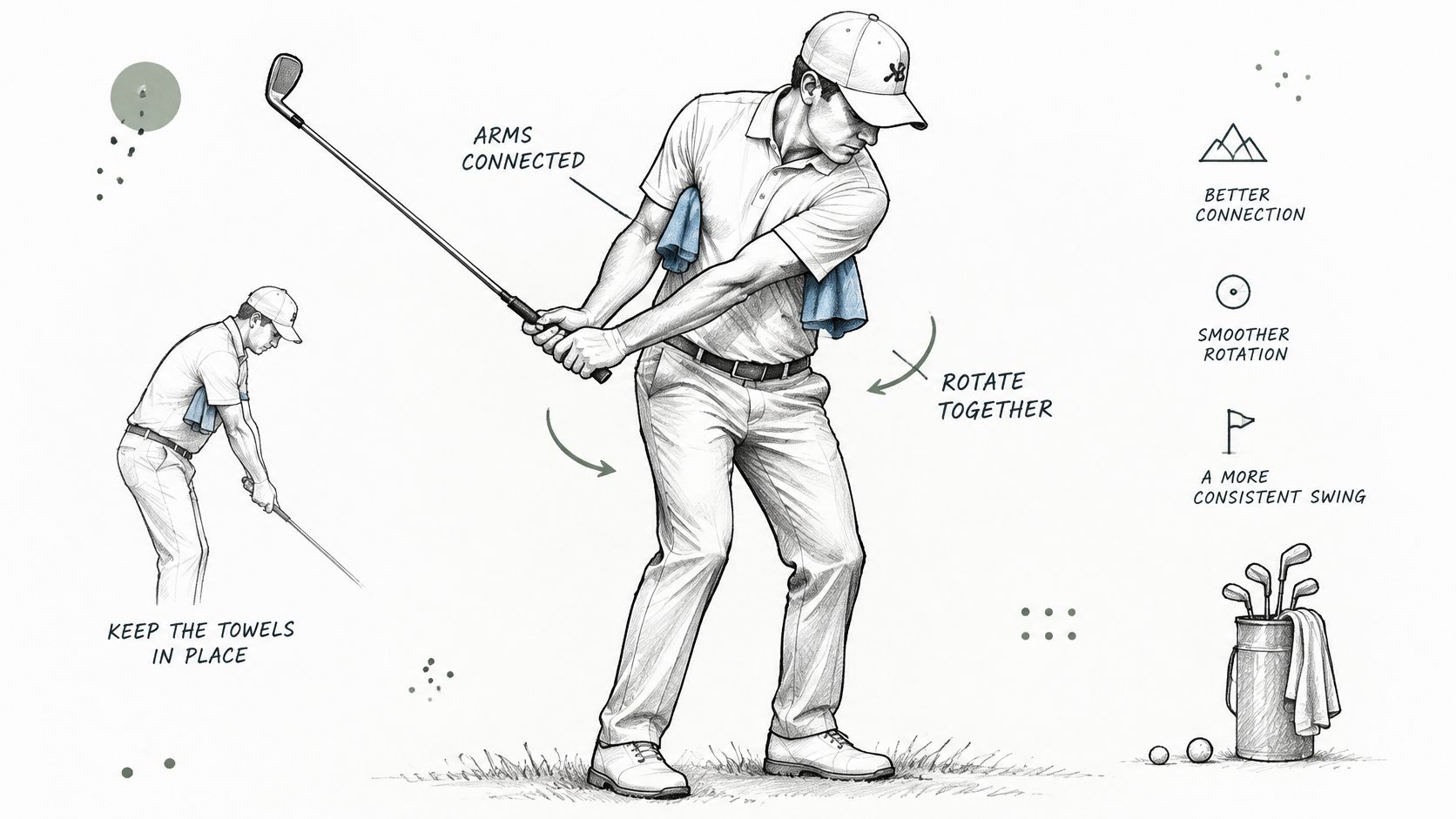
Connection drills get skipped because they feel slow and look ridiculous. That is the price. A towel or headcover under each armpit ties the upper arms to the chest through the swing and stops the hands from running away from the body's rotation.
Set up with a 9-iron, one towel under each armpit, and a narrow stance. Hit half-swing pitch shots first. Both towels stay until the follow-through. The instant one drops, the arms have separated and the hands are doing work the torso should be doing.
What it fixes and what it does not
The towel repairs a swing where the arms lift, disconnect, and flip at impact, and it is the fastest route back to a compact motion for a golfer who has been reaching for width. It does not fix a fat shot, and golfers who try to use it for that end up frustrated.
Low point is a separate problem with a separate setup: lay a towel on the ground a few inches behind the ball and hit short punch shots without brushing it, which forces the club to bottom out in front of the strike rather than behind it. Same towel, different job, and the two uses should not be mixed in one set.
Score the connection version by counting how many of ten half-swing shots keep both towels in place. Then hit five at full speed and check strike location, since a connected swing usually moves contact toward the center.
4. Impact Tape Strike Drill
Strike is the cheapest speed in golf. A ball met half an inch off center loses ball speed and picks up sideways spin, and most golfers cannot feel the difference between a center strike and a slightly heel-side one. Tape makes the difference visible in one set.
Apply a strip of impact tape across the face, or dust the face with athlete's foot spray, and hit ten balls with a single club from a clean lie. Do not adjust anything mid-set. Peel the evidence, stick it on a card, and repeat with a fresh strip.
Reading the mark
- Heel marks: the golfer stands too close, or the arms pull in through the downswing. Step back half a ball.
- Toe marks: the setup is too far away and the golfer reaches for the ball. Move in half a ball and check posture.
- High on the face: the tee is too high with a driver, or the strike is climbing rather than descending with an iron.
- Low on the face: the club is bottoming out early. That is a low point problem, not a tape problem.
Score it as center strikes out of ten, with center defined as the middle inch of the face. Then read ball speed on a launch monitor from the best strike and the worst one in the set. That gap is what better contact is worth, and it is the figure that motivates a golfer far more than the mark itself. Keep the taped-face photos in the same session record as the launch data so the pattern is trackable across weeks rather than re-diagnosed from scratch.
5. Ladder and Clock Drill for Wedge Distance
Anyone can hit a full wedge. The strokes that go missing sit at 40 to 90 yards, where the swing is a fraction of full length and nobody has measured what each fraction carries. The clock drill assigns a number to every length.
Picture a clock face around the body. A 7:30 backswing is hands at hip height, 9:00 is hands at shoulder height, 10:30 is just short of full. Pick a single wedge, hit ten balls at each position, and ignore the ones struck fat or thin when averaging.
Turning positions into yardages
Three positions and one club produce three reliable carries. Write them on the card, not in the head. Where the spread at one position runs wider than the golfer would tolerate on the course, that length is not yet repeatable and needs another ten balls before it earns a spot in the plan.
For the technique behind the shorter positions, this guide on how to hit a wedge covers the setup and shaft lean that make a partial swing predictable.
Score the drill as average carry at each clock position plus the gap between best and worst at each. A desktop app that builds the chart automatically, like Dialed Golf importing CSV files exported by Garmin, Rapsodo, or SkyTrak, saves the arithmetic and keeps last month's numbers for comparison.
6. Ladder Drill for Distance Control
A ladder forces one club to produce several distances in sequence, and it exposes a golfer who only owns one speed. Set targets at 10-yard steps for mid-irons, 5-yard steps with a wedge, then work up the ladder and back down, changing nothing except the length of the swing. The fault it hunts is the fake partial shot, a full-length swing throttled short by decelerating, so the constraint is same setup, same tempo, shorter arc.
Run it as a ladder rather than a block of identical shots because change is what makes the skill stick. A 2024 systematic review of 52 randomized controlled trials on golf-specific motor learning found that blocked practice, repeating one task consecutively, often improves immediate practice performance, while random or variable practice produces stronger retention and transfer, especially for skilled golfers. The same review reports that combined or progressively increasing variability can outperform either schedule alone, which is why the ladder mixes distances instead of grooving one.
In this session's order it lands after the wedge clock work has produced numbers and before the audit measures the whole bag. Six 7-iron shots at one target to calibrate, then twelve randomized shots alternating club, target, and trajectory, with the ladder embedded in the randomized half.
Practical rule: judge the drill a week later, not in the session. Random practice often looks worse while it is being learned.
Score it by counting shots inside each target window out of ten, then re-running the same ladder a week later. A higher count on the retest, with no extra coaching between attempts, is the number that proves the learning held.
7. Dispersion and Gapping Session
After the ladder has tested distance control, run the audit that maps the bag rather than the spec sheet. Hit at least ten shots per club, delete the obvious mishits, and record average carry, left-right spread, and the gap to the next club.
Tour practice shows why this session stays deliberately narrow. Observational data from 256,064 professional range shots, reported by Golf Digest's analysis of tour range practice, shows tour players averaged one shot every 32 seconds, typically hit only two or three shots to the same yardage window before changing tasks, devoted about 10% of range work to drivers, and often used roughly 50 balls for warm-up. The dispersion session is the exception: a deliberately blocked measurement set, built for comparison rather than retention, and it should close the bag audit instead of defining the practice week.
Keep the conditions boring: same ball, same target line, same intent, one club at a time, because the point is a clean read on carry and spread. Read the numbers two ways. Identical carry windows mean overlap, while a lone landing zone between clubs means a hole. When the numbers are in, this walkthrough on how to do a gap analysis shows where a set usually breaks.
Score it as the carry gap between adjacent clubs and the width of the dispersion oval. A gap wider than 15 yards between two irons is a decision waiting to be made: a loft adjustment, a different club in the bag, or a scoring club that needs another option.
8. Putting Ladder Drill
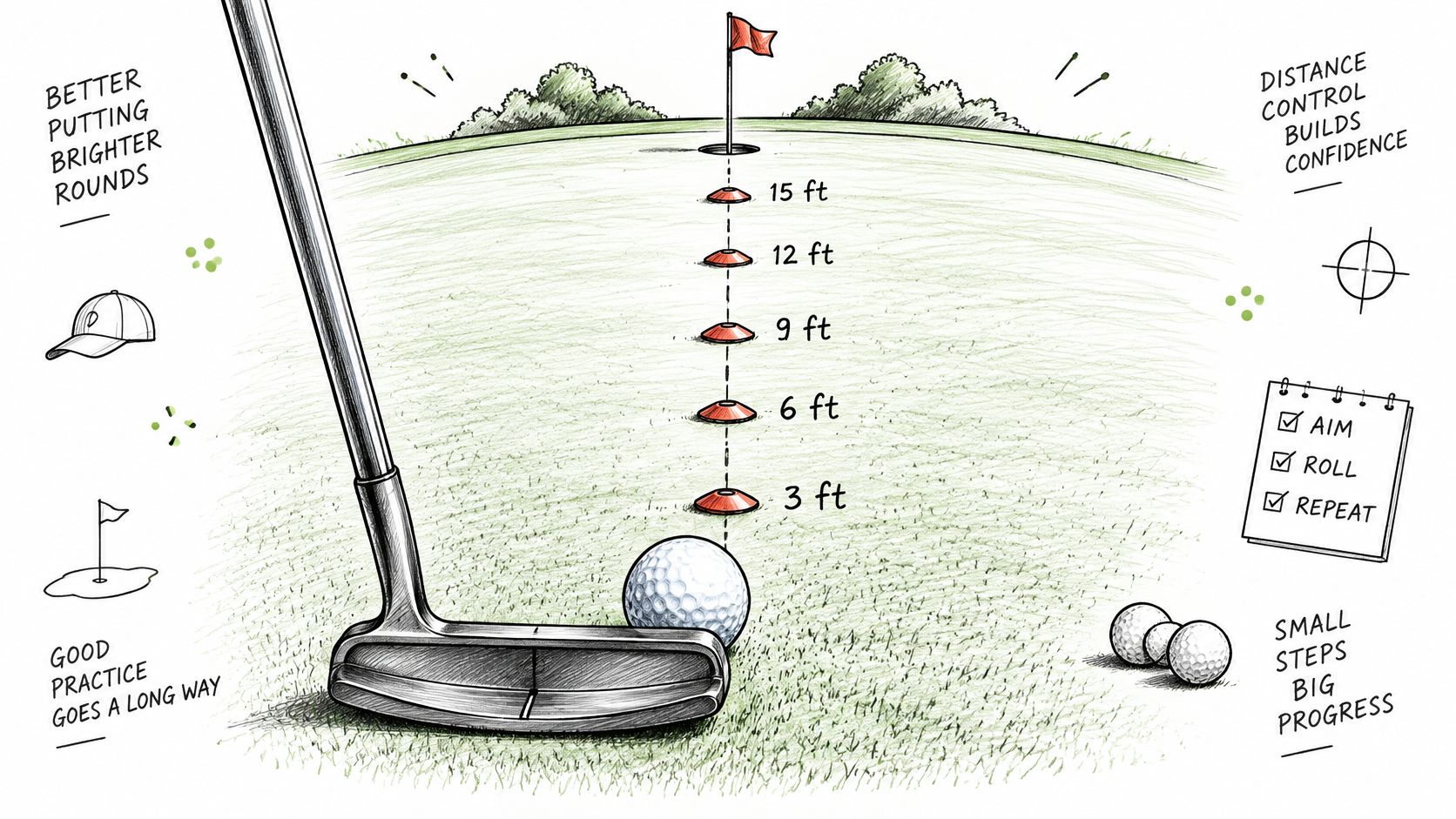
Putting practice dies from vagueness. The ladder gives it a structure and a finish line. Put tees at 3, 6, 9, 12, and 15 feet, then putt to each in sequence and back down again, trying to leave every ball inside a three-foot circle around the tee.
Distance control matters more than line at this range, which is why the ladder scores proximity rather than makes. Randomizing the distances inside a set does more for that than repeating one length. A controlled study of 30 participants assigned to random practice, blocked practice, or no practice had the groups train for six consecutive days with 10 blocks of 18 putts per day, then return a week later for an 18-trial retention test. The blocked group performed better during acquisition, but the random group putted more accurately in retention and built a mental representation closer to that of skilled golfers (the random versus blocked putting study).
A second study of 48 participants split evenly between blocked and random groups found the same pattern across three distances of 120 cm, 150 cm, and 180 cm, with 15 attempts from each. Blocked practice won during acquisition, random practice produced significantly more accurate putting in transfer, and the random group directed more attention to the target and the distance (the variable putting distance study).
The practical takeaway for the ladder is that good numbers during the drill do not guarantee the skill holds on the course. That is the reason to score proximity on a shuffled pass rather than count makes on a fixed one.
Score it as putts finishing inside the three-foot circle out of fifteen, then repeat once with a shuffled order. The shuffled number is the one worth keeping. Log both scores weekly; a gap between them closing is the sign the drill is transferring.
How the eight drills compare by skill, setup, and scoring
Run them as one session when the goal is a usable swing, not a loose menu: build the motion, check strike, set wedge and iron numbers, audit the bag, then finish on the green.
| Session slot | Drill and miss it fixes | Setup cue | Score that proves it worked |
|---|---|---|---|
| 1. Motion | Gate Drill for face and path misses | Two tees or headcovers about one clubhead width apart | Ten clean passes through the gate |
| 2. Motion | Alignment Stick Path Drill for an off-plane swing | Two sticks forming the target line and swing channel | Ball starts inside the intended window |
| 3. Connection | Towel Drill for lost arm-body sync | A towel under each armpit | Both towels stay in place through impact |
| 4. Strike | Impact Tape Strike Drill for heel, toe, and low-face contact | Impact tape on the clubface | Strike marks tighten toward center |
| 5. Wedges | Ladder and Clock Drill for random partial-shot yardages | One wedge and several backswing lengths | Average carry repeats for each length |
| 6. Irons | Ladder Drill for carry control | One club and targets at set yardage intervals | More shots finish inside each target zone |
| 7. Bag audit | Dispersion and Gapping Session for unclear club distances | Launch monitor and a set of clubs | Roughly 15 yards between irons, with visible carry spread |
| 8. Green | Putting Ladder Drill for weak lag speed | Markers at increasing distances | More putts stop inside the three-foot circle |
The order matters: the early rows make contact honest, and the later rows turn that contact into yardages, gaps, and putts.
Build a Practice Record, Not a Highlight Reel
Eight drills run in order are a workout, not a menu. The full sequence is the default session: build the motion, check the strike, dial the distances, audit the numbers, finish on the green. Single drills are for targeted repair after a round that exposed one specific miss. A golfer who slices driver under pressure goes back to the gate and the sticks. A golfer who leaves half his approach shots short revisits the clock drill and the ladder. A golfer who cannot explain why the 7-iron flies 150 one swing and 138 the next repeats impact tape and the dispersion session.
Skill level still changes how the session should be structured. A review of six eligible golf-practice studies concluded that distributed practice, meaning multiple sessions per week, combined with blocked and errorless practice may be particularly effective for improving putting accuracy in novice golfers, while random or variable practice may produce greater improvements in skilled golfers (the golf practice structure review). Beginners should not be handed an exclusively random plan and told to trust the process. Experienced players should not spend range time on errorless repetition and call it improvement.
Whatever the format, the record is what makes it practice. Write three things per drill: the setup used, the score, and one number that proves it worked. Carry dispersion from the gapping audit, clean passes out of ten from the gate, putts inside three feet from the ladder. Those figures turn a week of good intentions into a baseline, and a baseline is the only thing that shows movement two months later.
The same logic carries into captured sessions, where clubs, shots, and history live in one record rather than scattered across screenshots. Dialed Golf holds that record for one golfer in a macOS and Windows practice app: pair a launch monitor at the range for live capture, or import a session file, and everything lands in a single locker alongside the drills' scores. Nothing about it replaces the drills. It replaces the shoebox of notes they would otherwise live in.
The starting assignment for the next range visit is 25 minutes, no more. Ten balls through the gate as a warm-up with a purpose. Ten balls with impact tape on the 7-iron, counted for center strikes. Then the putting ladder from 3 to 15 feet for fifteen putts, scored on proximity. Before leaving, write the three numbers down. The following week, beat one of them.
The follow-up work is covered too. Seven free web tools, no account required, include the Wedge Distance Matrix Builder, which gives every scoring shot a reliable number, and the Golf Bag Gap Analyzer, which spots overlaps and missing yardages once the dispersion session exposes them. Start the next practice session at Dialed Golf and give every drill a score worth beating.