

A gap wedge distance chart shouldn't give a golfer one magic number. It should show repeatable carry windows, separated by swing length, strike quality, and club setup. A 50° or 52° gap wedge may sit in a familiar yardage range, but the useful question is whether it reliably covers the space between the pitching wedge and sand wedge.
A practical baseline places a 50° to 52° gap wedge at roughly 90 to 110 yards of full-swing carry for many mid-handicap players, with a target gap of about 10 to 15 yards between adjacent wedges. Those figures are useful for orientation, not club selection by themselves. The dependable chart comes from measured carry data, partial swings, and a record of how much the shot pattern moves around its average. (gap wedge distance guidance)
Table of Contents
- Why Generic Wedge Charts Fail Your Short Game
- The Evolution of Loft Gapping and the Gap Wedge
- Capturing Reliable Wedge Data with Launch Monitors
- Standard Gap Wedge Distance Chart and Loft Baselines
- Importing and Managing Wedge Data via CSV Workflows
- Diagnosing Bag Gaps Overlaps and Dispersion Issues
- Adjusting Lofts and Shafts to Fix Yardage Holes
- Applying Your Wedge Matrix on the Golf Course
- Quick Reference Checklist for Wedge Gapping
Why Generic Wedge Charts Fail Your Short Game
A generic gap wedge distance chart is often most useful for orientation and least useful for club selection. It usually presents one full-swing yardage beside a loft, while leaving out strike quality, swing length, launch conditions, and the range of carries a golfer can reproduce.
Golfers rarely face a level lie, calm air, and a perfect full swing. The same gap wedge may be played with a full, three-quarter, flighted, or half swing. Each motion creates a different carry window, and each window carries its own dispersion. An average that looks suitable on paper can still produce an unreliable scoring option if the actual carries spread too widely.
Build the chart around several shots for each intended swing, then record the carry range rather than only the longest result. Launch monitor data makes that process practical. Export the session to CSV, separate shots by swing length and strike quality, and use the resulting ranges to build a personal wedge matrix. The goal is a set of repeatable options, not a single headline number.
The gap wedge is also more than a shorter pitching wedge. It functions as a transition club, helping organize the loft and distance spacing at the bottom of the bag. A typical setup places it between a pitching wedge in the 44° to 48° range and a sand wedge around 54° to 56°. The club must cover the space between those wedges, not match a chart. (wedge loft and distance reference)
Practical rule: Use the carry window you can reproduce, not the longest carry recorded in a session.
Average distance is the wrong target
A chart can also push golfers toward the wrong equipment change. If a gap wedge falls short of an online average, the cause may be strike, shaft, ball speed, dynamic loft, or the actual pitching-wedge specification. Strengthening the wedge to chase a number can create an overlap with another club or leave a larger hole elsewhere.
Record the shortest and longest reliable carries for each swing length. Then compare those windows across clubs. The matrix should show whether a three-quarter pitching wedge or a full gap wedge gives the more dependable option for the shot required.
Dispersion belongs in the chart
Two wedges can show acceptable average separation while providing poor on-course coverage. A broad carry pattern in one club may erase the apparent gap on difficult lies or under pressure. Keep the average, usable window, strike quality, and dispersion together for every shot category. That information reveals which yardages are genuinely playable and which exist only as isolated launch monitor results.
The Evolution of Loft Gapping and the Gap Wedge
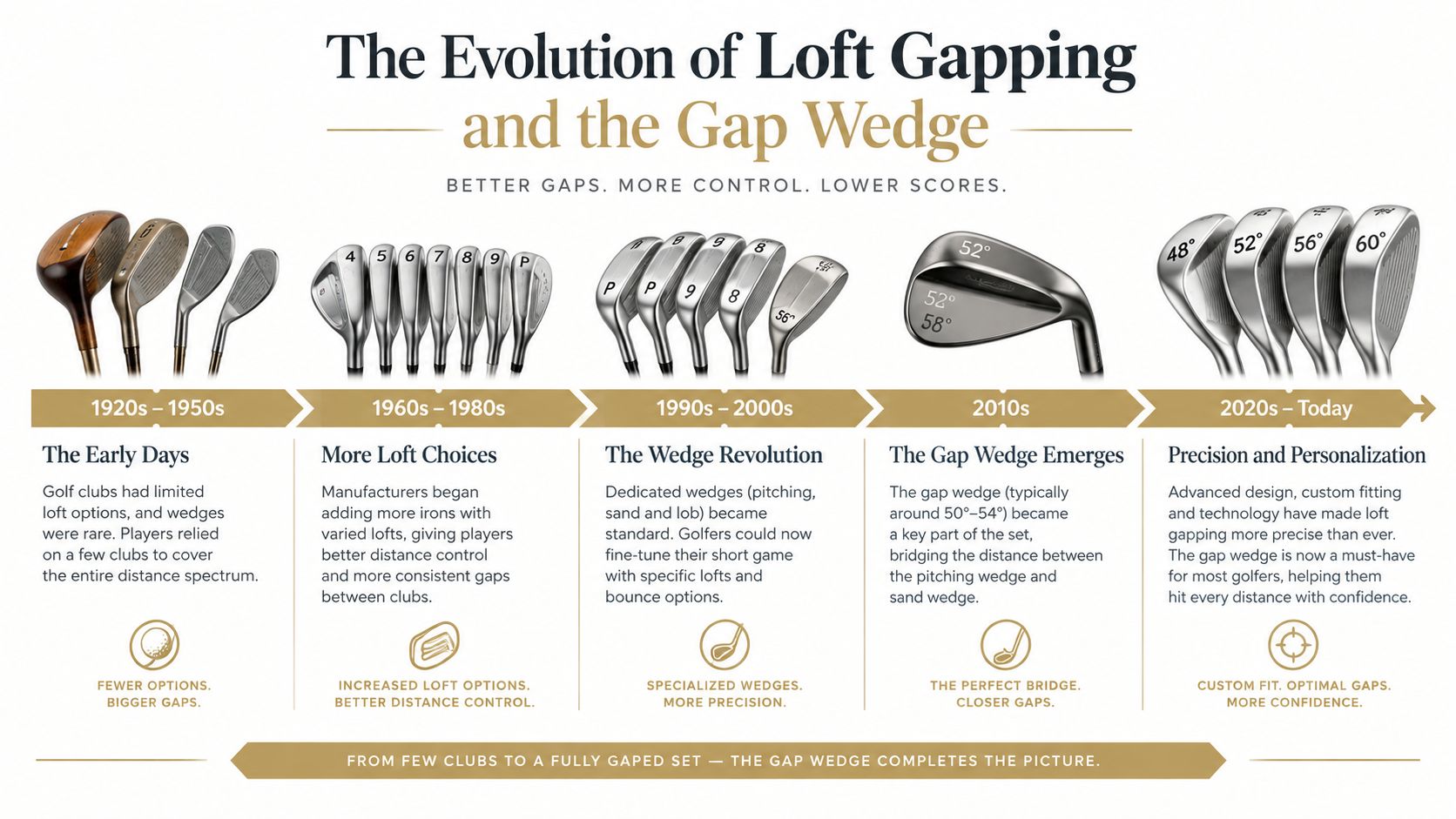
The gap wedge was created to solve an equipment problem, not to complete a tidy loft sequence. As pitching-wedge lofts became stronger, the distance to a traditional sand wedge grew too large for consistent scoring shots. Purpose-built gap wedges entered the market in the early to middle 1990s, giving golfers a practical option between those clubs. (historical wedge-gapping context)
Modern setups often use 4° to 6° of loft separation. A common progression places the pitching wedge around 44° to 48°, the gap wedge around 50° to 52°, the sand wedge around 54° to 56°, and the lob wedge around 58° to 60°. The usual planning target is about 10 to 15 yards between adjacent wedges, but loft alone cannot guarantee that result. Shaft length, strike, ball speed, sole design, and delivery change the actual carry. (loft-gapping guidance)
Why the stamped number isn't enough
The number on the sole is only a starting point. A modern iron set may have a stronger pitching wedge than expected, so a nominal 50° gap wedge may not produce a useful distance window. Measure the pitching-wedge loft, then establish its repeatable carry before choosing the next wedge. Loft specifications can provide a reference, while the player's delivery determines the working setup.
A 4° separation may suit one golfer and leave another with an awkward yardage hole. Shaft length, shaft characteristics, strike quality, sole design, and ball speed all affect the result. (club-loft and gapping reference)
Build from the pitching wedge outward
Start with the pitching wedge and work toward the higher-lofted clubs. Measure several reliable carry windows, then test candidate gap-wedge lofts and swing lengths against those results. Continue the same process through the sand and lob wedges, recording more than one stock motion where the golfer uses partial shots.
A personalized matrix should show usable carry ranges, not just one advertised yardage. CSV-ready launch monitor records make it easier to compare clubs, swing lengths, strike patterns, and overlaps across sessions. Nominal loft creates the framework. Measured carry windows determine whether the framework works.
Capturing Reliable Wedge Data with Launch Monitors
Generic distance charts inherit every weakness in their inputs. Build a wedge matrix from controlled launch-monitor sessions instead of chasing the longest shot. The goal is a repeatable carry window for each club and swing length.
Separate clubs and motions before recording. Label each session with the club, intended swing, ball, shaft setup, lie, and conditions. Record carry distance, not total distance. Rollout changes with landing angle, turf, green firmness, and strike, while carry identifies where the ball reaches the target area in the air.
Use a consistent protocol:
- Warm up without recording. Establish a normal rhythm first. Early swings often include contact that does not represent the stock motion.
- Define each swing. A full swing needs a repeatable intention. Three-quarter and half swings require a consistent backswing length, finish, or tempo. A vague “partial” label creates noisy data.
- Hit at least 10 balls per swing length. This gives enough observations to identify obvious mis-hits and prevents one unusually clean strike from defining the chart. (multi-shot wedge testing guidance)
- Record carry and strike context. Mark thin, heavy, toe-side, and heel-side contact instead of treating every shot as representative.
- Use the repeatable cluster. One outlier should not set the stock number. Select the carry range that appears repeatedly with the intended motion.
- Repeat after meaningful changes. A new ball, shaft, wedge, swing pattern, or launch-monitor setup can shift the matrix.
A launch-monitor practice guide can help organize sessions. Compatible launch monitors, whether paired directly or used through CSV import, can record carry, launch, spin, ball speed, and strike information. Those fields help explain an unexpected distance instead of merely displaying it. A short carry may reflect poor contact, excessive launch, reduced speed, or a changed delivery.
Keep the raw records. CSV files make it easier to compare clubs, swing lengths, strike patterns, and overlaps across sessions. They also preserve the context needed to decide whether a gap is real or came from one inconsistent practice day.
Why three swing lengths matter
Full swings establish the upper limit of each club. Three-quarter swings often provide the most practical scoring option, while half swings can cover shorter windows without forcing a full-motion effort. A personal matrix should include all three when the golfer can repeat them.
The aim is known options with predictable carry behavior. That gives the golfer a controlled three-quarter gap wedge for a specific window, rather than a full swing that adds unnecessary dispersion. The best matrix reflects how the player delivers the club, not how a static loft table predicts it.
Standard Gap Wedge Distance Chart and Loft Baselines
A static distance chart is useful for spotting an obvious setup issue, not for prescribing your wedge matrix. Use it as a screening tool, then replace its broad bands with carry windows from your own launch-monitor sessions.
Independent wedge references commonly place gap-wedge carry around 80 to 110 yards for many golfers. Pitching-wedge and sand-wedge results vary with loft, speed, contact, and set construction. (independent wedge loft and carry reference)
| Club Type | Typical Loft | Loft Gap | Amateur Carry (Yards) | Mid-Handicap Carry (Yards) |
|---|---|---|---|---|
| Pitching wedge | 44° to 48° | Starting point | 95 to 125 | 110 to 135 |
| Gap wedge | 48° to 52° | 4° to 6° from PW | 80 to 110 | 90 to 110 |
| Sand wedge | 54° to 56° | 4° to 6° from GW | 65 to 90 | 75 to 95 |
| Lob wedge | 58° to 60° | 4° to 6° from SW | 60 to 80 | 60 to 80 |
These ranges are intentionally broad. Ball speed, strike quality, shaft length, shaft profile, sole design, delivery, and ball choice can all change carry without indicating a defective club. Loft alone cannot explain the result.
Read the table as a diagnostic
A gap wedge near the lower end of the amateur band is not automatically too short. Compare it with the golfer's actual pitching-wedge and sand-wedge carry windows. If the pitching wedge and gap wedge overlap, inconsistent contact or delivery may be the problem rather than the loft.
A large jump from pitching wedge to sand wedge creates a practical dead zone. The golfer must then force a partial swing or overhit a club. Adding another wedge may not solve it. Measure the pitching-wedge loft, record repeatable three-quarter and half-swing carries, then choose lofts around the windows the golfer can control.
The chart also cannot show dispersion. A club may reach the desired carry while producing a wide left-right pattern or inconsistent front-to-back results. For scoring, a narrower, repeatable carry window often matters more than the longest recorded shot.
The midpoint is only a starting point
If only pitching-wedge and sand-wedge yardages are available, begin with a midpoint estimate. Common 50° to 52° lofts can provide a reasonable starting range, but launch-monitor data should confirm the choice before it becomes permanent. (gap wedge distance chart baseline)
Record several swing lengths and retain the raw results. A CSV export lets you compare carry windows, overlaps, strike quality, and session conditions later. The finished matrix should show usable options, not just a single chart number.
Importing and Managing Wedge Data via CSV Workflows
A single range session is only a snapshot. A CSV workflow preserves that session so carry windows, swing types, strike quality, and conditions can be filtered and compared after a loft, shaft, ball, or technique change. The goal is a personal wedge matrix built from repeatable swing windows, not a static yardage table.
Start with column mapping. Exported files may label carry, total distance, club, swing type, launch, spin, and strike data differently from the destination system. Match each field deliberately. Mapping total distance to carry can make the matrix look exact while answering the wrong fitting question.
Use this import sequence:
- Preserve the original file. Keep an untouched export so mistakes can be traced to the source.
- Normalize the club name. Use consistent labels such as PW, GW, SW, and LW across sessions.
- Separate swing intentions. Keep full, three-quarter, flighted, and half swings in distinct categories.
- Validate rows before analysis. Check blank club labels, impossible entries, duplicate uploads, and sessions recorded under different conditions.
- Add session context. Record the ball, shaft, lie, surface, and meaningful swing or equipment changes.
Major launch-monitor ecosystems may support direct pairing, CSV export, or both. A practical setup can combine live connections with imported files, provided the records use the same club names and swing categories. Review the CSV import workflow when sessions arrive from different systems and need a consistent structure.
Make the database useful over time
A persistent record helps compare carry windows after equipment or swing changes. Review the separation between adjacent wedges, the width of each carry window, and whether a swing produces consistent strike and direction. A longer carry is not automatically better if dispersion expands or the motion becomes difficult to repeat.
Dialed Golf's desktop product supports live pairing and CSV import workflows, giving golfers a way to keep sessions from different launch-monitor ecosystems in one record. Keep the raw files, use consistent labels, and update the matrix only after representative sessions.
Diagnosing Bag Gaps Overlaps and Dispersion Issues
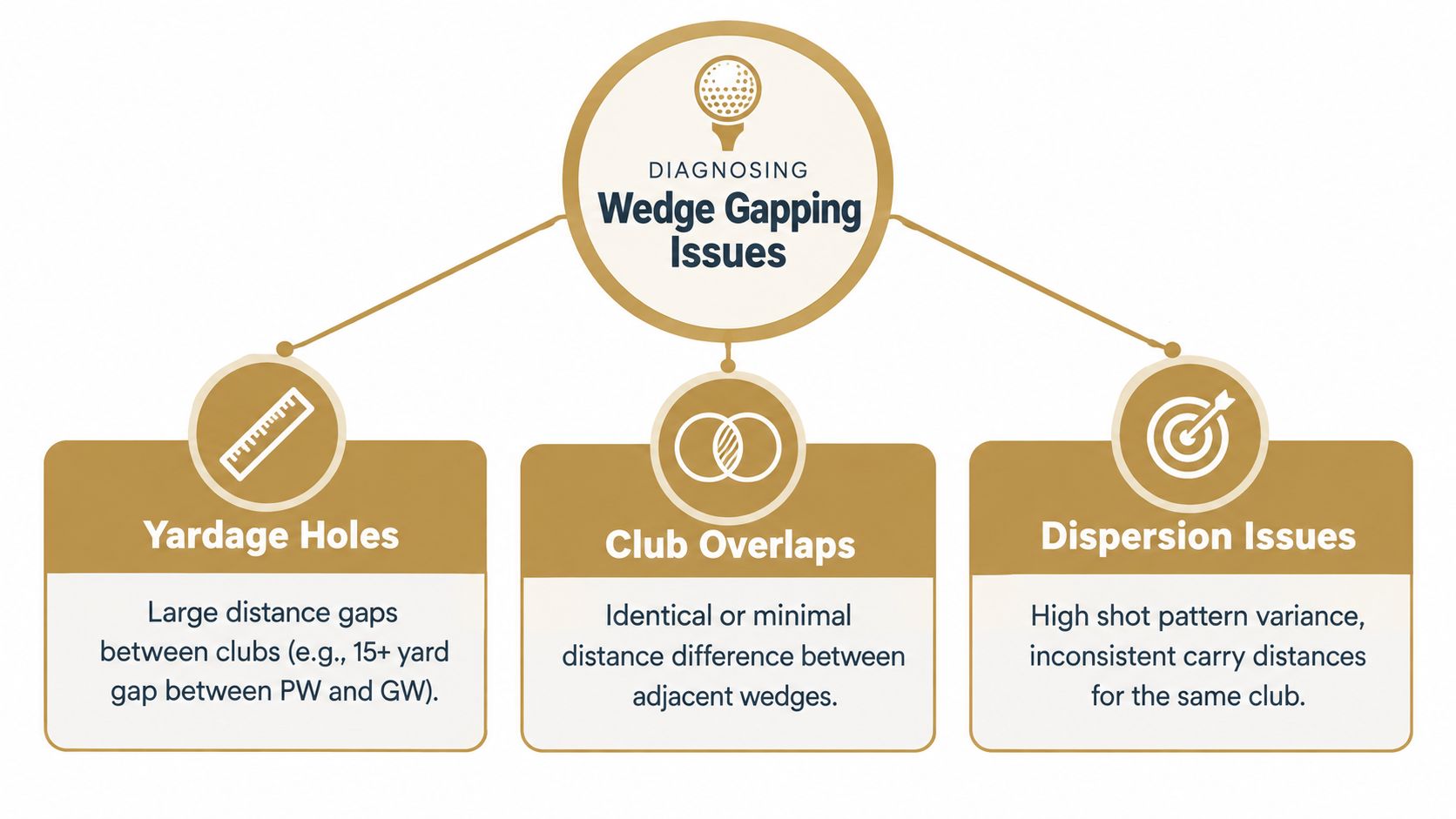
Once the data is organized, the fitting problem becomes easier to name. Most wedge setups fail in one of three ways: a yardage hole, a club overlap, or a dispersion problem that makes the apparent gap unreliable.
A yardage hole appears when adjacent carry windows leave a target area uncovered. For example, a golfer may have a comfortable pitching-wedge carry and a comfortable sand-wedge carry, but no stock motion that reaches the space between them. The gap isn't defined only by the difference between two averages. It's the absence of a repeatable option.
Club overlap is the opposite. Two wedges may produce nearly the same carry because the golfer doesn't strike one cleanly, delivers excess dynamic loft, or has lofts that are too close for the player's speed. Before changing equipment, the golfer should check whether both clubs were tested with comparable swing intentions and enough representative shots.
Separate a real problem from bad data
A single thin or heavy strike can create a false hole. So can a small sample, inconsistent swing length, or a session recorded into a different wind or surface. The matrix should be reviewed for a cluster of comparable shots, not one dramatic result.
Dispersion deserves its own column. A club may have the correct average carry but a wide pattern that makes it a poor choice for a narrow target. Another wedge may carry slightly shorter yet keep the landing window tighter. For scoring, the second club may be more useful.
A gapping problem is equipment-related only after the data proves the swing category is comparable.
Adjusting Lofts and Shafts to Fix Yardage Holes
Equipment changes should follow the diagnosis. If a measured gap is small and the wedges have compatible soles, a loft adjustment may solve it without replacing a club. Bending a wedge stronger can reduce its loft and generally move it toward the pitching wedge's carry. Bending it weaker can create more separation, but it may also alter bounce and the way the sole interacts with turf.
That sole change is the trade-off many golfers overlook. A stronger bend reduces effective bounce, while a weaker bend increases it. The effect may suit one lie and damage another, especially when the wedge has a specialized grind. Loft bending should therefore be checked against the golfer's strike, turf, and preferred shot pattern.
Choose the adjustment that fixes the cause
Use the data to distinguish among three options:
- Bend a current wedge when the loft gap is modest, the head is suitable for adjustment, and the resulting bounce remains playable.
- Change the wedge entirely when the required loft change would compromise the sole, create an unwanted overlap, or leave the golfer with an unsuitable grind.
- Review the shaft when launch, strike, or feel changes across the set suggest that the wedge shaft isn't matching the golfer's delivery.
Shaft weight and flex can influence launch and spin, which can alter carry even when the loft remains unchanged. The effect isn't a universal yardage promise. It must be checked through comparable shots, with the same ball and swing intention.
Fit the bottom of the bag as a system
A gap wedge shouldn't be adjusted in isolation. Changing its loft may solve the pitching-wedge gap while creating a new overlap with the sand wedge. The fitter should record the complete ladder before and after the change, including partial-swing windows.
A clean setup usually gives the golfer several usable options rather than a collection of theoretically even lofts. A club that fills a carry window and produces a playable sole interaction earns its place.
Applying Your Wedge Matrix on the Golf Course
A wedge matrix becomes useful when it changes decisions. Suppose a golfer faces a target that falls between a full gap-wedge carry and a full sand-wedge carry. The matrix may show that a three-quarter gap wedge reaches the target with a tighter window than a forced full swing, while a flighted sand wedge offers a lower alternative when wind affects the higher shot.
The course adds variables that the launch monitor cannot fully reproduce. Elevation changes the required carry, wind changes the ball's flight, and green firmness changes how much rollout matters after landing. The golfer should start with the measured carry, then adjust the decision for the lie and target rather than automatically adding or subtracting from a total-distance number.
A simple on-course routine looks like this:
- Identify the required carry, especially when a hazard or front edge is involved.
- Find the closest stock window in the personal matrix.
- Choose the swing length that leaves the most margin for a poor strike.
- Adjust for wind, elevation, lie, and landing firmness.
- Commit to the shot's intended flight and finish.
The wedge-shot practice guide can support the technique behind those swing categories. The matrix handles the distance decision, while the golfer still has to deliver the motion.
A pocket caddy can keep those windows available during the round, but the reference should remain simple. The golfer needs a club, a swing intention, and a carry target, not a long list of competing numbers.
Quick Reference Checklist for Wedge Gapping
A useful wedge checklist tests the golfer's actual shot pattern, not a generic yardage table. Build the matrix from measured carry windows, then use it to make equipment and course decisions.
- Confirm actual lofts. Verify the pitching wedge loft before selecting a gap wedge by its stamped number.
- Start with carry. Record how far the ball flies. Treat rollout as a separate result.
- Test intended motions. Include full, three-quarter, flighted, and half swings only when those shots belong in the golfer's repertoire.
- Hit at least 10 balls per swing length. Repeated shots reduce the effect of isolated mishits. (wedge data collection guidance)
- Label every session. Attach the club, swing type, ball, shaft, surface, and conditions to the recorded data.
- Check the loft ladder. Wedges commonly sit about 4° to 6° apart, but carry windows must confirm whether the setup works. (wedge loft chart guidance)
- Record windows, not single numbers. Keep the repeatable carry range, launch conditions, and dispersion for each motion.
- Find holes and overlaps. A gap may call for a different loft, while an overlap may reflect inconsistent contact rather than an equipment problem.
- Validate CSV imports. Confirm that carry, total distance, club, and swing-type fields map to the correct columns.
- Retest after changes. Rebuild the affected part of the matrix after changing the ball, shaft, loft, or swing.
- Use the matrix on the course. Select a stock motion from its carry window, then account for wind, elevation, lie, and firmness.
The matrix should remain easy to maintain. Free web tools can provide an initial reference, while a persistent record makes session-to-session comparisons practical. Dialed Golf combines a consumer app, desktop launch-monitor practice, and Dialed Academy in one golfer record. The consumer app is available through TestFlight rather than a general App Store launch, and the desktop workflow supports live pairing with compatible launch monitors plus CSV import. Dialed Academy offers memberships and front-desk tools for ranges and clubs at $99.99 per month or $999.99 per year, with the club keeping its dues. Golfer Pro is available across app and desktop at $9.99 per week, $29.99 per month, $149.99 per six months, or $249.99 per year. (Apple TestFlight overview)
Build the matrix from measured carry windows, compare full and partial swings, and use the gap analyzer to identify overlaps before changing equipment. Visit Dialed Golf to explore the free web tools, consumer app, desktop launch-monitor workflows, and Academy options for maintaining wedge data.