


A golfer stands over a long approach and sees the problem before choosing a club: the longest iron rarely launches well, but the fairway wood flies too far. A hybrid seems like the obvious bridge. Yet the wrong loft can leave the same distance gap untouched, or put two clubs in the bag that do nearly the same job.
That's why the best hybrid golf clubs aren't necessarily the models at the top of a generic ranking. The useful question is which club fills a measured carry gap, launches on a playable trajectory, and stays predictable from the lies the golfer faces. The framework below focuses on those outcomes, not a brand label: compare carry, launch, spin, peak height, descent, and dispersion, then decide whether the club earns its place.
Table of Contents
- When the Numbers Say Your Hybrid Is the Wrong Club
- What a Hybrid Actually Does and Why Lofts Lie
- Hybrid vs Long Iron at the Same Loft
- How Independent Hybrid Testing Actually Works
- Forgiveness Beats Headline Distance Every Time
- Building a Test Session That Mirrors Real Lies
- From Launch Monitor Numbers to Course Decisions
When the Numbers Say Your Hybrid Is the Wrong Club
A hybrid can feel easy to hit and still be wrong for the bag. Perhaps it carries almost the same distance as the longest reliable iron, leaving no useful separation. Or perhaps it flies so far that the golfer is left with a large uncovered window between it and the next club. In either case, the club's reputation matters less than its measured role.
Many “best hybrid” lists make the decision look simpler than it is. Hybrid lofts differ between models, golfers deliver the same club differently, and a club that wins a distance test may not fill a particular player's gap. A number stamped on the sole doesn't tell the whole story: a “4-hybrid” could replace an iron for one golfer but overlap with a fairway wood for another.
The fitting question starts with the clubs already in the bag. Measure the longest iron the golfer can carry reliably and the shortest fairway wood that produces a dependable shot. The space between those carries is the window a hybrid needs to fill. Dialed Golf's 4-hybrid distance guide can help frame that comparison, but the golfer's own repeatable results should make the final call.
Practical rule: A hybrid earns its place by filling a real carry gap, not by matching the iron number it's supposed to replace.
The test should answer more than “How far did the best shot go?” Record average carry, dispersion, launch, spin, peak height, and descent angle. Then check whether the club holds its performance across tee and turf shots, including lies that don't produce a perfect strike.
A useful result is a clear role: for example, a hybrid that carries farther than the longest reliable iron, lands steeply enough for an approach, and doesn't collide with the fairway wood's carry window. If it can't do that consistently, a highly rated model may still be the wrong club for this bag.
What a Hybrid Actually Does and Why Lofts Lie
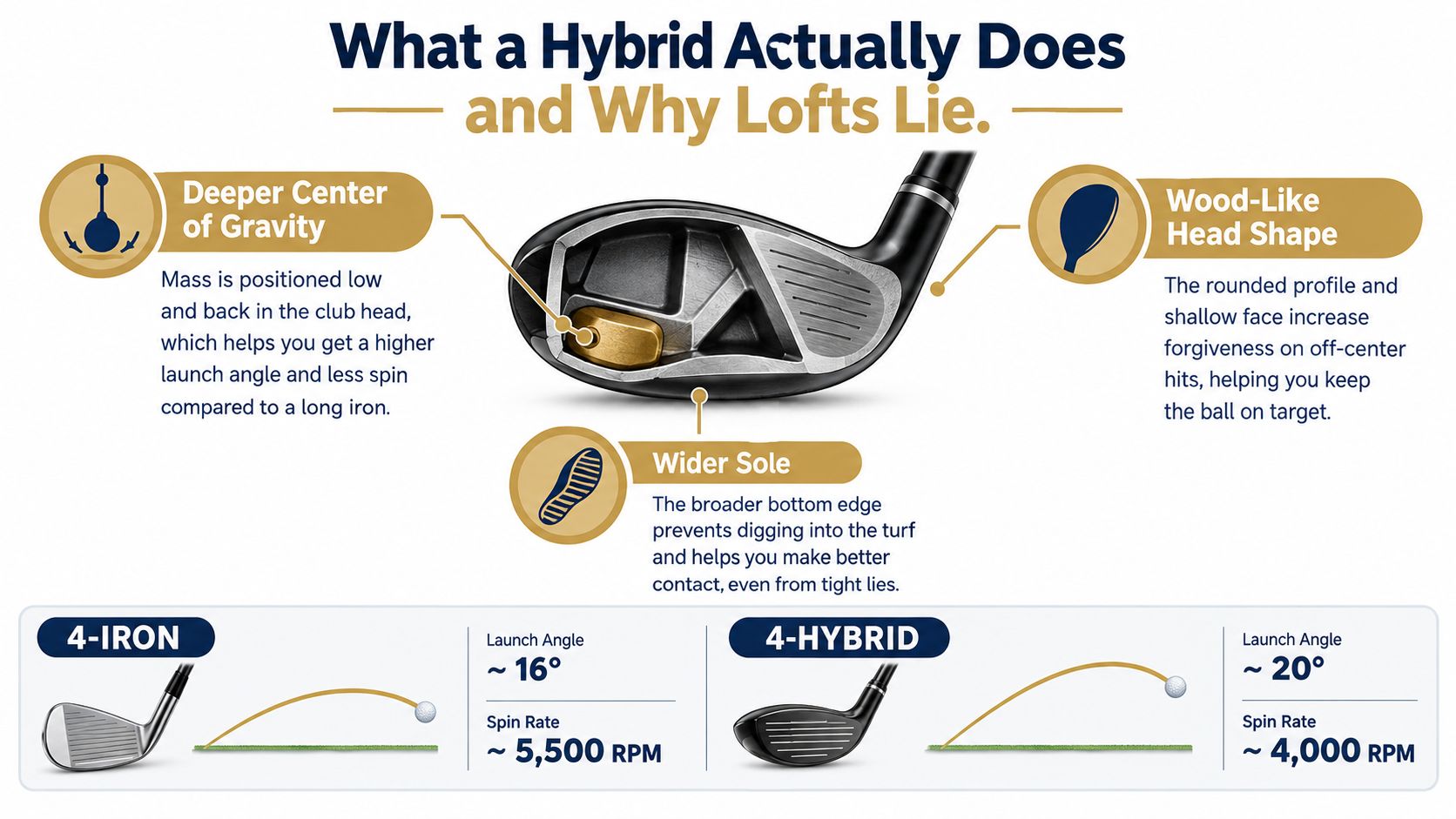
A hybrid combines a wood-like head shape with a shaft and playing role that often sit between a fairway wood and an iron. Its deeper center of gravity and broader sole can change how the ball launches and how the head meets the ground. Those design choices help explain why a hybrid may perform differently from an iron carrying a similar loft.
Read the head, not just the number
The center of gravity's position affects launch and spin. A deeper position can make it easier to launch the ball than with a long iron, while the wider sole changes how the club interacts with turf. A rounded, wood-like head also gives the face a different profile at address and can make off-center contact feel less demanding.
That doesn't mean every hybrid launches higher, spins less, or suits every lie. Head shape, loft, shaft, swing delivery, and contact all matter. Sole width, in particular, is a trade-off: a wider sole may help keep the head from digging in softer ground, but its interaction with tight turf depends on the player's delivery.
The face profile and offset matter too. A golfer who prefers a compact, iron-like look may find a larger head distracting, while another may feel more confident looking down at the broader shape. Confidence isn't a substitute for launch-monitor results, but it can affect whether a golfer swings freely.
Treat loft as a clue, not a fitting answer
Typical ranges alone show why the club number can mislead: a 3-hybrid may be 19–21°, a 4-hybrid 22–25°, and a 5-hybrid 25–28°, according to this hybrid loft and replacement guide. Two clubs carrying the same label can therefore have different lofts, and two clubs with similar lofts may still differ in shaft length, head design, and delivered launch.
Shaft length matters because it affects how the golfer delivers the club and finds the face. A longer shaft can influence speed and control, but it doesn't guarantee useful carry if contact becomes inconsistent. The actual test is whether the club produces repeatable distance and a flight that fits the intended job.
Set position should follow measured carry and trajectory, not the number on the sole. A hybrid's label can help narrow the search; it can't confirm that the club bridges the golfer's real gap.
Hybrid vs Long Iron at the Same Loft
A same-loft comparison helps separate what loft does from what head design can change. In one illustrative comparison, a 4-hybrid launched at about 17–19 degrees, while a 4-iron launched at 14–16 degrees. The hybrid also produced roughly 4,900–5,300 rpm of spin, compared with 4,300–4,700 rpm for the iron, and reached a peak height of approximately 90–100 feet versus 75–85 feet. Those figures come from the 4-iron versus 4-hybrid comparison.
The reported carry ranges were 178–188 yards for the hybrid and 170–180 yards for the iron. For golfers swinging between 85 and 95 mph, the comparison estimates a typical hybrid carry advantage of 5–10 yards at equivalent loft. These are illustrative results, not a promise for every player or club.
The flight matters as much as the carry
A higher peak and steeper descent can make a hybrid more useful for a long approach where the ball needs to land and hold. Spin is part of that picture, but no single spin number proves that a club will stop on a green. The delivered trajectory, descent angle, strike, and playing surface all affect the result.
Carry alone can also hide a bad fit. A club that reaches a target on a firm range may still produce a shallow flight that runs through a green. Another may carry a little less but arrive at a more useful angle. For a long-iron replacement, the relevant question is whether the golfer can reach the target with a repeatable flight and a workable stopping pattern.
The comparison's figures can shift with shaft, loft, center-of-gravity placement, delivery, strike quality, and launch-monitor measurement standards. A fitting session should therefore compare the golfer's own hybrid and iron under similar conditions. Look for consistent carry, launch, peak height, spin, and descent, rather than selecting the club solely because one shot flew farthest.
A hybrid isn't automatically better because it launches higher. It's better for the job only if the golfer can repeat the flight and use the carry gap.
How Independent Hybrid Testing Actually Works
A hybrid test is only useful when its scoring method matches the club's job. A long-distance club used from the tee presents a different question from a long-iron replacement aimed at a specific target. One testing protocol handles that distinction by evaluating 3-hybrids with a distance-minus-offline measure, while 4-hybrids are judged with a proximity-to-target score.
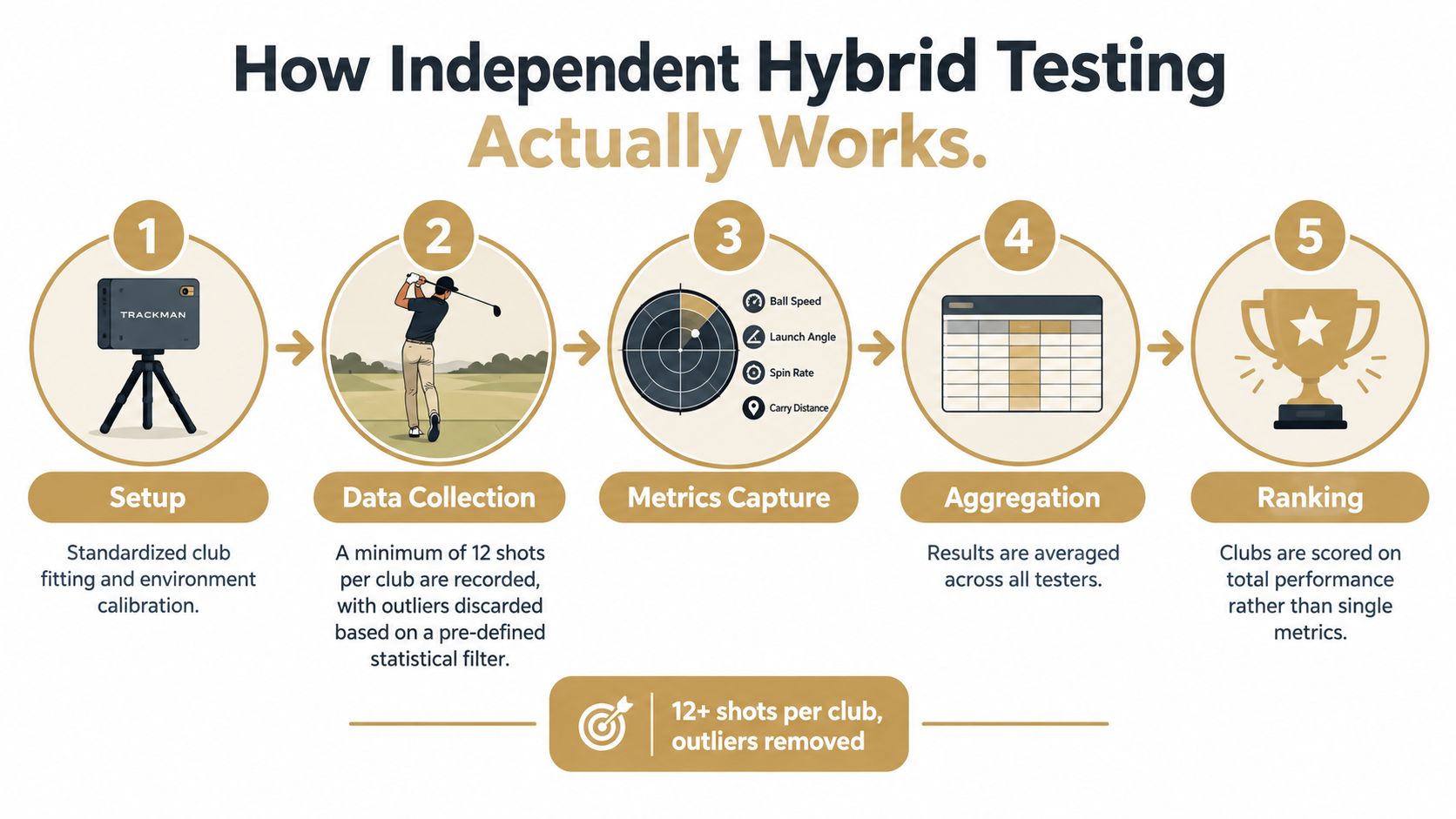
The protocol calls for testers to hit at least 12 shots per club, then discard launch-monitor misreads and gross mishits before scoring the 10 best valid shots. It also assigns 10% of the total score to subjective factors: looks, sound and feel, forgiveness, and purchase likelihood. The details are set out in MyGolfSpy's hybrid testing methodology.
Match the scoring to the shot
For a 3-hybrid used to cover distance while keeping the ball near the intended line, subtracting yards offline from total distance rewards a different performance profile than measuring how close a 4-hybrid lands to a target. Neither method is a universal definition of “best.” Each answers a narrower question.
That's why an overall ranking can obscure the information a golfer needs. A club might excel for distance but be less reliable in proximity, or look appealing while offering no meaningful improvement in dispersion. Testing conditions matter too: shots from a perfect lie can't show how the club handles turf variation.
A practical test checklist
A golfer can mirror the useful parts of a structured protocol without turning a session into a lab:
- Set a shared target: Test candidate clubs toward the same target under comparable conditions.
- Collect enough valid shots: Use a consistent shot count, record the monitor's results, and flag misreads and obvious mishits rather than choosing only flattering shots.
- Separate the job: Score a tee-oriented hybrid for distance and offline performance; score an approach-oriented hybrid for target proximity.
- Compare the full pattern: Review carry and dispersion alongside launch, spin, and height. A single long shot doesn't describe the club.
- Add the golfer's judgment: Note how the club looks, sounds, and feels, but keep those observations distinct from measured performance.
A useful review makes its test conditions visible. The golfer should know whether the ranking reflects the shot the club is meant to play, or a narrow test environment.
Forgiveness Beats Headline Distance Every Time
A hybrid that produces one outstanding shot can still be a poor choice if its mishits lose carry or scatter offline. That's the distinction between peak performance and dependable performance. For a golfer replacing a long iron, the second often matters more because the club needs to work when contact isn't perfect.
A 2024 multi-model test involved 20 golfers with varied handicaps and swing speeds, more than 140 testing hours, and 23 hybrid models. Its forgiveness category assessed ball speed, carry distance, backspin, and dispersion. The results and category rankings are reported in MyGolfSpy's 2024 hybrid test.
The category splits matter
The PXG 0311 Black Ops led the forgiveness category by performing strongly across those measured outputs. But the category leaders weren't interchangeable: PING G430 ranked first in accuracy and fourth in both distance and forgiveness; TaylorMade Qi10 ranked second in accuracy and distance but 15th in forgiveness; Mizuno ST-Max 230 ranked second in forgiveness and 18th in distance.
Those splits show why an overall position can't answer every golfer's question. A player seeking maximum distance may value one result, while someone trying to replace an inconsistent long iron may care more about retained carry and tight dispersion. The model that wins a ranking for one purpose may not be the right choice for another.
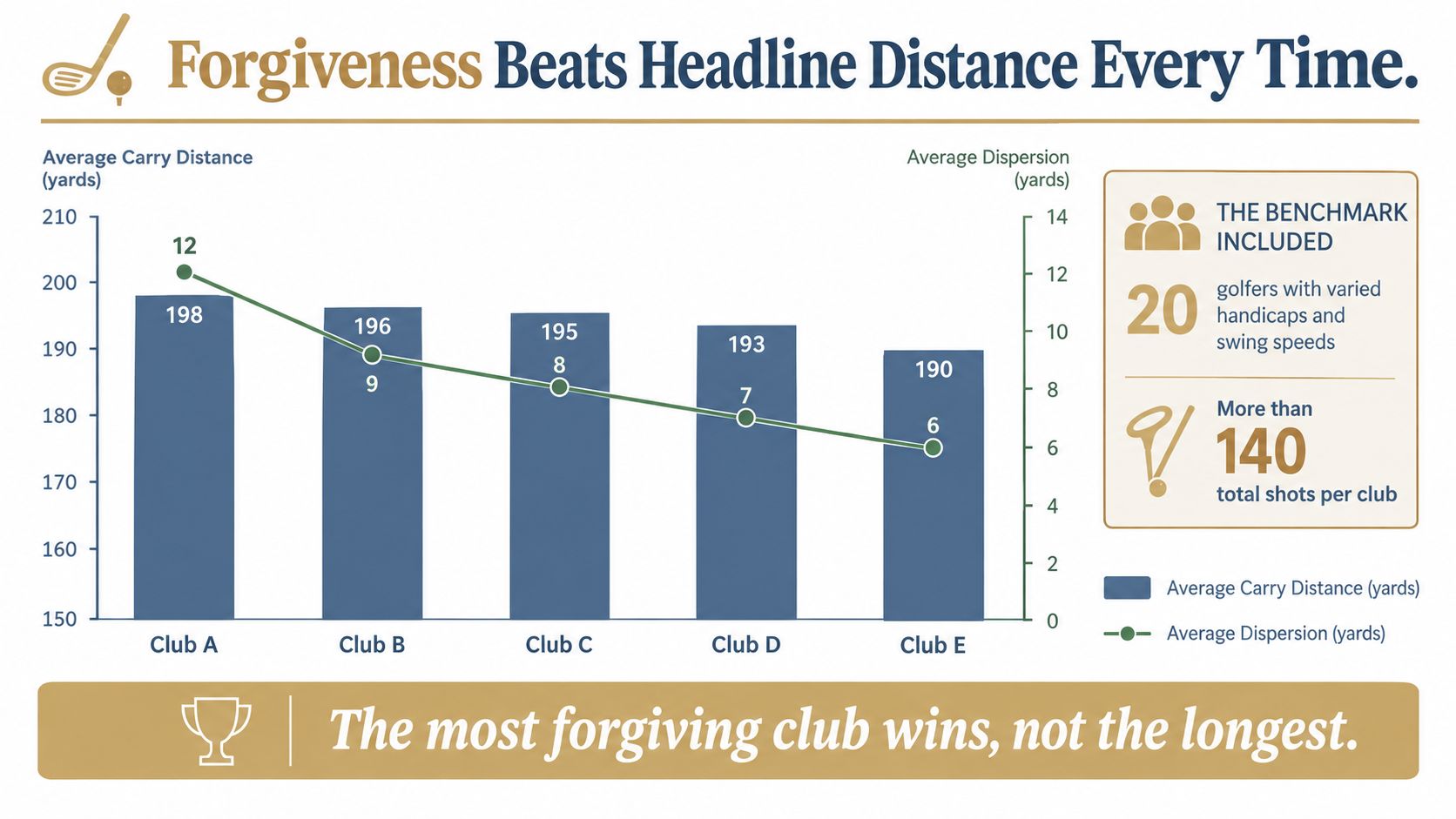
The chart's exact club-by-club values aren't established by the benchmark figures cited here, so they shouldn't be treated as measured results. The decision principle doesn't need invented data: compare valid shots across carry and dispersion, and prefer the club that gives the golfer a more useful cluster rather than a single impressive maximum.
Fitting rule: If two hybrids carry the same distance, choose the one with tighter dispersion, provided its flight suits the shot.
The 2024 results don't prove that every golfer should choose the most forgiving model. They do show why distance alone isn't enough to make that decision. A hybrid that preserves carry and direction when contact varies may produce more usable approaches than one that wins on its best strike.
Building a Test Session That Mirrors Real Lies
A range test from one perfect surface can miss the reason a golfer carries a hybrid: the club has to work from more than a clean fairway lie. A useful session alternates lie types rather than letting one club benefit from a run of ideal shots. That makes it easier to see whether the head's turf interaction suits the golfer's actual delivery.
Run a repeatable session
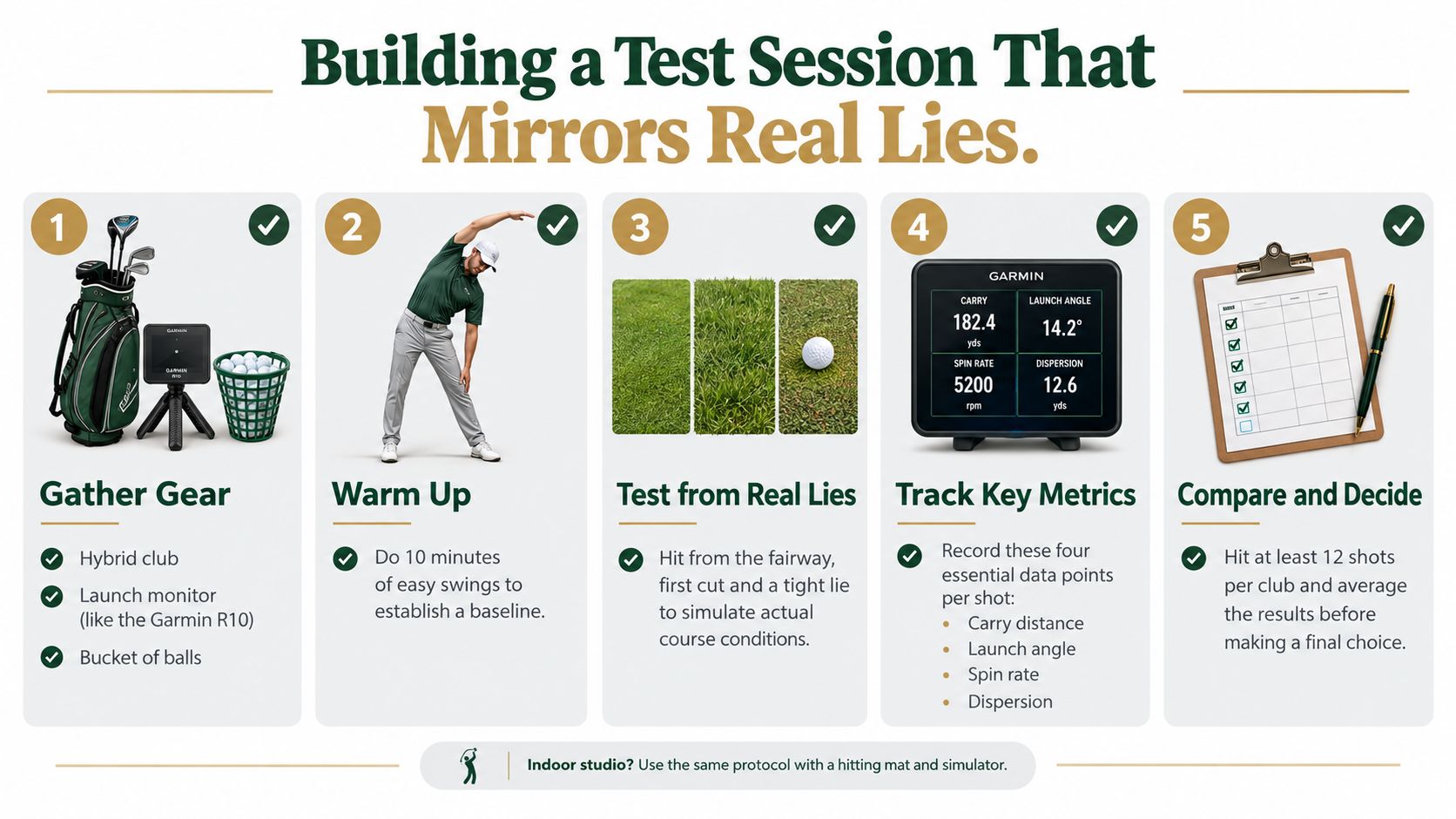
Start with a warm-up, then test each candidate from fairway grass, light rough, and a tight lie where available. Alternate clubs and surfaces so fatigue or a run of favorable contact doesn't define the outcome. An indoor mat can provide a consistent baseline, but it can't fully reproduce how grass and rough affect the sole.
Record average carry, offline dispersion, peak height, spin, descent angle, and strike retention. Don't make the decision from total distance alone. A golfer needs to know whether the hybrid carries its intended distance while maintaining an approach trajectory and a tolerable pattern of misses.
A practical threshold isn't a universal number of yards between clubs. Keep a hybrid when it fills a measurable uncovered carry window, gives a distinct role from the neighboring wood and iron, and produces a shot pattern the golfer can use. If its carry overlaps another club and its trajectory offers no added value, the bag may not need it.
Dialed Golf's desktop practice product works as a launch-monitor data layer, with desktop-first live pairing starting with Garmin R10 and expanding to additional sources, plus import workflows for Garmin, Rapsodo, SkyTrak, FlightScope, Uneekor, GSPro, Awesome Golf, and other systems. The desktop product and consumer app share one golfer record, so the practice data can sit alongside the golfer's on-course record. It's software for receiving or analyzing practice data, not launch-monitor hardware or a swing-analysis camera.
From Launch Monitor Numbers to Course Decisions
A fitting result only earns its keep if it helps choose a shot on the course. The same hybrid can be useful from one lie and awkward from another, so the choice should connect the club's measured flight and sole interaction to the job ahead. The table gives a practical way to translate those results into a decision.
| Course Job | Primary Metric | Recommended Hybrid Trait | Best Lie |
|---|---|---|---|
| Long approach where the ball must stop | Peak height and descent angle | Higher launch with a steep, repeatable descent | Fairway |
| Tee shot where rollout helps | Carry and total distance, with dispersion checked | Lower-launching, lower-spinning flight if it remains controllable | Tee or clean fairway |
| Shot from heavy rough | Strike retention and carry consistency | Wider sole if it moves through the grass without digging | Heavy rough |
| Shot from tight turf | Contact quality and launch consistency | Narrower sole if it suits a steeper attack | Tight lie |
| Approach with a narrow target | Dispersion and proximity | The hybrid with the tighter shot pattern | Fairway or light rough |
These are starting points, not guarantees. A wider sole may help one delivery through rough but feel less predictable on tight ground for another golfer. Likewise, a lower flight can make sense for a tee shot without being the right choice for an approach that needs to hold a green.
A bag-gap analysis framework helps organize the decision around the uncovered distance window. Validate the choice with measured testing, then check it against the lies and trajectories the golfer needs. The best hybrid golf clubs are the ones that fill a real carry gap, survive the golfer's regular course conditions, and produce a repeatable shot under pressure.
Dialed Golf offers a pocket caddy through TestFlight, desktop launch-monitor practice with live pairing and data imports, and Academy tools for facility memberships and front-desk operations. Free web tools stay free, while Golfer Pro applies across the consumer app and desktop; golfers can explore the products and practice workflows at Dialed Golf.