


A bag of new clubs sits beside a stack of range cards. The golfer has practiced regularly, found a few encouraging launch-monitor numbers, and still watches the same misses appear on the course. The handicap has barely budged, and another equipment change is starting to look tempting.
The missing piece may not be another drill. Best practice planning connects a specific problem to an executable session, a trustworthy record, and a decision about what happens next. The useful question isn't whether practice felt productive. It's whether the golfer can show what changed and whether that change survived on the course.
Table of Contents
- Why Most Practice Sessions Don't Move Scores
- Turning a Goal into a Measurable Practice Target
- Structuring a Practice Session That Actually Transfers
- Session Lengths That Fit a Real Schedule
- Running the Session With a Launch Monitor
- Tracking Progress Without Drowning in Data
- Adapting the Framework to Your Role
Why Most Practice Sessions Don't Move Scores
A range session can look organized without producing useful evidence. A golfer warms up, works through the bag, tries a swing cue, and finishes with several satisfying drives. Without a defined target or recorded comparison, there's no reliable way to distinguish improvement from a good finish.
A drill checklist describes activity. A practice feedback loop describes how the golfer will act, measure the result, evaluate it, and adjust. That distinction matters because completing the session and improving performance aren't the same outcome.
Research outside golf illustrates the execution problem. A study of 214 project managers reported that planning quality explained roughly 38% of variance in project-performance outcomes, while implementation effectiveness, including supervision, resource deployment, and monitoring, explained 52% of project-success variance. Those figures aren't golf improvement rates, and they shouldn't be added together, but they support treating execution as a separate responsibility rather than assuming a written plan will carry itself out.
Separate completion from improvement
A practical golf plan needs distinct checks:
- Leading indicators establish whether the intended work happened, including completed sessions, drill adherence, and valid launch-monitor readings.
- Lagging outcomes establish whether performance changed, including dispersion, carry consistency, gapping accuracy, and on-course scoring.
- Review actions establish what the golfer or coach will do with the evidence, rather than merely storing it.
A completed practice session is useful context, not proof of progress. Equally, a disappointing round doesn't automatically invalidate a technical change. The golfer needs enough context to judge whether the problem involved execution, shot selection, or the skill being trained.
Practical rule: A plan isn't finished when the drills are written. It's finished when the review can lead to a clear decision.
The working definition is straightforward: best practice planning specifies observable behaviors, recorded results, assigned responsibility, and scheduled evaluation. Motivation helps a golfer arrive at the range. A repeatable process determines whether the visit supplies evidence worth using.
Turning a Goal into a Measurable Practice Target
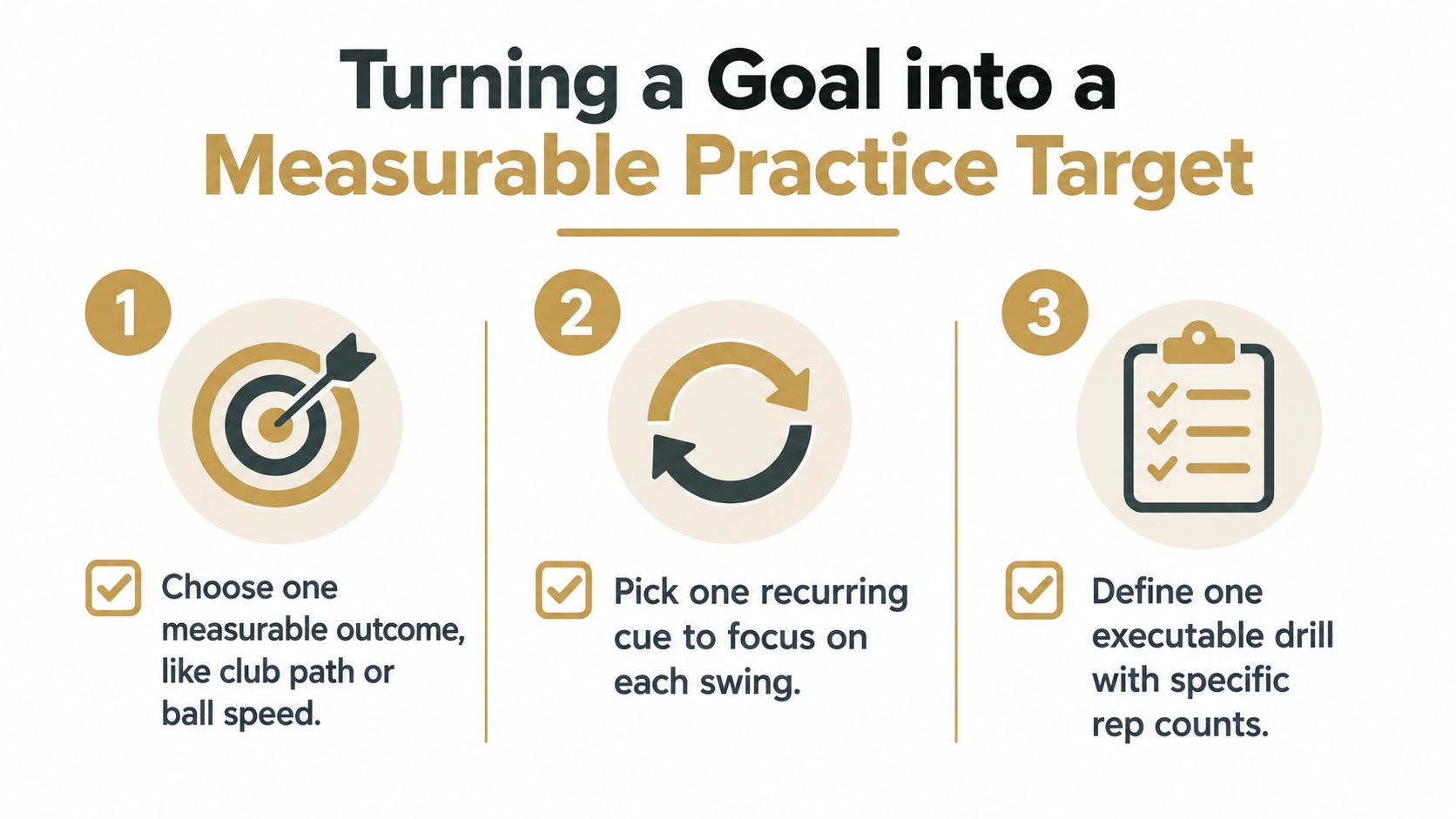
“Fix the driver” leaves too much undecided. It doesn't identify the miss, the measurement, the action, or the point at which the golfer should stop experimenting. A better target connects a course problem to a primary practice outcome.
For a golfer whose drives regularly finish outside the intended landing area, dispersion may be more relevant than peak ball speed. For someone investigating distance, the driver ball speed chart can provide a starting point for framing the question, but a comparison chart shouldn't replace that golfer's own baseline.
The target-setting sequence should remain simple enough to execute during practice.
Write a trigger, not a wish
Implementation intentions specify what happens when a recurring situation occurs. A meta-analysis of 94 independent studies found a medium-to-large effect on goal achievement, d = 0.65, including benefits for initiating action, resisting distractions, and abandoning ineffective strategies. That's a general behavioral finding, not a promised reduction in golf scores.
An example practice instruction is: If a launch-monitor session begins, then complete the prescribed 10-ball baseline before changing equipment. The rep count is a suggested protocol, not a validated universal minimum.
The rest of the specification should answer practical questions:
- Outcome: Which change would address the recurring course problem?
- Response: Which drill or controlled adjustment will the golfer execute after the baseline?
- Success criterion: What recorded result would justify keeping the adjustment?
- Context: Which club, ball, target, and conditions must remain identifiable?
Capture the baseline under the golfer's normal setup. Record the whole prescribed sample, not just the attractive strikes, and distinguish failed readings from genuine mishits. Removing poor shots merely because they look untidy creates an unrealistic starting point.
The primary metric should guide the decision. Supporting measurements can help explain it, but collecting every available field doesn't mean every field deserves a target. A plan with competing priorities can leave the golfer changing technique to improve a number that never addressed the original miss.
Structuring a Practice Session That Actually Transfers
Technical repetition belongs in practice, but it shouldn't occupy the entire session. A golfer also needs to select a club, choose a target, commit to a shot, and manage the consequences. Those decisions should appear before the next round, not only during it.
A study of golf coaches published in 2025 concluded that coaches should use an explicit decision-making framework in practice planning. The practical implication is to design tasks around choices as well as movement, rather than assuming that better repetition alone proves readiness for play.
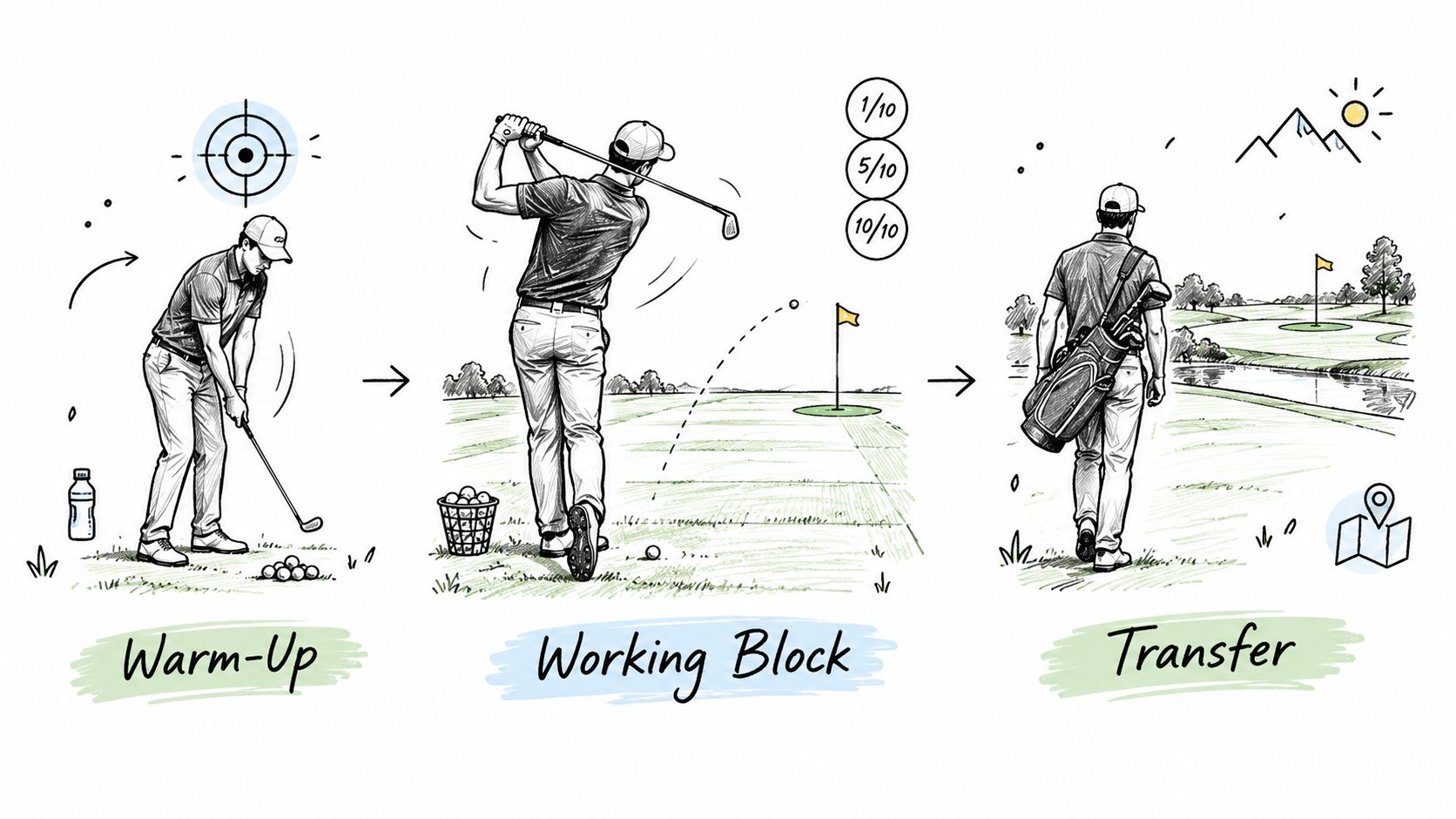
The session structure separates finding a reference feel from applying it under changing demands.
A worked wedge-session example
Consider a suggested 45-minute session aimed at tightening dispersion inside 100 yards. These are planning parameters, not evidence that this duration or distance produces a particular improvement.
- Warm-up: Use comfortable wedge shots to establish contact and a reference feel. Keep this block brief enough that preparation doesn't consume the working time.
- Working block: Complete a prescribed 10-ball set to a selected target, record the pattern, and repeat the task only while the intended cue remains clear. Keep the club and target stable while evaluating the adjustment.
- Transfer block: Change targets and require a club-and-shot decision before each attempt. Include a landing-area constraint and identify an acceptable miss rather than treating every flag as equally safe.
The time split should favor the working block while protecting a meaningful transfer block and a closing review. If setup runs long, reduce repetitions rather than deleting the decision-based work.
Judge the task, not the label
Random practice isn't automatically the right choice for every problem. A golfer who can't yet produce the intended contact may need stable repetitions before varying the task; a golfer who performs well under stable conditions may need more choices and less rehearsal.
Simulated lies should be identified as simulations. A flat hitting mat doesn't reproduce an uneven stance or turf interaction because the screen displays a difficult lie.
At the close, record whether the pattern held after the target changed. During the next round, note whether the relevant shot improved in context. Practice improvement earns an on-course test, not an automatic claim of lower scores.
Session Lengths That Fit a Real Schedule
A workable plan starts with the available window, including setup and review. It doesn't begin with a full training menu and hope everything fits. Travel, equipment preparation, interruptions, and fatigue all compete with hitting time.
Schedule optimism deserves deliberate attention. Research on the planning fallacy found predicted and actual completion times correlated at 0.77, yet participants still finished systematically late and completed less than half of the total work during the first period on average. The lesson isn't that forecasts are useless. It's that golfers should compare planned work with actual completion rather than trusting the same optimistic estimate repeatedly.
Session Lengths and What to Prioritize
The following are suggested templates, not tested prescriptions. Their time splits are deliberately qualitative so setup requirements and the golfer's pace can determine the allocation.
| Session length | Primary block | Drill count | Review step |
|---|---|---|---|
| 20 minutes | Brief preparation, dominant working block, short target-change test | Single focused drill | Record the target result and next action before leaving |
| 45 minutes | Short warm-up, substantial working block, protected transfer block | Primary drill followed by a decision-based task | Compare controlled and transfer performance |
| 90 minutes | Baseline, focused work, recovery pause, extended course simulation | Limited drill menu with deeper evaluation | Review context, results, and the next session's priority |
Make the sacrifice explicit
The short session sacrifices breadth. It suits a clear cue and a single measurement question, not an equipment comparison followed by a full-bag assessment. Its advantage is that the golfer can repeat it without needing an unusually free afternoon.
The middle-length session allows technical work and transfer without encouraging an endless drill list. The longer session permits deeper investigation, but extra time shouldn't become permission to change clubs, balls, technique, and targets without documenting why.
A shorter session completed with a useful review is preferable to a longer session abandoned before the evidence is recorded.
During a busy playing period, reduce practice scope before sacrificing recovery or skipping review. When more time becomes available, expand the task only if the existing plan identifies a question that needs the extra work.
Running the Session With a Launch Monitor
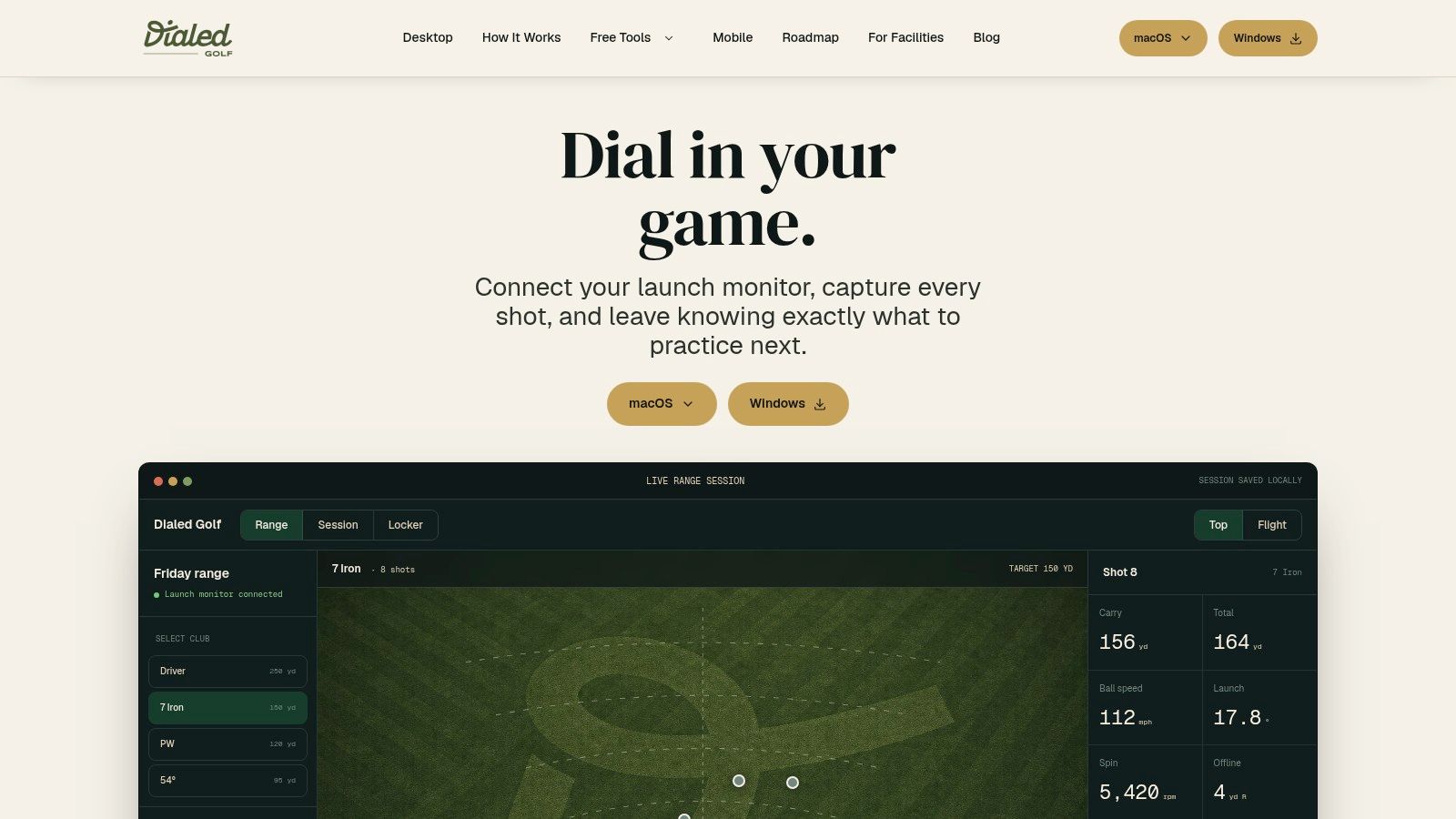
At a range or garage simulator, the golfer should decide how the session will enter the record before hitting. The desktop practice experience handles live connection where supported and exported files where it isn't. The launch-monitor app workflow provides a useful entry point for organizing that process.
The desktop view is relevant to the recording workflow, rather than a substitute for a session objective.
Choose the correct connection path
Live pairing is desktop-first, beginning with Garmin R10 support, with additional devices intended to follow. Mobile live pairing is later, so a golfer shouldn't assume that desktop connectivity establishes current mobile support.
For exported sessions, the published CSV workflow uses upload, map, validate, and submit, including batch submission, and supports imports from Garmin, Rapsodo, SkyTrak, FlightScope, Uneekor, GSPro, Awesome Golf, and others. Import support is not a claim of live compatibility with every named source.
- Upload: Select the exported session file associated with the intended practice.
- Map: Match source columns to destination fields such as carry, ball speed, launch, club, and date.
- Validate: Resolve broken headers, shifted delimiters, blank cells, and values mapped into the wrong fields.
- Submit: Send the validated rows in batches into the golfer record.
Validation belongs before comparison. A carry value assigned to the wrong destination field can make a clean-looking record unsuitable for evaluating progress.
The accompanying video provides another view of the practice-software workflow.
After each block, the golfer should preserve the intended target, club, drill cue, and any equipment or environmental change. Those contextual notes can sit alongside the imported measurements; they shouldn't be assumed to appear automatically in every export.
A clean post-session record identifies the session date, measured fields, baseline and working results, missing readings, transfer task, and review decision. It doesn't need an invented improvement claim. Its purpose is to make the next comparison interpretable without relying on memory.
Tracking Progress Without Drowning in Data
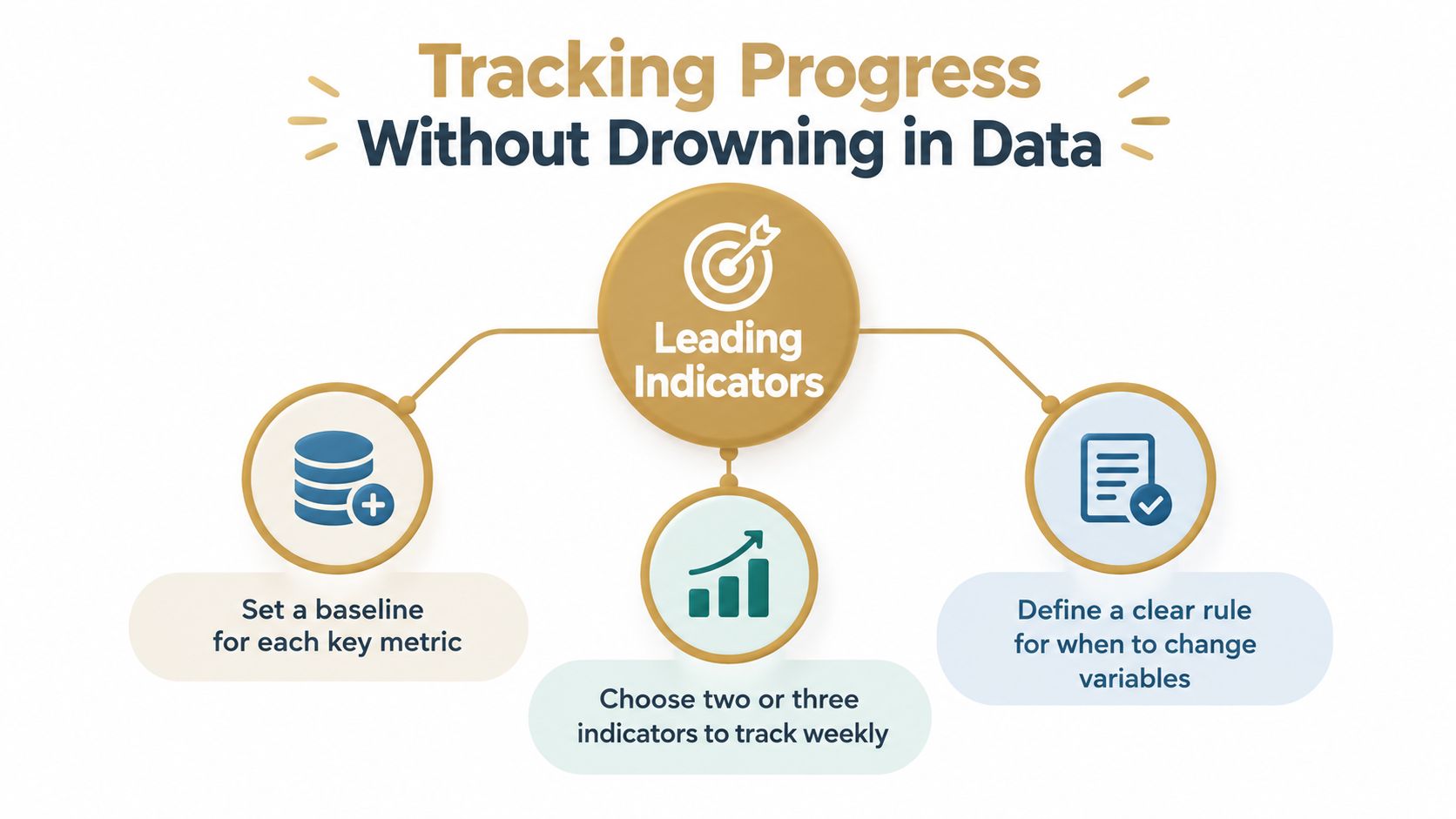
A dashboard should support a decision, not display every measurement with equal importance. The golfer needs to know whether the planned work happened, whether the chosen outcome moved, and whether the evidence is credible enough to justify an intervention.
Keep the categories distinct. Session completion and valid readings are execution checks; dispersion and carry consistency are performance outcomes. Calling every useful measurement a leading indicator makes it harder to see whether the golfer has a training problem or a performance problem.
The tracking structure should connect those categories without turning them into a scoreboard of unrelated targets.
Establish a rule before reacting
A suggested decision rule is to change a single variable only when the rolling average misses the chosen target across two consecutive sessions. This is an example review protocol, not a universal statistical threshold. Its value is that the golfer commits to a response before a frustrating shot invites an impulsive adjustment.
The target and acceptable variation should come from the golfer's baseline and the practical demands of the shot. A tighter target isn't automatically useful if the measurement conditions don't support that level of precision.
A compact review can use these checks:
- Execution evidence: Was the prescribed work completed, and were enough readings valid to interpret the task?
- Outcome evidence: Did the primary measurement change under comparable conditions?
- Context evidence: Did the ball, club setup, environment, or task change?
- Decision record: Will the golfer retain the approach, repeat the test, or modify a named variable?
Keep comparison definitions stable
For gapping work, a structured gap analysis helps frame the relationship between clubs rather than chasing an isolated long shot. The comparison still needs consistent definitions, especially when distinguishing carry from total distance.
Review standard: Missing or anomalous data should prompt an investigation, not a convenient explanation for the result.
The common failure isn't insufficient data. It's changing several variables, recording only highlights, or waiting until the end of a training period to discover that sessions weren't comparable. A small, well-maintained record is more actionable than a large collection that can't answer what changed.
Adapting the Framework to Your Role
Dialed Golf is three products, one golfer record, and one Golfer Pro plan across app and desktop, with a separate facility subscription for Dialed Academy. The planning logic stays consistent, but the person responsible for execution changes. A solo golfer manages the session; an instructor manages the learning task; an operator manages the conditions that make recurring practice possible.
Solo golfers and equipment testers
For a personal launch-monitor owner, the desktop product supports practice at the range or garage simulator through the connection and import paths described earlier. The useful workflow is to choose a course problem, run the prescribed task, preserve the result, and assign the next action before closing the session.
Equipment testers should define the question before changing the setup. If the purpose is to compare balls or club configurations, keep the practice task identifiable and record each intervention. A favorable strike with a new setup doesn't establish that the setup solved the recurring miss.
The consumer app serves a different setting: it's an on-course pocket caddy, not a conventional scorecard utility. Its published release and connection status identifies the iOS companion as available through TestFlight now, not generally available in the App Store. Practice findings should inform the decisions tested during play without confusing the mobile and desktop roles.
Instructors and coaches
An instructor should assign more than a drill name. The player needs the intended outcome, an executable cue, the required record, and a reason to contact the coach before making further changes.
A practical handoff distinguishes what the player controls from what the coach evaluates. The player completes and records the task; the coach checks adherence, interprets the trend, and decides whether the next assignment needs a technical adjustment or a more representative challenge.
This also separates lesson performance from independent execution. If a player succeeds with continual prompting but can't reproduce the task alone, adding more difficult targets may be premature. The assignment should expose that difference rather than conceal it.
Academy and range operators
Facility planning extends beyond the golfer's drill. Operators need lesson availability, bay access, recurring memberships, and follow-up responsibilities to support a member's practice journey.
Dialed Academy combines memberships and front-desk operations through recurring dues, lesson scheduling, bay scheduling, point of sale, and reporting in a member account. Its flat platform fee is $99.99 per month or $999.99 per year, and the club keeps its dues, as well as its lesson and retail revenue; this isn't a revenue-sharing arrangement. Academy handles facility administration rather than replacing the golfer-facing subscription.
Golfer Pro is $9.99/week, $29.99/month, $149.99/6 months, or $249.99/year across app and desktop, separate from Academy. Free web tools stay free and serve as the top of the funnel, not Pro. Dialed Golf is practice and on-course software, not launch-monitor hardware, a swing-analyzer camera, the apparel business at dialedgolf.com, or godialed.ai.
A starter plan for the next seven days
The following is a suggested starting checklist, not a promised improvement schedule:
- Measurable outcome: Select the recurring miss that deserves attention.
- If-then trigger: Write the situation that starts the prescribed action.
- Session template: Reserve a 45-minute practice window with working and transfer blocks.
- Review step: Record the result and whether it remained useful when the task changed.
- Decision rule: Specify the evidence required before adjusting the plan.
Memory-only reviews, premature equipment changes, indiscriminate metric chasing, and skipped evaluation can undo otherwise sensible practice. Best practice planning is a system, not a document, and its practical value depends on what the golfer, coach, or operator does after reviewing the evidence.
Dialed Golf offers desktop launch-monitor practice, an on-course pocket caddy, and facility administration through Dialed Academy. Golfers, instructors, and operators can visit Dialed Golf to explore the workflow that fits their role and build the next practice plan around a measurable outcome, a recorded session, and a specific review decision.