

You're standing in the pro shop, comparing sleeves with claims about distance, feel, control, and spin. The package doesn't tell you whether a ball will help with your high-spinning driver, keep an iron shot on a firm green, or behave predictably when the course is wet.
That's why the useful answer to which golf ball is right for me isn't a brand name or a compression chart. It's a ball that fits your launch, spin, strike patterns, short-game needs, and the conditions you play in.
Table of Contents
- Why Finding the Right Golf Ball Feels So Hard
- What Actually Makes Golf Balls Different
- How to Test Golf Balls with a Launch Monitor
- How Weather and Course Conditions Change Your Ball Choice
- Balancing Distance and Control for Your Shot Patterns
- Using Dialed Golf Tools to Compare Balls
- Building Your Personal Ball Selection Rule
Why Finding the Right Golf Ball Feels So Hard
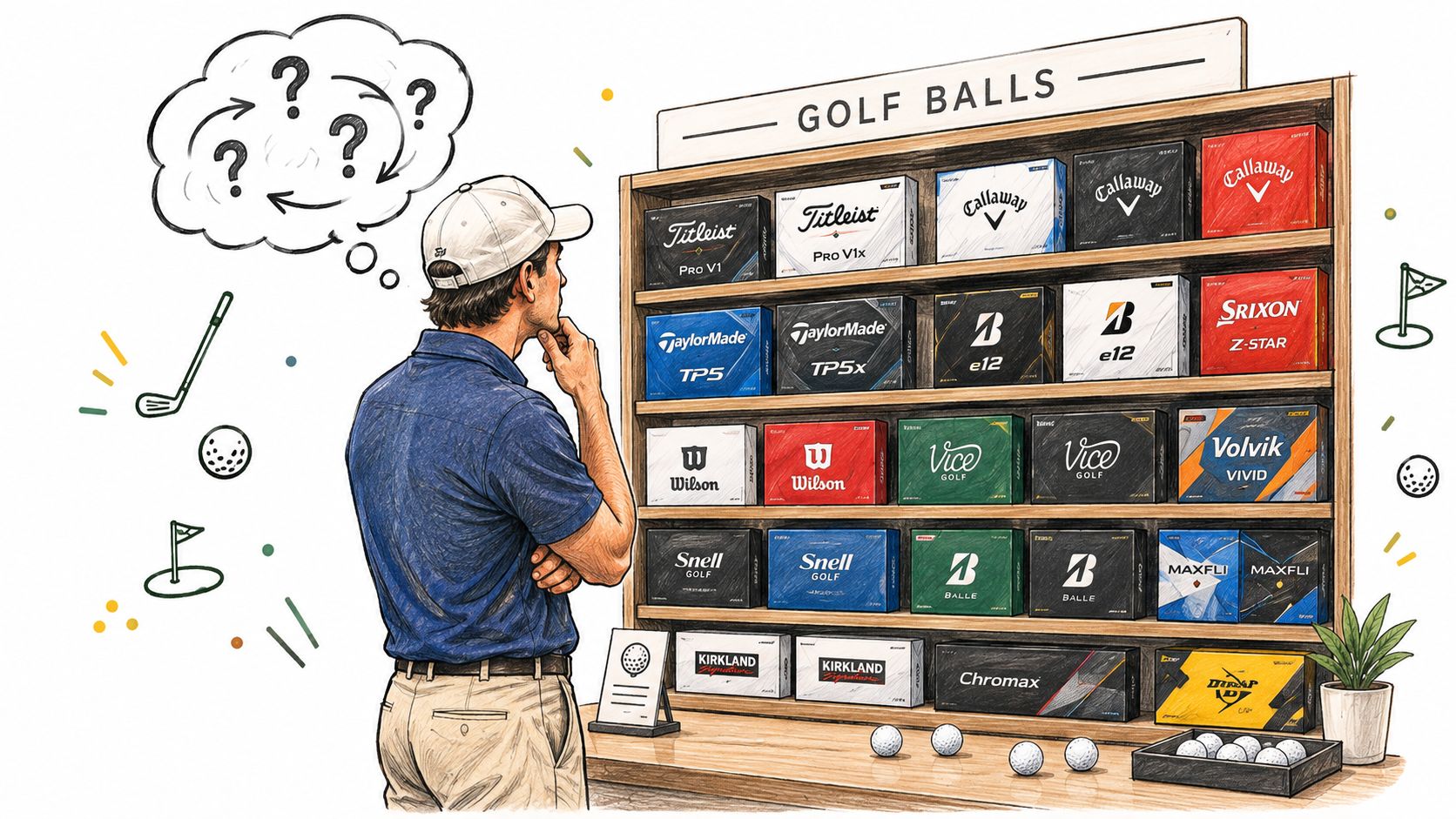
The shelf offers a dozen ways to promise more: longer off the tee, softer at impact, more stopping power, better feel. Those claims may describe real design priorities, but they don't tell a golfer what happens with their own driver delivery or wedge contact. Without a controlled comparison, it's easy to buy based on packaging, price, or a tour player's preference and never know whether the ball suits the game.
The first useful fact is that competition-approved balls operate within the same global equipment limits. Under the USGA and R&A golf-ball rules, a ball can weigh no more than 1.620 ounces, or 45.93 grams, and its diameter can't be smaller than 1.680 inches, or 42.67 millimeters. The rules also cap initial velocity at 250 feet per second, with a 2% testing tolerance, and limit total distance to 317 yards plus a 3-yard tolerance under a test using 120-mph clubhead speed.
Those restrictions don't mean every ball flies the same distance for every golfer. Players deliver the club differently, and their launch, spin, strike quality, and landing conditions vary. A ball that goes farther in one person's test hasn't escaped a universal limit. It's performing differently for that player and that shot.
Replace the brand question with a fitting question
The practical comparison is between a ball's performance across your bag. A model that reduces driver spin may help a player whose tee shots climb and lose distance. The same model could be a poor fit if its iron and wedge performance leaves approach shots short of the stopping power the player needs.
That makes ball selection a data problem, not a brand problem. Start with measured driver spin and launch, then check whether the ball gives you useful approach height, descent, and greenside control. Pay attention to your common misses, too. A player who often misses greens long has a different priority from one whose approaches release past the target.
A launch monitor won't make the decision on its own. But it can replace vague impressions with comparable numbers, as long as the test holds the club, alignment, temperature, and strike quality as steady as possible. The right ball isn't necessarily the one with the strongest single result. It's the one whose trade-offs make sense for the golfer's real shots and typical course conditions.
What Actually Makes Golf Balls Different
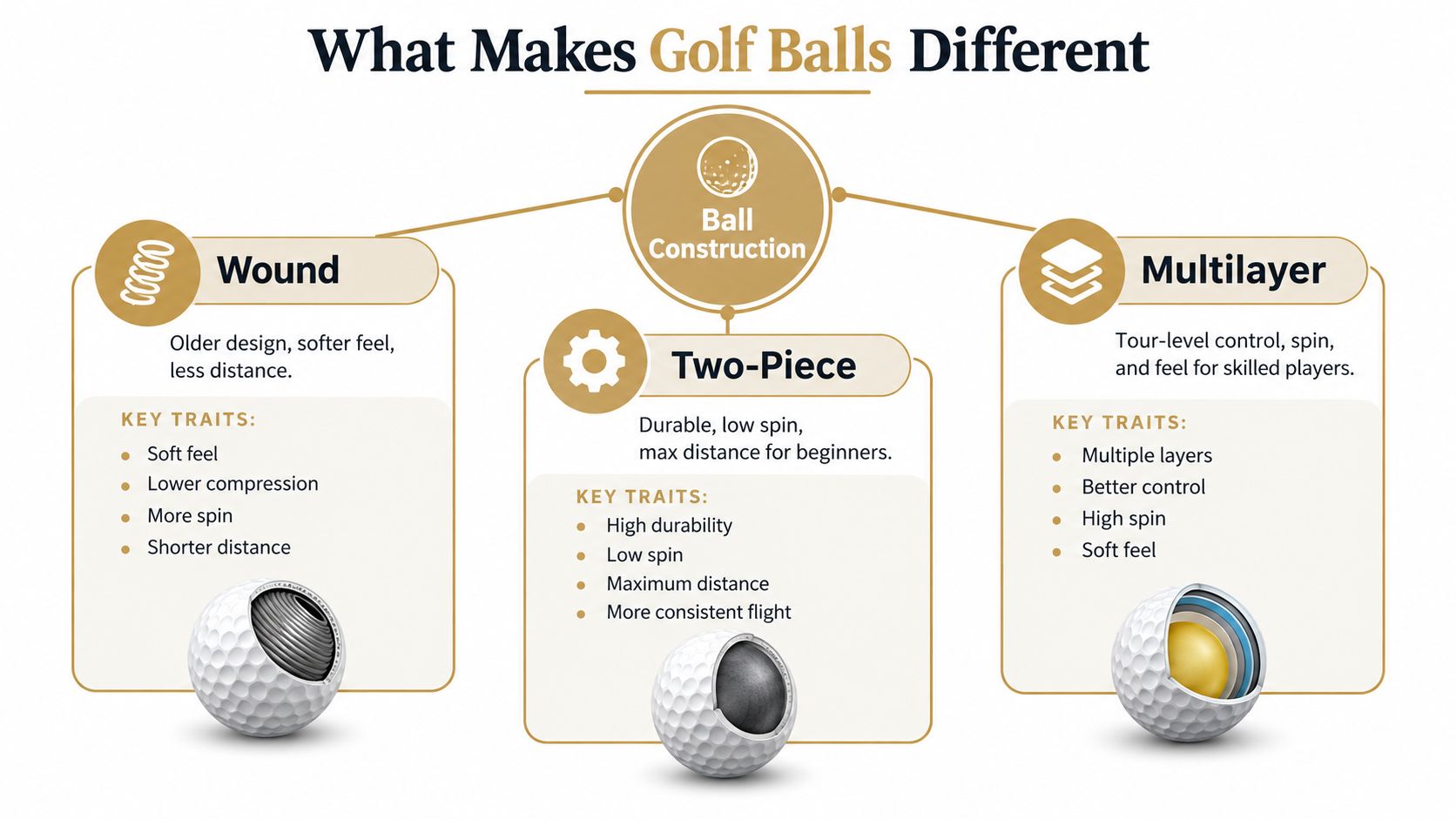
Since the basic dimensions and test limits are tightly constrained, ball-to-ball differences come mainly from construction, cover, compression, and aerodynamics. These design choices affect how the ball launches, how much it spins with different clubs, how it flies through the air, and how it feels at impact.
Construction matters because driver distance and approach control aren't independent. USGA equipment testing shows that multilayer balls generally preserve distance better than wound designs as spin changes. Some aerodynamic designs can also reduce the distance penalty associated with high spin. That doesn't make one construction automatically right for every golfer. It does show why comparing only the package's compression label or a single driver shot misses important differences.
Read the design, then test the result
A ball's core and layer structure influence how it responds to impact. Its cover affects feel and interaction with the clubface, particularly on shorter shots. Dimple aerodynamics shape flight. These features work together, so a label describing one characteristic can't stand in for actual performance through the bag.
Compression marketing is an especially incomplete shortcut. It describes a design characteristic, but it doesn't tell you whether the ball gives your driver the launch and spin you want, or whether your wedge shots arrive with enough height and stopping power. Rather than assume a softer or firmer model must be better, compare measured outcomes with the clubs you use.
Choosing a ball resembles choosing tires: the brand name alone doesn't settle the fit. The road, conditions, and driver matter. On a golf course, the equivalent is your swing, strike pattern, typical weather, and the shots you need the ball to handle.
Practical rule: If driver spin is excessive, test a multilayer option designed to reduce driver spin. If driver spin is already controlled but approach shots don't stop reliably, give iron and wedge performance more weight.
The point isn't to memorize construction categories. It's to understand why a ball can perform differently with a driver and wedge, then test those differences rather than letting compression claims decide the fitting.
How to Test Golf Balls with a Launch Monitor
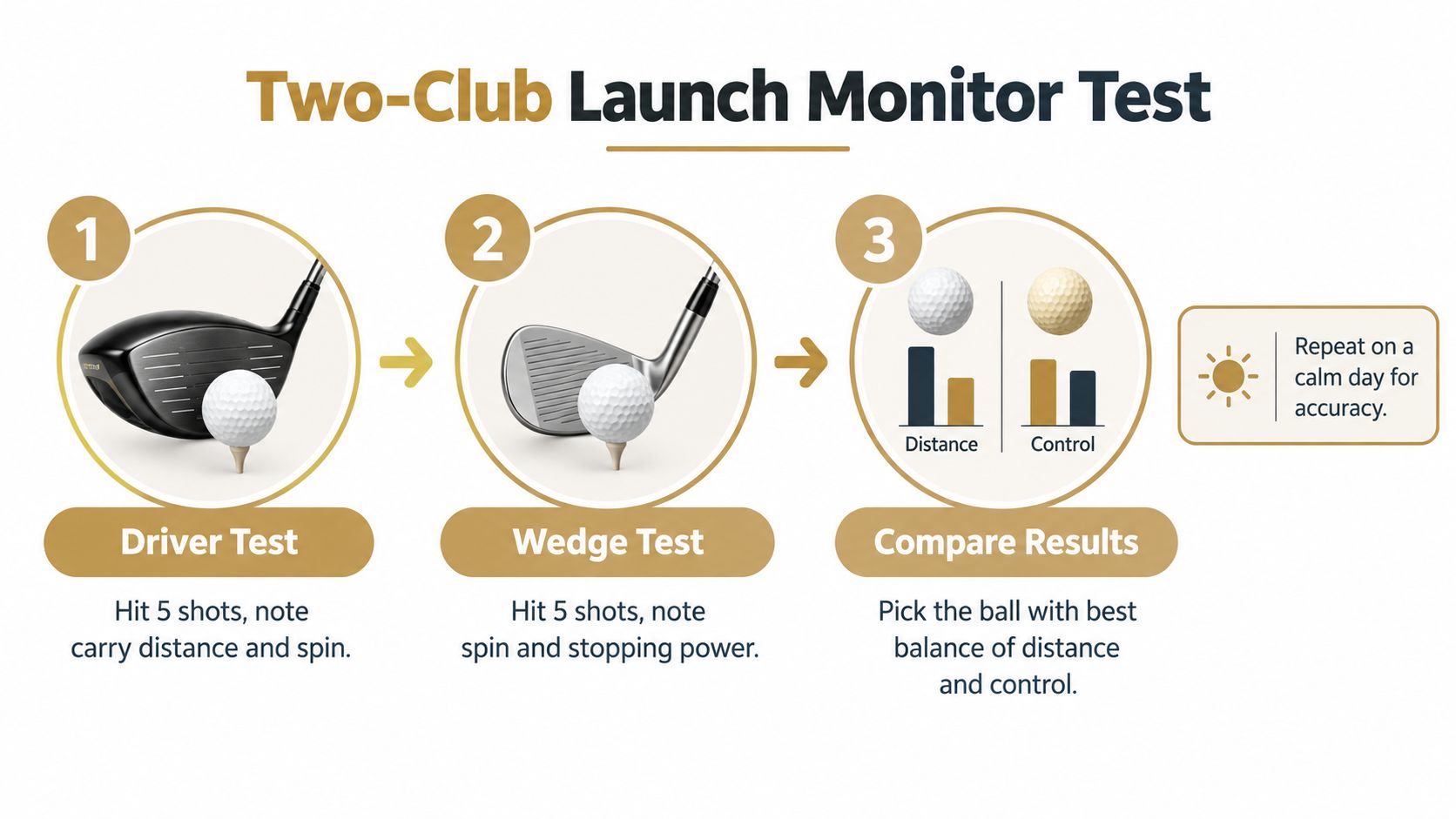
A useful test compares balls under repeatable conditions, not one excellent strike against one mishit. Keep the club, alignment, temperature, and setup consistent, and try to keep strike quality similar from ball to ball. The USGA research-and-test primer describes a two-club fitting approach that balances tee efficiency with control into the green.
Start with the driver
For each candidate, record ball speed, launch angle, backspin, carry, total distance, and dispersion across at least 8–10 centered strikes. Look for reduced spin-related distance loss without a materially lower launch or a wider shot pattern. A single long drive isn't enough to establish a reliable advantage.
Discard obvious mishits rather than letting them dominate the comparison, but don't cherry-pick only the best shots. The goal is to compare representative strikes from each ball. Keep the order consistent or alternate candidates, so fatigue or warming up doesn't unfairly favor one model.
Check approach and partial-wedge performance
Next, test a 7-iron and a partial wedge. Record peak height, descent angle, carry variance, and landing spin. Backspin contributes to lift in flight and braking on landing, so a ball that appears efficient off the tee can still leave an approach pattern that runs out too far.
A clear test sequence helps keep the session focused:
- Label each candidate. Track the ball model alongside every set of shots.
- Compare like with like. Use the same club and setup for each ball, and note any meaningful change in strike quality.
- Review the pattern. Compare typical results and dispersion, not just the longest carry or highest spin reading.
A launch-monitor practice setup for the driving range can make this kind of comparison easier to repeat. The equipment is only part of the process. If conditions or strike quality change substantially between candidates, the session may tell you more about the test than the ball.
For a visual walkthrough of a structured comparison, watch the fitting sequence below.
How Weather and Course Conditions Change Your Ball Choice
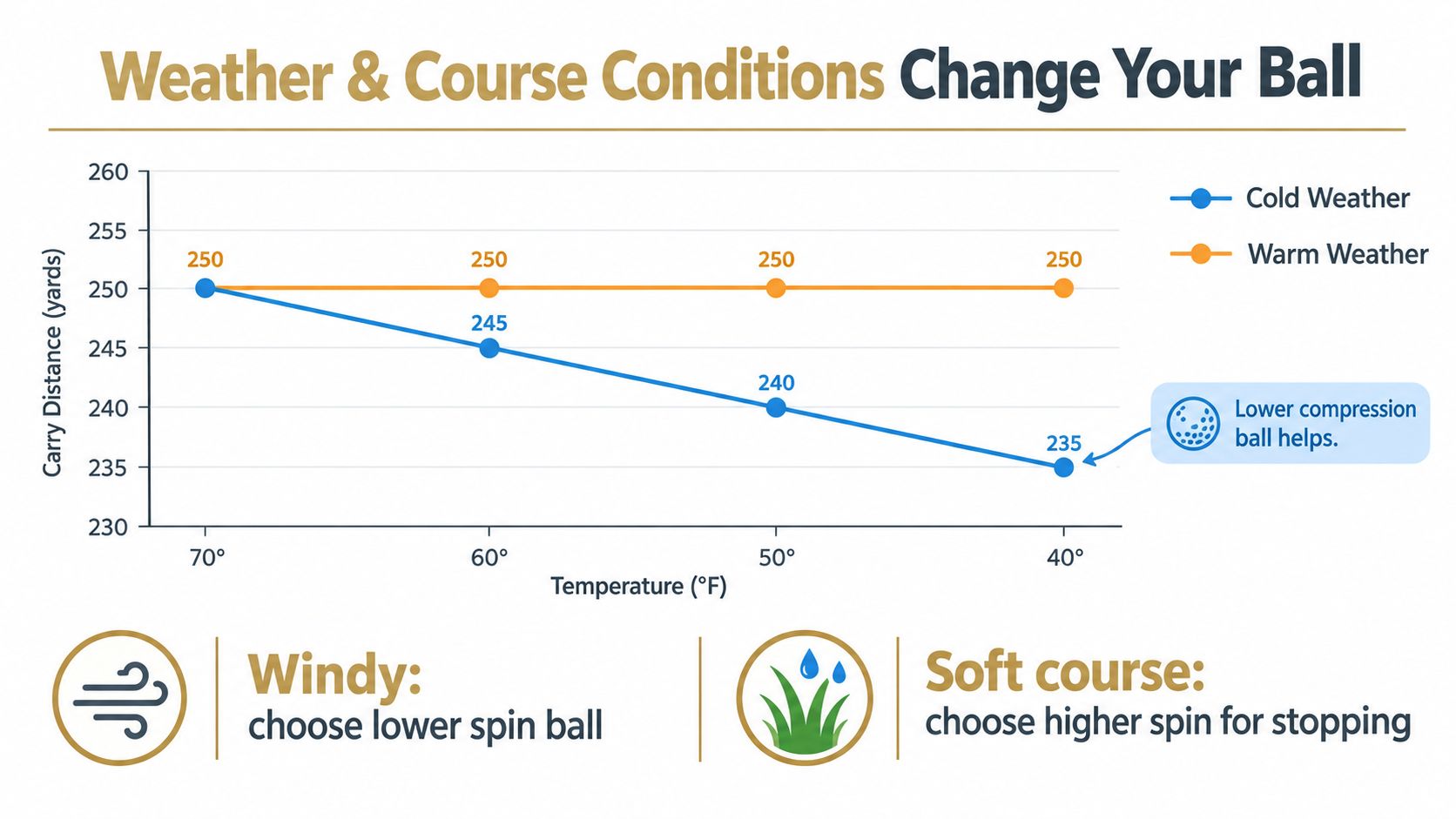
A ball fitting isn't necessarily permanent. The same player can see different outcomes when the air is cold, the ball or clubface is wet, or the ground changes how shots land and roll. A peer-reviewed analysis of Masters data found that cooler conditions increased score variability. Moisture can act as a lubricant between the clubface and ball, reducing iron spin and control, while humidity affects distance because moist air is less dense.
Wet testing can change the comparison
Recent robot testing found wet-condition ball-speed losses ranging from under 1 mph for the best-performing balls to more than 4 mph for the worst, a difference of over 4.5%. Moisture also reduced spin while increasing launch angle. That's a substantial reason to avoid treating a dry driver session as the complete verdict.
The same issue shows up on approach shots. When conditions change the interaction between ball and face, a golfer may see a different combination of launch and spin than in a dry test. A model that performs well in clean conditions may not preserve the same advantage when the course is damp.
Track relative performance in your conditions
A condition-specific setup could be worthwhile for a golfer who regularly moves between dry and wet courses or sees substantial seasonal changes. The practical test doesn't need a complicated theory: compare the same candidate balls under the conditions that matter, and log carry, peak height, spin, and dispersion. Keep the clubs and strike standard as consistent as possible.
The useful question is whether the ranking between candidates changes for that golfer. Absolute distance can shift with temperature and moisture, so a generic manufacturer claim doesn't answer whether one ball remains preferable to another in the golfer's own conditions. Record what happens rather than assuming that any category, including soft-feeling balls, automatically performs best in cold or wet weather.
Balancing Distance and Control for Your Shot Patterns
A ball choice should be judged by its cost across the golfer's common shots, not just its best driver result. One candidate may produce a compelling carry number but leave more approach shots running past the target. Another may give up some tee efficiency while producing a trajectory and stopping response that better match the player's scoring needs.
The key question is practical: how much tee distance is worth trading for approach control or a tighter pattern? There isn't a universal answer. A player who frequently misses fairways may value dispersion and predictable recovery shots more than a small carry gain. A player who finds the fairway consistently but struggles to hold greens may give more weight to iron and wedge results.
| Test Area | Metric to Record | Why It Matters |
|---|---|---|
| Driver | Ball speed, spin, carry, total distance, dispersion | Shows tee efficiency and whether distance comes with a wider pattern |
| Iron | Carry variance, peak height, descent angle | Helps assess approach consistency and the trajectory into the green |
| Partial wedge | Landing spin and stopping response | Tests control on scoring shots |
| Wet conditions | Ball speed, launch, spin, dispersion | Shows whether moisture changes performance between candidates |
| Durability and replacement | Cover condition and lost-ball cost | Keeps the choice realistic for how the ball is actually used |
Wet performance deserves its own line on that scorecard. Wet-condition testing from damp rough found substantial spin loss and unpredictable responses, with reported reactions varying by thousands of RPM. That means a dry driver result may not predict what happens when a golfer needs a controlled wedge from damp rough.
Weight the matrix by actual misses
Don't give every test equal importance by default. Look at the shots that most often cost this golfer strokes, then prioritize the metrics connected to those shots. If a player's common miss is a high, spinning drive, driver spin and dispersion deserve close attention. If the more damaging pattern is an approach that releases beyond the target, iron descent and wedge control should carry more weight.
A driver ball-speed chart for interpreting launch-monitor results can help put one part of the comparison in context. It still can't choose the ball on its own. The final call should reflect the player's full pattern, including wet conditions, durability, and how easily the ball can be replaced when it's lost.
Using Dialed Golf Tools to Compare Balls
Dialed Golf supports a ball-fitting process across practice and play, with three products, one golfer record, and one Pro plan. Each product serves a different part of the golfer's routine: the consumer app acts as a pocket caddy on the course, the desktop product supports launch-monitor practice, and Dialed Academy provides memberships and front-desk tools for ranges and clubs.
For a ball comparison, begin with free web tools to organize the decision and establish a starting point. Those tools stay free. They're the entry point for golfers who want to make a more informed choice, not a Pro feature.
Use desktop for launch-monitor practice
At the range or in a garage simulator, Dialed Golf's desktop practice product supports a live pair first with Garmin R10, with support expanding, and CSV or other imports from Garmin, Rapsodo, SkyTrak, FlightScope, Uneekor, GSPro, Awesome Golf, and more. A golfer can use that workflow to organize ball-test sessions and compare recorded launch-monitor results rather than relying on memory between rounds.
For a practical overview of the launch-monitor app workflow, consider how the desktop product fits into a repeatable session: capture the test, keep the ball labels attached to results, and review the driver and approach data together. Live pair is desktop-first. Mobile live pairing is later, so the mobile app shouldn't be described as the current live-pair option.
Match the product to the fitting stage
Use the consumer app as the on-course pocket caddy, then use desktop practice to review launch-monitor sessions. Ranges and clubs can use Dialed Academy for memberships and a front desk; memberships cost $99.99 per month or $999.99 per year, and the club keeps its dues.
Golfer Pro works across the app and desktop. Its options are $9.99 per week, $29.99 per month, $149.99 for six months, or $249.99 per year. The app is currently available through TestFlight beta access, not as a general App Store release. Apple describes TestFlight as a beta-testing channel, with builds available to testers for up to 90 days before they expire (Apple's TestFlight overview).
Building Your Personal Ball Selection Rule
A useful ball-selection rule starts with the golfer's most costly pattern, not a swing-speed label. If tee shots lose distance through excess spin or spread too widely, give driver launch, spin, and dispersion more weight. If approaches and partial wedges regularly fail to stop where intended, favor the candidate that gives those shots a more useful height and landing response.
Test in the conditions the golfer plays. A ball that suits a dry, warm fitting session may not remain the preferred choice when the course is cold or wet. Keep the comparison focused on relative performance between candidates, and revisit it when seasonal conditions or course patterns change.
Choose the ball that improves the shots causing the most trouble, without creating a worse problem somewhere else.
The resulting rule should be simple enough to use again: identify the dominant miss, name the metrics that relate to it, compare candidates under controlled conditions, and check whether the apparent gain holds across driver, iron, and wedge shots. That's a more reliable answer to which golf ball is right for me than choosing by compression, price, or popularity alone.
Dialed Golf brings the on-course consumer app, desktop launch-monitor practice, and Dialed Academy together around one golfer record, with free web tools that stay free. Use Dialed Golf to support a more repeatable ball comparison and carry the results from practice into play.