


A golfer pulls into the range after work, buys a bucket, and waits for a bay to open. Next to the counter, a sign offers a monthly plan. The price looks simple, but the decision isn't. Does the plan guarantee a place to practice at 6 p.m., or does it only remove the per bucket charge? That gap between sticker price and usable practice is where a driving range monthly membership either earns its keep or disappoints.
Table of Contents
- Why Monthly Range Access Changes the Practice Decision
- What a Driving Range Monthly Membership Includes
- How Monthly Membership Pricing and Benefits Work
- Comparing the Main Membership Types
- When a Membership Becomes Worthwhile
- Access Rules That Determine Real Member Value
- How Dialed Academy Supports Membership Operations
- How Dialed Golf Products Fit Around the Membership
Why Monthly Range Access Changes the Practice Decision
One golfer visits twice a month for a relaxed evening session. Another stops by three mornings a week before work. Both see the same monthly fee, yet they're buying very different things. The first golfer buys convenience. The second buys a routine.
A bucket purchase ends when the balls run out. A membership changes the question from "is this bucket worth it today?" to "does this facility fit the way practice already happens?" That's a season pass mindset. The value depends less on balls hit in a single visit and more on whether access lines up with real schedules.
What Actually Shifts
Timing matters first. A golfer who can practice at midday may never face a wait, while a golfer limited to evenings and weekends competes for the same crowded bays as everyone else. The lower fee doesn't help if the preferred hour is full.
Visit rhythm matters next. Short, frequent sessions suit membership well because there's no pressure to stretch one bucket into a long session. A golfer working through a structured practice plan, for example with a launch monitor app for range sessions, often benefits from coming back often rather than hitting more balls at once.
A membership doesn't lower the cost of practice by itself. It lowers the friction of showing up, and only pays off when showing up stays easy.
Operators face the mirror image of that choice. Every membership sold promises future access, so the facility has to honor that promise during its busiest hours, not just its quiet ones. A plan that looks generous on a flyer can strain capacity fast.
The word unlimited deserves skepticism from both sides. It describes billing, not physical space. Bays, mats, lighting, and staff still have limits, and those limits decide whether the membership feels like freedom or a queue.
What a Driving Range Monthly Membership Includes
A driving range monthly membership is a recurring plan where a golfer pays regular dues in exchange for defined access to practice facilities during each billing month. It's closer to a gym membership than to a single purchase. The payment continues whether the golfer visits often or not, and the benefits apply only within the terms the facility sets.
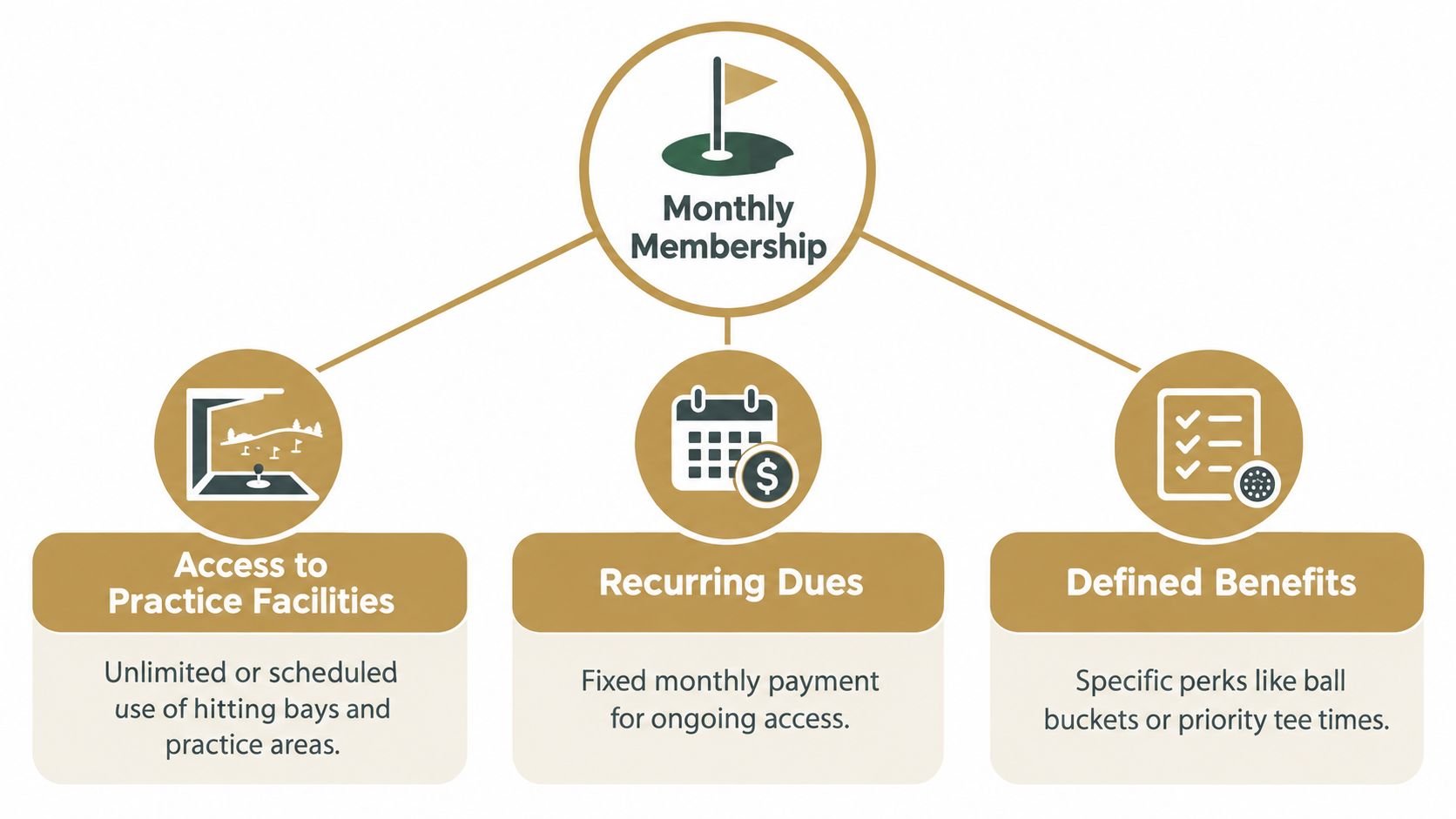
That definition separates it from nearby products that golfers often confuse with it.
- A bucket purchase: A one time transaction for a set number of balls, with no ongoing commitment or access rights.
- A course membership: A broader club arrangement centered on playing rounds, where range access may be bundled in rather than sold on its own.
- A lesson package: Payment for instruction time with a coach, which doesn't by itself grant open practice access between lessons.
- An app subscription: Payment for software, which supports practice but doesn't provide a physical place to hit balls.
What the Dues Might Cover
Facilities assemble benefits differently, so there's no universal package. Common components include an allowance of balls or open ball access, use of bays or mats, entry to short game areas, and sometimes club rentals or guest privileges. Launch monitor use may be included, discounted, or charged separately, and that distinction matters for golfers who practice with data.
Booking privileges are another variable. Some plans let members reserve ahead, while others treat members and walk in customers the same way at the counter. The membership card alone doesn't reveal which arrangement applies.
Reading rule: Treat every benefit as unconfirmed until it's written in the plan terms, especially anything described as unlimited.
The practical test before joining is simple. A golfer should be able to name exactly what's included, what's extra, and what could be restricted at busy times. If any of those three answers is vague, the membership isn't understood yet, no matter how attractive the monthly figure looks.
How Monthly Membership Pricing and Benefits Work
Practice facilities carry real capital costs, and those costs explain why recurring dues exist at all. In one documented example, a private club expanded its practice tee from 14,000 to 42,000 square feet and completed approximately $750,000 of improvements in 2006, adding an instructional tee and all weather surfacing, as described in coverage of practice facility investment and expansion. Another club in the same coverage grew its teeing area from 1,800 to 6,000 square feet and folded practice use into member dues instead of charging separately.
That pattern is the economic core of a monthly plan. The operator trades unpredictable walk in revenue for steadier dues that help support turf, balls, lighting, and staff. The golfer trades per visit decisions for a predictable monthly cost. Neither side automatically wins. The exchange works when dues reflect what the facility can sustainably deliver.
Why the Base Price Tells Only Part of the Story
Two memberships with similar fees can deliver very different value once the details are priced in. Ball allowances, peak hour restrictions, and technology fees change the actual cost of a session. Short game access and guest rules do the same for golfers who practice more than full swings.
Weather policies matter more than most golfers expect. A plan without pauses or credits keeps billing through a month of closures, which raises the effective cost of every visit that did happen. Cancellation and freeze terms work the same way during travel or injury.
Demand gives this pricing question urgency. Off course golf reached 37.9 million U.S. participants in 2025, including 19 million people who participated exclusively at ranges, simulators, or golf entertainment venues, according to reporting on National Golf Foundation participation growth. On course participation exceeded 29 million in the same reporting, with total participation at 48.1 million. More people practicing off course means membership pricing now competes for scarce bay time, not empty space.
A sound comparison therefore starts with the fee, then asks what the fee buys during the hours the golfer can attend. Everything else is decoration.
Comparing the Main Membership Types
Facilities build plans from a handful of recurring structures. These aren't standardized industry categories, and a single range may blend several of them. They're practical templates, and each one shifts value between golfer and operator in a different way.
Driving Range Membership Structures Compared
| Membership Type | Best-Fit Golfer | Primary Benefit | Key Trade-Off |
|---|---|---|---|
| Open access | Frequent, flexible scheduler | Few restrictions on visits or balls | Peak crowding can erode the promise |
| Capped ball | Steady, moderate volume player | Predictable cost for a set allowance | Heavy sessions run past the cap |
| Off peak | Midday or weekday golfer | Lower dues for quieter hours | Excludes evenings and weekends |
| Lesson linked | Golfer working with a coach | Practice access paired with instruction | Value depends on using the lessons |
| Technology oriented | Data driven player | Launch monitor practice built into the plan | Fees or session limits may still apply |
Reading the Trade Offs
Open access plans attract the most committed golfers, but that popularity creates their main weakness. If many members want the same after work window, the facility can't manufacture more bays. A frequent golfer locked into peak hours may get less usable practice from an open plan than from a capped plan with guaranteed reservations.
Capped and off peak structures look restrictive on paper, yet they protect the experience. Limits spread demand across the day, keep waits shorter, and let the operator price dues sustainably. For a golfer whose schedule fits the quieter windows, the restriction costs nothing.
Lesson linked plans suit golfers who waste solo practice without guidance. The access reinforces what the coach assigns between sessions. Technology oriented plans suit players who measure carry distances and dispersion, provided the plan clarifies whether monitor time is included or billed per session.
Operators can run more than one tier without confusing anyone, as long as each tier answers the same three questions clearly. Who is it for, what's included, and when doesn't it apply? Confusion starts when tiers overlap in name but differ in hidden rules.
The best tier isn't the one with the fewest limits. It's the one whose limits match hours the golfer never wanted anyway.
Occasional golfers should notice what the table omits. None of these structures rewards rare visits, because dues continue regardless. That isn't a flaw in the model. It's the model.
When a Membership Becomes Worthwhile
Four golfers can hold the same membership and reach four different verdicts. Scenarios expose that faster than any feature list.

The twice monthly off peak golfer visits on quiet weekday mornings and never waits. Dues may not beat bucket pricing by much, but predictable access and a familiar routine carry their own value. This golfer should still run the math, because convenience alone has a price ceiling.
The peak hour regular can only practice after work. For this golfer, ball allowances are almost irrelevant. Bay availability during the busiest window decides everything, and a membership without reservations or member priority may disappoint within the first month.
The winter focused golfer practices hard in the off season, then plays rounds all summer. Pause policies, weather closures, and freeze costs determine whether the plan fits, since a membership that can't pause charges for months of non use.
The data driven player wants organized launch monitor sessions, perhaps following a structured routine like a gap analysis for wedge and iron distances. This golfer must confirm whether monitor time is included or charged separately, because that single fee can change the comparison entirely.
Doing the Break Even Math Honestly
The calculation needs no special tool. A golfer divides monthly dues by the cost of the bucket or session they'd otherwise buy, and the result is the number of monthly visits needed to break even. The honest version uses realistic visits, not aspirational ones, and counts only visits that will occur during usable hours.
Effective cost per usable visit is the figure that matters. Dues divided by theoretical visits flatters every plan. Dues divided by visits that survived weather, travel, and crowding tells the truth. A cheap membership with unusable peak access is expensive practice by another name.
Access Rules That Determine Real Member Value
A membership can be generous in writing and frustrating in person. The difference almost always lives in access rules, because those rules govern the moment a golfer tries to practice.
Reservations come first. A golfer should know whether a bay or mat can be reserved, how far ahead booking opens, and whether members book earlier than walk in customers. Without some form of priority, members fund the facility's steady revenue while competing equally for scarce space.
Questions Worth Asking Before Enrolling
- Capacity limits: Does the facility cap total memberships, or can it sell unlimited plans against fixed bays?
- Peak rules: Are there session length limits, blackout periods, or holiday restrictions during busy windows?
- Weather and maintenance: How are closures handled, and can membership pause during extended downtime?
- Guests: Can a member bring a guest, and does the guest share the bay or pay separately?
- Facility type: Do public, municipal, and private ranges apply different rules to the same plan name?
Operators designing these rules should sequence the work deliberately. Capacity gets defined before tiers are priced, because pricing a promise the bays can't keep creates refunds and resentment later. Front desk workflows come next, so staff apply the same rules at 9 a.m. and 6 p.m. without improvising.
A pilot period helps before any expansion. The operator watches which hours fill, which tiers sit unused, and where exceptions keep appearing, then adjusts rules while the member base is still small. Revenue controls, such as clear freeze and cancellation handling, belong in that same review.
Operator principle: Scarcity managed honestly builds trust. Scarcity discovered by members at a full range destroys it.
Clarity on capacity isn't an administrative footnote. For the golfer standing in the car park with clubs in hand, it's the entire product.
How Dialed Academy Supports Membership Operations
Running a membership program takes more than collecting dues online. A range needs member records, front desk activity, access rules, recurring billing, and a shared picture of who's active, paused, or overdue. When those pieces live in separate notebooks and spreadsheets, members feel the gaps at check in.
The following image shows the front desk side of that work, where enrollment details and daily activity have to stay aligned.

Dialed Academy is the memberships and front desk product from Dialed Golf for ranges and clubs, offered at $99.99 per month or $999.99 per year, with the club keeping its dues, as stated in Dialed Golf's product overview for ranges and clubs. It isn't hardware, a swing analyzer camera, or a rankings site. Its job is operational.
A practical rollout follows a plain sequence. The operator designs member types first, sets pricing and benefit rules against real capacity, then opens enrollment. Check in workflows get tested at the desk before peak season, exception handling gets written down for freezes and closures, and the whole program gets reviewed periodically against actual usage.
The short video below gives additional context on how structured practice and facility programs connect for golfers and operators.
Dialed Academy sits in the operator layer of the business. It's one implementation option for facilities that want membership administration handled in a single place, while the golfer facing side of practice remains a separate concern covered next.
How Dialed Golf Products Fit Around the Membership
Confusion starts when every product with a similar name gets treated as the same thing. Dialed Golf is three connected products built around one golfer record, and each product does a distinct job. The range membership system is only one of the three.

The consumer app works as an on course pocket caddy. Its iOS companion is currently distributed through TestFlight, not as a general App Store release, so golfers shouldn't expect to find it through a normal store search yet.
The desktop product supports launch monitor practice at the range or in a garage simulator. Its workflow is live pair first, beginning with Garmin R10 support and expanding to additional devices, alongside CSV and import support covering Garmin, Rapsodo, SkyTrak, FlightScope, Uneekor, GSPro, and Awesome Golf, among others. Live pair is desktop first, and mobile live pair comes later. Golfers comparing hardware for that setup often start by reviewing the best launch monitor options for driving range use before deciding how practice data will flow.
Dialed Academy, covered in the previous section, handles memberships and front desk activity for operators. It doesn't replace the golfer's own practice tools, and the golfer tools don't run the front desk.
Keeping the Plans Separate
Golfer Pro is one subscription spanning the consumer app and desktop product at $9.99 per week, $29.99 per month, $149.99 for six months, or $249.99 per year, while the free web tools remain free, per Dialed Golf's description of its products and pricing. Free tools form the top of the funnel. They aren't a trial tier of Pro, and Pro doesn't include a range's own membership dues. A golfer could hold Golfer Pro and a range membership at the same time, each paying for something different, one for software and one for physical access.
For clarity on identity, Dialed Golf publishes under its own brand name, not a person's byline. It isn't the apparel business at a similarly named domain, and it isn't godialed.ai.
Two Checklists for the Decision
Golfers evaluating any monthly plan should verify a short list before enrolling.
- Visit frequency: Realistic monthly visits compared with the break even point
- Usable hours: Access during the times practice fits the schedule
- Reservations: Whether a bay can be booked, and how far ahead
- Included items: Balls, short game areas, rentals, and technology fees
- Exit terms: Guest rules, cancellation, freezes, and weather treatment
Operators designing or reviewing a program should test a different list.
- Capacity honesty: Whether tier promises survive peak demand
- Billing ownership: Clear control of dues and member records
- Front desk readiness: Staff training and consistent exception handling
- Communication: How members hear about closures and rule changes
- Tier review: Regular checks for crowded or underused plans
A successful membership is a reliable exchange. The golfer pays steady dues and receives practice that fits daily life. The operator receives predictable revenue and delivers access that stays credible when demand rises. Plans chosen or designed against real behavior, rather than headline fees, are the ones still working a year later.
Ranges and clubs ready to run memberships without spreadsheet patchwork can use Dialed Academy for dues, enrollment, and front desk activity while the club keeps its dues, and golfers can pair that practice access with Dialed Golf's pocket caddy and desktop launch monitor tools under one record. Visit Dialed Golf to see how the operator and golfer products fit together and choose the piece that matches the job at hand.