

A conforming golf ball must be at least 1.680 inches, or 42.67 mm, in diameter, which is 4.267 cm, commonly displayed as about 4.27 cm. That's a minimum legal diameter, not a requirement that every golf ball measure exactly the same.
The distinction matters more than the final decimal place. A size specification answers whether a ball meets the diameter requirement. It doesn't establish how that ball will launch, spin, or carry, and it isn't a measurement a launch monitor reports with every shot.
Table of Contents
- Official Size of a Golf Ball in Centimeters
- How Golf Ball Size Standards Are Categorized
- Centimeter Inch and Millimeter Conversions
- How the Ring Gauge Confirms Legal Size
- Why Centimeter Size Does Not Predict Flight
- Ball Size in Launch Monitor Practice Data
- Quick Reference for Golf Ball Size
- How to Check Ball Size Before Practice
Official Size of a Golf Ball in Centimeters
The official size of golf ball in centimeters is best expressed as a minimum diameter of 4.267 cm. The equivalent figures are 42.67 millimeters and 1.680 inches, with about 4.27 centimeters serving as the practical display value, according to the R&A's ball-conformance requirements.
Diameter means the distance across the ball through its center. It isn't the distance around the surface, and it doesn't describe the depth of the dimples. A golfer comparing specifications should therefore look for a diameter field rather than treating every measurement associated with a ball as interchangeable.
Manufacturers generally design balls close to the minimum while keeping them legal under the equipment rules. The important word is minimum: the rule establishes a lower boundary, not a promise that every conforming product has an identical measured diameter.
What the standard establishes
The R&A and USGA equipment standards underpin tournament golf and the specifications major manufacturers use worldwide. That gives the diameter figure a different role from a marketing description or a casual measurement taken at home.
- Rules reference: The minimum establishes the size boundary a conforming ball must meet.
- Product reference: A specification sheet can use the standard to describe the ball's general dimensions.
- Practice reference: A golfer can retain the diameter alongside a ball model without confusing it with the results of a particular shot.
A useful equipment note therefore distinguishes the applicable standard from an individual measurement. Copying the legal minimum into a record doesn't mean that a fitter measured that particular ball. Labeling the field clearly prevents that assumption.
Why diameter matters without explaining everything
Size does affect flight. For a given mass and speed, the smaller historical ball presented a slightly smaller frontal area and wake, which could provide a distance advantage, particularly in windy conditions.
That doesn't mean a golfer can predict modern ball performance by reading a centimeter specification alone. The historical comparison concerns a genuine difference in diameter, whereas modern comparisons also involve surface geometry and the conditions under which the ball launches.
Practical rule: Quote the diameter as a minimum, then keep equipment conformance separate from performance testing.
The useful answer is therefore more precise than “all golf balls are the same size.” Modern conforming balls share a legal size boundary. Their dimensions provide context for comparison, but the number alone doesn't identify which ball will suit a golfer's shots.
How Golf Ball Size Standards Are Categorized
An older reference to a smaller golf ball isn't necessarily a conversion mistake. Golf-ball size was split between governing standards for much of the last century, so a quoted dimension needs a category as well as a unit.
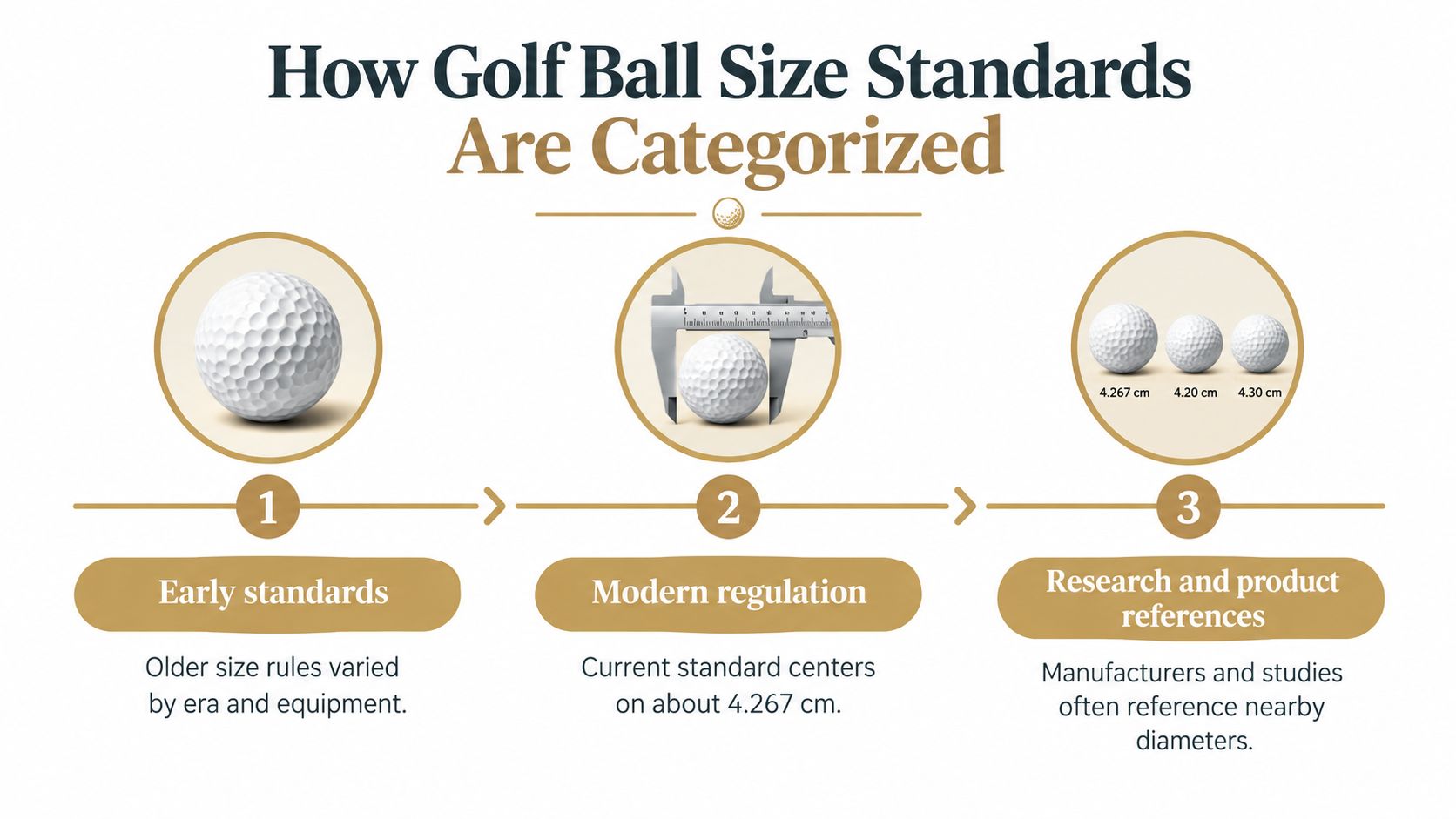
The distinction is between the current worldwide minimum, the historical British minimum, and a proposed compromise that wasn't adopted. The USGA's history of the ball-size rules documents the sequence: after the 1951 USGA–R&A conference, worldwide Rules took effect on January 1, 1952, but the USGA retained a 1.68-inch minimum while the R&A continued permitting a British ball of at least 1.62 inches, approximately 4.115 cm.
The historical split and the abandoned compromise
The difference between those minimum diameters was 0.06 inches, about 1.52 mm; the British ball was approximately 3.6% smaller in diameter. Those figures describe diameter, not a percentage change in distance or overall performance.
The governing bodies proposed a 1.66-inch compromise in September 1970, then withdrew it in August 1973 after debate involving golfers, professional tours, and manufacturers. That proposal belongs in the history of the rules, not in a list of current legal size options.
The R&A required the larger 1.68-inch ball in its Open Championship from 1974. The smaller ball remained permitted under some R&A rules until January 1, 1990, when the modern minimum of 1.68 inches, or 4.267 cm, became effective worldwide.
The visual below provides a broad map of historical, regulatory, and research references.
How to classify a quoted size
A reader checking an old equipment description should establish what the number represents before comparing it with a modern product sheet.
- Current legal minimum: Use this category for present-day conformance references.
- Historical British ball: Use this category for the smaller ball permitted under earlier R&A rules.
- Withdrawn compromise: Treat this as a proposal, not an alternative modern standard.
- Research or product dimension: Check whether the author describes a modeled ball, a measured sample, or a rules threshold.
That final distinction prevents another common error. A research model with a nearby diameter isn't necessarily defining a legal standard. Likewise, a historical ball's legitimate place in golf history doesn't make its smaller diameter acceptable under the modern rule.
Centimeter Inch and Millimeter Conversions
The same diameter can look different on a rules page, a product specification, and a practice worksheet. The units change; the underlying size reference doesn't.
For modern comparisons, the USGA reference is 42.67 mm, equivalent to 4.267 cm, commonly displayed as 4.27 cm. The USGA's golf-ball size specification also makes an important distinction: there's no maximum diameter in the size rule, provided the ball satisfies the other equipment standards.
Golf Ball Diameter Conversions
| Standard | Inches | Millimeters | Centimeters | How to use it |
|---|---|---|---|---|
| Modern minimum diameter | 1.680 | 42.67 | 4.267 | Store as the standards-based reference |
| General display of the modern minimum | 1.68 | 42.67 | About 4.27 | Use in reader-facing descriptions |
| Historical British minimum | 1.62 | Not needed for this comparison | About 4.115 | Identify historical references, not a modern conforming size |
The modern values above follow the USGA size specification. The historical comparison follows the USGA rules history cited earlier.
The inch figure is the conformance floor. Millimeters provide a convenient metric reference for equipment records, while centimeters answer the everyday question of how large the ball is across.
Rounding serves a different purpose. A general reader rarely needs the longer centimeter value in a short description, but a fitter maintaining a standards field should preserve the more precise reference rather than replacing it with the display value.
Choosing precision for the job
A clear record can retain a standards value and a display value without suggesting that either came from measuring an individual ball.
- Standards field: Store the precise metric reference and label it as the minimum.
- Display field: Show the rounded centimeter figure for ordinary reading.
- Measured field: Keep any actual measurement separate, with the method identified.
- Historical field: Label an older size explicitly rather than placing it beside modern specifications without context.
For example, the historical British minimum in the table converts to a smaller centimeter value than the modern minimum. The conversion itself doesn't confer legality. It lets the reader compare like units.
Rounding changes how a diameter is displayed. It doesn't change the legal boundary.
A slightly larger compliant ball also doesn't contradict the standard. Because the diameter rule supplies a minimum rather than an exact manufactured size, an above-minimum measurement isn't automatically a failure.
The ring-gauge procedure determines how the size requirement is checked. The quick-reference table later provides the compact lookup, but neither a rounded display nor a conversion table should be mistaken for the physical conformance test.
How the Ring Gauge Confirms Legal Size
4.267 cm is the minimum legal diameter for a golf ball, and a ring gauge checks whether the ball meets that boundary. Under the USGA's ball-size testing reference, a ball must not pass through a gauge corresponding to 1.680 inches, or 42.67 mm. The gauge gives the size rule a physical pass-or-fail test.
A ball that slips through the opening falls below the minimum. One that does not pass meets the size boundary addressed by this test. That result concerns diameter only; it does not establish that the ball meets every equipment rule.
The distinction is easy to misread: for this test, “passes through the ring” means the ball fails the size requirement. A photograph can't show whether a ball clears the gauge, and a caliper reading is not a substitute for the specified test.
At home, a golfer can use a ruler or calipers for a rough size check, much like checking whether a key is close to the right length. The result is only an estimate, since the measuring method and contact points affect the reading. Record the method alongside any observed dimension, and keep it separate from the standard's minimum.
The gauge addresses physical size, not flight or launch-monitor results. It also does not answer separate equipment questions, such as whether a surface modification changes a club's performance; the discussion of ChapStick on a driver covers that distinct topic. A legal diameter sets one boundary. It does not predict how the ball will fly.
Why Centimeter Size Does Not Predict Flight
A 4.267 cm diameter is the minimum legal size, confirmed with a ring gauge. That measurement defines a boundary for the ball's size. It does not describe the surface features that shape airflow or predict the result of a particular shot.
Dimple geometry changes how air moves around a golf ball. Computational research on golf-ball aerodynamics examines dimpled designs, including a model with 328 dimples, and describes how dimples affect the airflow transition compared with a smooth sphere. The study also uses ball diameters around 42.6 to 42.7 mm. Those dimensions provide research context, not a flight prediction based on diameter alone. (Computational golf-ball aerodynamics research)
A ball's diameter is like the frame around a more detailed design. It leaves out dimple depth, shape, size, count, and coverage. Those surface features influence airflow, while launch conditions determine how the ball begins its flight. Reynolds number is a way to describe the flow conditions involved; golfers do not need to calculate it to understand that surface geometry matters.
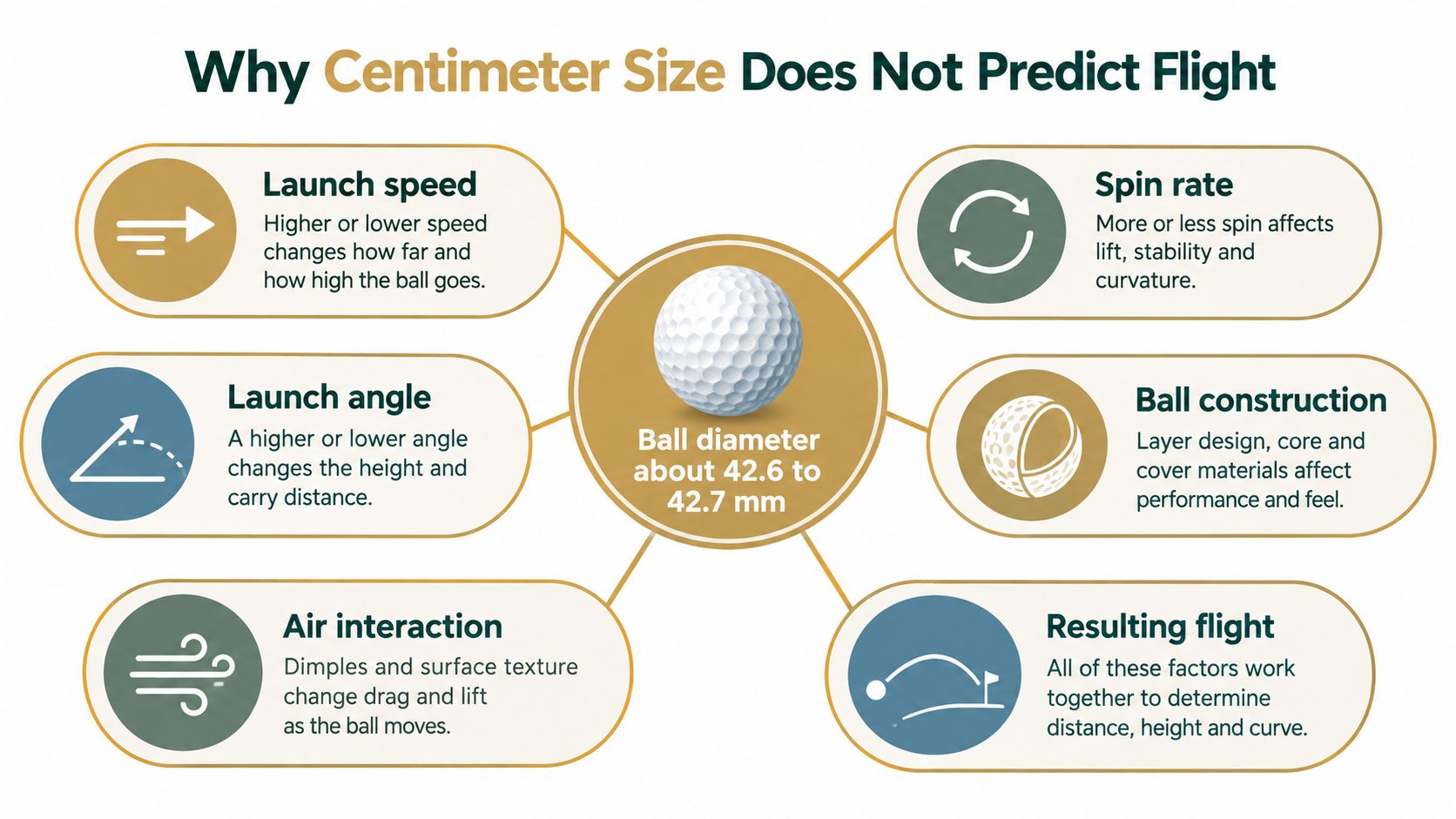
For example, a golfer may switch ball models and see a change in carry. A shared legal diameter cannot explain that result by itself, and the change does not prove that one particular design feature caused it. The comparison also depends on the shots' launch conditions and the test setup.
Keep the questions distinct: What are the ball's design characteristics? What happened during the shot? A ball description can include model, mass, compression, and available dimple details. Shot results belong to a separate record. The driver ball-speed chart helps explain speed as a shot metric, not as a substitute for a ball's dimensions or surface design.
Legal diameter sets a size boundary. It does not diagnose flight or explain a golfer's spin.
Ball Size in Launch Monitor Practice Data
The legal diameter belongs in the equipment record; a launch monitor's measurements belong in the shot record. A launch monitor commonly records ball speed, launch angle, launch direction, spin axis, spin rate, apex height, carry distance, and total distance. Those readings describe a struck shot, not the ball's diameter.
A practice file can preserve shot results for later review. Keep the ball model and any stated diameter reference in separate equipment fields, so a golfer does not mistake a session reading for a measurement of the ball itself.

Keeping specifications beside sessions
A golfer can review results in a device session, export a file for separate analysis, or organize sessions within a shared golfer record. The storage location matters less than keeping standing equipment specifications distinct from shot-specific results.
| Record element | What belongs there |
|---|---|
| Ball specification | Model and clearly labeled diameter reference |
| Shot record | Speed, launch, spin, height, and distance variables |
| Session context | Practice setup and ball used |
| Measurement note | Method and any uncertainty |
Dialed Golf offers three products, one golfer record, and one Pro plan. Its software organizes golfer records. It is not launch-monitor hardware or a swing-analyzer camera.
The consumer app is a pocket caddy for on-course use, available in TestFlight and not yet generally available in the App Store. Desktop supports launch-monitor practice at the range or in a garage simulator, with live pairing for supported devices and additional CSV import options. Mobile live pairing is planned for later.
Practice access and product boundaries
CSV and import support covers multiple launch-monitor and simulator formats. Import support and live pairing are different capabilities: a file can be imported without a device pairing live, and desktop live pairing does not mean mobile pairing is available.
Dialed Academy handles memberships and front desk operations for ranges and clubs at $99.99 per month or $999.99 per year, with clubs keeping their dues. Golfer Pro spans the consumer app and desktop, with plans at $9.99 per week, $29.99 per month, $149.99 for six months, or $249.99 per year.
Free web tools remain available without a Pro plan. Academy serves a separate need for facility operators.
The video shows the software context.
The launch-monitor app workflow provides more detail on organizing practice data. A session file records shot results; it does not measure the ball's legal diameter.
Quick Reference for Golf Ball Size
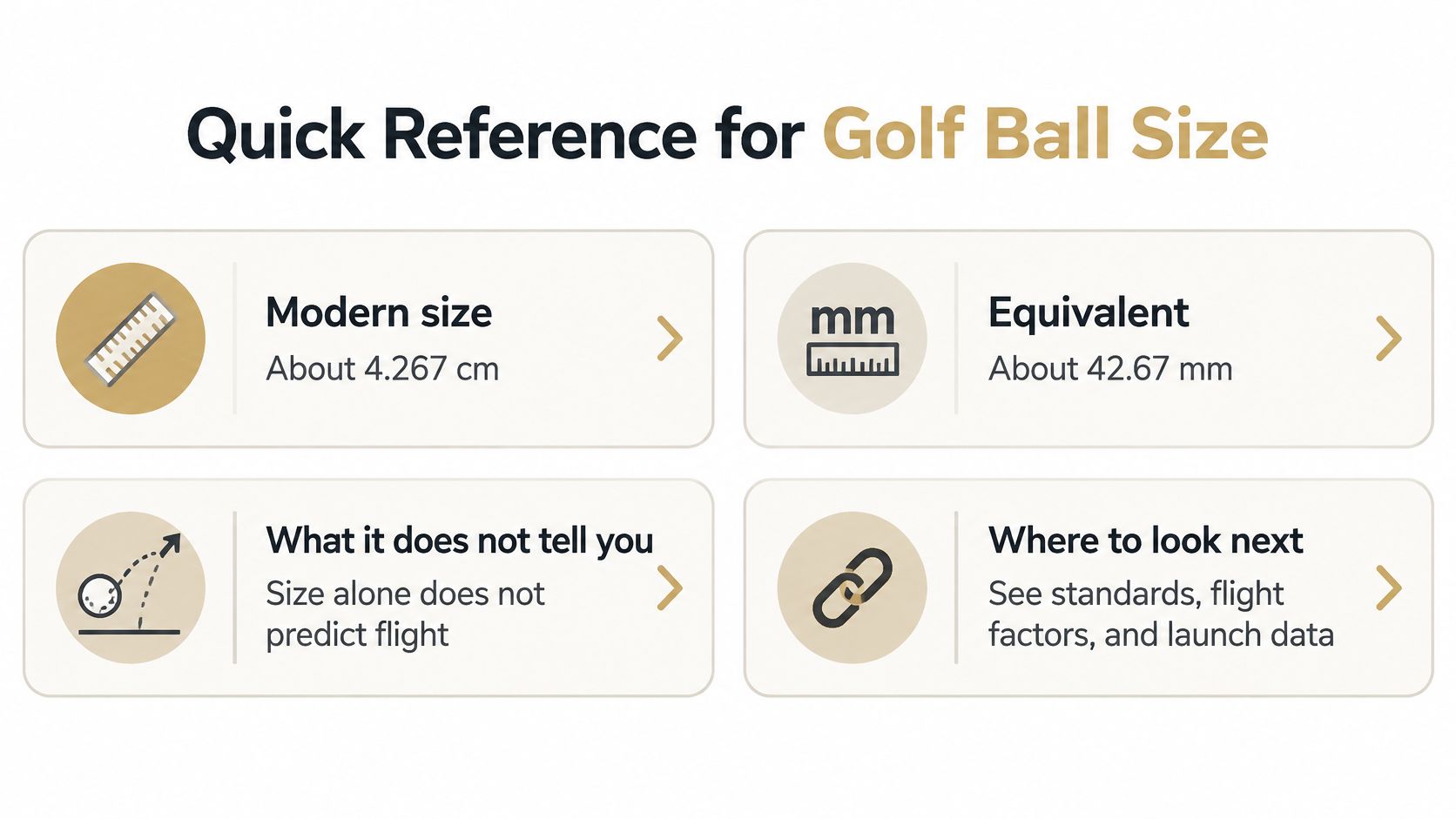
A legal golf ball must meet a minimum diameter of 4.267 cm. That number is a threshold, not a target measurement for every ball or a prediction of how it will fly.
Modern and historical lookup
| Question | Reference answer |
|---|---|
| What is the modern minimum diameter? | 1.680 inches, 42.67 mm, or 4.267 cm |
| What should a general display show? | About 4.27 cm |
| Must every compliant ball be exactly that size? | No. The figure is a minimum |
| Does the size rule set a maximum diameter? | No, provided the ball meets the other equipment standards |
| How is the minimum checked? | With a 1.680-inch ring gauge that the ball must not pass through |
| What was the historical British minimum? | 1.62 inches, approximately 4.115 cm |
| When did the modern minimum become worldwide? | January 1, 1990 |
| Is the proposed compromise a current standard? | No. The 1.66-inch proposal was withdrawn |
The modern entries reflect the equipment standards cited earlier, while the historical entries follow the USGA's ball-size history. A product's stated diameter and the legal minimum describe different things: one is a specification for that model, the other is the rule's lower limit.
Fields worth retaining beside a ball model
A useful equipment note separates reference values from observations. That distinction is like labeling a ruler's scale separately from the length of the object being measured.
- Stored diameter: Label the standards-based value as a minimum unless the ball itself was measured.
- Displayed diameter: Use the rounded centimeter figure for quick reading.
- Mass and compression: Record known specifications; leave unknown values blank.
- Dimple information: Keep available geometry details separate from the diameter standard.
- Session launch data: Attach launch speed, launch angle, and spin to the practice session, not to the size reference.
- Measurement method: Distinguish a ring-gauge check from an informal observation.
Diameter alone cannot explain flight. Dimples influence aerodynamic behavior, while a launch monitor records shot metrics such as speed, angle, and spin. Those readings describe a struck shot, not a new measurement of the ball's legal minimum.
Recordkeeping check: Label a minimum specification, a measured sample diameter, and a shot result as separate values.
How to Check Ball Size Before Practice
A pre-practice size check starts with the ball's identity and the right gauge. Record the model, then use a ring gauge to check whether the ball meets the legal minimum. A photo or ruler may help identify a ball, but it does not replace the specified gauge test.
Prepare the ball note
Before practice, record which ball is being tested and what the size figure means. The legal minimum is a standards reference; it is not a measurement of the individual ball.
- Identify the model: Record the ball being tested rather than using a general label such as “practice ball.”
- Use the ring gauge: Check the ball against the specified gauge when one is available.
- Label home observations: If using another method for orientation, record the method and any uncertainty.
- Keep reference and measurement distinct: Do not present the legal minimum as a measured sample diameter.
That distinction matters when reviewing notes later. A bare diameter can look like a measurement even when it was copied from a standard.
Keep the practice file separate
Store the size note with the equipment description. Ball speed, launch angle, spin, apex, and carry belong with the shot record because they describe the result of a particular swing and strike.
For a supported range session, the golfer can export the session as a CSV file and retain it for later comparison. Associate the file with the ball model; the shot data does not report the ball's dimensions. For supported desktop devices, a session can be paired live; other practice files can be brought in through CSV import.
Free web tools offer a starting point for recording practice, while paid records or membership software may suit other workflows. Learning the legal diameter does not require a subscription. Dialed Golf's on-course pocket caddy is currently available through TestFlight.
Dialed Golf offers free web tools, desktop practice software, and an on-course pocket caddy. Visit Dialed Golf to start with the free tools, keep the ball-size reference separate from shot metrics, and choose a workflow for the next practice session.