

Srixon Soft Feel is a soft, low-spin two-piece value ball that can carry well for moderate speeds, not a maximum-wedge-spin tour ball, with 63 measured compression and 266.2 yards of fast-test driver carry. Its strongest case is efficient full-shot performance with a softer impact sensation, provided the golfer's approaches still stop.
That makes the useful question behind Srixon Soft Feel golf balls reviews a fitting question rather than a star-rating question. A golfer needs to establish whether the ball improves playable distance without exchanging too much control for rollout.
Table of Contents
- Soft Feel Robot Numbers at a Glance
- What Twelve Generations of Soft Feel Are
- Soft Feel Next to Other Low Compression Balls
- Feel Distance Spin and Durability in Play
- Golfers Who Gain From Soft Feel
- How to Replicate the Soft Feel Test
- Keep Soft Feel or Change Balls
Soft Feel Robot Numbers at a Glance
Soft Feel combines a soft compression profile with restrained driver spin. The 2025 Today's Golfer robot test measured 63 compression, with its faster driver producing 266.2 yards of carry, 160.1 mph ball speed, 2,599 rpm backspin, 11.5 degrees launch, and a 31.0-yard peak height, as shown below alongside the slower-driver and iron results.
Srixon Soft Feel 2025 robot test baseline
| Shot | Carry | Ball speed | Backspin | Launch | Height or descent |
|---|---|---|---|---|---|
| Faster driver speed, about 108 to 114 mph | 266.2 yards | 160.1 mph | 2,599 rpm | 11.5 degrees | 31.0-yard peak height |
| Slower driver speed, about 78 mph | 158.8 yards | 112.3 mph | 2,338 rpm | 14.0 degrees | 15.0-yard peak height |
| 7-iron | 155.7 yards | 108.1 mph | 4,428 rpm | 21.3 degrees | 44.8-degree descent angle |
The approximate driver-speed bands and the slower row's 14.0-degree launch and 15.0-yard peak height are also documented in ForeFitter's Soft Feel ball data. Descent angle is an angle, not a distance, so the iron result belongs in degrees even though peak height belongs in yards.
Reading the driver rows
The faster row establishes that soft compression doesn't prevent substantial driver carry. It doesn't establish that Soft Feel is the longest choice for a faster player, because that conclusion requires a matched comparison against another ball under the same conditions.
The slower row answers a different question: what happens when less speed is available? Its lower flight makes launch and peak height particularly important. A golfer whose flight already falls short shouldn't select a ball from driver spin alone.
Ball speed also needs context. The driver ball speed chart helps distinguish speed delivered at impact from the carry produced by the resulting launch conditions.
Reading the iron row
The iron result describes a playable approach window rather than a high-spin promise. Carry identifies the landing point, while descent and spin help explain what might happen after landing.
A golfer attacking a receptive green may find that window entirely useful. A golfer landing the same shot on a firm surface needs to verify release rather than assuming that soft impact means a soft landing.
Together, these rows support a narrower conclusion than a blanket recommendation: Soft Feel can deliver useful tee distance while keeping driver spin restrained, but its approach performance still needs a stopping-power check.
These are controlled robot strikes, not an individual golfer's swing. They establish a comparison baseline, not a personal fitting. The repeatable session below tests the same flight characteristics with the golfer's own clubs.
What Twelve Generations of Soft Feel Are
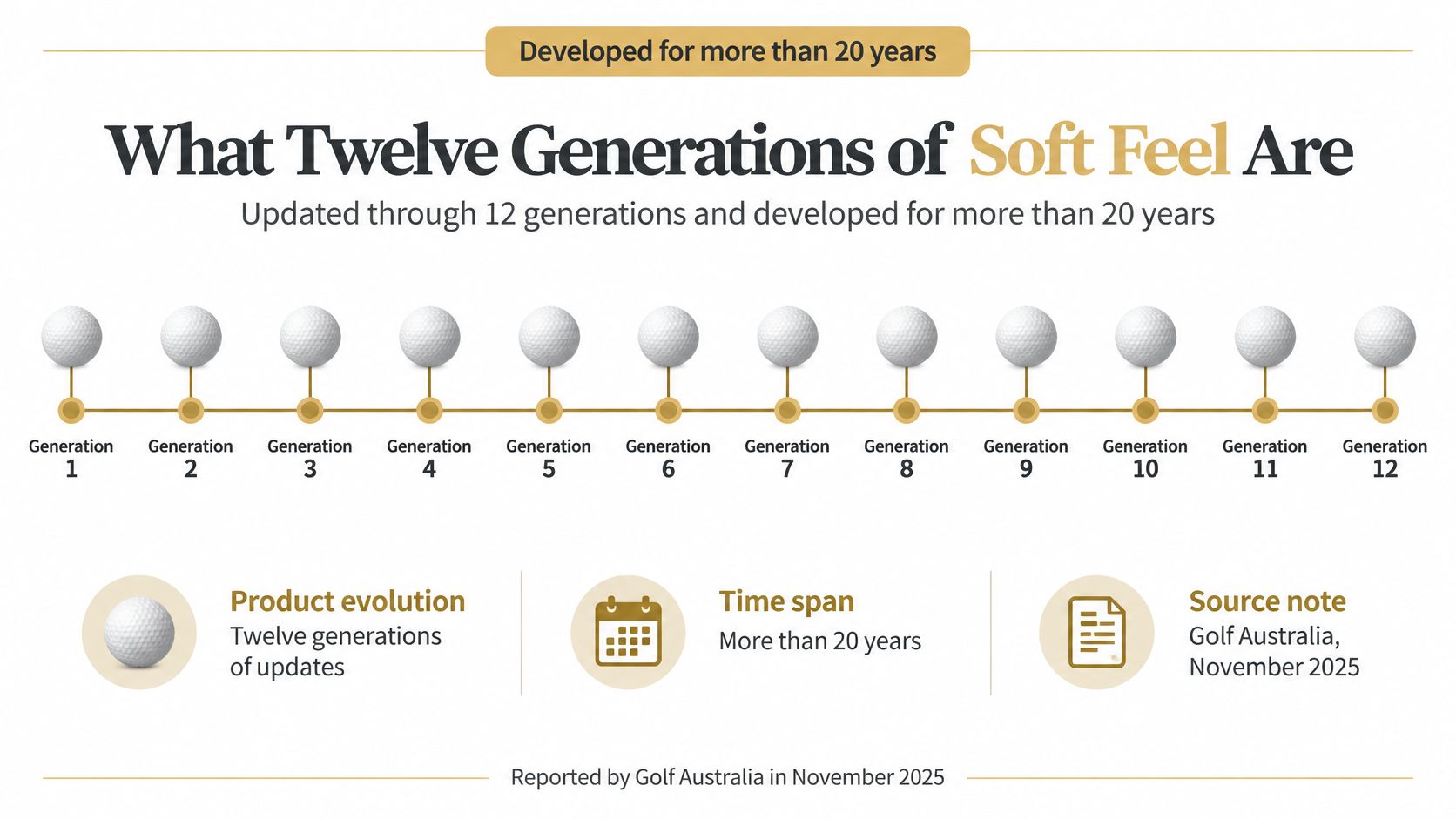
Across more than twenty years, Soft Feel developed through twelve generations, with the twelfth-generation launch in November 2020. Golf Australia's review of the twelfth-generation ball describes its FastLayer core and thin ionomer cover. The timeline shows a consistent product identity, while generation-specific performance still depends on the model being tested.
A stable product identity
Soft Feel's construction pairs a core designed for a soft response with a thin ionomer cover. That construction helps explain the ball's intended balance: comfortable impact and dependable full shots in a two-piece design.
The historical review describes useful distance, stable full-shot flight, approach control, and visible scuffing during play. Its assessment gives the ball credit for practical performance while identifying durability as a consideration for golfers who prioritize a pristine cover.
Satisfaction and measured performance
In 2023, Golf Insider UK's Soft Feel review reported an average rating of 4.6 out of 5 from 83 votes. That rating measures satisfaction among those voters; it does not establish a distance advantage.
A golfer may value the sound, price, and full-shot response while accounting for how the ball performs on the course. Fit depends on repeatable carry, spin, and launch measurements, with the ball's construction providing context for those results.
Soft Feel Next to Other Low Compression Balls
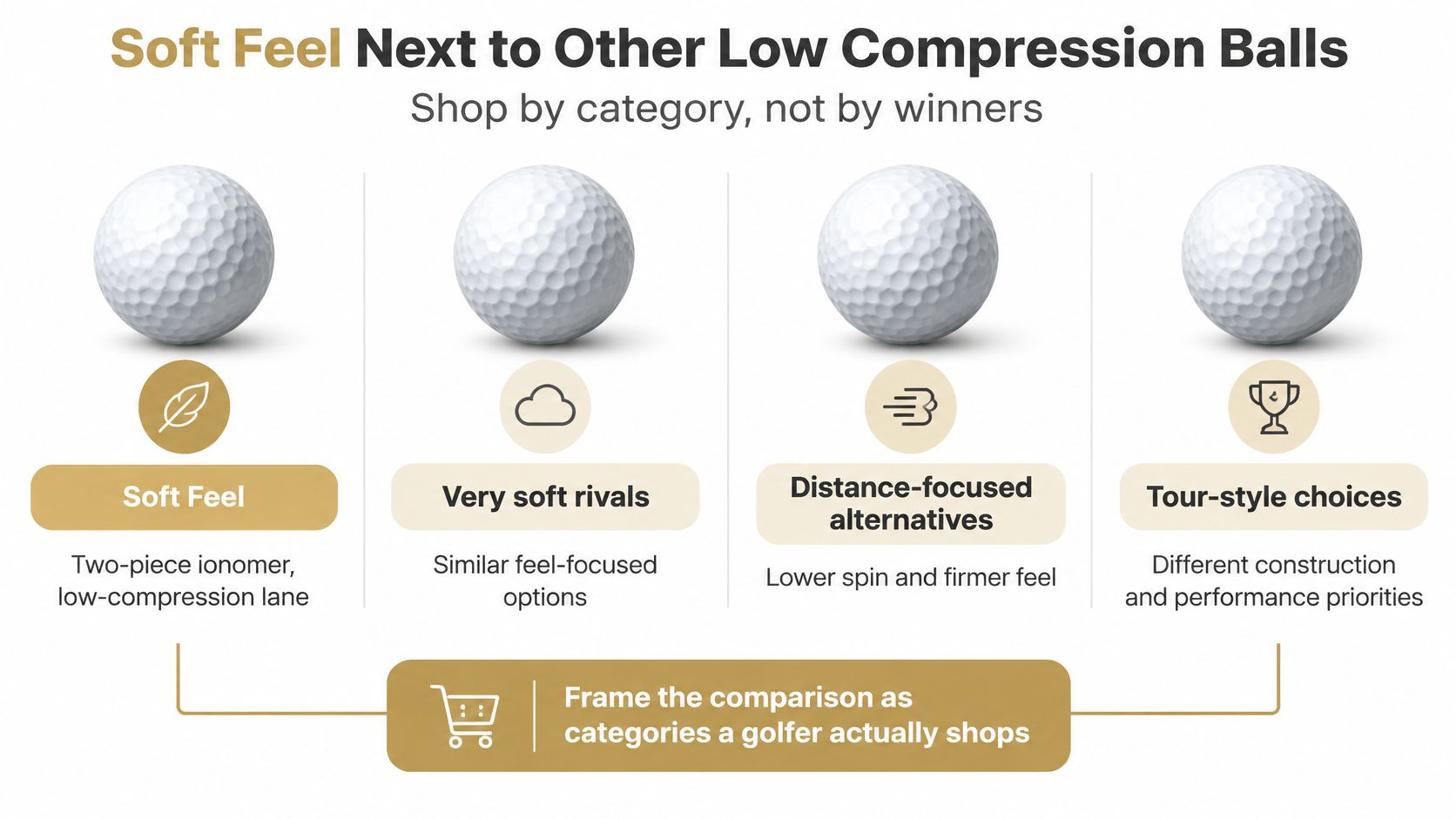
A meaningful comparison starts with the golfer's target: comfortable impact, a particular flight, or more stopping power. The best fit depends on measured carry and spin, not a compression label alone.
In its 2023 review, Golf Monthly listed Soft Feel at 60 compression, with 338 dimples, an RRP of £28, and a recommended driver speed of about 90 mph or less. Treat the speed figure as a shopping guide. Compare the ball's results with the golfer's own launch-monitor numbers rather than using it as a cutoff.
Soft Feel against nearby ball categories
| Category | Construction and feel | Speed guide | Greenside expectation | Choose it when |
|---|---|---|---|---|
| Srixon Soft Feel | Two-piece ionomer, low nominal compression, slightly firmer in independent measurement | Moderate or slower driver speed | Useful control, less bite than urethane | Soft feel and value full shots are the priority |
| Softer two-piece distance balls | Lower-compression ionomer options with very soft impact | Slower swings seeking comfortable response | Often modest, verify wedge spin | Feel and launch matter more than checking pitches |
| Q-Star Tour or Z-Star | Urethane-covered alternatives above Soft Feel in the Srixon line | Fit by launch and stopping requirements | More greenside bite is the reason to test | Ionomer approaches release too far |
| Firmer multilayer tour balls | Higher compression with tour-style covers | Faster swings merit a direct comparison | Strong spin potential with suitable contact | Speed is high and driver spin stays playable |
Choosing between comfortable impact and cover response
A golfer who prefers a soft impact can compare two-piece distance balls by carry and peak height. The lowest compression label does not establish which ball will travel farthest or produce the most useful flight.
For golfers struggling to control trajectory, carry and peak height offer a more relevant comparison than feel alone. A slower swing can still suit a firmer alternative if its measured flight and distance fit the golfer's needs.
Q-Star Tour or Z-Star merits testing when approaches release farther than desired. The comparison should include full-shot performance as well as greenside response, since added cover response matters only if the overall flight remains suitable.
Category distinction: Compression and wedge spin measure different properties. A ball can feel soft at impact and still produce a low-driver-spin flight.
When a firmer tour ball deserves testing
A golfer with manageable driver spin can compare firmer multilayer options on speed, flight, and stopping behavior. The useful question is which construction produces the most suitable combination for that player.
Tour-style construction offers a reason to test, not a guaranteed wedge result. Contact quality, loft, and lie all affect how the ball responds around the green.
Use feel as a preference and carry and release as measured outcomes. A fitting comparison should show whether Soft Feel's comfortable impact matches the shots the golfer needs.
Feel Distance Spin and Durability in Play
Soft Feel's performance is easier to judge when impact sensation, carry, wedge response, and cover condition are considered separately. Each affects a different part of the round.
Feel and distance
The 2025 specifications and independent findings summarized by Golfweek's Soft Feel review describe approximately 58 nominal compression and 63 measured compression, along with a two-piece construction, a gradational FastLayer core, and a 338-dimple pattern. The same findings report approximately 5,894 rpm on a 50-yard wedge at 31.6 degrees launch.
The 58 and 63 figures describe different measures. For a useful compression comparison, golfers should check whether the figures come from the same test method.
Restrained driver spin reduces curvature or adds rollout; it does not add carry. A longer finish on a dry fairway may help on an open hole, while the same result does little for a shot that must carry a bunker or reach a wet landing area.
Spin and cover life
The wedge result gives Soft Feel a measurable short-game reference point. On the course, the relevant question is whether partial pitches release predictably or stop soon enough for the golfer's usual landing areas.
A running pitch can suit a golfer who plans for release. A shot aimed beside a tucked flag may call for more checking action.
GolfLink's historical reviewers noted scuffing after several holes, while describing overall longevity as acceptable. A fresh ball provides a cleaner comparison when visible surface damage could affect the test.
Keep the club, swing intention, and monitor settings consistent when comparing driver flight and partial-wedge response. A launch-monitor app workflow helps preserve shot records for review.
Golfers Who Gain From Soft Feel
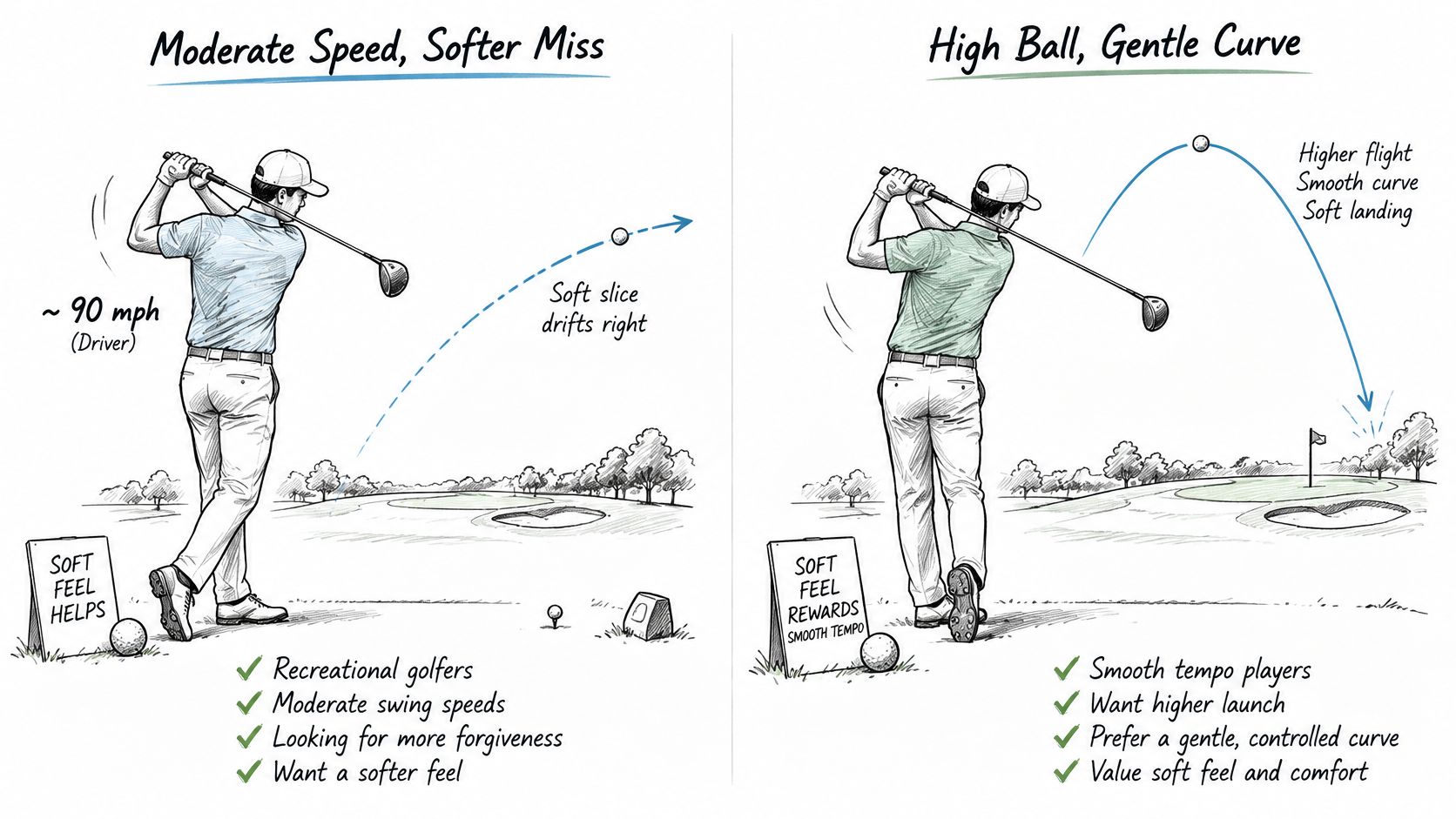
A moderate-speed drive starts high and curves away from the fairway. That golfer has a reason to test Soft Feel for a more manageable flight, provided enough carry remains to reach the intended landing area. It isn't a cure for face-to-path problems, so the decision is to trial the ball, not expect it to repair the swing.
The illustration separates the visible flight problem from the label attached to the player.
Golfers whose current stopping window works
Iron shots already land and stay near their pitch marks. If that player mainly wants a less expensive dozen and comfortable impact, there may be little reason to pay for additional greenside response. Soft Feel is a sensible stay when the on-course stopping result remains intact.
In 2026, GolfLink's testing recorded 135.3 mph ball speed, 218.4 yards of carry, and 240.1 total yards, a difference of approximately 22 yards. That gap demonstrates why a total-distance result should always be read alongside its carry component.
Approaches land on target but finish through the back. That golfer shouldn't let favorable tee-shot feel outweigh repeated scoring trouble. A urethane Srixon alternative deserves a comparison, and switching is justified if it improves landing control.
The accompanying video provides another visual reference for the swing discussion, but measured landing behavior should determine the ball choice.
Golfers who need evidence before switching
A faster drive launches low and falls out of the air. A soft label doesn't establish that the player will gain height or stopping power. The appropriate decision is to withhold the purchase until a matched monitor test shows an improvement.
A slower-tempo player dislikes harsh impact but also struggles to check chips. These are separate needs, and solving the first doesn't establish that the second has improved. Soft Feel should stay only if the golfer accepts its actual release pattern.
The fitting rule is conditional: choose Soft Feel when curve or harsh feel improves without a stopping penalty; change categories when the persistent miss is a ball that won't hold.
How to Replicate the Soft Feel Test
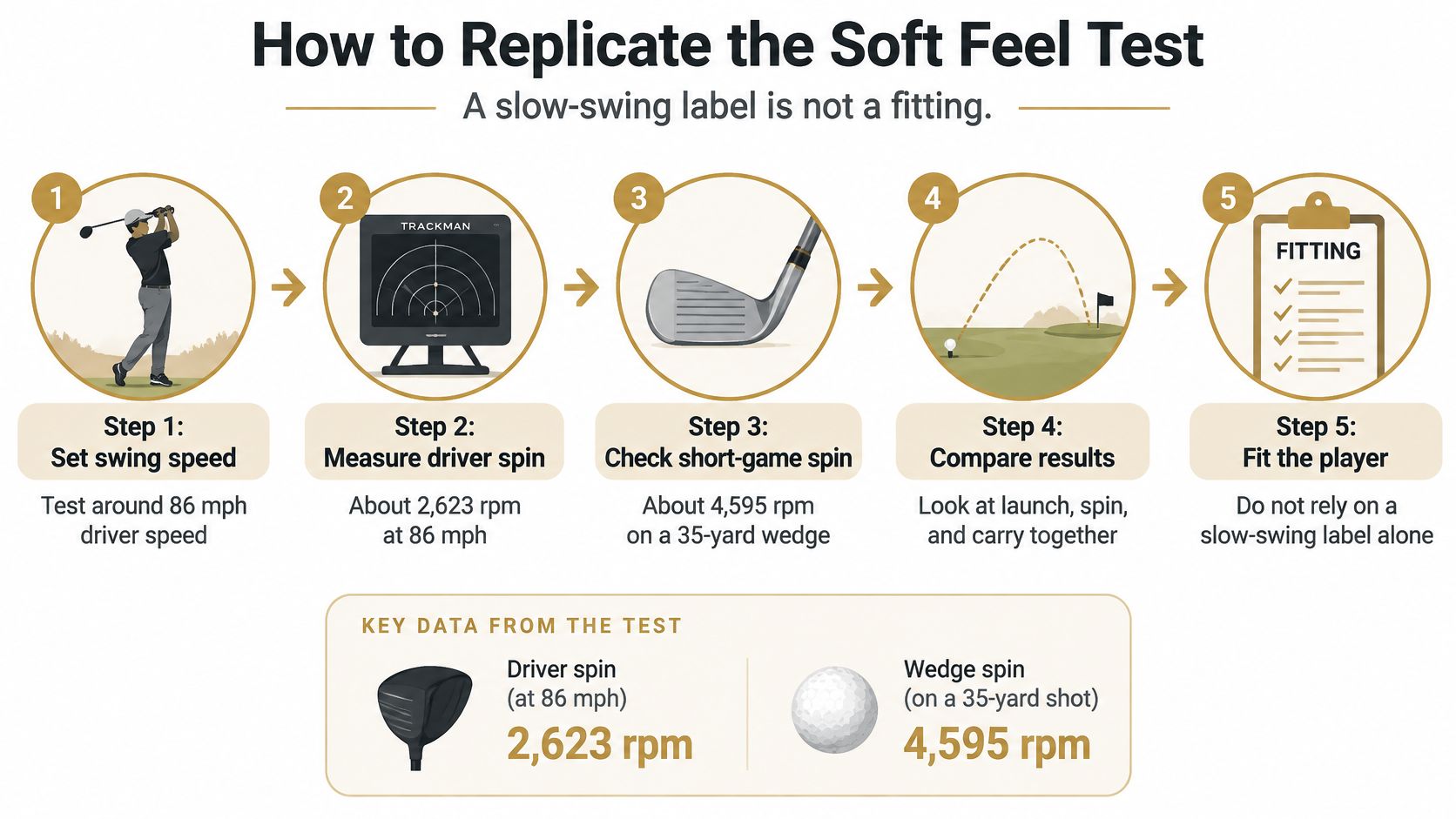
At 86 mph, the independent ball-data reference linked from Srixon's Soft Feel product information reports approximately 2,623 rpm of driver spin. Its 35-yard wedge reference is 4,595 rpm. These figures establish test conditions, not targets every golfer should match.
Use a normal swing and compare the same measures for both balls. The infographic outlines the process; the six-step protocol below turns it into a repeatable session.
A controlled range or simulator session
Establish matching conditions. After warming up, alternate the current ball and a fresh Soft Feel with the same driver, tee height, target, and monitor settings. Keep indoor normalization and environmental settings unchanged.
Build a representative sample. Collect eight to ten solid drives per ball instead of choosing a standout shot. Flag clear mishits separately, while keeping ordinary strike variation in the sample.
Record the complete flight. Log ball speed, launch, backspin, peak height, carry, total distance, descent angle, and side dispersion. Treat small differences cautiously when the monitor estimates a metric rather than measuring it directly.
Repeat with a mid-iron. Prioritize carry and descent over the longest finish. Extra distance from rollout can complicate approach planning rather than improve it.
Compare partial wedges. Hit a consistent short pitch, then a longer partial wedge, keeping loft and swing intention unchanged. Use the published wedge figure as context, not a pass mark: strike, delivery, and shot length affect spin.
Apply a combined pass-fail rule. Count Soft Feel as a gain if driver flight becomes more useful without an unacceptable landing-angle penalty, iron descent remains suitable, and wedge response holds the greens normally played. A longer total alone does not establish a better fit.
Keeping the session with the golfer's record
Dialed Golf's macOS and Windows apps support launch-monitor practice at the range or in a garage simulator. Live capture records shots locally for session review, with Garmin R10 pairing first and support expanding. Golfers can also import sessions from Garmin, Rapsodo, SkyTrak, FlightScope, Uneekor, GSPro, Awesome Golf, and more.
The consumer app is an on-course pocket caddy, currently available through TestFlight rather than general App Store availability. The free Golf Ball Fitter finds a ball profile that fits the golfer's flight and feel. A guide to choosing a launch monitor for the driving range can help frame the capture setup.
Keep Soft Feel or Change Balls
The comparison matrix provides the pass-fail rule. Use its results to choose a ball that fits the shots the golfer needs, rather than rewarding a pleasing impact sound alone.
When Soft Feel performs well but approaches and pitches release beyond their intended finish, test a urethane ball such as Q-Star Tour or Z-Star. The higher price only makes sense if the added wedge response improves the golfer's actual scoring shots.
A profile before a purchase
Dialed Golf offers seven free web tools without an account, including the Golf Ball Fitter, which finds a starting ball profile from flight and feel. Golfer Pro is optional across the consumer app and desktop at $9.99/week, $29.99/month, $149.99/six months, or $249.99/year.
Dialed Academy is a separate memberships and front-desk product for ranges and clubs, priced at $99.99/month or $999.99/year per facility. The club keeps its dues.
A controlled comparison session can stay with the golfer's practice record. The buy rule is simple: purchase a dozen only after comparing Soft Feel with the current ball on carry, total, descent, and a fixed wedge yardage using the same club.
The next step is to establish a starting profile with the free Golf Ball Fitter, then compare Soft Feel against the current ball before committing to a dozen.