


Nineteen million Americans played off-course golf exclusively in 2024, and women and girls represented 43% of that group, according to the National Golf Foundation. Practice facilities aren't just places to warm up before a round. For many participants, they're the main way to experience golf.
That changes the membership question. A golfer comparing range membership golf options isn't just buying cheaper balls, and an operator isn't only selling recurring access. Both are making a bet on practice volume and purpose. The strongest arrangement works financially, fits the golfer's actual schedule, and supports practice worth repeating.
Table of Contents
- What a Range Membership Covers Today
- Range Membership Pricing Models Compared
- Break-Even Visits and Whether a Membership Pays Off
- Checklist Before Joining or Offering a Membership
- What Range Owners Gain and What to Track
- Decide Whether a Membership Fits Your Range or Game
What a Range Membership Covers Today
A golfer pays top price for an unlimited monthly plan, then reviews a month of visits and finds they all happened before 10 a.m. on weekdays. A cheaper off-peak membership would have covered those same hours. The plan sold access, but the golfer only ever used a narrow slice of it.
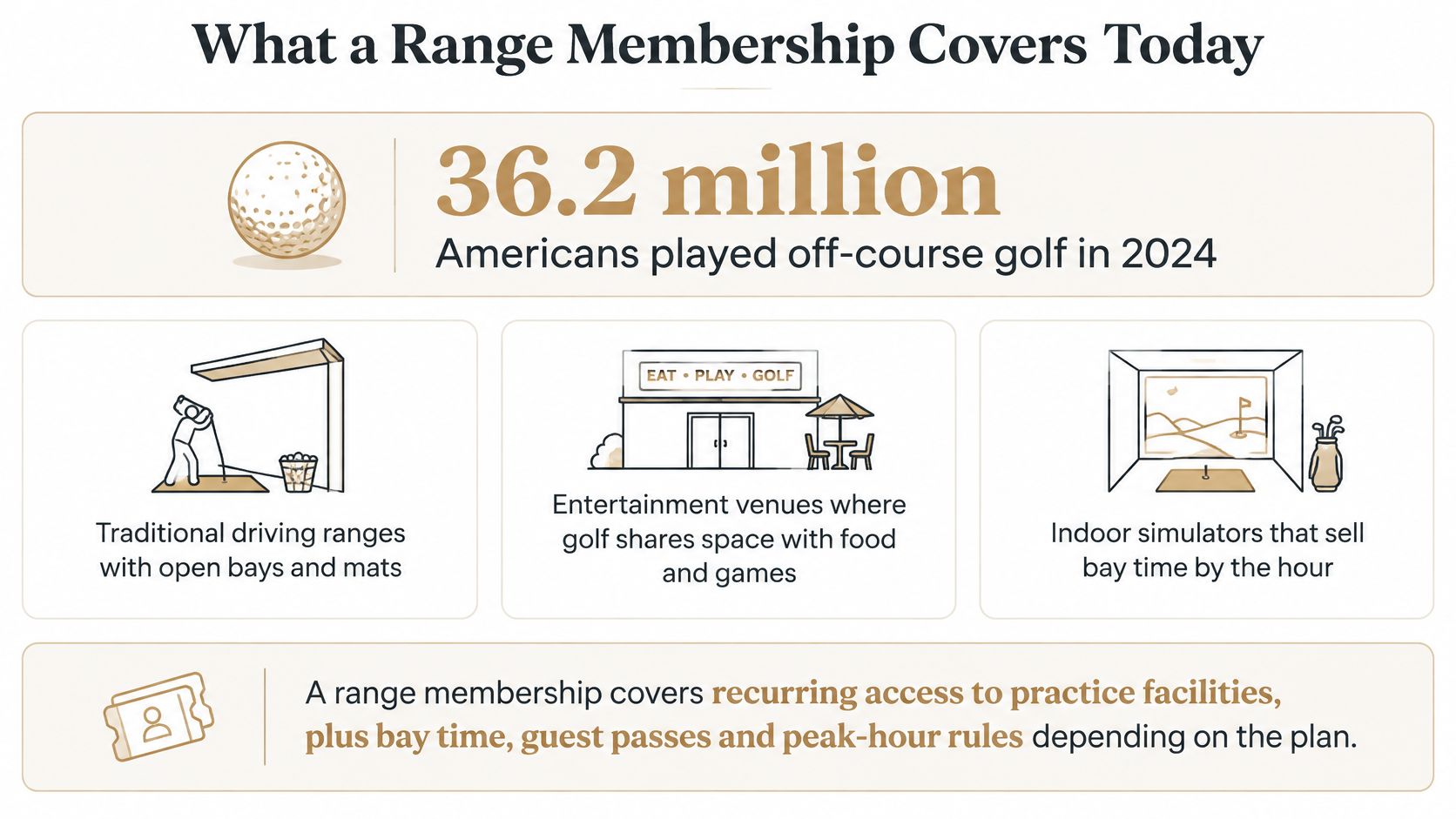
Off-course venues also sell very different experiences. The National Golf Foundation figure reported by Sports Business Journal counted 36.2 million Americans participating in off-course golf in 2024, spread across traditional driving ranges, entertainment venues, indoor simulators, and similar formats. A range membership needs a more precise definition than "access to golf."
A typical offer combines some of the following:
- Recurring or prepaid practice access. The member receives practice buckets, hitting-bay access, or an allowance of both. Balls and bay time aren't necessarily the same entitlement.
- Booking privileges and restrictions. A plan might provide reserved peak slots, advance reservations, or weekday-only access. Paying dues doesn't automatically guarantee a vacant station.
- Guest allowances. A friend or family member may be permitted under specified conditions. Sharing a bay doesn't necessarily mean sharing the member's ball allowance.
- Lesson discounts or technology access. Some packages include discounted instruction or launch-monitor time. Others charge separately for those services.
Included access isn't an all-inclusive visit
Premium balls, food and drink, equipment rental, and guests beyond the allowance may cost extra. A golfer should separate the base membership from optional purchases before comparing packages.
Technology deserves the same scrutiny. A facility might include ball-flight feedback without providing portable session records, or charge for a technology-enabled bay separately. A guide to launch monitor apps can help distinguish the measuring device from the software used to review practice.
The economics work like a gym membership. Members pay for repeated access to an environment where they can work, rather than purchasing a scored round each time. The benefit depends on attendance, usable facilities, and a routine that fits everyday life.
Membership principle: Access has value only when the member can use it at the times that matter.
Only the written terms define what the member owns. Before signing, a golfer should confirm four things on paper: which hours the access covers, whether a bay is reserved or merely available, how many guests and balls come included, and which extras carry separate fees. Anything promised only in conversation never made it into the deal.
Range Membership Pricing Models Compared
Range membership models and who they suit
| Model | How It Is Charged | Best For | Main Risk |
|---|---|---|---|
| Pay per bucket | Cash or card per bucket, usually by bucket size | Occasional golfers | Cost rises quickly with frequent visits |
| Prepaid bucket card | Balance or punch card bought up front | Golfers who practice in blocks | Unused balance may expire, check the terms |
| Unlimited monthly | Flat monthly dues for unlimited buckets | Frequent, regular golfers | High volume with little purpose if no practice plan |
| Off-peak or capped monthly | Lower dues for off-peak hours or a monthly visit cap | Flexible schedules, retirees | Blackout limits and crowding around permitted hours |
| Annual membership | One yearly fee, usually discounted against monthly | Committed members with set routines | Large upfront cost and limited refunds for missed months |
| Junior or family plan | Reduced rate per child or household | Families and junior golfers | Facility-specific age rules and guest limits |
Bucket pricing has long differed between facilities. An early-2000s industry profile from SBDCNet reported that 20.1% of facilities charged approximately 9.5–10 cents per ball for a small bucket, while 27.4% charged between $3.50 and $4.00 for a small bucket. Those are historical reference points, not current rates.
Current offers should be compared using the same bucket size, bay type, and permitted hours. A basic outdoor stall and a covered technology-enabled bay aren't interchangeable purchases. Nor is a weekday allowance equivalent to access after work.
Match the commitment to the calendar
Pay per bucket preserves flexibility. It suits a golfer whose practice depends on weather, travel, or an unpredictable work schedule, even if the individual bucket price looks less attractive.
A prepaid card sits between casual purchases and recurring dues. Before buying, the golfer should establish whether the balance expires, whether it can be shared, and whether promotional credit has different conditions from purchased credit. An apparent discount is less useful when unused credit disappears.
Monthly access fits a repeatable routine. An annual plan may reduce the equivalent monthly charge, but it also commits money before attendance is known. Any saving should be weighed against missed months, seasonal closures, and refund restrictions.
A discounted commitment isn't a saving when the golfer buys more access than the calendar allows.
“Unlimited” also needs interpretation. A facility can offer unlimited buckets while restricting reservations, consecutive bay time, or peak-hour entry. Members buy the written entitlement, not the broadest interpretation of the advertising.
The practical choice is straightforward: occasional attendance favors pay per bucket, regular attendance supports a monthly plan, and flexible schedules can make off-peak or capped access attractive. The financial test still matters, particularly when a prepaid card offers a credible alternative to full public bucket prices.
Break-Even Visits and Whether a Membership Pays Off
Monthly dues ÷ pay-per-bucket price = buckets needed to break even. This also equals visits only when the golfer would otherwise purchase the same single bucket during each visit.
For a hypothetical $120 monthly plan, a $10 bucket produces a break-even point of 12 buckets. Against a $15 bucket, the same hypothetical membership breaks even at 8 buckets. These are worked examples, not advertised facility prices.
Buckets needed to break even on a monthly membership
| Monthly Dues | Pay-per-Bucket Price | Buckets to Break Even |
|---|---|---|
| $75 per month | $10 per bucket | 8 buckets |
| $75 per month | $15 per bucket | 5 buckets |
| $120 per month | $10 per bucket | 12 buckets |
| $120 per month | $15 per bucket | 8 buckets |
| $200 per month | $10 per bucket | 20 buckets |
| $200 per month | $15 per bucket | 14 buckets |
All table amounts are hypothetical. Results are rounded up to the next whole bucket.
The calculation assumes equivalent access and no additional membership charges. A joining fee, mandatory bay surcharge, or separately purchased balls changes the comparison. Lesson discounts should count only when the golfer would have bought those lessons anyway.
Separate bucket volume from useful practice
The scale of participation doesn't prove that members improve. The National Golf Foundation reports 37.9 million off-course participants in 2025, compared with 29.1 million on-course golfers, but those participation totals don't establish practice consistency or scoring outcomes.
A range membership is not automatically a practice solution. Unlimited access can encourage bucket consumption without producing a clearer understanding of club selection or shot patterns.
A warm-up prepares a golfer to play. Deliberate practice tests something: carry control with a 52-degree wedge, separation between the 7-iron and 8-iron, or the width of a driver dispersion pattern. A golf gap-analysis walkthrough provides a framework for turning club-distance records into a specific practice task.
A practical experiment is a two-week trial before a 12-month commitment. The golfer records attendance, chooses a measurable goal, and checks whether the observed routine could meet the monthly break-even threshold. A useful goal might be a tighter carry window rather than more shots.
Habit test: Would the golfer still attend if buckets became more expensive?
If the answer is yes, the membership supports an established habit. If the answer is no, its main attraction may be a lower unit price, which only helps when attendance materializes.
Checklist Before Joining or Offering a Membership
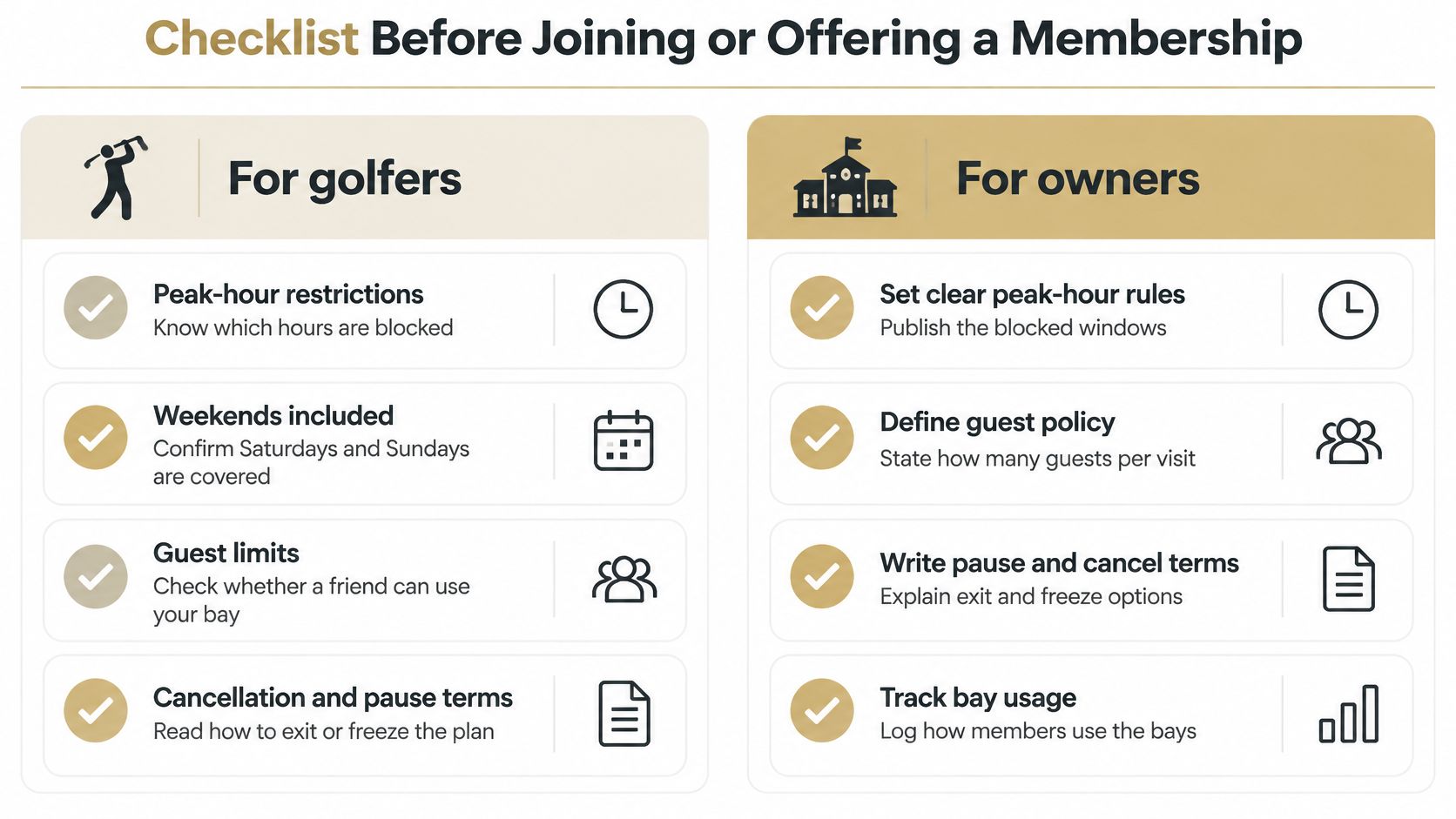
The word unlimited doesn't replace a contract. A membership agreement works like the yardage book for an unfamiliar course: its value lies in showing where the trouble sits before the swing. Before payment or launch, mark each item below clear, unclear, or missing, and keep the written terms next to the answers.
For golfers
Guest permissions, peak-hour access, junior rules, and equipment belong to the coverage questions addressed earlier in this guide. What remains here are the contract's edges, the clauses that decide what the membership is worth when life or weather interrupts it.
- What happens during travel, injury, or a long absence? Get the pause and cancellation process in writing, including any notice or evidence the facility requires.
- Can the golfer physically use the bays? Check accessible stations, the route from parking, lighting, covered areas, and seating. Generous access helps little at an unsuitable station.
- What does the facility owe when rain closes the range or cuts a session short? Ask rather than assume a credit or extension.
- When does the plan renew? Note whether renewal is automatic, the notice period, and the exact action that prevents the next charge.
For operators
A policy only works if a staff member can apply it at 6 p.m. on a Saturday. Test the rules with one scenario: a member arrives with a guest during peak hours and asks whether the friend can hit balls.
A workable front-desk answer sounds like this:
"Guests can share your bay on weekdays before 4 p.m. On weekends, guest play is charged at the standard bucket rate. I can book you both in for Tuesday evening if that helps."
That script exists only because the operator settled five questions first. The purchase: dues, joining fee, seats, and usable bay capacity, since seats describe who holds access while capacity describes how many can hit at once. The boundaries: off-peak windows, session limits, and guest permissions in plain language. The booking route: reserved, walk-in, or both, plus how no-shows are handled. The exit policy: a cancellation and pause process staff can run without escalating. The member record: how lesson credits and launch-monitor practice records attach when a household shares an account.
A checklist with several unclear marks is still doing its job. It tells the golfer exactly what to ask before paying, and it shows the operator which terms staff will otherwise end up negotiating one conversation at a time.
What Range Owners Gain and What to Track
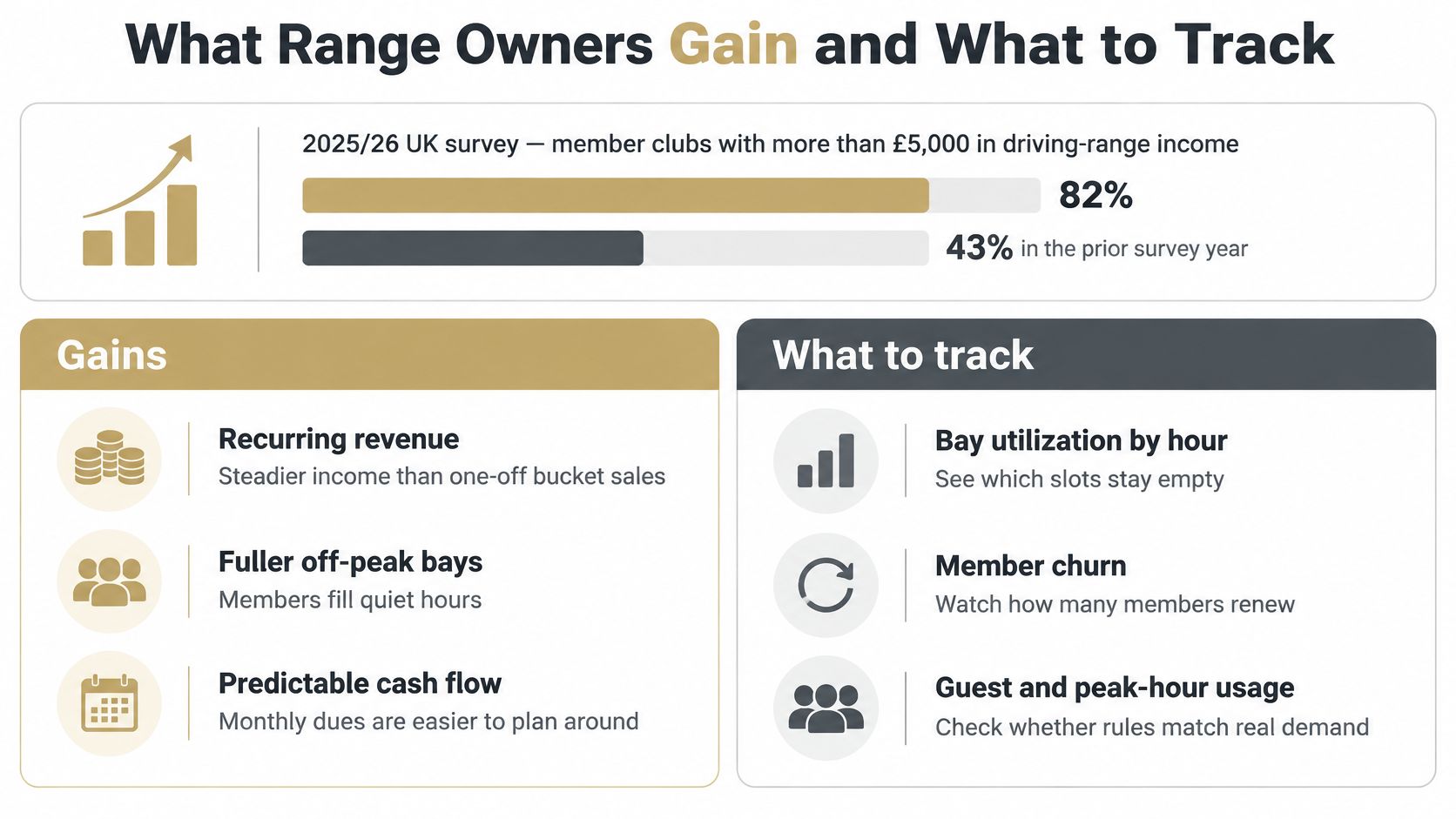
In the Hillier Hopkins 2025/26 UK golf-clubs survey, 82% of members' clubs generated more than £5,000 in driving-range income, up from 43% in the prior survey year; proprietary clubs reported range income from £12,000 to almost £1 million. These figures concern range income, not membership profit.
For operators, membership design is a utilization decision. Recurring dues can improve revenue predictability, off-peak members can fill quiet bays, and identifiable visits make it possible to connect attendance with lessons, ball purchases, food, or equipment spending.
The trade-offs are concrete. Existing pay-as-you-go customers may move into cheaper access without increasing total spending. Peak periods can become congested, while members expect priority the facility hasn't priced or staffed to deliver.
Measure attendance and contribution together
Tiered plans let operators separate frequent users from golfers willing to practice during quieter periods. The goal isn't to sell the largest possible number of unlimited memberships. It's to allocate access without displacing higher-value demand.
Membership metrics every range should report
| Metric | What It Shows | How to Calculate |
|---|---|---|
| Activation rate | Share of members who use the membership in a month | Active members divided by total members |
| Visits per active member | Frequency of use among members who come | Total visits divided by active members |
| Median days between sessions | Whether engagement is slowing | Median gap between each member's visits |
| Reactivation rate | Lapsed members who return | Returning members divided by lapsed members |
| Revenue per active member | Revenue available to cover costs | Total member revenue divided by active members |
| Contribution per bay | Contribution per hitting station | Bay revenue minus bay operating cost, divided by number of bays |
Operators should define an active member, a lapsed member, and the reporting period consistently. For contribution per bay, revenue and costs must cover the same period, with shared operating costs allocated on a documented basis.
Linking member identity to reservations, ball dispensing, coaching, and launch-monitor records enables cohort analysis: comparing groups by joining period or plan type. Hardware planning also matters, and a driving-range launch-monitor guide can help operators assess the practice setup separately from membership pricing.
A useful review asks whether a plan fills idle capacity, retains engaged golfers, and produces contribution after service costs. Dues collected alone can't answer those questions.
Decide Whether a Membership Fits Your Range or Game
A range membership is a bet on two things at once: how often the golfer will practice, and whether that practice has a purpose beyond hitting balls. The operator bets the member will visit less than planned; the golfer bets a fixed fee will beat the per-visit price over time. Frequent golfers should buy only after the break-even math and access conditions agree with their observed routine. Irregular golfers are often better served by prepaid credit, and coaches can help a player set a practice objective before recommending more access.
For golfers who want practice records in one place, and operators who need to administer access, the software decision is separate from the facility subscription. A practice application does not include range balls, and range access does not automatically produce a portable golfer record.
The golfer path
Dialed Golf is three products, one golfer record, one Pro plan. Seven free web tools, including the Carry Distance Chart Generator and Golf Bag Gap Analyzer, work without an account and stay free. They are the starting point, separate from paid Pro features.
On desktop, the app supports launch-monitor practice at the range or a garage simulator on macOS and Windows. Live pairing is desktop-first, starting with Garmin R10 and expanding, alongside CSV/import from Garmin, Rapsodo, SkyTrak, FlightScope, Uneekor, GSPro, Awesome Golf, and more.
The consumer app serves as a pocket caddy on the course and is currently a TestFlight release rather than a full App Store launch. Apple's TestFlight overview distinguishes beta distribution from a final App Store release.
Golfer Pro is optional across app and desktop: $9.99/week, $29.99/month, $149.99/6 months, or $249.99/year. The golfer supplies the launch monitor; the software turns recorded shots into carry, total distance, ball speed, spin, launch, and club speed trends.
The operator path
Dialed Golf Academy, also called Dialed Academy, is the separate B2B memberships and front-desk product for ranges and clubs. Its platform fee is $99.99/month or $999.99/year per facility, and the club keeps its dues. Operators can model dues, joining fees, seats, and commitment terms before launch.
The decision is between golfer practice software and facility membership administration. A golfer evaluating a home or range routine needs the first; an owner pricing dues and tracking member activity needs the second.
The next step is a written decision sheet. List the three most common visit patterns, then run the golfer break-even calculation or the owner metrics for one month. The resulting attendance and economics should choose the plan or platform, because unlimited access feels valuable whether or not the math supports it.
Dialed Golf offers free planning tools, connected golfer practice records, and separate membership administration for ranges and clubs. Visit Dialed Golf to choose the golfer or operator path and assess the offering against an actual practice routine or facility membership model.
[…] Club Management Software: Features and How to Choose Range Membership Golf: What It Costs and Who Benefits What Is Flex in Golf Clubs and How to Choose Golf Training Software: What to Buy First Golf […]