


A golfer finishes a range session, sees a driver club head speed reading, and immediately asks whether the number is good. The display might show a speed near the commonly cited amateur baseline, or it might sit far below a tour benchmark. Either way, one reading rarely answers the question the golfer cares about: whether the club is delivering useful, repeatable shots.
Average golf club head speed becomes valuable when it turns into a record, not an identity label. By comparing the same club, similar strikes, and consistent session conditions, golfers can use speed to understand distance potential, equipment behavior, and practice priorities without chasing a number that belongs to someone else.
Table of Contents
- What Club Head Speed Measures and What It Misses
- Average Speeds by Player Profile
- How Speed Changes From Driver to Wedge
- Measure Club Head Speed Reliably
- Read Your Numbers Without Fooling Yourself
- Turn Speed Into Fitting and Practice Decisions
- Three Golfer Profiles and What They Mean
- Build a Baseline and Make the Next Move
What Club Head Speed Measures and What It Misses
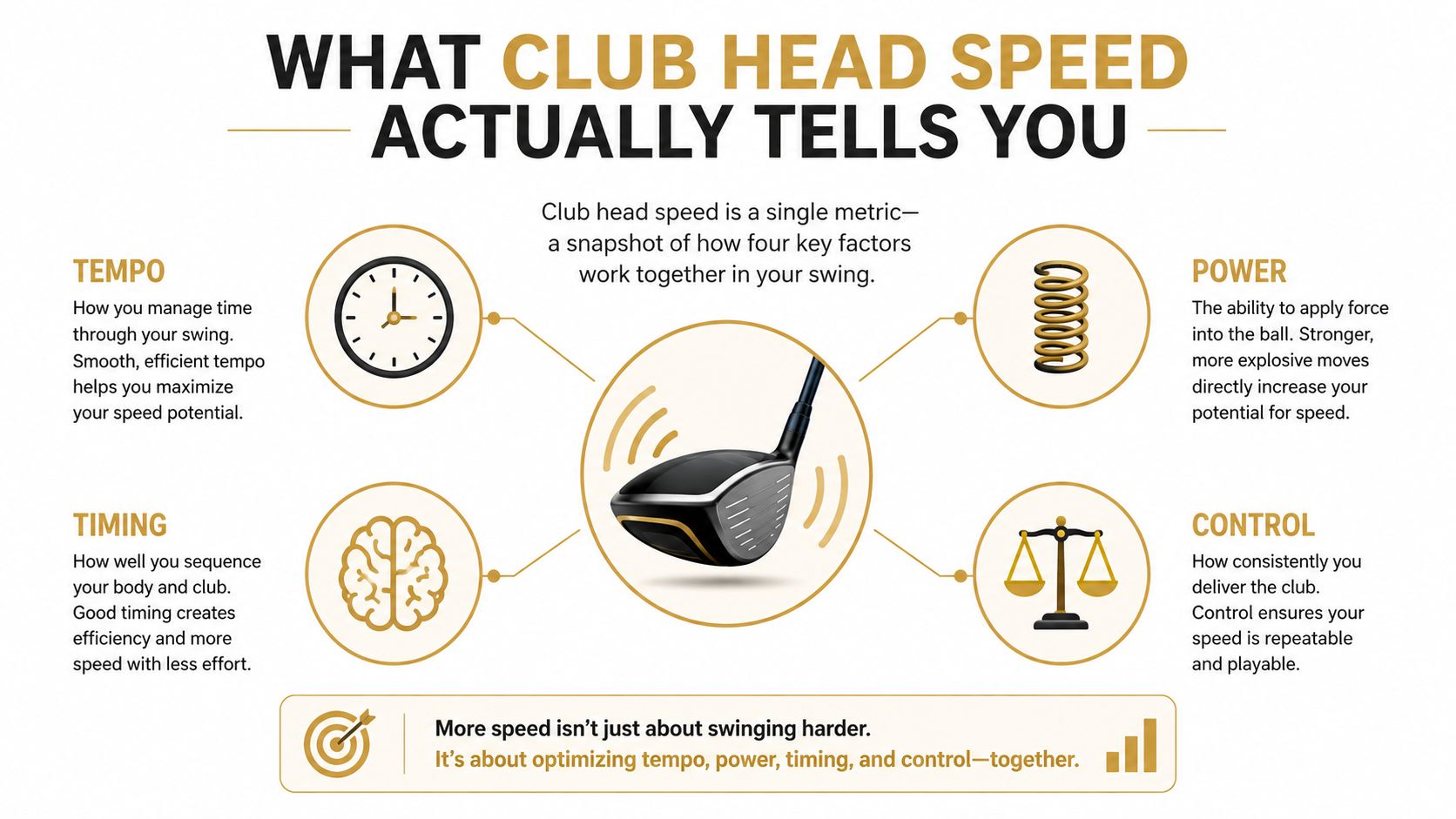
A golfer sees a launch monitor display after a swing. The number shows how fast the club head was moving at impact, but it does not describe the whole swing or guarantee a useful shot. It is one measurement in a larger record.
Club head speed, ball speed, and distance are different measurements. Ball speed describes how quickly the ball leaves the clubface after impact. Distance also depends on strike location, launch, spin, attack angle, and direction. A faster swing can produce less useful distance when contact moves away from the center or launch conditions become less efficient.
A coach reviewing a session would usually ask three questions:
- Is the speed repeatable?
- Does the strike turn that speed into ball speed and carry?
- Does the pattern make sense across the golfer's clubs?
The first question separates ordinary performance from an isolated swing. The second distinguishes raw motion from effective delivery. The third can expose gapping problems, equipment mismatches, or inconsistent sequencing. Together, these questions turn a speed reading into a club-by-club comparison rather than a standalone score.
What the metric can support
A stable speed profile helps a golfer compare similar sessions and track whether a change is repeatable. It gives a fitter context for discussing shaft behavior, ball selection, carry gaps, and club configuration. A coach can compare speed with contact and ball flight to choose between sequencing work, centered-contact practice, or a controlled speed-development exercise.
What it cannot answer alone
Club head speed does not reveal shot direction, strike quality, release timing, or launch efficiency. It also cannot prove that a faster swing is a better swing. Averages are reference points, not targets copied from another player.
Practical rule: Keep speed as one line in a golfer record. Interpret it alongside strike, launch, carry, and repeatability.
Average Speeds by Player Profile
A useful benchmark starts with the golfer being compared. A tour number describes an elite professional group, while an amateur benchmark covers a much wider range of recreational players. These figures work like traffic-flow ranges, not exact speed limits. A golfer can fall outside a typical band and still produce effective shots.
The figures below combine player-profile data from the peer-reviewed handicap and club head speed study indexed by PubMed with commonly used instruction benchmarks summarized in the average golf swing speed chart.
| Player profile | Driver speed benchmark | How to use it |
|---|---|---|
| PGA TOUR player | 115.9 mph in 2024 | A tour reference, not a recreational target |
| Scratch male golfer | Around 108 mph | A skilled-amateur comparison for fitting and gapping |
| 10-handicap male golfer | Around 96 mph | A practical low-to-mid handicap reference |
| 20-handicap male golfer | Around 92 mph | A useful higher-handicap comparison |
| Common male amateur baseline | About 93 mph | A starting point for personal benchmarking |
| Scratch female golfer | Around 91 mph | A skilled-player reference |
| 15-handicap female golfer | Around 79 mph | A practical comparison for player profiling |
The USGA's 2024 Distance Report summary places the PGA TOUR average at 115.9 mph in 2024, compared with 115.1 mph in 2023. It also reports averages of 112.78 mph in 2007 and 114.13 mph in 2016, indicating a gradual rise rather than a dramatic seasonal shift.
The handicap relationship is strong. The PubMed-indexed study reported a correlation of r = 0.950 between club head speed and handicap and modeled the relationship as ln(club head speed) = 4.065 – 0.0214 × handicap. Speed therefore provides a meaningful performance reference, but it does not replace course skill, contact, or decision-making.
A commonly cited male amateur figure of 93.4 mph for 14 to 15 handicap players appears in the instruction benchmark. Use these figures to set a personal range rather than comparing every swing to a tour number. Record a repeatable baseline, then check whether that speed supports the carry and control you need.
The practical question is not, “How close am I to the fastest group?” It is, “What speed range describes my ordinary swings, and what fitting or practice choice follows from it?”
How Speed Changes From Driver to Wedge
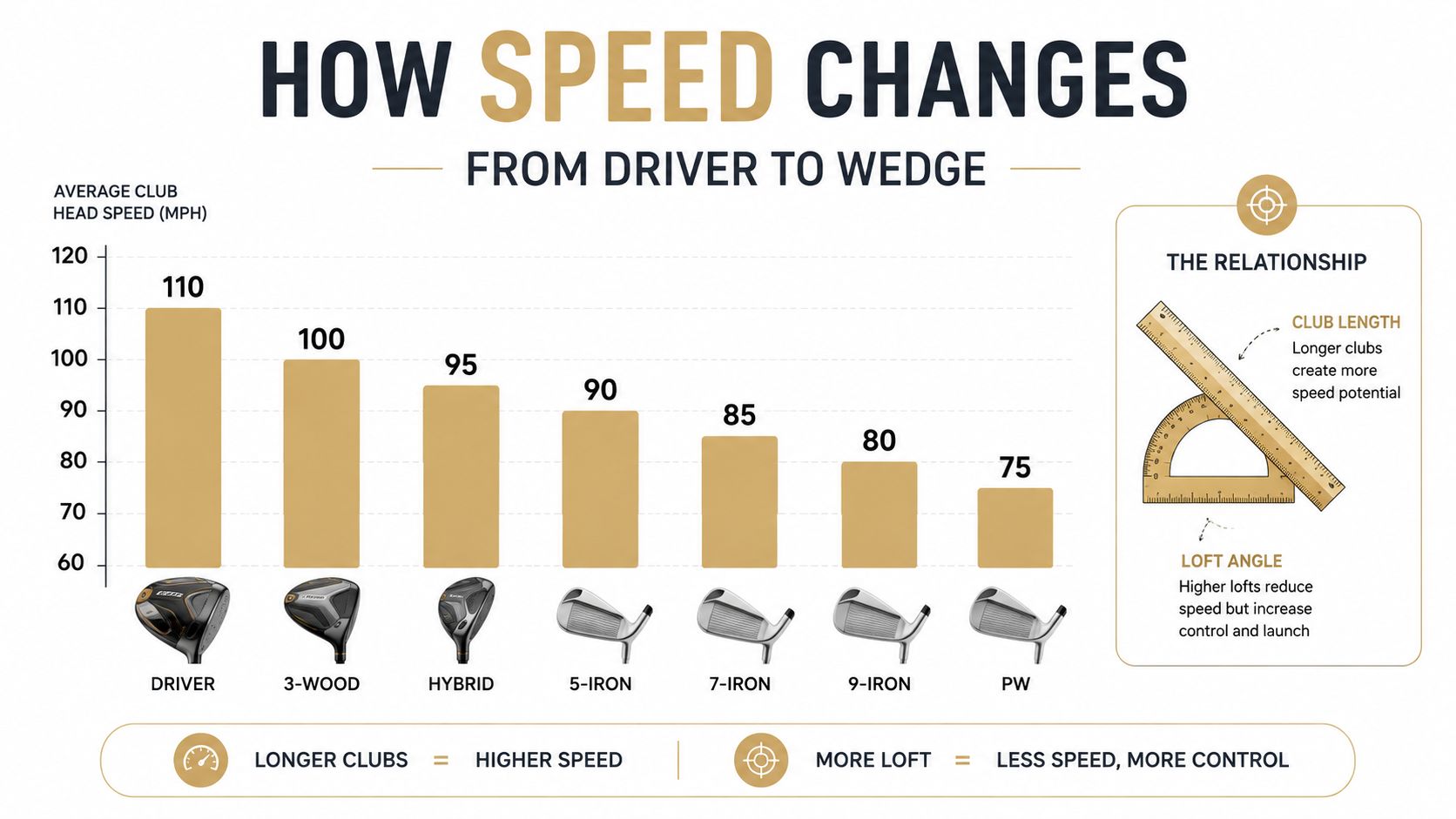
Within one golfer's bag, club head speed generally declines as clubs become shorter and more lofted. A driver gives the player the longest club and the greatest opportunity to create speed. A wedge asks for a shorter motion, more loft, and greater control.
That pattern is useful, but it isn't a universal ladder. The supplied visual uses illustrative values, including 110 mph for driver, 100 mph for 3-wood, 95 mph for hybrid, 90 mph for 5-iron, 85 mph for 7-iron, 80 mph for 9-iron, and 75 mph for pitching wedge. Those values should be read as a descending example, not as a required benchmark for every golfer.
Read the bag as a pattern
A club-by-club session should collect comparable shots with the driver, fairway woods, hybrids, irons, and wedge. The golfer can then record a typical speed range for each club rather than focusing on the fastest swing.
A useful record might include:
- Club identity: Confirm the exact club and loft before recording.
- Typical speed: Note the central range produced by ordinary swings.
- Carry: Pair speed with the distance the ball flies.
- Strike quality: Mark whether contact was centered or visibly poor.
- Next-club comparison: Look for a sensible progression rather than a perfect formula.
An unusual jump can indicate a measurement issue, a club that encourages a different motion, or a genuine fitting question. A reversal isn't automatically a problem, either. A golfer may swing a hybrid differently from an iron, and a wedge session may include partial shots rather than full swings.
The key question is whether the speed pattern explains the carry pattern. If two clubs show similar speed but produce an unexpected carry relationship, launch, loft, strike, or spin deserves attention. Speed by club is a diagnostic profile, not a staircase every golfer must climb in identical increments.
Measure Club Head Speed Reliably
An average becomes useful only when the measurement process is repeatable. A personal launch monitor can produce valuable data, but the unit still needs a consistent setup and a clearly defined session.
Start by placing the device and ball according to the manufacturer's guidance, then confirm the selected club in the session. A wrong club label can make a later gapping review misleading even when the speed reading itself looks plausible. The golfer should also keep the hitting environment as consistent as possible, especially when comparing sessions from a range and a garage simulator.
Use a repeatable session routine
A practical sequence looks like this:
- Prepare the setup. Place the monitor consistently, use the intended target line, and verify the club selection.
- Warm up before recording. Early swings often reflect preparation rather than normal playing motion.
- Collect representative shots. Include ordinary swings, not only personal bests.
- Inspect the group. Look for obvious outliers, mishits, and readings that don't match the visible shot.
- Save the context. Record the club, date, environment, ball, and any meaningful change in equipment or swing intent.
The purpose isn't to manufacture a perfect number. It's to create a defensible baseline that can be compared with another session. A device should be treated as a measuring instrument, not an oracle. Consistent placement and clear labels reduce noise before any software analysis begins.
Garmin's official support documentation confirms that a driving-range session in the Garmin Golf app can be exported as a CSV by opening the session's Activity view and selecting “Export to CSV.” That makes the session portable for later analysis or import. A golfer researching setup options can also review this guide to choosing a launch monitor for driving-range practice.
Dialed Golf's desktop workflow supports live pairing first for the Garmin R10, with support expanding, and also provides CSV or import paths for Garmin, Rapsodo, SkyTrak, FlightScope, Uneekor, GSPro, Awesome Golf, and more. The live-pair workflow is desktop-first. Mobile live pairing comes later, so mobile and desktop should not be treated as identical measurement experiences.
Read Your Numbers Without Fooling Yourself
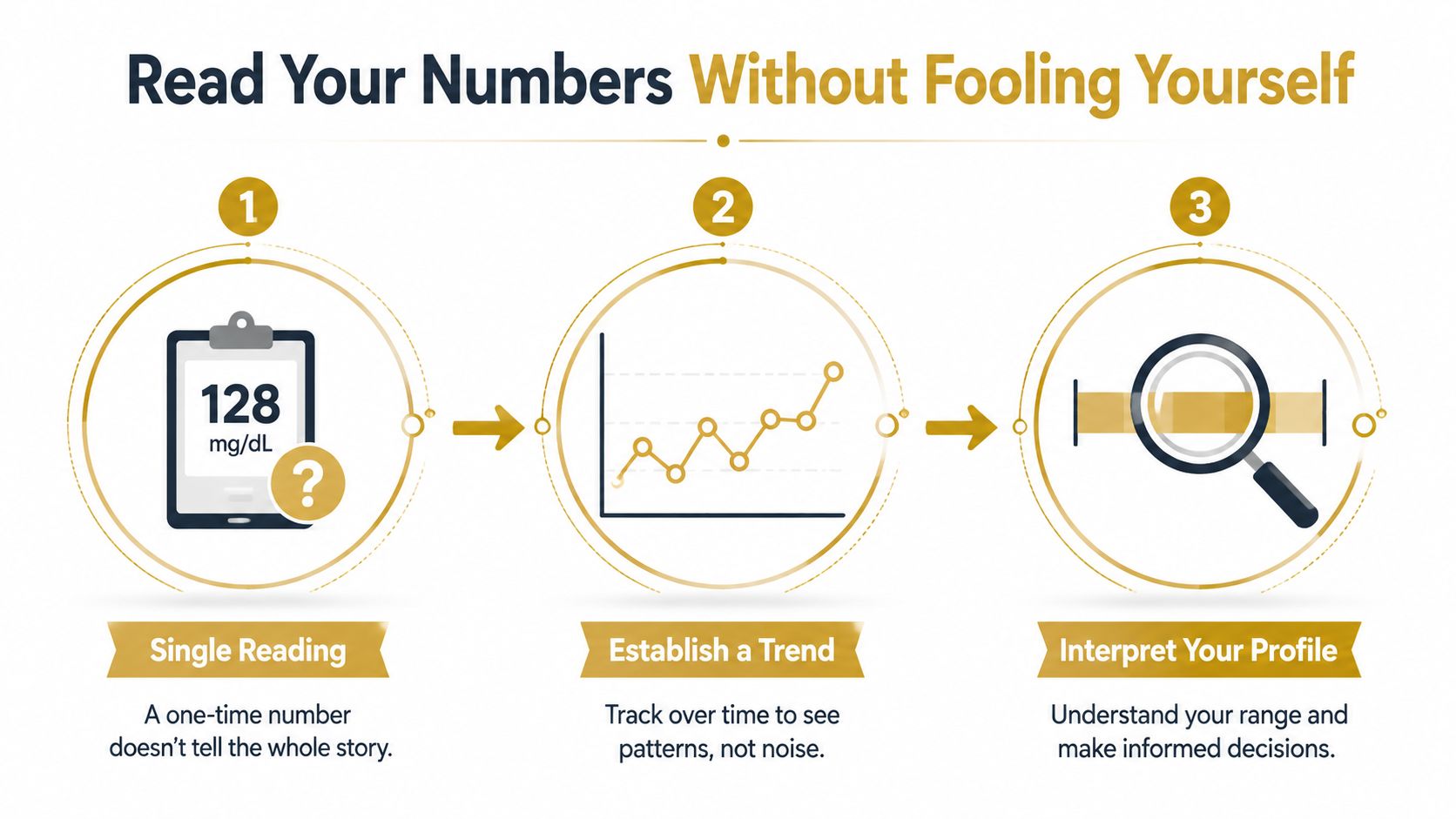
A single fast swing is interesting. It isn't automatically representative.
A golfer may produce a high reading after an aggressive effort, then lose contact and launch efficiency. Another golfer may record a slower session because of cold conditions, fatigue, restricted warm-up, or a changed swing intention. Neither reading should become a permanent label.
Compare like with like
A trustworthy comparison keeps the important variables aligned:
- Same club specification: Loft, shaft, and club identity should match.
- Comparable ball: A different ball can change the delivered shot and the interpretation.
- Similar conditions: Note whether the session occurred indoors, outdoors, into wind, or on a different surface.
- Plausible shot group: A cluster of ordinary swings is more useful than unrelated extremes.
- Clear annotations: Mark a lesson, equipment change, fatigue, or deliberate speed session.
A trend doesn't require every session to look identical. It requires enough context to distinguish a real change from setup noise. If speed rises while strike and carry remain stable, the change deserves a different interpretation from a rise accompanied by scattered contact.
Put modern benchmarks in perspective
Recent commentary has treated the 115.9 mph PGA TOUR average as a moving benchmark and has cited a 93 mph male amateur average alongside a scratch-amateur figure near 108 mph. The broader point is that published norms can shift with training habits, athlete-style swings, and equipment evolution, as discussed in this recent golf swing speed chart.
That long-term movement doesn't mean every golfer should chase the latest tour expectation. It means an internet chart is a starting reference. A golfer record built from comparable personal sessions should carry more weight when making an individual practice or fitting decision.
Turn Speed Into Fitting and Practice Decisions
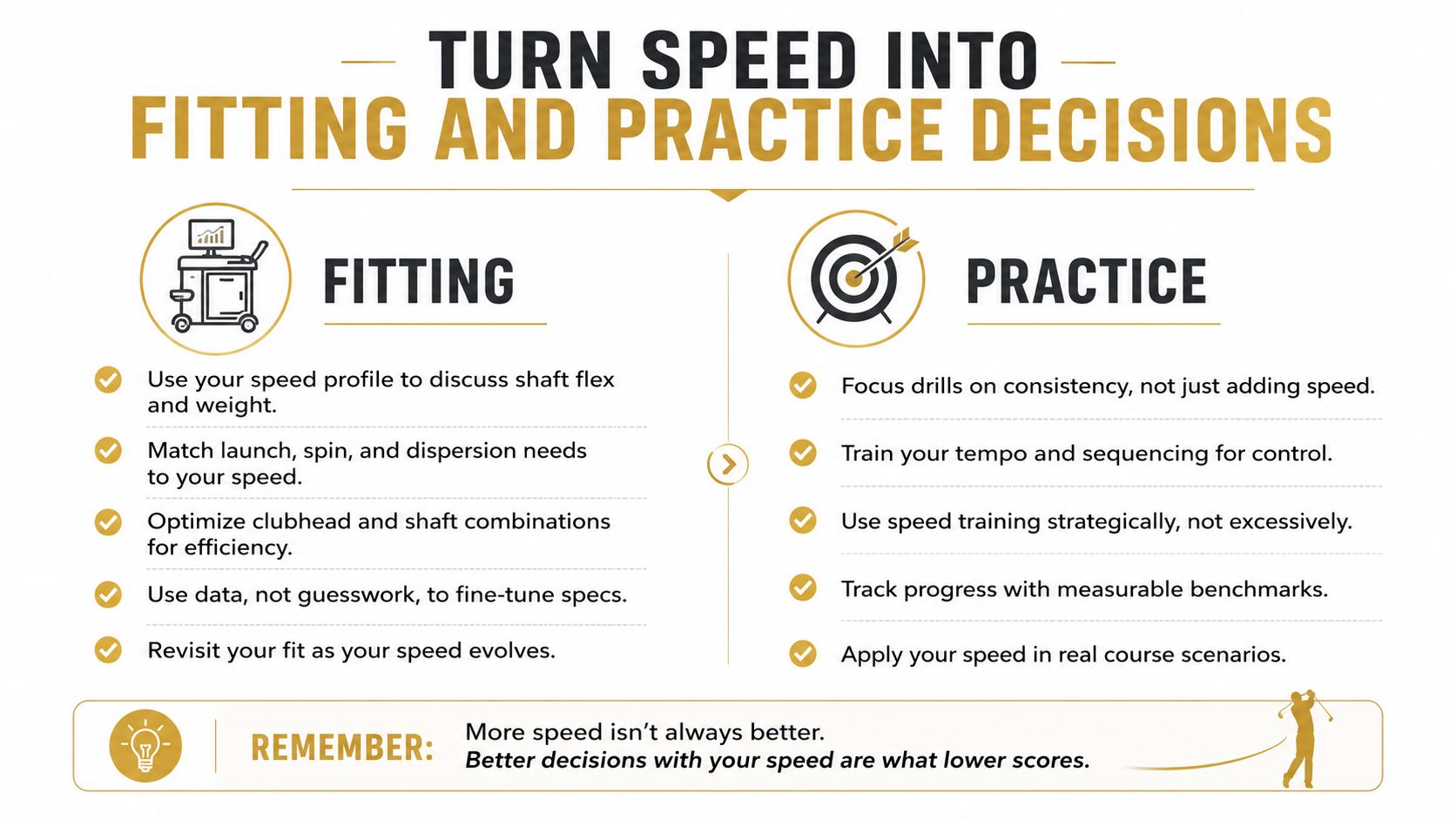
Club head speed helps frame a fitting conversation, but it doesn't prescribe the answer. A stable speed profile tells a fitter what delivery range the equipment must accommodate. The fitter still needs to evaluate launch, spin, strike, ball flight, and the golfer's desired carry.
For example, a golfer with a consistent driver speed but poor carry may need a strike or launch review before buying a different shaft. A golfer whose iron speeds are stable but whose carry gaps are compressed may need loft and distance mapping rather than speed training. Measurement identifies a constraint. It doesn't automatically identify the swing adjustment or equipment change.
Use a four-part decision sequence
- Collect a baseline. Record a typical speed range and the associated carry for one club.
- Review the pattern. Check strike, launch, spin, direction, and the relationship with adjacent clubs.
- Test one change. Alter one variable, such as setup intention, tee height, shaft option, or practice drill.
- Recheck the result. Keep the same measurement conditions and decide whether the change improved the whole shot, not just speed.
This approach prevents impulsive equipment purchases. It also keeps practice focused. If speed is adequate but contact is scattered, the priority is consistency. If contact is solid but the player lacks speed for a specific goal, structured speed development may be appropriate. If the main issue is uncertain data, another carefully controlled session comes before either choice.
A practical gapping workflow can connect the speed profile to carry spacing and club selection. Golfers who want a structured review can use this guide to performing a gap analysis as a companion process. Speed belongs in that review, but the carry outcome remains the decision that matters on the course.
Three Golfer Profiles and What They Mean
A speed reading becomes useful only after you know whose question it is meant to answer. The same number can support different decisions for a mid-handicap golfer, a low-handicap player, or someone studying tour performance.
The mid-handicap male golfer
A mid-handicap male golfer near the commonly cited 93 mph amateur baseline should first test whether that reading repeats across several swings. The driver's strike matters just as much. Comparing this golfer directly with the 115.9 mph PGA TOUR average can create pressure without identifying the next practical task.
A better record pairs driver speed with carry, launch, and strike quality. If contact moves around the face, improving centered delivery may produce more useful distance than chasing extra speed. If the speed range and contact are stable, a fitting session can examine whether shaft, loft, and ball setup support the intended flight.
The number is a starting point, not a verdict.
The low-handicap golfer
A low-handicap male golfer near the cited 108 mph scratch benchmark may already have enough speed to create strong distance potential. The next question is often how consistently that speed turns into predictable carry gaps, especially between driver and irons.
Fast swings also need to stay playable. If the golfer's peak readings come with wider dispersion, the useful comparison is between speed, strike location, launch, spin, and carry. Practice can then address the weakest link, whether that means retaining speed, improving contact, or controlling distance. A stable speed profile with poor gaps points toward fitting or gapping work rather than speed training alone.
The tour-level observer
A golfer studying the 115.9 mph tour average is using an elite reference point. Tour speed reflects a professional performance environment, so it should provide context rather than become a default recreational target.
The comparison shows how far elite driving speed sits above the common amateur baseline. It also clarifies a limit of the metric: speed does not identify the best next move by itself. Better contact, more reliable carry gaps, or smarter scoring decisions may matter more for the golfer's actual goal.
Choose the comparison group that matches the question. The most impressive number is rarely the most useful benchmark.
Build a Baseline and Make the Next Move
A useful golfer record begins with a repeatable test, not a single exciting swing. Start with one club and verify its identity and specifications. Use the same setup, then collect enough swings to represent the session. Record the typical speed range, including ordinary strikes rather than only the fastest reading.
Use that baseline to compare the club with the appropriate player-profile benchmark. Then add the measurements that explain the number: strike location, launch, spin, direction, and carry. A speed reading is like the engine output of a car. It suggests potential, but contact and launch determine how efficiently that potential reaches the target.
Choose one next action. That might be a fitting question, a technical practice goal, or a defined training block. Retest under similar conditions after a meaningful change, such as a new club or technique adjustment. Daily attempts to beat a personal best can obscure progress, while repeated tests show whether typical speed, contact, or carry has changed.
A single number cannot describe a golfer. It becomes useful when paired with consistent measurements and a clear question.
A fitter should join the process when a stable baseline leaves poor carry, unusual gaps, inconsistent launch, or a mismatch between speed and ball flight unexplained. The gap-analysis workflow helps organize those questions before the appointment.
Dialed Golf has three products, one golfer record, and one Pro plan. Its consumer app is a pocket caddy currently in TestFlight, not general App Store availability. Its desktop product supports launch-monitor practice at a range or garage simulator, with live pairing first for Garmin R10 and expanding support, plus CSV and import workflows. Golfer Pro works across app and desktop at $9.99 per week, $29.99 per month, $149.99 per six months, or $249.99 per year. Dialed Academy serves ranges and clubs with memberships and front desk tools at $99.99 per month or $999.99 per year, while the club keeps its dues. Free web tools remain free.
Dialed Golf helps golfers organize launch-monitor data, track club relationships, and turn speed readings into a useful golfer record for practice and on-course decisions. Visit Dialed Golf to review the consumer app, desktop workflows, free web tools, and Pro options before the next range session.