

Most golf advice treats golf driver swing speed as the answer. It isn't. A faster clubhead can produce a weaker drive when the strike, launch, spin, or equipment fails to convert that speed into ball speed and carry. The useful question isn't just how fast a golfer swings, but how much usable distance that speed creates.
That distinction matters for anyone reading a personal launch monitor, comparing driver setups, or planning speed training. A speed number is an input. Ball speed, smash factor, launch, spin, and carry reveal whether the input is doing useful work.
Table of Contents
- Why Raw Swing Speed Tells Only Half the Story
- Golf Driver Swing Speed Benchmarks by Skill Level
- How Swing Speed Converts to Ball Speed and Smash Factor
- Launch Angle and Spin Optimization for Your Speed Bracket
- Measuring Swing Speed with Launch Monitors and CSV Data
- The Case for Fitting Over Speed Training
- Setting Realistic Speed and Distance Goals
Why Raw Swing Speed Tells Only Half the Story
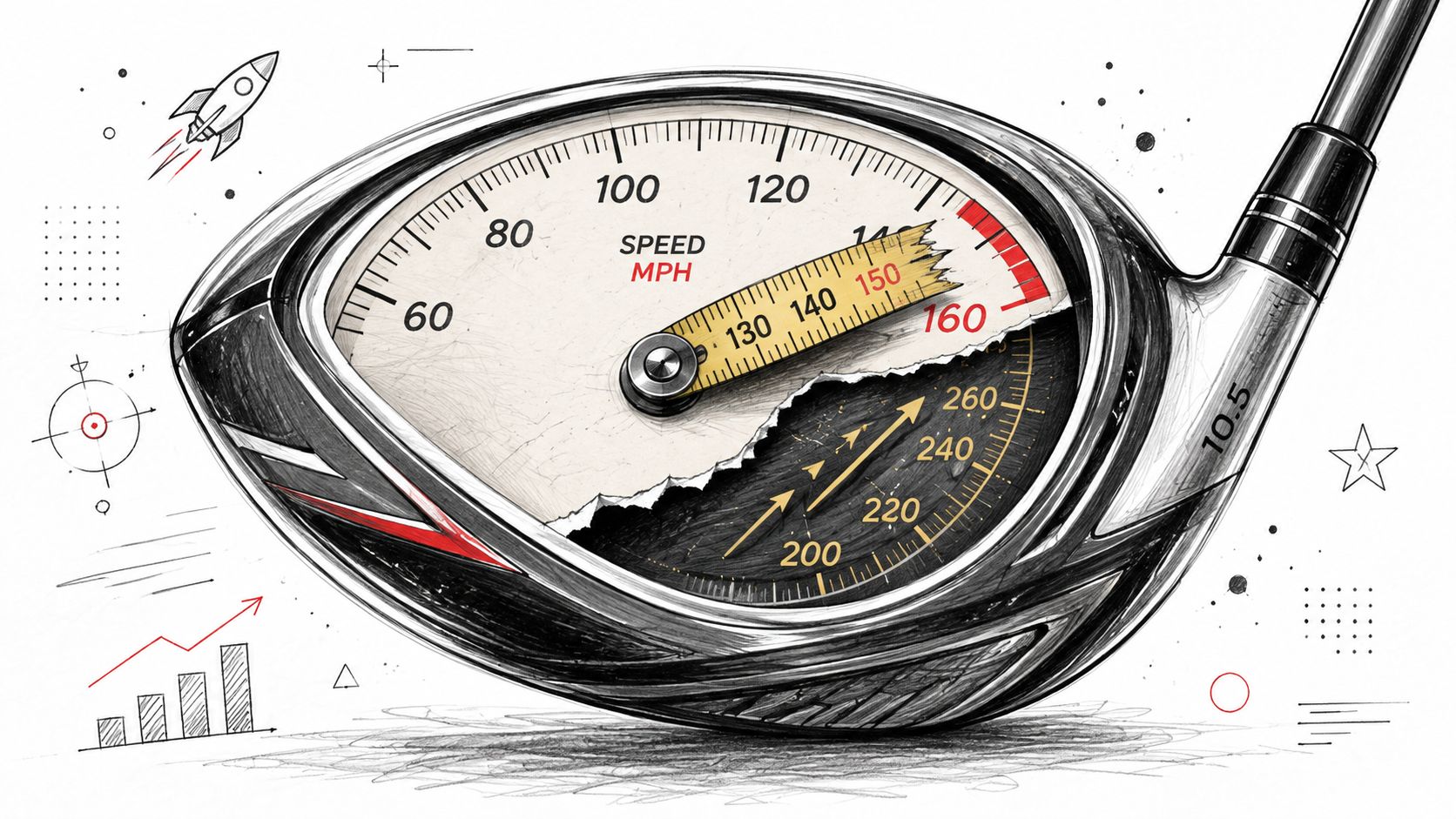
A driver swing speed reading can look impressive while the shot underperforms. Clubhead speed measures how quickly the head moves before impact, but distance depends on what happens at impact and during the ball's flight. A centered strike usually transfers more energy than a strike toward the heel or toe, and the correct launch conditions can preserve carry that a poorly fit setup wastes.
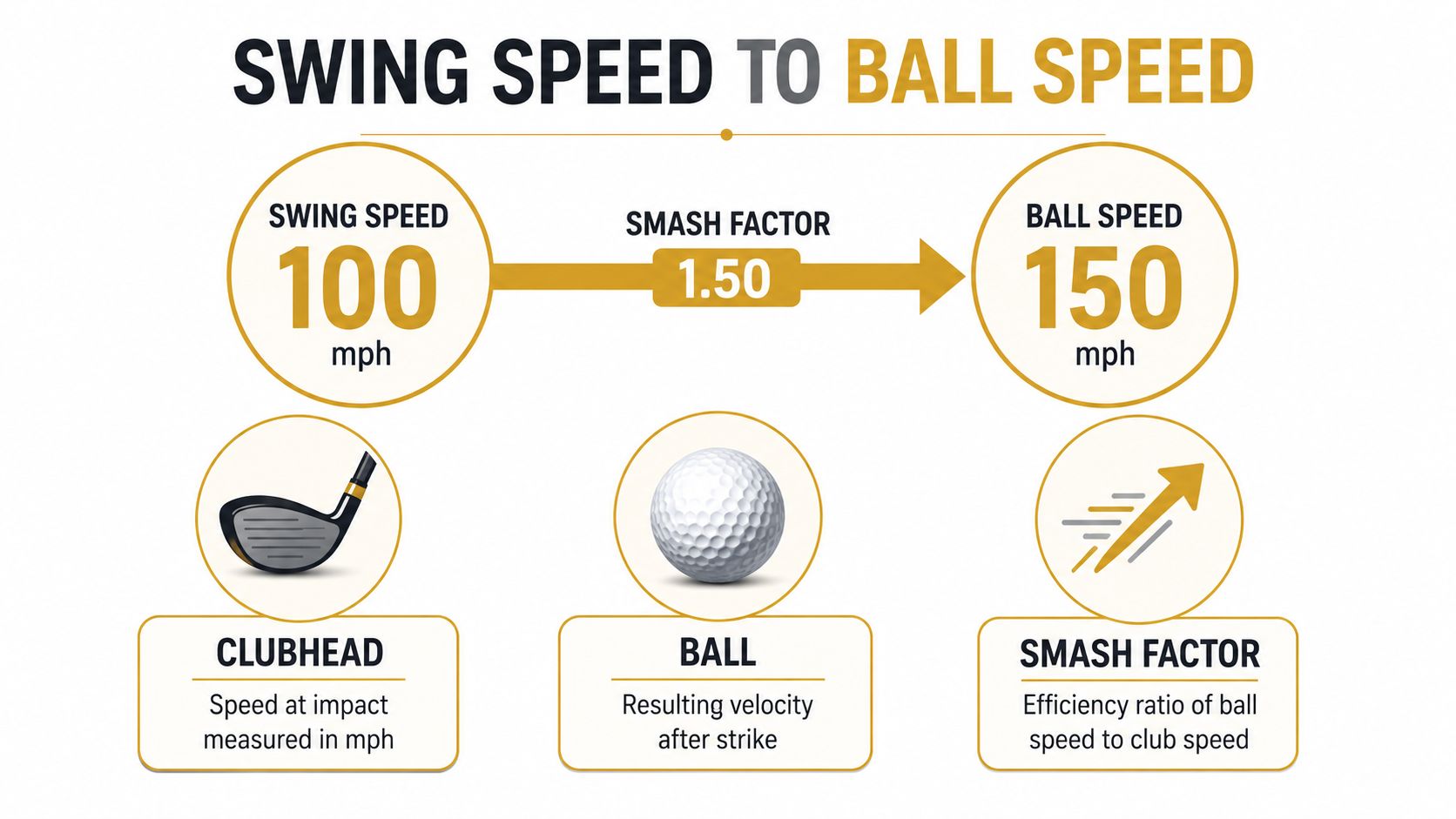
At around 100 mph of clubhead speed, efficient impact typically produces approximately 145 to 150 mph of ball speed, a smash factor of roughly 1.45 to 1.50. Those figures come from the practical relationship between club speed and ball speed described in launch-monitor number guidance. A golfer who swings harder but delivers the face inconsistently can therefore lose distance to a slightly slower golfer who finds the center more often.
Speed conversion is the practical metric
Consider two hypothetical launch-monitor sessions. One golfer creates 100 mph of club speed and a 1.48 smash factor, producing about 148 mph of ball speed. Another creates 105 mph but a 1.38 smash factor, producing about 145 mph of ball speed. The second golfer swings faster, yet the first golfer has created more speed at the ball.
The example isn't a promise about carry because launch and spin still matter. It demonstrates the diagnostic order that makes launch-monitor data useful:
- Clubhead speed shows the available input.
- Ball speed shows the energy transferred to the ball.
- Smash factor shows the conversion efficiency.
- Launch and spin show whether the ball can turn that speed into useful flight.
- Carry confirms the outcome.
Practical rule: If ball speed isn't rising with clubhead speed, the first investigation should be strike and delivery, not more effort.
A golfer can use the correct driver stance as one part of a repeatable setup, but stance alone won't solve every conversion problem. Face contact, dynamic loft, face angle, attack delivery, and head design all influence what the launch monitor records.
The same 10 mph gain can create very different carry results when two golfers launch the ball differently or use different driver heads. Independent testing reported by GolfSource's swing-speed analysis describes meaningful carry and spin differences between driver models tested at 95 mph and 105 mph, including one model moving from 203.2 yards to 240.0 yards of carry. Speed matters, but the conversion system matters just as much.
Golf Driver Swing Speed Benchmarks by Skill Level
Benchmark charts help golfers locate their current speed, but they shouldn't become a ranking system. Recreational golfers occupy a broad range, and the same clubhead speed can support different carry numbers depending on strike quality, launch conditions, weather, and equipment.
A widely cited 2026 chart places the average male amateur driver speed at about 93 mph, with most recreational male golfers clustered between 85 and 95 mph. It also reports that roughly 70% of amateur male golfers sit in that band, while PGA Tour averages fall around 113 to 118 mph, as summarized in the driver swing-speed chart from UpYourClub.
| Player Category | Avg Clubhead Speed (mph) | Typical Carry Distance |
|---|---|---|
| Bogey male golfer | About 85 | Qualitatively variable, often limited by strike and launch |
| Ten-handicap male golfer | About 95 | Qualitatively variable, dependent on efficiency |
| Average male amateur | About 93 | About 220 to 240 yards of carry for weekend players |
| Scratch male amateur | About 108 to 110 | Qualitatively variable, with stronger speed and delivery |
| LPGA Tour player | Near 94 to 96 | Qualitatively variable, shaped by elite strike and launch |
| PGA Tour player | About 113 to 118 | Qualitatively variable, supported by high ball speed and efficiency |
The 93 mph benchmark is more encouraging than many golfers assume. The same chart connects that speed with roughly 220 to 240 yards of carry for weekend players when the delivery is functional. That range isn't a guarantee, and it shouldn't be used to judge a golfer whose launch, spin, or strike differs from the chart's assumptions.
Why generic categories mislead
A second data summary places high-handicap players around 76 to 84 mph, ten-handicaps near 95 mph, scratch male amateurs around 108 to 110 mph, and PGA Tour driver speed at 115.9 mph in 2024, compared with 112.37 mph in 2007. The same handicap and age swing-speed chart reports the LPGA average near 96 mph.
Those figures expose a common classification problem. A woman or older golfer near the average male amateur speed isn't automatically a slow-speed player, and speed alone doesn't determine the correct loft, ball, or launch window. The better comparison is between a golfer's speed and the ball-speed, launch, spin, and carry results produced by that speed.
Golfers should treat these benchmarks as starting points. A realistic target might be improved conversion at the existing speed, a more repeatable launch window, or a smaller gap between good and poor strikes. A raw speed increase only matters if it survives contact with the ball.
How Swing Speed Converts to Ball Speed and Smash Factor
Smash factor equals ball speed divided by clubhead speed. It gives golfers a compact way to assess impact efficiency, although it isn't a complete diagnosis. A high number can reflect a strong strike, while a low number can indicate poor contact, a delivery issue, or a measurement inconsistency.
At approximately 100 mph, a well-delivered driver can produce 145 to 150 mph of ball speed and a smash factor around 1.45 to 1.50. Reported PGA Tour averages of about 113 mph club speed and 167 mph ball speed imply a smash factor near 1.48, according to launch-monitor metric guidance. Elite players separate themselves by preserving that conversion while controlling direction and flight, not by swinging harder.
What a low smash factor suggests
A smash factor below 1.40 generally deserves investigation for a driver swing near the 100 mph range. It doesn't identify the precise fault, but it tells the golfer that more clubhead speed may not be the immediate answer. The next checks should include strike location, face contact consistency, impact conditions, and whether the launch monitor is measuring the shot cleanly.
Strike location often explains why a golfer's speed conversion changes from shot to shot. A centered strike tends to preserve ball speed, while mishits can reduce it and alter spin or launch. A golfer who records a higher club speed on a poor strike hasn't necessarily improved performance.
Ball speed makes the comparison honest
Raw speed can flatter a session. Ball speed makes the comparison more revealing because it shows what reached the ball after impact. If clubhead speed rises but ball speed stays flat, the golfer has likely traded efficiency for effort. If both rise while launch and spin remain usable, the change has a better chance of producing additional carry.
Smash factor should be reviewed alongside carry rather than treated as a target in isolation. A golfer can produce an efficient strike but lose distance through excessive spin or an unsuitable launch angle. The useful performance chain is therefore:
- Create repeatable clubhead speed.
- Find the face with that speed.
- Convert the strike into ball speed.
- Match launch and spin to the delivery.
- Confirm the result through carry and dispersion.
That sequence prevents a common mistake, chasing a higher speed number while ignoring the ball-flight evidence that says the swing has become less efficient.
Launch Angle and Spin Optimization for Your Speed Bracket
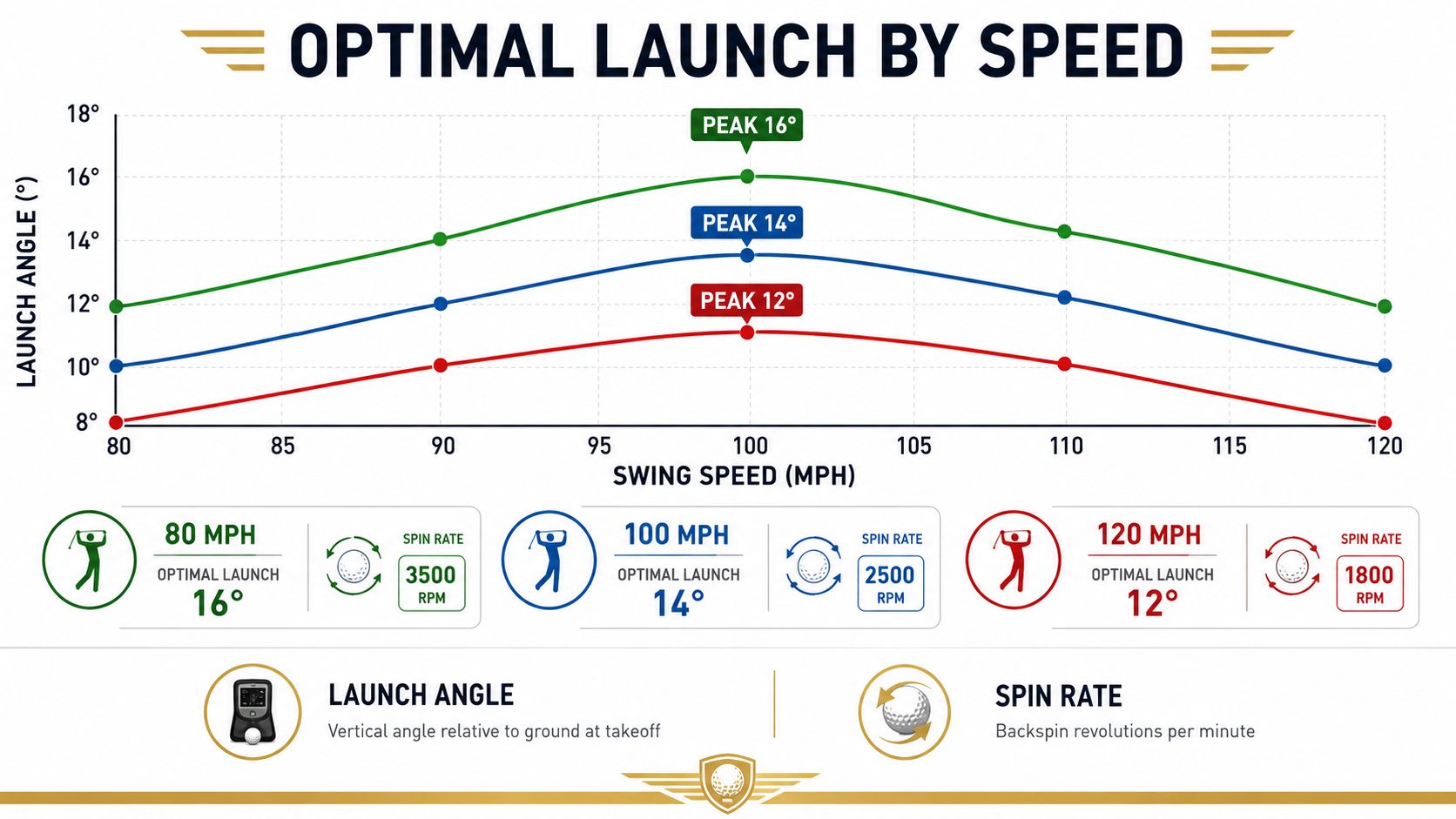
Adding speed doesn't automatically add carry. A faster swing can launch too low, spin too much, or produce a peak height that costs distance. The correct launch window depends on speed, strike, attack delivery, loft, and the driver head, so benchmark figures should guide testing rather than replace it.
For a 105 mph swing, a commonly cited driver benchmark calls for approximately 13° to 15° of launch, 2,200 to 2,500 rpm of spin, and 152 to 157 mph of ball speed, with carry around 265 to 275 yards. The figures are summarized in driver launch-angle optimization guidance.
Faster doesn't mean higher
Guidance for a 110 mph swing shifts toward roughly 10° to 12° of launch while maintaining high smash efficiency. As speed rises, golfers often need to manage spin more carefully because excess spin can increase height and reduce carry. The exact best window still depends on the individual delivery, but the direction of the adjustment is clear.
A golfer near 93 mph shouldn't copy a tour player's launch conditions. A slower delivery generally needs enough launch and spin to keep the ball in the air, while a faster delivery can often use a lower launch window without sacrificing flight. Loft changes, strike location, and attack angle can move the measured launch significantly, so a single fitting number isn't a universal prescription.
Compare speed gains with fit gains
Suppose a golfer adds speed through training but keeps a launch and spin combination that was already costing carry. The launch monitor might show a higher clubhead speed and a disappointing distance result. A slightly slower swing with a better launch window can produce more useful carry because the ball spends its available speed in a more productive flight.
The best review process compares groups of shots, not one exceptional ball. Track:
- Ball speed, to confirm energy transfer.
- Launch angle, to see whether the flight starts in a workable window.
- Spin rate, to identify excess or insufficient backspin.
- Carry, to measure the actual outcome.
- Dispersion, because a longer shot that misses the intended corridor may not improve scoring.
Speed training and equipment changes should both pass the same test. If the change raises speed but worsens ball speed, carry, or dispersion, it hasn't produced a usable gain yet.
Measuring Swing Speed with Launch Monitors and CSV Data
A personal launch monitor becomes useful when it creates a repeatable record rather than a stream of isolated numbers. Garmin Approach R10, Rapsodo MLM2PRO, SkyTrak, FlightScope Mevo+, and Uneekor systems can support this kind of analysis through direct connections or file-based workflows. Compatibility guides describe both live integrations and CSV import or export paths across these device categories, as outlined in this launch-monitor compatibility guide.
The measurement process should stay consistent:
- Use the same driver and ball. Changing equipment mid-session makes the baseline harder to interpret.
- Warm up before recording. Early swings often reflect preparation rather than the golfer's useful session speed.
- Record a meaningful group of shots. One maximum swing doesn't represent normal on-course delivery.
- Separate speed swings from scoring swings. A golfer's fastest possible motion and controlled driver motion answer different questions.
- Review median or typical results. The strongest shot is useful for potential, but the repeatable shot is more useful for planning.
Build a personal baseline
A useful CSV record includes clubhead speed, ball speed, smash factor, launch, spin, carry, total distance when available, and dispersion. It should also identify the session date, club configuration, ball, practice intent, and whether the shot came from a range or simulator environment.
Cross-device comparisons require caution. Different systems may calculate or label metrics differently, and a range session may present different environmental conditions from an indoor simulator. Consistent mapping matters more than forcing every file into one perfect-looking chart.
The CSV import workflow can help golfers organize imported session data into a continuing record. A practical dashboard should answer simple questions: Is typical ball speed rising? Is smash factor stable as speed rises? Is carry improving without a major dispersion penalty? Are launch and spin moving closer to a workable window?
GSPro's documentation describes a concrete export path through the clipboard menu, where a user selects Export CSV after practice. The guide names Garmin Approach R10, FlightScope Mevo+ and X3, Uneekor, SkyTrak, and Rapsodo MLM2PRO among supported devices in that workflow, as detailed in GSPro CSV export guidance. The important principle is continuity. A clean record helps distinguish a real improvement from a fast day, a favorable setup, or one unusually good strike.
The Case for Fitting Over Speed Training
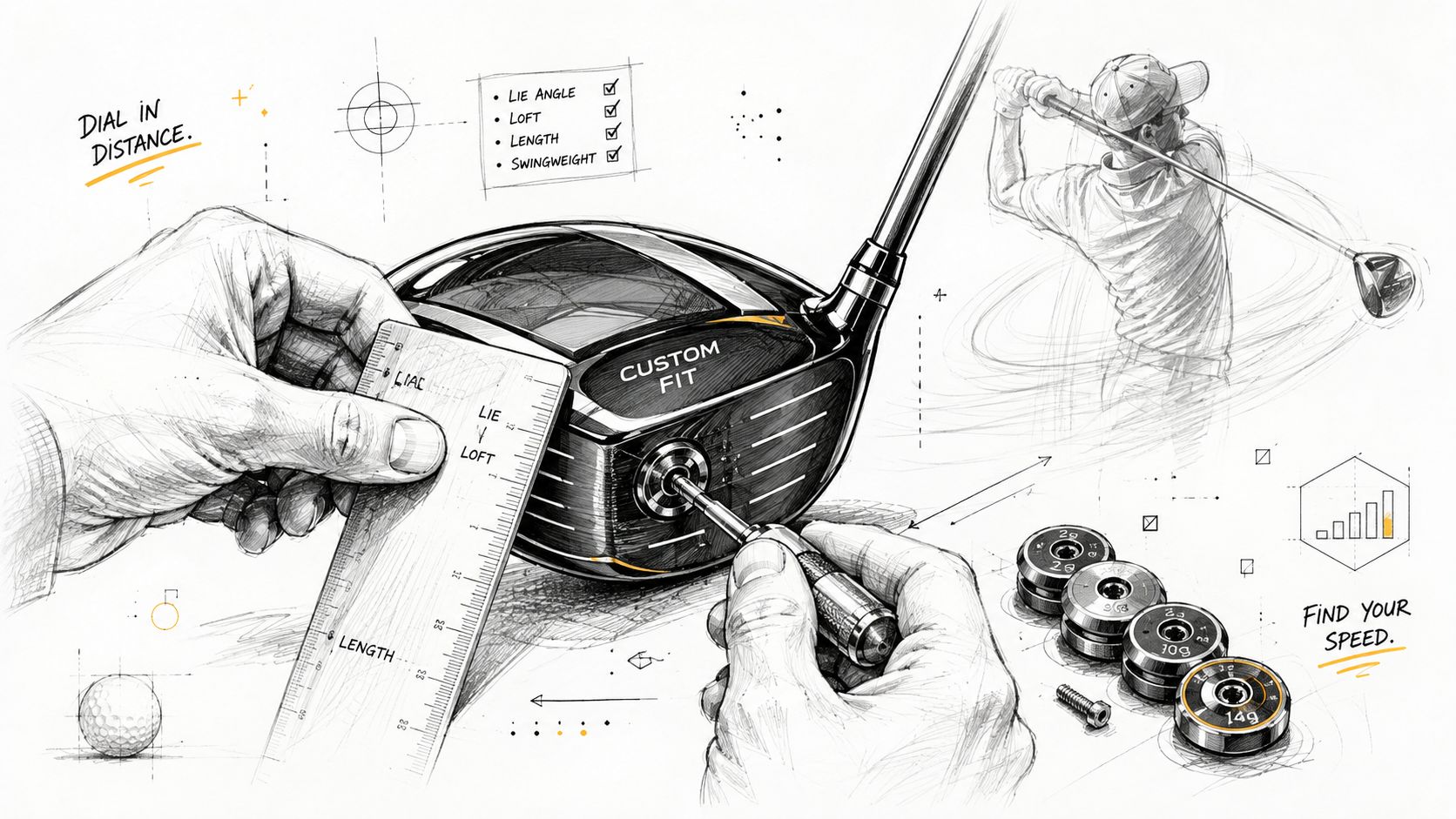
For many recreational golfers, a fitting can improve usable distance sooner than a speed program. That isn't because speed training lacks value. It reflects the fact that a driver head, shaft, loft, ball, and strike pattern determine whether existing speed becomes efficient flight.
A golfer swinging at 93 mph with a well-matched setup can produce more useful carry than a golfer swinging at 100 mph with a poor launch and spin combination. The comparison follows directly from the speed-to-efficiency relationship and the launch benchmarks described in driver optimization research and testing.
What fitting can reveal
A competent fitting process tests how the golfer's current motion interacts with equipment. It can expose a launch that is too low, spin that is too high, a head that changes strike behavior, or a shaft profile that makes center contact harder to repeat. The best option isn't the one with the fastest single swing. It's the one that produces a strong group of shots with a useful balance of ball speed, carry, and dispersion.
Speed training makes more sense when the golfer has a stable enough strike and wants to expand physical capacity. It makes less sense when the golfer's current shots already show inconsistent contact or a clearly unsuitable flight. Adding speed to an inefficient delivery can magnify the same problem.
The following visual can help frame the equipment conversation around measured outcomes rather than labels.
A useful decision rule is simple. If speed is stable but ball speed and carry are weak, test fitting and strike first. If ball speed is already efficient and the golfer wants more potential, structured speed work may have a clearer purpose. In both cases, the launch monitor should verify whether the change improved the shot rather than merely changed the swing sensation.
Setting Realistic Speed and Distance Goals
A sensible speed goal begins with a baseline, not a tour comparison. A golfer should record typical driver speed, ball speed, smash factor, launch, spin, carry, and dispersion across repeatable sessions. The baseline should describe normal performance, not a single maximum swing.
A 90-day plan can combine three forms of work:
- Measurement sessions: Repeat the same test format and watch the typical shot, not only the fastest one.
- Skill or speed practice: Train the chosen priority while protecting strike quality and delivery.
- Equipment reviews: Recheck the setup when launch, spin, or strike patterns change.
The time frame is a planning structure, not a promise of a particular gain. Physical capacity, age, mobility, technique, practice quality, and recovery all influence how much speed a golfer can create and transfer. Older golfers and women shouldn't be assigned a generic slow-speed solution when their ball flight may call for a different launch or loft strategy.
Track conversion, not ego
A meaningful improvement might be a higher typical ball speed at the same clubhead speed, a more stable smash factor, or additional carry without a wider dispersion pattern. A golfer who adds speed but loses center contact may need to reduce intent temporarily and rebuild the delivery. The best goal is the one that improves the shot pattern used on the course.
Dialed Golf can serve as a single golfer record for launch-monitor metrics and on-course performance. Its consumer app is available through TestFlight rather than general App Store availability, while its desktop experience is built around live pairing first with Garmin R10 and expanding support, plus CSV and import workflows from Garmin, Rapsodo, SkyTrak, FlightScope, Uneekor, GSPro, Awesome Golf, and more. Free web tools remain free, and Golfer Pro is offered at $9.99 per week, $29.99 per month, $149.99 for six months, or $249.99 per year, with access across app and desktop, as listed in the Dialed Golf Pro plans.
The record should make the next decision obvious. If speed rises, check conversion. If conversion rises, check launch and spin. If carry rises while dispersion stays playable, the change is earning its place in the bag.
Visit Dialed Golf to keep driver speed, ball speed, launch, spin, carry, and practice data in one golfer record. Use the free web tools to start, then choose the app and desktop Pro workflow when a connected, trackable practice system fits the way the golfer trains.