


A golfer flushes a 7-iron, watches it land well short of a playing partner's shot, and immediately blames the swing. The more likely explanation may be hiding on the sole: one club is stamped 34°, while the other is built closer to a modern distance iron, so the two golfers aren't really hitting comparable lofts.
That difference affects launch, spin, carry, descent angle, and the gaps between clubs. The loft angle of golf clubs also interacts with shaft lean, angle of attack, strike location, face angle, and adjustable-hosel settings. A launch monitor can expose those interactions, but only if the golfer knows which numbers matter.
Table of Contents
- Why the Loft on Your Club Matters More Than You Think
- What Loft Angle Actually Means on a Golf Club
- Typical Loft Ranges From Driver to Lob Wedge
- How Loft Angle Shapes Launch and Distance
- Loft Creep and Why Modern Irons Are Stronger
- Delivered Loft, Spin Loft, and What a Launch Monitor Sees
- Adjustable Hosels, Face Angle, and Loft Sleeves
- Fitting and Gapping Your Bag Around Loft
Why the Loft on Your Club Matters More Than You Think
Loft is one of the quietest distance controls in the bag. A higher-lofted face generally launches the ball higher, adds spin, and produces a shorter, softer flight. A lower-lofted face generally launches lower, reduces spin, and encourages more rollout, as explained in this beginner's guide to golf-club loft.
That doesn't mean lower loft is automatically better. A golfer who needs height may lose carry with a strong-lofted iron, while a golfer who already delivers plenty of loft may produce a flight that climbs too high and stalls. The club's shaft, head design, strike, and speed all matter, but loft establishes the starting geometry.
Five terms that prevent confusion
The number printed on the club is static loft. It describes the manufactured clubhead under a standardized measurement setup.
Delivered loft, also called dynamic loft, is the loft presented to the ball at impact. Shaft lean, handle position, release, and face orientation can make the delivered number higher or lower than the stamped number.
Spin loft describes the relationship between delivered loft and the club's angle of attack. It helps explain why two golfers using the same club can produce different launch and spin results.
Loft creep describes the long-term movement toward stronger iron lofts. A modern 7-iron may carry a number that once belonged to a much longer club.
An adjustable hosel adds another layer because changing a sleeve can alter loft, face angle, and sometimes lie angle at the same time.
The practical promise is simple. Read the stamped lofts, compare them with modern norms, then interpret the launch-monitor data through delivered conditions rather than club labels alone.
What Loft Angle Actually Means on a Golf Club
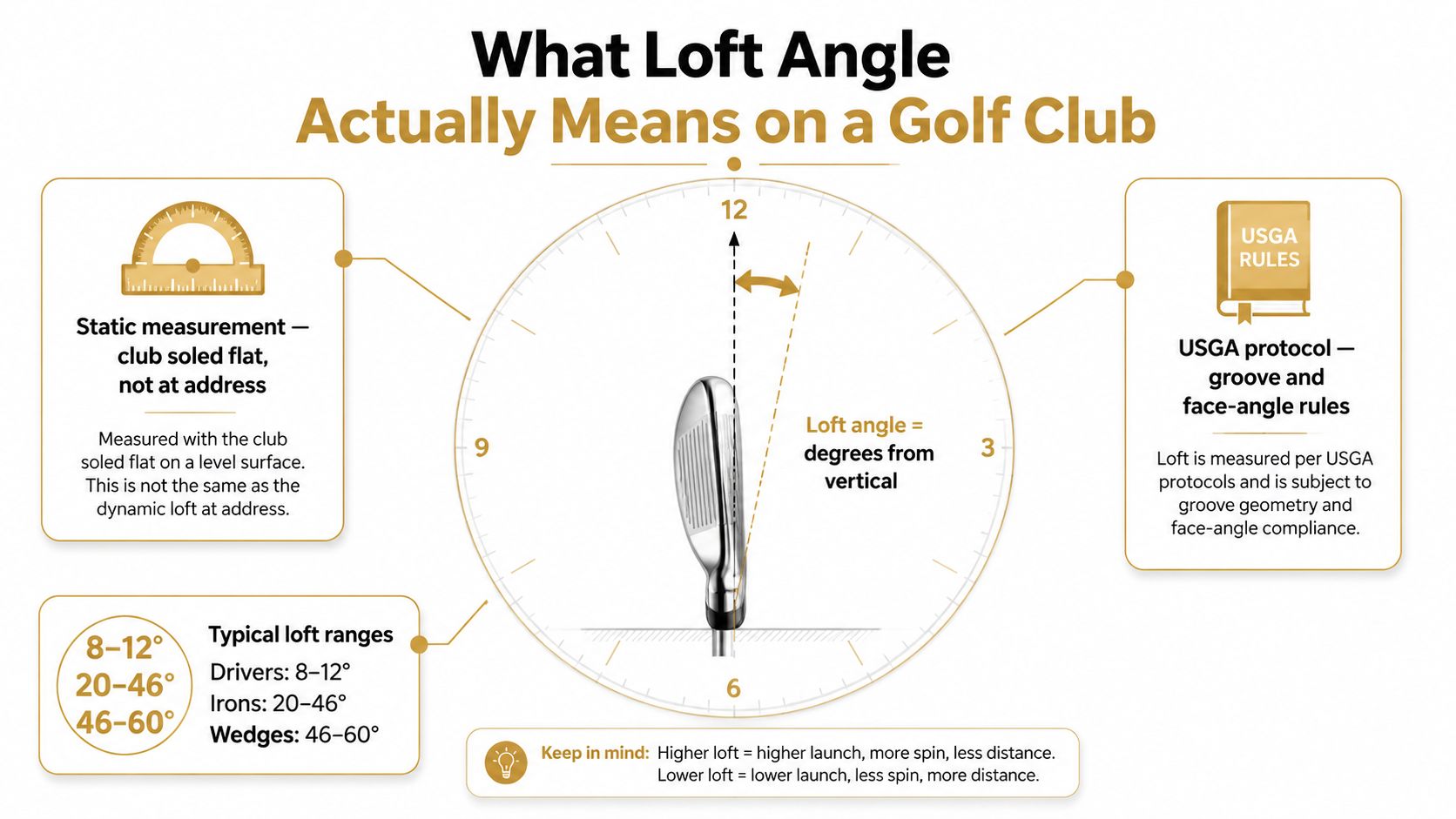
Loft is the static angle of the clubface relative to the shaft's vertical reference when the club is soled flat. It isn't the same as the face angle, which describes whether the face points left, square, or right of the target line. It also isn't lie angle, which describes how the shaft sits relative to the ground.
A clock-face analogy makes the geometry easier to picture. With the club soled flat, the shaft provides the upright reference and the face tilts back from that reference. The more the face points toward the sky, the more loft the club has. A driver at 10.5° presents far more upward-facing loft than a 4-iron at roughly 22°, so the two clubs launch and spin the ball in very different ways.
USGA measurement procedures use a dedicated loft-and-lie gauge. The club is clamped with the sole approximately 1/8 inch above the base plate, and the measurement is taken at the center of the impact area, as specified in the USGA measurement procedure outline. That context matters because a golfer holding a club at address isn't measuring the same thing as a technician measuring its static specification.
Why the stamped number still matters
The stamped loft remains the correct reference point for identifying a club. It lets golfers compare heads, map the set, and spot unusual gaps. It just doesn't predict the complete launch condition by itself.
A club marked 34° can perform differently from another 34° club because of center-of-gravity placement, shaft length, face construction, sole design, and the golfer's delivery. Static loft tells the fitter what the head is built to provide. Impact data shows what the ball receives.
Typical Loft Ranges From Driver to Lob Wedge
Loft progresses through the bag in recognizable groups, although manufacturers don't build every set to the same chart. A typical reference places a driver around 9–12.5°, a 3-wood near 15°, a 5-wood around 18–19°, a 7-iron near 34°, a pitching wedge around 46°, a sand wedge around 54–58°, and a lob wedge around 58–64°, according to this club-loft reference chart.
The higher-lofted woods and hybrids help golfers replace difficult long-iron shots with easier launch and more stopping power. Irons then take over for distance control, while wedges create shorter gaps and different trajectories around the green.
| Club | Typical Loft Range | Typical Role |
|---|---|---|
| Driver | 9–12.5° | Longest tee shot, high launch and controlled rollout |
| 3-wood | About 15° | Tee alternative and long fairway shot |
| 5-wood | 18–19° | Higher-launching long club |
| Hybrid | Broadly between fairway woods and long irons | Easier long-distance launch |
| 4-iron | Around the low 20s | Long iron for stronger launch and penetrating flight |
| 7-iron | About 34° in a traditional reference | Mid-iron approach and distance control |
| Pitching wedge | About 46° | Full approach and transition into wedges |
| Sand wedge | 54–58° | Bunker play and shorter approach shots |
| Lob wedge | 58–64° | High, soft shots and short-sided recovery |
The chart is a starting point, not a replacement for checking the actual sole. A golfer comparing hybrid options can use this hybrid golf club lofts chart to see how those clubs occupy the space between fairway woods and irons.
Match loft to the shot, not just the club name
A lower-lofted club tends to produce more distance when the golfer can launch it efficiently. A higher-lofted club tends to produce a higher flight that lands more steeply and stops sooner. The correct choice depends on whether the golfer needs carry, rollout, height, or predictable separation from the neighboring club.
That's why a bag should be organized by usable carry gaps, not by whether every traditional club number is present.
How Loft Angle Shapes Launch and Distance
Adding loft raises the launch window and generally increases spin. The ball climbs more easily, reaches a steeper flight, and often lands softer. Reducing loft flattens the launch, lowers spin, and can add rollout when the strike remains efficient.
Each added degree lifts the window but also gives the ball more aerodynamic drag. A stronger face trades some height for speed and distance potential when contact is centered, but that trade only works if the golfer can generate enough launch and spin to keep the ball airborne.
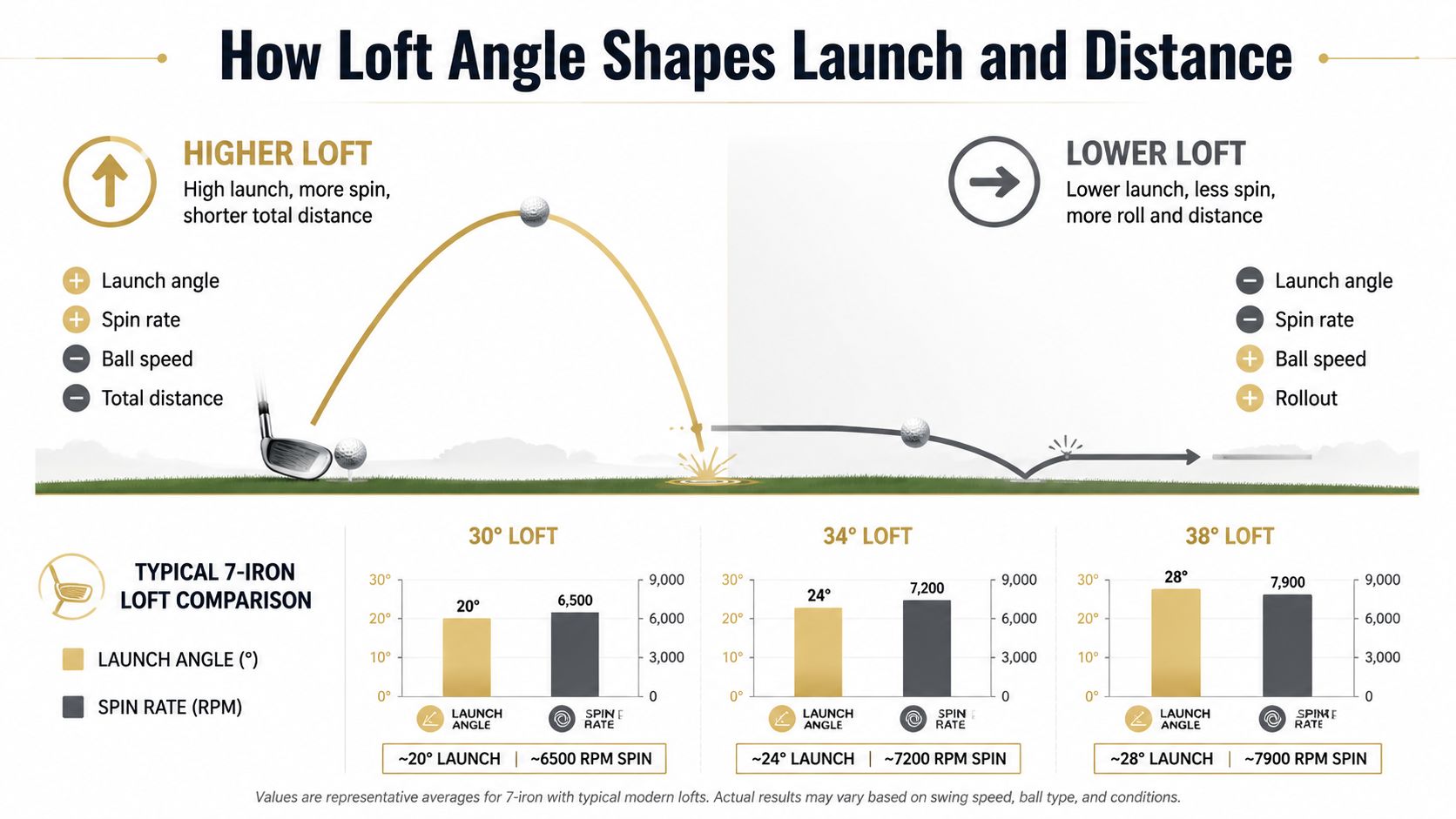
Why identical lofts can produce different flights
Club speed affects how much energy and lift the ball receives. Angle of attack changes the relationship between the clubhead and ball, while strike location can change launch and spin through the head's construction and gear-effect behavior.
The key fitting concept is spin loft, the difference between dynamic loft and angle of attack. A golfer delivering more loft or striking with a steeper downward attack generally creates more spin loft. That can raise spin and launch, but excessive spin loft can reduce ball-speed efficiency, particularly with longer clubs.
The technical explanation of launch angle and spin emphasizes why stamped loft alone can't explain launch-monitor output. The fitter needs to see delivered loft, attack pattern, strike, launch, spin, carry, and descent angle together.
Read the flight pattern before changing the club
A low-launching shot isn't automatically caused by too little static loft. The golfer may be delofting the face, striking low on the clubface, or delivering the club with a downward attack. A high, floating shot isn't automatically caused by too much stamped loft either. Added dynamic loft and excessive spin loft may be the primary issue.
Practical rule: Change loft only after checking delivery and strike. A different number on the sole can't fix every launch problem.
The best loft is the one that creates a repeatable flight and useful carry, not the one that produces the longest single shot.
Loft Creep and Why Modern Irons Are Stronger
Modern irons have shifted toward stronger lofts. A traditional iron chart might place a 3-iron near 21° and a pitching wedge near 46°, with roughly 3°–4° of progression between clubs. Modern game-improvement sets are often stronger by several degrees across the set, a trend documented in the USGA Equipment Rules.
The clearest example is the 7-iron. Independent summaries describe a 7-iron from the 1980s as roughly 36°–38°, while modern examples commonly sit around 28°–30°. That makes a modern 7-iron roughly 6°–10° stronger, so its distance claim isn't directly comparable with an older 7-iron.
| Club | 1980s Stamped Loft | Modern Stamped Loft | Approximate Difference |
|---|---|---|---|
| 7-iron | 36°–38° | 28°–30° | Roughly 6°–10° stronger |
Why manufacturers strengthen the set
Stronger lofts can work with faster faces, different center-of-gravity positions, improved sole geometry, and shaft designs that help launch the ball. The result is often more distance from the same club number, but the golfer still needs enough height and stopping power for the intended shot.
The marketing label creates confusion because a modern 7-iron may behave more like an older 5-iron or 6-iron in loft. That doesn't make the club dishonest, but it does make old yardage references unreliable.
The gapping consequence
A stronger pitching wedge can leave a large gap into the next wedge. Long irons may also become difficult to launch for golfers who don't create enough speed or height. The sensible response is to measure carry distances, check descent angles, and replace difficult top-end clubs with easier-launching options when needed.
Stronger lofts aren't automatically a performance gain. They're a set-design choice that requires fresh gapping.
Delivered Loft, Spin Loft, and What a Launch Monitor Sees
A stamped loft describes the club before the swing. Delivered loft describes the face orientation at impact, after shaft lean, handle position, release, and face rotation have changed the club's presentation. That impact condition is what the ball responds to.
A golfer can hold a 34° 7-iron at address, then deliver less loft through forward shaft lean. Another golfer can add loft by releasing the club differently or presenting the handle less forward. Both golfers use the same head, but their launch, spin, peak height, and descent angle can differ sharply.
Spin loft connects delivery to spin
Spin loft is commonly described as the difference between delivered loft and angle of attack. It isn't the same as the printed loft, and it isn't merely the shaft's lean. The launch monitor uses the relationship between face delivery and attack pattern to explain why one strike spins more than another.
A golfer who adds delivered loft while hitting down can create a larger spin-loft condition. A golfer who reduces delivered loft or approaches with a different attack pattern may create a lower-spin flight. Neither result is automatically better. The right outcome depends on club type, speed, strike, and the shot's intended landing.
The launch-monitor app guide is useful context for golfers who want to track these patterns over practice sessions rather than judge one swing in isolation.
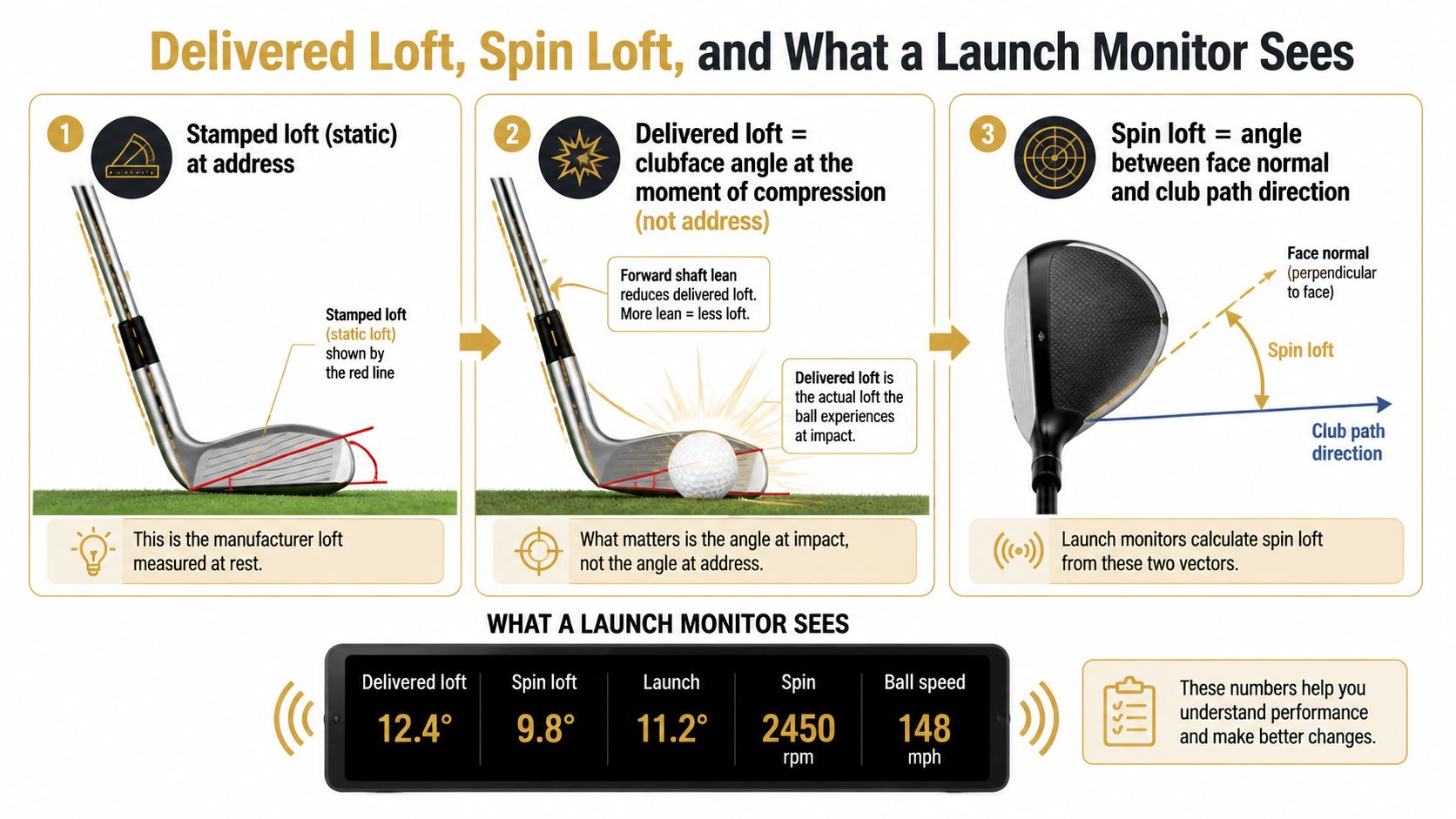
What to inspect on the screen
A launch monitor may show club speed, ball speed, launch angle, spin rate, attack angle, carry, descent angle, and peak height. The golfer shouldn't isolate one value. A higher launch with more spin may be ideal for one club and inefficient for another.
The more useful question is whether the delivered condition creates a repeatable carry gap and a playable landing angle. If a 7-iron flies too low, the golfer may need more delivered loft, a different strike, or a different club design. If it flies too high and loses distance, the golfer may need to reduce delivered loft or control spin loft.
Adjustable Hosels, Face Angle, and Loft Sleeves
An adjustable sleeve doesn't change loft in isolation. Rotating the sleeve changes how the shaft sits in the head, which can alter loft and face angle together. Some designs also influence lie angle, especially in fairway woods and hybrids.
One fitting reference describes an approximately 0.7:1 face-angle-to-loft relationship in one context, while another fitting guide describes about 1.5°–2° of face-angle movement for 1° of loft change, depending on the manufacturer. Those figures shouldn't be treated as universal. They show why the same sleeve instruction can produce different visual and ball-flight results from one head to another, as shown in this adjustable-hosel fitting chart.
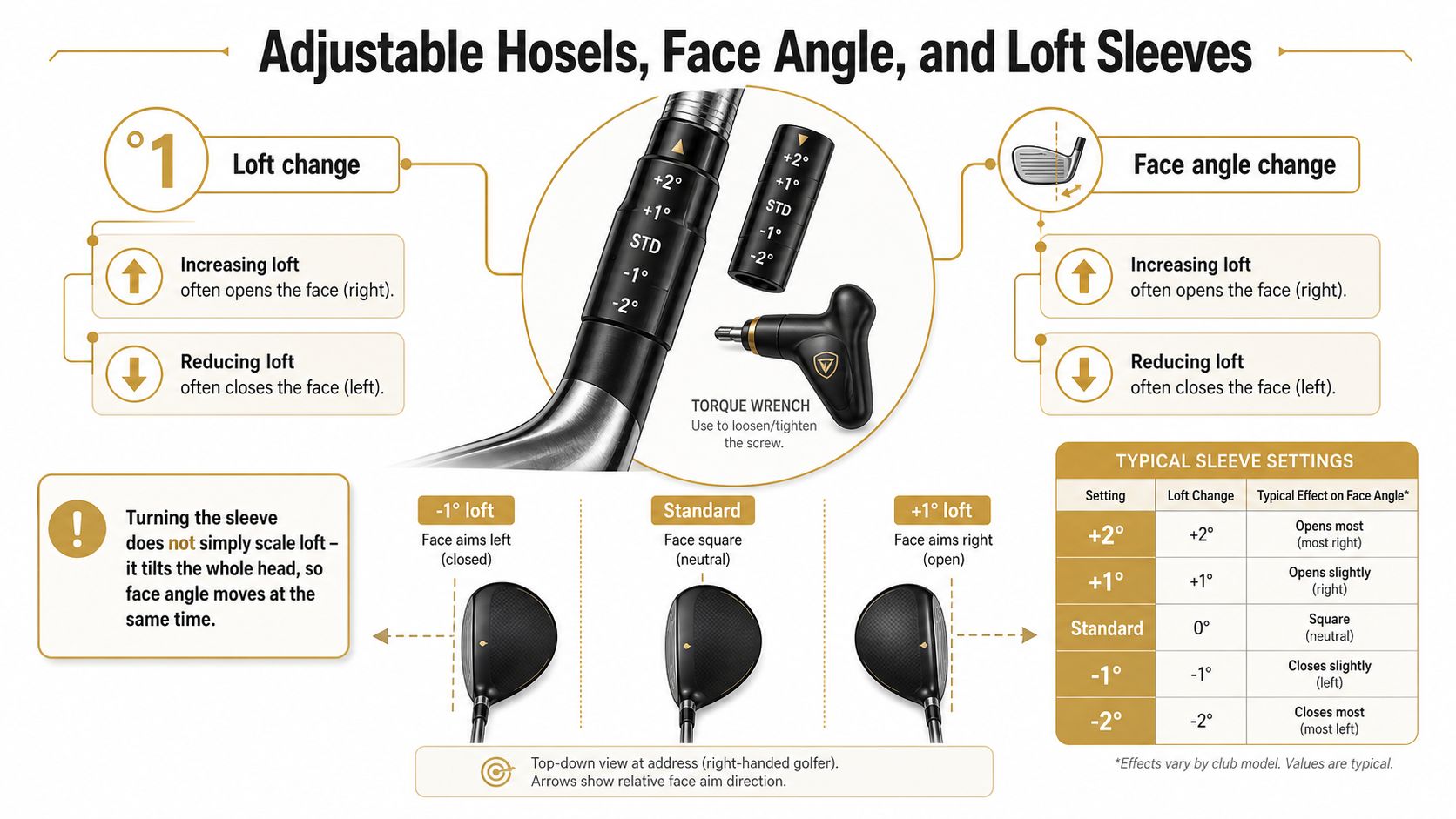
A controlled sleeve-testing routine
Start at the neutral setting and establish the normal start line, curve, strike location, and launch. Then make one sleeve change and test again. If several settings, tee heights, and swing thoughts change at once, the golfer can't identify which variable caused the new flight.
- Add loft: Expect a higher launch, with a possible face-angle change.
- Reduce loft: Expect a lower launch, with a possible face-angle change.
- Change directional bias: Check whether the face now sits more open or closed.
- Test lie interaction: Watch start direction and turf contact with fairway woods and hybrids.
A golfer who lowers loft to reduce spin may unintentionally open the face and worsen a right miss. A golfer who adds loft may close the face and alter the start line. The sleeve is a fine-tuning device, not a substitute for selecting a suitable head and baseline loft.
Fitting and Gapping Your Bag Around Loft
A practical gapping session starts with the clubs already in the bag. The golfer should hit each club under consistent conditions, record carry rather than relying only on total distance, and compare neighboring clubs for useful separation.
A launch-monitor gapping checklist
Record the club specifications. Write down the stamped loft, shaft length, and any sleeve setting. The static number establishes the map.
Capture the delivery. Review club speed, smash factor, launch angle, spin rate, descent angle, and peak height. These numbers help show whether a club is launching efficiently or relying on a misleading total-distance result.
Compare carry gaps. Look for smooth separation through the irons and wedges. The exact spacing depends on the golfer, but an obvious overlap or dead zone signals a fitting problem.
Check landing behavior. A club that reaches the target but lands too shallow may not hold a green. A club that launches too high and spins excessively may lose useful distance.
Adjust one variable. A fitter might alter loft, head design, shaft, or club category, but changing several items at once makes the result difficult to interpret.
For a more structured process, use this gap-analysis guide to organize the results. Combo sets, matched sets, and hybrid replacements can solve odd gaps more effectively than forcing every traditional iron into the bag.
A written fitting report should include the final lofts, carry yardages, launch conditions, and any sleeve settings. Loft angles can drift through wear, and swing delivery can change over time, so periodic checks help preserve consistent gapping.
Dialed Golf connects on-course practice and launch-monitor work through one golfer record. The consumer app is a pocket caddy, currently available through TestFlight rather than general App Store availability, while the desktop product is desktop-first for live pairing, beginning with Garmin R10 and expanding, plus CSV or imported data from Garmin, Rapsodo, SkyTrak, FlightScope, Uneekor, GSPro, Awesome Golf, and more. Visit Dialed Golf to compare the free web tools, Golfer Pro across app and desktop, or Dialed Academy for range and club memberships with front-desk tools.