

The putt looked easy until it wasn't. A golfer stands over a three-footer, feels the right hand tighten, watches the face twitch through impact, and then sees the ball catch the edge of the hole. After a few lip-outs, the same golfer starts wondering whether moving the left hand below the right could quiet everything down.
That setup is the cross-handed putter grip, also called left-hand-low putting for a right-handed golfer. It can reduce unwanted hand action and make the stroke feel more connected, but it isn't a guaranteed repair. The useful question isn't whether cross-handed putting is popular. It's which distances improve, which can suffer, and whether the golfer's practice results justify staying with it.
Table of Contents
- Why Golfers Reach for the Cross Handed Putter Grip
- Setting Up the Grip Correctly From the First Putt
- A Two Week Practice Progression That Builds Trust
- Honest Pros and Cons Across Short Mid and Long Putts
- Common Mistakes That Stall the Switch and How to Fix Them
- Who Should Commit and Who Should Walk Away
Why Golfers Reach for the Cross Handed Putter Grip
The usual trigger is a short putt that exposes a larger problem. A golfer may roll solid ten-footers but miss three-footers right, pull them left, or stab at the ball when the score matters. The dominant right hand starts taking over, the putter face rotates, and the stroke loses its quiet rhythm.
With a conventional grip, the lower right hand can become the most active hand in the stroke. It may yank the face closed, push it open, or add a sudden burst of speed when the golfer decelerates. Under pressure, that movement can become more obvious. A run of missed short putts or a nervous tournament round often creates the urge to try something that changes the hierarchy of the hands.
What the hand order changes
For a right-handed golfer, cross-handed putting places the left hand below the right. That doesn't make the left hand physically stronger, but it gives the lead side more influence over the handle and makes it harder for the trail hand to steer the putter independently.
The shoulders also tend to sit more level at address. That can help a golfer who lets the lead shoulder dip, pulls the handle, or releases the putter with too much forearm action. The intended feel is less of a hand-driven hit and more of a shoulder-led motion with the putter face returning square.
Practical rule: The grip should make the stroke quieter, not make the golfer squeeze harder.
The search often includes putting yips, nervousness at impact, and deceleration. Cross-handed putting may give the golfer a different set of sensations, enough to interrupt an ingrained reaction and create a calmer release. That reset can be valuable, but a first-day feeling isn't proof of lasting improvement.
A legitimate option, not a magic trick
Professional golf has treated the style as a serious alternative for decades. Sports Illustrated's historical account traced Freddie Haas Jr.’s regular use of cross-handed putting to the late 1940s and noted that about 20 Tour professionals had adopted it by the mid-1990s. The same account identified major winners including Nick Faldo, Fred Couples, Paul Azinger, Payne Stewart, and Tom Kite, while noting Kite's switch in 1991 and his 1992 U.S. Open victory. The New York Times' history of the method also connected its wider visibility with Bruce Lietzke's victories in Tucson and Hawaii in the late 1970s.
That history makes the grip worth testing. It doesn't make it right for every golfer. The switch has to survive different distances, imperfect contact, pressure, and the unglamorous repetitions on a practice mat.
Setting Up the Grip Correctly From the First Putt
A cross-handed grip feels awkward when the hands are placed correctly but the rest of the setup still belongs to a conventional stroke. The golfer needs to rebuild the address position around the new hand order, then make small equipment adjustments only if the putter no longer sits naturally.
Build the hand position
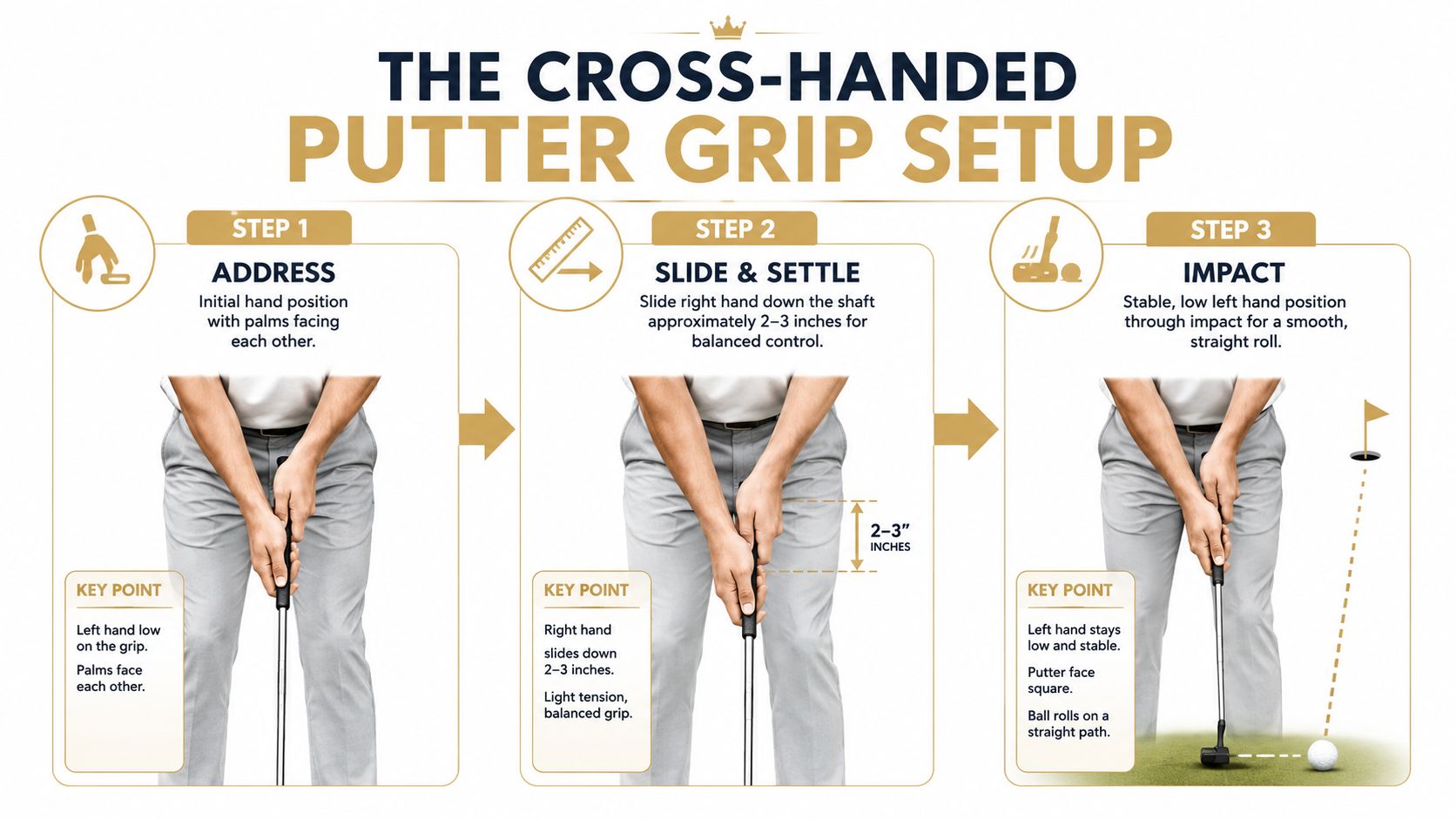
Place the left hand first. For a right-handed golfer, put the lead hand lower on the handle. Let the grip run through the palms rather than deep into the fingers, and keep both thumbs pointing down the flat top if the putter grip has one.
Add the right hand above it. Slide the right hand down the shaft enough that the hands feel connected and the remaining grip length still feels balanced. The exact amount depends on the putter and the golfer's arm length, but the supplied setup visualization uses approximately 2 to 3 inches as a practical balance reference.
Set the ball forward. Start with the ball one ball forward of center. The changed shoulder alignment can move the natural low point of the stroke, and a slightly forward ball position gives the putter a better chance to return through the intended strike area.
Stand slightly closer. The new hand order changes the effective arm length. Moving closer helps the arms hang without reaching, while avoiding a stance so close that the elbows and forearms become cramped.
Match the handle to the new feel
A layer of tape under the right-hand area can build diameter and make the upper hand feel less dominant. If the golfer has to reach because the closer stance changes the relationship with the ball, shortening the putter by half an inch can restore a natural posture. A grip that feels too soft may exaggerate wrist action, so the handle should provide enough firmness for the left hand to guide without squeezing.
The best first-session cue is simple: the left palm pushes the putter head, while the right hand rests along the handle for stability instead of steering. Excess pressure defeats the purpose of the change and turns a stabilizing experiment into another hand-controlled stroke.
Before leaving the mat, perform one checkpoint rep. Set the ball one ball forward of center, confirm the hands are in the intended order, let the shoulders settle, and make a short stroke while watching whether the putter face stays square through impact. If the right hand feels as though it is throwing the head, reset before hitting more putts.
A Two Week Practice Progression That Builds Trust
A grip change needs a controlled test, not a pile of random putts. The first week should answer whether the golfer can make centered contact and control the face. The second should reveal whether the new motion can start the ball online and manage pace beyond the short-putt zone.
The schedule below uses 15 minutes daily, which is easier to repeat than one long weekend session. The targets are checkpoints, not promises. If the golfer misses the target, the next response should be diagnosis, not an immediate return to the old grip.
Week one builds contact and face control
Begin with three-foot straight putts for 20 minutes during the first focused session, then continue with the shorter daily routine. The face should return square, the left wrist should remain quiet, and the ball should leave without a jab. After that, alternate five-foot putts with the cross-handed and conventional grips so the golfer can identify whether the new method changes the miss.
Finish with a gate drill using two tees just wider than the putter head. The goal isn't to avoid the tees. It's to learn whether the putter can travel through impact without the golfer rescuing the face with the trail hand.
The first benchmark is 8 makes out of 10 from three feet. That number comes from the practice plan, not from a promise that every golfer will achieve it immediately.
Week two adds start line and speed
Use a chalk line on the mat for ten-foot putts. The golfer should select the starting line, make the stroke, and observe whether the ball begins on that line before judging the result. A putt can miss because of speed or break even when the face delivered a good start line.
Move to 20-foot lag putts next. The only objective is to finish inside a three-foot zone, with the target being 5 of 6 successful lags. Speed work exposes a weakness that short straight putts can hide, especially if the lower hand has stopped contributing useful feel.
At the end of the second week, record a face-on and down-the-line video. Check that the left shoulder isn't pulling open through impact and that the golfer isn't standing farther away to create room for the altered hand position.
| Day | Drill Focus | Distance | Reps | Success Target |
|---|---|---|---|---|
| 1 | Straight-in contact | 3 feet | 10 | 8 of 10 makes |
| 2 | Face-control comparison | 5 feet | Alternate grips | Record miss pattern |
| 3 | Gate drill | Short putts | Repeatable set | No tee contact |
| 4 | Straight-in confirmation | 3 feet | 10 | 8 of 10 makes |
| 5 | Start-line preparation | 5 feet | Controlled set | Consistent face return |
| 6 | Chalk-line putting | 10 feet | 10 | 7 of 10 starts online |
| 7 | Review and video | Mixed | Short session | Confirm setup |
| 8 | Chalk-line start line | 10 feet | 10 | 7 of 10 starts online |
| 9 | Speed transition | 20 feet | 6 | 5 of 6 inside 3 feet |
| 10 | Mixed distance control | 10 to 20 feet | Repeatable set | Stable pace |
| 11 | Gate and speed blend | Short to mid | Repeatable set | No face manipulation |
| 12 | Pressure routine | 3 to 20 feet | Structured set | Follow full routine |
| 13 | Lag confirmation | 20 feet | 6 | 5 of 6 inside 3 feet |
| 14 | Video and comparison | Mixed | Final session | Keep or reject based on results |
A useful record can include the grip, distance, start-line result, finish distance, and miss direction. Golfers who want a structured place to review practice patterns can use the practice data resources without treating a single session as a verdict.
Honest Pros and Cons Across Short Mid and Long Putts
Cross-handed putting is often marketed as a universal fix because it can make the face feel stable immediately. The better coaching answer is narrower. The grip may help direction at shorter distances, while creating a different challenge when pace and release become the priority.
Short putts favor stability
From three to eight feet, the grip can help a golfer whose dominant right hand flips the face or creates a push. The left-hand-low position limits the trail hand's ability to make a last-second correction, which may reduce the familiar yips-style miss.
That doesn't mean every short putt gets easier. A golfer who relies on a responsive trail hand may initially leave the face open or start the ball right. The first question is whether the golfer's normal miss comes from too much rotation. If it does, the restriction can feel useful.
Mid-range putts test the start line
From eight to twenty feet, a shoulder-led stroke may provide a more predictable start line because the right hand is less likely to overwhelm the lead side. That benefit matters when the putt has enough break that a small face error sends the ball away from the intended entry window.
Independent research found that nine-foot putts were made at a significantly higher rate with a cross-handed grip than with a conventional grip, with p < 0.05, and connected the result with gaze and head movement. The putting grip and eye movement study supports the idea that the grip can affect visual control and head stability, not only hand placement.
Long putts expose the trade-off
From twenty to thirty-five feet, some golfers gain a steadier stroke but lose touch on downhill putts. The lower hand may no longer provide the same sense of release, so the golfer leaves the ball short or misjudges the pace.
Beyond thirty-five feet, that short tendency can become more noticeable if the golfer pulls the stroke slightly inside and fails to add enough length. The evidence doesn't support a blanket claim that cross-handed putting improves all distances. An independent 18-hole grip comparison found conventional putting performed better from five and ten feet, while cross-handed putting looked better from twenty feet, and concluded that a quick switch didn't reliably improve overall performance.
Tour-level data show the same kind of split. Golf Digest's 2023 analysis identified 24 PGA Tour players using a cross-handed grip, whose average putting rank was 69 compared with 75.2 for standard-style players. Cross-handed players also led the grip categories in average make percentage from four to eight feet, but ranked fourth of five techniques for three-putt avoidance.
| Distance | Result | Why | Recommendation |
|---|---|---|---|
| 3 to 8 feet | Often steadier for face rotation | Trail-hand flipping is reduced | Test first |
| 8 to 20 feet | Potentially cleaner start line | Stroke becomes more shoulder-led | Keep if starts improve |
| 20 to 35 feet | Mixed speed results | Stability can replace useful release feel | Measure lag distance |
| Over 35 feet | May leave more putts short | Inside path and reduced release can rob pace | Compare with conventional |
The practical starting point is the 3-to-25-foot zone. Test long lags separately before committing to cross-handed putting for every putt.
Common Mistakes That Stall the Switch and How to Fix Them
Most failed grip changes don't fail because the idea is useless. They fail because the golfer changes the hands, ignores the setup, then judges the method after a round played with an unfamiliar motion.
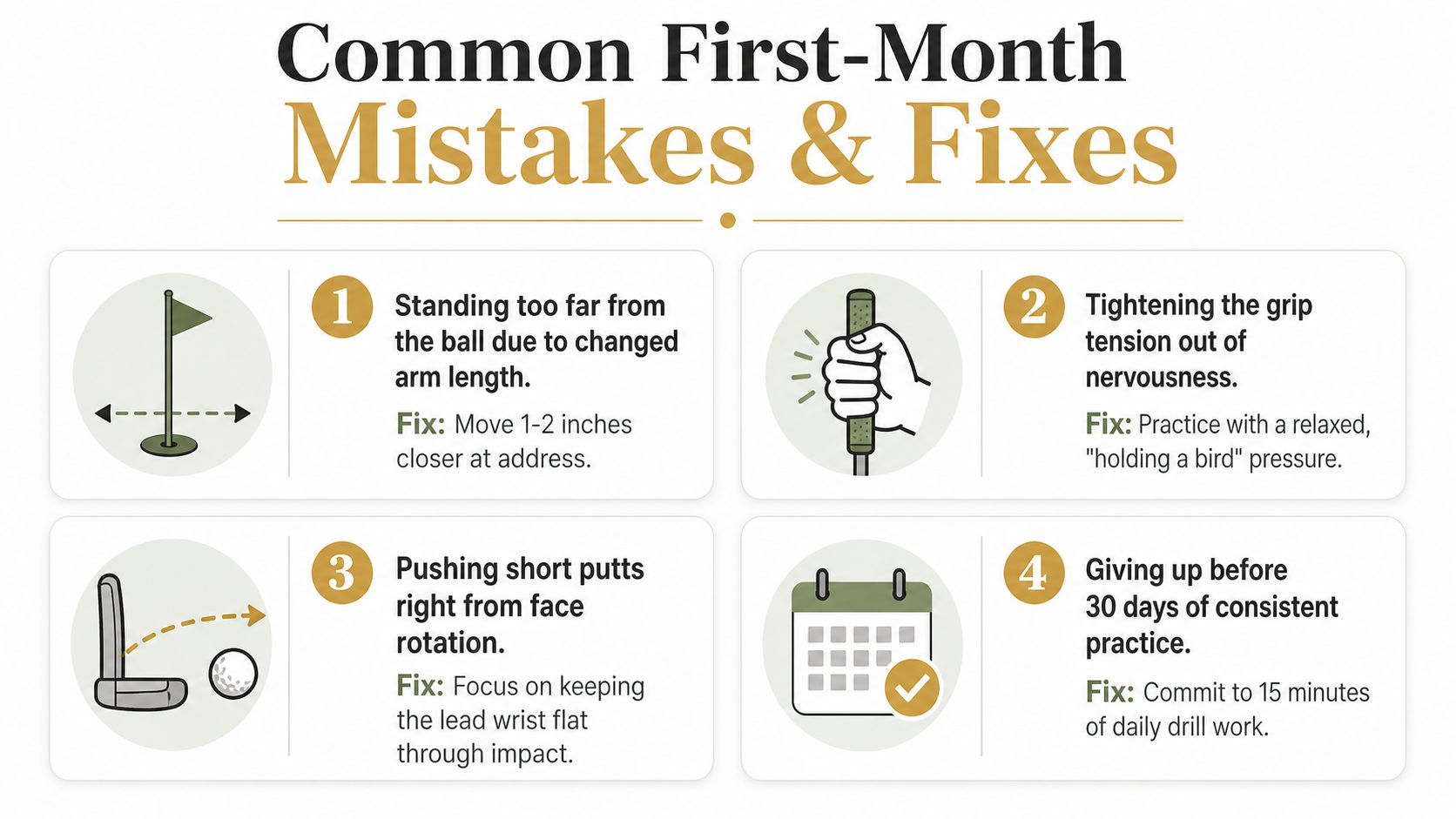
The stance becomes too distant
The first symptom is a cramped takeaway that travels inside, followed by a face that arrives open. The golfer often stands too far from the ball because the altered hand order changes how the arms hang.
Move roughly half an inch closer as a starting adjustment, then confirm that the ball remains one ball forward of center. The tactile cue is the feeling that both arms hang under the shoulders without reaching toward the ball.
The right wrist becomes rigid
Some golfers hear “quiet hands” and lock the right wrist. That creates a jabby stroke, removes useful speed control, and makes the grip feel dead.
The correction is soft pressure, similar to holding a tube of toothpaste without squeezing it. The right hand should support the handle, not freeze it. The left palm can guide the putter while the right fingers remain relaxed enough to sense motion.
The shoulders aim the golfer left
A cross-handed setup can feel closed even when the putter face is square. Many golfers respond by changing the grip or opening the stance, when the problem is alignment.
Use an alignment stick or a straight edge on the practice surface. Keep the grip unchanged and check the feet, hips, shoulders, and putter face independently. If the ball starts right, the face needs attention. If it starts on line but misses because of break, the grip isn't the immediate culprit.
One bad round ends the experiment
The motor pattern needs repeated exposure before it feels automatic. A golfer who switches on Monday and abandons the grip after Saturday's poor round may be reacting to unfamiliarity rather than performance.
A thirty-day commitment creates a fairer test, provided the golfer records distance buckets instead of relying on memory. The launch-monitor practice workflow can help organize broader practice habits, although putting still requires direct start-line and pace testing on a green or mat.
Use this coaching checklist:
- Setup: Move closer if the stroke feels cramped.
- Pressure: Keep the right hand soft instead of locked.
- Alignment: Check the shoulders and face before changing grip position.
- Commitment: Give the pattern consistent practice before judging it.
The video below can serve as a visual reference for the basic motion, but the golfer should still verify the actual start line and finish distance during practice.
Who Should Commit and Who Should Walk Away
The right decision depends on the miss the golfer needs to fix. A cross-handed putter grip makes the strongest case when the problem is face rotation on short putts, not when the golfer already controls direction and struggles mainly with pace.
Commit when direction is the recurring failure
A full switch makes sense for golfers who regularly push three-to-eight-foot putts right, flip the face with the trail hand, or have a history of yips. It also suits a golfer who can spend a month practicing before an important tournament, rather than introducing the grip during a competitive stretch.
The commitment should be evidence-based. The golfer should compare makes from short range, start-line results from ten feet, and lag finishes from twenty feet. If the short and mid-range gains outweigh the long-putt losses, the new grip has earned a place in competition.
Test briefly when feel is the golfer's strength
A strong feel-based long putter may not want to abandon the conventional grip. If most birdie opportunities come from outside twenty feet and the golfer already controls the face, cross-handed putting could remove more useful touch than unwanted manipulation.
A split approach can be tested in practice. Cross-handed putting may handle the short zone, while the conventional grip returns for longer lags. That arrangement isn't a rule or a shortcut. It's a way to preserve distance feel while using the more restrictive setup where direction matters most.
Walk away when the current stroke already works
Leaving the grip alone is sensible when the conventional setup produces a face-balanced stroke and the main weakness is distance control. A golfer whose putting statistics inside ten feet are already above tour average has less reason to trade familiar feel for a new motor pattern.
The same caution applies when the golfer dislikes the sensation after consistent practice or has a physical limitation that makes the setup uncomfortable. A grip change shouldn't create pain, tension, or a new restriction because it looks stable on another player.
The framework below keeps the decision practical rather than emotional.
A useful next step is to run a gap analysis for putting practice across short, mid-range, and lag distances. The grip is a means, not an end. The best putter on the practice mat wins, regardless of which hand sits on top.
Dialed Golf helps golfers organize practice around the distances that matter, including structured records for start line, make rate, and lag control. Explore the pocket caddy and practice tools at Dialed Golf and use the results to decide whether cross-handed putting belongs in the bag.