

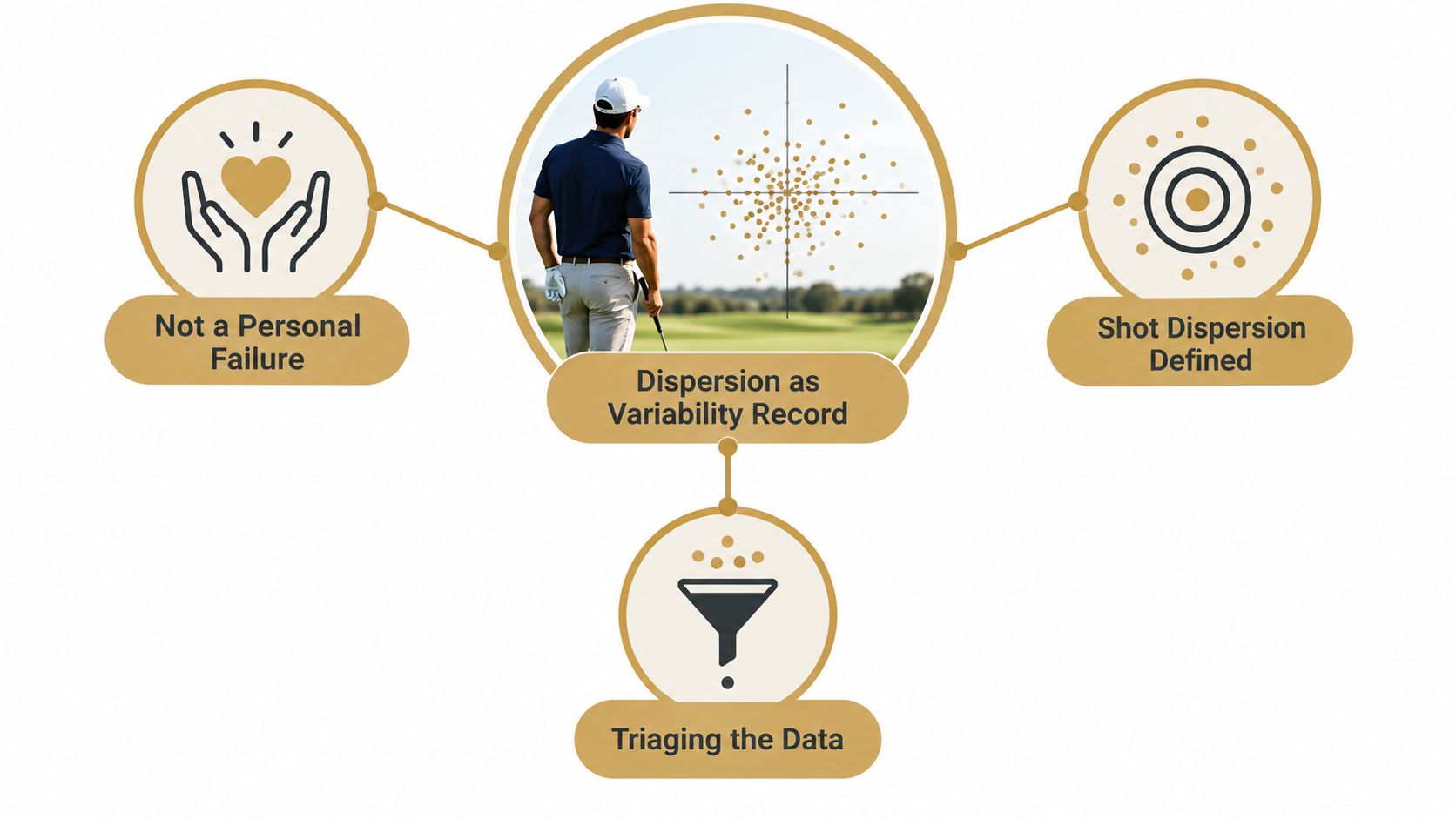
A golfer finishes a range session, looks at the launch-monitor screen, and sees shots scattered short, long, left, and right of the target. The first reaction is often mechanical: the face must have been wrong, the path must have changed, or the swing must have broken down. That reaction misses the larger point. Dispersion is the visible record of variability, not a verdict on the golfer.
The useful question isn't only what causes dispersion. It's which kind of variability is creating the pattern. A launch monitor can reveal mechanical direction error, strike-induced curvature, changing ball speed, and the effects of conditions outside the golfer's control. Once those layers are separated, the scatter cloud becomes a practice map.
Table of Contents
- The Pattern on the Screen Is Not the Problem
- Face Angle and Club Path, The Mechanical Core
- Strike Location and the Hidden Curve
- Wind, Air, and the Outdoor Pattern
- Ball Speed, Gear Effect, and Equipment Spread
- Reading a Launch Monitor Like a Coach
- Drills and Adjustments That Match the Cause
- A Working Mental Model for the Next Range Session
The Pattern on the Screen Is Not the Problem
A player finishes a range session with shots scattered short, long, left, and right of the target. On the launch monitor, that spread may appear as individual points, a cluster, or an ellipse around the average shot. The display shows the outcome, but the shape needs interpretation.
Two measurements describe the basic pattern. Offline dispersion is the left-to-right distance between shots and the target. Carry dispersion is the front-to-back range of landing distances. A golfer can have a narrow pattern in one direction and a wide pattern in the other, so “tight” requires more than a small left-right cloud.
The pattern combines random variation with systematic bias. Random variation can come from slightly different strike points or small changes in delivery. Systematic bias shifts the whole group: shots may start too far right, curve repeatedly left, or finish short because similar delivered conditions keep producing the same error.
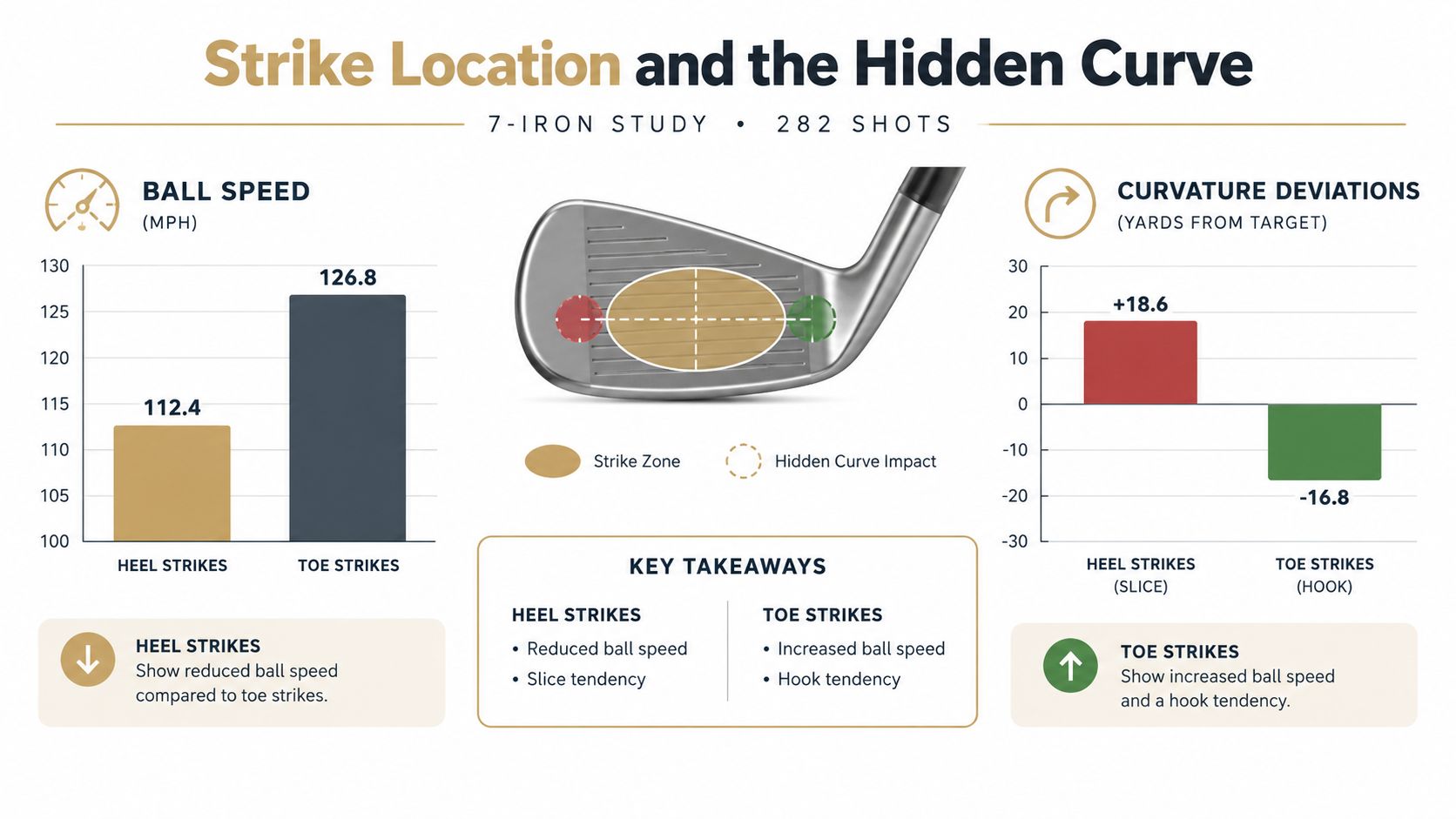
A 2023 peer-reviewed experiment recorded 282 valid seven-iron swings from one athlete and placed impact locations into three areas. The shots were distributed approximately evenly across those classes. That result shows how similar-looking swings can produce different launch conditions when contact changes. The researchers linked contact-location changes with launch angle, ball speed, spin, distance, and lateral position in the peer-reviewed impact-location study.
Three layers inside one scatter cloud
A launch-monitor-savvy coach separates the pattern into three overlapping layers:
- Mechanical direction error: Face angle and club path influence the ball's starting direction and the face-to-path relationship that shapes curvature.
- Strike-induced curvature: Heel or toe contact changes energy transfer and can create gear-effect movement.
- Aerodynamic spread: Wind, canopy geometry, and other conditions alter the ball's flight after impact.
A basic left-right plot can make these causes look the same. A shot finishing right may have started right because of the face, curved right after a heel strike, or been pushed by wind. The final position alone cannot identify the source.
Practical rule: A tight pattern requires shrinking all three layers, so identify the layer contributing most before changing the swing.
Start the diagnosis with face angle, club path, face-to-path, spin axis, and strike quality. Ball speed and smash factor show whether energy is being transferred efficiently. Reliability flags and a suitably sized sample help prevent one unusual shot from becoming a false diagnosis.
Face Angle and Club Path, The Mechanical Core
Start with the clubface because it has the strongest relationship with the ball's initial direction. Face angle describes where the face points at impact relative to the target line. Club path describes the direction the clubhead travels through impact relative to that same line.
The ball generally starts closer to the face direction than to the path direction. The gap between those two measurements is face-to-path. That relationship also influences the spin axis, which describes the tilt associated with the ball's curving flight.
Published technical literature places face angle's contribution to launch-direction variance at approximately 61–83%, and its contribution to spin-axis variance at about 82%, depending on the club and study. Those figures are summarized in the face-angle and club-path technical guide. The coaching implication is direct: a golfer who changes path repeatedly while leaving face delivery unstable may be working on the less influential variable.
Read the delivery in sequence
Consider two simple deliveries:
- A face 2 degrees open to a square path sends the ball right of the target and can produce a small cut.
- A path 3 degrees in-to-out with a square face can send the ball right of the target with draw curvature.
The first pattern is face-led. The second has a face-to-path relationship that favors curvature in the opposite direction. The same final position on the screen can therefore come from different combinations of face and path.
A golfer with a stable face-to-path relationship can produce a tighter pattern even if the path isn't perfectly neutral. More skilled players often deliver smaller face-to-path errors, so the same numerical change can cost less offline distance. That doesn't make path irrelevant. It means path should be interpreted alongside face angle, not treated as the sole explanation for every curve.
| Face Angle | Path | Starting Line | Curve |
|---|---|---|---|
| Open to target | Near neutral | Right | Cut or fade tendency |
| Near square | In-to-out | Slightly right | Draw tendency |
| Closed to target | Near neutral | Left | Draw or pull tendency |
| Near square | Out-to-in | Slightly left | Fade tendency |
A golfer checking setup and alignment can also use this guide to a correct stance for a golf driver, but setup changes shouldn't be used to hide an unstable delivery. The monitor should show whether the adjustment reduces face variation, path variation, or only changes the average direction.
Smash factor and ball speed provide the next clue. A delivery can show a reasonable face and path while producing inconsistent ball speed because the strike is moving around the face. When direction and speed vary together, the mechanical pattern may be fighting a contact problem rather than representing a pure face-control issue.
Strike Location and the Hidden Curve
A golfer can make a familiar swing and still contact a different part of the clubface. That small change can alter the shot before wind affects it, adding a second layer to the mechanical face-and-path pattern.
The 282 valid swings in the seven-iron experiment cited earlier were grouped by impact area, and the results connected strike location with several launch and flight outcomes in the study of impact location and golf-shot performance. The practical point is simple: a launch monitor can show similar face angle and path values while the ball leaves with a different speed, spin profile, or starting result because contact moved.
Why the same swing can produce a different flight
Off-center contact changes energy transfer and can create gear-effect curvature. For a right-handed golfer, a heel strike tends to add curvature to the right, while a toe strike tends to add curvature to the left. The size and direction of that change depend on the clubhead, strike height, delivered face, and path.
Strike height adds another variable. A high or low impact can change launch and spin, so two shots with similar heel-to-toe positions may still climb and curve differently. A low strike can also reduce ball speed and alter the flight's stopping power, while a higher strike may produce a different launch and spin combination. Read the impact location in two dimensions, across the face and from sole to crown.
A right miss therefore deserves a contact check before a swing overhaul. A slightly open face may start the ball right, while a heel strike adds curvature that sends it farther right. A toe strike can add leftward curvature, offsetting a small fade or intensifying a draw.
Center contact usually transfers energy more efficiently than an off-center strike. Club design influences how much speed and direction remain when impact moves away from the center, but there is no universal distance penalty for every golfer, club, or ball.
Coaching diagnosis: If face angle and path stay similar while spin axis, ball speed, and offline position change, inspect strike location before changing the swing.
Use impact tape, face spray, or a visible strike pattern. The aim is to determine whether contact is centered, consistently toward the heel, consistently toward the toe, or scattered across the face, rather than chasing one perfect mark.
Strike location separates mechanical direction error from strike-induced curvature. Equipment geometry affects how much ball speed and offline movement remain when contact drifts from center.
Wind, Air, and the Outdoor Pattern
A golfer can produce a familiar indoor pattern, then watch the same delivery spread wider outdoors. The launch monitor measures the launch conditions at impact. The ball then travels through gusts, changing air, terrain, and vegetation that the indoor session does not reproduce.
Wind changes more than the ball's final direction. A computational study examining launch angle, spin rate, terrain, vegetation, canopy structure, and weather conditions found that wind direction and strength affect ball speed, distance, and direction. Wind combined with tree-canopy geometry can also change the flight path. Treat launch angle as another variable in the pattern, because small differences in launch can change how long the ball remains exposed to moving air.
As a worked seven-iron illustration, wind can change trajectory height by about 6 yards and reduce carry to approximately 145 yards, roughly 24 yards shorter than the comparable no-wind flight. Another wind-variability example produced about 4 yards of carry variation in the analysis of wind, club range, and shot variance.
The same launch can meet different air
Higher shots generally spend more time in the wind. A crosswind can therefore turn a small launch or spin difference into a larger offline result by the time the ball reaches the ground. The swing may feel equally repeatable while the outdoor pattern changes after impact.
That creates a third layer of dispersion. Face angle and path describe the mechanical direction layer. Strike location can create a separate curvature layer. Wind and air add an aerodynamic layer that changes the ball's flight after those launch conditions already exist.
Tree-lined holes add another complication. An open range exposes the ball to a different airflow pattern than a hole bordered by trees. Terrain and vegetation can redirect or disturb air near the flight, making the course pattern wider or less predictable than a calm simulator pattern.
Record the conditions before assigning every change to technique.
| Condition | Change from Baseline | Yardage Effect |
|---|---|---|
| Calm air | Minimal external movement | Launch conditions dominate |
| Variable wind | Direction and strength change during flight | Carry and offline position vary |
| Tree-canopy exposure | Airflow interacts with vegetation and canopy shape | Flight path becomes less predictable |
| Different temperature or air density | The ball experiences different aerodynamic conditions | Carry pattern can expand or contract |
A calm-air pattern remains useful as a controlled baseline. It describes the delivery under measured conditions, not a guaranteed on-course result. Compare similar conditions when possible, and record wind, temperature, lie, target direction, and ball choice before deciding that a swing change caused the entire spread.
Ball Speed, Gear Effect, and Equipment Spread
Equipment sets the response around the golfer's delivery. Start with MOI, because it explains why two clubs can receive the same impact error yet produce different results. A higher-MOI head resists twisting more when contact occurs away from the center. That resistance can preserve more ball speed and reduce the offline penalty compared with a less stable design. The same impact is still imperfect, but the club may make its consequences smaller. An impact-location study using robot testing provides useful context for this relationship: impact-location study.
As established in the strike-location section, off-center contact can bend the flight. Equipment changes how much that bend costs you. Head shape, weight distribution, and face construction influence how much speed, launch, and curvature change when contact moves toward the heel or toe.
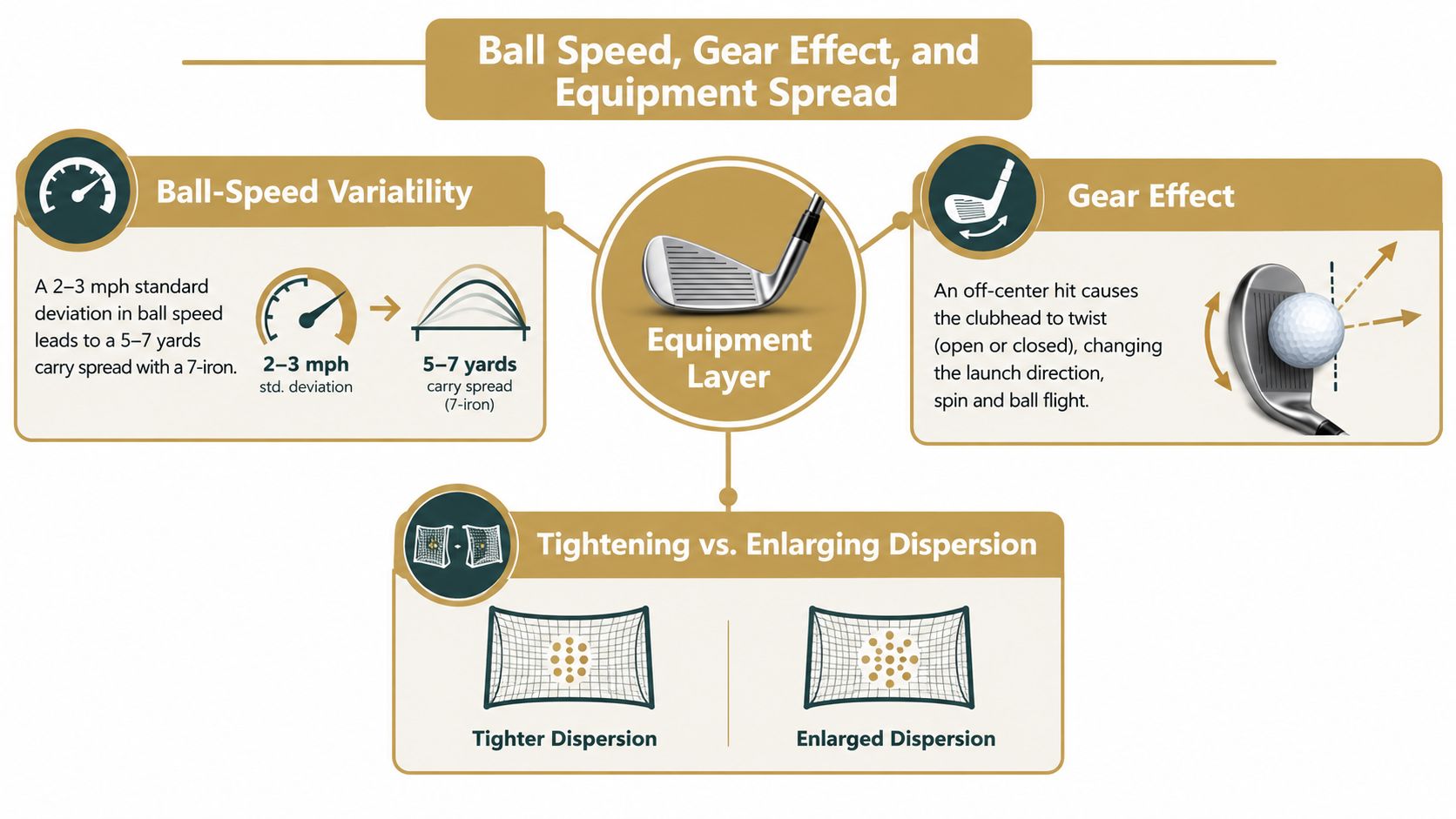
Ball speed is a practical consistency signal. It shows how efficiently the club and ball interacted on each shot. If ball speed varies widely, inspect strike quality before pursuing more clubhead speed. Two shots can show similar face and path readings while producing different carry and curvature because contact was not equally centered.
The launch monitor helps separate those causes. A delivery problem changes the mechanical direction layer. Contact and gear effect add a curvature layer. Equipment response determines how strongly that contact error affects speed and offline position. A rightward miss, for example, may combine a face-to-path issue with heel-side contact, while a more stable head may reduce the final penalty.
For fitting, compare center strikes and mishits separately. Review ball speed, carry, spin axis, and offline position for each group rather than relying only on average carry. A club that performs well on centered shots may create a wider equipment pattern when impact moves across the face.
Use this driver ball-speed chart as context for expected speed ranges, not as a replacement for your own strike data. Equipment can tighten its layer of the pattern. It cannot replace a repeatable contact plan.
Reading a Launch Monitor Like a Coach
You hit six shots that finish in a wide cluster. Before changing your swing, ask which layer created the spread. A useful coaching read separates mechanical direction, strike-induced curvature, and aerodynamic variation. The screen becomes a ranked investigation, not a reaction to the most dramatic miss.
Start with face and path
Begin with face angle and club path. Face angle largely sets the starting line, while the face-to-path relationship helps explain curvature. If the start line shifts while curvature stays similar, face delivery may be changing. If the start line stays stable but curvature changes, examine path and face-to-path more closely.
Then check spin axis. It is a flight check against your interpretation of the delivery. A golfer may feel a major path change, yet a stable spin-axis reading suggests that the perceived swing difference did not create the main change in curvature. Face angle generally contributes more to spin-axis variation than path, although the relationship changes with the club and the strike.
Then inspect contact and consistency
Strike location is the next layer. Smash factor and ball speed indicate how efficiently the club met the ball, while a face map or impact mark can show whether heel or toe contact added gear-effect curvature. Two swings can show similar face and path numbers but produce different curves when contact moves across the face, a distinction that significantly affects ball flight.
Use this triage order:
- Face angle versus path: Relate the starting line to the curve.
- Spin axis: Check whether the measured flight matches the delivery.
- Strike location: Look for heel or toe contact that adds curvature.
- Ball-speed deviation: Separate inefficient contact from directional error.
- Reliability flags: Review sample size, calibration, setup, and unusual readings.
Independent launch-monitor research indicates that ball-launch measurements are generally more reliable than some club-delivery parameters. Another study reported that spin rate, launch angle, and dynamic loft can become less consistent between sessions, as described in the launch-monitor reliability research.

A shank, extreme strike, or misread measurement should not define a session. Repeated patterns carry more weight than outliers. Keep monitor placement, target alignment, ball, lighting, and environmental notes consistent so session-to-session comparisons remain useful.
Dialed Golf records launch-monitor practice in a shared golfer record, and its launch-monitor app overview shows how logging each practice block makes session comparison a reading exercise rather than a memory exercise. A supported consumer launch monitor can pair live, while imported session data lets older results remain comparable with newer ones.
Drills and Adjustments That Match the Cause
A diagnosis becomes useful only when the drill addresses the variable that moved. Changing several things at once makes the next pattern harder to interpret.
Face-angle drift
For an unstable face, a gate drill can provide a clear start-line constraint. Place two objects roughly two clubhead-widths inside a tee line, keep the feet in a stable position, and make controlled swings through the gate. The task is to return the face without clipping either object or manipulating the finish to rescue the shot.
Path variation
For a path issue, place a towel line several feet outside the ball and rehearse the intended clubhead direction. The golfer should make small swings first, then increase speed only when the start line and contact remain predictable. The drill should create a delivery sensation, not force a permanent swing shape.
Heel or toe contact
Contact problems need a contact drill, not a new swing thought. Use impact tape or a face-marking method during controlled half-swings, then record whether the strike moves toward the center. Dry-fire rehearsals can help the golfer practice the intended low point and spacing without immediately adding full-speed ball flight.
Spin-axis tilt
A tilted spin axis should prompt a face-to-path check before a major technique change. If the face is too open or closed relative to the path, the golfer should first reduce that relationship with a small, measurable adjustment. The screen should confirm whether the curve narrows.
Ball-speed variation
Block a five-shot series at one target and record carry, ball speed, strike location, and offline position. The priority is a repeatable group, not the longest individual shot. Once the pattern becomes stable, the golfer can test whether added speed preserves the same contact and direction.
Session logging gives the adjustment a time horizon. Dialed Golf's consumer app serves as a pocket caddy on the course and is currently distributed through Apple TestFlight rather than generally available in the App Store. Its desktop practice product and the separate Dialed Academy business product keep the golfer record, practice data, and facility workflows distinct, rather than treating dispersion as a single scorecard number.
A Working Mental Model for the Next Range Session
The next range visit can use three questions.
First, where did the ball start? That points toward face angle and the relationship between face and path. Mechanical direction is the first layer because it shapes the initial line and much of the curvature.
Second, did the face strike the same place? Contact location can change ball speed, launch, and gear-effect curvature even when the golfer believes the swing was repeated. A moving strike pattern can make a delivery look less stable than it really is.
Third, what happened after launch? Wind, canopy geometry, and other aerodynamic conditions can expand the outdoor pattern. Clubhead design also affects how much an off-center impact changes distance and offline position.
A useful session follows a controlled sequence:
- Alignment: Set the target line and monitor orientation consistently.
- Club selection: Choose one club for the baseline block.
- Ball: Keep the ball type consistent when comparing sessions.
- Wind note: Record whether conditions are calm, variable, or directional.
- Shot goal: Define whether the session is testing start line, strike, carry, or curve.
The golfer can then hit a baseline block, log the scatter, isolate one layer, and retest. A narrower pattern is meaningful only when the improvement comes from the intended variable rather than a favorable outlier or a changed target.
The best answer to what causes dispersion isn't one number or one swing fault. It's the interaction of face and path, strike location, equipment response, and the air around the ball. A launch monitor becomes far more useful when the golfer reads those layers separately and makes one adjustment at a time.
Dialed Golf brings on-course caddie functionality, desktop launch-monitor practice, and facility operations into connected products under one golfer record, while free web tools remain available. Visit Dialed Golf to log patterns, compare sessions, and turn the next scatter cloud into a specific practice decision.