

Most golf ball weight comparisons start with the wrong question: which ball weighs more? A heavier ball sounds as though it should carry farther, while a lighter ball appears attractive for golfers who want a higher launch. Launch-monitor analysis points to a less convenient answer. Conforming models occupy an extremely narrow mass range, so the larger performance differences usually come from compression, construction, cover material, spin, strike quality, and dimple aerodynamics, not from a fractional change on a scale.
| Comparison point | What the measurement can show | What it cannot show alone |
|---|---|---|
| Measured mass | Whether an individual ball sits below the legal ceiling and how balls vary within a batch | Carry, spin, feel, or trajectory |
| Construction | How the ball may interact with the clubface and different impact conditions | The result for every golfer |
| Launch-monitor output | Ball speed, launch, spin, height, carry, and dispersion under controlled conditions | Whether mass caused the difference without matched testing |
| Ball condition | Whether wear, dirt, or water exposure may affect consistency | The original specification of a used ball |
A useful golf ball weight comparison therefore treats mass as a control variable and compliance check first. The fitting decision should come from repeatable ball-flight data.
Table of Contents
- Why Nominal Weight Misleads Golfers
- The Legal Ceiling and Conformance Rules
- Heavier Versus Lighter Ball Flight Physics
- Swing Speed Bands and Trajectory Trade-offs
- Launch Monitor Testing Protocol for Ball Mass
- Manufacturing Tolerances and Ball Condition
- Building a Data-Driven Ball Fitting Record
Why Nominal Weight Misleads Golfers
The number printed on a golf-ball package has limited fitting value. It identifies a nominal design specification, not the mass of the individual ball in a golfer's hand and certainly not its expected flight. Conforming models occupy a tightly restricted range, so the practical question is whether a small mass difference survives the effects of construction, impact, and aerodynamics.
A heavier ball can carry more momentum at the same speed, while a lighter ball requires less force to accelerate. That relationship is physically sound. Its performance signal among compliant retail balls is usually small beside changes in coefficient of restitution, compression, spin response, cover formulation, and dimple design. These properties affect energy transfer, launch, lift, drag, and descent together.
The scale answers a narrow question
The useful distinction is between nominal weight and measured mass. A manufacturer's specification describes a model or design target. A calibrated scale measures one physical ball under particular conditions. Moisture, dirt, wear, and scale accuracy can also influence the reading, especially when the difference being examined is fractional.
The governing conformance limit is concentrated around approximately 46 grams, and ordinary differences between compliant models are generally fractions of a gram rather than several grams. The R&A conformance specification sets the maximum mass and pairs it with a minimum diameter. That combination prevents a manufacturer from pursuing a heavier design by making the ball smaller.
Practical rule: A kitchen-scale reading can flag an unusual ball, but it cannot explain the ball's performance on its own.
Mass is still useful as a screening variable. A reading that differs materially from the rest of a batch may indicate a damaged, water-affected, or otherwise unusual ball. Small differences within a compliant set deserve more caution. They may reflect ordinary production variation without producing a meaningful change in play.
Construction often supplies the larger explanation. A firmer core or mantle can change energy transfer and spin behavior. A cover formulation can alter friction, particularly on partial wedges. Dimple geometry can change lift, drag, peak height, and sensitivity to wind. Those interactions can outweigh the flight effect associated with a small mass difference.
Why weight charts produce weak conclusions
A weight chart ranks one physical property. It does not describe how that property interacts with a specific clubhead, impact speed, strike location, or aerodynamic surface. Two balls with nearly identical measured mass can therefore behave differently, while two balls with slightly different mass can produce similar flight.
Use nominal weight to establish a baseline and measured mass to identify outliers. Treat the ball's construction and aerodynamic behavior as the stronger explanations for differences that appear on the course.
The Legal Ceiling and Conformance Rules
The legal ceiling is a boundary, not a performance target. The R&A rules of equipment specify a maximum mass of 1.620 avoirdupois ounces, equal to 45.93 grams, alongside a minimum diameter of 1.680 inches, or 42.67 millimeters. Those limits establish compliance. They do not predict which conforming ball will launch higher, spin less, or carry farther.
There is no mandated minimum mass. Manufacturers can produce conforming balls below the upper limit, so a lower reading does not make a ball defective or unsuitable. The practical comparison range remains narrow, which makes scale resolution, ball condition, and sample consistency more informative than nominal packaging specifications.
Record limit 45.93g / 42.67mm as a compliance field, then flag any ball >45.93g for re-weigh on a 0.01g scale before launch testing.
Size and mass work together
The rules pair maximum mass with minimum diameter. A manufacturer cannot pursue a heavier performance profile by shrinking the ball below the permitted size. For a fitter, that creates a consistent compliance baseline across retail balls, practice samples, and launch-monitor tests.
The USGA equipment-rules record clarifies the practical distinction: the specification sets a maximum weight and a minimum diameter, rather than one universal standard weight. A measured value therefore describes a sample, not a required product target.
Conformance is a batch decision
A single ball cannot certify an entire model. The USGA golf-ball weight and size test protocol evaluates a 24-ball sample, and four or more balls exceeding the mass limit render the sample nonconforming.
That procedure makes variation part of the fitting record. Log the sample identity, scale resolution, temperature, and ball condition. A reading above the ceiling warrants re-weighing and inspection, while a reading below it remains a screening observation, not proof of better flight or superior construction.
Heavier Versus Lighter Ball Flight Physics
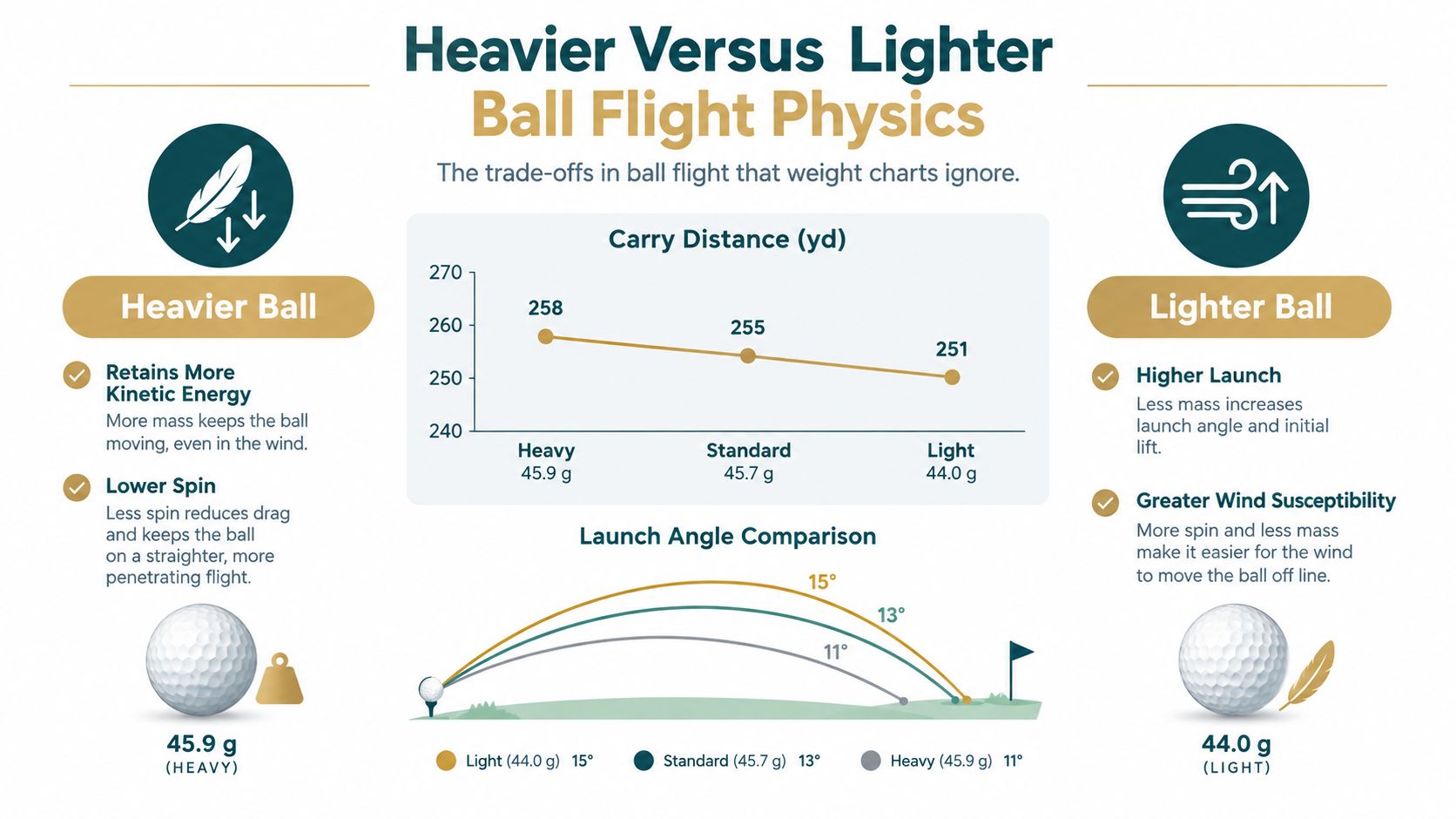
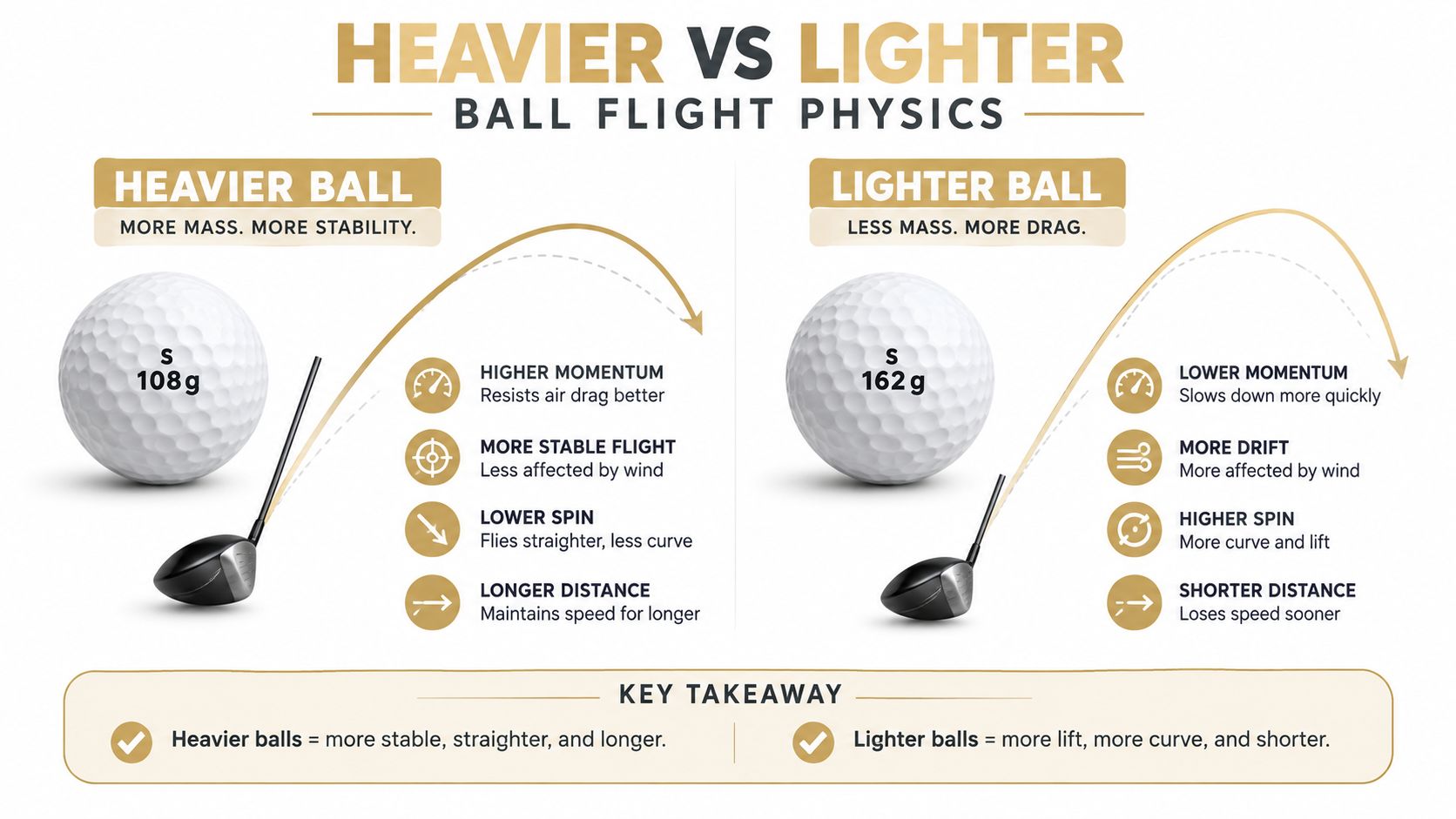
Mass affects flight through competing mechanisms. At the same impact speed, a heavier ball carries more kinetic energy and can retain speed better as it travels. The same increase in mass also magnifies aerodynamic forces, so the result depends on how the ball spins and how its dimples manage airflow.
The R&A and USGA equipment research on golf-ball distance describes the trade-off directly. A heavier ball can retain speed better through flight because of higher kinetic energy, but increased spin raises lift and drag, and the additional drag can reduce distance despite the mass advantage.
Retained speed isn't the same as longer carry
A ball that loses speed more slowly has a theoretical advantage, but carry depends on the full trajectory. If a heavier construction produces more spin than a lighter construction, the added drag can reduce the distance gained from energy retention. A ball can therefore be marginally heavier and still finish shorter.
The same logic applies to launch height. More lift can extend flight time, but excess lift paired with excess drag can create a high, short shot. A lower-launching ball can also underperform if it doesn't stay in the air long enough. The launch monitor must show which effect is occurring rather than allowing a weight chart to decide.
The useful comparison is multidimensional
A proper side-by-side test holds the club, impact conditions, and environment as constant as possible. The key outputs should include:
- Ball speed: Indicates how efficiently impact energy became initial velocity.
- Launch angle: Shows whether a mass or construction change altered the starting trajectory.
- Spin rate: Helps identify lift and drag behavior that can outweigh a small mass advantage.
- Carry and total distance: Separates airborne performance from rollout.
- Peak height and descent angle: Reveals whether a distance change came with a playable landing pattern.
- Dispersion: Shows whether the ball-flight change is useful on the course, not just longer in a single shot.
The conclusion is less exciting than “heavier goes farther,” but more useful: mass matters through its interaction with spin and aerodynamics. A golfer who compares only grams is measuring the least informative part of the flight system.
Swing Speed Bands and Trajectory Trade-offs
Slower swing speed doesn't automatically make a lighter ball the better choice. The relationship between mass and trajectory changes as clubhead speed changes, because the impact supplies the initial velocity and the aerodynamic forces then determine how long the ball remains airborne.
The USGA equipment specifications research indicates that lower clubhead speeds, such as approximately 72 mph, produce lower initial lift relative to ball weight. If the ball is too light to stabilize the trajectory, flight time and carry can fall rather than improve.
Why the lighter-ball shortcut fails
A lighter ball may appear attractive for a slower swinger because it seems easier to accelerate. That reasoning ignores the flight after impact. A ball that doesn't generate enough useful lift relative to its mass can leave the player with a flatter or shorter flight, particularly when launch angle and spin are also suboptimal.
A heavier ball isn't automatically the answer either. If the player delivers excessive spin, the additional aerodynamic drag can erase the benefit of retained speed. The fitting task is to identify the combination of mass, compression, launch, and spin that produces a stable trajectory for that golfer.
A driver distance baseline can help separate these variables from assumptions about ball weight. Dialed Golf's driver ball speed chart provides a useful reference point for organizing speed data before a golfer compares ball models.
Speed bands need launch evidence
A useful test doesn't ask whether slower players should use light balls in general. It asks whether a particular player maintains adequate launch, height, and carry with the tested construction. The answer may differ between a driver, an iron, and a wedge because the club changes impact speed, loft, spin, and strike location.
A fitter can group results by the golfer's own speed ranges and then inspect the trajectory variables within each group. The priority should be:
- Stable launch: The ball starts on a repeatable trajectory.
- Useful height: Peak height supports carry rather than exposing the shot to unnecessary drag.
- Appropriate spin: Spin creates lift, but excessive spin can shorten the flight.
- Playable descent: The ball arrives with enough height and angle for the intended shot.
- Repeatable dispersion: A small distance gain isn't valuable if directional spread expands.
This approach produces a more defensible conclusion than assigning a ball by swing speed alone. A slower player may need a construction that preserves launch and height, not the lowest measured mass.
Launch Monitor Testing Protocol for Ball Mass
A credible golf ball weight comparison starts with a scale, but it ends with matched launch-monitor data. The test should isolate mass as much as possible while recognizing that no golfer can remove every source of variation from a real session.
Each ball should be weighed on a calibrated scale and recorded to at least 0.01 gram. The USGA equipment-rules guidance notes that a 0.10-gram difference represents about 0.22% of total ball mass, which is why mass readings need to be paired with launch speed, spin, and carry under identical impact conditions.
A repeatable test sequence
The cleanest process uses the same club, ball position, launch-monitor settings, and environment for every model. A golfer should also record the ball's condition and measured mass before hitting it.
- Prepare the session. Keep temperature, wind assumptions, altitude settings, tee height, club, and target consistent. Mark each ball so its launch data remains attached to its mass reading.
- Warm up without mixing samples. Early swings can differ from settled swings, so the golfer should establish a stable strike pattern before recording comparison shots.
- Log every meaningful variable. Record model, ball mass, strike quality, ball speed, launch angle, spin, carry, total distance, peak height, descent angle, and dispersion.
- Remove obvious outliers. A topped shot, severe mishit, or strike with a visibly damaged ball shouldn't represent normal performance.
- Compare medians. Median outputs reduce the influence of one unusually good or poor strike and give a better picture of typical performance.
- Repeat the test. A difference that appears once but disappears in a second controlled session isn't strong evidence of a ball-mass effect.
A practical guide to selecting a launch-monitor setup is available in this launch monitor guide for driving-range practice, but the measurement principle remains the same across devices.
Metrics that deserve a place in the record
| Metric | Why it matters for weight comparison |
|---|---|
| Ball speed | Shows whether impact efficiency changed |
| Launch angle | Identifies a shift in initial trajectory |
| Spin rate | Indicates whether aerodynamic drag may offset retained speed |
| Carry | Measures airborne distance |
| Total distance | Adds rollout, but should not replace carry |
| Peak height | Shows whether the ball is sustaining a useful flight |
| Descent angle | Helps judge stopping and landing behavior |
| Dispersion | Tests whether the change is playable |
The scale is most valuable when it helps explain a repeatable launch pattern. It shouldn't be used to force a conclusion that the monitor doesn't support.
Manufacturing Tolerances and Ball Condition
Individual ball condition can matter more than the small differences golfers expect between new models. A new ball, a scuffed ball, a dirty ball, and a ball affected by water shouldn't automatically be treated as equivalent samples in a weight test.
An independent compilation weighing 52 balls across new, good, average, and poor conditions found that most average-condition balls were within roughly 0.3 grams of the 45.93-gram limit, as reported in this compilation of golf-ball weight measurements. The useful inference isn't that every used ball changes by the same amount. It's that condition introduces a separate source of variation that can be larger than the model-to-model difference a golfer is trying to isolate.
Separate condition from manufacturing variation
A fair sample should contain balls with comparable histories. Mixing new balls with recovered or heavily worn balls makes it impossible to know whether a launch change came from the design or the condition.
The test record should distinguish:
- New and unused: The clearest sample for comparing models.
- Played but intact: Useful for normal-course evaluation, but only when condition is matched.
- Scuffed or cut: A damaged cover can alter airflow and should be excluded from precision comparisons.
- Dirty: Surface contamination can change the aerodynamic surface and should be cleaned consistently.
- Water-affected: A ball exposed to water deserves separate treatment because its measured mass and performance may no longer represent the original sample.
The contrarian fitting conclusion
Golfers often obsess over a fraction of a gram while ignoring whether the ball was struck from the center, exposed to different temperatures, or carrying visible damage. That ordering is backwards for practical fitting. A consistent strike and controlled environment usually offer a cleaner signal than a tiny difference between compliant new balls.
A weight reading becomes useful only when the ball's history, test conditions, and launch output travel with it.
For coaches and fitters, the operational lesson is simple. Build the comparison from matched new samples first, then test used-ball behavior separately. That preserves the distinction between manufacturing tolerance and course wear, instead of blending both into a misleading average.
Building a Data-Driven Ball Fitting Record
The best ball fitting record doesn't rank products by grams. It creates a personal baseline that shows how a golfer's chosen ball behaves under repeatable conditions. Mass belongs in the database because it can explain an outlier, but carry, spin, launch, descent, and dispersion determine whether the ball fits the player.
A useful record links five items for every session:
- Ball identity: Model, condition, and measured mass.
- Impact context: Club, strike quality, and speed band.
- Environment: Temperature, wind assumptions, and launch-monitor settings.
- Flight output: Ball speed, launch, spin, peak height, carry, total distance, and descent angle.
- Decision note: Why the ball was retained, rejected, or tested again.
That structure lets a golfer compare the same player across sessions rather than treating a generic weight ranking as universal. It also makes equipment changes easier to interpret. A new club, altered shaft, different temperature, or inconsistent strike can otherwise masquerade as a ball effect.
From raw shots to a usable baseline
The record should prioritize repeatability over a single best shot. Median results within a consistent group provide a more useful reference than the longest carry of the day. Dispersion deserves equal attention because a small gain in distance may not compensate for a wider pattern.
A golfer can also use a structured gap analysis framework to identify where the chosen ball creates a practical weakness, such as insufficient height, excessive driver spin, or an unhelpful descent angle. The same record can then guide a focused retest instead of encouraging random product changes.
The final decision should answer three questions. Does the ball produce the intended launch and spin? Does it maintain a playable trajectory across the golfer's relevant clubs? Does the result repeat when mass, condition, and strike quality are logged together?
Dialed Golf gives golfers one record for ball model, measured mass, launch-monitor output, temperature, and strike quality across practice and on-course use. Its consumer app is a pocket caddy in TestFlight, its desktop product is built for launch-monitor practice with live pairing first and imports from major ecosystems, and Dialed Academy supports range and club memberships at $99.99 per month or $999.99 per year, while Golfer Pro runs across app and desktop at $9.99 per week, $29.99 per month, $149.99 per six months, or $249.99 per year. Golfers and coaches can start with the free web tools and visit Dialed Golf to build a ball-performance record based on measured outcomes rather than nominal weight.