

The launch monitor is glowing beside the mat, and a mid-handicap golfer has finally hit the driver that felt like the swing of the day. Ball speed looks healthy. Carry looks acceptable. The launch angle reads 15 degrees, which sounds close to the familiar advice found in countless fitting conversations. Then the doubt arrives: is 15 degrees right for this golfer, or does it only look right on the screen?
That question matters because driver launch angle never works alone. Swing speed, attack angle, strike location, effective loft, and spin rate all shape the flight. A number that helps one golfer carry the ball efficiently can produce a ballooning shot or a low, falling-out-of-the-sky flight for another.
Table of Contents
- Standing Over the Tee With Numbers on the Screen
- What Driver Launch Angle Actually Measures
- The Launch and Spin Tradeoff That Drives Carry
- Recommended Launch Windows by Swing Speed
- Three Levers That Move Your Launch Angle
- Reading Your Launch Monitor Data the Right Way
- Why Chasing a Single Number Backfires
- Building a Repeatable Practice Loop Around Your Numbers
Standing Over the Tee With Numbers on the Screen
The golfer hits another drive. This one launches lower, turns over slightly, and finishes short of the previous ball. The screen now shows a different launch angle, a different spin rate, and a different carry number. Both swings felt solid enough to keep, yet the monitor is telling two different stories.
That's the everyday starting point for a player who has access to launch-monitor data but doesn't yet know how to interpret it. Most golfers glance at ball speed, launch angle, spin rate, and carry, nod at the numbers, and move on. The screen reports what happened, but it doesn't automatically explain whether the result came from a useful delivery or a fortunate strike.
Driver launch angle is especially easy to misunderstand because a single number looks authoritative. A golfer sees a launch angle in the low teens and assumes the number must be good, even if the ball started with too much spin, launched from a low-face strike, or carried less efficiently than a slightly higher launch would have produced.
Practical rule: A launch angle is useful only when it's read beside speed, spin, attack angle, and strike quality.
The better question isn't “What launch angle should every golfer hit?” It's “What launch window gives this golfer a reliable combination of carry, flight stability, and total distance?” A 2014 driver-fitting study linked launch conditions from the clubhead strongly to shot outcome, while current guidance from the same measurement ecosystem models 13.6 degrees as an optimum for a 94 mph swing with a 0-degree attack angle. That example is useful precisely because it includes the swing conditions, rather than presenting the number as universal. TrackMan's launch-angle guidance also defines launch angle as a directly measured ball-flight variable.
By the end of a good practice session, the golfer should know whether the current number belongs in the target window, which lever is most likely to move it, and when changing it would make the shot worse.
What Driver Launch Angle Actually Measures
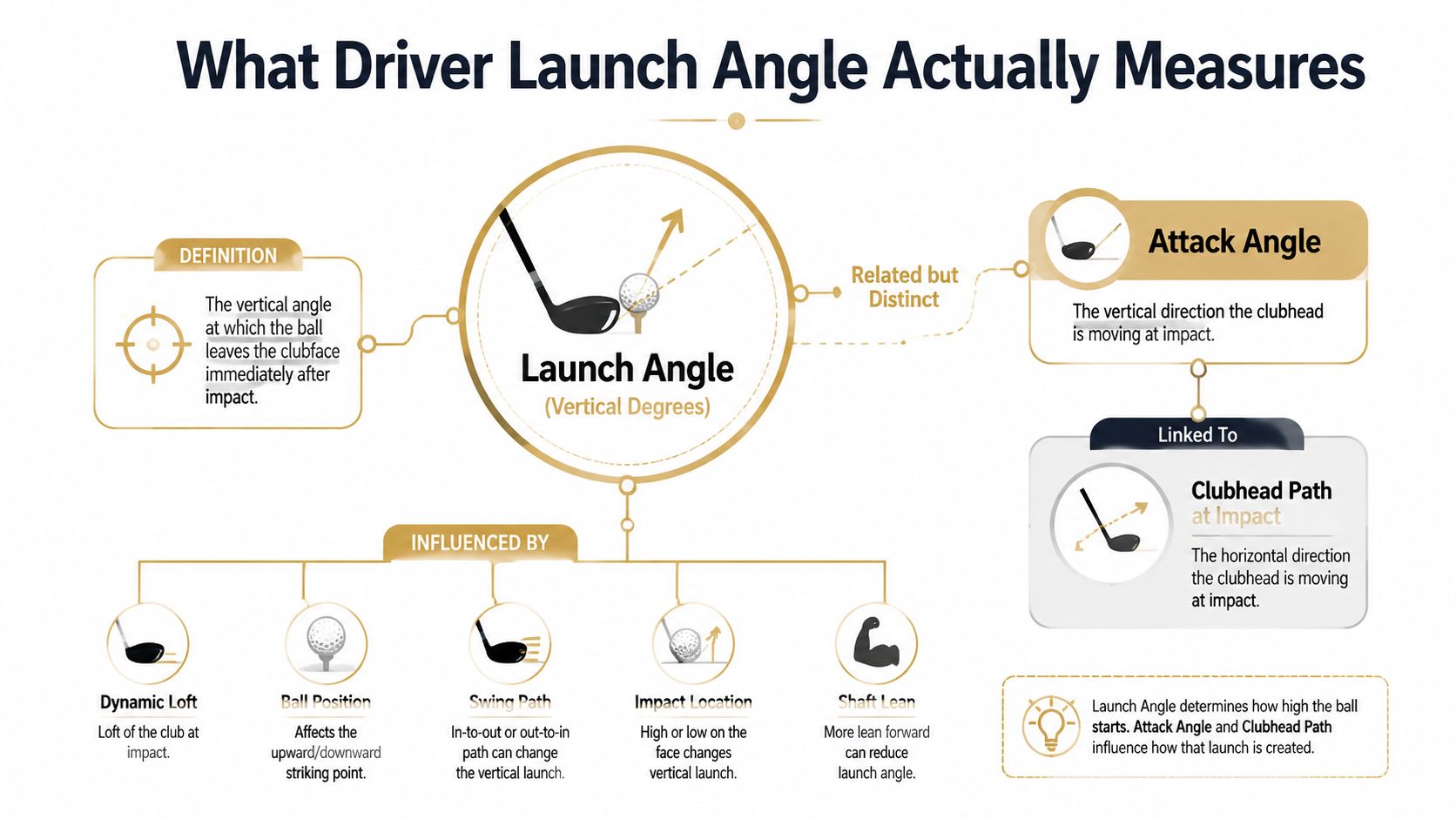
Driver launch angle is the vertical departure angle of the ball immediately after impact. In practical terms, the launch monitor measures how steeply the ball leaves the clubface, expressed in degrees. TrackMan's terminology describes it as the ball's vertical departure angle immediately after impact, so it isn't a visual estimate based on peak height or how high the shot appears.
Attack angle is different. It describes the clubhead's vertical movement through impact. A golfer can deliver a positive attack angle, meaning the clubhead is moving upward, while the ball launches at a lower angle because delivered loft and strike location don't support a high launch. The two measurements interact, but they aren't interchangeable.
The three numbers that explain the flight
Launch angle sits inside a simple ball-flight triangle:
- Ball speed provides the energy and influences how much distance the shot can produce.
- Launch angle influences the initial height and how long the ball can remain airborne.
- Spin rate acts as the flight governor, helping the ball climb, stabilize, or lose forward momentum.
Carry is the output the golfer sees downrange. A shot launched at 15 degrees with 160 mph ball speed and 2,500 rpm spin will fly very differently from one with the same launch and ball speed but 3,500 rpm spin. Those figures are an illustration of the relationship, not a universal prescription.
Higher launch generally gives the ball more time in the air, while lower launch can create a flatter, more penetrating flight. Spin determines whether that launch produces efficient carry or excess height followed by a steep descent. That's why launch angle alone tells a golfer very little.
A 2024 academic study reported that a driver launch angle between 12 and 15 degrees can help increase driving distance, while also emphasizing that driver head angle and launch angle should be fitted together. The study record supports the central fitting principle: static loft is an input, but launch angle is the measured result.
The Launch and Spin Tradeoff That Drives Carry
Consider a mid-handicap golfer swinging the driver at 95 mph, producing 145 mph ball speed. Two shots can feel equally solid while taking very different routes through the air.
| Profile | Launch Angle | Spin Rate | Attack Angle | Carry (yds) | Total (yds) |
|---|---|---|---|---|---|
| A, penetrating flight | 11° | 2,400 rpm | -1° | 235 | Not specified |
| B, higher, softer flight | 15° | 3,200 rpm | +3° | 210 | Similar total to Profile A |
Profile A launches low, spins moderately, and produces a strong, penetrating flight. The negative attack angle isn't ideal because it's negative, but the combination still produces the longer carry in this example. Profile B launches higher and lands more softly, which could make it useful when a golfer values stopping power, yet its higher spin reduces carry even though the attack angle is more favorable.
The important lesson is that higher launch doesn't automatically mean longer carry. If the golfer raises launch while allowing spin to climb too far, the ball can spend more energy climbing than moving forward. A 16-degree launch at 3,800 rpm in this example stalls in the air and loses 15 yards of carry.
A launch monitor doesn't reward an attractive number. It rewards a compatible group of numbers.
Independent fitting guidance commonly places effective driver launch for many golfers in the 12 to 16-degree range, with slower swingers often benefiting from the higher end and faster swingers often performing better lower. This launch-angle and spin guidance also connects launch conditions with attack angle and strike quality, reinforcing that the golfer has to evaluate the entire flight pattern.
A separate study of driver length found a positive trend between backspin and launch angle, while also reporting inverse associations between initial launch speed and both backspin rate and launch angle. The PubMed study adds another reason to avoid isolated readings. Ball speed, launch, and spin can shift together as the club, strike, and delivery change.
For the 95 mph golfer, the target isn't to copy Profile B's launch or Profile A's total distance. The target is to find the launch-spin pair that produces dependable carry without a ballooning peak or an unstable, low-spin flight.
Recommended Launch Windows by Swing Speed
The broad starting window for many golfers is 12 to 16 degrees, but speed changes the conversation. A slower golfer usually needs more height to preserve carry, while a faster golfer can launch lower without losing the same amount of airborne distance. Attack angle and strike consistency still matter, so the tiers below are starting windows, not rigid fitting prescriptions.
| Swing Speed (mph) | Launch Window (°) | Attack Angle (°) | Target Spin (rpm) | Common Mistake |
|---|---|---|---|---|
| Under 90 | 14° to 18° | Positive | Not specified | Chasing a low, fast-player launch and losing carry |
| 90 to 105 | 12° to 16° | Neutral to positive | Moderate | Adding loft without checking strike and spin |
| 105 to 115 | 11° to 14° | Shallow positive | Tighter ceiling | Over-launching and creating a high, unstable flight |
| Above 115 | 9° to 12° | Positive if consistent | Not specified | Trying to add height when speed and strike already support carry |
The under-90 mph golfer shouldn't copy a faster player's low launch. A higher window can help the ball remain airborne, even when the player's speed is limited. The 90 to 105 mph group is where many recreational golfers land, and it usually requires balancing enough launch with enough spin to keep the flight from falling out of the sky.
For golfers between 105 and 115 mph, the window tightens. These players can often create useful carry with a lower launch, but over-launching can produce a shot that climbs sharply and loses forward momentum. Above 115 mph, a lower launch can work when strike quality is dependable, but a poor strike still overrides the theoretical advantage.
The supplied fitting guidance places golfers around 85 to 95 mph near 14 to 17 degrees, faster golfers above 105 mph near 11 to 14 degrees, and pairs a positive attack angle of roughly +3 to +5 degrees with efficient launch conditions. The speed-based launch and spin reference provides that starting framework.
For a useful mental model, launch roughly reflects attack angle plus effective loft. That isn't a calculation for a practice session. It's a reminder that the printed loft on the driver head doesn't determine the final launch by itself. Spin rate decides whether the launch window stays efficient once the ball is airborne.
Golfers comparing their ball speed with a speed-based reference can also use this driver ball speed chart before judging whether a launch number is helping or hurting.
Three Levers That Move Your Launch Angle
A golfer with low launch has three practical places to start: the driver head, the tee, and the ball position. Loft is the most direct equipment lever, but it shouldn't automatically be the first adjustment.
Loft changes the delivered starting point
Adding loft to the driver head generally raises launch, provided the shaft delivery and strike remain compatible. The exact result depends on how the golfer presents the club, so the monitor should confirm the change rather than the golfer assuming it happened.
Test loft in small increments, such as 0.5 to 1 degree, and watch launch, spin, carry, and strike location together. If launch rises but spin becomes excessive, the golfer hasn't solved the flight problem. The golfer has traded one issue for another.
Tee height changes the strike opportunity
Tee height is inexpensive and quick to test. Raising the ball can encourage a higher strike on the face and support a more upward delivery, while a lower tee can move contact down the face and alter the launch-spin relationship.
A golfer should make a modest tee-height change, then hit a short group of comparable shots. The key metric isn't launch alone. It's whether the contact pattern, launch, spin, and carry move together in a useful direction. Research using Doppler radar found that impact-location variability materially affects launch angle and total-distance variability, which is why strike deserves attention before a golfer blames the club setting. The impact-location research supports checking contact directly.
Ball position affects delivery and strike
Moving the ball slightly forward can give the clubhead more time to travel upward before impact. It can also change where the ball meets the face, so the adjustment shouldn't become a blind setup rule.
A golfer testing ball position should watch attack angle, launch angle, spin rate, and face strike. If the ball moves too far forward, contact can drift toward the heel or the golfer can leave the face open. If the ball remains too far back, the golfer may deliver more downward motion and launch the shot lower.
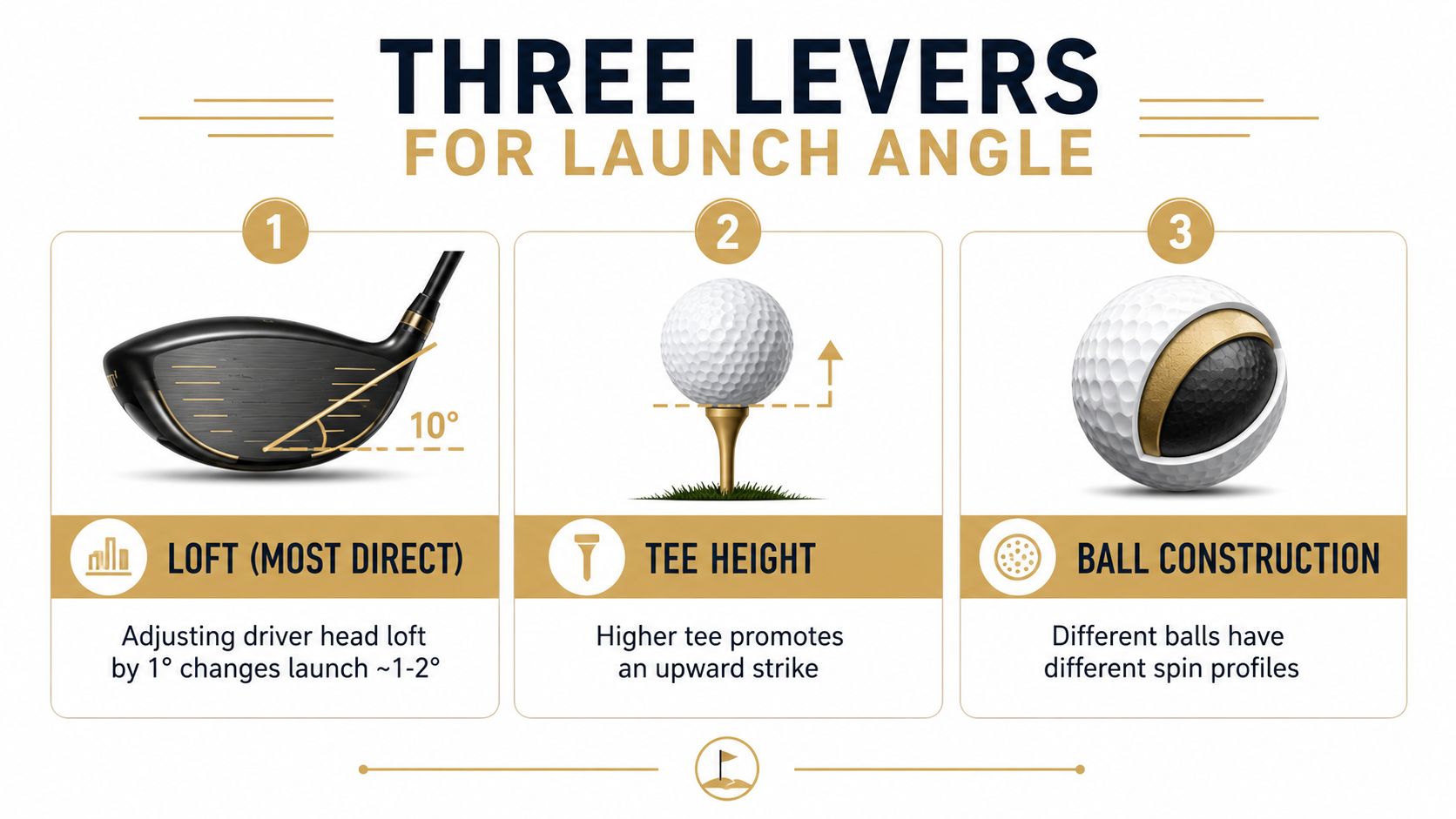
The practical order is simple: verify strike, test tee height and ball position, then fine-tune loft. A golfer with low launch and high spin may benefit from a higher tee, a slightly forward ball position, and a loft increase, but each change should be tested separately. Guidance on the correct driver stance can help establish a repeatable setup before the monitor data is interpreted.
Reading Your Launch Monitor Data the Right Way
A single driver swing is a story, not a trend. The golfer who changes settings after one low-launch shot is reacting to noise, especially when strike location can materially change launch and distance.
Start with a consistent group of shots using the same club, ball, tee, and intended shot. The supplied practice approach calls for hitting a bucket, excluding the worst two and best two, and reading the median of the remaining shots. That method prevents one skyed drive or one worm-burner from distorting the picture.
Read relationships, not isolated values
The median matters because launch and spin often move when strike quality changes. A low-face strike can create a lower launch and more spin, while a high-face strike can produce a higher launch and less spin. The golfer needs to know whether a launch change came from a deliberate adjustment or from a different point of contact.
The most useful comparisons are:
- Launch with spin: A higher launch is not automatically efficient if spin rises sharply.
- Spin with strike location: A spin spike may point to contact rather than a loft problem.
- Launch with attack angle: A golfer can see whether the club is delivering the intended vertical motion.
- Launch with carry: The final test is whether the ball travels farther through the air with a stable flight.
One launch-monitor-based workflow can capture every shot in a desktop practice session, group shots into queryable buckets, and filter them by club, lie, or intent. Dialed Golf's launch-monitor practice workflow is built around that kind of session record, turning a range bucket into a dataset rather than a fading memory.
A clean session filter
After practice, filter the session to driver and review the launch-spin cluster before changing anything. If most shots sit near the same launch but spin varies widely, strike or delivery deserves attention. If launch and spin move together across the group, the golfer can test an equipment or setup lever with more confidence.
A useful result might be less dramatic than the longest shot of the day. A tighter cluster with predictable carry usually gives the golfer a better on-course reference than one exceptional drive surrounded by scattered numbers.
Why Chasing a Single Number Backfires
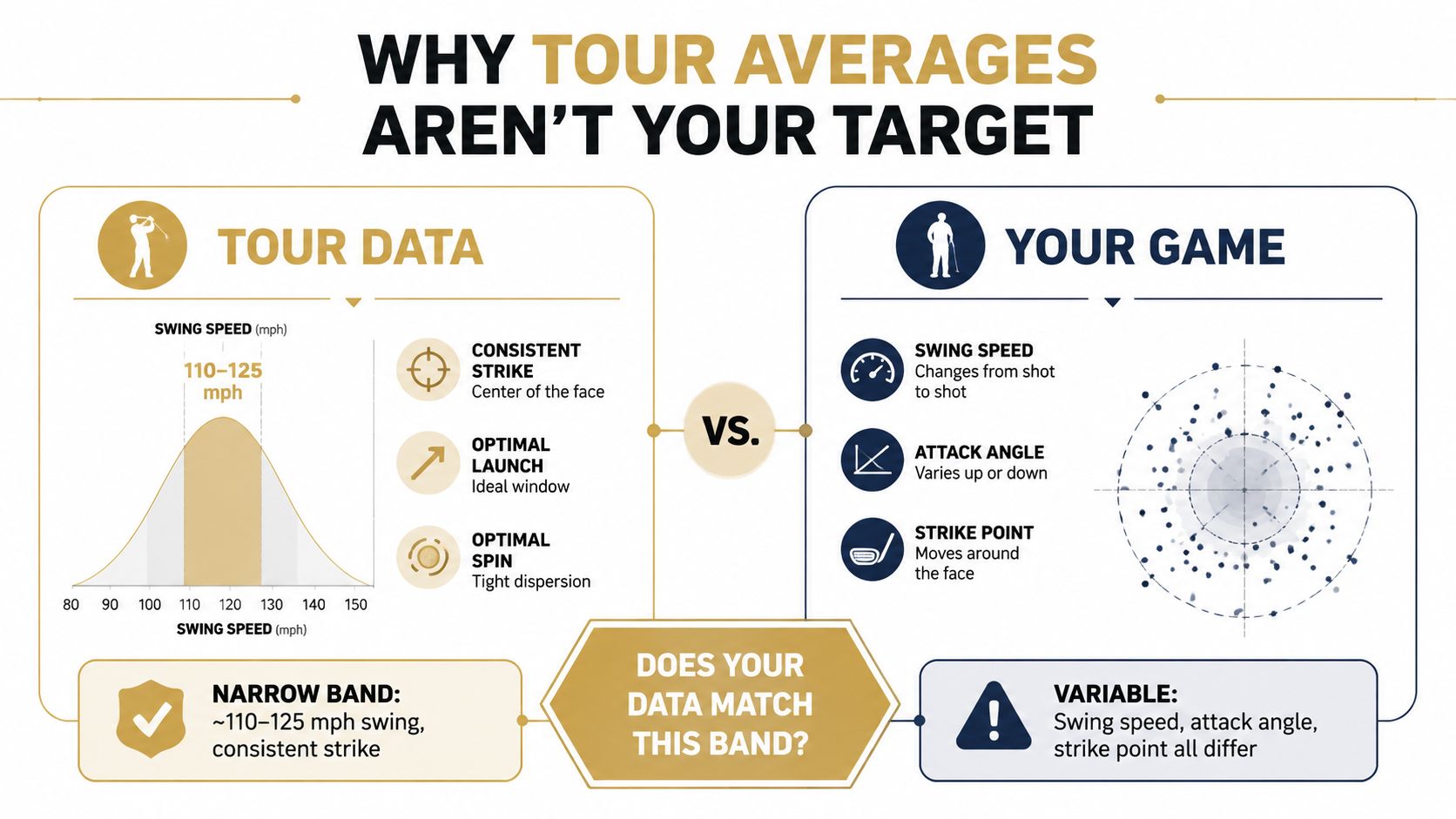
Tour averages are tempting because they look precise. A golfer sees a low launch and moderate spin associated with elite driving, then tries to reproduce those numbers without matching the swing speed, attack angle, delivered loft, or strike pattern that created them.
That approach often turns into a low, weak flight for an amateur. A golfer with less ball speed may need more launch to preserve carry, while a golfer with a faster swing can afford a lower launch when strike quality remains consistent. The 2024 study cited earlier also found that optimum driver head angle varies by swing style, which argues against treating a launch number as independent from the golfer's delivery. The academic research on driver head angle and launch supports fitting the two together.
The same launch angle can also hide a different quality of strike. A 13-degree shot struck near the center of the face isn't equivalent to a 13-degree shot struck low or toward the heel. One may produce a reliable carry pattern, while the other may owe its launch and spin values to face curvature and impact conditions.
Use a window that survives the session
A personal target should survive a full practice group, not just the flush drive the golfer remembers. The golfer's ball speed trend, smash factor trend, launch cluster, spin cluster, and strike pattern deserve more weight than a borrowed benchmark.
The right launch angle is the one that keeps producing a useful flight when the swing is merely solid, not perfect.
That's why a window beats a point. If a player's launch varies slightly but carry remains stable, the window may already be doing its job. If the monitor shows a beautiful launch number paired with erratic strike and inconsistent carry, the number is not yet a meaningful target.
Building a Repeatable Practice Loop Around Your Numbers
A productive driver session needs a question, a baseline, and one controlled change. Without those three elements, golfers tend to hit until a good shot appears, then rebuild the entire setup around it.
Start with a baseline
The golfer can begin with five normal driver shots, recording carry, ball speed, launch, spin, and attack angle. The point isn't to create a definitive average. It's to establish the current launch-spin pattern and identify whether strike quality is consistent enough to interpret the data.
Group the shots by strike quality before judging the numbers. A center strike and a low-face strike shouldn't carry equal authority when the purpose is to understand the golfer's repeatable delivery.
Change one lever at a time
The next block should alter only one variable. A golfer might test tee height for two shots, then test a slightly stronger loft setting for two shots, while keeping the intended swing and ball position stable. Those small blocks aren't large enough to prove a final fitting answer, but they can reveal whether a lever moves launch, spin, strike, or carry in the desired direction.
Ball position can then receive its own test. The golfer should record the meaningful delta, not every minor fluctuation. If launch rises but spin balloons, the change didn't improve the window. If launch stays similar while strike becomes more centered and carry tightens, the adjustment may still be valuable.
Compare blocks instead of memories
A desktop practice record can store each block as a queryable set, allowing the golfer to compare the current loop with an earlier session and identify which lever moved the launch-spin pattern. Dialed Golf brings together three products under one golfer record and one Pro plan. Its consumer app serves as a pocket caddy on the course and is currently available through TestFlight rather than general App Store availability. Its desktop product is focused first on live launch-monitor pairing, including Garmin R10 and an expanding set of integrations, along with CSV or imported data from Garmin, Rapsodo, SkyTrak, FlightScope, Uneekor, GSPro, Awesome Golf, and more. Dialed Academy provides memberships and front-desk tools for ranges and clubs at $99.99 per month or $999.99 per year, while the club keeps its dues. Free web tools remain free, and Golfer Pro is priced at $9.99 per week, $29.99 per month, $149.99 for six months, or $249.99 per year across the app and desktop.
A golfer can use the workflow to preserve the baseline, compare each adjustment, and carry one clear setup cue onto the course. The consumer app is mobile-first for on-course use, while the live pairing workflow is desktop-first, with mobile live pairing planned later.
The following visual summarizes the loop from baseline to retest.
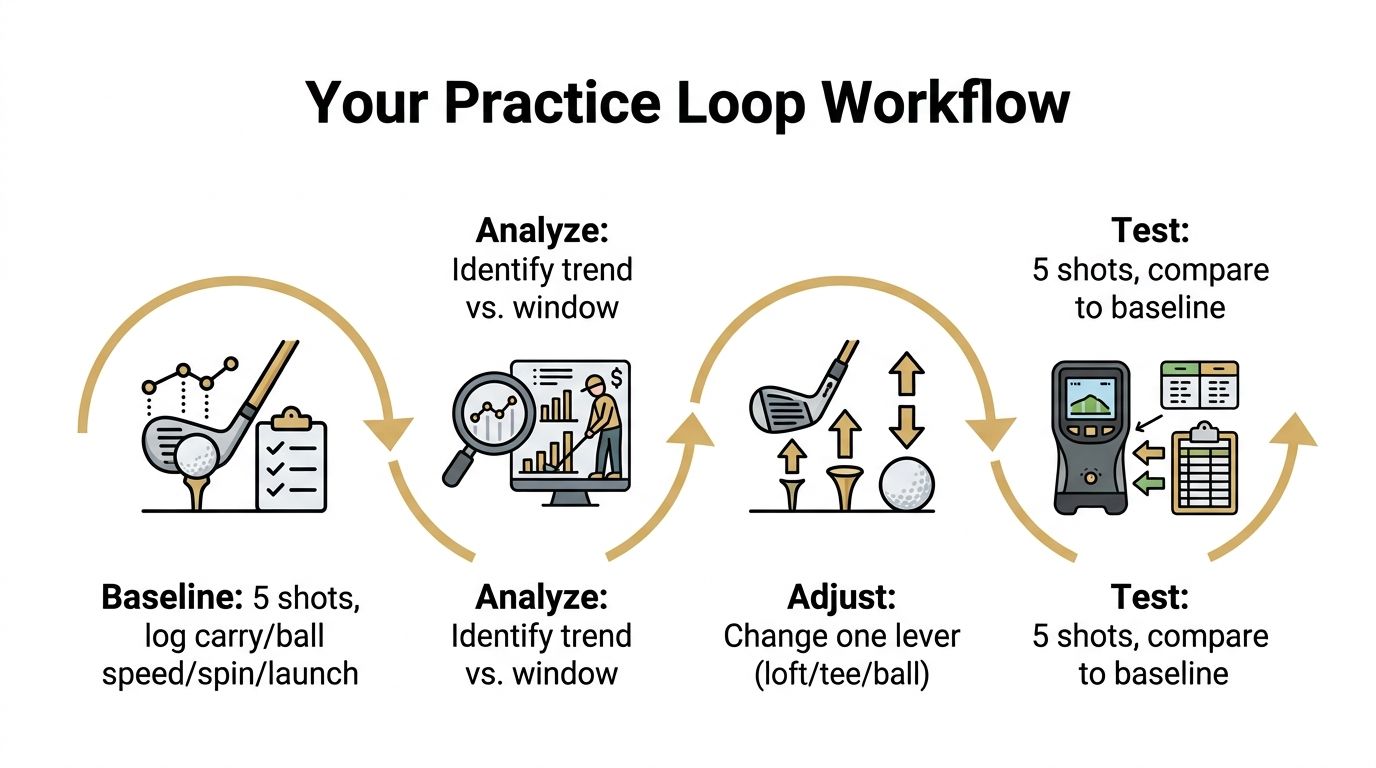
A launch monitor becomes most useful when the golfer repeats the same question across sessions, rather than chasing whichever number flashed after the best swing.
Dialed Golf can help golfers preserve driver launch-angle sessions as organized, searchable practice data instead of relying on memory, while its course app provides a pocket-caddy experience for on-course decisions. Visit Dialed Golf to review the free web tools and explore the app, desktop practice workflow, and Academy options.