

A 40-yard pitch can land on the same part of a green and produce two completely different results. One shot lands short, releases across the putting surface, and rolls off the back. Another lands on a similar line and checks near the pin. The difference isn't always a better swing or a more expensive club. Spin changes how the ball behaves after landing.
Golfers often search for a high spin wedge as if it were a single product category with a guaranteed result. In practice, wedge spin is a moving outcome shaped by loft, delivery, groove condition, ball cover, face friction, and strike quality. A launch monitor can show the result, but understanding the inputs makes the number useful.
Table of Contents
- What a High Spin Wedge Actually Means
- Loft, Attack Angle, and the Spin Loft Window
- Grooves, Face Texture, and the 2010 Rule Shift
- Ball Choice and the Friction Behind Greenside Bite
- Contact Quality, Strike Location, and Wedge Technique
- Groove Wear and the Half-Life of High Spin
- Putting It Together to Control Wedge Spin
What a High Spin Wedge Actually Means
A wedge shot's spin rate is measured in revolutions per minute, or rpm. Contemporary independent testing found an average of 9,270 rpm across a wedge test pool, while the highest club in that dataset reached 10,046 rpm and the lowest recorded 8,474 rpm under the same testing conditions. The exact result changes with loft, strike, speed, ball, and environment, so those figures are reference points, not promises. The independent wedge test data places modern wedge performance in the upper four-digit to low five-digit rpm range.
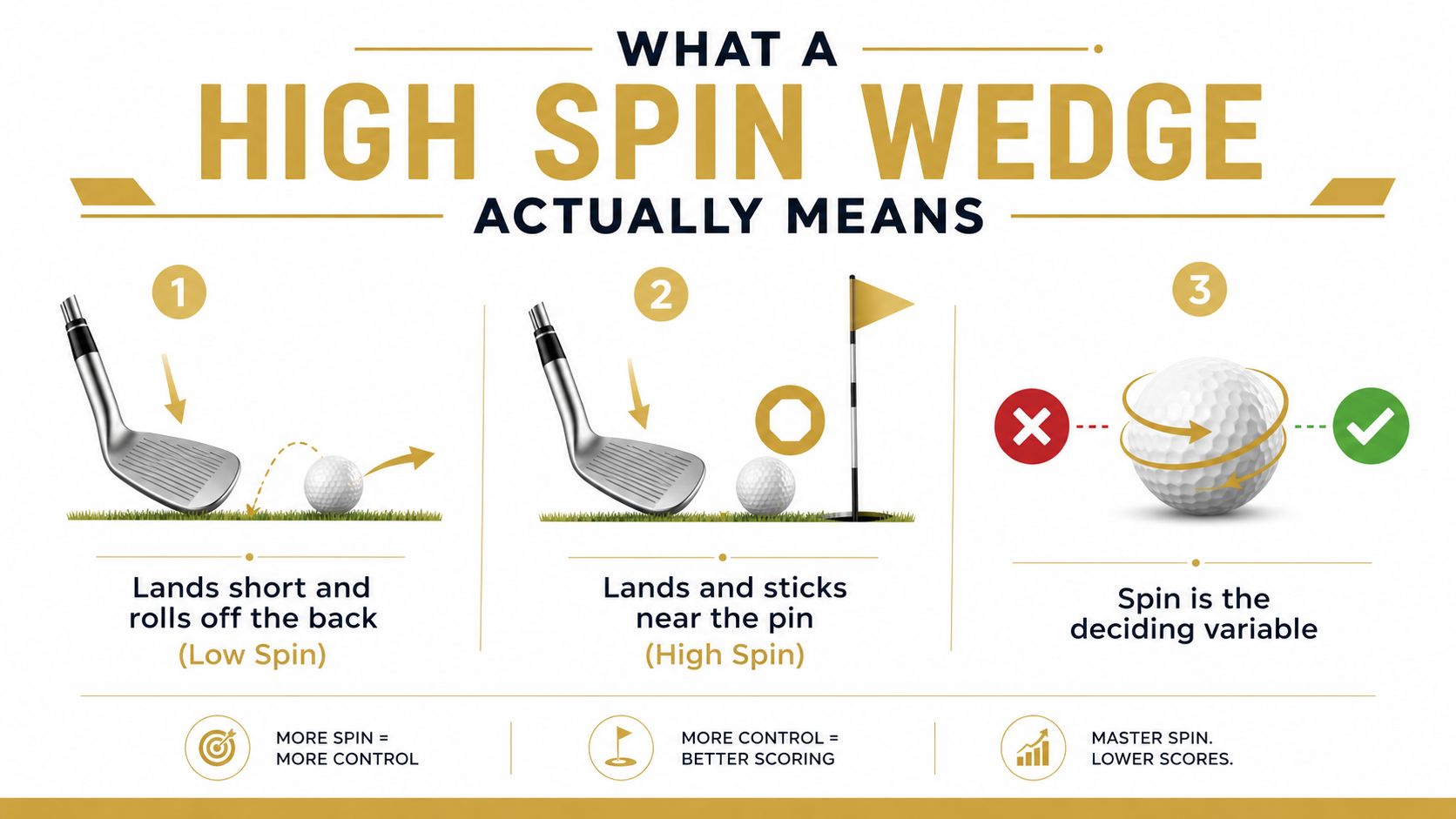
Backspin rate describes how quickly the ball rotates backward after impact. Launch monitors may also report total spin, which can include the combined spin behavior of the shot rather than only a clean backspin component. For a wedge, the useful question isn't whether the number is higher. A high rpm reading needs to work with a suitable launch angle, landing angle, and dispersion pattern. A shot that spins heavily but launches too high or lands inconsistently may not stop closer to the hole.
Spin is a system outcome
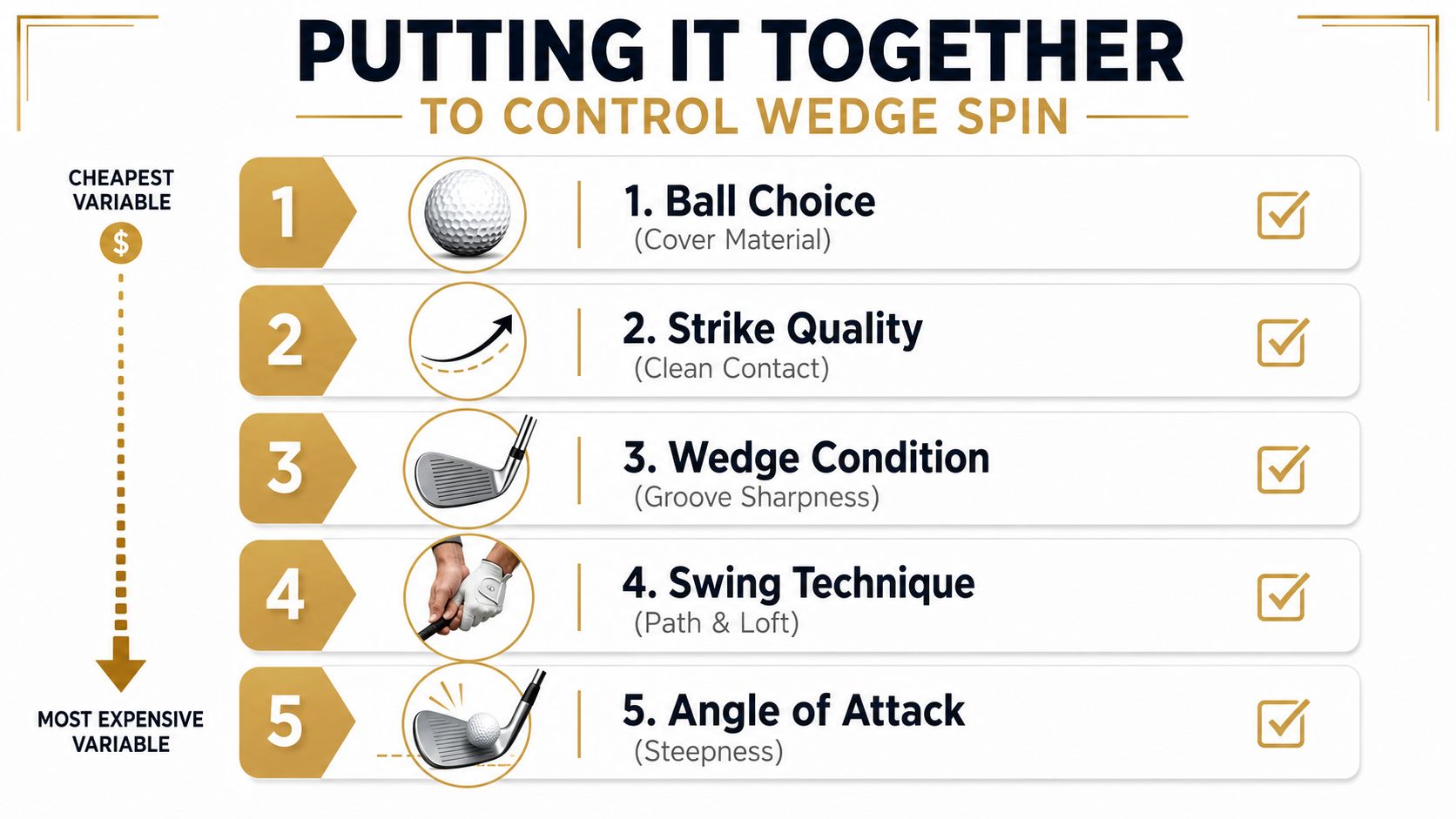
A high spin wedge is better understood as a system made up of five connected inputs:
- Loft and delivery, which establish the impact geometry.
- Grooves and face texture, which help the face grip the ball.
- Ball cover, which changes friction during impact.
- Strike quality, which determines how cleanly energy transfers.
- Wear and maintenance, which decide whether the face keeps producing its original friction.
Broader wedge guidance commonly places pitching wedges around 7,000 to 9,000 rpm, with gap, sand, and lob wedges around 8,500 to 10,500 rpm or more on full swings. Controlled robot testing has also found some wedges exceeding 11,000 rpm at an 80 mph test speed, showing that ideal conditions can push spin beyond the usual benchmark. The broader wedge spin-rate reference also reinforces why a single ranking can hide important differences between full shots, partial shots, and greenside play.
Practical rule: The highest spin number isn't automatically the most useful number. The best result is repeatable stopping power with a landing angle and rollout pattern the golfer can manage.
Loft, Attack Angle, and the Spin Loft Window
The loft stamped on a wedge tells only part of the story. At impact, the ball responds to dynamic loft, the loft delivered by the club, and angle of attack, the direction the clubhead travels vertically through impact. Spin loft is the difference between those two measurements.
For example, if a golfer delivers 42 degrees of dynamic loft with a minus 3-degree angle of attack, the spin loft is 45 degrees. The formula is:
Spin loft = dynamic loft minus angle of attack
That distinction explains why two golfers using the same 56-degree wedge can create different launch and spin patterns. A golfer who adds shaft lean may present less dynamic loft. A golfer who releases the club earlier may present more. Face orientation, shaft lean, and strike location all influence what the ball sees.
The useful range isn't infinitely large. Independent wedge research explains that a relatively tight spin-loft window tends to maximize frictional transfer. As spin loft becomes excessive, the face-to-ball interaction becomes more sliding than gripping, which raises launch while reducing the amount of useful spin. The research on spin loft and wedge delivery shows why adding loft or hitting farther down isn't a complete solution.
A practical launch-monitor example
A golfer can compare three deliveries with the same wedge:
- Stock delivery: moderate shaft lean and a centered strike.
- More de-lofted delivery: additional forward lean and a steeper attack.
- More lofted delivery: less forward lean and a shallower strike.
The monitor should be used to compare dynamic loft, attack angle, spin loft, launch, landing angle, and spin together. A wedge that produces more rpm but launches too high may stop differently from one that produces slightly less rpm with a lower, more predictable descent.
| Attack Angle | Dynamic Loft | Spin Loft | Typical Backspin (rpm) |
|---|---|---|---|
| Shallow | Moderate | Larger | May launch higher without maximizing friction |
| Controlled downward | Moderate | Tight window | Often supports strong, repeatable wedge spin |
| Very steep | High or reduced by shaft lean | Potentially excessive | Can become less efficient despite added downward strike |
A golfer looking for a better high spin wedge setup should match loft and bounce to the delivery that appears most often, not to an idealized swing. The launch-monitor app guide can help frame that process around measured results rather than the loft number alone.
Grooves, Face Texture, and the 2010 Rule Shift
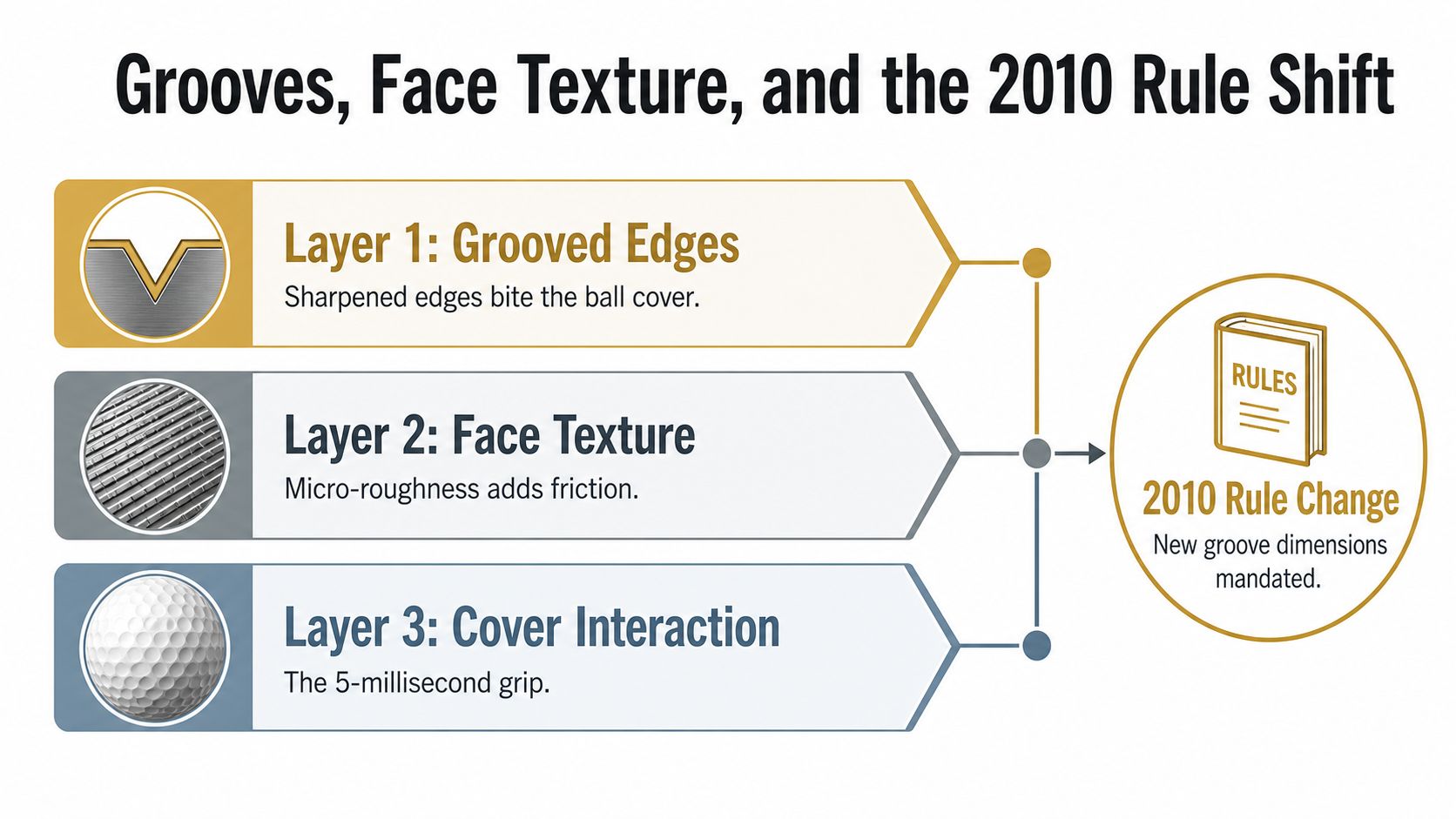
A wedge face has only a brief opportunity to grip the ball. During impact, the cover and face interact for roughly 5 milliseconds, so groove edges and surface texture must create friction immediately. Grooves help channel grass, moisture, and debris away from the contact area, while the areas between grooves provide additional face texture.
Three layers work together:
- Grooved edges can bite into the ball cover.
- Micro-texture adds friction between the larger grooves.
- Surface finish and plating help preserve the face's working edges.
The modern high-spin wedge era changed sharply with the groove rule announced by the USGA and R&A in 2008. The new limits applied to clubs manufactured after January 1, 2010, entered major professional competition in 2010, and reached top amateur events in 2014. The rule targeted groove edge sharpness and groove volume, reducing how aggressively a club could generate spin from the rough. Contemporary coverage of the groove-rule shift reported that the newer V-grooves could spin the ball as much as 50% less than the square-groove designs they replaced.
That change created the modern definition of high spin. Manufacturers had to maximize friction within tighter limits rather than sharpening grooves. Pre-2010 wedge heads are therefore often treated as a different performance category from conforming wedges sold after the rule change.
Conforming grooves can still produce plenty of spin when the golfer combines a clean strike, a downward delivery, and a ball cover that creates friction. The face also needs to be clean and dry. A groove design that looks aggressive won't compensate for grass, water, impact debris, or worn edges.
The practical point is easy to miss: groove design and groove condition are separate variables. A new wedge may have excellent geometry and texture, but the face gradually loses its original ability to grip. That makes maintenance part of spin fitting, not an afterthought.
Ball Choice and the Friction Behind Greenside Bite
A wedge face doesn't create spin alone. The ball cover deforms against the face, and the hardness and material of that cover influence how much friction survives impact. Polyurethane-covered balls generate greater backspin than ionomer-covered balls because the lower-hardness cover increases friction during the collision. Sports Engineering findings summarized in wedge research also show how cover material can matter more than cosmetic groove claims.
A controlled comparison produced 8,300 rpm with a premium urethane ball on a 75-yard wedge shot and 5,600 rpm with a Surlyn-covered two-piece ball under the same conditions. That difference was 2,700 rpm, enough to change how quickly the ball stops and how far it rolls after landing. The result doesn't mean every urethane ball will produce the same number, because construction, speed, loft, strike, and surface conditions still matter.
Cover material changes the shot
| Cover Material | Typical Spin (rpm) | Launch (deg) | Compression Feel | Wet-Weather Grip |
|---|---|---|---|---|
| Urethane | Higher wedge spin potential | Depends on delivery | Softer, more responsive | More friction potential when the face and ball are clean |
| Ionomer | Lower wedge spin potential | Depends on delivery | Firmer, more distance-oriented feel | More likely to slide when friction is limited |
The table describes performance tendencies rather than fixed specifications. A ball can spin on a full 56-degree wedge and still slide on a tight greenside chip because the low-speed impact may not deform the cover enough to create the same grip. Cold or wet conditions can widen that difference, especially when moisture remains between the face and ball.
A simple two-ball test
A useful practice test needs no swing change. Hit the same half-wedge with the current ball and a urethane-covered alternative, keeping the target, wedge, and setup constant. Record:
- Ball speed
- Launch angle
- Spin rate
- Landing angle
- Carry and rollout
Five shots with each ball can reveal whether the change improves stopping power or merely raises launch. If the urethane ball produces more spin but also creates a wide dispersion pattern, the golfer may need to investigate contact before changing equipment.
Contact Quality, Strike Location, and Wedge Technique
A high spin wedge can't rescue poor contact. The face may have fresh grooves and the ball may have a friction-friendly cover, but a thin, glancing, or heavily toe-side strike changes the collision before the monitor records the spin.
Strike location also matters because the clubhead's delivered loft, face curvature, and energy transfer change across the face. On a 56-degree wedge, a mishit roughly half an inch away from the preferred strike can cost around 500 to 1,500 rpm, depending on the direction and quality of the miss. Launch-monitor guidance on wedge strike and spin supports using strike pattern and delivery as the first diagnostic rather than assuming the wedge head is the problem.
Read the delivery, not just the result
Shaft lean, grip pressure, ball position, and face orientation combine to control dynamic loft and attack angle. A slightly forward shaft position with a slightly open face can help a golfer present the face cleanly, but the correct amount depends on the shot and turf. Excessive forward lean can reduce delivered loft and produce a low, running shot, while an early release can add loft and create a high flight without efficient friction.
A launch monitor helps separate these causes:
- Low spin with a shallow launch may point to a de-lofted face or poor friction.
- High launch with weak stopping power may indicate excessive spin loft and sliding contact.
- Spin loss with a glancing strike can reflect face-to-path problems or an open face at impact.
- Large spin variation usually deserves a strike-pattern check before a club change.
The guide to hitting a wedge gives the setup and motion context, but the monitor supplies the evidence for which adjustment works.
Run a three-shot setup test
Use the same wedge and ball for three groups:
- Stock setup: the golfer's normal ball position, shaft lean, and face.
- Ball forward: test whether added delivered loft improves launch and landing angle.
- Ball back: test whether contact becomes cleaner without creating excessive de-lofting.
The best group isn't necessarily the one with the highest rpm. Compare median spin, launch angle, landing angle, carry distance, and left-right dispersion. A repeatable 9,000-rpm shot that lands predictably can be more useful than an occasional higher reading surrounded by inconsistent contact.
Groove Wear and the Half-Life of High Spin
Many golfers treat high spin as a buying decision. The wedge has a fresh face, the grooves look sharp, and the club produces impressive numbers during the fitting. That performance doesn't remain fixed. Groove wear turns spin into a maintenance problem.
Independent testing cited by equipment coverage found a fresh wedge producing 8,500 rpm with 10 feet of rollout, while a wedge after 125 rounds produced about 6,500 rpm with 24 feet of rollout. The comparison shows why a wedge can remain playable while behaving very differently around the green. The groove-wear evidence and rollout comparison makes the practical cost of worn grooves clear.
A separate summary of the same issue indicates that roughly 75 rounds can already create a noticeable control drop, with worn wedges losing around 1,000 to 2,000 rpm and adding substantial rollout. Those figures shouldn't be treated as a universal replacement calendar. Practice volume, strike pattern, turf, sand, and cleaning habits all change the wear rate.
Track shots, not just months
Hot, dry conditions can harden turf and expose the face to abrasive contact. Range mats can transfer dirt and debris into the impact area, while bunker sand can round groove edges quickly. Storage conditions can also dull the face texture that supports friction between grooves, particularly when clubs remain dirty or damp.
A practical maintenance routine includes:
- Brush after practice: Remove grass, dirt, and sand before they dry into the grooves.
- Wash with warm soapy water: Use a soft brush to clean the face without damaging the finish.
- Inspect the groove edges: Look for visibly rounded edges, packed debris, or a face that feels smoother than expected.
- Track practice volume: A golfer who hits many wedge shots should inspect the face by shot count rather than waiting for a calendar date.
Fitting implication: A wedge bought for spin in March may not produce the same stopping pattern by August, especially when practice volume is high.
The monitor can confirm the change. Repeat the same half-wedge test with the same ball, target, and delivery. If launch and strike remain stable while spin and rollout change, face wear becomes a stronger suspect than technique.
Putting It Together to Control Wedge Spin
A wedge that produces the highest spin number during one session may still be the wrong choice for a golfer's scoring shots. Spin changes with loft, grooves, ball, strike, and wear, so control starts by isolating those inputs instead of chasing one impressive reading.
Start with ball choice and strike quality. A different cover can change face friction, while a centered strike may restore spin without changing the wedge. Then check whether the current loft and bounce suit the golfer's delivery. If the player repeatedly adds or removes loft to create a usable trajectory, the setup may not match the usual attack angle or turf interaction.
Use a controlled monitor sequence
A launch monitor can turn that diagnosis into a repeatable comparison without rebuilding the bag:
- Current ball: Hit five normal wedge shots and record spin, launch, landing angle, carry, and rollout.
- Premium urethane ball: Hit five shots with the same wedge and target.
- Compare the pattern: Review the typical result and consistency, not only the highest reading.
- Check strike: Use face-impact feedback if available, and remove obvious mishits from the equipment comparison.
- Judge the landing: Choose the setup that produces predictable stopping power and dispersion.
The gap-analysis guide can help identify overlapping wedge carry windows or an uncovered scoring distance. The goal is a usable distance system, not maximum spin on every shot.
Dialed Golf keeps records across its consumer app, desktop launch-monitor practice product, and Dialed Academy for range and club memberships. Its desktop workflow begins with a live pair for a supported launch monitor and includes CSV or import workflows from supported ecosystems. The consumer app is distributed through an in-app onboarding process, while desktop live-pair functionality is prioritized before mobile live pair.
Dialed Golf separates its offerings into two plans with transparent pricing. Golfer Pro costs $9.99 per week, $29.99 per month, $149.99 for 6 months, or $249.99 per year across app and desktop. Dialed Academy costs $99.99 per month or $999.99 per year, with the club keeping its dues. Free web tools remain free and are not a disguised Pro requirement.
High spin is therefore a managed input, not a maximum-score contest. The useful result is the shot that launches, lands, stops, and disperses predictably for that golfer. Recheck the pattern when the ball, strike, face condition, or delivery changes.
Track wedge spin with the ball, strike, landing angle, and rollout that matter on the course, then use Dialed Golf's consumer app and desktop launch-monitor workflows to organize the record over time. Visit Dialed Golf to explore its free tools, Pro options, and measured practice workflows.