


A fresh sleeve sits beside the range mat. The golfer chose it because the packaging promised soft feel and distance, then hit three acceptable drives before watching a wedge land near the flag and release well beyond it. The next ball feels different, the next swing produces a different curve, and the golfer leaves with no clear answer except that the recommendation seemed designed for somebody else.
That's the problem with shopping for the best golf balls for mid to high handicappers by handicap label alone. A handicap describes scoring performance, not the delivery conditions at impact. The useful question is whether a ball creates a tighter, more playable window for a particular golfer's speed, launch, spin, strike pattern, and short-game needs.
A ball comparison should therefore look less like a popularity list and more like a fitting screen. The most useful evidence comes from driver and iron carry, dispersion, peak height, wedge stopping behavior, and how consistently those numbers repeat.
| Construction | Driver distance at 93 mph | Short-game spin | Feel feedback | Durability | Best fit |
|---|---|---|---|---|---|
| Two-piece ionomer | Similar broad-category distance to other constructions in robot testing | Lower than urethane on partial wedges | Clear, often firmer feedback | Strong practical choice | Frequent losses, durability, reduced curve sensitivity |
| Three-piece mid-cover | Broadly similar to two-piece results at the same test speed | Middle ground, model dependent | Balanced feedback | Moderate to strong | Golfers wanting a bridge between value and control |
| Multilayer urethane | No measured driver advantage over non-urethane balls in cited testing | Higher short-game spin | Softer, more responsive feedback | More vulnerable to cover damage | Approach stopping power and greenside control |
Table of Contents
- Why the Usual Ball Recommendations Miss Mid and High Handicappers
- What Mid and High Handicap Swings Actually Deliver to the Ball
- The Five Performance Categories That Matter
- Comparing Ball Types by Construction and Cover
- Matching Ball Choices to Real Scoring Problems
- A Launch Monitor Protocol for Picking Your Own Ball
- Durability, Cost per Round, and When to Retire a Ball
- Situational Picks and the Tightest-Window Argument
Why the Usual Ball Recommendations Miss Mid and High Handicappers
The golfer in that range session hasn't made an irrational choice. Soft feel is easy to notice. A distance label is easy to understand. A handicap category gives the recommendation a reassuring sense of precision. None of those signals reveals whether the ball launches high enough with a 7-iron, keeps driver dispersion manageable, or stops predictably from a partial wedge.
A label can't describe an impact pattern
Two golfers can share a handicap and deliver very different shots. One may create too much driver spin and lose carry through a ballooning flight. Another may launch the driver acceptably but strike irons low on the face, producing inconsistent launch and carry. A third may hit reasonable full shots but struggle to stop pitches and chips.
The USGA's launch-condition research found that launch angle and spin were statistically significant predictors of handicap, while the spin coefficient remained consistently small for both male and female golfers in its analysis of golfers at different skill levels. That finding doesn't mean higher spin automatically lowers scores. It means the complete launch window deserves attention, especially when impact conditions change from shot to shot.
Practical rule: A ball that repeats a usable trajectory can be more valuable than one that produces a spectacular result on a single centered strike.
The shopping question is usually backward
Label-first shopping asks whether a ball is soft, long, tour-style, or forgiving. Measurement-first fitting asks what happens with the golfer's driver, longest reliable approach club, 7-iron, partial wedge, and pitch. The second approach is fairer because it tests the ball against the golfer's actual delivery rather than against a category built for a broad audience.
A handicap still provides context, but it shouldn't make the decision. Golfers who want a clearer picture of what their score reflects can use Dialed Golf's handicap calculation guide, then treat that number as a starting point rather than a ball specification. The decisive evidence is the pattern on the launch monitor and the course.
What Mid and High Handicap Swings Actually Deliver to the Ball
A mid or high handicap player can hit two drives that finish near each other and still deliver the club very differently. One strike comes from the center with manageable spin. The next catches the low heel, launches flatter, spins more, and flies on a different curve. That is why ball selection starts with what the swing delivers at impact, not with a label on the box.
Start with the delivery before considering compression
For moderate-speed players, small impact changes tend to matter more than category labels. The ball reacts to club speed, strike location, launch, spin, and face-to-path conditions together, and those inputs often vary enough from swing to swing that a single average carry number hides the underlying fitting problem. The better question is how wide the launch, spin, and carry window becomes with each model. For context on how club speed translates to distance, see Dialed Golf's driver ball speed chart.
Compression still matters, but mainly as one part of the collision. Feel changes with compression and deformation, while the core, mantle, cover, and dimples also influence speed, launch, drag, spin, and stopping behavior. A low-compression ball does not automatically reduce curvature, and a multilayer ball does not automatically ask for a better player.
The equipment story supports that view. The USGA describes the shift from higher-spin wound designs to lower-spin multilayer solid constructions in the early 2000s, a change associated with longer driving among elite players in its history of equipment rules. Modern balls are built around tradeoffs, especially the balance between lower driver spin and more responsive short-game control.
Why 93 mph is a more honest baseline
Tour-speed testing can flatten differences that become clearer at everyday delivery speeds. An independent robot test measured 2,232 shots across driver speeds of 114, 93, and 84 mph, plus 7-iron and 40-yard wedge shots in its full 2025 results. The 93 mph setting was used as a typical male club-golfer speed, and 84 mph as a typical female club-golfer speed.
At 93 mph, two-piece balls averaged about 141 mph ball speed, 12° launch, 2,730 rpm backspin, and 227 yards of carry. Three-piece club balls averaged about 142 mph, 12° launch, 2,731 rpm, and 228 yards in the same test. Those are small gaps. For a player who misses center often, they are usually less important than whether one ball holds a tighter spin band and more consistent front-to-back carry.
That makes 93 mph useful as a reference point, not a prediction. The fitter's job is to check whether your own ball speed, launch, spin, and dispersion create usable gapping on your launch monitor, then choose the ball that repeats the narrowest scoring window.
The Five Performance Categories That Matter
A ball fitting for this player group works best when it starts with shot windows, not shelf labels. Mid and high handicappers gain more from shrinking front-to-back carry spread, tightening left-right misses, and protecting wedge gapping than from chasing the single longest drive or the softest feel.
Distance means repeatable carry
Distance is useful only when it repeats. Median carry is a better screening number than a ball's occasional longest shot because it reflects the center of the pattern you can plan around. Then the launch monitor needs one more layer. Dispersion. If one model flies a touch shorter but lands in a tighter band, it often leaves more predictable approach yardages and fewer awkward half-swings.
That matters more than peak output.
Launch defines the playable window
Launch is the start of the whole flight window. It influences peak height, carry, descent, and how much the ball releases after landing. For a player whose irons launch too low, the practical question is whether a different ball helps produce a flight that can hold greens often enough to matter. For a player who launches the driver high with too much spin, the better fit may be the ball that keeps the flight from climbing into a less efficient pattern.
The key is repeatability from the same club and similar strike quality, not a one-shot highlight.
Spin has two jobs
Spin needs to be split into long-game spin and scoring-shot spin. They solve different problems. Driver spin affects flight efficiency and curvature management. Wedge spin affects how often a ball lands, checks, and finishes inside a usable leave instead of releasing past the hole or off the green.
That is why cover material can separate models more clearly on short shots than on full drives. In the Golf Digest robot testing cited earlier, non-urethane balls spun materially less than urethane balls on partial wedges, with visibly different rollout behavior in its ball-testing process. For many mid and high handicappers, that changes scoring more than a marginal driver gain because partial wedges and chips expose poor distance control quickly.
Feel as feedback
Feel still matters. It influences confidence on the greens and how clearly a player senses strike quality on short shots. But feel works best as feedback layered on top of launch, spin, and dispersion results. If a ball feels good yet produces inconsistent rollout or unstable carry gaps, the monitor has already identified the larger problem.
Durability means trusted performance
Durability is about flight staying reliable after normal play. Cover scuffs, small cuts, and damaged dimples can change how the ball launches, spins, or curves, even when the paint still looks acceptable. A durable ball is one you would keep in play without wondering whether the next wedge or tee shot will fly differently.
Comparing Ball Types by Construction and Cover
Ball construction matters most when it changes launch windows you can measure and rollout patterns you have to predict. For mid and high handicappers, that usually means treating the choice as a dispersion and gapping decision first, then using feel as a tiebreaker.
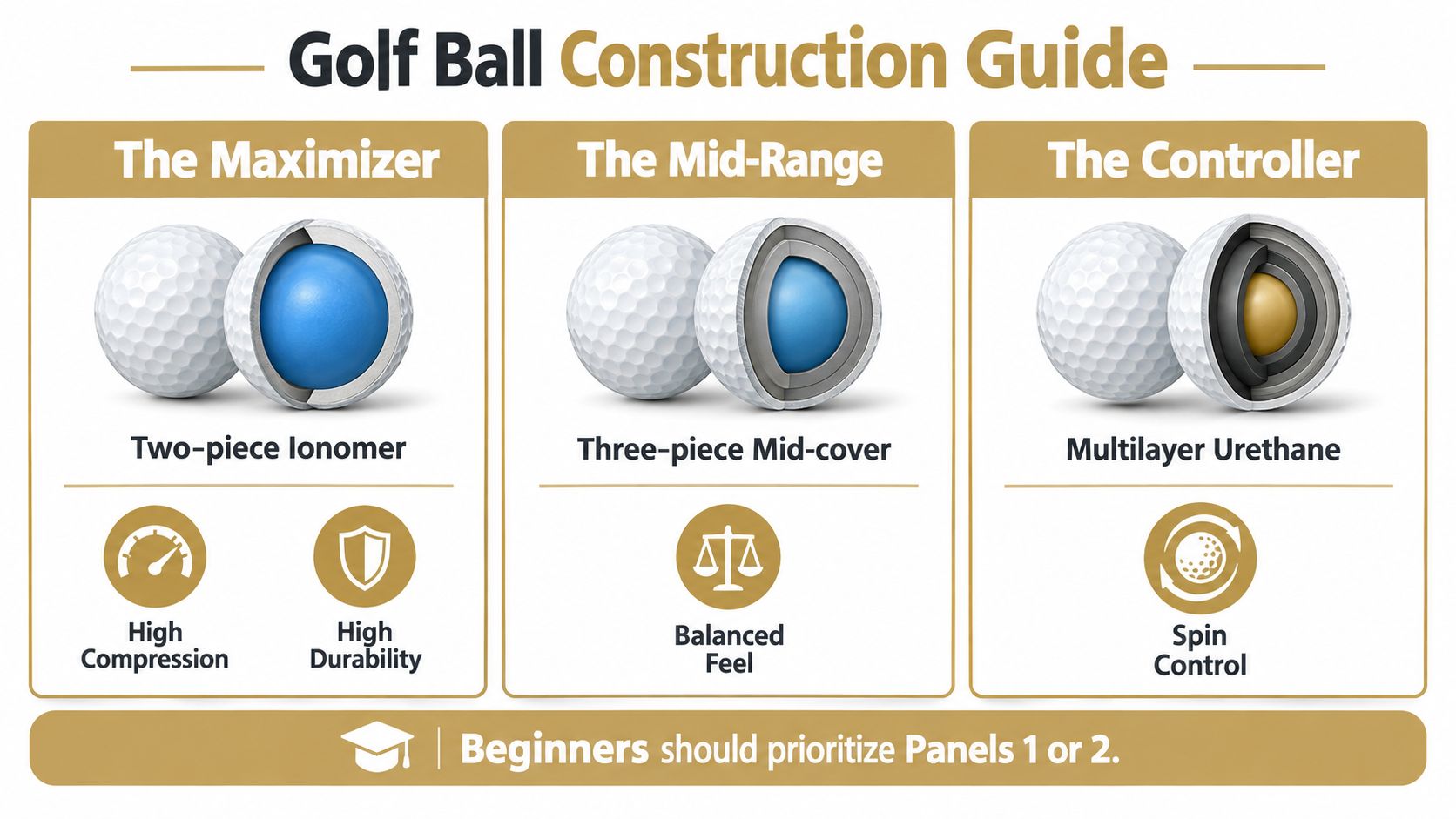
Two-piece ionomer
A two-piece ionomer ball uses the simplest core-and-cover build of the three categories. That tends to fit golfers whose scores are still heavily affected by lost balls, cover damage, or tee shots that need a straighter, lower-spin profile more than extra check on short shots.
The trade-off shows up once the club slows down and loft increases. As noted earlier, non-urethane covers generally produce less partial-wedge spin and more release than urethane models. For a player who already struggles to control carry numbers, that can widen the finish window even if the full-shot launch monitor numbers look acceptable.
Three-piece mid-cover
A three-piece mid-cover ball sits in the middle, but that label only helps if the monitor confirms a real middle result. Some players see a steadier blend of driver spin, iron peak height, and short-game response. Others get numbers that look almost identical to a two-piece option on full shots, with only a modest short-game change.
That is why this category should not be treated as an automatic upgrade. Its value is in reducing extremes. If a two-piece ball releases too much on pitches and a urethane ball adds cost or cover wear without tightening dispersion enough, a mid-cover model can give a more usable carry-to-release pattern.
Multilayer urethane
A multilayer urethane ball is the clearest control play, especially for golfers trying to tighten landing behavior from scoring distances. The construction can increase wedge spin and improve stopping power, but the earlier robot comparisons did not show a built-in driver distance gain for well-struck shots. That changes the buying logic. The question is not whether urethane sounds premium. The question is whether it narrows your short-game finish pattern enough to save strokes.
A simple comparison makes the categories more useful than another broad construction table:
| Construction | Main measurable advantage | Main measurable risk | Best use case |
|---|---|---|---|
| Two-piece ionomer | Stable long-game value, durable cover | More release on pitches and chips | Golfers losing balls often or prioritizing tee-shot management |
| Three-piece mid-cover | More balanced flight and greenside response | Can overlap heavily with two-piece results | Golfers trying to smooth out both long-game and short-game extremes |
| Multilayer urethane | More stopping control on scoring shots | Higher cost and more cover sensitivity | Golfers whose scoring leak is rollout, not raw distance |
The practical separator is usually the wedge window, not the driver headline. The independent test set cited earlier showed that relatively few balls cleared 6,000 rpm on a 40-yard pitch, which is why cover choice should be judged by launch monitor gaps and on-course rollout, not by category labels alone.
Matching Ball Choices to Real Scoring Problems
A mid-handicap index can describe two players with completely different score losses. One sprays tee shots wide enough to force punch-outs. Another hits plenty of fairways, then gives away shots because partial wedges land and release past the useful leave. Ball choice works better when you treat it as a dispersion and gapping decision tied to the miss that costs the most.
The large-curvature player
If the scorecard is being wrecked by tee shots that finish in rough, trees, or penalty areas, the first job is to shrink the playable miss. A lower-spin, durable construction can make sense here, especially if the golfer also loses enough balls for replacement cost to matter. The trade is on the scoring side of the bag. Less cover friction usually means more release on pitches and chips, so the player should test whether that rollout pattern stays predictable on the greens they play regularly.
The straight hitter with weak stopping control
Some golfers already keep the driver in a usable window. Their expensive mistake happens later, when an approach lands on line but releases through the back portion of the green, or a pitch carries the front and never checks. For that player, a urethane-cover model is worth testing as a short-game control decision. As noted earlier, the robot comparison cited previously did not show a well-struck urethane distance gain off the driver, so the case for paying more usually starts with landing behavior and rollout consistency.
The low-launching iron player
This player should measure launch, peak height, and left-right spread before deciding that a ball feels better. A slightly higher iron window can help if it produces more reliable carry and a more usable descent pattern into greens. That only counts if dispersion stays tight enough to hold the target.
The frequent ball loser
Cost per round can outweigh premium greenside performance. An ionomer ball is often the sensible play when balls disappear regularly, provided the golfer can still manage wedge rollout and keep directional spread within a scoring range.
The right ball is the one that improves the golfer's most expensive miss.
A Launch Monitor Protocol for Picking Your Own Ball
You hit two balls that both feel fine, but one leaves you a 15-foot putt and the other leaves a short-sided chip. For mid and high handicappers, that difference usually starts with dispersion, carry repeatability, and rollout pattern, not with a label such as soft or distance. A personal launch monitor helps turn that into a measurable test.
Set up a controlled comparison
Use any personal launch monitor that reports carry, launch, spin, and dispersion. Warm up first, then test one ball model at a time with the same clubs, the same target line, and the same session conditions.
Use this club sequence:
- Driver: Record carry, total distance, launch, spin, and dispersion.
- Longest reliable approach club: Check whether the ball launches and carries consistently enough to hold the golfer's normal approach gap.
- 7-iron: Record median carry, peak height, and left-right dispersion.
- Partial wedge: Measure carry and spin consistency, not the single shot that grabs the most.
- Greenside pitch: Watch carry-to-roll behavior and directional spread.
Ten shots with each club is a practical minimum for a solo session. Mishits should be tagged, not hidden, because a ball that widens the playable pattern on average is still a problem even if its best strike looks good. The useful comparison is median carry, dispersion width, peak height, and stopping behavior. One long driver ball does not solve a scoring problem if it also creates larger misses or uneven gapping.
Log the session, then make the decision
A desktop launch-monitor app can pair with supported hardware or import CSV data from compatible systems. Dialed Golf's desktop product is built around launch-monitor practice, with live pairing for supported devices and CSV import workflows for other compatible setups. Its consumer app is available through TestFlight rather than general App Store availability, so the live-pair workflow is desktop-first.
Save each session under the ball model, then compare the center of the pattern rather than the longest result. The best switch is usually the ball that tightens the playable window or makes wedge rollout more predictable without creating a worse long-game shape. That is a fitter's view of ball testing. You are not shopping by handicap category. You are checking whether one model gives you more makeable next shots.
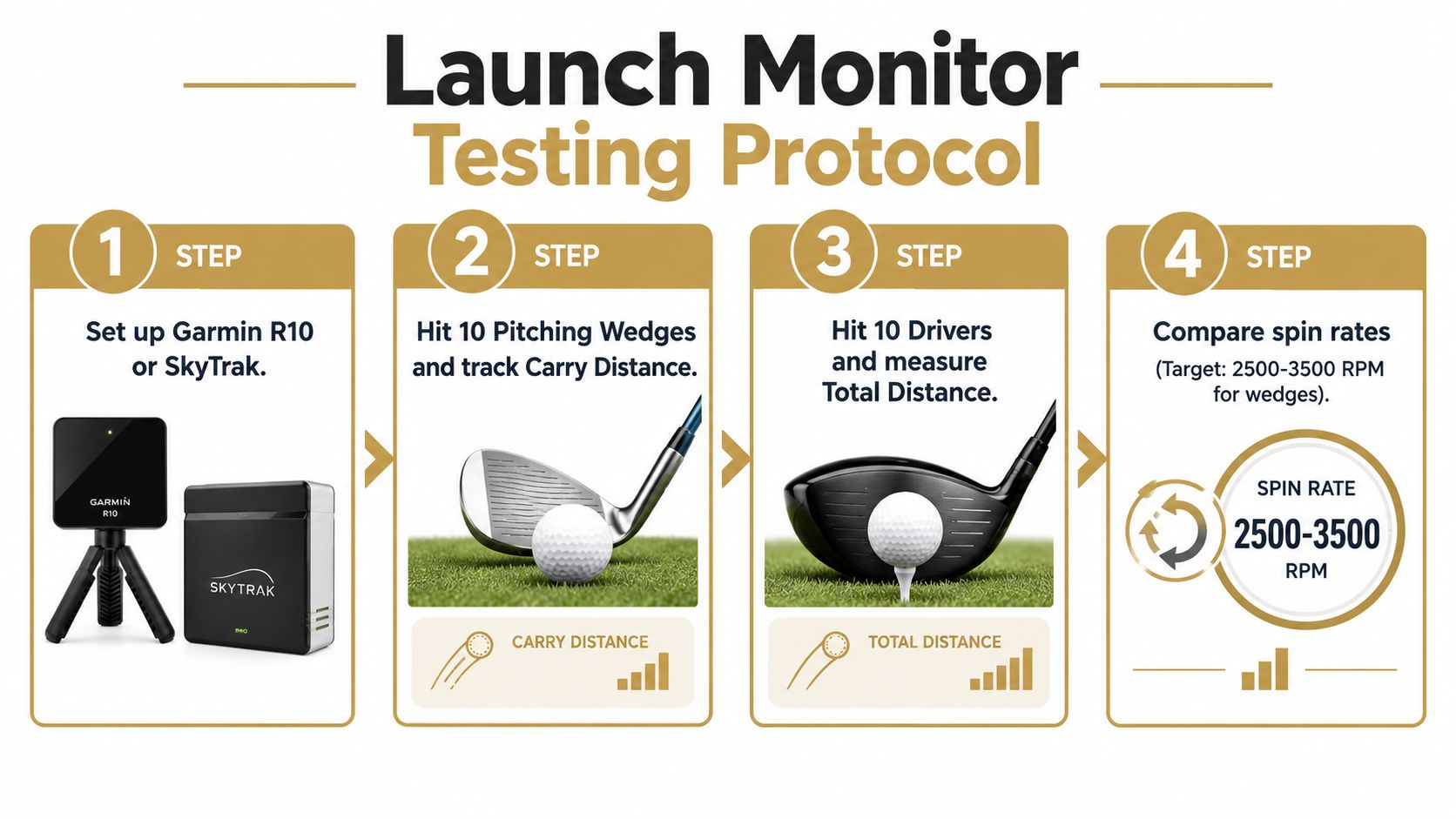
A visual process helps golfers repeat the same test instead of changing variables between sessions.
For golfers who want to connect ball testing with club-distance relationships, a structured gap analysis process helps turn the session into a usable on-course plan.
Durability, Cost per Round, and When to Retire a Ball
Durability is a performance question before it becomes an appearance question. A ball with a cut, deep wedge mark, or damaged dimples can alter spin and directional flight, especially when the surface damage is asymmetric. A golfer may not notice the cause, only that the ball starts pulling or curving differently.
Use a performance-based retirement rule
Remove a ball from play when it has a structural cut, visibly damaged dimples, or a deep impact mark that can affect the cover. Paint wear alone doesn't prove that the ball has failed. If a used ball looks acceptable but starts producing an unusual side-pull, compare it with a new ball using repeated short-iron and wedge shots.
The practical decision is simple: trust the flight, not the whiteness. A durable ionomer ball can be economically useful for a golfer who loses balls often, while a urethane ball can justify replacement when stopping performance matters more than surviving every encounter with a bunker or cart path.
Calculate value without inventing certainty
The basic calculation is:
cost per round = balls purchased and lost or retired during the round multiplied by cost per ball
That calculation should include replacement caused by loss and damage, not just the retail price of a sleeve. A premium ball that survives the full round but fails to stop approaches may cost less in purchases and more in scoring opportunities. A lower-priced ball that disappears frequently may still be the better value if it keeps the golfer's total replacement burden manageable and produces acceptable dispersion.
The best economic choice is therefore conditional. Frequent-loss golfers should test durable, replacement-friendly constructions, then verify wedge behavior. Golfers who keep a ball in play and need reliable approach stopping can reasonably accept greater cover sensitivity.
Situational Picks and the Tightest-Window Argument
Three choices cover most mid and high handicap situations. The budget first-pick is a durable two-piece ionomer ball for golfers whose priority is keeping replacement simple and long-game misses manageable. The control pick is multilayer urethane for golfers who already produce a reasonably playable tee-shot pattern and need more predictable wedge stopping.
The fitting pick is whichever construction produces the narrowest useful pattern in the launch-monitor protocol. That may be a three-piece mid-cover ball, a durable two-piece model, or urethane. The answer can change when the golfer's speed, strike, or scoring pattern changes.
A robot test can identify broad construction differences, but it can't decide whether a particular golfer's dispersion is playable. The golfer's own median carry, peak height, wedge rollout, and directional width should outrank a single long drive or a soft-feel label.
The best ball isn't the longest ball on the screen. It's the ball that creates the tightest playable window under the golfer's actual swing.
Dialed Golf lets golfers keep one golfer record across a pocket caddy app and desktop launch-monitor practice, with ball-testing data that can be logged and revisited rather than forgotten after a range session. Visit Dialed Golf to explore the free web tools and the Golfer Pro plan, then use the same measurement-first process to choose a ball with evidence instead of packaging language.