

A launch monitor flashes 102 mph of club head speed and 151 mph of ball speed after a flushed drive. The golfer smiles, then checks the previous session. Last week, the monitor showed 105 mph and only 148 mph, yet the carry was longer. Which swing was better?
That question sits at the center of ball speed vs club head speed. Club head speed describes the speed delivered to the ball. Ball speed shows how much of that speed survived the collision and traveled away from the face. The difference is speed conversion, and it often matters more than chasing another few miles per hour on the swing.
This distinction becomes especially important for golfers practicing with personal launch monitors. A useful launch-monitor practice workflow should help separate speed gains from strike gains, because the number that swings isn't always the number that predicts the shot.
Table of Contents
- Two Numbers on the Screen You Keep Comparing
- What Club Head Speed and Ball Speed Actually Measure
- Smash Factor and the Speed Conversion Equation
- Typical Ratios by Club and Swing Speed
- Why More Swing Speed Stops Paying Off
- Reading a Launch Monitor Session for Both Metrics
- Decide Whether to Chase CHS or Strike Quality
- A One-Month Plan Using Dialed Golf to Track Both
Two Numbers on the Screen You Keep Comparing
Club head speed and ball speed look like neighboring figures, but they answer different questions. Club head speed asks, “How fast was the club moving before impact?” Ball speed asks, “How effectively did the collision send the ball away?”
That distinction explains why the 102 mph swing with 151 mph ball speed can outperform the 105 mph swing with 148 mph ball speed. The second swing delivered more club speed, but the first converted more of it into ball speed. The golfer didn't necessarily need to swing harder. The golfer needed the face to meet the ball more effectively.
Practical rule: Club head speed is the input. Ball speed is the usable output.
A centered strike, appropriate face delivery, and stable impact conditions can turn a moderate swing into a fast ball. A rushed delivery or poor contact can waste speed before the ball leaves the face. Two swings with identical club head speed can therefore produce noticeably different ball speeds, launch conditions, and carries.
Speed that swings versus speed that travels
Club head speed is a movement metric. It tells a coach how quickly the clubhead is moving immediately before impact, but it doesn't reveal whether the ball was struck in the most effective part of the face.
Ball speed is an outcome metric. It incorporates the collision, including how the club and ball interacted at impact. That makes it the more useful number for asking whether a change produced a better shot, although it still needs to be read alongside strike and flight data.
The practical choice for the next month of practice is simple. If club head speed rises while ball speed stays flat, the player has probably improved the input without improving conversion. If ball speed rises at similar club head speed, the player has found a more valuable performance change.
What Club Head Speed and Ball Speed Actually Measure
A launch monitor doesn't measure both speeds at the same location or from the same object. That matters because a direct subtraction, such as ball speed minus club head speed, doesn't describe impact quality in a useful way.
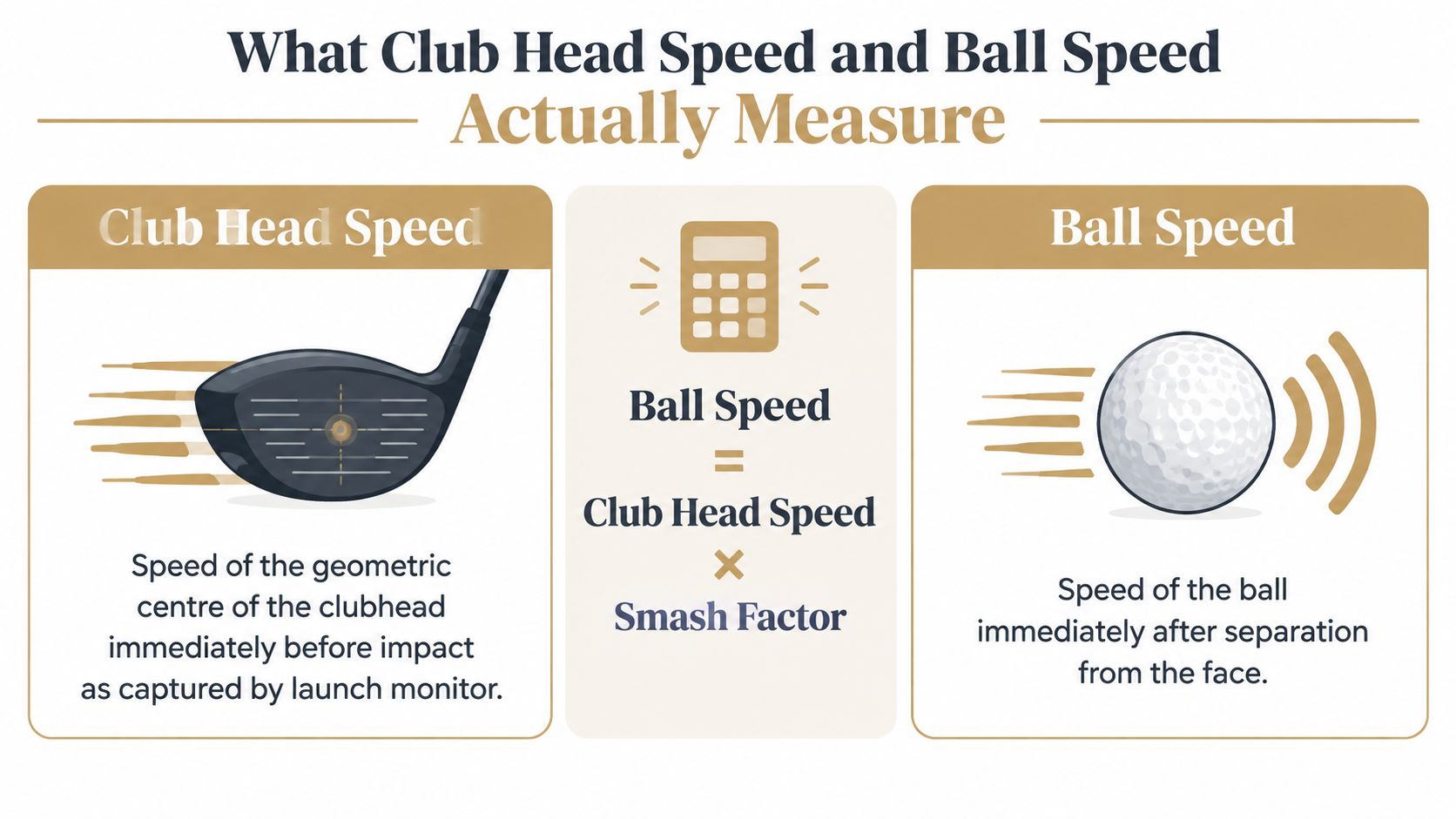
Club head speed is defined as the speed of the club's geometric centre immediately before impact. Ball speed is the speed of the ball's centre of gravity immediately after separation from the face. A TrackMan-based reliability study describes those measurement definitions and also identifies club head speed and ball speed as among the more reliable launch-monitor metrics, while warning that smash factor requires more caution because it's a ratio of two measurements. The published TrackMan measurement research2138-2143_Trackman%204.pdf) is useful context for interpreting session noise.
Why the measurement point changes the coaching question
A thin strike can occur during a fast swing. The monitor may record strong club head speed even though the ball leaves the face with disappointing speed. A more controlled swing can produce slightly less club speed but better contact and a faster ball.
Launch monitors may use radar, photometric tracking, or a combination of measurement methods, and each system interprets the club and ball at different moments around impact. That doesn't make the metrics useless. It means the player should compare like with like, using the same setup and a repeatable shot pattern.
The relationship becomes useful only when the two measurements are linked by a ratio. That ratio is smash factor, which turns separate speed readings into a practical view of speed conversion.
The video below provides another visual explanation of how the two metrics relate during impact.
Smash Factor and the Speed Conversion Equation
Smash factor equals ball speed divided by club head speed. It isn't a separate type of speed. It's a conversion ratio that shows how much ball speed came from the delivered club speed.
The equation is straightforward:
Smash factor = ball speed ÷ club head speed
A driver traveling at 100 mph and producing 149 mph of ball speed has a smash factor of 1.49. TrackMan reports driver smash factor at 1.49 for PGA Tour players, 1.49 for LPGA Tour players, and around 1.44 for average golfers, while a practical driver ceiling is commonly described as 1.50 in this smash factor reference. Another launch-monitor explanation of smash factor places elite driver strikes near 1.49 to 1.50 and amateur driver averages around 1.42.
| Player Tier | Typical Smash Factor | What the Same Number Can Hide |
|---|---|---|
| Elite driver player | Around 1.49 to 1.50 | Strong collision efficiency, but not necessarily identical strike location |
| Average golfer | Around 1.42 to 1.44 | Variable contact, delivery, and face interaction |
| Developing player | Often below the average range | Speed loss from inconsistent contact and impact conditions |
Why the ratio is diagnostic, not definitive
Smash factor reflects the result of the collision, but it doesn't identify every reason behind that result. A player can post the same ratio from a centered strike or from a different face location with altered gear effect. The number can also look respectable on a shot where launch, spin, or direction makes the ball unusable.
The ratio is still valuable. If club head speed remains stable while smash factor improves, ball speed should improve with it. If smash factor falls during a speed session, the player may be swinging beyond the current ability to control strike and delivery.
The legal performance limits of the club and ball constrain the ratio, which is why elite driver values cluster close to the upper boundary. That ceiling changes the coaching priority. A player already near the ceiling has less to gain from squeezing the ratio and more to gain from launch, spin, face delivery, or added club speed.
Smash factor also changes with club design, loft, shaft length, and swing speed. A driver ratio shouldn't be used as the standard for a seven-iron or pitching wedge.
Typical Ratios by Club and Swing Speed
Club comparisons require care. A driver has a different loft, shaft length, and face interaction from a seven-iron, so the same club head speed won't produce the same smash factor across the bag.
The supplied Dialed Golf session profile is intended as a calibration framework rather than a universal promise. It places driver efficiency around 1.45 to 1.50 for elite players and 1.40 to 1.45 for amateurs, while seven-iron smash factors generally compress into a lower band because loft and strike location affect the collision more strongly.
| Driver CHS Bucket | Driver Ball Speed / Smash | 3-Wood Ball Speed / Smash | 7-Iron Ball Speed / Smash | PW Ball Speed / Smash |
|---|---|---|---|---|
| 75 mph | Calibrate from session | Calibrate from session | Calibrate from session | Calibrate from session |
| 90 mph | Calibrate from session | Calibrate from session | Calibrate from session | Calibrate from session |
| 105 mph | Calibrate from session | Calibrate from session | Calibrate from session | Calibrate from session |
| 120 mph | Calibrate from session | Calibrate from session | Calibrate from session | Calibrate from session |
The table deliberately avoids pretending that one fixed ball-speed output applies to every golfer. The correct use is to record the player's own median values at each speed bucket, then compare later sessions against that baseline. A driver ball speed chart can help organize that comparison, but the player's repeatable data remains more useful than a generic target.
The seven-iron contact cliff
A seven-iron exposes contact problems quickly. A player can make what feels like the same 90 mph swing and receive very different ball speeds depending on whether impact occurs near the intended strike location, toward the heel or toe, high or low, or thin across the face.
That spread is the contact cliff. The golfer may believe the problem is insufficient speed, when the larger issue is that the collision isn't repeatable. A club-by-club profile helps reveal whether the weakness follows the swing or the club.
The calibration process should record club head speed, ball speed, smash factor, and strike location. Once the player knows the normal relationship for each club, an unusual number becomes a clue instead of a verdict.
Why More Swing Speed Stops Paying Off
“Just swing faster” is incomplete advice. More club head speed can create more potential, but the ball doesn't receive every additional mile per hour with perfect efficiency.
The R&A explains that coefficient of restitution declines as impact speed rises, while aerodynamic drag increases with the square of ball speed. In practical terms, higher speed can produce diminishing returns, particularly near the upper end of driver performance. The R&A equipment-distance research explains why ball speed and total distance don't scale perfectly in a straight line.
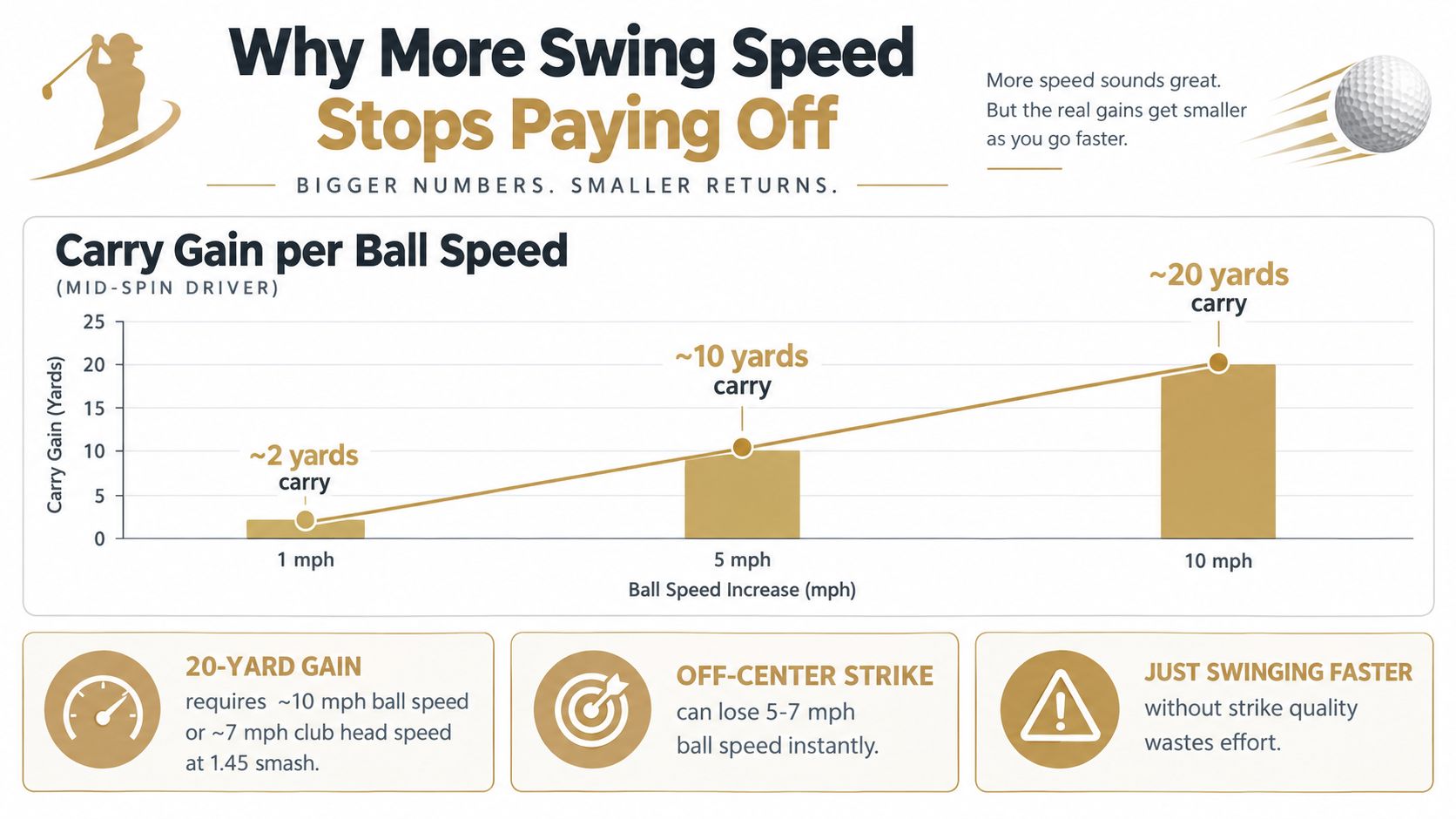
A useful practical relationship is that an additional 1 mph of ball speed can produce about 2 yards of driver carry, depending on launch and spin conditions. The same coaching analysis notes that a 20-yard driver gain typically requires about 7 mph more club head speed when other variables stay constant, as documented in this club head speed analysis.
The trade-off behind the speed chase
That calculation doesn't mean every golfer should pursue seven more miles per hour immediately. A speed increase that damages strike quality can reduce ball speed, widen dispersion, and make the player's playable driving distance worse.
The better sequence is to test conversion first. If a player swings at 100 mph but converts inconsistently, a centered strike may produce more useful ball speed than a faster swing with contact scattered across the face. The player should then add speed only when the faster motion preserves the collision.
A faster swing is valuable only when the ball can keep the speed.
The distance question therefore changes from “How fast can the golfer swing?” to “How much of that swing speed becomes ball speed under repeatable conditions?” That wording keeps speed training, strike practice, and delivery work in the same conversation.
Reading a Launch Monitor Session for Both Metrics
A useful session begins with a defined sample, not a single exciting shot. Ten stock swings provide a workable starting point for reviewing the relationship between club head speed and ball speed, provided the golfer doesn't mix warm-up swings, maximum-effort swings, and obvious mishits into one comparison.
The primary line items are:
- Club head speed: Treat it as the speed input immediately before impact.
- Ball speed: Treat it as the main outcome to monitor across comparable swings.
- Smash factor: Use it to diagnose conversion, not as a standalone score.
- Spin and launch: Keep them available because they influence how ball speed becomes carry.
- Strike location: Use contact information to explain why two similar swings produced different outputs.
Finding a suspicious shot
A ball-speed outlier deserves investigation when its smash factor sits more than two points outside the session median, according to the supplied practice framework. That outlier might reflect face-to-path, contact depth, strike location, or shaft delivery rather than a genuine change in athletic output.
The ratio itself also contains noise. A 2024 indoor reliability study cautions that ratio data can complicate change tracking over time, even when the component measures are relatively reliable. Ball speed is therefore the steadier outcome KPI, while smash factor helps explain the reason behind a change.
For practical logging, a golfer should save:
- The session date and club
- The shot intention and effort level
- Club head speed and ball speed
- Smash factor, launch, and spin
- Strike location and obvious contact notes
- The median and spread of the comparable shots
If standard deviation across ten stock swings exceeds 2.5 mph of ball speed, the supplied framework recommends collecting a larger sample before drawing conclusions. CSV import for launch-monitor practice data can make that longer-term record easier to maintain across sessions.
The trend matters more than the best swing. A player who saves only the fastest shot can't tell whether ball speed improved, whether contact became more stable, or whether the monitor captured a favorable outlier.
Decide Whether to Chase CHS or Strike Quality
The right priority depends on the player's current conversion pattern. Club head speed matters, but its value increases when the player turns it into repeatable ball speed instead of merely producing a larger number on the screen.
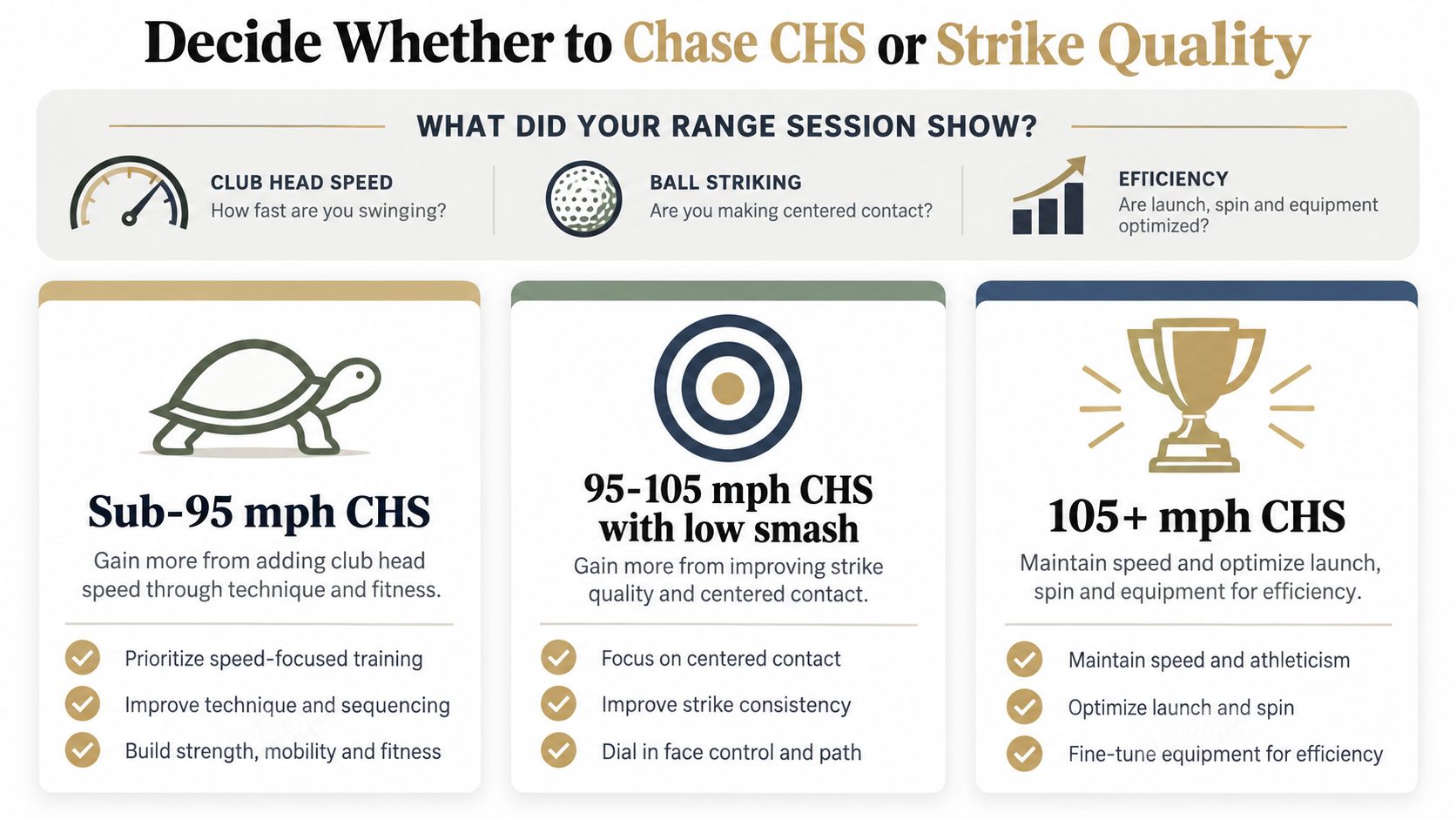
The supplied Dialed Golf averages create three practical profiles:
Sub-95 mph club head speed
Players below 95 mph who also sit under 1.42 smash factor usually have more immediate opportunity in strike and delivery than in chasing raw speed. A better contact pattern can raise ball speed without requiring a more violent motion.
95 to 105 mph with inconsistent conversion
This is the gray zone. Players in the 1.45 to 1.48 conversion band may have enough speed already for meaningful gains from small strike improvements. A better face contact pattern can create the next 8 to 12 mph of ball speed when the underlying club head speed is already present, as described in the supplied Dialed Golf session framework.
110 mph and above
Players at 110 mph or more who already approach the 1.50 smash factor ceiling have less room to gain through collision efficiency. Their next improvements are more likely to involve face-to-path, launch, spin, and equipment optimization, while preserving the speed they already create.
The following checklist keeps the decision tied to the last ten comparable shots:
- Ball speed variance: Is it under 2 mph?
- Smash factor variance: Is it under 0.015?
- Mishit cost: Are poor strikes costing more than 5 mph of ball speed?
- Speed trend: Is club head speed still moving upward across the month?
If ball speed is flat and smash factor is inconsistent, strike quality deserves the next block of practice. If strike metrics have plateaued and ball speed remains stable, club head speed work becomes a more logical choice. If both are unstable, the player shouldn't chase either number at maximum effort. The first task is to make the test repeatable.
That triage avoids a common mistake. A golfer sees a low club head speed and assumes speed training is the answer, even though the loss occurs at impact. The monitor should identify the bottleneck, not encourage the player to pursue whichever number looks most impressive.
A One-Month Plan Using Dialed Golf to Track Both
A four-week plan works best when each week isolates a different variable. The player doesn't need every dashboard metric after every swing. The player needs a consistent record that shows whether club head speed, ball speed, or conversion changed.
Week 1 establishes the baseline. The golfer hits 20 drives and 15 seven-iron shots, then records club head speed, ball speed, smash factor, and strike location. Every shot receives a contact tag such as center, heel, toe, high, low, or thin. The purpose is to identify the normal relationship before training changes the swing.
Week 2 emphasizes strike. Half-set swings and a headcover placed six inches behind the ball can encourage a more controlled delivery, but the tracking rule stays narrow. The golfer logs only shots that land in the intended center stripe, then compares the clean-contact smash factor with the broader Week 1 sample.
Week 3 adds speed. Overspeed swings with a lighter shaft or a structured speed block can test whether club head speed rises without damaging contact. The key comparison is ball speed at an equal smash factor against the Week 1 baseline. That prevents a faster but less efficient swing from being labeled an improvement.
Week 4 reviews the evidence. The golfer identifies which variable moved ball speed most clearly, then writes one coaching note into the session history. The note should be specific, such as “center contact held during faster swings,” or “speed rose, but heel strikes reduced ball speed.”
A month of tracking should leave the golfer with a clearer answer about whether the ceiling is speed-limited or strike-limited. The supplied framework describes a possible scoreboard of 2 to 4 mph more ball speed and 0.01 to 0.02 higher smash factor, but those figures aren't guaranteed outcomes and shouldn't replace the player's own baseline.
The product setup supports this kind of record without requiring the golfer to treat one metric as the entire practice objective. Dialed Golf combines a consumer app for on-course use, a desktop launch-monitor practice workflow with live pairing first and expanding device support, and Dialed Academy memberships and front-desk tools for ranges and clubs. Free web tools remain free, while Golfer Pro is available across the app and desktop at $9.99 per week, $29.99 per month, $149.99 for six months, or $249.99 per year. Academy pricing is $99.99 per month or $999.99 per year, with the club keeping its dues.
The useful scoreboard is ball speed first, smash factor second, and club head speed in context. A golfer who tracks all three can see whether the next breakthrough requires a faster swing, a better strike, or a better match between the two.
Start the next practice block by recording comparable shots, tagging strike location, and reviewing ball speed alongside club head speed instead of chasing smash factor alone. Dialed Golf brings launch-monitor practice records and on-course tools into one golfer record, so visit Dialed Golf and use the next month of data to identify whether speed conversion or raw speed is holding the game back.