

A player stands over a 142-yard approach with a slight breeze in the face. The rangefinder says 142, but that number doesn't answer the question. An 8-iron might reach it, a 9-iron might fly more comfortably, and a pitching wedge could work with a smooth swing. The player changes clubs twice, rehearses three swings, and watches the group behind begin to wait.
The problem isn't a lack of equipment. It's the absence of a personal yardage window for today's lie, wind, and temperature. The player knows the distance to a flat pin, but doesn't know how each club behaves around that number. That gap between measured distance and trusted carry is where club caddy golf becomes useful.
A modern club caddy turns launch-monitor practice into an on-course decision process. It uses gapping, carry windows, and a pocket-caddy workflow to replace last-second arithmetic with a club choice the golfer can commit to.
Table of Contents
- The Shot You Cannot Decide On
- What a Club Caddy Actually Does
- Why the Pocket Caddy Exists Now
- Gapping and Carry Windows From Launch Monitor Data
- How Dialed Golf Stitches the Round and the Range Together
- Putting the Pocket Caddy to Work on Course
- Trade-Offs Golfers Actually Weigh
- Where to Start This Week
The Shot You Cannot Decide On
At 142 yards, three clubs can look reasonable on paper. The 8-iron may carry long enough with a normal swing, the 9-iron may fit the target with a more aggressive motion, and the pitching wedge may offer the highest flight if the player controls the tempo. None of those descriptions tells the golfer what will happen today.
A flat range number hides the variables that matter. The ball may be sitting in a slightly soft fairway lie. The breeze may be stronger above the trees than beside the ball. The air may be cooler than during the last practice session. A player who only knows an average 9-iron distance has to solve every one of those questions while standing over the shot.
Average distance is not a decision
Golfers rarely produce their average carry when the target matters. A centered strike can fly differently from a low-face strike, and a smooth swing can produce a different window from a forced one. The useful question isn't, “How far does the 9-iron go?” It's, “What carry range can this golfer produce with a normal 9-iron swing under conditions like these?”
That distinction changes the choice. If the player's 9-iron carry window is 136 to 148 yards, 142 sits inside a comfortable zone. If the 8-iron window begins at 149, it may require a hard swing or a perfect strike. If the pitching wedge tops out near 135, it may leave too little margin unless the player wants to play short.
Practical rule: The right club usually isn't the one with the largest possible distance. It's the one whose normal carry window gives the target a sensible landing zone.
The process beats the hunch
A reliable club caddy doesn't promise a perfect result. It gives the golfer a repeatable way to choose. The player checks the target distance, considers the conditions, compares that number with personal carry windows, selects the club with the best margin, and makes the normal swing.
That workflow starts on the range. Launch-monitor data supplies the carry windows, a gap analysis shows where the bag overlaps or leaves holes, and a pocket caddy brings the finished profile to the course. The golfer still has to read the lie and choose a target, but the choice no longer begins with a guess.
What a Club Caddy Actually Does
A club caddy is a function, not necessarily a person or a gadget. Picture a 12-handicap standing over a 142-yard approach, checking the pin distance, wind, and lie, then asking which club can reach the target without demanding a forced swing. The caddy turns that question into a repeatable choice.
Distance to the pin is only the starting point. Wind, elevation, temperature, lie, strike quality, and swing effort can all change the shot's carry. A useful club caddy organizes those conditions around the golfer's measured carry behavior, rather than a manufacturer's distance or one memorable flushed shot.
Carry windows are the working unit
Suppose a golfer's 7-iron carries between 150 and 165 yards with normal swings. That 150 to 165-yard range is more useful than saying the club goes 175. The lower end supports front targets and imperfect strikes. The upper end helps with back targets or favorable conditions. The range works like a lane on a road: the golfer can choose a target inside it without steering toward one exact number.
Gapping connects those lanes across the bag. A practical benchmark uses 10 to 15-yard iron gaps, 15 to 20-yard wedge gaps, and 25 to 35-yard wood gaps. The purpose is to find dead zones where no club produces a comfortable carry. The numbers are starting points, not a fitting prescription for every golfer.
| Club | Carry Window (yds) | Overlap Check |
|---|---|---|
| 8-iron | 150–165 | Overlaps the 7-iron at the lower edge |
| 9-iron | 136–148 | Leaves a manageable transition to the 8-iron |
| Pitching wedge | 120–134 | Connects with the 9-iron without a large dead zone |
These windows should come from measured launch-monitor sessions. Record normal swings, review carry rather than total distance, and note where a club's results overlap the next club. A golfer whose 8-iron occasionally reaches 150 but usually carries shorter should not treat that occasional shot as the start of a dependable window.
Measurement tools and decision tools differ
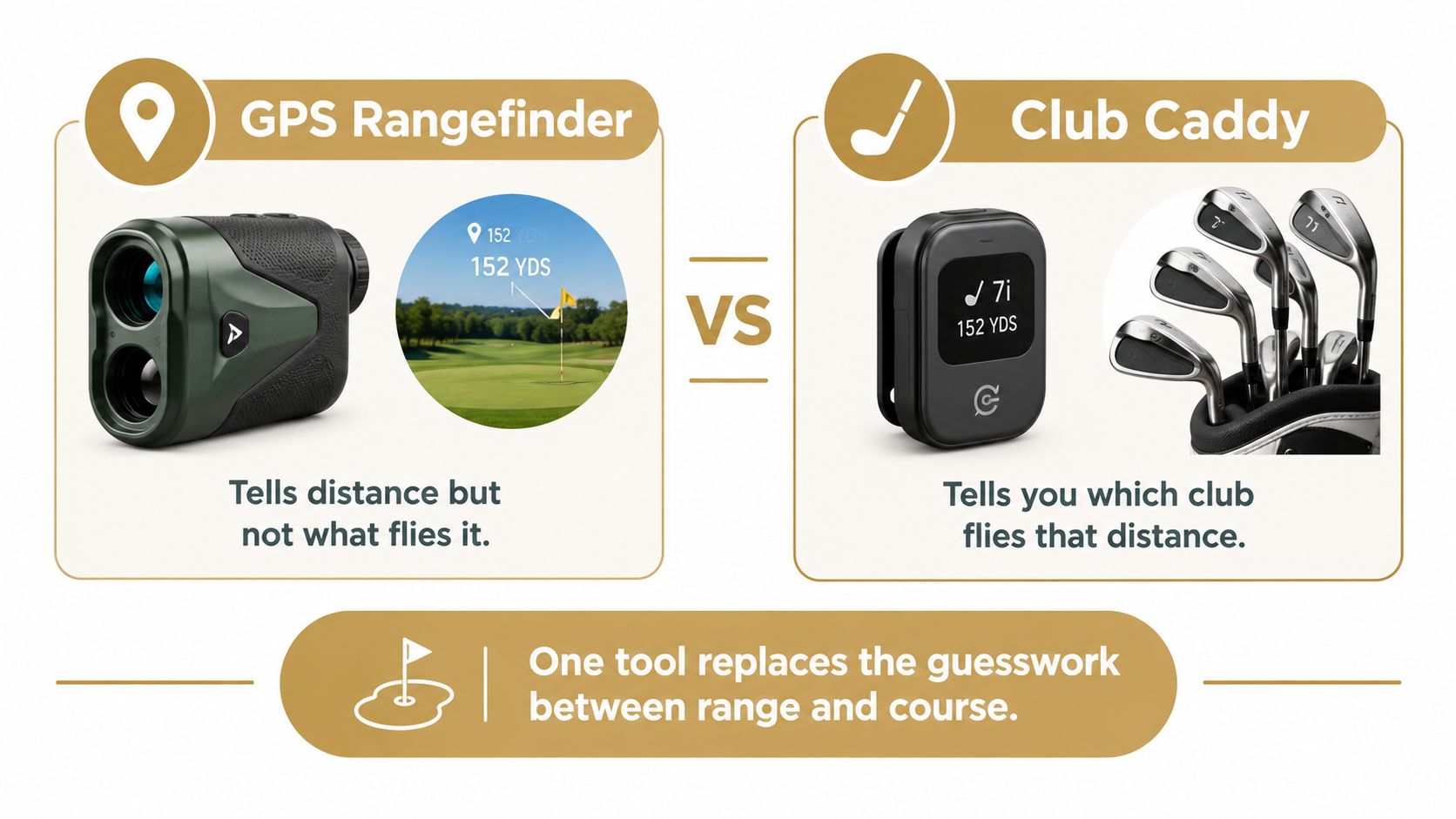
A rangefinder measures distance to a target. A GPS display can show front, center, back, and hazard distances. A swing aid can address motion or contact. A club caddy maps those readings to the clubs that fit the golfer's personal carry windows.
That distinction matters on the course. A laser can report 142 yards without saying whether the golfer should hit 8-iron or 9-iron. A GPS map can show a hazard without identifying the club that keeps the ball short of it. The club caddy connects measurement to execution, carrying the range session's evidence into the round.
Why the Pocket Caddy Exists Now
A golfer standing over a 142-yard shot needs more than a distance reading. The useful question is which club can carry that number reliably, given the player's normal swing and the day's conditions. That decision is the part a pocket caddy is designed to support.
Caddies have served that role for centuries. Golf historians trace documented caddying in Scotland to at least 1681, when Andrew Dickson is cited as the first named caddie, carrying clubs for the Duke of York on Leith Links and helping locate featherie golf balls. The term is linked to the French “cadet” and entered Scottish usage in the early 1600s. Records from St. Andrews mention caddies by 1691, as described in the history of club caddies.
Carrying clubs was only the visible task. A capable caddy learned a player's distances, noticed wind and turf conditions, and converted a target into a practical shot choice. The pocket caddy preserves that decision process in a golfer's own record.
Golf replaced memory with data
Club-caddie traditions declined as professional golf and course operations changed. The PGA Championship, U.S. Open, and Masters required club-provided caddies in 1974, while later rule changes allowed players to bring their own caddies or removed host-club requirements. Full-time touring professionals and golf carts also reduced demand for many club caddie programs, according to this account of the PGA caddie transition.
A launch monitor can now capture information that once stayed in a caddy's memory. Carry results from practice become club choices on the course, while conditions and target distances refine those choices during the round. The golfer still supplies judgment. The record reduces guesswork and mental arithmetic at address.
Dialed Golf connects the range session with the round by keeping that club-selection record available as part of the same workflow.
Software is the visible layer
Today, pocket caddy usually means software that combines location, target distance, and shot data with the clubs in a golfer's bag. Hardware supplies measurements. The decision layer matches those measurements to usable carry windows.
That match depends on credible gapping. One flushed shot creates a fragile recommendation. Repeated launch-monitor results show the range of outcomes a golfer can expect, making the pocket caddy more useful when the course presents an awkward number.
Gapping and Carry Windows From Launch Monitor Data
A golfer standing over a 158-yard approach may have three clubs that appear plausible. The choice becomes clearer when a launch-monitor session has mapped each club's carry distance rather than total distance, along with the normal spread around that result. Gapping turns practice data into a club-selection system that can travel from the range to the course.
Hit several representative shots with every club, then examine the average and variation together. A 7-iron averaging 158 yards with a typical variation of 6 yards might produce a working carry window of roughly 152 to 164 yards. That window is more useful than a single “stock” number because it reflects what the golfer can actually produce.
Build the window before adjusting the wind
Start with the golfer's normal swing. Remove an obvious mishit only when it does not represent a shot that could occur during play. Ordinary misses belong in the record, because a carry window built from perfect strikes will make on-course decisions too aggressive.
Use this sequence:
- Warm up naturally. Record shots after reaching a normal rhythm.
- Measure each club consistently. Keep the ball, setup, and target similar so the comparisons mean something.
- Record carry first. Rollout changes with turf, landing angle, and conditions, while carry gives a cleaner comparison.
- Inspect the spread. A narrow window usually supports a more confident target. A wide one may call for practice or a safer choice.
- Check the gaps. Large spaces or excessive overlap show where the bag needs attention.
| Club | Avg Carry (yds) | Std Dev (yds) | Carry Window | Overlap with Next Club |
|---|---|---|---|---|
| Pitching wedge | 125 | 6 | 119–131 | Connects with 9-iron |
| 9-iron | 138 | 7 | 131–145 | Meets pitching wedge at 131 |
| 8-iron | 152 | 7 | 145–159 | Meets 9-iron at 145 |
| 7-iron | 166 | 8 | 158–174 | Meets 8-iron at 158 |
The table illustrates the format, not measured results from a particular golfer. The practical output is a set of honest windows. On the course, those windows act like lanes on a road. The target distance determines the lane, while wind, lie, and trouble determine how safely the golfer should use it.
Reliability determines whether the data helps
Indoor launch-monitor readings can be repeatable enough to support serious practice design. A peer-reviewed indoor measurement study reported excellent reliability for club-head speed, ball speed, and carry distance, including club-head speed reliability of ICC = 0.99, ball speed reliability ranging from ICC = 0.97 to 0.99, and carry-distance reliability ranging from ICC = 0.91 to 0.97.
Indoor numbers still differ from outdoor play. Temperature, wind, altitude, lie, and shaft temperature can change the result. Treat the carry window as a moving range, not a permanent promise. Pair it with a simple wind-adjustment table, then check the recommendation across several real holes.
The gap analysis guide explains how to turn those measurements into a bag-level view instead of a list of isolated club distances. That structure gives a pocket caddy a dependable starting record for on-course decisions.
How Dialed Golf Stitches the Round and the Range Together
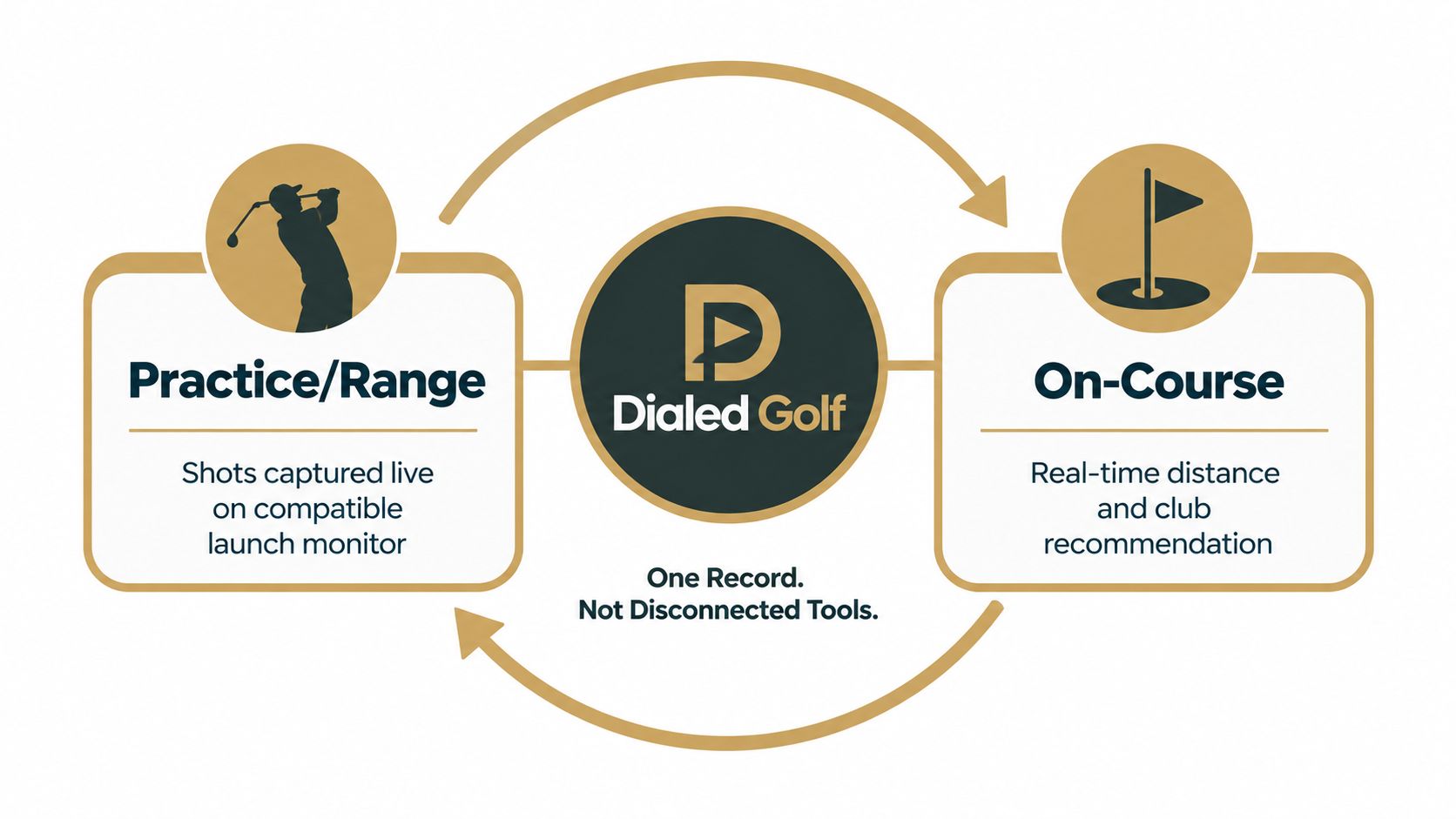
A golfer finishes a range session on Tuesday, then faces a 157-yard approach on Saturday. The useful question is not which club once reached that distance. It is which club's recorded carry window fits the target, conditions, and preferred miss. Dialed Golf connects those two moments through one golfer record, so practice data can support the decision made during the round.
The workflow has three parts. The consumer app serves as the pocket caddy on course. The desktop experience supports launch-monitor practice at a range or home simulator. Dialed Academy provides memberships and front-desk tools for ranges and clubs. For consumer use, the current workflow begins with a live desktop pairing, while other supported devices can contribute through compatible connection or import methods. Mobile live pairing is planned for later.
One record keeps the bag coherent
A range session can update the same carry windows the golfer checks on the course. Shots may arrive through live pairing or through CSV and manual import from a broad set of compatible launch monitors and simulators. The launch-monitor app guide explains how those practice connections support club decisions.
That shared record works like a single notebook with two uses. At the range, it stores evidence about what each club normally does. On the course, it turns that evidence into a shorter list of plausible choices. The golfer still accounts for wind, lie, elevation, and trouble, but the starting point comes from measured practice rather than memory.
Free web tools support importing, basic gapping, and on-course recommendations before an upgrade. Dialed Pro is the single paid plan across the consumer app and desktop, adding deeper analysis, advanced bag builds, and integrations without splitting the golfer's information into separate records.
Dialed Academy remains separate from golfer access. Range and club memberships cost $99.99 per month or $999.99 per year, while consumer access follows its own structure. Golfer Pro is available across app and desktop at $9.99 per week, $29.99 per month, $149.99 for 6 months, or $249.99 per year.
The consumer app is currently available through TestFlight rather than general App Store availability. Dialed Golf is a software workflow, not apparel at dialedgolf.com and not godialed.ai.
Putting the Pocket Caddy to Work on Course
The pocket caddy becomes useful only after the golfer builds a bag it can trust. The setup doesn't need to become a full fitting project. It needs enough consistent shots to show what each club does when the player makes the swing they can repeat on the course.
Start with a measured bag
The first step is a focused launch-monitor session. The golfer records several shots per club, saves the carry results, and imports the data or uses a live desktop pairing where supported. The resulting profile should reflect the current swing and the ball being played, not a distance remembered from a different season.
Next comes the gap analysis. The golfer looks for iron windows that barely separate, wedges with a large dead zone, or clubs that rarely fit a useful target. A club that appears impressive on a maximum-distance chart may still have little value if its normal window duplicates another club.
Move the finished profile to the course
Once the bag is set, the golfer loads it into the pocket-caddy view on the phone. A target distance can then be compared with the saved carry windows and the wind or temperature adjustments established during practice. The recommendation isn't an order. It is a quick way to narrow the choice before the golfer considers lie, trouble, and preferred miss.
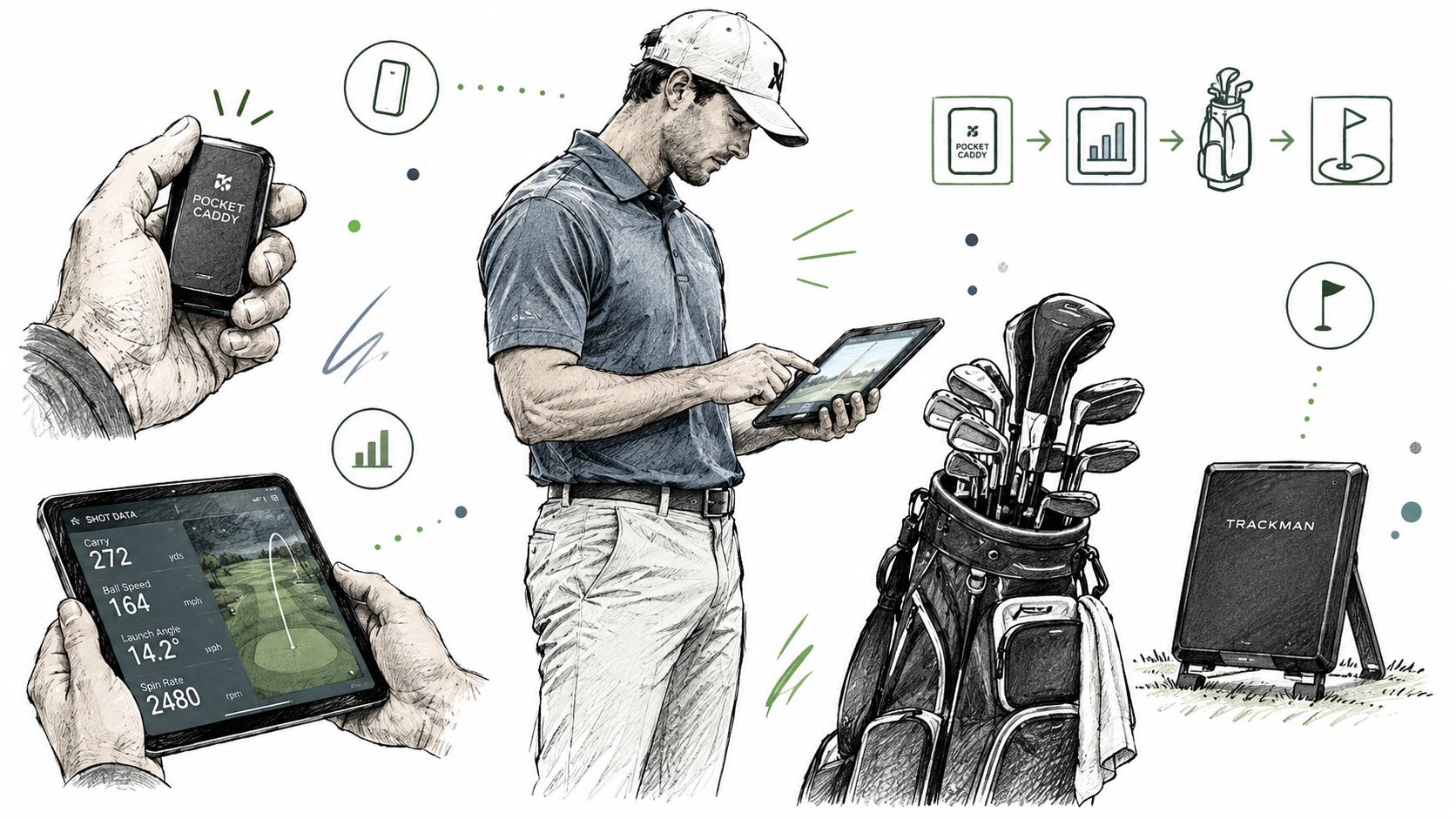
The final step happens after the shot. If a club repeatedly comes up short in cool air, from a poor lie, or under pressure, the golfer marks that pattern for the next practice session. The bag stays a living document. A round supplies feedback, the range tests the assumption, and the updated window returns to the course.
Trade-Offs Golfers Actually Weigh
A GPS rangefinder answers where the target is. A laser answers the distance to the exact object the golfer aims at. Neither one automatically explains which club produces the appropriate carry for that player, and that is the decision a club caddy is designed to support.
The distinction becomes clearer in a 145-yard example. The distance tool reports 145. The club caddy compares 145 with the player's current iron windows, accounts for the chosen adjustment, and identifies the club with the best margin. The golfer still decides whether the pin is worth attacking, but the club choice comes from a bag profile rather than a memorized average.
Software and hardware solve different problems
Free range software may store shots without turning them into a playing bag. Paid hardware may produce detailed measurements without carrying those measurements into a round. A software club caddy sits between those categories. It doesn't need a sensor to charge or a club to align, but it depends entirely on the quality of the data supplied.
That dependency should remain visible. Inconsistent launch-monitor sessions create inconsistent windows. A recommendation can't correct poor sampling, changing equipment, or a swing that the golfer can't reproduce.
The club caddy isn't a swing teacher or a rangefinder. It's a decision aid built on measured carry behavior.
The practical question is whether the workflow removes enough uncertainty to justify the golfer's time and preferred level of complexity. Some players want only front, center, and back numbers. Others need a bag record that explains why a 4-hybrid or long iron fits a particular distance pattern, as discussed in this 4-hybrid distance guide.
Where to Start This Week
The fastest starting point is one focused session, not a complete overhaul of the bag. A golfer can hit seven shots with each wedge and mid-iron, send the results into a Dialed Golf profile, and use the gap analysis to identify the carry windows already present but not yet named.
That session gives the golfer something more useful than a single distance. It creates a working answer for targets between clubs, exposes overlaps that make a club redundant, and shows where the player needs more evidence. The free tools can carry the golfer through the next range visit and the following round, while Pro preserves a longer history for players who want to track a bag across a full season.
The payoff is concrete. When the next 145-yard shot appears, the golfer can compare the number with a defensible carry window, account for the conditions, choose the club with the best margin, and make the swing without cycling through three options. That's what club caddy golf means in practice: range data that travels into the round and turns club selection into a repeatable decision.
Dialed Golf combines a consumer pocket caddy, desktop launch-monitor practice, and one golfer record, with free web tools available before any Pro upgrade. Golfers who want to turn measured carry windows into faster on-course club decisions can visit Dialed Golf and start building a more trustworthy bag.