


You've just finished a satisfying range session. The launch monitor shows respectable ball speed, a tidy pattern around the target, and several shots that feel like the swing is finally coming together. Two days later, the wind changes on a par five, a 7-iron finishes short, and a rushed recovery creates a triple.
That gap isn't usually explained by a lack of effort. It comes from practicing a version of golf that doesn't ask the same questions as the course. A useful golf range practice plan must train contact and launch, but it must also test decisions, changing targets, imperfect repetition, and the ability to produce a shot without a warm-up groove.
Table of Contents
- Why Your Range Numbers Don't Match Your Scorecard
- The Hidden Cost of Hitting the Same Shot 30 Times in a Row
- Designing a Session That Builds Skill Instead of Numbers
- Rep Counts, Rest Rules, and How to Budget a Week of Practice
- Which Launch Monitor Metrics to Track and Which to Ignore
- Closing the Loop With Retests and On-Course Transfer
- Your Pre-Range Planning Ritual and What to Do Tomorrow
Why Your Range Numbers Don't Match Your Scorecard
A golfer leaves the range after flushing a 7-iron, tightening the dispersion pattern, and recording reassuring launch numbers. On Saturday, the same golfer faces a different lie, a crosswind, and a target that demands a different trajectory. The contact becomes uncertain, the start line drifts, and the scorecard shows little evidence of the polished practice session.
The gap comes from what the session asks the golfer to solve. At the range, one club, one target, and repeated setup conditions make improvement easy to see. On the course, every shot changes the question. Club selection, lie, wind, target, and consequence all influence the decision before the swing begins.
A range plan should therefore be judged by transfer, not by how impressive the final bucket looks.
Scoreboard practice versus learning practice
A ball-beasting workout measures output. The bucket is empty, the average carry appears acceptable, and the golfer leaves feeling productive. Repeating a shot until the numbers improve can build useful movement awareness, but it can also reward comfort rather than adaptability.
A learning study measures whether the golfer can use the skill without the same support. Ask:
- Can the golfer reproduce the shot after a pause?
- Can the golfer change club or target and keep the same routine?
- Can the golfer identify a poor strike before checking the screen?
- Does the pattern hold on another day?
- Does the practice choice improve a real on-course decision?
These questions expose a weakness that a tidy range pattern can hide. The 2024 systematic review of motor-learning research in golf found that golfers may perform better during repetitive practice, while more varied practice can support learning that appears later or under changed conditions.
The practical implication is simple: treat each session as a small training study. Establish the movement or contact first, then introduce decisions, pauses, and changing targets. Save the strongest test for later, rather than using the last few balls to chase a flattering average.
Practical rule: A good range number describes one shot. A good retest shows whether the skill survived a different question.
Launch-monitor data still has a job. Carry, start direction, strike, and dispersion can identify a problem and provide a baseline. The screen becomes misleading only when it acts as the sole judge of readiness. Use it as a measuring instrument, then judge success by whether the golfer can reproduce the shot when the course removes the warm-up groove.
The Hidden Cost of Hitting the Same Shot 30 Times in a Row
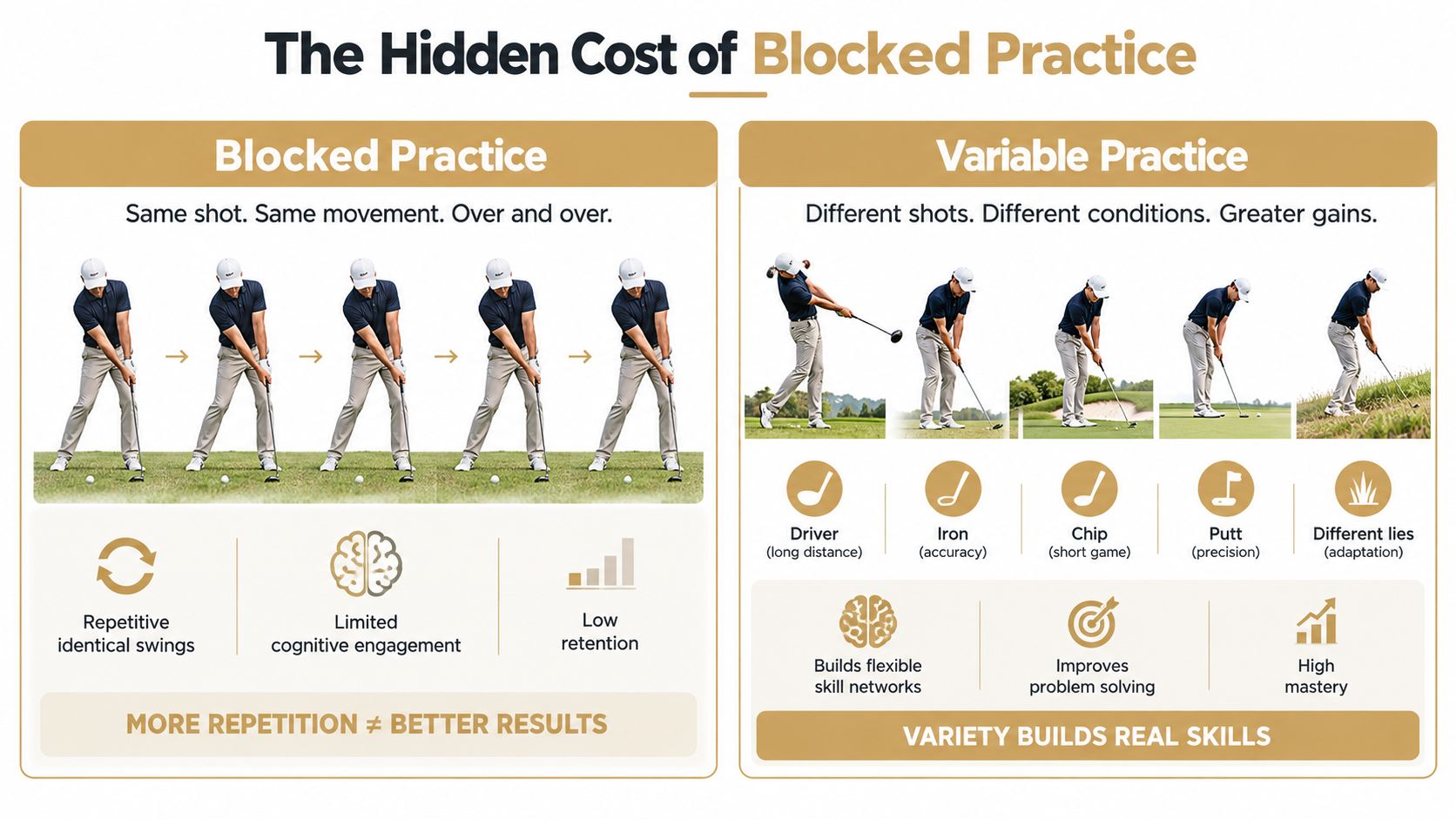
A golfer hits the same 7-iron to the same target until the launch monitor shows a tidy cluster. The session feels productive. Then, on the course, the first shot after a club change starts right, the contact fades, and the familiar swing is gone.
The standard bucket encourages this pattern: drivers first, then 7-irons, then wedges. Repeating one club, target, setup, and intention makes comparison easy, but each later ball receives help from the previous one. The golfer is no longer solving the shot from scratch.
Why the screen can flatter the golfer
The 30th shot to one target is not an independent test. The golfer is warm, remembers the previous swing, and has repeated information about the same task. A tight launch-monitor pattern proves that the golfer can perform in that narrow setup. It does not prove the shot will survive a changed club, target, lie, or pause.
That distinction matters because a good-looking average can reward familiarity. The golfer may make a small adjustment after every miss, repeat it immediately, and finish with numbers that describe the correction rather than a skill that can be recalled tomorrow.
A controlled putting study gives this problem a clear example. Participants using random practice performed worse while acquiring the skill, then putted more accurately during a delayed retention test and developed a more structured mental representation resembling skilled golfers, as reported in the published putting study. The practical lesson is uncomfortable: practice can feel worse while becoming more useful.
Do not mistake discomfort for failure.
When repetition earns its place
A short blocked set has a job. A beginner may need several swings with one club to find the ball, feel centered contact, and recognize the basic launch pattern. An experienced player changing a movement may also need focused repetitions before asking that change to hold under a less predictable task.
Use repetition to establish a reference, then test whether the reference belongs to the golfer or only to the setup:
- Start with a short calibration block. Check contact, start direction, or one movement priority.
- Leave before the pattern becomes automatic. Change the target, club, distance, trajectory, or lie.
- Return to repetition only to address a specific weakness. Avoid rebuilding the entire session around a flattering number.
- Retest after a delay. Put the club away, hit another shot, and see whether the same decision and motion return without immediate feedback.
If the golfer keeps hitting the same shot because the numbers improve, the session has shifted from learning to reassurance. The 30th ball should create a harder question, not merely confirm the previous 29. A range plan earns its value when a useful shot appears after the conditions change and the warm-up groove disappears.
Designing a Session That Builds Skill Instead of Numbers
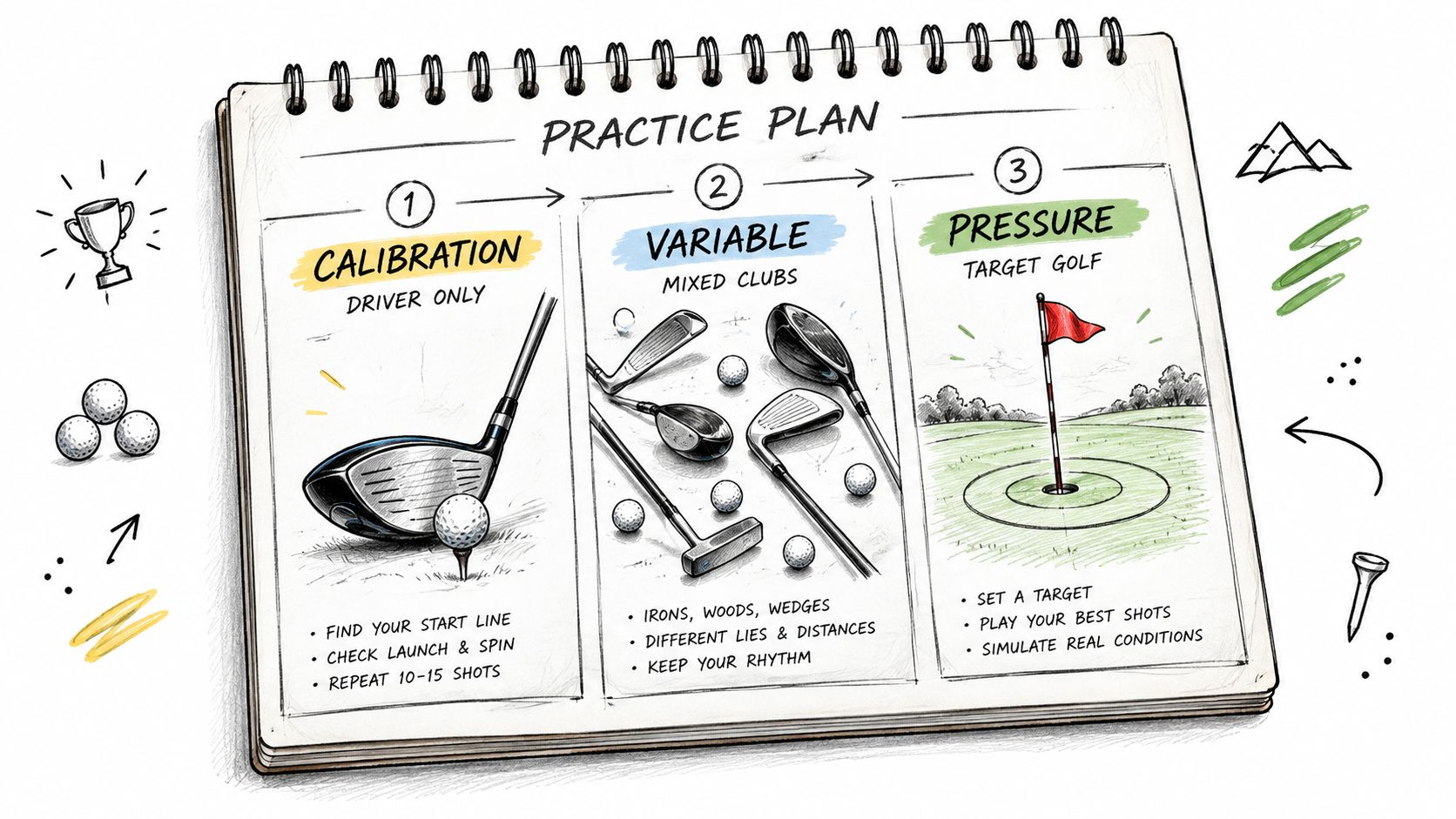
A practical session should move from calibration to variation to transfer. Each phase has a different job, and the order matters. Calibration gives the golfer enough information to make the later challenges meaningful. Variable practice removes the groove. Transfer practice asks whether the skill can support a decision that resembles golf.
The following structure gives a clear first 40-ball session. The exact number isn't sacred, but the sequence creates a useful constraint.
Phase one establishes the reference
Start with a wedge or an easy half swing, then move into the club being tested. The calibration block should be short enough to prevent the golfer from becoming dependent on the same look.
For a 7-iron session:
- Hit five calibration shots toward one clear target.
- Record contact quality, start direction, and carry behavior.
- Don't chase one outlier. Look for the usable pattern.
- Stop the block even if the last shot is excellent.
The point isn't to produce a perfect cluster. It's to establish what a centered strike and a sensible starting line feel like before the task changes.
Phase two makes the golfer solve the shot again
Next, hit 18 shots across three carry windows and two start lines. For example, the golfer might alternate between a shorter, normal, and longer 7-iron intention while selecting a left start line and a right start line. The target can change between shots, and the golfer should step away from the ball before every attempt.
No more than two consecutive shots should repeat the same task. A sequence might look like this:
- Short carry, left start line
- Normal carry, right start line
- Longer carry, left start line
- Short carry, right start line
- Normal carry, left start line
The golfer should use the full pre-shot routine, including target selection and one rehearsal. That routine adds time, but it also removes the artificial advantage of rapid-fire practice. Guidance on correct driver stance can help golfers keep the setup portion of that routine consistent when the club changes.
The putting evidence is relevant here even though a full-swing session isn't identical. Random practice can feel worse while it's happening, yet the later test can reveal stronger retention. The uncomfortable shots aren't automatically bad practice. They may be exposing the parts of the skill that repeated swings conceal.
Phase three adds consequence
Use the final 17 balls as a transfer block. Create a small simulated sequence rather than another collection of isolated swings. Select a target, choose a club, make one attempt, and then change the situation. A golfer might alternate between a tee shot, an approach, a recovery trajectory, and a wedge distance.
The monitor can record the result, but the golfer should first answer three questions:
- What was the intended shot?
- Where did the shot start?
- Was the miss acceptable for the decision?
A transfer block shouldn't become a game in which the golfer manipulates targets to protect the average. The task should include shots that are inconvenient and decisions that aren't obvious. The course doesn't provide a reset button after a poor swing, so practice shouldn't either.
The best session often feels less fluent than the old bucket. That's a feature, not a defect, provided the golfer records what changed and retests it later.
Rep Counts, Rest Rules, and How to Budget a Week of Practice
A bucket size is not a training plan. Each repetition needs a job, and enough time between shots for the golfer to make a fresh decision. Otherwise, a full bucket can produce tidy launch-monitor numbers without preparing the player for the changing demands of a round.
A controlled putting study described earlier used 10 blocks of 18 trials per day, or 180 trials daily, across six consecutive days, followed by a retention test one week later. Full-swing practice is different, so those figures are not a prescription for the range. The useful lesson is the distributed rhythm: separate practice, protect decision quality, and test the skill after time has passed.
A review of practice scheduling found that multiple weekly sessions may improve putting accuracy more effectively than one weekly session. That supports spreading range work across the week instead of relying on one exhausting visit. The review also indicates that practice should match the golfer's experience. Novices can gain from progressive blocked practice, while experienced players generally need more variable practice, as described in the practice scheduling review.
A workable weekly rhythm
| Day | Phase | Reps | Purpose |
|---|---|---|---|
| Day 1 | Calibration and variable work | 40 shots | Establish one pattern, then change targets and clubs |
| Day 3 | Variable and transfer work | 40 shots | Rebuild the skill under changing decisions |
| Day 5 | Transfer and pressure work | 40 shots | Test one-ball execution and shot selection |
| Day 7 | Delayed retest | 20 shots | Measure the earlier focus without a long groove |
The 40/40/40/20 rhythm maps directly to the 40-ball session used for full-swing practice. Each 40-ball visit can begin with a small calibration block, then move quickly into changing targets, clubs, lies, and decisions. The final 20-ball visit is deliberately shorter. Its purpose is to reveal what remains after the groove has faded, not to rebuild the motion through extra volume.
A golfer with less time can keep the same order and reduce the repetitions. Preserve the progression before chasing a larger bucket.
How to run a longer visit
A 90-ball session can be divided into:
- 15 calibration shots
- 45 variable shots
- 30 transfer shots
Pause after each block, review the planned metric, and note fatigue. Between individual shots, rake, choose the target, rehearse, and settle. That reset takes time, but it prevents a continuous swing from replacing a decision.
Stop a block when strike quality drops repeatedly, the pre-shot routine disappears, or the golfer swings only to finish the balls. Deliberate fatigue can belong in a later pressure block. Unplanned fatigue creates noisy feedback and weakens the choices the session is meant to train.
Which Launch Monitor Metrics to Track and Which to Ignore
A launch monitor can report more information than a golfer can use intelligently in one session. The answer isn't to track everything. It's to choose the metric that controls the decision being trained.
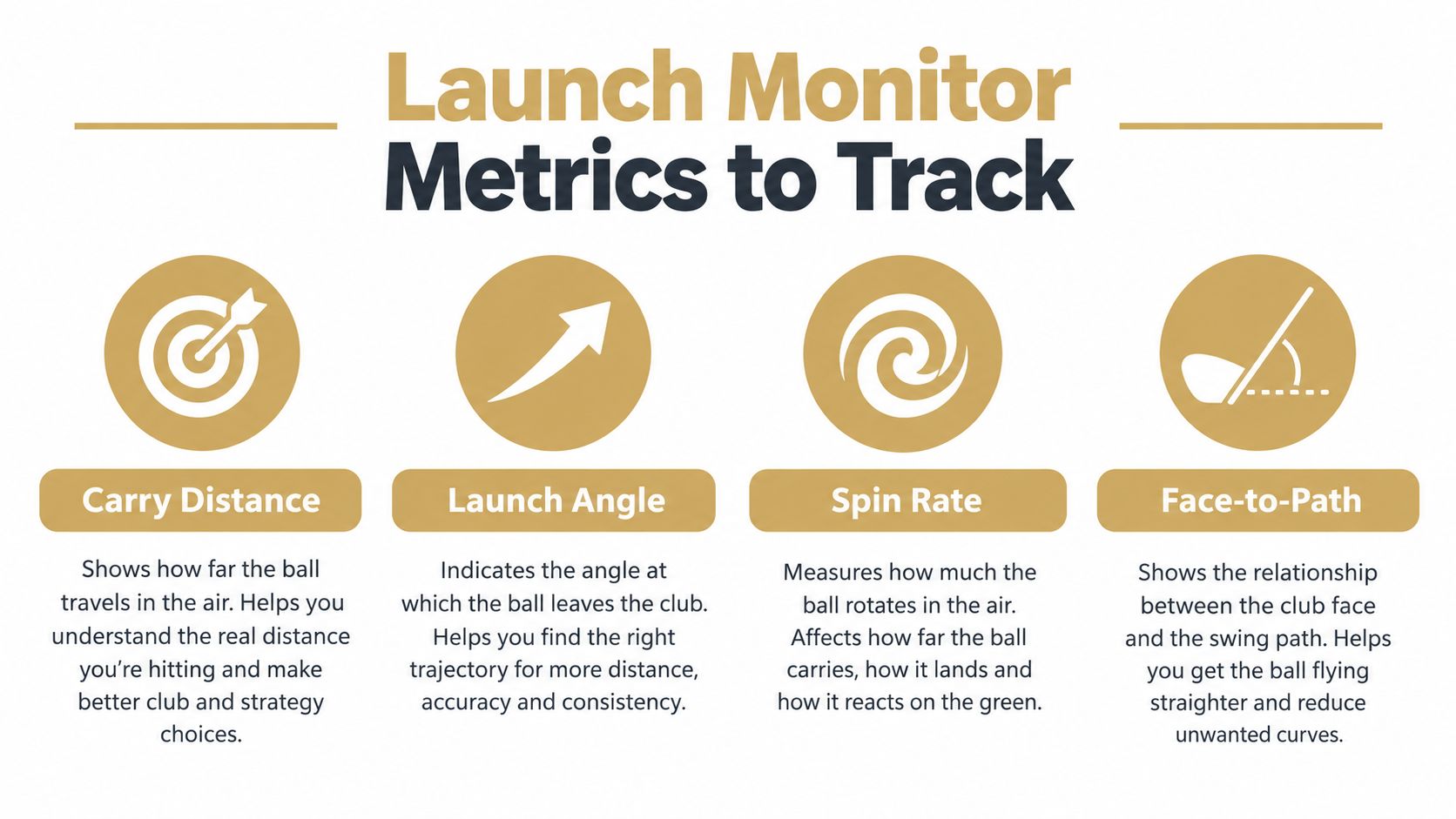
For most range work, a small set of measures is enough:
- Carry distance shows whether the shot reaches the intended window.
- Launch angle helps describe the initial trajectory and whether the chosen flight is plausible.
- Spin rate helps explain whether a carry pattern is stable or dependent on an unusual strike.
- Face-to-path helps describe curvature alongside the starting direction.
Use a bandwidth, not a reaction
A bandwidth is an acceptable range around the task. The golfer doesn't correct every shot. The golfer intervenes when the result leaves the agreed range often enough to matter.
For a start-line session, the primary question might be whether the ball begins inside the intended corridor. Curvature still matters, but it becomes secondary. A shot that starts correctly and curves modestly may be more useful than a shot that finishes near the flag only because it began far away and curved back.
A simple process works well:
- The golfer predicts the result before looking at the screen.
- The golfer identifies the likely cause using contact and ball flight.
- The screen confirms or challenges that diagnosis.
- Technical feedback appears only when a measure exceeds the chosen bandwidth.
Motor-learning literature summarized in golf research reports that reducing augmented feedback from every trial to approximately half of trials can reduce the dependency effects associated with constant correction. Bandwidth feedback supplies information only when performance leaves an acceptable range, as explained in this golf motor-learning review.
Separate signal from decoration
One poor strike shouldn't trigger a new swing thought. One high-spin shot shouldn't lead to an equipment change. A metric becomes useful when it repeats under a controlled task and affects a decision the golfer faces.
A practical launch-monitor workflow can store the session while keeping the screen out of the golfer's attention between shots. A desktop practice system such as Dialed Golf's launch-monitor app can be used to capture or import session data and turn a recurring gap into a practice priority. The important behavior is the same with any system: choose one outcome, define the acceptable bandwidth, and avoid turning every measured variable into a problem.
Feedback rule: If the golfer can't say what decision a metric will change, it doesn't belong in the current session.
Closing the Loop With Retests and On-Course Transfer
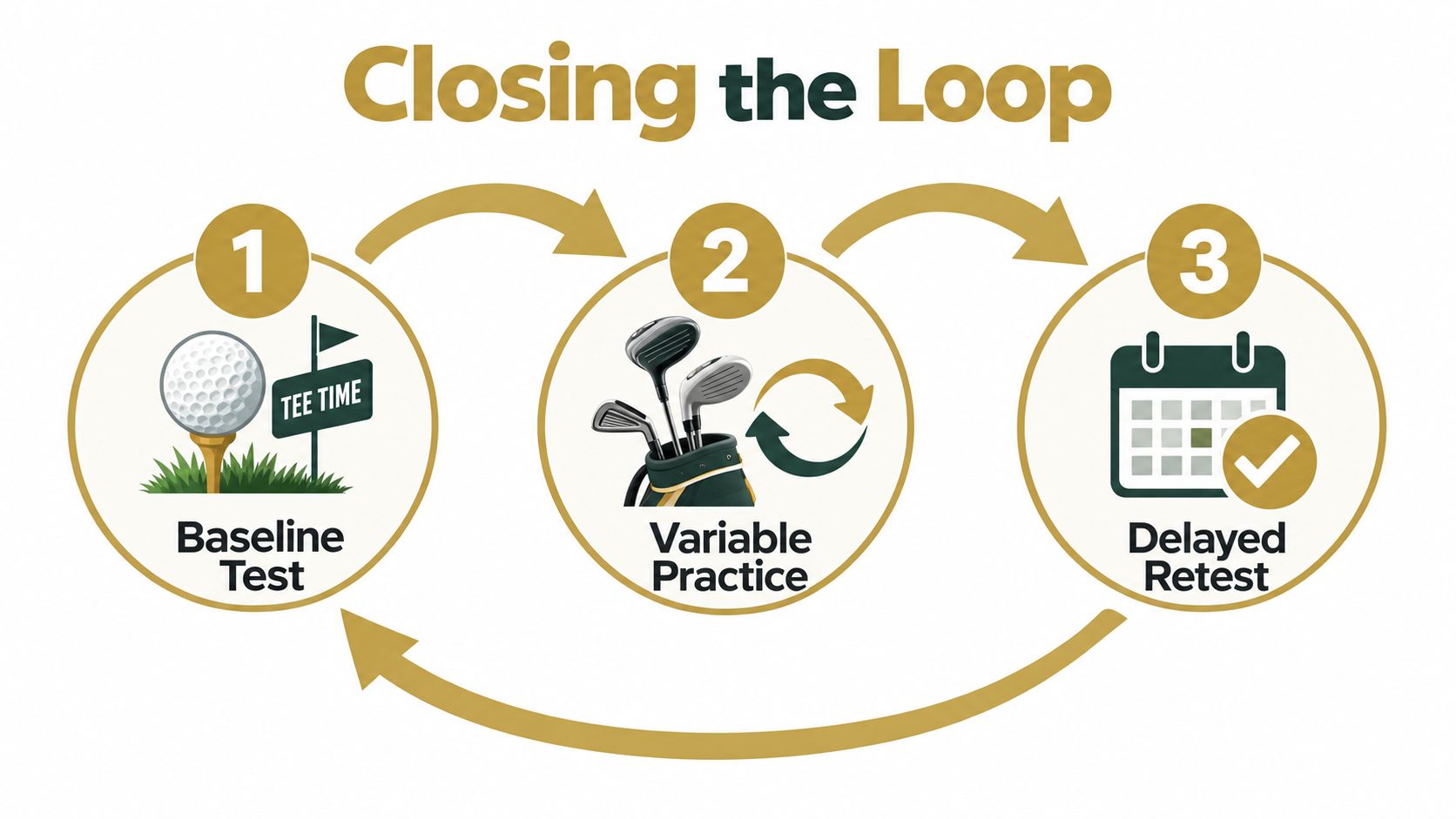
Practice isn't complete when the last ball lands. It's complete when a later test shows whether the skill survived without the original setup.
A delayed retest should use the same basic task but avoid the long calibration block that made the first session comfortable. The golfer can select the same club and carry window, then record the result under a different target or a changed order. The earlier bandwidth still applies. The question is whether the golfer can produce an acceptable shot without rebuilding the groove first.
Keep equipment checks separate
Equipment-validation sessions and skill-development sessions answer different questions. A new ball, altered setup, or equipment change can affect launch and carry enough to make trend comparisons difficult. If the purpose is to test equipment, the golfer should label the session accordingly instead of treating it as evidence that a swing change worked.
Skill-development sessions need stable enough conditions to make learning interpretable. That doesn't require perfect laboratory conditions. It does require recording the club, intended shot, target, and any major setup change so the golfer knows what the data represents.
Take the test to the course
A simple transfer task can be more revealing than another screen average. For example, during nine holes, the golfer can commit to one pre-shot routine for every approach inside 150 yards, then record the decision as well as the result. The record should note the intended target, the selected trajectory, and whether the miss matched the acceptable side of the decision.
A poor result doesn't automatically disprove the practice. A bad swing can occur inside a good decision. The useful review asks whether the golfer selected the right shot, committed fully, and reproduced the practiced routine.
The gap-analysis framework can help organize the difference between intended performance and observed performance. If the same failure appears in the delayed retest and on the course, the next range session has a clear job. If the failure appears only in one unusual situation, the golfer may need a more representative transfer task rather than another technical correction.
Your Pre-Range Planning Ritual and What to Do Tomorrow
A two-minute written plan beats a mental promise to “work on the irons.” Before the first ball, the golfer should identify the goal, the metric, the repetition cap, and the test that will decide whether the session helped.
A reusable template looks like this:
- Goal:
- Primary metric:
- Acceptable bandwidth:
- Rep cap:
- Variable task:
- Retest day:
- On-course check:
For a 7-iron gapping session, the goal might be to produce reliable carry windows. The primary metric is carry, the bandwidth is the golfer's preselected acceptable range, the cap limits the number of attempts, and the retest uses a different target order. For a driver dispersion session, the goal might be a dependable start corridor, with face-to-path used as explanatory information rather than the sole target.
The plan should fit on one card. If it needs a full dashboard to explain, the golfer has probably selected too many outcomes.
Start this week with one club, one bandwidth, and one retest day. The smallest complete system, baseline, variable practice, delayed test, is more valuable than a dramatic redesign that never reaches the course.
Dialed Golf connects launch-monitor practice data with a repeatable golfer record across desktop practice and the pocket-caddy consumer app, which is currently distributed through TestFlight rather than general App Store availability. Build the next session around a clear priority, track the transfer task, and visit Dialed Golf to put that practice loop into a usable workflow.