

The bucket is full, the launch monitor shows a few excellent shots, and the golfer leaves feeling productive. Two days later, the first tee exposes the problem. The target is different, the lie isn't perfect, the club choice feels uncertain, and the swing that looked repeatable on the range doesn't produce the same result under pressure.
That pattern isn't caused by a lack of effort. It usually comes from treating practice as ball consumption instead of skill development. A useful driving range practice plan must build contact, challenge adaptability, and test whether the improvement survives after the session ends.
Table of Contents
- Why Your Range Sessions Are Not Translating to Better Scores
- The Science Behind Effective Practice Design
- Building Your Two-Phase Practice Architecture
- Transferring Range Gains to the Course
- Measuring Improvement Without Complex Gear
- Creating Your Actionable Practice Schedule
Why Your Range Sessions Are Not Translating to Better Scores
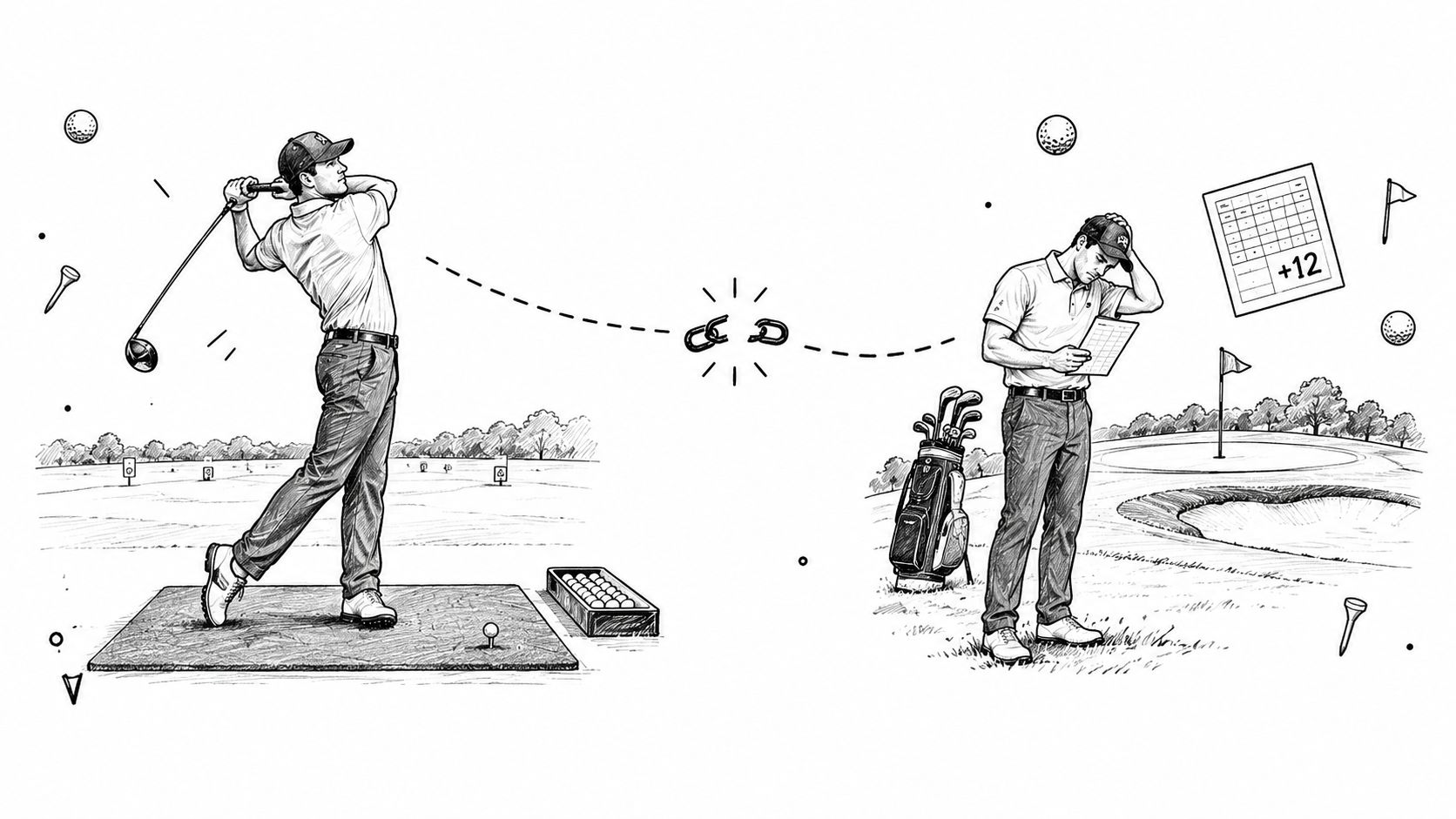
A golfer arrives with a vague intention, perhaps to “work on the swing,” and starts with a driver. One shot curves left, the next flies right, and the following shot feels better after a faster swing. The golfer changes clubs, aims at different flags, and reacts to every result. By the end, several balls look excellent, but there isn't a clear answer to what was trained or whether the result can be repeated.
The course asks different questions. It asks for a club and target decision, a committed pre-shot routine, a response to an imperfect lie, and a shot that stays inside an acceptable risk window. A range stall often removes those decisions. The golfer hits another ball immediately, with the previous result still fresh, and can adjust the next attempt until the ball looks right.
Volume creates a misleading sense of progress
Unsupervised volume can improve comfort without improving performance. Repeating the same club, target, and movement demand may make the current session look smoother, but it doesn't necessarily prepare the golfer for a new distance or an unfamiliar target. Fatigue also changes the feedback. A player may start chasing speed or correcting every poor shot with a new thought rather than protecting the original objective.
A 2026 Rakuten GORA survey illustrates the practical gap between access and effective practice. Among its surveyed Japanese golf users, 74.8% reported self-practice at driving ranges or indoor facilities, while 90% reported some concern or challenge with current practice. The survey also found that difficulty improving scores was the leading concern, and respondents rated instructor-led golf-school lessons as the most effective single method for lowering scores at 53.9%, compared with 20.4% for range or indoor practice. These findings apply directly to that survey population, not automatically to golfers everywhere, but they show why access alone doesn't solve the learning problem. (Rakuten GORA survey coverage)
Practical rule: A good range session should make its objective obvious before the first ball is struck.
A practice plan is a learning architecture
A real plan assigns a purpose to each block. One block might establish predictable contact with a short iron. Another might test start-line control with a chosen target window. The final block should remove the comfort of repetition and ask whether the golfer can select, visualize, and execute a shot without rapid-fire corrections.
The plan also needs a delayed test. If the golfer only judges success by the final ten shots, the session may reward temporary rhythm rather than durable learning. The more useful question is whether the same skill appears after a break, with a different target, or on the course.
The Science Behind Effective Practice Design
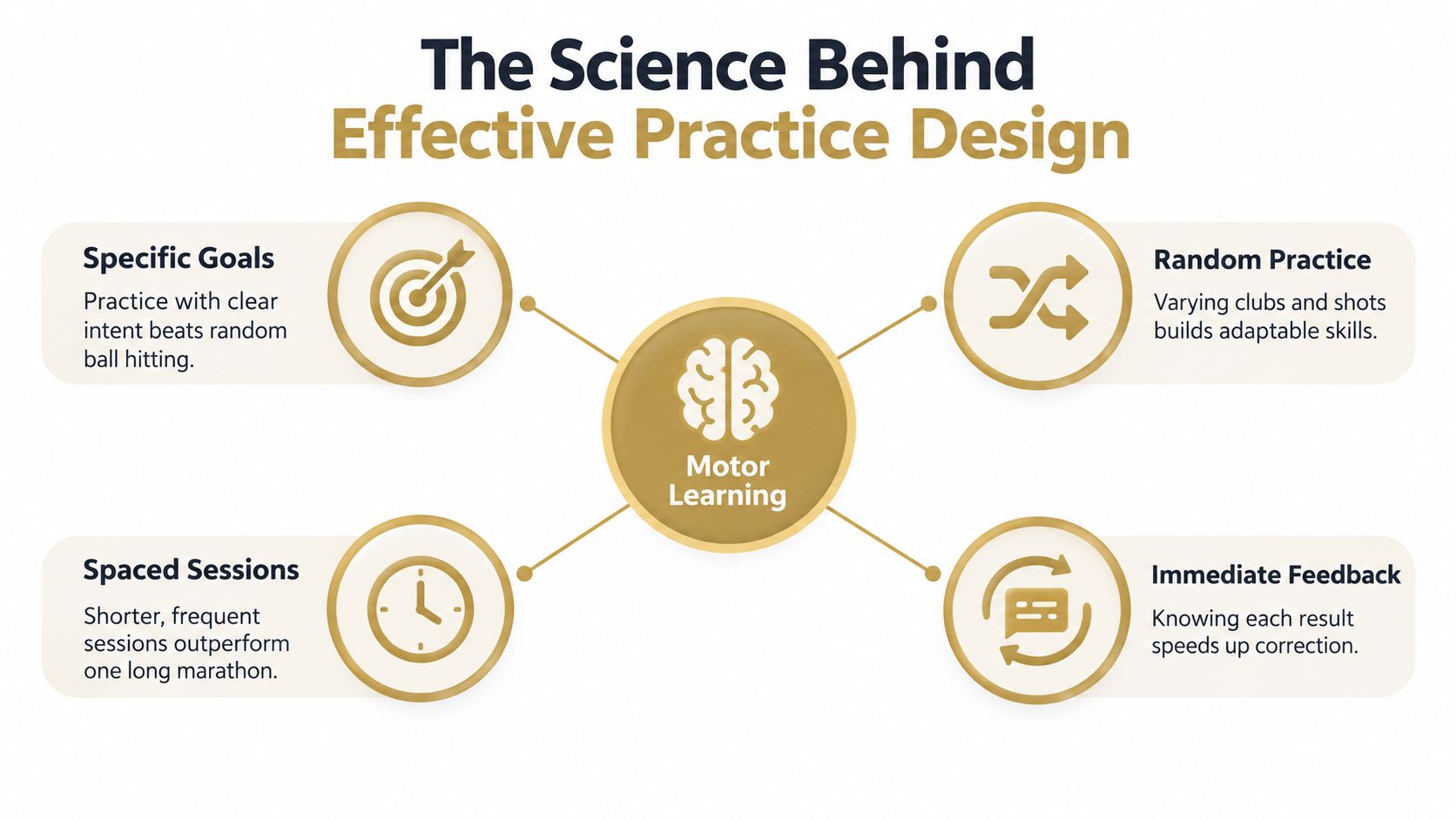
Motor-learning research treats practice design as more than a question of how many swings a golfer completes. A 2024 systematic review of golf motor-learning research reported an overall positive effect from greater contextual interference, meaning practice that changes the task, target, club, or movement demand instead of repeating one identical shot. The same review reported benefits from distributed and varied practice, while intervention groups generally performed better than control groups at the first retention test. It didn't establish a statistically clear winner among the different interventions, so variety should be applied intelligently rather than treated as a universal shortcut. (2024 systematic review of golf motor-learning research)
Contextual interference makes practice harder for a reason
Blocked practice feels efficient because the golfer can repeat a club and cue without rebuilding the task each time. That comfort can produce strong immediate execution. Variable practice creates more mistakes during acquisition because the golfer must reconstruct the movement intention, target, and club selection on every attempt.
That difficulty can be useful. A golfer who alternates a short iron and a fairway club, changes the target window, and chooses a different trajectory has to solve a new problem rather than replay a memorized motion. The range result may look less polished, but the decision process is closer to what happens during a round.
A sensible sequence is:
- Stabilize first: Use enough repetition to establish functional contact and a clear movement cue.
- Change one variable: Alternate targets or clubs before changing every part of the shot.
- Increase uncertainty: Add distance, trajectory, and target changes once contact remains reliable.
- Test transfer: Finish with one-ball decisions that don't allow an immediate retry.
Distributed practice protects retention
Massed practice can create temporary gains while weakening retention. The systematic review included a comparison of 240 putts in one day with 60 putts on each of four days. The distributed group showed significantly better retention, including follow-up testing up to 28 days later. The evidence comes primarily from putting research, so it should guide practice design as a motor-learning principle rather than promise an identical full-swing outcome. (Frontiers review on golf motor learning and distributed practice)
For a launch-monitor session, shorter blocks are easier to repeat and easier to evaluate. A golfer might use 10 minutes of technical rehearsal, 15 minutes of one-club pattern work, and 15 to 20 minutes of randomized course-style shots, then finish with a small transfer test. Those blocks should be distributed across separate visits instead of compressed into one long marathon whenever the schedule allows.
The key feedback isn't the prettiest ball of the day. It's whether carry, strike, and dispersion remain usable after fatigue, a delayed return, or a change in target.
Building Your Two-Phase Practice Architecture
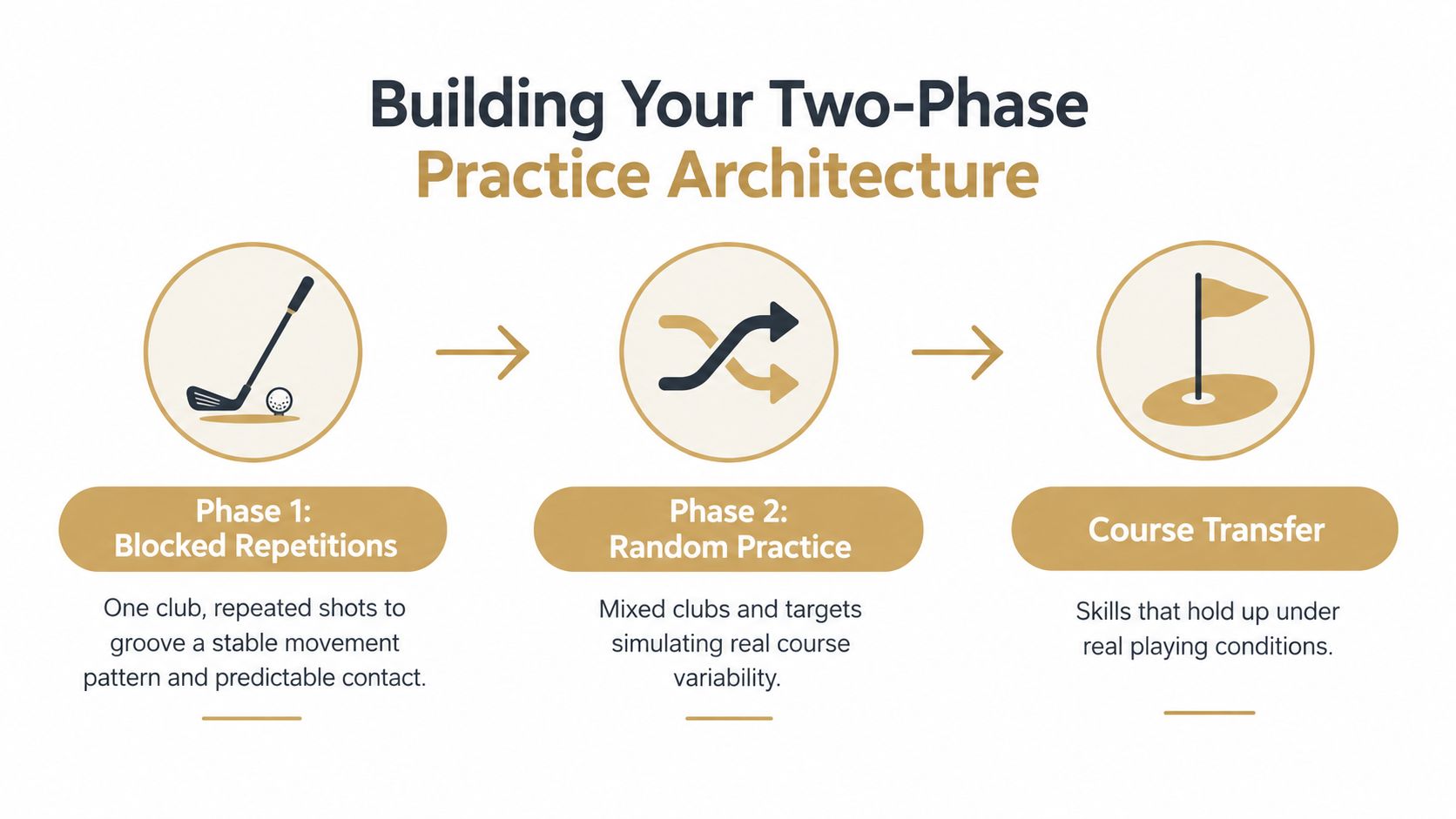
The most reliable structure starts with repetition and ends with adaptability. Phase one builds a stable pattern. Phase two checks whether that pattern survives change. Skipping the first phase can turn random practice into unproductive scrambling, while skipping the second leaves the golfer prepared only for the exact range drill.
Phase one establishes the movement
Begin with one club, one technical cue, and one defined outcome. The cue might concern setup, low point, or strike location, but it shouldn't become a list of swing instructions. The golfer should know what a successful ball looks like before starting the block.
A useful 40-ball architecture begins with 12 balls using one club and one technical cue. The golfer can pause between shots, rehearse the intention, and record whether contact and start line fall inside the chosen acceptance window. If contact deteriorates, the block should end or reset rather than continue until the bucket is empty.
The purpose isn't to create a perfect range pattern. It is to build enough predictability that the golfer can stop thinking about the basic movement and allocate attention to the shot problem.
Phase two introduces course uncertainty
The next 12 balls alternate two clubs or target windows. The golfer should change clubs or targets deliberately, reset the routine, and state the intended shot before each swing. The session becomes harder here, but the difficulty has a specific purpose. A course never presents the same shot indefinitely.
The final 16 balls simulate holes, with a new club, target, and trajectory for each attempt. A golfer can select a fairway target, choose a conservative iron, or play a controlled approach window. There are no immediate do-overs. The result gets recorded against the acceptance window, not judged only by whether the ball looked attractive.
The transition matters more than the label. Blocked practice should prepare the golfer for variability, not become a permanent hiding place from it.
Random practice isn't automatically superior. Research reviews report that variable practice may help skilled golfers more, while novices often benefit from progressive blocked work. Several studies also found no significant retention difference between blocked and variable groups, so the correct balance depends on functional contact, skill level, and the quality of the transfer test. (Review of blocked and variable practice in golf)
The most common mistake is randomizing too early. If a golfer can't make functional contact with one club and one intention, changing target, trajectory, and club on every shot only multiplies confusion. The second mistake is changing too many variables at once. A structured progression makes it possible to identify what caused the improvement or breakdown.
For setup and alignment work, a golfer can also use the correct stance for a golf driver as a focused reference, then return to the range with one setup priority rather than several unrelated swing thoughts.
A visual walkthrough can help golfers see how the blocks connect:
Transferring Range Gains to the Course
A range session becomes course-relevant only when it includes decisions that the golfer can't edit after the swing. A clean launch-monitor number is useful feedback, but it isn't the final outcome. The final outcome is whether the golfer chose a sensible shot, started it on the intended line, and kept the miss inside an acceptable risk window.
A transfer block should begin after technical work, not replace it. The golfer can move from a stable pattern to changing targets, then finish with one-ball scoring tasks. The objective is to reproduce the mental sequence of a round, where every shot has a consequence and the next decision depends on the previous result.
Use course-shaped constraints
Useful constraints include:
- Club-selection uncertainty: Choose the club only after identifying the target and desired landing area.
- Pre-shot routine: Step away, visualize the shot, rehearse the intended motion, and reset before addressing the ball.
- Uneven lies: Use available slope or stance variation rather than practicing every ball from the same flat mat.
- One-ball scoring: Give one attempt per target and record the outcome without a second try.
- Risk windows: Define where a miss remains playable before selecting the shot.
The golfer should score decisions as well as shots. A ball that finishes outside the ideal proximity window may still represent a sound decision if the target was narrow and the miss stayed safe. Conversely, a technically attractive shot can reflect poor strategy if it was aimed at a high-penalty area.
Measure what lowers pressure
Course-relevant outcomes include proximity windows, start-line dispersion, penalty risk, and decision quality. These measures connect practice to scoring without requiring the golfer to chase every available metric. A player working on distance control can track whether the ball finishes inside a selected carry band. A player working on driver control can track whether the starting direction stays inside the intended corridor, even when total distance varies.
Ball-speed context can be useful when it supports a specific decision rather than becoming the entire goal. The driver ball speed chart can provide reference context, but a faster shot isn't automatically a better shot if dispersion or penalty exposure worsens.
Off-course golfers need this transfer step especially because many practice environments don't provide regular on-course feedback. The National Golf Foundation reported that 37.9 million Americans used off-course golf in 2025, including 19 million who played exclusively at traditional or technology-enabled ranges, indoor simulators, or golf-entertainment venues. Outside the United States and Mexico, the R&A reported 68.3 million off-course participants, with ranges, simulators, and shorter formats helping golf fit time-constrained lifestyles. (Sports Business Journal coverage of off-course golf participation)
The more time a golfer spends off the course, the more deliberately the practice environment must recreate course decisions.
Measuring Improvement Without Complex Gear
A useful measurement system can fit on a notebook page. The golfer needs a target, an acceptance window, and a record of whether the shot met the requirement. Immediate feedback helps correction, but delayed testing reveals whether the correction became a usable skill.
Consider two sessions. In the first, the golfer hits repeated 7-iron shots to one target and records the best carry, average-looking strike, and favorite ball flight. In the second, the golfer changes target and club on every attempt, records start-line misses, and evaluates the result against a preselected corridor. The first session may look cleaner. The second provides stronger evidence about adaptability.
Track outcomes that support decisions
A simple log can include:
| Measure | What it reveals |
|---|---|
| Carry distance | Whether the intended distance is repeatable |
| Offline dispersion | Whether the start line and curve stay playable |
| Strike quality | Whether contact survives the block |
| Launch variables | Whether a technical change alters flight |
| Acceptance result | Whether the shot met the defined target window |
| Decision quality | Whether the chosen shot matched the situation |
A launch monitor adds detail, but it doesn't replace a clear question. If the question is contact, strike quality matters more than a single peak-distance shot. If the question is driver control, dispersion and penalty risk matter more than speed alone.
Stop before fatigue changes the lesson
A fixed bucket encourages golfers to continue after quality has dropped. The better stopping rule is a sustained decline in strike or dispersion. One poor ball may be noise. A run of deteriorating contact suggests that the golfer is no longer training the intended movement with useful quality.
The delayed test should repeat the same task 24 to 72 hours later without a warm-up. The golfer can use the same acceptance window, then repeat the task with an unfamiliar target or distance. Immediate execution answers whether the golfer can perform now. Delayed and changed-condition testing answers whether the golfer learned something durable.
The evidence for distributed practice is strongest in the cited putting comparison, so the full-swing application remains a practical learning principle rather than a guaranteed result. It still offers a better standard than judging a plan by the final few balls of a single visit.
For golfers who want to organize launch-monitor records, launch monitor app workflows can support session comparisons and trend review. Garmin's documented process also allows a range session to be exported as a CSV file from the Garmin Golf app, giving golfers a file-based route into another analysis system. (Garmin's CSV export instructions)
Creating Your Actionable Practice Schedule
A repeatable visit can follow this sequence:
- Warm up without a ball. Rehearse grip, setup, and the day's single cue.
- Stabilize contact. Use one club and one target until the intended pattern is clear.
- Change the task. Alternate clubs, target windows, or trajectories while recording acceptance results.
- Simulate the course. Play one-ball decisions with a pre-shot routine and a defined risk window.
- Log the test. Record carry, offline dispersion, strike quality, and decision quality.
- Re-test later. Repeat the task after 24 to 72 hours, without warm-up, and compare retention rather than peak performance.
Dialed Golf supports this workflow through one golfer record across its consumer app, desktop launch-monitor practice tools, and Dialed Academy for range and club operators. Its consumer app is currently distributed through TestFlight rather than general App Store availability, while the desktop experience is built around launch-monitor practice, live pairing first with Garmin R10 and expanding, plus CSV and import workflows for supported systems. Apple explains that TestFlight builds are beta distributions for invited testers, while final App Store releases require App Review. (Apple's TestFlight overview)
For operators, Dialed Academy offers memberships and front-desk tools at $99.99 per month or $999.99 per year, with the club keeping its dues. Golfer Pro is available across app and desktop at $9.99 per week, $29.99 per month, $149.99 for six months, or $249.99 per year. Free web tools remain free. (Apple's beta and release distribution documentation)
Build the next range visit around one technical block, one variable block, and one course-transfer test instead of an undirected bucket. Use Dialed Golf to organize launch-monitor practice data, compare sessions, and keep the delayed re-test connected to the golfer record. Start with a clear acceptance window today, then return without warm-up and judge whether the skill held up.