

You just posted your first few rounds, opened the app, and saw a number that didn't quite match the scorecard in your head. That's normal. How to calculate handicap sounds like one formula, but the modern system gives you a portable index, a course-specific number, and a playing number, and they're not the same thing.
Table of Contents
- Why Your Handicap Number Is More Than a Score Average
- The Score Differential Formula Explained Step by Step
- Turning Differentials Into Your Handicap Index
- Calculating a Handicap With Fewer Than 20 Rounds
- Handicap Index Versus Course Handicap Versus Playing Handicap
- Using the Dialed Golf Handicap Calculator
- Habits That Keep Your Handicap Accurate All Season
Why Your Handicap Number Is More Than a Score Average
A lot of golfers start by asking for one simple answer, then get confused when the same score seems to “mean” something different on two courses. That's because a Handicap Index is not your average score, it's a portable measure built to compare your scoring potential across different setups, and the system was designed so golfers in major markets can use the same core calculation through the USGA and The R&A Rule 5.
A round can mean different things on different tees
If you shoot the same raw number on two courses, the handicap impact won't always match. A course's Course Rating and Slope Rating change the way the round is translated into handicap terms, which is why two golfers can post identical scores and still end up with different differentials USGA handicap manual.
That's the part beginners miss. They look for a score average, but the system is asking a different question, how well did you play relative to the course you faced?
Practical rule: your handicap number follows your scoring record, but it only becomes useful when it's adjusted for the tee set and course difficulty you actually played.
Why the number in your app changes
The number you see in a GHIN-style app isn't frozen. It updates as new scores come in, and the system uses your most relevant rounds rather than all your rounds equally Rule 5. That's why a golfer can feel like they “played better” and still see the index move in an unexpected direction.
The key is to stop thinking of the handicap as a badge. Think of it as a live estimate of playing potential, built to travel with you from course to course and from tee to tee. Once that clicks, the formula stops looking like trivia and starts looking like a tool.
The Score Differential Formula Explained Step by Step

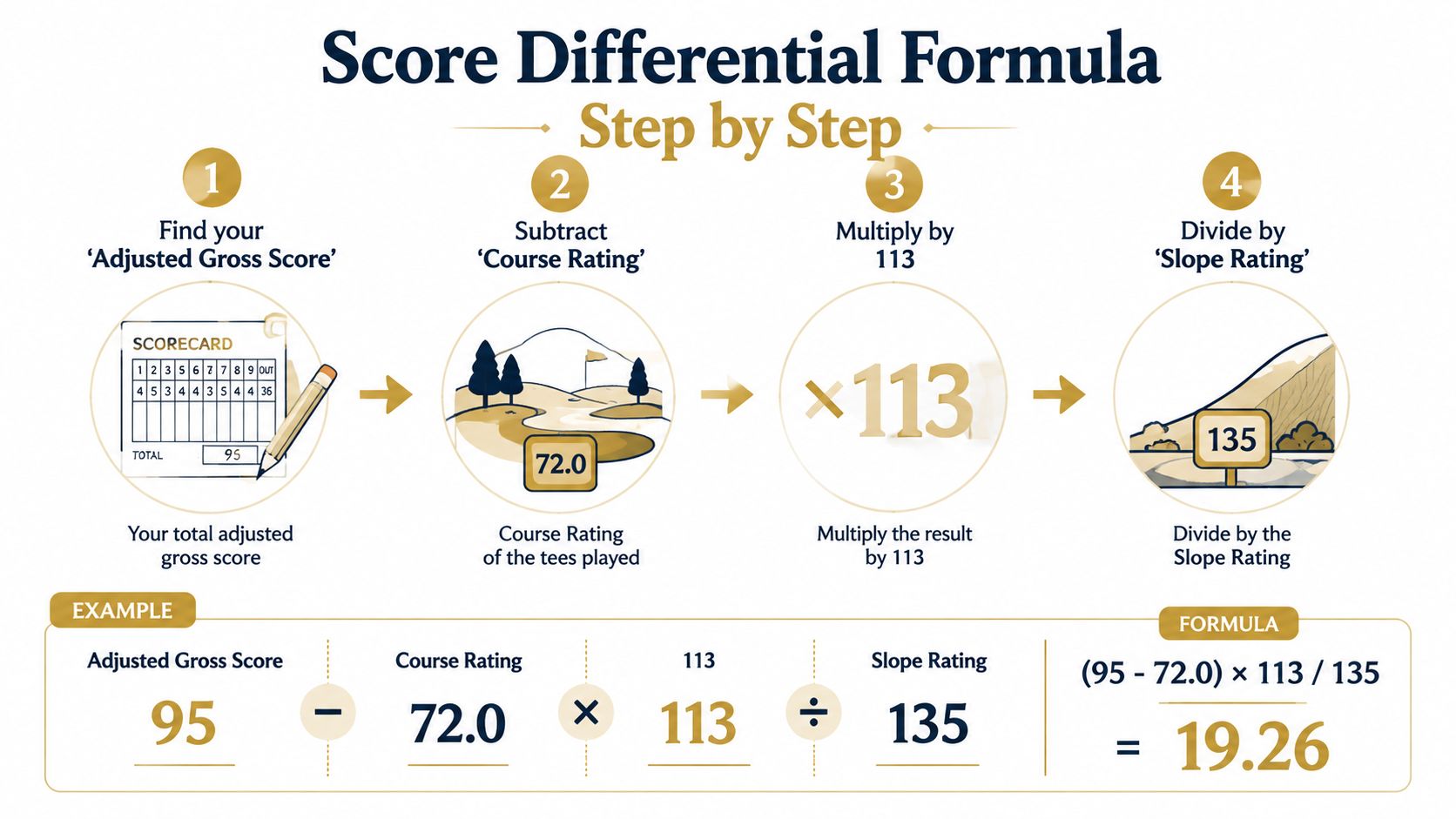
The building block under every handicap calculation is the Score Differential. The USGA formula is (Adjusted Gross Score − Course Rating) × 113 ÷ Slope Rating, and 113 is the standard slope baseline used in the calculation USGA handicap manual. The differential is then rounded to the nearest tenth.
What adjusted gross score really means
Adjusted Gross Score is your score after handicap-aware hole adjustments are applied, so one disaster hole does not overpower the round. That matters because the system is measuring potential, not your worst-case blowup. If you have ever made an eight on one hole and thought, “Well, there goes the whole round,” the handicap system is designed to keep that from wrecking the math.
The adjusted score is the part many beginners miss. Raw strokes tell you what happened on the card, but they do not show how the round should be measured for handicap purposes. A double bogey cap or other adjustment can change the number before the formula ever sees it.
Two golfers can both shoot 90, but if one did it from a tougher tee set, the handicap impact can be different because the course rating and slope changed the context of the round. That is why the formula starts with an adjusted score and then places it beside the course numbers, instead of treating every 90 the same.
A worked example you can repeat
Take a score of 81 on a course with a 71.2 rating and a 126 slope. The differential comes out to about 8.8 strokes before any later averaging step. That example is useful because it shows the shape of the math without getting buried in jargon.
Mental shortcut: if your score is only a little above the course rating on a tough slope, the differential can still be quite playable. If your raw score looks similar but the tees were easier, the differential can land higher than you expect.
The raw number on the scorecard does not tell the whole story. Course difficulty does.
Why the same score can mean different things
The formula ties your score to the course you played, not to a universal average. That is the piece online guides often flatten too much. A round posted from the wrong tees can distort your record even when the score itself looks harmless.
For golfers who do not want to work the math by hand every time, a free calculator can do the same conversion in a few clicks. A tool like the one shown in the Screenshot from https://dialedgolf.app can save time, especially when you are comparing multiple rounds or checking whether a score needs adjustment before it enters your record.
Turning Differentials Into Your Handicap Index
A golfer may post a score differential that looks reasonable on its own, then wonder why the handicap number does not match a simple scoring average. The answer is that the system is not built to reward every round equally. Under the modern World Handicap System, a golfer's Handicap Index is based on the best 8 score differentials from the most recent 20 rounds, and the result is rounded to the nearest tenth Rule 5.
Why the system looks at your better rounds
That rule matters because the handicap is meant to reflect scoring potential, not every bad hole you have ever posted. The index is a filtered snapshot of how you can play when things are coming together. It does not average all 20 rounds equally, and that is why a player's index can sit lower than a casual scoring average.
The system also has guardrails to keep the number from swinging too wildly. Those guardrails include exceptional score reduction and annual caps that limit excessive upward movement. In plain English, the goal is to keep the number stable and credible even when a player hits a hot streak, falls into a slump, or has a season where nothing feels reliable.
What this means in practice
A run of mediocre rounds does not push the index upward forever. The number is still tied to the better differentials inside the recent scoring record, so it can lag behind how a player feels on the course, especially during swing changes or after a break.
Here's the part to remember:
- Best 8 differentials matter most. Your current index comes from the strongest rounds in the recent set Rule 5.
- The result is rounded to one decimal. That is why you will see numbers like 14.2 instead of a whole number Rule 5.
- Safeguards can change the trajectory. Exceptional scores and caps keep the index from moving too fast Rule 5.
If your handicap went up after a rough stretch, that does not mean the system is broken. It usually means the recent scoring record is now being reflected more honestly.
A practical way to think about it is this. The handicap index is a filtered snapshot, not every round you have ever played, and it is not the same as your average score. It is the part of your record the system trusts most.
For golfers who do not want to work through the conversion by hand, a free calculator can handle the math in a few clicks. A tool like the one shown in the Dialed Golf handicap calculator can save time, especially when you are comparing multiple rounds or checking whether a score needs adjustment before it enters your record.
Calculating a Handicap With Fewer Than 20 Rounds
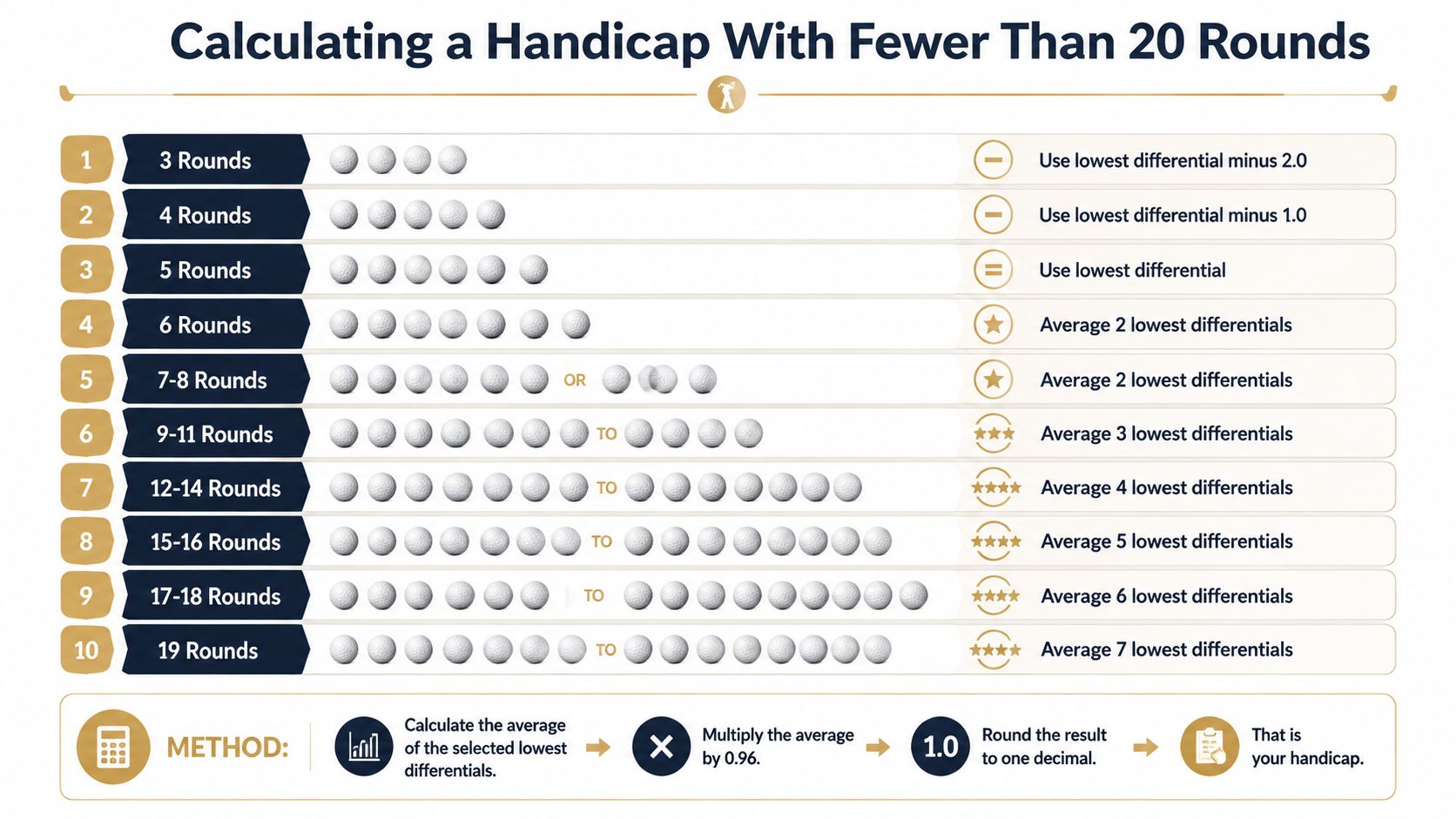
New golfers usually don't have 20 rounds sitting in the system yet, and that's where online explainers often get fuzzy. The USGA says a Handicap Index can be established with as few as 3 18-hole scores when a player doesn't yet have 20 scores, and fewer than 20 scores triggers a different calculation path USGA FAQ. NCGA also notes that a player may need a minimum of 54 holes in a mix of 18-hole and 9-hole rounds before a Handicap Index is generated in GHIN workflows USGA FAQ.
The part most beginner guides skip
Golfers often get tripped up here. They expect the full 20-round rule to apply immediately, but the system has a startup path for incomplete records. If you've just joined a club, come back to the game after years away, or mostly play nine holes, you're still building toward that first stable index.
The practical move is simple. Post every acceptable round you have, keep the tees and course details accurate, and let the system build the record. If you're mixing 9-hole and 18-hole scores, make sure the posted round type matches what you played, because the calculation only works if the inputs are clean.
What to do before the record fills out
A few habits help a lot here:
- Post every acceptable round promptly. A fresh record is easier to verify and easier to trust.
- Avoid duplicate entries. One round should appear once, with the correct format and tees.
- Check the dashboard after posting. If the number doesn't appear yet, you may not have reached the minimum scoring threshold.
For golfers using a simple digital workflow, the Dialed Golf tools page is a practical place to sanity-check the math while the record is still growing.
Don't assume a blank or partial dashboard means you did something wrong. It often just means you haven't met the minimum scoring path yet.
What matters most is consistency. A half-built handicap record can still tell the truth about your game, but only if you post the right rounds and wait for the system to have enough data to calculate the index correctly.
Handicap Index Versus Course Handicap Versus Playing Handicap
A lot of confusion starts when golfers treat every handicap number as if it does the same job. It doesn't. The USGA and The R&A separate a Handicap Index, a Course Handicap, and a Playing Handicap, and the system converts between them using Slope Rating and, for course-based play, a Course Rating minus Par adjustment USGA FAQ.
The three numbers do three different jobs
Your Handicap Index is the portable number tied to your overall scoring record. Your Course Handicap is the number you use for a specific tee set on a specific course. Your Playing Handicap is the number used in the actual competition, after any allowance is applied.
Those roles are easy to mix up if you only see one number on an app screen. A golfer can carry the same Handicap Index everywhere and still end up with different stroke totals from course to course, because tee selection changes the conversion. Then the event format can change it again, since match play, team events, and other allowances may ask for a different final number.
Why course and playing numbers are the ones that matter on the day
If you're walking to the first tee, the index by itself won't tell you how many strokes to take. You need the course-specific conversion, then the format-specific one if the event calls for it. The USGA points golfers toward calculators, tables, and apps for that reason, since the math depends on the course and the competition setup USGA FAQ.
A simple way to sort the three numbers is this:
| Number | What it's for |
|---|---|
| Handicap Index | Your portable scoring potential |
| Course Handicap | The strokes you get on a specific course and tee set |
| Playing Handicap | The final number used in the competition format |
If you want the quick version, the index travels with you, the course handicap fits the tee sheet in front of you, and the playing handicap fits the event rules. That is why a free handicap calculator is useful once you know the difference, it removes the guesswork when the round calls for a conversion.
Using the Dialed Golf Handicap Calculator
Manual math is useful once. After that, most golfers just want the right number without pulling out a calculator on the cart path. Dialed Golf offers a free USGA Handicap Calculator that estimates a Handicap Index from adjusted gross scores, Course Rating, Slope Rating, and PCC through the World Handicap System workflow, and it lives on the public handicap calculator page.
How to use the calculator without overthinking it
Enter the score information from the round, then check the course and slope inputs carefully. The calculator handles the formula for you, which is exactly what most golfers want once they understand what the pieces mean. If you're still learning, manually working through one round first makes the inputs feel less abstract.
That's where a free tool like this earns its keep. It's useful when you want to compare tees, sanity-check a number before posting, or convert the same scoring record across different courses without rebuilding the math each time.
Where automation helps most
The biggest advantage isn't speed, it's consistency. Once you understand the relationship between Index, Course Handicap, and Playing Handicap, a calculator keeps you from mixing up the steps when you're moving between different tees or formats.
Dialed Golf also fits into a broader practice workflow because the site's tools sit alongside launch-monitor and shot-tracking features for golfers who want scorekeeping and practice data in one place. If you're the kind of player who likes to see the pattern behind the number, that kind of setup saves time later.
Use the calculator to confirm the result, then learn the math well enough to know when a posted score looks off.
Habits That Keep Your Handicap Accurate All Season
A handicap only stays honest if the scoring record behind it stays clean. Post the round you played, use the correct tees, and don't guess at the format when the round was casual, competitive, or incomplete. The system can only help if the inputs are right.
Small habits that prevent big mistakes
Same-day posting is a strong habit because the round is still fresh and the details are easier to verify. When the weather shortens a round, or travel interrupts your normal tee set, make sure the posted score reflects the actual conditions rather than what you wish had happened.
A few reminders matter all season:
- Post from the correct tees. Wrong tees change the course rating and slope context.
- Apply hole-score caps properly. Blowup holes shouldn't distort the record.
- Keep tournament rounds separate when needed. The format matters as much as the score.
The more often you post accurately, the less your handicap drifts away from the golf you're playing. If you want another useful practice companion, the Dialed Golf Wedge Distance Matrix is handy for turning short-game work into something you can trust on the course.
A good handicap system shouldn't feel mysterious. Pick a posting rhythm, learn which tee set represents your real game, and use a free calculator when you want a quick check before league night. If you want a simple way to keep your numbers straight and your practice organized, visit Dialed Golf and use the tools that fit your routine.
[…] can review the broader process in Dialed Golf's handicap calculation guide. The useful habit is to compare tee ratings before the round, not after a difficult score has […]
[…] who need a refresher on the relationship between posted scores and handicap calculations can use Dialed Golf's handicap calculation guide. Dialed Golf's pocket caddy builds on this familiar structure, but the paper card remains the […]
[…] who want a plain-language walkthrough can also use this guide to calculating a golf handicap, especially when checking why the index and Course Handicap don't […]
[…] in a labeled sleeve or binder. Before filing it, confirm any attestation requirements and use the handicap calculation guide when the round needs to enter a handicap […]
[…] does. For handicap-minded players, that difference is the entire game, and it's why the handicap calculation guide matters as a baseline reference point rather than a vanity […]